ACER’s Zinglersen: Integrate electricity markets to bolster flexibility as new era is already here
The surge in the number of hours with negative wholesale electricity prices in Europe made 2024 the second consecutive record year. According to ACER’s Director Christian Zinglersen, it means a new era is here. Speaking at Belgrade Energy Forum – BEF 2025, he called on governments, regulators and system operators to tackle the issue with more flexibility and reap the benefits of integrated electricity markets.
At EUR 81 per MWh, the average day-ahead power price in the European Union and Norway was lower last year than in 2021, when the energy crisis began. This is good news, but there are significant differences in price averages across the continent, Director of the EU Agency for the Cooperation of Energy Regulators (ACER) Christian Zinglersen asserted.
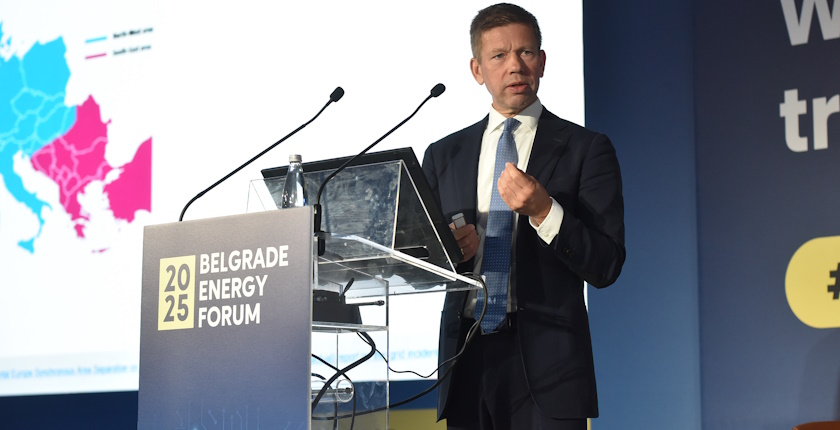
In a keynote speech at Belgrade Energy Forum, BEF 2025, he also pointed out that the percentage of days with significant price swings remained elevated. “This suggests that we need much more short-term flexibility in the system,” Zinglersen said.
[wpcc-iframe title=”Belgrade Energy Forum 2025 Christian Zinglersen, Director, ACER” width=”500″ height=”281″ src=”https://www.youtube.com/embed/c2JGLvLEInQ?feature=oembed” frameborder=”0″ allow=”accelerometer; autoplay; clipboard-write; encrypted-media; gyroscope; picture-in-picture; web-share” referrerpolicy=”strict-origin-when-cross-origin” allowfullscreen=””]
Prices in Romania, Bulgaria, Greece, Hungary among highest in Europe
In 2024, the share of time when prices were above EUR 150 per MWh landed at 6.1%, compared to 11.3% in the previous year and 66.7% in 2022. The number of days with price swings greater than EUR 50 per MWh accounted for a strong 70.4% of the total, though down from 77.1% in 2023 and 87.8% one year before.
The average price in Romania was virtually unchanged in 2024. It fell only 1% in Bulgaria and 5% in Hungary. Conversely, the drop was the strongest in Sweden, Norway, France and Belgium: 22% to 39%.
The average day-ahead electricity price in Romania was virtually unchanged last year, while in several countries it tumbled by at least 22%
Last year, prices were the highest across Italy, between EUR 106 per MWh and EUR 112 MWh, in Ireland (EUR 109 per MWh), Romania (EUR 104 per MWh), Bulgaria (EUR 103 per MWh) and Greece and Hungary (both EUR 101 per MWh).
Importantly, 2024 was the second consecutive record year in the number of hours with negative wholesale prices. Their share jumped to 2.8% from 1.9%.
“This is very significant and it shows we are already, in my view, in a new era. We’re not just embarking upon it. We’re there,” Zinglersen stressed.
Share of very low wholesale prices rallies back to level from 2020
As for the share of time with very low wholesale prices, it surged last year to 8.8%. The level was last seen in 2020, when the pandemic erupted and resulted in an unprecedented demand shock, ACER’s chief noted. He called on governments, regulators and system operators to tackle the issues with more flexibility.
Grid tariffs increasingly need to show what the system needs, in his view: more time nuance and more locational nuance. “That combination of an energy signal and a tariff signal should hopefully enable us to build more of what we need in the right places, as opposed to build what we don’t need, in the wrong places,” Zinglersen stated.
Integrated markets bring benefits
A policy brief that Brussels-based think tank Bruegel published last year pointed to the benefits of the integration of electricity markets. Among other factors, there is more security with fewer backup power plants and more flexibility with less investment in energy storage, together with lower capital costs. In 2022, ACER, based in Ljubljana, estimated benefits from cross-border trade alone at EUR 34 billion in the EU.
“It has very significant security of supply implications as well, to be in a very integrated-type jurisdiction,” Zinglersen underscored. But integrated markets come with tradeoffs, he said.
One of the examples is an incident in 2021 that split the Continental Europe synchronous area into two parts for an hour and reserves were pulled from across the continent. “But you can also bring the system much more quickly back together again,” Zinglersen said at the conference.
The same goes for the June 2024 blackout in the Balkans.
There are many solutions in Europe, but they are not evenly distributed
ACER’s director also recalled the power price decorrelation that affected Southeastern Europe and Hungary from July to September. He attributed some of the spikes in day-ahead prices to the lack of short-term flexibility, for instance batteries.
There are lots of technical solutions and frameworks in place across Europe, but they are not very evenly distributed, he added.
Zinglersen pointed to the opportunities and benefits of further integrating the electricity market of the Western Balkans region and the EU.