by in News

MEMO Analysis Links Solar Output to Lower Day-Ahead Power Prices in North Macedonia

Electricity generation from solar power plants tends to push prices down on the power exchange, while reduced solar output is associated with price increases, according to an analysis by Ana Angelova, a market operations specialist at the National Electricity Market Operator (MEMO).

The analysis aimed to identify seasonal trends and highlight the relationship between photovoltaic (PV) generation, electricity consumption, traded volumes, and day-ahead prices on the North Macedonian power exchange. MEMO noted that the day-ahead market operates in an isolated mode.

Angelova used official power exchange data for 2024, focusing on hours when PV plant efficiency exceeded 30%.

Consumption remains broadly stable across the year

The findings point to a clear seasonal pattern. Electricity consumption stays relatively steady throughout the year, with only minor declines during spring and summer. PV generation, however, shows a pronounced seasonal swing—peaking in summer and reaching its lowest levels in winter.

Angelova also stressed that higher PV output coincides with increased traded volumes on the day-ahead market.

Prices bottom out in April, rise toward winter

According to the analysis, day-ahead prices are lowest in April, a period linked to milder weather, lower demand, and stronger solar production. From summer onward—and particularly during winter—prices trend higher, peaking in November.

The November price peak aligns with a combination of weak PV generation and higher consumption.

“Increased electricity generation from photovoltaic plants is associated with lower prices, while low generation leads to higher market prices, emphasizing the impact of renewable energy availability on price formation. The trend indicates that energy policies should focus on addressing weaknesses during the winter period and harnessing the potential of solar energy in summer,” Angelova wrote.

Proposed measures to strengthen renewables integration
north macedonia solar analysis memo power exchange ana angelova

Photo: MEMO

Angelova outlined several options to improve the integration of renewables—especially solar—into the power system. The proposed mechanisms include:

  • Flexible market mechanisms: introduction of a 15-minute trading interval, creation of an intraday market, dynamic tariffs, and guarantees of origin.

  • Energy storage technologies: battery energy storage systems (BESS) and pumped-storage hydropower plants.

  • Alignment with the European energy framework: adoption of ENTSO-E grid codes, coupling with the single European electricity market, deployment of smart meters, and use of financial instruments such as contracts for difference (CfD) and power purchase agreements (PPA).
by in News

IRENA: Global daily flexibility needs are quadrupling by 2050

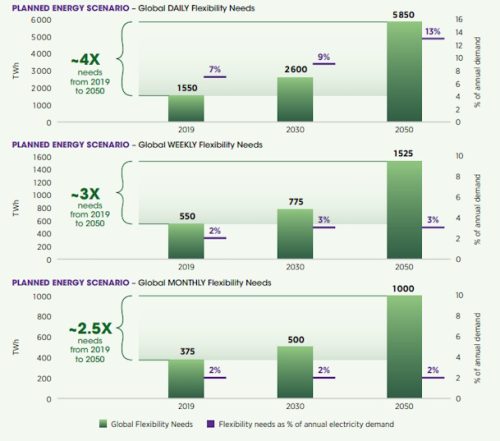
In IRENA’s Planned Energy Scenario at the global level, electricity system flexibility needs on a daily timescale are four times higher in 2050 than in 2019. In the weekly and monthly timescales, the energy required for the purpose grows by three and 2.5 times, respectively. As for the 1.5°C Scenario, implying a much higher share of renewables, the daily flexibility needs jump ten times by mid-century, versus six times for both remaining segments.

Electrification of end-use energy, large-scale deployment of distributed energy resources and the emergence of large new electricity loads from data centres are increasing demand and adding new layers of complexity. It means power systems will need stronger grids and more flexibility to ensure that electricity is available when and where needed and at the lowest possible cost, the International Renewable Energy Agency (IRENA) pointed out in a brief called Flexibility for a secure and affordable power sector transformation.

Aside from buildings and transportation, new demand is coming from the growing adoption of artificial intelligence (AI), driving the expansion of data center capacity. In 2024, data centers consumed 1.5% of electricity. The International Energy Agency expects the share to double by 2030.

The share of variable renewable energy is increasing – wind and solar power in particular. Demand patterns become more complex, so the potential for mismatches between supply and demand is likely to grow, becoming more frequent and significant. It highlights the increasing importance of system flexibility. It is the capacity to respond to expected and unexpected fluctuations in the demand for and supply of electricity in a cost-effective manner.

Some forms of flexibility act automatically to keep the system stable, while others can be scheduled and operate over hours, days or even seasons

Insufficient system flexibility can result in excessive curtailment or, in market-based systems, negative electricity prices. It can also result in shortages, jeopardising the reliable supply of electricity.

System flexibility is needed by the power system to adjust to the variability of generation and demand patterns across different timescales. Some forms of flexibility act automatically within seconds to keep the system stable, while others can be scheduled in anticipation and operate over hours, days or even seasons, through market adjustments and operational and resource planning.

Network flexibility, which isn’t covered in IRENA’s brief, is different. It is the capacity to adjust for grid availability by means of preventing or solving congestion or voltage issues.

Required flexibility depends on numerous factors

In the timescale of seconds to minutes, flexibility is needed to maintain the balance during sudden changes in demand or supply, such as the
disconnection of an interconnector or a major load or generator. The hours and days timescale has daily ups and downs of solar and wind generation alongside the peaks and troughs in demand throughout the day.

In the weeks and seasons segment, flexibility enables covering longer weather patterns caused by changes in the season or low-wind periods. In power systems mainly supplied by renewables, flexibility is also needed at inter-annual timescales. The main factors are climate-driven variations in resource availability. It especially concerns hydrology, but also wind and solar, as well as year-to-year differences in seasonal heating and cooling demand.

In power systems mainly supplied by renewables, flexibility is also needed at inter-annual timescales

Flexibility is not a single asset or function; instead it corresponds to a capability provided by a portfolio of different technologies, operational practices and market mechanisms. The required level of flexibility in a power system depends on, among other factors, the prevailing generation mix, geography, power sector structure and affected timescales.

Storage, demand-side management (DSM), interconnections and dispatchable resources each contribute differently.

Advances in forecasting and the introduction of shorter dispatch intervals, scheduled closer to real-time operation, allow more frequent and precise adjustments of generation and demand before electricity is delivered. One example are intraday markets complementing day-ahead markets.

Electricity must become main energy carrier by mid-century to keep global warming in check

In IRENA’s 1.5°C Scenario, the energy transition will be driven by the deployment of renewable energy, improvements in energy efficiency and the electrification of end-use sectors. The aim is to limit global warming to 1.5 degrees Celsius by 2100.

Electricity would need to become the main energy carrier by 2050. It would account for over half of total final energy consumption. The 2022 level was 23%.

Global electricity generation is projected to be 36% higher in 2030 and three times higher in 2050 than in 2023. Renewable resources would supply 68% of electricity in 2030 and 91% in 2050. Renewables would account for 77% of total installed power capacity in 2030 and 94% in 2050.

In the same setting, 70% of electricity generated in 2050 comes from wind and photovoltaics, taken together. In IRENA’s Planned Energy Scenario, not projecting full decarbonization, the level is 53%.

In IRENA’s 1.5°C Scenario, the share of electricity in total final energy consumption more than doubles by 2050, surpassing 50%

Flexibility needs are calculated as total cumulated annual energy deviation from the average net load (which excludes variable renewable energy generation).

In the 1.5°C Scenario, the power sector requires ten times more flexibility in 2050 than in 2019 to manage the daily variability of net load. In terms of share of annual electricity demand, the authors observed a surge to 30% from 7%. Flexibility needs for managing the variability in weekly and monthly timescales are both six times higher.

In IRENA’s Planned Energy Scenario, daily flexibility needs in 2050 are four times higher. In the weekly timescale, the level triples from 2019, and the monthly item is 2.5 times higher.

IRENA Global daily flexibility needs quadrupling by 2050
Photo: The height of bars indicates flexibility requirements in terawatt-hours per year. Purple horizontal markers show flexibility needs as a percentage of annual electricity demand. (IRENA)

Batteries perform best in daily segment

Battery energy storage is the most effective in addressing daily flexibility needs, the report finds. It is only 24% as effective at meeting weekly needs and 12% as effective for monthly needs.

Interconnections and LDES are effective on the weekly and monthly scales

Interconnections are the most effective in addressing weekly flexibility needs, but also 98% as effective for monthly needs. As for the daily segment, the coverage is just 28%.

The numbers for long-duration energy storage (LDES) solutions are similar. Compared with addressing weekly flexibility needs, LDES is 90% as effective for monthly needs and 34% as effective in the daily item.

by in News

IRENA: Global daily flexibility needs are quadrupling by 2050

In IRENA’s Planned Energy Scenario at the global level, electricity system flexibility needs on a daily timescale are four times higher in 2050 than in 2019. In the weekly and monthly timescales, the energy required for the purpose grows by three and 2.5 times, respectively. As for the 1.5°C Scenario, implying a much higher share of renewables, the daily flexibility needs jump ten times by mid-century, versus six times for both remaining segments.

Electrification of end-use energy, large-scale deployment of distributed energy resources and the emergence of large new electricity loads from data centres are increasing demand and adding new layers of complexity. It means power systems will need stronger grids and more flexibility to ensure that electricity is available when and where needed and at the lowest possible cost, the International Renewable Energy Agency (IRENA) pointed out in a brief called Flexibility for a secure and affordable power sector transformation.

Aside from buildings and transportation, new demand is coming from the growing adoption of artificial intelligence (AI), driving the expansion of data center capacity. In 2024, data centers consumed 1.5% of electricity. The International Energy Agency expects the share to double by 2030.

The share of variable renewable energy is increasing – wind and solar power in particular. Demand patterns become more complex, so the potential for mismatches between supply and demand is likely to grow, becoming more frequent and significant. It highlights the increasing importance of system flexibility. It is the capacity to respond to expected and unexpected fluctuations in the demand for and supply of electricity in a cost-effective manner.

Some forms of flexibility act automatically to keep the system stable, while others can be scheduled and operate over hours, days or even seasons

Insufficient system flexibility can result in excessive curtailment or, in market-based systems, negative electricity prices. It can also result in shortages, jeopardising the reliable supply of electricity.

System flexibility is needed by the power system to adjust to the variability of generation and demand patterns across different timescales. Some forms of flexibility act automatically within seconds to keep the system stable, while others can be scheduled in anticipation and operate over hours, days or even seasons, through market adjustments and operational and resource planning.

Network flexibility, which isn’t covered in IRENA’s brief, is different. It is the capacity to adjust for grid availability by means of preventing or solving congestion or voltage issues.

Required flexibility depends on numerous factors

In the timescale of seconds to minutes, flexibility is needed to maintain the balance during sudden changes in demand or supply, such as the
disconnection of an interconnector or a major load or generator. The hours and days timescale has daily ups and downs of solar and wind generation alongside the peaks and troughs in demand throughout the day.

In the weeks and seasons segment, flexibility enables covering longer weather patterns caused by changes in the season or low-wind periods. In power systems mainly supplied by renewables, flexibility is also needed at inter-annual timescales. The main factors are climate-driven variations in resource availability. It especially concerns hydrology, but also wind and solar, as well as year-to-year differences in seasonal heating and cooling demand.

In power systems mainly supplied by renewables, flexibility is also needed at inter-annual timescales

Flexibility is not a single asset or function; instead it corresponds to a capability provided by a portfolio of different technologies, operational practices and market mechanisms. The required level of flexibility in a power system depends on, among other factors, the prevailing generation mix, geography, power sector structure and affected timescales.

Storage, demand-side management (DSM), interconnections and dispatchable resources each contribute differently.

Advances in forecasting and the introduction of shorter dispatch intervals, scheduled closer to real-time operation, allow more frequent and precise adjustments of generation and demand before electricity is delivered. One example are intraday markets complementing day-ahead markets.

Electricity must become main energy carrier by mid-century to keep global warming in check

In IRENA’s 1.5°C Scenario, the energy transition will be driven by the deployment of renewable energy, improvements in energy efficiency and the electrification of end-use sectors. The aim is to limit global warming to 1.5 degrees Celsius by 2100.

Electricity would need to become the main energy carrier by 2050. It would account for over half of total final energy consumption. The 2022 level was 23%.

Global electricity generation is projected to be 36% higher in 2030 and three times higher in 2050 than in 2023. Renewable resources would supply 68% of electricity in 2030 and 91% in 2050. Renewables would account for 77% of total installed power capacity in 2030 and 94% in 2050.

In the same setting, 70% of electricity generated in 2050 comes from wind and photovoltaics, taken together. In IRENA’s Planned Energy Scenario, not projecting full decarbonization, the level is 53%.

In IRENA’s 1.5°C Scenario, the share of electricity in total final energy consumption more than doubles by 2050, surpassing 50%

Flexibility needs are calculated as total cumulated annual energy deviation from the average net load (which excludes variable renewable energy generation).

In the 1.5°C Scenario, the power sector requires ten times more flexibility in 2050 than in 2019 to manage the daily variability of net load. In terms of share of annual electricity demand, the authors observed a surge to 30% from 7%. Flexibility needs for managing the variability in weekly and monthly timescales are both six times higher.

In IRENA’s Planned Energy Scenario, daily flexibility needs in 2050 are four times higher. In the weekly timescale, the level triples from 2019, and the monthly item is 2.5 times higher.

IRENA Global daily flexibility needs quadrupling by 2050
Photo: The height of bars indicates flexibility requirements in terawatt-hours per year. Purple horizontal markers show flexibility needs as a percentage of annual electricity demand. (IRENA)

Batteries perform best in daily segment

Battery energy storage is the most effective in addressing daily flexibility needs, the report finds. It is only 24% as effective at meeting weekly needs and 12% as effective for monthly needs.

Interconnections and LDES are effective on the weekly and monthly scales

Interconnections are the most effective in addressing weekly flexibility needs, but also 98% as effective for monthly needs. As for the daily segment, the coverage is just 28%.

The numbers for long-duration energy storage (LDES) solutions are similar. Compared with addressing weekly flexibility needs, LDES is 90% as effective for monthly needs and 34% as effective in the daily item.

by in News

Shared power, shared security: Nordic lessons for Europe’s energy resilience

Author: Parvathy Sobha, Brida Mbuwir and Bart Overdevest,EUSEW Young Energy Ambassadors

Renewables are transforming Europe’s energy landscape, but the rapid green transition is testing grid stability. The Iberian blackout exposed the risks of ambition outpacing the system’s flexibility. Yet the story looks different in the north. Nordic countries have integrated vast shares of renewables while keeping the lights on, proof that reliability and decarbonisation can go hand in hand. What can the rest of Europe learn from the Nordics to safeguard its energy security in a net-zero grid?

Europe’s energy security test

As wind and solar replace conventional power plants that once provided system inertia, maintaining voltage and frequency stability grows more fragile. Recent fuel market volatility and supply shocks have also exposed the limits of isolated national grids. This is no reason to slow the green transition, but a reminder that Europe must now build a power system that combines scale, resilience and low carbon intensity.

The Nordic blueprint

The Nordic countries—Sweden, Norway, Finland and Denmark—have built one of the world’s most reliable and decarbonised power systems, known for their unique combination of resources, coordination and market integration. A complementary energy mix forms its backbone: dispatchable hydropower balances variable wind, while nuclear and bioenergy add stability and seasonal flexibility. This is further complemented by growing contributions from batteries and demand response.

Moreover, the cross-border links allow electricity to flow to where it is most needed, easing local shortages and damping price volatility. Additionally, strong regional cooperation, harmonised grid codes, shared market rules and coordinated system planning enable national operators to function as a single, interconnected network. Finally, deeply integrated day-ahead, intraday and balancing markets turn variability into an asset by smoothing prices, reducing reserve needs and strengthening reliability as renewable shares rise.

Author, Parvathy Sobha, Brida Mbuwir and Bart Overdevest, EUSEW Young Energy Ambassadors

Adapting Nordic lessons for Europe’s energy future

Adopting the Nordic model requires adaptation to Europe’s diverse realities. Not every region has the hydropower that underpins the Nordics’ flexibility. Balancing variable renewables in other parts of Europe will depend on smarter combinations of storage, flexible demand and interconnections. The Nordic example shows that strong coordination, consistent investment and shared market rules can overcome resource disparities and geography alike. Infrastructure gaps, uneven market maturity and regulatory differences remain obstacles, but none are insurmountable.

The EU must strengthen not only its physical grids but also the cooperation that connects them. Accelerating interconnectors and internal reinforcements through programmes such as TEN-E and REPowerEU will allow renewable electricity to flow across borders, turning surplus wind in one region into stability in another. Equally important is market integration. Deepening day-ahead, intraday and balancing market coupling will ensure that flexibility—whether storage, demand response, or variable renewables—reaches where it creates the greatest value. Treating flexibility as core infrastructure and valuing fast frequency response and grid-scale storage within capacity and balancing mechanisms, will anchor reliability in a cleaner and more dynamic power mix.

Operational harmony will be the glue that binds this system together. Aligning grid codes, planning standards and market rules across Member States can enable transmission and distribution operators to act as one coordinated European network. A shared digital backbone, built on real-time data, forecasting and automation will add the visibility and speed needed to manage decentralised generation. Citizens remain central to this transformation. Cross-border projects must deliver tangible local benefits: fair prices, clean air and sustainable jobs. Earning public trust through transparency and equitable outcomes will sustain momentum and legitimacy.

This opinion editorial is produced in co-operation with the European Sustainable Energy Week 2026. See ec.europa.eu/eusew for open calls.

Disclaimer: This article is a contribution from a partner. All rights reserved. Neither the European Commission nor any person acting on behalf of the Commission is responsible for the use that might be made of the information in the article. The opinions expressed are those of the author(s) only and should not be considered as representative of the European Commission’s official position.

by in News

Romania’s biggest battery system put into operation

Nova Power & Gas has commissioned the largest battery energy storage system in Romania, doubling the country’s total capacity. The installation in Florești, Cluj County, has an operating power of 200 MW and a capacity of 400 MWh.

Before the new facility was commissioned, Romania’s overall battery energy storage capacity was 398.8 MWh, according to data from the country’s transmission system operator, Transelectrica. Nova Power & Gas earlier said its own capacity was 240 MWh.

The company was already operating 240 MWh in batteries

The new battery energy storage system (BESS) became operational after Mayor of Florești Bogdan Pivariu signed a certificate of occupancy, Profit.ro reported.

In addition, Nova Power & Gas is building a 150 MW gas-fired power plant in Câmpia Turzii, with the first phase set to come online by December 2026.

Nova Power & Gas is developing further battery systems totaling 1,200 MWh

By 2028, the company plans to install one more gas power plant, of 200 MW, and energy storage systems of another 600 MW / 1,200 MWh overall.

“Through these investments, we aim to maintain and strengthen our leadership in energy storage, while making substantial investments in gas-fired electricity generation to support balance and flexibility in the national energy system,” Septimiu Costea, CTO of Nova Power & Gas, stated in July.

Nova Power & Gas, part of Romania-based E-Infra Group, is active across the Southeast Europe region, with subsidiaries in Bulgaria, Serbia, Hungary, and Moldova.

The company is also a major power and natural gas supplier, with over 4.6 TWh of electricity and gas delivered in 2024 and a turnover of almost RON 3 billion (EUR 589.4 million), according to Profit.ro.

by in News

Premier Energy acquires 400 MWh battery energy storage project

Premier Energy has acquired a project for a 400 MWh battery energy storage system at a site near Iași, Romania’s third-largest city.

Premier Energy Group has announced the acquisition of 100% of a ready-to-build project for a battery energy storage system (BESS).

The planned power input and output is 200 MW, while the energy storage capacity would be 400 MWh.

Premier Energy Group is an electricity producer, distributor and supplier as well as natural gas distributor and supplier in Romania and Moldova. It owns and operates a total capacity of 1,100 MW.

The investment is estimated at EUR 75 million

The company has 328 MW in renewable energy projects under construction and in the pipeline.

Premier Energy revealed that the total development and construction cost of the battery near Iași is estimated at EUR 75 million. The firm’s management is currently in advanced discussions on financing options for the project, the update reads.

It expects to secure a long-term financial structure, while the BESS project would be commissioned in late 2026 or early 2027.

Garza: It will be among the largest battery plants in Southeastern Europe

In a market characterized by significant 15-minute price fluctuations and an increasing number of prosumers, the facility will enhance flexibility, reduce system costs and support the efficient integration of renewable generation, the company underscored.

According to José Garza, Premier Energy Group CEO, the project aligns naturally with its strategy of building a more flexible, integrated electricity platform in Romania.

“Its scale places it among the largest battery plants in Southeastern Europe, and it will support the market by helping to alleviate intraday price volatility, improve grid stability and complement our renewable production and supply activities,” he added.

Stohr: Large-scale storage enhances the efficiency of the entire value chain

Peter Stohr, Premier Energy Group CFO, explained that large-scale storage enhances the efficiency of the entire value chain, from production to supply, and creates important synergies with the company’s existing portfolio.

“We are already engaged in discussions with a major CEE financial institution regarding the project’s financing, and we are confident that this asset will integrate seamlessly into our broader energy platform,” he stated.

by in News

Renewables investors are seeking tailored financing services as they add BESS, adapt to risks

Market conditions have become challenging for renewables in the CEE region, alongside uncertainties in the regulatory sphere, which calls for advanced and tailored financing solutions, according to participants in UniCredit Serbia’s workshop on navigating capital flows in the segment, including mergers and acquisitions (M&A). Investors, UniCredit’s clients, highlighted the growing importance of battery energy storage systems – and especially adding co-located storage to photovoltaics.

The renewable energy market is evolving in Central and Eastern Europe, as large players join the game and developers emerge as producers. With its surge in photovoltaic capacity and the revival in the construction of wind power plants, Romania has become a frontrunner. In neighboring Bulgaria, the first power purchase agreements (PPAs) are indicating a strong perspective, while Serbia might become more relevant soon, investors agreed at an event that UniCredit Bank Serbia organized in Belgrade.

M&A and financing trends in the region were the central topics. The idea was to have an open discussion with industry players active in the region about their investment strategies and the bank support, said the Head of Specialized Lending in UniCredit Serbia Svetlana Cerović, who moderated a panel within the conference.

A stable top line and a legal framework is the key driver for investments, with a particular emphasis on grid connections

Cerović pointed out that volatility has been on the rise for the last couple of years, after a huge wave of investments that followed the Paris Agreement and the European Green Deal. Sound and predictable regulatory framework along with stable revenues is key. To assure market flexibility and grid stability, new investments in western Europe and in the region are supported with the government programs including investments in battery energy storage systems (BESS). Thus, one of the prerequisites for the execution of future projects in local market will be certainty regarding the third auction timeline and availability of the longer term PPAs.

The participants at the workshop on navigating capital flows in renewables said a stable legal framework is the key driver for investments – grid connections especially, and permitting as a whole. On that note, developers will lean on the slowly maturing PPA market, though support from banks is necessary in the equation. Battery energy storage systems are a game changer, particularly colocated with solar parks for the optimization of the project returns.

UniCredit is strongest player in renewables financing in Serbia

UniCredit has a wide set of tailor-made project finance loans as well as a full range of services from advisory to various financing solutions, Head of Project and Structured Finance in Serbia Jelena Nestorović said.

The Italy-based bank has financed a string of major wind power and photovoltaic projects in the region, including facilities with colocated BESS, like Sunterra RE’s Galabovo in Bulgaria.

As for Serbia, it is the strongest player in the renewable energy segment. UniCredit financed six wind parks in the country, of 430 MW in total, and of which three as the sole lender. Notably, Čibuk 1 and 2 are the largest in Serbia.

UniCredit Bank Serbia is financing the country’s biggest wind power plants – Čibuk 1 and 2

Some of the participants and winners at the first two domestic auctions for contracts for difference (CfDs) are among the bank’s clients as well. Nestorović stressed that Bank is financing in total 30MW of smaller scale solar power plants .

She pointed to one of the largest industrial rooftop solar power plants in the region. UniCredit provided EUR 3.1 million facility and acts as a hedging and account bank for CWP Europe and Resalta’s project company. It built a PV system of 6 MW on a rooftop of Henkel Serbia facility in Kruševac, under an ESCO (energy service company) model.

Since 2019, the bank has participated in the financing of first waste-to-energy cogeneration plant,  located just outside of Belgrade. UniCredit is financing energy efficiency projects in the country, too.

Jelena Nestorovic UniCredit Renewables investors tailored financing services BESS adapt risks
Photo: UniCredit’s Jelena Nestorović presenting

Priority in Europe shifted from energy transition to energy security

Maria Vastola, Managing Director of UniCredit’s Energy Advisory Team covering Power & Utilities across the Group’s core countries, said valuations for renewable energy stocks on public markets are strongly down compared to 2021-2022 period and below the 3Y historical average. Independent power producers (IPPs) are factoring in a great uncertainty related to the permitting process, the regulatory framework in certain countries and the macroeconomic environment, she explained.

The bottom line is the shift in the European paradigm from the energy transition to energy security, due to geopolitical tensions, Vastola underscored. On the other hand, M&A still has good valuations, she said at the panel discussion.

Investors are focusing on operational quality, meaning high-quality assets, returns and value creation, as opposed to growing at any cost, Vastola added.

“There are more investors ready to put capital in projects and in the region. Private capital flow is a good bridge and a complementary tool for banks’ balance sheets,” she asserted and placed an emphasis on large corporations, private equity and M&A.

Scale creates efficiency, and efficiency and flexibility create value in a challenging market, Vastola stressed, highlighting investments in hybrid power plants that include battery storage. Over the past few years, corporates, traders and utilities are flocking into the renewables realm in “a big shift from big oil to big energy,” she said.

Actis to invest in infrastructure projects across region

Vice President for Energy Charles Lachapelle from Actis agreed with the other panelists about the significance of hybrid power plants and underscored that the sustainable infrastructure investment firm is mostly doing very large projects as they are much more competitive.

“Definitely, for solar, I think having a BESS is a must,” he said and added that “it goes without saying at this point.” As for batteries with wind parks, they enable flexibility for offtake, Lachapelle noted.

Actis is a growth market investor in the infrastructure and energy space, best known in the region for Rezolv Energy. In Romania, the company obtained a financing package for the first phase of its giant Vifor wind farm via PPAs with companies in the commercial and industrial (C&I) sector. The second part was secured thanks to the CfD from a renewable energy auction.

The next chapter for Actis could involve more than a billion euros

Among other investments in Romania, Rezolv has the Dama Solar project for 1.2 GW in peak capacity. It would currently be one of the biggest in Europe. The company is also active in Bulgaria.

Actis is looking at a pipeline of projects across the region, including in Serbia, Lachapelle revealed. Asked about the next auction that the country is planning, he said a wind power project in the 200 MW range would be suitable.

Lachapelle specified that the next chapter may involve over EUR 1 billion and that Actis would require support in financing.

On the subject of power purchase agreements, he said the optimal tenure is longer than ten years, with more than 70% of output contracted. “However, we’ve done cross-border PPAs. We’ve looked at solutions, in the past, combining wind, solar and BESS. We can be creative on that front,” Lachapelle stated.

Regulatory stability is essential for investor-friendly countries

While the PPAs of 70% and at least 10 years are necessary for non-EU countries, banks in the EU are more risk-hungry, according to CWP Europe’s General Counsel Jovana Rubežić.

One of the most important factors is how investor-friendly a country is, she added. “When I say investor-friendly, I mean the regulatory framework… The next thing we look at is whether we can connect our project and can the power markets absorb the power,” Rubežić said.

The rules have basically stayed the same in all of CWP Europe’s key markets, except with respect to grid connection, as transmission system operators are becoming stricter, she underscored. The company is transitioning from project development to the IPP sector, Rubežić said. She pointed to the need for support in regulatory matters, especially in sleeved PPAs, both from the government and government-owned utilities such as Elektroprivreda Srbije (EPS) in Serbia.

Structured portfolio transactions are facilitating growth for companies with multiple projects

Bankers generally seem to prefer co-located batteries to standalone ones, UniCredit’s Head of Infrastructure and Export Financing Lazar Nikolić said.

The main reason is the more diversified revenue stack, as a combination of BESS and a renewable electricity plant is effectively a single asset. With global battery storage capacity on a steep growth trajectory, banks and investors will need to look for bankable solutions to enable that.

Firstcomers in the standalone battery segment may have an extremely short payoff period ahead, but the bank needs a revenue stack

Nikolić stressed that developers need advanced capital solutions such as structured portfolio transactions, saying that they pave the way for renewables platforms to grow. Namely, firstcomers in the standalone battery segment may have an extremely short payoff period ahead, however a solid revenue stack remains key for the bank to take on risk. Countries with strong state support schemes will enable standalone BESS faster, he added.

In structured portfolio financing, the client company has different BESS, power plants and projects grouped.

“The assets can be different in terms of technology, they can be different in terms of location, they can be different in terms of offtake, in terms of also the cycle of the assets. We pack them together, bundle assets and structure debt solution on top of them, significantly enhancing portfolio diversification,” Nikolić said.

Lazar Nikolic UniCredit
Photo: UniCredit’s Lazar Nikolić presenting structured portfolio financing options

Battery storage is natural hedge for green power production

Enery, headquartered in Austria, decided at one point to add battery storage across its power plants as well as both mature and greenfield projects in Romania, Vice President for Financing Sebastian Staicu said. BESS is “a natural hedge” and it has become very cheap, he noted.

UniCredit acted as the lead bank for the company’s 230 MW portfolio of wind, photovoltaics and battery storage in the country. “That’s a smart structure where, instead of having to negotiate financing for each project, you have this wholesale facility and you just bring in new projects, which contribute to the diversification element,” Staicu said.

by in News

Romania to roll out flexibility market where you get paid to consume less power

Companies and, eventually, households will be able to participate in the Romanian flexibility services market, getting compensated for cutting their electricity use at a time scheduled one day earlier. The aim is to prevent power outages during peak loads in the transmission grid.

The National Energy Regulatory Authority (ANRE) of Romania published a draft regulation that would allow payments to electricity consumers – companies or, in the future, even households – for temporarily reducing their consumption. The mechanism is called the consumption flexibility service. Its purpose is to balance the grid and prevent power outages during peak consumption.

Romania’s transmission system operator Transelectrica would be able to purchase consumption reduction services from market participants: large companies, suppliers and aggregators. They would commit to temporarily limiting energy use.

Demand response also replaces expensive emergency power imports.

Day-ahead market for demand response

Transelectrica will schedule the service through auctions organized a day earlier. Market participants would be able to bid with available consumption capacity reductions and prices.

The proposed regulation requires providers or aggregators to transfer at least half of the revenues to their end customers who contributed to the consumption cut.

Renewable electricity production – especially solar – has increased significantly over the previous years. During the day, Romania sometimes produces more energy than it consumes, but in the evening, when people return home and consumption increases sharply, production no longer covers demand.

The trend is known as the duck curve, per the shape of the daily chart of demand and solar power production. It leads to imbalances and bolsters the risk of grid overload. Through flexibility services, Transelectrica will be able to shave the peaks.

Households to eventually join through their aggregators

In the first stage, the mechanism will involve large consumers such as factories, retail chains, logistics operators and office buildings. They would be able to bid with a minimum of 500 kW. Households could join at some point through so-called flexibility aggregators.

It is also important that demand response decreases balancing costs, which spill over to electricity bills.

The draft regulation is undergoing a public consultation process until December 3. According to the schedule, the flexibility market will be established in the spring.

by in News

Sunotec, Shell join forces to develop BESS in Europe

Sofia-based Sunotec signed an agreement with oil and gas major Shell on the development of battery energy storage systems in Central Eastern Europe.

Sunotec is developing projects for large solar and battery energy storage systems (BESS) in Europe while Shell is one of the leading oil and gas companies in the world.

Sunotec said it signed a cross-border agreement with Shell Energy Europe B.V. It marks a milestone in advancing innovative financial mechanisms for the development of battery energy storage systems in Central Eastern Europe, the Bulgaria-based company added.

The five-year agreement is linked to a 600 MW BESS project owned by Sunotec. The battery is under development and expected to enter commercial operation by Q2 2026, the update reads.

The deal helps Shell to diversify its wider power portfolio in the region

“The agreement provides long-term price stability for the project, supporting its financial viability. For Shell, the deal helps to diversify its wider power portfolio in the region. The agreement was facilitated by Enery Portfolio Optimisation,” Sunotec said.

The transaction is among the first of its kind in Central Eastern Europe and it helps to establish battery project development in the region, according to the renewables developer.

Kaloyan Velichkov, Sunotec founder and CEO, stressed that agreements like the one with Shell highlight the company’s commitment to working with leading energy players who share its vision for a sustainable and forward-looking energy future.

Velichkov: The agreement demonstrates the power of collaboration in advancing flexibility and renewable-energy driven independence

“This pioneering agreement demonstrates the power of collaboration in advancing flexibility and renewable-energy driven independence. By uniting technical expertise with financial ingenuity, we are helping to build a more resilient and integrated energy system,” he underlined.

The transaction demonstrates how cross-border cooperation and forward-looking financial mechanisms can enhance regional energy market integration and facilitate the deployment of large-scale renewable energy assets, in Kaloyan’s view.

Of note, Sunotec has been very active in the market over the last few months.

In October, the firm secured financing for a portfolio of seven projects in Bulgaria.

Three months prior, it signed an agreement with Sungrow on installing 2.4 GWh of BESS in Europe.

by in News

Domac: No energy transition without much stronger grid investments

Croatia is investing only half as much in the electricity network as Slovenia and Austria, said Managing Director of North-West Croatia Regional Energy and Climate Agency (REGEA) Julije Domac. He warned that without an acceleration in grid investments, there are no renewable sources and no energy transition.

Croatia is about to overcome one of the biggest obstacles to investments in green energy, with its proposed methodology for the grid connection fee. However, there are several more bottlenecks in the sector, and they mostly also concern the electricity network.

The grid is apparently not among priority segments in Croatia, which depends to a large extent on electricity imports. The situation is similar throughout the Balkans and Europe, and beyond, and the basic question is who will cover the expenses as well as which projects are the most important for enabling the deployment of renewables. Among other difficulties, the administrative capacity for permitting for grid improvements and expansion is too weak, alongside complex environmental and spatial planning requirements.

Managing Director of REGEA Julije Domac outlined his view on the matter in a LinkedIn post. “Without an electricity network, there are no grid connections, no RES, no transition… There is more than 13 GW of solar and wind power projects under development today, but the network cannot integrate it without accelerated investments,” he wrote.

Photo: Julije Domac (REGEA)

Grid operators reacting with emergency measures instead of long-term strategy

The free capacity in the power distribution grid is estimated at 3.7 GW, but a large part is in areas with low interest for investing, Domac pointed out. Of note, he is also Croatian President Zoran Milanović’s special advisor on energy and climate.

“In the coastal area and Dalmatia, where the resources are the best, the network is near the maximum load in many parts – it means a malfunction of one element could jeopardize the system’s stability. To avoid that, the operators are already often turning to emergency measures in dispatching now: shutting down parts of the network, redirecting flows, pausing works. It is ‘putting out fires’ – and not a long-term strategy,” the head of REGEA said.

The regulated income from tariffs limits investments as the transition’s urgency isn’t acknowledged

Domac stressed that Croatia is investing less than EUR 20 per customer per year, only half as much as Slovenia and Austria. In his opinion, the tariff-based methodology is limiting investments. Namely, Croatian Transmission System Operator (HOPS) and HEP-ODS, the national distribution system operator, are funded through regulated income under the Croatian Energy Regulatory Agency (HERA), and the mechanism doesn’t acknowledge the urgency of the transition, according to the energy expert.

Another point is delayed digitalization, as Croatia has a much lower share of smart meters than neighboring Slovenia, where it surpassed 99%, or Italy, where the level is around 95%, he underscored. There is no domestic market for flexibility and no contracts with batteries and with consumers that could help ease the pressure on the grid, Domac claims.

In addition, he highlighted the sluggish grid connection procedure, saying it lasts ten years for wind power plants and four years for photovoltaics, the most in all European Union.

Grid connection costs can be covered with EU funding, green bonds

Domac is recommending to the authorities to introduce temporary connection points, with a controlled power delivery – limited until network enhancements are completed. HERA did envisage such a possibility in its draft methodology.

The grid connection fee for renewable electricity plants should be abolished, which was already promised, Domac recalled. It is an obstacle blocking 60 projects for 3.5 GW in total, he noted. It is the grid operator that should bear the cost and, aside from the tariff items, it can finance them through EU funds and green bonds, like most member states do, Domac added.

He expressed the belief that ten or so most important grid interventions should be accelerated – transformer stations and transmission lines in particular and especially in Dalmatia. Pilot projects for batteries and flexibility would pave the way for more grid connections without the wires, and public procurements need to be streamlined as well for works worth up to EUR 1 million, for instance, so that the replacement of one transformer doesn’t last twelver months, Domac asserted.