by in News

North Seas region signs landmark offshore wind deal

Seven heads of state and government and energy ministers of nine countries gathered in Hamburg today to boost the expansion of offshore wind. Together with industry and transmission system operators, the countries launched the Offshore Wind Investment Pact for the North Seas. They envisage cross-border projects totaling 100 GW.

Nine European countries committed to building 15 GW of offshore wind per year over 2031-2040 and derisking offshore wind investments. The industry, in return, pledged cost reductions, 91,000 additional jobs and EUR 1 trillion of economic activity.

Europe is charting the massive offshore wind buildout it needs to deliver on its energy security and competitiveness objectives, WindEurope said.

At the North Sea Summit in Hamburg today, Belgium, Denmark, France, Germany, Ireland, Luxembourg, the Netherlands, Norway and the United Kingdom confirmed their ambition to build 300 GW of offshore wind in the so-called North Seas by 2050.

Over one hundred companies participate in offshore wind pact

Governments, the wind industry and transmission system operators (TSOs) signed the Offshore Wind Investment Pact for the North Seas. The agreement is underpinned by separate declarations of the heads of state, energy ministers and the industry. The last of the three is an undertaking by more than 100 offshore wind companies across the value chain, the update adds.

Offshore wind has been a European success story with 37 GW installed across 13 countries, WindEurope stressed.

“That’s more than 6,000 turbines providing homegrown, clean and competitive electricity at scale. But deployment has been dragged by suboptimal auction design, increased costs of capital and lack of visibility for the supply chain due to an uncertain project pipeline,” the organization pointed out.

Two-sided CfDs to be auction standard

In the Investment Pact, governments pledge to provide planning and investment security and derisk offshore wind projects. It involves two-sided contracts for difference (CfDs) as the standard for offshore wind auction design, for visibility on revenue. The countries agreed to remove any regulatory obstacles to power purchase agreements (PPAs) – direct agreements between electricity producers and corporate end-consumers.

A steady pipeline of offshore wind projects will bring the needed confidence to invest in new capacity for manufacturing, ports infrastructure and vessels, according to WindEurope.

In return, Europe’s offshore wind industry pledges to drive down costs of offshore wind by 30% towards 2040 against the 2025 levels. The cost reduction would be driven by scale effects, lower costs of capital and further industrialization underpinned by clarity and visibility on the project pipeline.

The industry vowed to create lasting value for the economy, communities and consumers. It also said it would invest EUR 9.5 billion in the value chain including manufacturing, port infrastructure and vessels.

The TSOs intend to identify cost-effective cooperation opportunities and 20 GW of economically promising cross-border endeavors by 2027 for deployment in the 2030s. It includes offshore projects with interconnections to more than one country. The operators are about to develop cost-sharing principles.

The new partnership will secure 100 GW of joint offshore wind projects, Britain said.
by in News

IRENA: Global daily flexibility needs are quadrupling by 2050

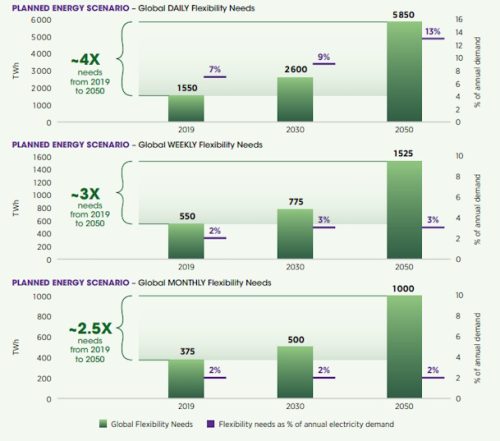
In IRENA’s Planned Energy Scenario at the global level, electricity system flexibility needs on a daily timescale are four times higher in 2050 than in 2019. In the weekly and monthly timescales, the energy required for the purpose grows by three and 2.5 times, respectively. As for the 1.5°C Scenario, implying a much higher share of renewables, the daily flexibility needs jump ten times by mid-century, versus six times for both remaining segments.

Electrification of end-use energy, large-scale deployment of distributed energy resources and the emergence of large new electricity loads from data centres are increasing demand and adding new layers of complexity. It means power systems will need stronger grids and more flexibility to ensure that electricity is available when and where needed and at the lowest possible cost, the International Renewable Energy Agency (IRENA) pointed out in a brief called Flexibility for a secure and affordable power sector transformation.

Aside from buildings and transportation, new demand is coming from the growing adoption of artificial intelligence (AI), driving the expansion of data center capacity. In 2024, data centers consumed 1.5% of electricity. The International Energy Agency expects the share to double by 2030.

The share of variable renewable energy is increasing – wind and solar power in particular. Demand patterns become more complex, so the potential for mismatches between supply and demand is likely to grow, becoming more frequent and significant. It highlights the increasing importance of system flexibility. It is the capacity to respond to expected and unexpected fluctuations in the demand for and supply of electricity in a cost-effective manner.

Some forms of flexibility act automatically to keep the system stable, while others can be scheduled and operate over hours, days or even seasons

Insufficient system flexibility can result in excessive curtailment or, in market-based systems, negative electricity prices. It can also result in shortages, jeopardising the reliable supply of electricity.

System flexibility is needed by the power system to adjust to the variability of generation and demand patterns across different timescales. Some forms of flexibility act automatically within seconds to keep the system stable, while others can be scheduled in anticipation and operate over hours, days or even seasons, through market adjustments and operational and resource planning.

Network flexibility, which isn’t covered in IRENA’s brief, is different. It is the capacity to adjust for grid availability by means of preventing or solving congestion or voltage issues.

Required flexibility depends on numerous factors

In the timescale of seconds to minutes, flexibility is needed to maintain the balance during sudden changes in demand or supply, such as the
disconnection of an interconnector or a major load or generator. The hours and days timescale has daily ups and downs of solar and wind generation alongside the peaks and troughs in demand throughout the day.

In the weeks and seasons segment, flexibility enables covering longer weather patterns caused by changes in the season or low-wind periods. In power systems mainly supplied by renewables, flexibility is also needed at inter-annual timescales. The main factors are climate-driven variations in resource availability. It especially concerns hydrology, but also wind and solar, as well as year-to-year differences in seasonal heating and cooling demand.

In power systems mainly supplied by renewables, flexibility is also needed at inter-annual timescales

Flexibility is not a single asset or function; instead it corresponds to a capability provided by a portfolio of different technologies, operational practices and market mechanisms. The required level of flexibility in a power system depends on, among other factors, the prevailing generation mix, geography, power sector structure and affected timescales.

Storage, demand-side management (DSM), interconnections and dispatchable resources each contribute differently.

Advances in forecasting and the introduction of shorter dispatch intervals, scheduled closer to real-time operation, allow more frequent and precise adjustments of generation and demand before electricity is delivered. One example are intraday markets complementing day-ahead markets.

Electricity must become main energy carrier by mid-century to keep global warming in check

In IRENA’s 1.5°C Scenario, the energy transition will be driven by the deployment of renewable energy, improvements in energy efficiency and the electrification of end-use sectors. The aim is to limit global warming to 1.5 degrees Celsius by 2100.

Electricity would need to become the main energy carrier by 2050. It would account for over half of total final energy consumption. The 2022 level was 23%.

Global electricity generation is projected to be 36% higher in 2030 and three times higher in 2050 than in 2023. Renewable resources would supply 68% of electricity in 2030 and 91% in 2050. Renewables would account for 77% of total installed power capacity in 2030 and 94% in 2050.

In the same setting, 70% of electricity generated in 2050 comes from wind and photovoltaics, taken together. In IRENA’s Planned Energy Scenario, not projecting full decarbonization, the level is 53%.

In IRENA’s 1.5°C Scenario, the share of electricity in total final energy consumption more than doubles by 2050, surpassing 50%

Flexibility needs are calculated as total cumulated annual energy deviation from the average net load (which excludes variable renewable energy generation).

In the 1.5°C Scenario, the power sector requires ten times more flexibility in 2050 than in 2019 to manage the daily variability of net load. In terms of share of annual electricity demand, the authors observed a surge to 30% from 7%. Flexibility needs for managing the variability in weekly and monthly timescales are both six times higher.

In IRENA’s Planned Energy Scenario, daily flexibility needs in 2050 are four times higher. In the weekly timescale, the level triples from 2019, and the monthly item is 2.5 times higher.

IRENA Global daily flexibility needs quadrupling by 2050
Photo: The height of bars indicates flexibility requirements in terawatt-hours per year. Purple horizontal markers show flexibility needs as a percentage of annual electricity demand. (IRENA)

Batteries perform best in daily segment

Battery energy storage is the most effective in addressing daily flexibility needs, the report finds. It is only 24% as effective at meeting weekly needs and 12% as effective for monthly needs.

Interconnections and LDES are effective on the weekly and monthly scales

Interconnections are the most effective in addressing weekly flexibility needs, but also 98% as effective for monthly needs. As for the daily segment, the coverage is just 28%.

The numbers for long-duration energy storage (LDES) solutions are similar. Compared with addressing weekly flexibility needs, LDES is 90% as effective for monthly needs and 34% as effective in the daily item.

by in News

IRENA: Global daily flexibility needs are quadrupling by 2050

In IRENA’s Planned Energy Scenario at the global level, electricity system flexibility needs on a daily timescale are four times higher in 2050 than in 2019. In the weekly and monthly timescales, the energy required for the purpose grows by three and 2.5 times, respectively. As for the 1.5°C Scenario, implying a much higher share of renewables, the daily flexibility needs jump ten times by mid-century, versus six times for both remaining segments.

Electrification of end-use energy, large-scale deployment of distributed energy resources and the emergence of large new electricity loads from data centres are increasing demand and adding new layers of complexity. It means power systems will need stronger grids and more flexibility to ensure that electricity is available when and where needed and at the lowest possible cost, the International Renewable Energy Agency (IRENA) pointed out in a brief called Flexibility for a secure and affordable power sector transformation.

Aside from buildings and transportation, new demand is coming from the growing adoption of artificial intelligence (AI), driving the expansion of data center capacity. In 2024, data centers consumed 1.5% of electricity. The International Energy Agency expects the share to double by 2030.

The share of variable renewable energy is increasing – wind and solar power in particular. Demand patterns become more complex, so the potential for mismatches between supply and demand is likely to grow, becoming more frequent and significant. It highlights the increasing importance of system flexibility. It is the capacity to respond to expected and unexpected fluctuations in the demand for and supply of electricity in a cost-effective manner.

Some forms of flexibility act automatically to keep the system stable, while others can be scheduled and operate over hours, days or even seasons

Insufficient system flexibility can result in excessive curtailment or, in market-based systems, negative electricity prices. It can also result in shortages, jeopardising the reliable supply of electricity.

System flexibility is needed by the power system to adjust to the variability of generation and demand patterns across different timescales. Some forms of flexibility act automatically within seconds to keep the system stable, while others can be scheduled in anticipation and operate over hours, days or even seasons, through market adjustments and operational and resource planning.

Network flexibility, which isn’t covered in IRENA’s brief, is different. It is the capacity to adjust for grid availability by means of preventing or solving congestion or voltage issues.

Required flexibility depends on numerous factors

In the timescale of seconds to minutes, flexibility is needed to maintain the balance during sudden changes in demand or supply, such as the
disconnection of an interconnector or a major load or generator. The hours and days timescale has daily ups and downs of solar and wind generation alongside the peaks and troughs in demand throughout the day.

In the weeks and seasons segment, flexibility enables covering longer weather patterns caused by changes in the season or low-wind periods. In power systems mainly supplied by renewables, flexibility is also needed at inter-annual timescales. The main factors are climate-driven variations in resource availability. It especially concerns hydrology, but also wind and solar, as well as year-to-year differences in seasonal heating and cooling demand.

In power systems mainly supplied by renewables, flexibility is also needed at inter-annual timescales

Flexibility is not a single asset or function; instead it corresponds to a capability provided by a portfolio of different technologies, operational practices and market mechanisms. The required level of flexibility in a power system depends on, among other factors, the prevailing generation mix, geography, power sector structure and affected timescales.

Storage, demand-side management (DSM), interconnections and dispatchable resources each contribute differently.

Advances in forecasting and the introduction of shorter dispatch intervals, scheduled closer to real-time operation, allow more frequent and precise adjustments of generation and demand before electricity is delivered. One example are intraday markets complementing day-ahead markets.

Electricity must become main energy carrier by mid-century to keep global warming in check

In IRENA’s 1.5°C Scenario, the energy transition will be driven by the deployment of renewable energy, improvements in energy efficiency and the electrification of end-use sectors. The aim is to limit global warming to 1.5 degrees Celsius by 2100.

Electricity would need to become the main energy carrier by 2050. It would account for over half of total final energy consumption. The 2022 level was 23%.

Global electricity generation is projected to be 36% higher in 2030 and three times higher in 2050 than in 2023. Renewable resources would supply 68% of electricity in 2030 and 91% in 2050. Renewables would account for 77% of total installed power capacity in 2030 and 94% in 2050.

In the same setting, 70% of electricity generated in 2050 comes from wind and photovoltaics, taken together. In IRENA’s Planned Energy Scenario, not projecting full decarbonization, the level is 53%.

In IRENA’s 1.5°C Scenario, the share of electricity in total final energy consumption more than doubles by 2050, surpassing 50%

Flexibility needs are calculated as total cumulated annual energy deviation from the average net load (which excludes variable renewable energy generation).

In the 1.5°C Scenario, the power sector requires ten times more flexibility in 2050 than in 2019 to manage the daily variability of net load. In terms of share of annual electricity demand, the authors observed a surge to 30% from 7%. Flexibility needs for managing the variability in weekly and monthly timescales are both six times higher.

In IRENA’s Planned Energy Scenario, daily flexibility needs in 2050 are four times higher. In the weekly timescale, the level triples from 2019, and the monthly item is 2.5 times higher.

IRENA Global daily flexibility needs quadrupling by 2050
Photo: The height of bars indicates flexibility requirements in terawatt-hours per year. Purple horizontal markers show flexibility needs as a percentage of annual electricity demand. (IRENA)

Batteries perform best in daily segment

Battery energy storage is the most effective in addressing daily flexibility needs, the report finds. It is only 24% as effective at meeting weekly needs and 12% as effective for monthly needs.

Interconnections and LDES are effective on the weekly and monthly scales

Interconnections are the most effective in addressing weekly flexibility needs, but also 98% as effective for monthly needs. As for the daily segment, the coverage is just 28%.

The numbers for long-duration energy storage (LDES) solutions are similar. Compared with addressing weekly flexibility needs, LDES is 90% as effective for monthly needs and 34% as effective in the daily item.

by in News

Greece’s IPTO mulls capital increase with existing shareholders

Greece’s Ministry of Environment and Energy is reportedly nearing a final decision regarding a capital increase for Independent Power Transmission Operator. The state-controlled transmission system operator (TSO) needs EUR 1.1 billion to continue its investment projects. The government is said to be in favor of existing shareholders providing the funds. There were rumors earlier that the government was going to sell a stake, where it would become a minority co-owner but remain in the driver’s seat, like it did before with Public Power Corp.

Independent Power Transmission Operator (IPTO) needs a capital injection of some EUR 1.1 billion to keep the ten-year core growth plan worth EUR 7.8 billion on track, according to Greek media reports. The government holds a 51% stake through two entities, and the only other major shareholder is State Grid Corp. of China. It acquired 24% in 2017.

The company, also known for its Greek acronym Admie, is said to require an urgent capital increase as it can’t get loans anymore. The last one amounted to EUR 300 million, from the National Bank of Greece.

Greece aiming to keep 51% stake amid geopolitical uncertainty

Energypress learned, citing unnamed sources in the Ministry of Environment and Energy, that the government is about to make a decision. The latest unofficial information was that, due to unprecedented geopolitical uncertainty, Greece wants to keep its majority stake and raise the capital in tandem with other existing shareholders.

China’s State Grid holds 24% of IPTO since 2017

Earlier reports have indicated that the government was considering a sale of a stake and a stock market listing. It would keep some 34%, allowing it to continue running the Independent Power Transmission Operator, like it did in 2021 with Public Power Corp. – PPC Group.

Major tender already underway for Dodecanese Interconnection

Most of the capital expenditure through 2034 is scheduled for before the end of the decade, EUR 6.5 billion. The biggest projects on the current ten-year list, updated in September, are the Dodecanese Interconnection, North Aegean Interconnection and the one for the second line to Italy. They amount to EUR 5.2 billion in total. All three are for submarine cables.

Last month the TSO published a tender for a bidirectional undersea link between the mainland grid, in Corinth, and the Dodecanese island of Kos. The cable system would be 1,290 kilometers long and have 1 GW in total transmission capacity. The budget is EUR 1.35 billion.

Notably, the company froze another major tender last year after receiving the bids in April.

Interconnections with Egypt and Saudi Arabia are planned in the longer term. The Crete-Cyprus link, part of the Great Sea Interconnector endeavor, is also separate.

BlackRock, Meridiam, Fortress, Fidelity, KKR and Abu Dhabi National Energy Co. (TAQA) were rumored to have expressed interest in entering ownership, among others.

by in News

Electrification is redefining energy: Volue appoints Stephan Sieber as CEO

Volue’s new Chief Executive Officer Stephan Sieber is responsible for the expansion and transformation ahead, to unleash the company’s expertise across data and forecasting, trading, optimization and planning, and grid operations. “Volue turns complexity into advantage, and the momentum with our customers right now is just the beginning,” he stated.

Norwegian electrification software maker Volue revealed that it has appointed Stephan Sieber as CEO and stressed that it is a pivotal moment for the energy sector. In the artificial intelligence era, the company provides real-time intelligence, automation, and optimization of assets for efficiency, precision and performance, the update adds.

“Electrification is accelerating at historic speed. Weather-dependent renewable power systems are becoming more unpredictable and data-intensive, and customers face rising operational complexity. Stephan’s mandate is to extend Volue’s market leadership and drive transformation and growth, unleashing Volue’s expertise across data and forecasting, trading, optimisation and planning, and grid operations – helping energy customers turn complexity into competitive advantage,” the announcement reads.

Market at inflection point

Europe is on track to double its electrification efforts by 2030, adding as much capacity in the next five years as in the previous three decades, Volue pointed out. It noted that the surge is driven in part by the electrification of transportation and heat, and rising digital demand from AI and data centres, fundamentally reshaping energy markets.

Power systems are no longer centralized and predictable; they are becoming distributed, volatile, and data-intensive, the company underscored. Decision windows are shrinking, markets transact continuously, and success now depends on real-time intelligence, automation, and precision, Volue said. The company has more than 800 energy customers across Europe and Japan.

Volue said it had stellar organic growth last year alongside selective mergers and acquisitions.

Stephan Sieber, CEO, Volue, said: “With electrification accelerating and system complexity rising, customers need to partner with the best technology providers. Volue turns complexity into advantage, and the momentum with our customers right now is just the beginning. I’m extremely excited about where the company, the market, and our customers are, and how quickly the impact is compounding,”

Enabling performance in volatile markets

Volue operates other companies’ assets through real-time operations intelligence, enabling market anticipation and execution, and 30% of Europe’s intraday market volume is flowing through Volue Trading solutions, the company stressed. Its AI-driven optimization is influencing decisions across 500 TWh of annual generation, representing 20% of Europe’s total power production.

The company claimed it is “the dominant partner of choice” for 40% of Europe’s independent power producers in renewables integration.

“Throughout his career, Stephan has consistently delivered exceptional results, driving growth, leading complex strategic and operational transformations, and building high-performing teams in some of the most competitive markets. He has an extraordinary ability to understand customer needs, anticipate market trends, and turn opportunities into tangible, lasting outcomes, earning him a reputation as a market-proven leader,” Chairman of Volue Pete Daffern stated.

by in News

Why CEE is one of most attractive regions for investment in new energy projects

Munir Hassan and Thomas Hamerl, partners in CMS’s world-leading energy practice, discussed the most significant developments in the renewable energy market for 2026 with Balkan Green Energy News.

There is great potential for early movers in the segments of battery storage and ancillary services, according to Munir Hassan, global head of the energy and climate change at CMS (London), and Thomas Hamerl, regional head of energy and climate change at CMS Vienna.

Interconnection and interoperability with the EU’s electricity market will enhance the region’s value for established producers and increase its attractiveness for new investors, they told Balkan Green Energy News.

Beyond grid availability and tariffs, potential investors in renewables and storage focus on the target country’s policy direction and the scalability of projects, Hassan and Hamerl explained.

Investors need advisors who are familiar with international contracts and can navigate local energy markets

Potential investors in renewables and storage do not just look for efficient support with time-sensitive grid availability and network tariffs. They appreciate legal advisors who are familiar with international contracts and can also navigate local energy markets. The current policy direction of the target country and the scalability of projects are more interesting than ever, Hassan and Hamerl asserted.

CMS’s regional footprint and its global network enable it to share expertise across jurisdictions, and its local teams contribute to regulatory initiatives. With over 70 offices worldwide, including 17 offices in CEE region, CMS supports renewable energy developers and investors. The global law firm follows policy developments that are shifting from saturated markets to the CEE region, with the aim of applying best practices and overcoming challenges and bottlenecks beforehand.

Speaking to Balkan Green Energy News, Hassan and Hamerl said companies should ride the investment wave and use opportunities as legal frameworks in Southeast Europe and the wider CEE region are advancing rapidly and opening new market segments.

At CMS’s traditional annual CEE Energy Conference (CEE Energy Conference 2025), held in London in October 2025, most investors were seriously considering to add energy storage to power plants and PPAs for industrial customers.

Data center projects are adding to demand growth in green electricity

Hassan pointed to digital infrastructure as the main driver of demand, even more in SEE than the rest of the CEE region, alongside the decommissioning of coal and gas-fired power plants.

Things are starting to move with data center projects in Slovenia, Croatia and Austria, for example, Hamerl stressed.

“Usually, data center developers are international and well-experienced, bringing technical and commercial know-how. These need not be only global hyperscalers such as Amazon, Google and Microsoft. Smaller data centre operators and telecom companies are strengthening their presence in CEE. They may all seek out the expertise and networks of local infrastructure developers,” he added.

CMS is involved in major projects throughout Southeast Europe

The changes are spurring the need for more resilience in the energy sphere and national sources. It is one of the factors behind the nuclear energy program in Poland, for shielding against geopolitical shocks, according to Hassan.

There are also nuclear power projects in Romania, including an advanced one for a small modular reactor (SMR) system, and Bulgaria, and CMS is involved in all of them. It has also contributed to deals for the giant Vifor wind power endeavor in Romania. Slovenia and Serbia are next.

Financing through debt could contribute to nuclear energy and interconnector projects

Hassan said there is a notable appetite for debt financing in CEE and suggested that the model could contribute to nuclear projects including the ones for SMRs.

“Another relevant development that we see is the development of electricity networks and even interconnectors. There’s a lot of private capital that’s looking to build electricity grids in Southeast Europe and Central and Eastern Europe. But the regimes there are designed for the existing system operators to develop these projects. The difficulty, like here in the UK and other parts of the world, is that they are unable to deliver the infrastructure quickly because they don’t have the resources and financial capability,” he asserted.

Western Europe is comfortable with the idea that private companies can own and run such assets, Hassan underscored and added that transmission upgrades in general could be financed the same way. But TSOs would typically take ownership of transmission system infrastructure including interconnectors.

EU funds would have better effect as loan guarantees

Among the investment appeal factors in CEE, Hassan highlighted the grants via the European Union’s Modernization Fund and Recovery and Resilience Facility (RRF).

“Those sorts of funds are very, very important. I think the governments need to find smart ways of effectively using that money to help create conditions in which you can get private international investment into the region, rather than simply as grant funding. If you give it as a way of, let’s say, underwriting debt, in case there’s a risk issue, that’s a better way, that kind of multiplier effect,” he stressed.

Knowhow for navigating legal frameworks in emerging market segments in CEE

The United Kingdom and other parts of Western Europe are experiencing growth of the markets for new system support services. Southeast Europe and Central and Eastern Europe may follow soon. For instance, Austria is about to introduce a capacity market. Serbia is rolling out an ancillary services market in January 2026, enabling a potential revenue stream for standalone battery energy storage systems (BESS).

“It’s not a mature market yet, but market entrants with the required experience and knowhow, will find a lot of possibilities in the region. If you want to be a first mover or an early mover, you must go there now,” said Hamerl. He added it is an opportunity for battery storage, to support the grid through the flexibility market or frequency restoration and new kinds of services, instead of just arbitrage.

It is much more expensive to expand the power grid than to use energy storage capacity available in the market

Regulatory frameworks are either in place or will very soon be in place, Hamerl noted.

“Batteries play an important role in supporting the grids and saving money because building new grids is always much more expensive than storage capacity in the market. I still see a long way to go for alternatives to batteries,” he said.

The fact is that it takes several years to build a pumped storage hydropower plant, while hydrogen and ammonia production and distribution infrastructure are not sufficiently developed yet.

Photovoltaics, BESS in sharply upward trajectory

Locations for photovoltaics in Southeast Europe are much better than in most parts of Europe, Hamerl underscored, adding that the coastal areas are particularly favorable for wind power.

For instance, experts predict the total operational solar and wind capacity in Montenegro to reach 400 MW by the end of this year. For Croatia, RES generation capacity is expected to increase from 4.7 GW in 2025 to almost 12 GW by 2040.

In Bulgaria, PV capacity jumped fivefold since 2019, to 5 GW, the law firm pointed out and emphasized the surge in both co-located and standalone BESS as well. Forecasts see the segment, currently at 600 MW, to hit 5 GW by the middle of 2026.

CMS Sofia has advised on more than 50% of all installed renewable energy capacities in Bulgaria. One of the clients, Renalfa IPP, has an investment program worth EUR 1.2 billion, involving 1.6 GW in electricity generation assets and 3.3 GWh of battery storage in Bulgaria, Romania, Hungary and North Macedonia.

CMS helping optimize regulations to suit governments as well as investors

There are obviously differences in every country of Central and Eastern Europe, but there are similarities drawing investors into the region, according to Hassan.

“They want to see the revenue risk is dealt with, the technical risks are dealt with, the political risk is kind of dealt with, et cetera. So our job as lawyers is to help people understand the frameworks, but also our local teams are helping to design some of these frameworks. To that extent, we can try and design them upfront in a way that achieves not only what the countries want, the governments want, but also what the international investors will be looking for,” he asserted.

The most important factors for investors are a clear direction of law making and scalability

In his view, the most important factors are a clear direction of lawmaking and regulation – strong policy backing, and scalability, in the sense that a company can do many more projects on the back of the first one.

Hamerl said that the waiting time for grid connection remains one of the most important elements, together with network charges. Investors seek stable grid fees or at least clarity about the pace and way of growth, he stressed.

“They are always asking us about the stability of the grid and the grid usage charges. However, in some markets there is a diversity of federal, provincial, and  local laws requiring different permits. Investors ask themselves in which province it is possible to obtain permits in time. Zoning and spatial planning is crucial too. For most of our clients, it’s nice to get subsidies, but those other issues are more important,” Hamerl asserted.

by in News

Electrification is redefining energy: Volue appoints Stephan Sieber as CEO

Volue’s new Chief Executive Officer Stephan Sieber is responsible for the expansion and transformation ahead, to unleash the company’s expertise across data and forecasting, trading, optimization and planning, and grid operations. “Volue turns complexity into advantage, and the momentum with our customers right now is just the beginning,” he stated.

Norwegian electrification software maker Volue revealed that it has appointed Stephan Sieber as CEO and stressed that it is a pivotal moment for the energy sector. In the artificial intelligence era, the company provides real-time intelligence, automation, and optimization of assets for efficiency, precision and performance, the update adds.

“Electrification is accelerating at historic speed. Weather-dependent renewable power systems are becoming more unpredictable and data-intensive, and customers face rising operational complexity. Stephan’s mandate is to extend Volue’s market leadership and drive transformation and growth, unleashing Volue’s expertise across data and forecasting, trading, optimisation and planning, and grid operations – helping energy customers turn complexity into competitive advantage,” the announcement reads.

Market at inflection point

Europe is on track to double its electrification efforts by 2030, adding as much capacity in the next five years as in the previous three decades, Volue pointed out. It noted that the surge is driven in part by the electrification of transportation and heat, and rising digital demand from AI and data centres, fundamentally reshaping energy markets.

Power systems are no longer centralized and predictable; they are becoming distributed, volatile, and data-intensive, the company underscored. Decision windows are shrinking, markets transact continuously, and success now depends on real-time intelligence, automation, and precision, Volue said. The company has more than 800 energy customers across Europe and Japan.

Volue said it had stellar organic growth last year alongside selective mergers and acquisitions.

Stephan Sieber, CEO, Volue, said: “With electrification accelerating and system complexity rising, customers need to partner with the best technology providers. Volue turns complexity into advantage, and the momentum with our customers right now is just the beginning. I’m extremely excited about where the company, the market, and our customers are, and how quickly the impact is compounding,”

Enabling performance in volatile markets

Volue operates other companies’ assets through real-time operations intelligence, enabling market anticipation and execution, and 30% of Europe’s intraday market volume is flowing through Volue Trading solutions, the company stressed. Its AI-driven optimization is influencing decisions across 500 TWh of annual generation, representing 20% of Europe’s total power production.

The company claimed it is “the dominant partner of choice” for 40% of Europe’s independent power producers in renewables integration.

“Throughout his career, Stephan has consistently delivered exceptional results, driving growth, leading complex strategic and operational transformations, and building high-performing teams in some of the most competitive markets. He has an extraordinary ability to understand customer needs, anticipate market trends, and turn opportunities into tangible, lasting outcomes, earning him a reputation as a market-proven leader,” Chairman of Volue Pete Daffern stated.

by in News

Greece’s IPTO mulls capital increase with existing shareholders

Greece’s Ministry of Environment and Energy is reportedly nearing a final decision regarding a capital increase for Independent Power Transmission Operator. The state-controlled transmission system operator (TSO) needs EUR 1.1 billion to continue its investment projects. The government is said to be in favor of existing shareholders providing the funds. There were rumors earlier that the government was going to sell a stake, where it would become a minority co-owner but remain in the driver’s seat, like it did before with Public Power Corp.

Independent Power Transmission Operator (IPTO) needs a capital injection of some EUR 1.1 billion to keep the ten-year core growth plan worth EUR 7.8 billion on track, according to Greek media reports. The government holds a 51% stake through two entities, and the only other major shareholder is State Grid Corp. of China. It acquired 24% in 2017.

The company, also known for its Greek acronym Admie, is said to require an urgent capital increase as it can’t get loans anymore. The last one amounted to EUR 300 million, from the National Bank of Greece.

Greece aiming to keep 51% stake amid geopolitical uncertainty

Energypress learned, citing unnamed sources in the Ministry of Environment and Energy, that the government is about to make a decision. The latest unofficial information was that, due to unprecedented geopolitical uncertainty, Greece wants to keep its majority stake and raise the capital in tandem with other existing shareholders.

China’s State Grid holds 24% of IPTO since 2017

Earlier reports have indicated that the government was considering a sale of a stake and a stock market listing. It would keep some 34%, allowing it to continue running the Independent Power Transmission Operator, like it did in 2021 with Public Power Corp. – PPC Group.

Major tender already underway for Dodecanese Interconnection

Most of the capital expenditure through 2034 is scheduled for before the end of the decade, EUR 6.5 billion. The biggest projects on the current ten-year list, updated in September, are the Dodecanese Interconnection, North Aegean Interconnection and the one for the second line to Italy. They amount to EUR 5.2 billion in total. All three are for submarine cables.

Last month the TSO published a tender for a bidirectional undersea link between the mainland grid, in Corinth, and the Dodecanese island of Kos. The cable system would be 1,290 kilometers long and have 1 GW in total transmission capacity. The budget is EUR 1.35 billion.

Notably, the company froze another major tender last year after receiving the bids in April.

Interconnections with Egypt and Saudi Arabia are planned in the longer term. The Crete-Cyprus link, part of the Great Sea Interconnector endeavor, is also separate.

BlackRock, Meridiam, Fortress, Fidelity, KKR and Abu Dhabi National Energy Co. (TAQA) were rumored to have expressed interest in entering ownership, among others.

by in News

Why CEE is one of most attractive regions for investment in new energy projects

Munir Hassan and Thomas Hamerl, partners in CMS’s world-leading energy practice, discussed the most significant developments in the renewable energy market for 2026.

There is great potential for early movers in the segments of battery storage and ancillary services, according to Munir Hassan, global head of the energy and climate change at CMS (London), and Thomas Hamerl, regional head of energy and climate change at CMS Vienna.

Interconnection and interoperability with the EU’s electricity market will enhance the region’s value for established producers and increase its attractiveness for new investors, they told Balkan Green Energy News.

Beyond grid availability and tariffs, potential investors in renewables and storage focus on the target country’s policy direction and the scalability of projects, Hassan and Hamerl explained.

Investors need advisors who are familiar with international contracts and can navigate local energy markets

Potential investors in renewables and storage do not just look for efficient support with time-sensitive grid availability and network tariffs. They appreciate legal advisors who are familiar with international contracts and can also navigate local energy markets. The current policy direction of the target country and the scalability of projects are more interesting than ever, Hassan and Hamerl asserted.

CMS’s regional footprint and its global network enable it to share expertise across jurisdictions, and its local teams contribute to regulatory initiatives. With over 70 offices worldwide, including 17 offices in CEE region, CMS supports renewable energy developers and investors. The global law firm follows policy developments that are shifting from saturated markets to the CEE region, with the aim of applying best practices and overcoming challenges and bottlenecks beforehand.

Speaking to Balkan Green Energy News, Hassan and Hamerl said companies should ride the investment wave and use opportunities as legal frameworks in Southeast Europe and the wider CEE region are advancing rapidly and opening new market segments.

At CMS’s traditional annual CEE Energy Conference (CEE Energy Conference 2025), held in London in October 2025, most investors were seriously considering to add energy storage to power plants and PPAs for industrial customers.

Data center projects are adding to demand growth in green electricity

Hassan pointed to digital infrastructure as the main driver of demand, even more in SEE than the rest of the CEE region, alongside the decommissioning of coal and gas-fired power plants.

Things are starting to move with data center projects in Slovenia, Croatia and Austria, for example, Hamerl stressed.

“Usually, data center developers are international and well-experienced, bringing technical and commercial know-how. These need not be only global hyperscalers such as Amazon, Google and Microsoft. Smaller data centre operators and telecom companies are strengthening their presence in CEE. They may all seek out the expertise and networks of local infrastructure developers,” he added.

CMS is involved in major projects throughout Southeast Europe

The changes are spurring the need for more resilience in the energy sphere and national sources. It is one of the factors behind the nuclear energy program in Poland, for shielding against geopolitical shocks, according to Hassan.

There are also nuclear power projects in Romania, including an advanced one for a small modular reactor (SMR) system, and Bulgaria, and CMS is involved in all of them. It has also contributed to deals for the giant Vifor wind power endeavor in Romania. Slovenia and Serbia are next.

Financing through debt could contribute to nuclear energy and interconnector projects

Hassan said there is a notable appetite for debt financing in CEE and suggested that the model could contribute to nuclear projects including the ones for SMRs.

“Another relevant development that we see is the development of electricity networks and even interconnectors. There’s a lot of private capital that’s looking to build electricity grids in Southeast Europe and Central and Eastern Europe. But the regimes there are designed for the existing system operators to develop these projects. The difficulty, like here in the UK and other parts of the world, is that they are unable to deliver the infrastructure quickly because they don’t have the resources and financial capability,” he asserted.

Western Europe is comfortable with the idea that private companies can own and run such assets, Hassan underscored and added that transmission upgrades in general could be financed the same way. But TSOs would typically take ownership of transmission system infrastructure including interconnectors.

EU funds would have better effect as loan guarantees

Among the investment appeal factors in CEE, Hassan highlighted the grants via the European Union’s Modernization Fund and Recovery and Resilience Facility (RRF).

“Those sorts of funds are very, very important. I think the governments need to find smart ways of effectively using that money to help create conditions in which you can get private international investment into the region, rather than simply as grant funding. If you give it as a way of, let’s say, underwriting debt, in case there’s a risk issue, that’s a better way, that kind of multiplier effect,” he stressed.

Knowhow for navigating legal frameworks in emerging market segments in CEE

The United Kingdom and other parts of Western Europe are experiencing growth of the markets for new system support services. Southeast Europe and Central and Eastern Europe may follow soon. For instance, Austria is about to introduce a capacity market. Serbia is rolling out an ancillary services market in January 2026, enabling a potential revenue stream for standalone battery energy storage systems (BESS).

“It’s not a mature market yet, but market entrants with the required experience and knowhow, will find a lot of possibilities in the region. If you want to be a first mover or an early mover, you must go there now,” said Hamerl. He added it is an opportunity for battery storage, to support the grid through the flexibility market or frequency restoration and new kinds of services, instead of just arbitrage.

It is much more expensive to expand the power grid than to use energy storage capacity available in the market

Regulatory frameworks are either in place or will very soon be in place, Hamerl noted.

“Batteries play an important role in supporting the grids and saving money because building new grids is always much more expensive than storage capacity in the market. I still see a long way to go for alternatives to batteries,” he said.

The fact is that it takes several years to build a pumped storage hydropower plant, while hydrogen and ammonia production and distribution infrastructure are not sufficiently developed yet.

Photovoltaics, BESS in sharply upward trajectory

Locations for photovoltaics in Southeast Europe are much better than in most parts of Europe, Hamerl underscored, adding that the coastal areas are particularly favorable for wind power.

For instance, experts predict the total operational solar and wind capacity in Montenegro to reach 400 MW by the end of this year. For Croatia, RES generation capacity is expected to increase from 4.7 GW in 2025 to almost 12 GW by 2040.

In Bulgaria, PV capacity jumped fivefold since 2019, to 5 GW, the law firm pointed out and emphasized the surge in both co-located and standalone BESS as well. Forecasts see the segment, currently at 600 MW, to hit 5 GW by the middle of 2026.

CMS Sofia has advised on more than 50% of all installed renewable energy capacities in Bulgaria. One of the clients, Renalfa IPP, has an investment program worth EUR 1.2 billion, involving 1.6 GW in electricity generation assets and 3.3 GWh of battery storage in Bulgaria, Romania, Hungary and North Macedonia.

CMS helping optimize regulations to suit governments as well as investors

There are obviously differences in every country of Central and Eastern Europe, but there are similarities drawing investors into the region, according to Hassan.

“They want to see the revenue risk is dealt with, the technical risks are dealt with, the political risk is kind of dealt with, et cetera. So our job as lawyers is to help people understand the frameworks, but also our local teams are helping to design some of these frameworks. To that extent, we can try and design them upfront in a way that achieves not only what the countries want, the governments want, but also what the international investors will be looking for,” he asserted.

The most important factors for investors are a clear direction of law making and scalability

In his view, the most important factors are a clear direction of lawmaking and regulation – strong policy backing, and scalability, in the sense that a company can do many more projects on the back of the first one.

Hamerl said that the waiting time for grid connection remains one of the most important elements, together with network charges. Investors seek stable grid fees or at least clarity about the pace and way of growth, he stressed.

“They are always asking us about the stability of the grid and the grid usage charges. However, in some markets there is a diversity of federal, provincial, and  local laws requiring different permits. Investors ask themselves in which province it is possible to obtain permits in time. Zoning and spatial planning is crucial too. For most of our clients, it’s nice to get subsidies, but those other issues are more important,” Hamerl asserted.

by in News

EU simplifying CBAM exemption for electricity, improving emissions calculation

The European Union is further simplifying the Carbon Border Adjustment Mechanism (CBAM), but with stricter oversight and an extension to 180 steel- and aluminium-intensive downstream products. From January 1, importers of designated goods and commodities will be paying the emissions tax.

Among the novelties, countries in the Energy Community that transposed the relevant EU regulations are getting an opportunity for exemptions for CBAM for electricity earlier than initially planned. The new legislation is tackling the hurdles for electricity transit as well. The calculation of emissions on national levels in the same sector is becoming more favorable for the payers of the cross-border CO2 tax. There is even a possibility, in theory for now, to declare the actual emissions level, which would suit renewable energy producers.

In response to feedback from industrial producers and other stakeholders, the European Commission proposed measures to prevent circumvention of CBAM and strengthen its efficacy. The next step is to expand it to 180 manufactured products with high steel or aluminum content, 79% on average. The list mostly consists of machinery and hardware, and 6% of the items are household appliances.

From January 1, importers will be paying a carbon price within the Carbon Border Adjustment Mechanism, which is tied to the Emissions Trading System (EU ETS). It concerns aluminum, cement, electricity, iron and steel, hydrogen and fertilizers, and the expenses will spill over to their suppliers in third countries such as the Western Balkans and Turkey.

The charge for downstream products is planned to be rolled out in January 2028.

Striving for level playing field

The system gradually levels the field, by the beginning 2034, with producers of the same goods and commodities in the EU. The measures are introduced in the form of delegated and implementing acts. They enter into force if other institutions responsible for them, like the European Parliament, don’t block them.

Hoekstra: Our system was too broad, too clunky and had too many loopholes.

“CBAM makes sure there is a level playing field – that we’re not asking anything more, or asking anything less for those goods that come into the EU. And in doing so, we’re rewarding investments in low carbon… We’re not going to ask anything more from others, than we’re asking from ourselves. During the CBAM transition period, we learned important lessons. Our system was too broad, too clunky and had too many loopholes,” said European Commissioner for Climate, Net Zero and Clean Growth Wopke Hoekstra.

Thoroughly against evasion

The tax level is envisaged to be proportional to an established quantity of greenhouse gases released in production. However, if the authorities notice attempts to evade the levy, they can make the process of providing evidence stricter and, in the meantime, switch to a charge under the emissions factor of the particular country of origin.

“If I had to summarize these points in a few words, I would say: a simpler CBAM, more robust in its application, and fairer in its scope,” said the European Commission’s Executive Vice-President for Prosperity and Industrial Strategy Stéphane Séjourné.

Shortcut to exemption from CBAM for electricity

One of the measures is intended for easing the administrative burden for countries in the process of electricity market coupling with the EU, namely the Energy Community contracting parties.

There is going to be a possibility to sign an MoU with the European Commission with a detailed schedule

The commission may sign a memorandum of understanding with a third country, once the commission has assessed that the country has fully transposed the electricity market acquis, the proposal reads. The document would lay down details on the timeline for the CBAM exemption, including in relation to technical work still to be carried out between transmission system operators (TSOs), and for implementing a carbon pricing instrument equivalent to the EU ETS as far as electricity generation is concerned.

Hoekstra said technical adjustments to CBAM would be made to facilitate market coupling when the relevant countries are ready.

Import tax for electricity from Energy Community to be 30% lower on average

Stakeholder feedback and the experience with the implementation of CBAM during the transitional period – before the actual charge – demonstrated that the rules for electricity imports are overly rigid, the European commissioners added. In particular, they ascertained that progress in decarbonizing electricity production isn’t sufficiently acknowledged or encouraged.

Unlike with the goods, for electricity there is a default country-specific emissions value. It is based on production from fossil fuels and a five-year average. Coal is mostly dominant in the Western Balkans, except for Albania, which has a completely green mix. In addition, the conditions which must be met to declare actual emissions of electricity have proven to be almost impossible.

The proposed package is introducing solutions for electricity transit and cross-border PPAs

In the new setting, the national value will reflect the carbon intensity of all sources of electricity. The estimated taxes in the Energy Community would be over 30% lower on average.

The procedure is being streamlined for declaring actual emissions. On the other hand, at least in the Western Balkans, there has been almost no progress in that area. The proposed package is also introducing solutions for the hurdles in electricity transit through Energy Community Contracting Parties and cross-border power purchase agreements (PPAs).

Power imports from the Western Balkans account for 1% of the EU’s demand, but their share in Croatia, Bulgaria and Greece is significant, the European Commission explained. Importantly, exports of electricity to the EU represent some 58% of Montenegro’s exports to the EU, compared to 5% for Serbia and Albania.

Funds for maintaining competitiveness of domestic industrial producers in third countries

A fund has been launched to temporarily support EU producers of CBAM goods and mitigate carbon leakage risks. It addresses the competitiveness loss in third-country markets with a weaker climate policy and lower costs. Potential beneficiaries will have to demonstrate decarbonization efforts.

Th European commission is also preparing proposals for limiting scrap aluminum exports and using more scrap metal. Furthermore, it said pre-consumer metals scrap, from manufacturing, would come under CBAM.