by in News

Margün Energy takes over licenses for potential 505 MW in geothermal power plants

Turkish contractor and solar power plant operator Margün Energy, which is expanding to geothermal energy including lithium extraction, acquired nine geothermal licenses that enable access to a potential power production capacity of 505 MW. It counts on USD 405 million per year from electricity sales alone.

Margün Energy, listed at the Istanbul Stock Exchange since 2021, said it would establish a subsidiary called Margün Jeotermal. It would be responsible for nine geothermal licenses in the provinces of Denizli, in southwestern Turkey, and Manisa, in the west.

The company said it is targeting 3.86 TWh in annual electricity output upon completing the investments. In a regulatory filing, Margün Energy revealed that it conducted the transaction through its fully-owned subsidiary Bosphorus Yenilenebilir Enerji, which would own 77.5% of the new business.

Having a potential new power production capacity of 505 MW overall, the company counts on USD 405 million in sales. It translates to an annual earnings before interest, tax, depreciation and amortization of USD 324 million, it added.ž

Turkey is the fourth in the world in geothermal power capacity.

The company mostly operates solar power plants and works as a contractor for engineering, procurement and construction (EPC) and operations and maintenance.

Notably, it owns the largest stake in Enda Energy Holding. The affiliate operates four hydropower plants, five wind power plants, one geothermal power plant and three solar power plants of 200 MW altogether.

Margün Energy intends to search for lithium in geothermal waters in Seferihisar in western Turkey, where it took over a 12 MW geothermal power plant earlier this year. It also launched a project to add a photovoltaic unit of 5.4 MW to the existing facility and create a hybrid power plant.

Turkey is the fourth in the world in geothermal power capacity.
by in News

First section of Čibuk 2 wind park in Serbia begins trial operation

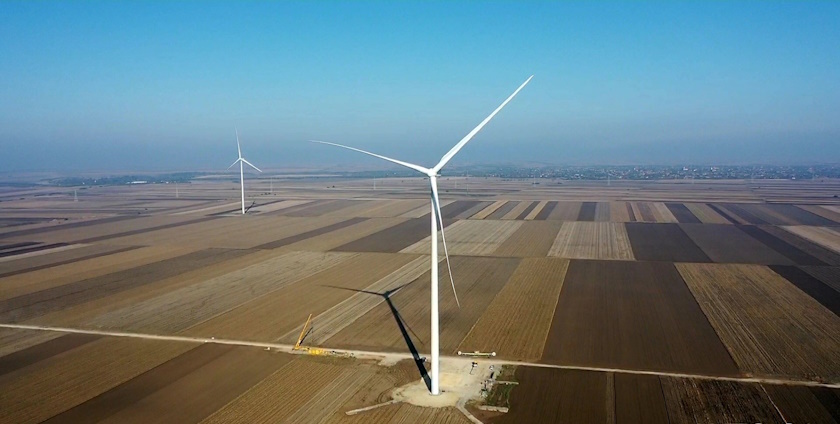
Masdar and Taaleri Energia generated the first megawatt-hours in their Čibuk 2 wind farm in Serbia. The first 35 MW out of the planned 154 MW is now in trial operation.

The installation of all 22 turbines in the Čibuk 2 wind power plant northeast of Belgrade is set to be completed by mid-November, Renewable Energy Sources of Serbia (RES Serbia) revealed. Trial operation of the first part began on October 21 and 35 MW has been connected to the grid so far, according to the update.

The entire wind farm will come online in early December, the association said. The project in the municipality of Kovin in the south Banat area is for 154 MW. The wind farm is between the villages of Bavanište and Mramorak.

Abu Dhabi Future Energy Co. – Masdar and Finland-based Taaleri Energia’s Taaleri SolarWind III Fund reached the financial close just 13 months ago. At the same time, special purpose vehicle (SPV) Čibuk 2 Wind Energy, a subsidiary of their joint venture Masdar Taaleri Generation, signed a power purchase agreement (PPA), as well as contracts on balancing and a market premium, with state-owned power utility Elektroprivreda Srbije (EPS).

UniCredit and Erste provided project financing, while Nordex is the equipment supplier.

The Čibuk 2 project secured a market premium at Serbia’s first wind power auction.

The facility is located next to the existing Čibuk 1 wind farm of 158 MW, the largest in Serbia. Masdar and Taaleri Energia commissioned it in 2019.

by in News

Božinovska: Solar overtakes hydro in North Macedonia

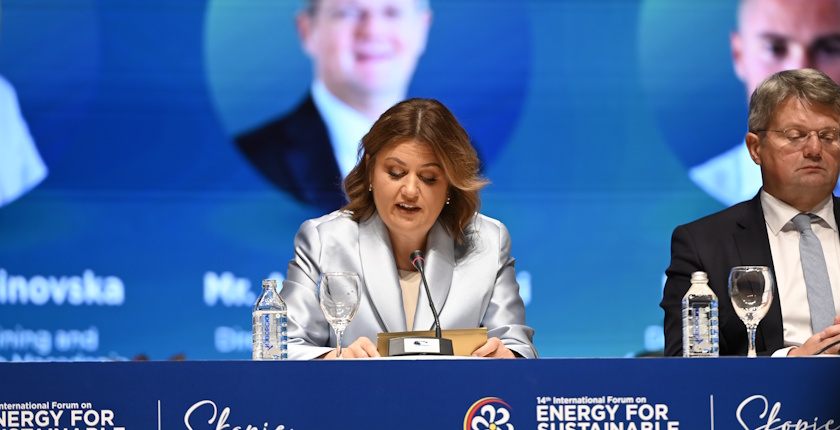
The share of solar power plants’ capacity in North Macedonia has surpassed hydropower plants in 2024, Minister of Energy, Mining and Mineral Resources Sanja Božinovska said at the 14th International Forum on Energy for Sustainable Development in Skopje.

The three-day International Forum on Energy for Sustainable Development (IFESD-14) started yesterday. Its theme is From Goals to Action: Powering the Future with Sustainable Energy. The event was organized by the Ministry of Energy, Mining and Mineral Resources of North Macedonia, in cooperation with the United Nations Development Programme (UNDP) and the UN’s five regional commissions – UNECE, UNESCAP, UNECLAC, UNECA, and UNESCWA.

According to Sanja Božinovska, Minister of Energy, Mining and Mineral Resources, North Macedonia has taken decisive steps in recent years to transform its energy system and align it with the principles of sustainability, security, and affordability.

The reforms are already delivering measurable results, with renewables now accounting for more than half of the country’s total installed electricity capacity – 56% in 2024, she noted.

North Macedonia is moving from goals to action

“The structure of that progress is even more striking. Photovoltaic power plants now represent 28% of installed capacity, surpassing large hydropower, which is at 24%. For the first time in our history, solar has overtaken hydro – a symbolic and practical milestone in our path toward decarbonization,” the minister stated.

In 2024 alone, solar output grew by 186%, she underlined at the first high-level plenary session.

Photo: Ministry of Energy, Mining and Mineral Resources

The numbers speak louder than words: they highlight a nation that is not just planning a transition, but living it, in Božinovska’s view.

Of note, at the end of 2024 the capacity of solar power plants was 848 MW. The year-on-year was higher than 340 MW. Hydropower capacity was 720 MW, at the end of last year.

Božinovska: We are supporting over 5,000 workers and communities affected by the coal phaseout

“The numbers confirm it — North Macedonia is moving from goals to action,” Božinovska stressed.

She added that the country is investing in new solar and wind projects, expanding energy storage, and modernizing the national grid to absorb growing renewable capacity. “These investments are essential for maintaining reliability and flexibility as we integrate more clean energy sources,” she explained.

Božinovska pointed out that the commitment to a just energy transition is equally important.

“We are supporting over 5,000 workers and communities affected by the coal phaseout, helping them to retrain, diversify local economies, and secure green jobs,” she underlined.

Joksimović: Serbia to reach 2030 renewables target

Sanja Božinovska and Jovana Joksimović (photo: Ministry of Energy, Mining and Mineral Resources)

According to Jovana Joksimović, Serbian Assistant Minister of Mining and Energy for International Cooperation and European Integration, coal is still the backbone of the energy system in Serbia, while the share of energy from renewables is significant and growing, and it reached 38% in 2023.

The government plans that one in two megawatt-hours would be produced from renewables by 2030, she underlined.

“Existing valuable resources will need to remain the foundation of Serbia’s electricity sector until renewable energy, transmission and distribution infrastructure, as well as storage capacities and ability to integrate renewables, are sufficiently developed and aligned to reliably and securely replace coal-based electricity generation,” the assistant minister told the audience during the second high-level plenary session.

It is necessary to diversify supply channels but also the energy mix

Joksimović stressed that the increased capacity for clean energy, secured from the two very successful rounds of the auctions, would contribute to reaching 2030 targets.

When it comes to advancing the energy transition and powering the future, it is necessary to think outside the box, she added. Supply channels should be diversified but so does the energy mix, to be as self-sustainable as possible, in Joksimović’s view.

There is huge support for it from relevant international financial institutions – IFIs, but more is needed, in her words.

“If we are going to reach the targets that we set for us, I believe that the European Commission would be partnering with us in all efforts that we are taking,” she concluded.

Photo: Ministry of Energy, Mining and Mineral Resources
by in News

Renewable electricity should not be subject to EU’s CO2 import tax

The European Commission is collecting evidence to come up with solutions for unintended effects of the Carbon Border Adjustment Mechanism (CBAM) on renewable electricity in the Western Balkans, Director of the Energy Community Secretariat Artur Lorkowski pointed out in an interview with Balkan Green Energy News, as one of the most important developments in the sector. Boosting renewable energy development and trade with third countries such as the Western Balkans was supposed to be accelerated by the European Union’s CO2 import tax.

To reduce the payment obligations of EU importers under CBAM, the contracting parties in the region are planning carbon pricing systems, but under different models. The ultimate goal is eventually joining the EU Emissions Trading System, implying the need for coordination and cooperation between the governments in the process, Lorkowski stressed.

Looking back twenty years since the Energy Community Treaty was signed, it proved to be a successful format of cooperation, the Energy Community Secretariat Director Artur Lorkowski said. On the occasion of the anniversary, Balkan Green Energy News sat down with the head of the international organization to speak about the achievements and benefits for the contracting parties, and the remaining milestones that the Western Balkans need to reach in order to integrate with the EU’s energy union.

“Economic growth depends on energy security and fair pricing. There is visible progress in transformation, clearly seen from the 2024 figures. And the final element is the accelerated energy market integration with the EU, and this is what we can be really proud of,” Lorkowski asserted.

Among the segments with tangible improvements, he also highlighted the convergence on the wholesale gas and electricity markets. It is facilitating competitiveness in the Energy Community, the secretariat’s chief added.

Renewables capacity doubled in four years

Fossil fuels used to account for 60% of electricity production in the contracting parties five years ago, compared to 50% now, Lorkowski noted. The significant results in renewables except for large hydro are illustrated by the fact that the overall capacity in the segment has more than doubled between 2020 and 2024, he stressed. More importantly, the carbon footprint – the CO2 emissions per unit of the nominal gross domestic product, fell 11% last year alone.

CO2 emissions per unit of the nominal GDP fell 11% last year in the Energy Community

As for EU integration, electricity market coupling is progressing very well, as a good example, in Lorkowski’s view. The legislation is mostly aligned, so most countries are just waiting for the process to be concluded, the director of the Energy Community Secretariat explained.

“There are operating wholesale markets everywhere in the Western Balkans except in Bosnia and Herzegovina, which is about to adopt the required law. Serbia is at the forefront of that process. North Macedonia and Montenegro are very close, with small elements yet to be achieved. It is a non-reversible point, point of no return on a path towards EU integration,” Lorkowski said. He recalled that when capacity calculations regions (CCRs), operationalization and verification are cleared from the to-do list, it would take 18 months to join the EU’s market coupling project.

Electricity can be exempted from CBAM at later stage

Energy Community contracting parties may become eligible for exemption until 2030 from CBAM in electricity, if they meet the CBAM requirements. However, the EU is starting to charge the CO2 import tax already on January 1.

“I wish the contracting parties followed my messages from the Belgrade Energy Forum in 2023, because you might remember me saying that CBAM is coming and we have to prepare for that. But unfortunately, we have observed a lot of delays and hiccups in the preparatory process. Fair enough, this is the reality we have to face now – no country of the Energy Community will be exempted on 1 January 2026. But we can still work to be exempted at a later stage,” Lorkowski underscored.

Artur Lorkowski was a keynote speaker at Belgrade Energy Forum 2025, organized by Balkan Green Energy News

European Commission expected to clarify rules by end of year

The second part of the story is that CBAM, in addition to its intended impacts, especially on coal power, also has unintended impacts, Lorkowski explained. For example, electricity transit between EU member states through the contracting parties, in practice, may also be subject to the tax, even if it was not intended by the European legislators.

CBAM was intended to provide equal treatment for products produced inside and outside the EU when it comes to carbon payments. “Renewable energy, not being subject to the EU ETS, would – logically – not need to be subject to CBAM, but with the current rules, even EU off-takers with cross-border power purchase agreements (PPAs) may still be subject to payment obligations, as the implementing rules remain overly complex, effectively treating them in the same way as fossil fuel importers. These are real problems that stakeholders have been raising with us in our targeted outreach to power companies, traders, and other stakeholders both from the EU and Energy Community,” Lorkowski added.

Legislative efforts to further improve trade in renewables with the EU continue under the Energy Community

The Energy Community Ministerial Council reported it in Athens to the European Commission and asked it to find a solution.

Lorkowski said he expects the EU’s top executive body to soon issue implementing and delegated acts, by the end of 2025, clarifying the CBAM implementation rules, and to follow it up in 2026 with a targeted amendment proposal on electricity.

Legislative efforts to further improve trade in renewables with the EU continue under the Energy Community. “The European Commission has presented to the contracting parties a draft decision on the mutual recognition of guarantees of origin and is now awaiting their feedback. I hope that in 2026 we can have a decision. But it does not mean that the guarantees of origin can be used as the currency for paying the CBAM fee. That would require amending the CBAM legislation,” he stated.

Carbon pricing systems need to evolve toward matching EU ETS

For a potential reduction of CBAM payments in other areas as well – iron and steel, aluminum, fertilizers, cement and hydrogen – third countries need to introduce carbon pricing systems. Serbia recently drafted legislation for a CO2 tax and for a tax on imports of carbon-intensive products. It is a good step forward, according to Lorkowski.

“We expect each and every country to make a decision on the carbon pricing. All of the countries of the Energy Community, with the exception of Kosovo*, have communicated to the secretariat which model they will implement. And the models vary: from Serbia’s carbon tax to a domestic emissions trading system of Montenegro, which is already in place,” he revealed.

There is no uniform carbon pricing model for the Energy Community

Namely, the Energy Community Ministerial Council decided not to implement a uniform regional carbon pricing mechanism but opted for individual models. They should all be built with the perspective of aligning eventually with the EU Emissions Trading System (EU ETS), Lorkowski said.

“The key challenge now for the Energy Community is how to maintain the integrity of the electricity market between the contracting parties and the European Union after CBAM enters its definitive phase from next January. We need to figure out how to coordinate among the systems. It implies not only the existence of the domestic carbon markets, but also the cooperation within the region,” he pointed out.

Ministerial Council to announce way forward on carbon pricing coordination

The Ministerial Council is due to conclude on carbon pricing at its regular annual meeting in December, Lorkowski said.

“The three critical elements are how much the CO2 will cost, who will pay – which businesses and sectors are in scope – and when those carbon pricing systems will be introduced. They need to maintain the integrity of the market, the level playing field of the market, and avoid market distortions,” the top Energy Community official added.

Practical policies more important than coal phaseout dates alone

Turning to the coal phaseout, essential for the decarbonization of the economy, Lorkowski acknowledged the significance of political declarations such as the Sofia Declaration and commitments from the national energy and climate plans (NECPs).

“That said, it is critically important to anchor the actions for the future with practical policies. The decisions on the establishment of carbon pricing mechanisms are even more important. In addition, we should focus on monitoring, reporting and verification – MRV systems. The contracting parties need to identify emitters and measure quantities,” the director of the Energy Community Secretariat underscored.

* This designation is without prejudice to positions onstatus and is in line with UNSCR 1244/99 and the ICJ Opinion on the Kosovo declaration of independence.
by in News

Shanghai Electric becomes contractor for Romania’s largest solar park with batteries

Israeli company Econergy, owner of the largest photovoltaic park in Romania, has selected Shanghai Electric as the engineering, procurement, and construction contractor for a facility with a two times higher capacity and a 150 MW battery energy storage system.

After building the solar park in Romania’s Brașov county for Econergy, Shanghai Electric also won the contract for Părău 2. “Building on our successfully completed projects in Romania, we aim to further strengthen our presence across Central and Eastern Europe and deliver tailored solutions that accelerate Romania’s energy transformation,” Chairman of Shanghai Electric Group Wu Lei said.

The company’s photovoltaics portfolio in the country has reached 550 MW, according to the update. The investor behind Părău and Părău 2 is Israel-based Econergy. The first part, of 91.4 MW in peak capacity, was commissioned a year ago.

Econergy operates Romania’s largest solar park, Rătești. It has 155 MW in peak capacity. Părău 2 is for 342 MW, together with a 150 MW battery energy storage system (BESS).

Shanghai Electric is the EPC contractor for Econergy’s four PV parks, of which two are already operational

The investment is valued at EUR 275 million altogether. Părău 2, on 337 hectares in central Romania, has won a 15-year contract for difference (CfD) in December at the country’s first round of renewable energy auctions.

Econergy bid EUR 49.4 per MWh for 125 MW in connection terms or 150 MW in peak capacity. It was the biggest project on the list. The developer expects to put it into operation in 2027.

The solar park will supply both residential and commercial users, according to Shanghai Electric. Its Romanian portfolio includes Econergy’s Scurtu Mare 56 MW photovoltaic plant, which was provisionally cleared for the start of operations in June. Another one is the Ovidiu project for the same client, with 60 MW in peak capacity under construction.

Econergy has hinted that it could invite a partner for Părău 2. The Israeli company noted that it normally holds a 49% or 50% stake in Romania. It revealed that it could pick a previous partner such as Phoenix, headquartered in Israel, or RGreen Invest, a French investment fund.

by in News

Alerion to begin construction of wind parks in Romania totaling 336 MW

Italy-based Alerion Clean Power has obtained all permits for three wind farms in Romania. All the sites, for a combined 336 MW, are in Constanța county, the country’s wind power hub, and in a small area swarming with renewable energy projects.

When Alerion struck a deal with Monsson Alma for three wind power projects in Romania in 2021, the country was just beginning to revive the sector following several completely dormant years. The Italian company’s investments are entering the construction phase, Profit.ro reported, at a time when investors are preparing to break ground for dozens of such facilities, and some are soon coming online.

The sites are in Crucea, Saraiu and Vulturu in Constanța county, part of the historic Dobruja (Dobrogea) region. It is the heart of Romania’s wind energy production.

Furthermore, there are numerous other projects and facilities in the same area northwest of the port city of Constanța and bordering Tulcea county. The article adds that Italy-based Alerion Clean Power took over the wind power projects from Emanuel Muntmark, who controls Monsson Group. His company has a significant presence in the ongoing investments in and around the territory of the Crucea commune, in the country’s southeast.

Alerion has received the so-called establishment authorization or permit from the National Energy Regulatory Authority (ANRE). The three projects are for 336 MW altogether, consisting of a 108 MW unit and two twin investments of 114 MW each.

Monsson Group has developed several major projects in and around the territory of the Crucea commune

They will all be connected to the grid via a 400/110 kV transformer station that the Italian company needs to build, the update revealed. The estimated commissioning date is 2027.

Alerion expects the future wind parks to generate an overall 1.1 TWh per year, bringing EUR 85 million in earnings before interest, tax, depreciation and amortization (EBITDA).

The company operates 15 solar parks in Romania, with 165 MW in combined peak capacity. Alerion took out an EUR 18 million loan earlier this year from Banca Comercială Română (BCR), part of Erste Group, for a photovoltaic project of 35 MW in Călărași county. The project was valued at EUR 26.8 million.

In neighboring Bulgaria, Alerion operates the Krupen wind power plant of 12 MW.

by in News

Share of private power producers in Albania tops 50%

Since last year, there is more electricity generation capacity in private ownership in Albania than in the system under state-controlled utility KESH. Growth in the solar power segment is the biggest factor for the switch. Its share of capacity has reached 10%.

Government-owned KESH in Albania lost its monopoly in electricity production in 2007 with the introduction of hydropower concessions. According to the Energy Regulatory Authority (ERE), power plants in private ownership account for the majority of the capacity since last year, Monitor reported.

The total grew by 537 MW in 2024 to 3.21 GW, mainly due to a surge in the photovoltaic segment. KESH operated 1.56 GW or 48.6%, against 1.65 GW run by private companies. One year earlier, the state-owned utility held 56%, the article adds. Nevertheless, a hydropower plant usually generates three times more electricity than a PV plant of the same size.

Diversification into photovoltaics, wind, gas, storage

Albania is specific in the Western Balkans region for having no coal power plants and producing almost all its electricity in hydroelectric systems, which makes it vulnerable to droughts. KESH has dominated the sector mainly with its cascade on the Drin (Drim) river.

Private solar parks are leading the way in capacity additions in Albania, but a hydropower plant normally generates three times more electricity than a PV park of the same capacity

Norway-based Statkraft stands out among the largest private companies, with its projects on the Devoll, together with Turkish company Ayen Enerji’s endeavors in the Fan river basin and Austrian Verbund’s Ashta complex, also on the Drin.

Efforts are underway to diversify the country’s mix with solar and wind energy and introduce storage capacity. However, not a single wind turbine has been built yet. In addition, there is an opportunity for strengthening the electricity supply using gas from the Trans Adriatic Pipeline – TAP.

Two major solar power plants commissioned this year

ERE’s data show that in the first eight months of this year, Albania added two solar power plants of an overall 150 MW and a hydropower facility of 48.9 MW to its transmission grid.

The country hosts Karavasta, the biggest photovoltaic park in the region, at 140 MW in peak capacity. Its operator Voltalia, headquartered in France, is building Spitalla, a 100 MW facility. It won both projects at Albania’s renewable energy auctions.

Deputy Prime Minister and Minister of Infrastructure and Energy Belinda Balluku said today that solar power reached 10% of capacity.

In other recent news, CWP Europe recently signed a joint declaration with the European Commission and the Albanian Investment Development Agency in support of its Tropoja wind farm project.

by in News

Domac: No energy transition without much stronger grid investments

Croatia is investing only half as much in the electricity network as Slovenia and Austria, said Managing Director of North-West Croatia Regional Energy and Climate Agency (REGEA) Julije Domac. He warned that without an acceleration in grid investments, there are no renewable sources and no energy transition.

Croatia is about to overcome one of the biggest obstacles to investments in green energy, with its proposed methodology for the grid connection fee. However, there are several more bottlenecks in the sector, and they mostly also concern the electricity network.

The grid is apparently not among priority segments in Croatia, which depends to a large extent on electricity imports. The situation is similar throughout the Balkans and Europe, and beyond, and the basic question is who will cover the expenses as well as which projects are the most important for enabling the deployment of renewables. Among other difficulties, the administrative capacity for permitting for grid improvements and expansion is too weak, alongside complex environmental and spatial planning requirements.

Managing Director of REGEA Julije Domac outlined his view on the matter in a LinkedIn post. “Without an electricity network, there are no grid connections, no RES, no transition… There is more than 13 GW of solar and wind power projects under development today, but the network cannot integrate it without accelerated investments,” he wrote.

Photo: Julije Domac (REGEA)

Grid operators reacting with emergency measures instead of long-term strategy

The free capacity in the power distribution grid is estimated at 3.7 GW, but a large part is in areas with low interest for investing, Domac pointed out. Of note, he is also Croatian President Zoran Milanović’s special advisor on energy and climate.

“In the coastal area and Dalmatia, where the resources are the best, the network is near the maximum load in many parts – it means a malfunction of one element could jeopardize the system’s stability. To avoid that, the operators are already often turning to emergency measures in dispatching now: shutting down parts of the network, redirecting flows, pausing works. It is ‘putting out fires’ – and not a long-term strategy,” the head of REGEA said.

The regulated income from tariffs limits investments as the transition’s urgency isn’t acknowledged

Domac stressed that Croatia is investing less than EUR 20 per customer per year, only half as much as Slovenia and Austria. In his opinion, the tariff-based methodology is limiting investments. Namely, Croatian Transmission System Operator (HOPS) and HEP-ODS, the national distribution system operator, are funded through regulated income under the Croatian Energy Regulatory Agency (HERA), and the mechanism doesn’t acknowledge the urgency of the transition, according to the energy expert.

Another point is delayed digitalization, as Croatia has a much lower share of smart meters than neighboring Slovenia, where it surpassed 99%, or Italy, where the level is around 95%, he underscored. There is no domestic market for flexibility and no contracts with batteries and with consumers that could help ease the pressure on the grid, Domac claims.

In addition, he highlighted the sluggish grid connection procedure, saying it lasts ten years for wind power plants and four years for photovoltaics, the most in all European Union.

Grid connection costs can be covered with EU funding, green bonds

Domac is recommending to the authorities to introduce temporary connection points, with a controlled power delivery – limited until network enhancements are completed. HERA did envisage such a possibility in its draft methodology.

The grid connection fee for renewable electricity plants should be abolished, which was already promised, Domac recalled. It is an obstacle blocking 60 projects for 3.5 GW in total, he noted. It is the grid operator that should bear the cost and, aside from the tariff items, it can finance them through EU funds and green bonds, like most member states do, Domac added.

He expressed the belief that ten or so most important grid interventions should be accelerated – transformer stations and transmission lines in particular and especially in Dalmatia. Pilot projects for batteries and flexibility would pave the way for more grid connections without the wires, and public procurements need to be streamlined as well for works worth up to EUR 1 million, for instance, so that the replacement of one transformer doesn’t last twelver months, Domac asserted.

by in News

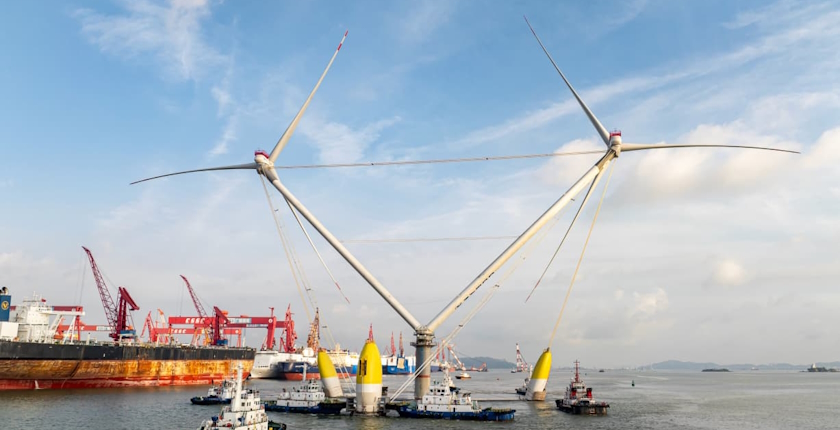
Mingyang presents ultralarge floating twin wind turbine concept

Within its OceanX platform for dual floating wind turbines, Ming Yang Smart Energy is designing a machine for 50 MW. It would be almost two times more than the currently strongest wind turbine.

Manufacturers in China keep pushing the limits in renewable energy technology. Dongfang Electric installed the world’s largest wind turbine for testing just two months ago, and Ming Yang Smart Energy already revealed that it is developing a floating machine that would be almost two times stronger. The company, also known as Mingyang, presented the concept for a 50 MW unit, though it is actually a double turbine.

It is designing it within its OceanX platform for V-shaped floaters. The foundation for the dual rotor will be engineered for waters deeper than 40 meters, according to Mingyang.

Twin floating turbines could turn out to be the new frontier in renewable energy technology

The company said it would provide typhoon resistance, for up to 260 kilometers per hour, and open an entirely new solution for tapping deep sea wind potential. The ultralarge twin turbine is envisaged with 290-meter rotors.

Targeted cost is below USD 1,300 per kW, or almost five time less than the European average. It compares to between USD 3,000 per kW and USD 4,300 per kW in China. OceanX is currently available at 16.6 MW at most.

Mingyang recently said it would build a manufacturing facility in Scotland for floating technology. It valued the project at GBP 1.5 billion.

The largest floating wind power turbine so far has 20 MW. It was manufactured by China Railway Rolling Stock Corp. (CRRC).

by in News

EU allows Romania to delay shutdown of coal plants until end-2029

Amid severe delays in projects for gas power plants, the European Commission approved Romania’s request to push back the closure of several coal-fired systems. The country is increasingly risking electricity shortages due to the lack of baseload capacity.

Romania will be able to keep three coal plants in operation until the end of 2029, following the renegotiation with the European Commission of the decarbonization calendar for electricity production, Minister of Energy Bogdan Ivan said. In a social media post, he announced that 900 MW would remain online.

Two other coal plants can operate at least until the end of August next year, Ivan revealed earlier at a press conference, where he first said the closure of 990 MW would be postponed until the end of 2029.

Turceni, Ișalnița gas power plants must be completed by 2029

State-owned Complexul Energetic Oltenia (CE Oltenia) remains fully active until the end of the summer, he added. “We will continue to have active coal-fired units in the city of Craiova, in order to continue to supply heat to the population, electricity, and steam to the Ford company. And those in Govora, which will produce heat for the inhabitants this winter, until the summer, when the municipality’s [Râmnicu Vâlcea] new energy system comes into operation,” the minister stated, as quoted by Profit.ro.

Romania was supposed to take 1.76 GW of coal power capacity offline at the end of this year. Ivan earlier warned of the risk of energy poverty and even blackouts. He explained that the European Commission accepted the 2029 deadline for the commissioning of CCGT (combined-cycle gas turbine) power plants in Turceni and Ișalnița.

Ivan: Romania will have 1.5 GW of coal power available in the winter season

The two new facilities of 1.33 GW would replace the coal plants in the same two towns. Their projects have suffered massive delays. Tender procedures are still ongoing for contracting the works.

Romania will have 1.5 GW of coal power available this winter, the minister claimed. In the amended National Recovery and Resilience Plan (NRRP or PNRR), the Rovinari and Turceni coal plants in Gorj county and one in the Jiu Valley in Hunedoara remain, together with the units in Craiova and Râmnicu Vâlcea.

Deal with EU to halve estimated nominal gap in winter

In a document from the beginning of October, National Energy Dispatcher (DEN), a unit of transmission system operator Transelectrica, said it counted on 850 MW from lignite for the upcoming winter. The season lasts from November through March. It would be one unit in Turceni, of 250 MW, with another one in technical reserve, and two units of 600 MW in total in Rovinari, having a third one as backup.

The electricity production deficit in the peak evening hours would range from 1.12 GW in the moderate scenario, to a stunning 3.8 GW.

The minimum required reserve is 1,000 MW, but only 520 MW would be available, so the expected gap was actually 1.6 MW – or 4.3 GW in the pessimistic version! The report puts transmission capacity at 4.5 GW for exports and 4.2 GW for imports.

Notably, Turceni, a small town in southwestern Romania dependent on the local coal power plant, is kickstarting a EUR 380 million project. The municipal authority is turning to agrivoltaics, energy storage and green hydrogen to replace it.