by in News

China-based Envision opens world’s largest green hydrogen, ammonia plant

Green technology developer Envision Energy has commissioned the world’s largest and most advanced green hydrogen and ammonia plant. The Shanghai-based company said the production facility, developed in its hydrogen park in Chifeng, China, is also the first in the world delivering green ammonia at industrial scale and the first of its kind to be fully AI-enabled.

The plant can deliver 320,000 tons of green ammonia annually, with exports set to begin in the fourth quarter of this year, Envision said, adding that the facility represents a major leap forward in industrial decarbonization. By 2028, the output is projected to rise to 1.5 million tons a year.

Green ammonia output is expected to rise to 1.5 million tons a year by 2028

The project, powered by Envision’s proprietary off-grid renewable energy system, applies innovative energy storage and load flexibility. Surplus green power is stored in the form of liquid nitrogen, and electrolyzers intelligently respond to renewable power swings, dynamically optimizing energy absorption and ammonia production.

By leveraging green ammonia as a stable transportation and storage medium, Envision has unlocked a practical path to scaling hydrogen across heavy industries, reads the press release.

Zhang Lei, Envision’s founder and CEO, noted that scalable, green alternatives are now real and operational, adding that the world cannot reach net zero without green hydrogen.

The first offtake deal is accelerating green ammonia adoption in fertilizer production, chemicals, and shipping

Envision’s project has already concluded a long-term offtake agreement with Marubeni Corporation, one of Japan’s largest trading houses, which will accelerate green ammonia adoption in sectors including fertilizers, chemicals, and shipping.

The company announced that its Chifeng Hydrogen Net Zero Industrial Park is officially the world’s first green ammonia facility to receive the ISCC PLUS certification for green ammonia with a verified greenhouse gas footprint. Envision also noted that its plant has a replicable design that can be quickly deployed globally.


by in News

Impact Report 2024: GGF grows direct lending, committed to energy transition, energy security

In its Impact Report 2024, the Green for Growth Fund outlined how it powers the green transition across Southeast Europe, the Caucasus and beyond – from repurposing coal sites and decarbonizing industries to strengthening energy security and building climate resilience. It ended last year with EUR 1.09 billion in assets under management and an outstanding investment portfolio of EUR 1.03 billion.

Luxembourg-based GGF has become one of the largest green blended-finance funds. It marked its 15th anniversary in 2024 by passing the EUR 1 billion mark in its portfolio.

“To date, we have delivered over EUR 2 billion in green finance through 70+ active financial institutions, companies, and infrastructure projects. This is impact on a systematic level and reflects the dedication of our partners, teams, and investors. We delivered many landmark projects as we continue to grow our direct lending,” the fund said in its 2024 Impact Report: Breaking the billion for lasting green impact.

GGF highlighted its role in transforming legacy energy systems into clean energy sites in North Macedonia. “We are also investing in corporate decarbonization across resource-intensive sectors in Turkey, including the country’s second-largest retail chain. Working with our financial institution partners, Ukraine’s energy security – and the security of the wider region – remains our focus,” the update reads.

Driving the energy transition and strengthening energy security is an urgent task, the fund said and stressed that its commitment remains strong. It ended 2024 with EUR 1.09 billion in assets under management and an outstanding investment portfolio of EUR 1.03 billion.

Energy-intensive sectors in region can decarbonize

The cumulative volume invested in partner lending institutions has reached EUR 2 billion. GGF is active in 18 countries.

“Passing the EUR 1 billion mark brings greater responsibility. We must continue to show the world that energy-intensive sectors in the region can decarbonize and renewables can lead to energy stability and security,” Chairperson of the Board of Directors Simon Gupta stated.

Headline figures include 1.4 million tons of carbon dioxide emission savings per year, which is the equivalent of taking 949,000 cars off the road. GGF supported 1.76 GW of renewable energy capacity through 2024, which is a whopping 36.4% more than one year before. Its activity resulted in 2.16 million cubic meters of water saved or treated per annum, which translates to 865 swimming pools.

GGF strategically manages impact through supporting measures that mitigate climate change and promote sustainable economic growth in Southeast Europe including Turkey, the European Eastern Neighborhood Region, and the Middle East and North Africa.

From coal pit to solar plant

Recognizing the need for energy independence, the Western Balkans are prioritizing projects that support the green energy transition, GGF pointed out.

“But financing is essential to help countries shift to domestic and clean renewable power. We arranged EUR 25.7 million in project financing for a 50 MW solar power generation project on the site of the former Oslomej coal mine in Kičevo, North Macedonia,” it added.

GGF arranged a EUR 25.7 million package for a PV plant on former coal mining land in the REK Oslomej complex in North Macedonia

The region’s reliance on legacy coal-fired power plants has resulted in outages, shortfalls, closures and volatile energy costs, GGF warned. “Governments recognize this and are increasingly prioritizing sustainable power projects aimed at reducing fossil fuel imports, lowering costs and stabilizing energy supply. To fulfill this ambitious agenda, they need support,” the fund stressed.

Oslomej is GGF’s second project finance transaction in North Macedonia, following its investment as a minority shareholder in the 36 MW Bogoslovec wind farm in 2021.

“Our investment in the Oslomej solar project underscores our commitment to North Macedonia’s green energy transition. By reducing reliance on fossil fuels and enhancing energy security, this project aligns with our mission to mitigate climate change and promote sustainable energy solutions,” said Fund Director for GGF at Finance in Motion Borislav Kostadinov.

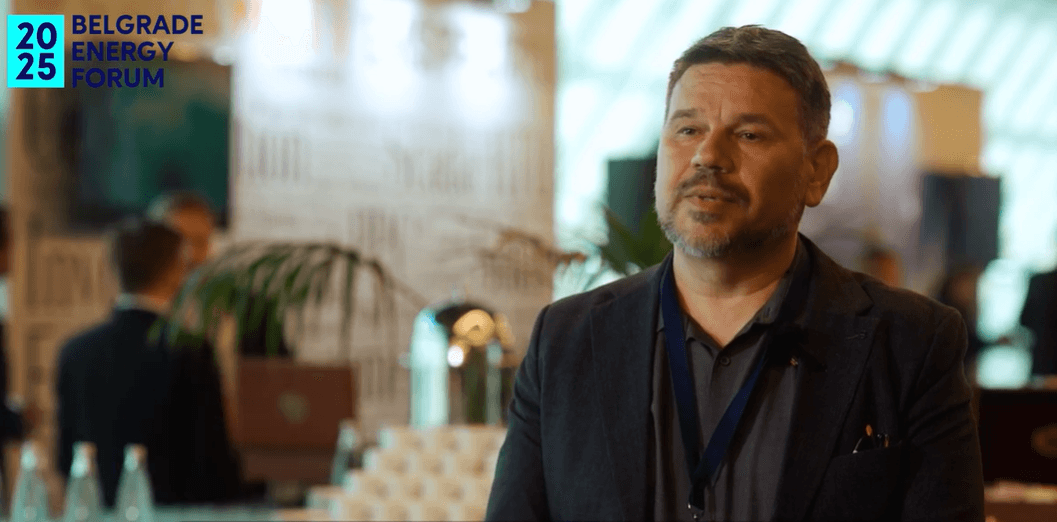
Of note, he was one of the keynote speakers at this year’s edition of Belgrade Energy Forum (BEF 2025), organized by Balkan Green Energy News. Finance in Motion is GGF’s advisor.

Future-proofing Turkish businesses

The fund provided USD 26 million to Sanko Tekstil, one of the largest yarn producers in Turkey. It financed the full cost of a 20 MW rooftop photovoltaic system and partially covered the construction of a fiber recycling facility in Gaziantep.

Meanwhile, a USD 18 million investment into A101, the country’s second-largest retail chain, is decarbonizing store operations across 81 cities via a large-scale solar installation. It supported a 30 MW solar power project, expected to meet 10% of the company’s electricity needs.

Embedding sustainability

GGF complements its financing with advisory and capacity-building services, and risk-management support. It includes environmental and social due diligence, as well as monitoring, to keep projects aligned with international best practices.

The advisory and capacity-building activities in 2024 focused on embedding sustainability and advancing green finance across partner institutions.

A key highlight was the completion of four Deep Greening Mainstreaming projects, which supported financial institutions in developing strategies in the environmental, social, and governance (ESG) sector, green products, and internal sustainability structures.

by in News

GGF grows direct lending, committed to energy transition, energy security

In its Impact Report 2024, Green for Growth Fund outlined how it powers the green transition across Southeast Europe, the Caucasus and beyond – from repurposing coal sites and decarbonizing industries to strengthening energy security and building climate resilience. It ended last year with EUR 1.09 billion in assets under management and an outstanding investment portfolio of EUR 1.03 billion.

Luxembourg-based GGF has become one of the largest green blended-finance funds. It marked its 15th anniversary in 2024 by passing the EUR 1 billion mark in its portfolio.

“To date, we have delivered over EUR 2 billion in green finance through 70+ active financial institutions, companies, and infrastructure projects. This is impact on a systematic level and reflects the dedication of our partners, teams, and investors. We delivered many landmark projects as we continue to grow our direct lending,” the fund said in its 2024 Impact Report: Breaking the billion for lasting green impact.

GGF highlighted its role in transforming legacy energy systems into clean energy sites in North Macedonia. “We are also investing in corporate decarbonization across resource-intensive sectors in Turkey, including the country’s second-largest retail chain. Working with our financial institution partners, Ukraine’s energy security – and the security of the wider region – remains our focus,” the update reads.

Driving the energy transition and strengthening energy security is an urgent task, the fund said and stressed that its commitment remains strong. It ended 2024 with EUR 1.09 billion in assets under management and an outstanding investment portfolio of EUR 1.03 billion.

Energy-intensive sectors in region can decarbonize

The cumulative volume invested in partner lending institutions has reached EUR 2 billion. GGF is active in 18 countries.

“Passing the EUR 1 billion mark brings greater responsibility. We must continue to show the world that energy-intensive sectors in the region can decarbonize and renewables can lead to energy stability and security,” Chairperson of the Board of Directors Simon Gupta stated.

Headline figures include 1.4 million tons of carbon dioxide emission savings per year, which is the equivalent of taking 949,000 cars off the road. GGF supported 1.76 GW of renewable energy capacity through 2024, which is a whopping 36.4% more than one year before. Its activity resulted in 2.16 million cubic meters of water saved or treated per annum, which translates to 865 swimming pools.

GGF strategically manages impact through supporting measures that mitigate climate change and promote sustainable economic growth in Southeast Europe including Turkey, the European Eastern Neighborhood Region, and the Middle East and North Africa.

From coal pit to solar plant

Recognizing the need for energy independence, the Western Balkans are prioritizing projects that support the green energy transition, GGF pointed out.

“But financing is essential to help countries shift to domestic and clean renewable power. We arranged EUR 25.7 million in project financing for a 50 MW solar power generation project on the site of the former Oslomej coal mine in Kičevo, North Macedonia,” it added.

GGF arranged a EUR 25.7 million package for a PV plant on former coal mining land in the REK Oslomej complex in North Macedonia

The region’s reliance on legacy coal-fired power plants has resulted in outages, shortfalls, closures and volatile energy costs, GGF warned. “Governments recognize this and are increasingly prioritizing sustainable power projects aimed at reducing fossil fuel imports, lowering costs and stabilizing energy supply. To fulfill this ambitious agenda, they need support,” the fund stressed.

Oslomej is GGF’s second project finance transaction in North Macedonia, following its investment as a minority shareholder in the 36 MW Bogoslovec wind farm in 2021.

“Our investment in the Oslomej solar project underscores our commitment to North Macedonia’s green energy transition. By reducing reliance on fossil fuels and enhancing energy security, this project aligns with our mission to mitigate climate change and promote sustainable energy solutions,” said Fund Director for GGF at Finance in Motion Borislav Kostadinov.

Of note, he was one of the keynote speakers at this year’s edition of Belgrade Energy Forum (BEF 2025), organized by Balkan Green Energy News. Finance in Motion is GGF’s advisor.

Future-proofing Turkish businesses

The fund provided USD 26 million to Sanko Tekstil, one of the largest yarn producers in Turkey. It financed the full cost of a 20 MW rooftop photovoltaic system and partially covered the construction of a fiber recycling facility in Gaziantep.

Meanwhile, a USD 18 million investment into A101, the country’s second-largest retail chain, is decarbonizing store operations across 81 cities via a large-scale solar installation. It supported a 30 MW solar power project, expected to meet 10% of the company’s electricity needs.

Embedding sustainability

GGF complements its financing with advisory and capacity-building services, and risk-management support. It includes environmental and social due diligence, as well as monitoring, to keep projects aligned with international best practices.

The advisory and capacity-building activities in 2024 focused on embedding sustainability and advancing green finance across partner institutions.

A key highlight was the completion of four Deep Greening Mainstreaming projects, which supported financial institutions in developing strategies in the environmental, social, and governance (ESG) sector, green products, and internal sustainability structures.

by in News

Solar beats nuclear in June, becoming EU’s biggest electricity source for first time

Solar became the EU’s largest source of electricity for the first time in June 2025. National records for both photovoltaics and wind rolled in in May and June, pushing coal to an all-time low.

Solar was the largest source of electricity in the European Union for the first time last month, with multiple countries producing record amounts of solar power, Ember found. Wind power achieved the highest ever generation for the months of May and June, the think tank said.

Solar power generated 22.1% of EU electricity (45.4 TWh) in June, more than any other power source. It was a year-over-year increase of 22%. In second place was nuclear, with 21.8% (44.7 TWh), followed by wind, with 15.8% (32.4 TWh).

The big opportunity now comes from adding battery storage and flexibility to extend the use of renewable power into mornings and evenings, where fossil fuels still set high power prices, according to Ember’s Senior Energy analyst Chris Rosslowe.

At least thirteen EU countries set monthly solar records

At least thirteen countries recorded their highest-ever month of solar generation, amid an ongoing surge in photovoltaic installations. Among them were Bulgaria, Croatia, Greece, Slovenia and Romania, all the EU countries in the region that Balkan Green Energy News is focused on except Cyprus, for which there was no data for June.

Wind power reached an all-time high shares of 16.6% (33.7 TWh) and 15.8% (32.4 TWh) in May and June, respectively

Strong photovoltaic output helped the power system to handle higher levels of demand resulting from heatwaves that gripped the continent towards the end of the month, according to the report.

Wind farms generated 16.6% (33.7 TWh) and 15.8% (32.4 TWh) of EU electricity in May and June, respectively. It was an all-time high for both months. Notably, at the start of the year, wind conditions were relatively poor. They improved, and they were the main driver, though capacity has been continuously growing over the past year. Several large offshore wind farms were commissioned.

Coal falls to record low

As a result of high renewables generation in June, coal had the lowest-ever share of EU electricity. Total fossil generation was also low, but it grew in the entire first half of the year on an annual basis.

Coal generated just 6.1% (12.6 TWh) of EU electricity in June, down from the 8.8% registered in the same month of last year.

The two countries that account for the vast majority of EU coal power (79% in June) both saw record lows in June. Namely, Germany generated just 12.4% (4.8 TWh) of its power from coal, and Poland 42.9% (5.1 TWh). Four other countries recorded their lowest-ever month of coal generation in June: Czechia (17.9%), Bulgaria (16.7%), Denmark (3.3%) and Spain (0.6%), which is approaching its coal phaseout.

Fossil fuels generated 23.6% (48.5 TWh) of EU electricity in June, just above the record low of 22.9% in May 2024. Nevertheless, fossil generation in the first half of 2025 was 13% higher (by 45.7 TWh) than in the first half of 2024, mainly due to a jump in gas generation by 19% or 35.5 TWh. Lower hydropower (due to drought) and wind generation than last year, and increasing demand marked the period.

Electricity demand continued on an upward trajectory. In the first half of 2025, the EU consumed 1.31 PWh of electricity or 2.2% more than in the same period of last year.

by in News

Open call for green hydrogen high-efficiency CHP pilot plant in northern Greece

Greece’s Alternate Minister of Economy and Finance Nikos Papathanasis has launched an open call for the installation and operation of a high-efficiency combined heat and power (CHP) unit using fuel cells powered by green hydrogen. The site for the pilot project is in the Western Macedonia coal region in the country’s north. It is part of the government’s Just Development Transition Programme 2021–2027.

Western Macedonia is Greece’s main coal region, and the other one is Megalopolis in the Peloponnese. The country is transforming the economies of the two areas toward clean and smart technologies, largely with funding from the European Union and aiming at a just transition.

The open call signed by Alternate Minister Nikos Papathanasis for the installation and operation of a pilot unit for high-efficiency combined heat and power (CHP) facility, running on fuel cells, has a total budget of EUR 7.87 million. The facility would utilize green hydrogen produced in electrolyzers powered by renewable electricity.

The energy would be used to provide 24/7 power and heat to the Bodosakeio General Hospital of Ptolemaida, the Chemical Process & Energy Resources Institute (CPERI) in the same city and the Daycare Center for People with Disabilities in the municipality of Eordaia.

The deadline for proposal submission is October 31

The deadline for the submission of proposals is October 31, with immediate evaluation of applications.

The project is for the construction of a pilot CHP unit and a photovoltaic park on municipal land in Eordaia.

According to the announcement from the Ministry of Economy and Finance, the flagship initiative aims to showcase and implement cutting-edge energy and environmental technologies, contributing to the region’s energy transition and decarbonization efforts.

In April, Public Power Corp. (PPC) announced a EUR 5.8 billion investment plan to support the transition of Western Macedonia. The endeavor consists of the decommissioning of old assets and the rollout of new energy technologies.

According to the decarbonization timeframe, Ptolemaida 5 will be the last coal plant in the country, continuing to operate until the end of 2026. It is set to be converted to a gas power plant with a capacity of 350 MW. PPC is also open to upgrading it to 500 MW or even 1 GW.

The plan also includes: 2.1 GW of solar PV capacity, with one 550 MW project nearing completion in a former lignite mine, 860 MW of energy storage, including pumped hydro and battery systems, and a 300 MW data center, planned to be scaled up to 1 GW.

by in News

EU’s Modernisation Fund disburses EUR 3.66 billion for clean energy projects in nine countries

Energy modernization projects in nine member states of the European Union will receive a total of EUR 3.66 billion from the Modernisation Fund, in the largest disbursement to date from the facility financed by carbon pricing revenues, according to a press release from the European Commission. The selected projects focus on renewable energy, grid upgrades, energy storage, and energy efficiency.

The largest beneficiary of the latest disbursement is Poland, which will receive EUR 1.33 billion for its projects, followed by the Czech Republic, with EUR 1.05 billion, and Romania, with EUR 712.3 million. Hungary will get EUR 181.3 million, Croatia EUR 170 million, and Greece EUR 113.6 million. The rest will go to Latvia (EUR 40 million), Lithuania (EUR 37 million), and Slovenia (EUR 19.7 million).

Croatia will finance renewable heat production and zero-emission transportation, and Slovenia will upgrade power grid to integrate renewables

In Croatia, EUR 80 million will be used for the production and use of heat from renewable energy sources and energy efficiency improvement in heating and cooling systems. The rest will go to investments in zero-emission transportation. In Slovenia, the funding will facilitate renewables integration through the modernization and development of the electricity transmission and distribution network.

Greece, which became a Modernisation Fund beneficiary in January 2024, intends to replace urban diesel buses with new electric buses, improve energy efficiency in municipal swimming pools, and switch the heating and cooling systems in its greenhouse infrastructure to renewables.

In Romania, the funding will help improve the energy efficiency of facilities covered by the European Union’s Emissions Trading System (EU ETS), support the contract-for-difference (CfD) scheme for onshore wind and solar, and finance the installation of solar and wind power plants for self-consumption in the agricultural and food sectors and public institutions. It is also intended for investments in new solar, wind, and hydropower capacities and to support the modernization and rehabilitation of the district heating network.

In the Czech Republic and Lihtuania, the funding will support energy storage projects

Other example projects include investments in storage capacity for renewable electricity in the Czech Republic, investments in large-scale energy storage capacities in Lithuania, and a clean air program in Poland that focuses on energy efficiency improvements and heat source replacements in single-family houses, according to the press release.

The investments will reduce greenhouse gas emissions in the energy, industry, and transportation sectors, improve energy efficiency, and help the beneficiary states meet climate and energy targets, the commission said.

The projects will also help improve people’s everyday lives, by reducing bills, improving public services, creating jobs, and making the energy transition real, fair, and beneficial for all, according to Teresa Ribera, the European Commission’s Executive Vice-President for Clean, Just and Competitive Transition.

With this latest round of funding, the total disbursements from the Modernisation Fund since January 2021 have climbed to EUR 19.1 billion. The fund is financed by revenues from the auctioning of emission allowances under the EU ETS.

by in News

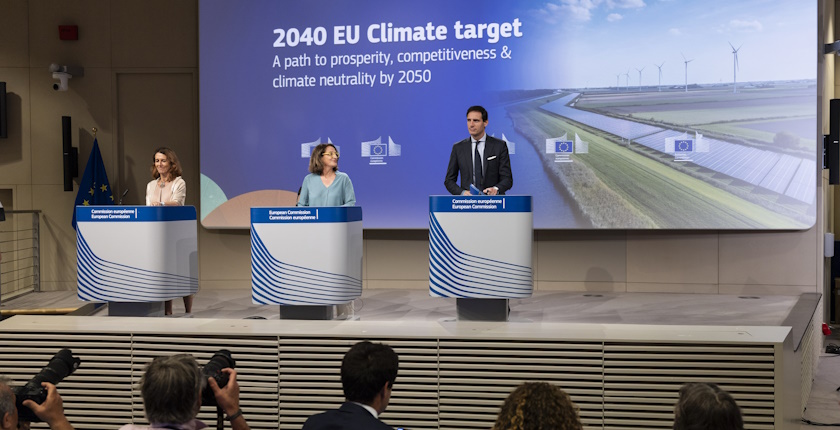
EU outlines measures for 90% emissions cut by 2040

The European Commission proposed an amendment to the European Climate Law, setting a 2040 target of a 90% reduction in net greenhouse gas emissions from the 1990 level. The outlined measures would give certainty to investors, promote innovation and business competitiveness and increase energy security, according to the European Union’s executive body.

The EU is closing in on its 2030 goal to slash annual net emissions by 55% from the 1990 baseline, according to the European Commission’s recent report on national energy and climate plans (NECPs). It is part of the efforts to reach climate neutrality by mid-century. Today the EU’s top executive body formally outlined the proposal for the next intermediate target – 90% by 2040.

It is in the form of an amendment to the European Climate Law, which entered into force in July 2021. In the meantime, the 27-member bloc adopted a 2030 legislative package known as Fit for 55.

The European Parliament and the Council of the EU now need to discuss and adopt the amendment.

Nature-based and industrial carbon removals will play an increasingly important role in reaching the targets, the European Commission pointed out. It implies domestic permanent carbon removals within the Emissions Trading System (EU ETS) to compensate for residual emissions from hard-to-abate sectors. Such systems need to scale up significantly by 2040, the commissioners said.

More pragmatic, flexible trajectory toward 90% reduction in emissions by 2040

The proposal sets out a more pragmatic and flexible way to reach the milestone, the European Commission claimed.

“Aligned with the EU Competitiveness Compass, Clean Industrial Deal and Affordable Energy Action Plan, the proposed 2040 climate target takes fully into account the current economic, security and geopolitical landscape and gives investors and businesses the predictability and stability they need in the EU’s clean energy transition. By staying the course on decarbonisation, the EU will drive investment in innovation, create more jobs, growth, increase our resilience to impacts of climate change and become more energy independent,” the statement adds.

Von der Leyen said industry and investors require a predictable direction on the path to the climate goal

“As European citizens increasingly feel the impact of climate change, they expect Europe to act. Industry and investors look to us to set a predictable direction of travel,” said European Commission President Ursula von der Leyen.

Today’s proposal is based on an impact assessment and advice from the Intergovernmental Panel on Climate Change (IPCC) and the European Scientific Advisory Board on Climate Change. The adoption follows engagement with member states, the European Parliament, stakeholders, civil society and citizens since the commission’s recommendation in February 2024.

EU eyeing international carbon credits

The commission vowed to consider a limited role for high-quality international carbon credits, starting in 2036, and greater flexibility across sectors to help achieve targets in a cost-effective and socially fair way. For instance, a member state would have the possibility to compensate for a struggling land use sector with an overachievement in reducing emissions from waste and transportation.

Emphasis is also on the competitiveness of the European industry and a level playing field with international partners. Among the guidelines is technological neutrality.

Fiscal incentives are under consideration for clean tech and industrial decarbonization projects.

The commission highlighted its Clean Industrial Deal State Aid Framework, adopted last week, and the simplification of the Carbon Border Adjustment Mechanism (CBAM). It also issued a recommendation on tax incentives for investments in clean technologies and industrial decarbonization.

Measures on affordable energy to scale up manufacturing of grid components and support power purchase agreements, the pilot for the upcoming Industrial Decarbonisation Bank, the forthcoming Chemicals Industry Action Plan and the sectorial dialogues with stakeholders are among the actions that will help deliver the Clean Industrial Deal, the commissioners explained. Their draft seven-year budget, officially called Multiannual Financial Framework, is due to be unveiled next month.

WindEurope urges for annual targets for renewables

Reacting to the announcement, WindEurope said EU member states would need to translate the 90% ambition into clear annual goals for the deployment of wind and other renewables for the period 2031-40.

“Otherwise the 2040 target will remain academic,” the organization underscored.

by in News

Montenegro publishes NECP for public consultation – sole coal plant planned for shutdown in 2041

State institutions, companies, organizations, and individuals have until August 6 to deliver their suggestions and comments about the draft National Energy and Climate Plan of Montenegro. It sets the provisional date for taking the Pljevlja coal power plant, the only one in the country, at 2041, but the authors pointed out that it primarily depends on a just transition and the security of electricity supply.

Montenegro’s long-awaited draft National Energy and Climate Plan (NECP) sets out the key 2030 targets for greenhouse gas emission cuts, share of renewable energy sources in gross final energy consumption, and energy efficiency.

The document, also known for its acronym INECP, in which the first letter stands for integrated, was published for the public consultation phase. It lasts until August 6. The Ministry of Energy and Mining called on the interested public – local authorities and other state institutions, the expert and scientific communities, associations, organizations, companies and individuals, to send their comments and suggestions.

“The energy and climate policy isn’t just a task for the government – it is a joint responsibility. That is why I am inviting all stakeholders, and especially nongovernmental organizations, to use this opportunity and contribute to the creation of a realistic, ambitious and just plan,” Minister Admir Šahmanović stated.

Renewables target can be surpassed

National goals match the ones adopted within the Energy Community. The targeted primary energy consumption in 2030 amounts to 0.92 million tons of oil equivalent. Under the business-as-usual scenario (with existing measures – WEM), the benchmark is expected to land at 1.04 million. With additional measures (WEM), the trajectory moves closer to the objective, projected at 0.97 million tons of oil equivalent.

The goal for final energy consumption is 0.73 million tons of oil equivalent. Existing measures result in 0.82 million, and added ones in 0.77 million tons of oil equivalent.

The share of renewable sources in transportation could reach 24.4% instead of only 7.2%

Montenegro fares better with its expected share of renewables in gross final energy consumption, against the 50% target. In the WEM scenario, it reaches 42.5%, and the WAM projection is 53.3%.

Without additional measures, renewable sources have a 66.3% share in electricity production. The document’s authors calculated that it could grow to 79.4%. As for transportation, the range is from 7.2% to 24.4%. In heating and cooling, the possible progress from the results of current measures is only 0.4 percentage points, reaching 49.2%.

The targeted reduction in emissions is 55%, the same as in the European Union. It translates to 2.42 million tons of carbon dioxide equivalent in the final year of the current decade. With existing measures, the curve touches 3.06 million in 2030, and with added ones the result is 2.4 million tons of CO2 equivalent.

Retirement of Pljevlja coal plant depends on socio-economic situation in northern region

Oil derivatives, which are all imported, participated in the 2022 final energy consumption with 47.3%, followed by electricity, 33.3%. Wood fuel is the next item, with 18.7%. The share of coal is only 0.7%, because almost the entire output goes to thermal power plant Pljevlja, the only such facility in Montenegro.

The overall electricity production capacity at the end of 2023 was 1.07 GW. The Pljevlja coal plant, which is currently under reconstruction, has 225 MW.

According to the projection, the Pljevlja coal plant is in cold reserve after 2040

The provisional date for its shutdown is 2041, but it primarily depends on the success of the just transition process and maintaining the security of electricity supply, the NECP reads. It also shows the Pljevlja coal plant in cold reserve after 2040.

In addition, taking it offline requires supplying end consumers under favorable conditions, while minding the overall socio-economic situation in the country’s northern region, where the coal mines and the power plant are, the authors explained. They noted as well that an energy storage pilot project is under consideration for the site of the Pljevlja facility.

Electricity sector’s self-sufficiency varying due to dependence on hydrological conditions

The country’s two large hydropower plants Piva and Perućica have 342 MW and 307 MW in capacity, respectively.

There are 38 other hydroelectric units in Montenegro, of which the smallest one is 200 kW. The biggest facility, Vrbnica (6.75 MW), is owned by a firm with the same name, registered in the capital Podgorica.

The high share of hydropower plants in electricity production, implying dependence on hydrology, is the main reason of the variability of the level of self-sufficiency of the national energy balance year after year, the NECP says.

There are two wind power plants on the grid: Krnovo (72 MW) and Možura (46 MW), while the third one, called Gvozd, is under construction. The project envisages 54.6 MW in the first phase.

There are only five independent solar power plants. The biggest one, Čevo, has 4.4 MW in nominal capacity and a 3.25 MW connection. Nevertheless, units operated by prosumers reached 75 MW altogether, according to one entry, though the numbers are lower in other parts of the NECP.

by in News

Serbia plans hydrogen transport through gas pipelines

Serbia’s natural gas transmission system operator, Transportgas Srbija, has invited bids for the preparation of a study on the technical feasibility of transporting hydrogen through the gas network. The study should assess the quantities of hydrogen that can be transported, as well as the impact of blending hydrogen with natural gas on the transmission system and key consumers. The goal is to determine the technical, investment, and regulatory measures necessary for integrating hydrogen into Serbia’s gas infrastructure.

Transportgas notes that hydrogen, as an alternative fuel, is becoming increasingly important in the context of decarbonization and energy security. It also recalls that the Energy Community has set goals for defining natural gas quality for all transmission system operators in Southeast Europe, with special emphasis on the introduction and application of hydrogen.

Serbia would transport hydrogen by blending it with natural gas. Transportgas recalled that gas pipelines built in recent years or currently under construction in Europe are capable of transporting 100% pure hydrogen.

Transportgas: New gas pipelines in Europe can transport pure hydrogen

The study should, among other things, determine the maximum percentage of hydrogen that can be blended with natural gas, as well as the impact on equipment and transmission system losses.

The selected consultant will also be required to determine the chemical composition of the hydrogen-natural gas blend, define the blending procedure, and identify the optimal blending points within the transmission system, as well as suitable sites for hydrogen production and storage in Serbia.

The study should also assess how much hydrogen blended with natural gas can be transported through existing gas pipelines, taking into account the varying qualities of natural gas from different supply routes. The construction of the Balkan Stream gas pipeline and the interconnector with Bulgaria near Dimitrovgrad has enabled Serbia to diversify its gas supplies, Transportgas pointed out.

The study should also identify suitable sites for hydrogen production and storage in Serbia

The study must include an assessment of the impact of the chemical composition and quality of the hydrogen-natural gas blend on major gas consumers in Serbia – steelworks Železara Smederevo, asphalt plants, compressed natural gas (CNG) filling stations, oil refinery Rafinerija nafte Pančevo, cogeneration plants TE-TO Pančevo and TE-TO Novi Sad, petrochemical plant HIP-Petrohemija Pančevo, methanol producer MSK Kikinda, and district heating plants in Belgrade and Zrenjanin.

The consultant will be required to recommend investments needed to introduce hydrogen, such as installing gas analyzers, building new gas pipelines, and upgrading existing infrastructure.

The consultant will be expected to recommend necessary regulatory changes

The consultant’s obligation will also be to propose regulatory changes to enable the introduction of hydrogen into the gas infrastructure, the invitation states, noting that the regulations in question include the Law on Energy and the government decree on terms of natural gas delivery and supply.

The deadline to submit bids is July 23, and the selected consultant will have 180 days to complete the work.

by in News

Hitachi Energy: Game-changing solutions for a sustainable energy future

Hitachi Energy, a global leader in energy technology, develops system solutions and offers products and services that actively contribute to sustainable energy and a better future, Igor Anđelković, the company’s Country Marketing and Sales Leader in Serbia, said at Belgrade Energy Forum 2025. Game-changing technologies for high-voltage grids and transportation, along with solutions for renewables integration, support decarbonization efforts and deliver added value to both clients and local communities.

Multinational company Hitachi Energy, a silver sponsor of the BEF 2025 conference, is present in the Southeast Europe region through its Balkan Cluster, which covers seven markets – Albania, Bosnia and Herzegovina, Montenegro, Croatia, Kosovo*, North Macedonia, and Serbia.

[wpcc-iframe title=”Igor Andjelkovic, Country Lead Serbia, Hitachi Energy at the Belgrade Energy Forum 2025″ width=”500″ height=”281″ src=”https://www.youtube.com/embed/KVbO8HI5oLk?feature=oembed” frameborder=”0″ allow=”accelerometer; autoplay; clipboard-write; encrypted-media; gyroscope; picture-in-picture; web-share” referrerpolicy=”strict-origin-when-cross-origin” allowfullscreen=””]

Inspiring the next era of sustainable energy

Since 2010, Hitachi Energy has implemented eco-efficient solutions for high-voltage grids of up to 550kV. The company’s innovative and eco-efficient EconiQ® high-voltage portfolio applies revolutionary technology free of sulfur hexafluoride (SF6) and proven to significantly reduce carbon footprint throughout the life cycle.

The high-voltage EconiQ® roadmap demonstrates the scalability of this technology, which allows customers and industry to quickly transition to eco-efficient solutions.

Photo (Hitachi Energy): Hitachi Energy has implemented eco-efficient solutions for high-voltage grids of up to 550kV

Now more than ever, pioneering technologies like EconiQ are needed to advance a sustainable energy future, says Anđelkovic.

Efficient renewables integration

In the renewable energy segment, Hitachi Energy offers a range of substation solutions that help to efficiently integrate renewable energy into the transmission grid and distribution network. This includes grid connection solutions for all types of renewables power plants.

Hitachi solutions are used in a large number of wind projects in Southeast Europe

The major projects in Southeast Europe, completed or in the implementation phase, which use Hitachi Energy’s technology are wind farms Pupin and Crni Vrh in Serbia, Gvozd in Montenegro, Komanje Brdo and Ivan Sedlo in Bosnia and Herzegovina, and Pometeno Brdo and Korlat in Croatia.

Photo (Hitachi Energy): Hitachi Energy offers a range of substation solutions that help to efficiently integrate renewable energy into the transmission grid and distribution network

Driving transportation and energy towards carbon neutrality

Hitachi Energy is also committed to decarbonizing the transportation sector. Its revolutionary ‘grid-to-plug’ electric vehicle charging system, called Grid-eMotion® Fleet, is a smart mobility solution that enables operators to efficiently scale up their operations and is expected to contribute to sustainable society for millions living in urban areas.

Grid-eMotion® Fleet marks a game-changing shift from a charger-product based approach to a charging-system based approach, which helps to accelerate the future of smart mobility.

Hitachi Energy has been pioneering EV charging solutions since 2013, when it first introduced innovative flash-charging eBus solutions in Geneva and Nantes.

Advanced technologies for smart airports

With its innovative solutions, Hitachi Energy has made significant advancements in air traffic as well, with the development of smart airports being one of its key innovations. This includes advanced technologies such as artificial intelligence (AI), video analytics, and 3D LiDAR to improve the passenger experience and improve airport operational efficiency.

Hitachi Energy also helps airport to decarbonize and become more sustainable with its electrification and digitization solutions.

* This designation is without prejudice to positions onstatus and is in line with UNSCR 1244/99 and the ICJ Opinion on the Kosovo declaration of independence.