by in News

Belgium’s former Ministry of Energy Tinne Van der Straeten to become CEO of WindEurope next month

WindEurope’s new Chief Executive Officer Tinne Van der Straeten, member of the Chamber of Representatives of the Federal Parliament of Belgium and the country’s former minister of energy, will assume office on February 2. She is replacing Giles Dickson. The EU added 13 GW of wind capacity in 2025, less than half of what it requires.

WindEurope appointed Tinne Van der Straeten as its new CEO, effective on February 2. The organization pointed out that Belgium’s former minister of energy, from 2020 to 2025, is taking the helm at a critical time for Europe’s energy security, industrial competitiveness and climate commitments.

Tinne Van der Straeten oversaw Belgium’s wind energy expansion, including a broad consensus on Belgium’s response to the energy crisis in 2022, the announcement adds. She chaired the North Seas Energy Cooperation in 2020 and at the start of 2025 and the European Energy Council in 2024, and vice-chaired the ministerial meeting of the International Energy Agency (IEA) in 2022.

Most recently, the former minister served as a member of the Chamber of Representatives of the Federal Parliament of Belgium. She is a member of the Flemish Green Party – Groen.

Wind energy is central to Europe’s energy independence

Van der Straeten said she would take on her new responsibility with determination at a defining moment for Europe.

“Wind energy is central to Europe’s energy independence, industrial competitiveness and climate ambitions. Wind is a home-grown and scalable technology. It delivers affordable power, strengthens energy independence and sustains a competitive industrial base with high-quality jobs across Europe,” the incoming chief said.

Former CEO Giles Dickson served ten years

WindEurope’s Chairman Henrik Andersen praised Tinne Van der Straeten for passionately ensuring wind was kept high on the political agenda in her home country of Belgium and across the European Union.

“She has collaborated across industry and government to shape energy policy and build positive long-term investment frameworks that enable sustainable wind deployment. I look forward to working with Tinne as she leads WindEurope forward and supports Europe’s journey to a more competitive, homegrown energy system together with its members,” he stated.

The WindEurope Board thanked former CEO Giles Dickson for his 10 years of leadership and contribution to Europe’s wind industry.

Affordability, competitiveness, security

Van der Straeten will focus on ensuring Europe gets the most from wind to deliver affordability, industrial competitiveness and energy security, the organization said.

Faced with mounting geopolitical challenges, the continent must shake its dependence on imported fossil fuels, WindEurope stressed.

“Wind is uniquely placed to deliver that. A renewables-based energy system, with wind at its core, will save Europe up to EUR 1.6 trillion, even when counting the grid and backup costs. To reap these benefits, Europe must deliver on the Clean Industrial Deal, accelerate the buildout of homegrown and competitive renewables and ramp up the electrification of its economy,” the update reads.

Today wind energy generates 20% of all electricity consumed in Europe. With the right policies, the level will rise to 34% by 2030 and more than 50% by 2050, WindEurope estimated.

The EU installed 13 GW of new capacity in 2025. It is less than half of what Europe needs to deliver its 2030 energy security and climate targets.

“The wind sector is at a turning point. The industry is ready to accelerate and to provide more than 600,000 jobs by 2030. But it is held back by permitting issues and infrastructure delays,” said Tinne Van der Straeten.

by in News

Albania gives green light to CWP Europe for 600 MW wind park

Prime Minister of Albania Edi Rama and Deputy Prime Minister and Minister of Infrastructure and Energy Belinda Balluku promoted CWP Europe’s wind power project Tropoja of 600 MW. After receiving the ministry’s preliminary approval at the event, the company’s CEO Dimitar Enchev highlighted the importance of local electricity production for a modern economy, including AI and data centers, and for energy independence. Albania still doesn’t host a single operational wind turbine.

CWP Europe will hopefully connect its future wind park Tropoja to the grid within 12 months, excluding the period of harsh winter, according to Albania’s Prime Minister Edi Rama. Speaking at the project’s presentation, he said the investment is a step toward the country’s ambition of becoming self-reliant in energy production.

“For a long time, we had complete dependence on water and rainfall. At the same time, we inherited a system with so many weaknesses that, when rainfall was lacking, we had to go to international markets and purchase large quantities at inflated prices. Meanwhile, when rainfall came in abundance, we often saw much of this potential value, water, go to waste and not only fail to be converted into energy, but at times also cause extraordinary damage,” Rama stated.

Namely, hydropower plants accounted for almost 100% of domestic electricity production until recently. By the end of the decade, the combined share of wind and solar power will reach 30%, Rama underscored.

Preparing final stages of Tropoja wind power project

CWP Global’s Co-founder and Chief Executive Officer for Europe Dimitar Enchev received a preliminary approval from the Ministry of Infrastructure and Energy at the event. He highlighted the importance of local electricity production for a modern economy and energy independence, especially with the expansion of artificial intelligence and data centers.

“The last time I was here was about three months ago, when we decided and signed a joint cooperation agreement with the EU, and now, after three months, we receive the permission that allows us to engage in preparing the final stages of our project,” he stated, as quoted by CNA.

CWP Europe has more than 7 GW under development in Southeast Europe

CWP Europe has 900 MW in wind power projects under development in Albania, part of a portfolio of more than 6 GW across Southeast Europe plus more than 1 GW in photovoltaics.

The Tropoja area is in the country’s far north. Albania still doesn’t host a single operational wind turbine.

Support from European Commission

CWP Europe signed a joint declaration in October with the European Commission, the Albanian Investment Development Agency and the Montenegrin Investment Agency, in support of the Tropoja project and the Montechevo solar farm with battery storage in Montenegro, respectively.

In September, the company’s subsidiary Eralb Invest submitted its wind power project to the Ministry of Infrastructure and Energy, for 603.9 MW. It is not subject to concession and doesn’t benefit from state support measures.

In 2023, the firm sent a proposal to the Strategic Investment Committee (SIC or KIS) in which the project was for a wind and solar park of 826 MW in total capacity. It is an interministerial panel chaired by Prime Minister Edi Rama.

The entire designated area in Tropoja municipality reportedly spanned 385 hectares, encompassing the territories of the villages Viçidol, Berisha, Luzha and Pac, and the investment was valued at EUR 1.2 billion.

In October 2023, CWP and GE Vernova’s Onshore Wind business agreed to develop a large-scale hybrid wind and solar project in Albania. They estimated the investment at more than EUR 1 billion.

Fântânele-Cogealac-Gradina, the biggest onshore wind park in Southeastern Europe and, until recently, in entire Europe, has 600 MW in capacity. It is located in Romania. CWP developed the project and sold it in 2008.

Balluku: Diversification is strategic necessity

Albania is moving to a modern, balanced energy model, where diversification of sources is no longer a solution, but a strategic necessity, according to Deputy Prime Minister and Minister of Infrastructure and Energy Belinda Balluku.

“The Tropoja wind farm is not just an energy investment. It is a symbol of the transformation that Albania is experiencing, a transformation towards a sustainable, stronger and more innovation-friendly economy. This project proves that the Albanian energy sector is entering a new phase, where private investment and foreign direct investment are becoming engines of growth, thanks to serious partnerships and long-term visions,” she stated.

Wind and solar power projects totaling 1.5 GW are under development in Albania

In recent years, Albania added over 700 MW of photovoltaic capacity, and another 400 MW for self-supply, Balluku revealed. Wind and solar power projects totaling 1.5 GW are under development, she added. Future pumped storage hydropower capacity in the Drin (Drim) cascade and Statkraft’s project in Moglica amount to 1.6 GW, Balluku stressed.

Since 2013, losses in the power distribution network have dropped to 16.9% from more than 45%, while total electricity capacity increased by 1.5 GW, the deputy prime minister added. She said outages have been reduced to an all-time low and that they usually only last a few minutes.

The Special Court Against Corruption and Organized Crime suspended Balluku in late November amid an investigation, but the Constitutional Court soon reinstated her.

by in News

Kelag International strengthens European presence with brand unification

Kelag International has unified its subsidiaries under its single brand. The move is strengthening the group’s European identity, it said. It reflects the group’s ambition to become a key driver of Europe’s green energy transition through long-term, sustainable investments and strong regional partnerships, according to Kelag International.

International entities now operating under the Kelag International brand, including Interenergo, were already part of the group. They have completed their legal and brand transition. The company based in Klagenfurt, Austria, said the alignment of brand identity was designed to enhance visibility, strengthen cooperation and facilitate the transfer of expertise across markets, while ensuring a consistent strategic and operational approach across the group.

Kelag International, which has offices in nine other countries, is active across 14 European markets. The broader platform is covering Southeast Europe, the Mediterranean and the Iberian Peninsula.

“Uniting our international activities under the Kelag International brand is a strategic decision that positions us among the most ambitious players in Europe’s energy transition,” said Managing Director of Kelag International Christian Schwarz.

Local roots remain, strengthened by European network

Long-standing partnerships remain at the core of the company’s approach, the announcement reads. What changes is the scale and connectivity. Local expertise is now supported by a wider European network, shared resources and coordinated strategic development, Kelag International pointed out.

Schwarz: Uniting our international activities under the Kelag International brand is a strategic decision that positions us among the most ambitious players in Europe’s energy transition

It operates 54 renewable energy facilities with a total installed capacity of 280 MW, producing more than 680 GWh of green electricity annually. It is enough to supply nearly 200,000 households. The company has more than 160 employees.

Balanced technology mix for resilient energy future

Kelag International follows a clear guiding principle: the balanced development of all key renewable energy technologies, from solar and wind to hydropower, tailored to the specific requirements of each market, the update adds. In response to the growing share of renewables in Europe’s power system, the group is increasingly focusing on flexibility solutions, system stability and security of supply.

A particular emphasis is placed on the development of energy storage and battery systems, which are essential for grid balancing, price stability and long-term decarbonization, the company said.

Kelag International revealed that its development activity is strongest in Italy, followed by Croatia and the wider Balkan region, where several new renewable energy projects are in advanced stages of development and nearing completion. It aims to reach 818 MW of installed capacity by 2035 and generate 1.69 TWh of renewable electricity per year. The company stressed that it is offering stable, long-term and sustainable energy supply solutions to large electricity consumers.

“Alongside project development and operations, we are also active in the wholesale supply of electricity, including the structuring and management of long-term power purchase agreements (PPAs) for industrial customers and energy markets — supporting the integration of renewable energy into Europe’s energy system,” it added.

by in News

Kelag International strengthens European presence with brand unification

Kelag International has unified its subsidiaries under its single brand. The move is strengthening the group’s European identity, it said. It reflects the group’s ambition to become a key driver of Europe’s green energy transition through long-term, sustainable investments and strong regional partnerships, according to Kelag International.

International entities now operating under the Kelag International brand, including Interenergo, were already part of the group. They have completed their legal and brand transition. The company based in Klagenfurt, Austria, said the alignment of brand identity was designed to enhance visibility, strengthen cooperation and facilitate the transfer of expertise across markets, while ensuring a consistent strategic and operational approach across the group.

Kelag International, which has offices in nine other countries, is active across 14 European markets. The broader platform is covering Southeast Europe, the Mediterranean and the Iberian Peninsula.

“Uniting our international activities under the Kelag International brand is a strategic decision that positions us among the most ambitious players in Europe’s energy transition,” said Managing Director of Kelag International Christian Schwarz.

Local roots remain, strengthened by European network

Long-standing partnerships remain at the core of the company’s approach, the announcement reads. What changes is the scale and connectivity. Local expertise is now supported by a wider European network, shared resources and coordinated strategic development, Kelag International pointed out.

Schwarz: Uniting our international activities under the Kelag International brand is a strategic decision that positions us among the most ambitious players in Europe’s energy transition

It operates 54 renewable energy facilities with a total installed capacity of 280 MW, producing more than 680 GWh of green electricity annually. It is enough to supply nearly 200,000 households. The company has more than 160 employees.

Balanced technology mix for resilient energy future

Kelag International follows a clear guiding principle: the balanced development of all key renewable energy technologies, from solar and wind to hydropower, tailored to the specific requirements of each market, the update adds. In response to the growing share of renewables in Europe’s power system, the group is increasingly focusing on flexibility solutions, system stability and security of supply.

A particular emphasis is placed on the development of energy storage and battery systems, which are essential for grid balancing, price stability and long-term decarbonization, the company said.

Kelag International revealed that its development activity is strongest in Italy, followed by Croatia and the wider Balkan region, where several new renewable energy projects are in advanced stages of development and nearing completion. It aims to reach 818 MW of installed capacity by 2035 and generate 1.69 TWh of renewable electricity per year. The company stressed that it is offering stable, long-term and sustainable energy supply solutions to large electricity consumers.

“Alongside project development and operations, we are also active in the wholesale supply of electricity, including the structuring and management of long-term power purchase agreements (PPAs) for industrial customers and energy markets — supporting the integration of renewable energy into Europe’s energy system,” it added.

by in News

Polat Enerji completes largest wind-BESS hybrid power plant in Turkey

Polat Holding’s joint venture with İş Enerji has received the license for the 12.8 MW battery energy storage system (BESS) integrated with its Ege wind power plant of 15.2 MW in western Turkey. It is the largest hybrid power plant of its kind in the country.

In cooperation with SolarToday Türkiye and iNOVAT, Polat Enerji reached another milestone in combining renewable energy plants with battery storage. The Ministry of Energy and Natural Resources of Turkey has issued an approval for its BESS with 12.8 MW in operating power and a capacity of 15.2 MWh.

The facility is integrated with the company’s Ege wind power plant. They are located in the Kemalpaşa district of Izmir province in the country’s west. It is Turkey’s first DRES, an acronym for a licensed wind-storage system, of 10 MWh or more. The companies pointed out it is also the first hybrid power project of its kind to receive incentives.

Polat Enerji’s BESS consists of four 3.8 MWh units manufactured by Contemporary Amperex Technology Co. Ltd (CATL) from China. In the second phase, the capacity will reach 28.2 MWh, according to the update.

In the second phase, BESS capacity will reach 28.2 MWh

Electricity from wind turbines will be stored and delivered to the grid to cover production imbalances and stabilize the system. The companies signed the agreement about the battery project in January.

Ege was built in 2015. The wind park consists of eight turbines, of which the last two were connected almost two years ago. It has 15.2 MW in nameplate capacity and a 13 MW connection.

Earlier this month, Polat Enerji won a 160 MW project at a wind power auction under Turkey’s YEKA support mechanism. The company is a joint venture of Polat Holding and İş Enerji Yatirimlari, each holding 50%. The latter is a subsidiary of Türkiye İş Bankası, the largest private sector bank in Turkey.

The ministry said today that the country’s wind power capacity reached 14.5 GW in November, out of 121.8 GW in total. There was 24.7 GW of solar power in operation.

by in News

Leitwind drives energy independence across Balkans

Leitwind makes wind turbines from 250 kW to 3 MW, engineered to perform efficiently under the full range of wind conditions in Southeastern Europe, from the calm Aegean islands to the stronger continental winds of Serbia, Thrace, or the Danube basin.

The Balkans are entering a new phase of wind energy development — one defined not by the largest turbines, but by smart, flexible, medium-scale solutions. Countries including Greece, Romania, Bulgaria, Serbia, Montenegro, Albania, Bosnia Herzegovina and North Macedonia are rapidly expanding their renewable portfolios while facing grid constraints, curtailment risks, and the growing need for decentralized energy supply.

Industrial zones, coastal communities, and remote mountainous regions increasingly require reliable, locally controlled generation that fits their terrain, their infrastructure, and their energy autonomy goals.

As the only Italian manufacturer of megawatt-class wind turbines, Leitwind offers an engineering approach tailor-made for this landscape — delivering advanced Direct-Drive turbines that combine efficiency, durability, and resilience in even the most demanding environments.

Smarter engineering for tougher terrains

At the center of Leitwind’s technology is its Direct-Drive generator, which eliminates the gearbox entirely — removing the single most failure-prone component in conventional wind turbines.

With fewer mechanical parts, Leitwind turbines ensure:

  • Lower energy losses
  • Minimal maintenance requirements
  • Higher availability and longer operating life

These advantages are especially important in the Balkans, where wind projects often sit atop mountain ridges, on isolated plateaus, or along rugged coastlines. Leitwind’s portfolio — from 250 kW to 3 MW — is engineered to perform efficiently under the full range of regional wind conditions, from the calm Aegean islands to the stronger continental winds of Serbia, Thrace, or the Danube basin.

Leitwind’s engineering philosophy is simple and powerful: Simplify the mechanics. Strengthen performance. Maximize lifetime.

Empowering energy autonomy in industry

A new trend is emerging across the Balkans: industrial self-generation.

Manufacturers, logistics hubs, agricultural units, and food-processing facilities are increasingly adopting on-site energy production to protect against volatile energy prices and grid interruptions.

Leitwind’s medium-scale turbines (250 kW – 2.0 MW):

  • Enable self-generation directly at the point of consumption
  • Integrate seamlessly into microgrids
  • Support both grid-connected and stand-alone operation
  • Require low maintenance, an essential benefit for industrial sites
  • Offer compact footprints suitable for constrained areas

The result is a new level of operational resilience: companies produce clean, stable, low-cost electricity while simultaneously enhancing their environmental credentials.

Leitwind2025@michaelschweigkofler-104
Photo: Leitwind2025 @michaelschweigkofler-104


Hybrid and island systems: independence by design

In island regions, remote communities, and areas with weak grid infrastructure — found in Greece, Cyprus, Croatia, and Montenegro — Leitwind turbines are increasingly deployed within hybrid systems combining wind, solar, and storage.

These systems:

  • Create independent renewable microgrids
  • Stabilize energy supply, even under poor grid conditions
  • Reduce or eliminate diesel dependency
  • Lower curtailment by absorbing excess production
  • Ensure 24-hour renewable availability

Leitwind’s modular architecture allows easy transportation, installation, and maintenance — even in locations where access is limited or environmental conditions are harsh.

Revitalizing the Balkan wind fleet: a regional repowering imperative

Across the Balkans — including Greece — a substantial portion of the wind fleet consists of early-generation turbines, typically 500 kW to 1 MW, installed between the late 1990s and mid-2000s. After 20+ years of operation, these machines face escalating maintenance needs, reduced availability, and outdated control systems. Yet the sites they occupy remain among the most promising wind locations in the region, with valuable existing grid connections.

This landscape creates one of the most attractive repowering opportunities in Europe.

Leitwind’s Direct-Drive portfolio (250 kW – 3 MW) is engineered specifically to unlock this potential:

  • Higher AEP through optimized aerodynamics
  • Superior durability thanks to gearbox-free design
  • Reduced O&M costs and fewer mechanical interventions
  • Compliance with modern Balkan grid codes, including demanding voltage-ride-through and frequency-support functions
  • Re-use of existing infrastructure, where applicable, reducing investment costs and permitting complexity

At many Balkan sites, replacing a cluster of old 660 kW–900 kW turbines with one or two modern Leitwind units can double the energy yield, significantly improve local grid stability, and extend the lifetime of the park by 20–25 years.

For developers, EPCs, and investors, modernizing these sites is not simply a technical improvement — it is a strategic and highly profitable modernization step.

With its proven direct-drive technology, adaptable tower configurations, and strong field presence across Southeastern Europe, Leitwind stands as the ideal partner for repowering projects that deliver greater performance with far fewer turbines.

Powering a regional wind renaissance

From industrial microgrids to island hybrid systems and fleet-wide repowering, Leitwind is redefining how wind energy supports energy independence across the Balkans. Its technology directly addresses the region’s three critical energy pillars:

  • Efficiency, driven by Direct-Drive simplicity and aerodynamic optimization
  • Autonomy, through on-site energy generation and decentralized solutions
  • Resilience, enabled by hybrid integration and robust engineering

As the Balkans transition toward a cleaner, more decentralized, and more self-reliant energy landscape, Leitwind stands as a strategic partner and technology enabler — not merely supplying turbines, but powering long-term independence, reliability, and economic growth.

In a region where every kilowatt counts, Leitwind delivers not just wind turbines — but energy freedom.

For further inquiries, technical information, or commercial cooperation, write to [email protected] or call +39 0472 722 000.

Leitwind is part of HTI Group.

by in News

OX2 completes 99 MW wind farm in Romania, starts building another – for clients

Sweden-based OX2 installed the last turbine at Nala Renewables’ Green Breeze wind farm in Romania as the contractor for its former project. Earlier it launched the construction of the Ansthall Green Energy facility of 96 MW for HELLENiQ Energy, under a similar arrangement. The company has also bought three wind power projects in Romania, totaling 235 MW.

OX2 Romania, a subsidiary of Swedish OX2, completed the last wind turbine at the Green Breeze facility of 99.2 MW. Construction started just over one year ago. The company sold the project last year to Nala Renewables, but stayed on as a contractor.

It was the first project in the country for OX2, which entered it four years ago. The facility is in Galați county in eastern Romania. The Sweden-based firm will also be tasked with operating the wind park, consisting of 16 Vestas V162-6.2 MW machines.

The forecasted annual output is 312 GWh. It is equivalent to the electricity consumption of 51,000 Romanian households.

Nala Renewables claimed that Green Breeze would lower carbon dioxide emissions by 150,000 tons per year, per the United Nations Climate Change IFI Default Grid Factors. IFI stands for international financial institutions.

Apple recently expressed interest in buying electricity from Green Breeze under a long-term virtual power purchase agreement or vPPA.

Project pipeline in Romania expands by 235 MW

Earlier this month, OX2 said it acquired three wind power projects in Romania totalling 235 MW from Future Power. The sites are in Vaslui and Vrancea counties. OX2 boosted its portfolio in the country to more than 1.1 GW with the transaction.

It expects to commission the three facilities between 2028 and 2030, subject to permitting. OX2 also continues to develop additional wind projects in regions with strong wind resources including Constanța, Brăila and Galați.

The company has nine onshore wind projects under­ construction in Romania, 195 MW overall, and 766 MW in development, as well as 150 MW in solar and battery storage projects.

OX2 breaks ground for Ansthall wind farm after selling it to HELLENiQ Energy in August

Within an arrangement similar to the one with Nala Renewables, OX2 started building the Ansthall Green Energy wind farm of 96 MW in November. It is located in Galaţi, in the communes Scânteiesti, Fârţăneşti, Cuca, Schela, Cuza-Vodă, Pechea, Rediu and Slobozia-Conachi.

The wind farm is set to feature 15 Vestas V162 turbines of 6.4 MW, the largest in Romania so far. Rezolv Energy is installing the same kind in its giant project Vifor in Buzău.

HELLENiQ Renewables Romania, operating under HELLENiQ Energy, acquired the project from OX2 in August. The Greek company expects to put the facility into operation in 2027.

Total annual output is estimated at 309 GWh, equivalent to the electricity needs of 89,000 domestic households.

Earlier, OX2 signed a 12-year virtual power purchase agreement (PPA) with Koninklijke Ahold Delhaize, for 158 GWh per year. The future offtaker operates supermarket chains.

Headquartered in Stockholm, OX2 is owned by EQT, one of the world’s largest private equity firms.

by in News

Applications open for first wind power auction in Kosovo*

The Ministry of Economy of Kosovo* invited the three prequalified entities to submit bids for a wind power auction for a targeted capacity of up to 100 MW. The authorities didn’t declare any deadline.

Eight months after the prequalifications process was completed, when Minister of Economy Artane Rizvanolli said the next phase would start soon, eligible bidders can now submit proposals within the first wind power auction in Kosovo*. They are France-based Akuo Energy, consortium of Notus Energy from Germany and domestic firm Stublla Energy, and a consortium led by Güri̇ş, headquartered in Turkey.

The prequalifications call was launched one whole year ago. The Ministry of Economy said it intends to award up to 100 MW. According to earlier updates, the plan is to support 150 MW in total in two rounds. Participants will bid for 15-year power purchase agreements (PPAs) and contracts for difference (CfDs).

Maximum bidding price is EUR 80.2 per MWh

Interestingly, no deadline was published in the announcement. Rizvanolli earlier said the request for proposals would last half a year.

The lowest price per megawatt-hour wins and the upper limit is EUR 80.2 per MWh.

Investments envisaged as public-private partnerships

Wind projects would be run by special purpose vehicles (SPVs), firms where the government would have a share of up to 49%, as per initial documentation. The Ministry of Economy intended to use the funds from the International Monetary Fund’s Resilience and Sustainability Facility (RSF) in the development of the 150 MW.

The purpose of the public-private partnership scheme is to reduce risk for the private investors. They will be obligated to design, build, operate, maintain and decommission wind parks.

Balancing responsibility is limited to imbalance volumes greater than 10%. Curtailment is subject to financial compensation.

Funded by Germany, International Finance Corp. – IFC, which is part of World Bank Group, has provided support for organizing the first wind power auction in Kosovo*, alongside the now defunct United States Agency for International Development (USAID), Luxembourg Development Cooperation Agency – LuxDev, and the European Bank for Reconstruction and Development (EBRD).

Kosovo* hosts just three wind power facilities: Selac, also known as Bajgora (104.1 MW), Kitka (32.4 MW) and Golesh (1.35 MW).

The first solar power auction was held last year.

* This designation is without prejudice to positions onstatus and is in line with UNSCR 1244/99 and the ICJ Opinion on the Kosovo declaration of independence.
by in News

Energy system based on renewables is cheapest solution to achieve net zero by 2050 – study

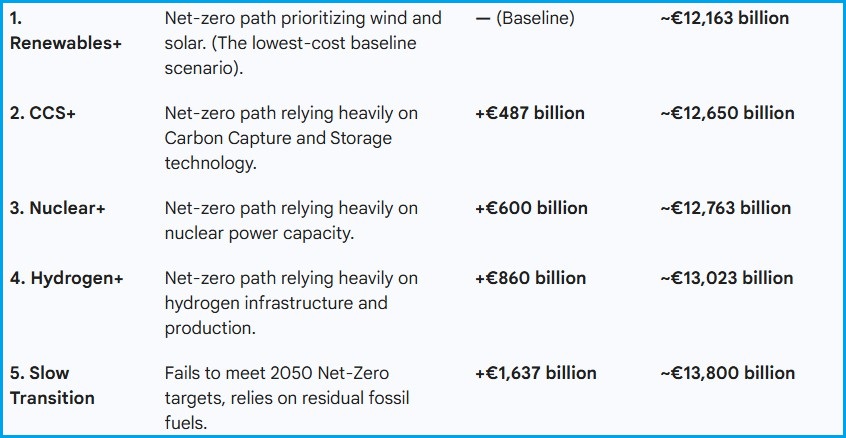
A European energy system based on a high share of renewable energy is the cheapest scenario until 2050 for achieving the net-zero goal, when compared to an increased use of nuclear capacity, or hydrogen, or carbon capture and storage, and against a delayed energy transition, according to a study produced by Hitachi Energy for WindEurope.

Costs for each scenario include not only generation facilities, but investments in grids, storage and back-up systems, according to WindEurope.

The study has mapped out the total system costs of five energy scenarios. Four scenarios deliver net zero and the remaining one is for a slow transition, where Europe doesn’t meet its climate targets, wind power advocacy group said.

The difference between the cheapest net zero path (Renewables+) and the most expensive path (Slow Transition) is EUR 1.64 trillion, the study reveals.

eu energy system 2050 scenarios costs hitachi study

The study’s authors calculated the total societal cost of building, operating, and adapting to the required energy system across electricity, transport, heat, and industry to meet or fall short of the 2050 climate targets.

The total system costs have three major groups of expenses.

The first group are new infrastructure investments in generation assets, as well as in grid, hydrogen, storage and carbon capture and storage (CCS) infrastructure.

Operational expenses are represented by fuel and CO2 costs, while the third group are electrification and demand shift costs.

The Renewables+ scenario drastically lowers import dependency

The Renewables+ scenario achieves net zero by 2050 through a massive deployment of variable renewable energy, primarily wind and solar power, leading to high electrification across the energy mix.

The renewables share reaches 85% of total electricity and nearly 70% of total gross available energy. Dependency on imported energy fuels falls drastically from 71% in 2030 to just 22% in 2050, the report reads.

“As Europe looks ahead to 2050, it is revealing to think what our energy system looked like 25 years ago. Back in 2000 the share of wind and solar in Europe’s electricity was a combined 0.8%. It’s 30% today. And Europe’s emissions are down by nearly 1/3 compared to 2000 while the economy has grown 45%. Let’s build on this success,” WindEurope stressed.

It is an inception report for the Energy System Costs Study, a project commissioned by WindEurope.

by in News

Turkey awards 1.15 GW in wind power auctions – all at just EUR 35 per MWh

The six winners from the latest round of wind power auctions under the YEKA state support mechanism in Turkey will have at least EUR 35 per MWh guaranteed from the sale of electricity in the first six years. It was the floor price in the bidding. After it was reached for each zone, the remaining participants had to compete by offering to pay for the right to sign the contract.

Delays and the lack of money for the construction of high-voltage, transmission lines is one of the main hurdles slowing the uptake of wind and solar power. Turkey’s approach has turned out to be successful, as it allows investors to compete to pay one-off fees for available predetermined projects in auctions. At the same time, the beneficiaries get guaranteed prices for the future sales of their electricity.

The country has earned EUR 530 million overall this year from two rounds for solar and two for wind power, Minister of Energy and Natural Resources Alparslan Bayraktar said. It includes EUR 208 million just from the latest bidding under the Renewable Energy Zones (REZ) state support mechanism, he claimed. It is better known by its Turkish acronym YEKA.

The winners are getting grid connections for 49 years

The ministry awarded zones for six projects for 1.15 GW in total connection capacity. The winners are getting grid connections for 49 years, a minimum price during the six-year open market sale period and power purchase agreements (PPAs) at the same level for another 20 years.

Entire capacity allocated at floor price

In the bidding in the REZ WPP 2025 (YEKA RES 2025) round, the ceiling price was EUR 55 per MWh. With 75 applications altogether, 30 companies participated – between six and 20 per zone.

In all cases, the bottom price of EUR 35 per MWh was reached, so the remaining bidders were switched to the second phase. The YEKA auctions are broadcast live.

The winners need to pay between EUR 56,000 per MW and a stunning EUR 312,000 per MW of capacity, or from EUR 23.8 million to EUR 34.3 million for each zone. Combined, the contribution fees amount to EUR 173 million, or some EUR 470 million for all auctions held this year.

Bayraktar estimated total investments in projects involved in the last wind power round at USD 1.1 billion.

Eksim, Polat among winners

The Kütahya zone of 120 MW went to İçdaş Elektrik Enerjisi, for EUR 222,000 per MW. Stone Enerji snatched the Aydın-Denizli project of 140 MW with a winning bid of EUR 170,000 per MW. The firm was a winner at the recent solar power auctions as well.

For the Sivas area, the largest of all (500 MW), Kanat Rüzgar Enerji will be required to pay EUR 56,000 per MW, which is the lowest level.

Three zones are in Balıkesir province. Eksim Energy (Enerji) committed the most of all winners, EUR 312,000 per MW, for the Balıkesir-3 project. It is for 110 MW. Balıkesir-2, of 120 MW, was won by Balıkesir Elektrik. It offered a contribution fee of EUR 218,000 per MW.

The Balıkesir-1 area is for 160 MW in connection capacity. Polat Enerji’s subsidiary Soma Enerji was the best bidder, with EUR 212,000 per MW.

Turkey hosts wind power plants of more than 14 GW combined, of more than 121 GW in total electricity capacity.