by in News

Zatriq Wind Farm Nears Completion as Kosovo Expands Renewable Capacity

Turkey-based Çalık Renewables, in partnership with Kosovo’s domestic firm Eurokos, is advancing the construction of a 72 MW wind power plant in Kosovo, with commissioning targeted for July.

During a recent site visit to the Zatriq wind park, Acting Prime Minister Albin Kurti and Minister of Economy Artane Rizvanolli reviewed progress on the project. The development is led by Çalık Enerji, part of Çalık Holding, which secured €112 million in financing last year. The project marks the group’s first renewable energy investment outside Turkey and represents the first wind initiative backed by Swiss Export Risk Insurance.

Construction is progressing steadily, with four of the planned twelve turbines already installed. According to Prime Minister Kurti, the Zatriq project underscores Kosovo*’s growing attractiveness for foreign direct investment, supported by an improving legal and regulatory framework. The construction workforce totals 175 personnel, including 130 local workers, highlighting its domestic economic contribution.

The total investment is estimated at €124.4 million, as confirmed by Eurokos. Minister Rizvanolli noted that two additional turbines are expected to be completed within weeks, keeping the project on track for full completion by July. Once operational, the wind farm is expected to enhance energy security, reduce reliance on imports, and generate annual savings exceeding €27 million.

With an anticipated annual output of 185 GWh, the Zatriq wind park will be capable of supplying electricity to approximately 45,000 households. The facility will be connected to the transmission network via a 110 kV overhead line.

Located near the village of Zatriq, the site benefits from one of the strongest wind resources in Kosovo*. The country’s existing wind capacity remains limited, comprising projects such as Selac Wind Farm (104.1 MW), Kitka Wind Farm (32.4 MW), and Golesh Wind Farm (1.35 MW).

For the Zatriq project, Çalık Enerji has partnered with GE Vernova to supply wind turbines featuring 79-meter blades. Beyond Kosovo*, the company operates two wind farms in Turkey with a combined capacity of 72 MW and is developing additional projects in Poland totaling 170 MW.

In the broader energy sector, Çalık Holding, together with Limak, jointly controls Kosovo’s electricity distribution operator KEDS and supplier KESCO.

by in News

PPC Renewables Romania Adds 60.12 MWh Battery to Sălbatica Wind Complex

PPC Renewables Romania plans to install a battery energy storage system (BESS) with a capacity of 60.12 MWh within its Sălbatica 1 wind farm, as the company accelerates its storage rollout alongside existing renewable assets.

The storage project is valued at RON 68.2 million (EUR 13.4 million), PPC Renewables Romania said. The company operates the Sălbatica 1 and Sălbatica 2 wind farms, which together total 140 MW, located in Tulcea County in southeastern Romania.

PPC Renewables Romania is a subsidiary of Greece’s state-controlled Public Power Corporation (PPC).

Modernization Fund support of EUR 1.9 million

The BESS investment will be supported by the European Union’s Modernization Fund, through a public call aimed at financing electricity storage capacities connected to existing renewable generation facilities.

From the overall investment, RON 9.87 million (EUR 1.9 million) will come from the Modernization Fund, while the remainder will be financed by PPC Renewables Romania.

According to PPC, the battery will contribute to the development of storage capacity and improve the flexibility and efficiency of electricity produced from renewable sources.

Broader storage pipeline underway

PPC Renewables Romania is developing a series of storage projects across the country. The company plans to install:

  • 27 MWh at the Topolog wind farm,

  • 80 MWh at the Corugea wind farm, and

  • 120 MWh in total at the Nicolae Bălcescu and Târgușor wind farms.

PPC operates 1.3 GW of wind, photovoltaic, and hydropower capacity in Romania. Its 600 MW Fântânele–Cogealac–Grădina wind farm is the country’s largest wind facility and already includes a BESS installation.

Romania’s largest BESS commissioned in December 2025

Romania’s largest battery storage system was inaugurated in December 2025 by Nova Power & Gas, doubling the country’s total BESS capacity. The facility in Florești, Cluj County, has an operating power of 200 MW and an energy capacity of 400 MWh.

by in News

Saudi Arabia to build 2 GW of solar power in Turkey within 5 GW deal

After extended negotiations, Saudi Arabia has signed an agreement enabling its companies to develop solar power plants totaling 2 GW across two provinces in Turkey. The move forms part of a broader bilateral framework covering 5 GW of photovoltaic and wind capacity.

Turkey’s Minister of Energy and Natural Resources, Alparslan Bayraktar, and Saudi Arabia’s Minister of Energy, Abdulaziz bin Salman Al Saud, signed an intergovernmental agreement focused on renewable electricity generation. Bayraktar said the objective is to deliver a combined 5 GW of solar and wind power plants in Turkey with Saudi Arabian companies.

In the first phase, two 1 GW solar projects are planned: one in Taşeli in Karaman province and another in Sivas province, Bayraktar said.

Bilateral agreements positioned as a new model for large-scale projects

Bayraktar noted that tenders under Turkey’s state-backed Renewable Energy Zones mechanism (REZ/YEKA) are continuing, alongside investments in self-consumption power plants and energy storage projects. He described intergovernmental and bilateral agreements as a new model for delivering large-scale electricity generation projects, adding that such structures can secure electricity at significantly lower prices over long periods. He made the remarks in Riyadh, where the negotiations were concluded.

Bayraktar reiterated Turkey’s target to triple its combined wind and solar PV capacity to 120 GW by 2035.

He also said the investments—described as a major example of foreign direct investment in Turkey’s energy sector—would be financed externally, with loans expected from international financial institutions.

25-year offtake terms and pricing

Bayraktar stated that electricity from the Karaman solar plant would be purchased for 25 years at 1.995 euro cents per kilowatt-hour (EUR 19.95 per MWh), while power from the Sivas project would be priced at 2.3415 euro cents per kilowatt-hour. He said both levels are the lowest among Turkey’s renewable electricity plants.

He added that the projects are expected to support Turkey’s electrical equipment and services sectors through a 50% locality rate. Bayraktar estimated the first two solar power plants will require around USD 2 billion in investment and will cover the electricity needs of 2.1 million households.

According to Bayraktar, foundations are scheduled to be laid in 2027, with overall completion targeted across 2028 and 2029.

Bayraktar previously said Turkey had been in talks with Saudi partly state-owned utility ACWA.

Turkey had 25.1 GW of solar capacity and 14.8 GW of wind capacity at the end of last year, within a total installed power capacity of 122.5 GW. Bayraktar also said last week that 3.5 GW of self-consumption capacity would be allocated this year, prioritising local authorities, public institutions, and strategic and export-oriented sectors.

by in News

BIG Mega Renewable Energy secures financing for Văcăreni wind farm project

BIG Mega Renewable Energy, a renewable energy developer and a joint venture between BIG Shopping Centers and MEGA OR Holdings, has reached financial close for its Văcăreni onshore wind project in Tulcea county in Romania. The package, amounting to over EUR 100 million, will support the development, construction and operation of the future 102 MW facility.

The financing was provided by Erste Group Bank and Intesa Sanpaolo, which have extensive experience with large-scale renewable energy projects in Central and Eastern Europe, BIG Mega Renewable Energy pointed out.

The Văcăreni wind farm project is backed by a 10-year power purchase agreement (PPA) with a major European energy trader, the update reads. It is providing long-term revenue stability and underpinning the project’s financial structure, the company underscored.

“The financial close of the Văcăreni project, with financing exceeding EUR 100 million, alongside the completion of the Urleasca wind farm, both with an installed capacity of 102 MW, demonstrates our strong execution capabilities in delivering large-scale, complex projects and our commitment to supporting Romania’s transition to green, sustainable energy.” Chief Executive Officer Eran Davidi said.

The Văcăreni site is in Romania’s main wind power area

The Văcăreni commune is in Tulcea county in Northern Dobruja, or Dobrogea, in the country’s southeast. It is one of the windiest parts of Romania and the main hub for a long time for such projects.

BIG Mega Renewable Energy has obtained a senior loan for Urleasca of up to EUR 45.9 million from the European Bank for Reconstruction and Development, and EUR 92 million overall. The project got its name after a village in Traian commune, in the vicinity of the city of Brăila.

For both projects, the developer has hired CJR Renewables for the balance of plant (BoP) scope. It covers access roads, turbine foundations and other accompanying equipment and infrastructure.

BIG Mega acquired Urleasca in late 2021. BIG Shopping Centers is an Israeli shopping mall developer.

by in News

North Seas region signs landmark offshore wind deal

Seven heads of state and government and energy ministers of nine countries gathered in Hamburg today to boost the expansion of offshore wind. Together with industry and transmission system operators, the countries launched the Offshore Wind Investment Pact for the North Seas. They envisage cross-border projects totaling 100 GW.

Nine European countries committed to building 15 GW of offshore wind per year over 2031-2040 and derisking offshore wind investments. The industry, in return, pledged cost reductions, 91,000 additional jobs and EUR 1 trillion of economic activity.

Europe is charting the massive offshore wind buildout it needs to deliver on its energy security and competitiveness objectives, WindEurope said.

At the North Sea Summit in Hamburg today, Belgium, Denmark, France, Germany, Ireland, Luxembourg, the Netherlands, Norway and the United Kingdom confirmed their ambition to build 300 GW of offshore wind in the so-called North Seas by 2050.

Over one hundred companies participate in offshore wind pact

Governments, the wind industry and transmission system operators (TSOs) signed the Offshore Wind Investment Pact for the North Seas. The agreement is underpinned by separate declarations of the heads of state, energy ministers and the industry. The last of the three is an undertaking by more than 100 offshore wind companies across the value chain, the update adds.

Offshore wind has been a European success story with 37 GW installed across 13 countries, WindEurope stressed.

“That’s more than 6,000 turbines providing homegrown, clean and competitive electricity at scale. But deployment has been dragged by suboptimal auction design, increased costs of capital and lack of visibility for the supply chain due to an uncertain project pipeline,” the organization pointed out.

Two-sided CfDs to be auction standard

In the Investment Pact, governments pledge to provide planning and investment security and derisk offshore wind projects. It involves two-sided contracts for difference (CfDs) as the standard for offshore wind auction design, for visibility on revenue. The countries agreed to remove any regulatory obstacles to power purchase agreements (PPAs) – direct agreements between electricity producers and corporate end-consumers.

A steady pipeline of offshore wind projects will bring the needed confidence to invest in new capacity for manufacturing, ports infrastructure and vessels, according to WindEurope.

In return, Europe’s offshore wind industry pledges to drive down costs of offshore wind by 30% towards 2040 against the 2025 levels. The cost reduction would be driven by scale effects, lower costs of capital and further industrialization underpinned by clarity and visibility on the project pipeline.

The industry vowed to create lasting value for the economy, communities and consumers. It also said it would invest EUR 9.5 billion in the value chain including manufacturing, port infrastructure and vessels.

The TSOs intend to identify cost-effective cooperation opportunities and 20 GW of economically promising cross-border endeavors by 2027 for deployment in the 2030s. It includes offshore projects with interconnections to more than one country. The operators are about to develop cost-sharing principles.

The new partnership will secure 100 GW of joint offshore wind projects, Britain said.

by in News

Greece adds 340 MW of wind farms in 2025, acceleration seen for this year

New wind capacity came in at 340 MW in Greece last year, with 76 onshore turbines installed, according to the Hellenic Wind Energy Association (HWEA or ELETAEN).

Installations increased by 6.4% on an annual scale and represented EUR 420 million in investment. Total wind capacity reached 5,695 MW in the country, with HWEA expecting a 900 MW rise in 2026.

Papastamatiou: 2 GW await connection

Based on these numbers, the wind sector appears to be going through rebirth, after several years of low to average installations. Currently, 1.1 GW of new projects are under construction or contracted and the majority is expected to come online within the next 18 months.

Added on top are 200 MW from previous auctions, which took place during the period 2018-2022. HWEA said that even though 1,592 MW was awarded, only 852.4 MW managed to connect to the grid by the end of 2025.

“Right now, about 2 GW of wind farms have an installation license, but have not been completed. Half of those are under construction or contracted. There are also 3 GW who have completed environmental licensing and await grid connection terms. Naturally, there are even more projects that go through the licensing jumble. All of them – especially the most efficient – constitute national wealth and can reduce energy costs for consumers,” said HWEA’s General Director, Panagiotis Papastamatiou.

Terna Energy and Vestas top the charts

The top 5 operators by capacity in Greece are Terna Energy (18.2%), MORE (13.6%), Iberdrola Rokas (7.2%), Principia (6.5%) and PPC Renewables (5.6%).

Vestas has the highest share among manufacturers, 44%. Enercon accounts for 25%, followed by Siemens Gamesa with 15.8% and Nordex, which is at 9.2%.

Notably, the day with the highest hourly wind share in power production was April 28, 2025, when wind farms supplied 97.2%. In total, these units covered more than 50% of the demand for 616 hours of the year.

by in News

Greece adds 340 MW of wind farms in 2025, acceleration seen for this year

New wind capacity came in at 340 MW in Greece last year, with 76 onshore turbines installed, according to the Hellenic Wind Energy Association (HWEA or ELETAEN).

Installations increased by 6.4% on an annual scale and represented EUR 420 million in investment. Total wind capacity reached 5,695 MW in the country, with HWEA expecting a 900 MW rise in 2026.

Papastamatiou: 2 GW await connection

Based on these numbers, the wind sector appears to be going through rebirth, after several years of low to average installations. Currently, 1.1 GW of new projects are under construction or contracted and the majority is expected to come online within the next 18 months.

Added on top are 200 MW from previous auctions, which took place during the period 2018-2022. HWEA said that even though 1,592 MW was awarded, only 852.4 MW managed to connect to the grid by the end of 2025.

“Right now, about 2 GW of wind farms have an installation license, but have not been completed. Half of those are under construction or contracted. There are also 3 GW who have completed environmental licensing and await grid connection terms. Naturally, there are even more projects that go through the licensing jumble. All of them – especially the most efficient – constitute national wealth and can reduce energy costs for consumers,” said HWEA’s General Director, Panagiotis Papastamatiou.

Terna Energy and Vestas top the charts

The top 5 operators by capacity in Greece are Terna Energy (18.2%), MORE (13.6%), Iberdrola Rokas (7.2%), Principia (6.5%) and PPC Renewables (5.6%).

Vestas has the highest share among manufacturers, 44%. Enercon accounts for 25%, followed by Siemens Gamesa with 15.8% and Nordex, which is at 9.2%.

Notably, the day with the highest hourly wind share in power production was April 28, 2025, when wind farms supplied 97.2%. In total, these units covered more than 50% of the demand for 616 hours of the year.

by in News

Renewables account for 99% of Turkey’s net electricity capacity additions

Electricity capacity in Turkey reached 122 GW in 2025, of which 62% was from renewable sources, according to the SHURA Energy Transition Center. Photovoltaics grew by 4.9 GW, compared to 1.7 GW in the wind power segment. Renewables made up 99% of the net additions, amounting to 6.3 GW, the think tank calculated. This year, however, the first unit of the Akkuyu nuclear power plant is scheduled to come online, adding 1.2 GW.

Gross electricity production in Turkey increased 2% last year, to 360 TWh, the SHURA Energy Transition Center estimated in a new report. The share of renewables dropped to 44.1% from 46%. Namely, hydropower output is on a downward trajectory, due to droughts. Wind, solar and geothermal power rallied to 24.6%, though. Photovoltaics and wind power together surpassed 20%.

Renewables continue to dominate the sector’s development, accounting for 99% of the overall 6.3 GW in net additions, the think tank calculated. The total reached 122 GW. Renewable sources made up 62%, compared to 59.7% in 2024.

Solar power surged by 4.9 GW and the wind power capacity jumped by 1.7 GW, while the natural gas item declined by 684 MW.

Importantly, the picture is about to change, as the first, 1.2 GW reactor in Akkuyu, Turkey’s first nuclear power plant, is scheduled to be commissioned this year. Coal plant projects remain dormant and uncertain.

Race to 2035 targets

Daily power consumption reached an all-time high of 1,244 GWh on July 29. SHURA attributed the record to cooling demand caused by rising temperatures.

To reach the 2035 targets, an average of 8 GW of combined solar and wind capacity must be commissioned each year. The high momentum is expected to continue in 2026, the report reads. The government aims to hit 120 GW altogether from the two technologies, against the current 40 GW.

However, grid constraints for self-consumption units (formally, unlicensed power plants) may slow solar energy growth, the authors warned. The plan is to resolve the issue through capacity allocations for the segment. The increasing prevalence of renewable and hybrid power plants with storage will enhance system flexibility, SHURA added.

Electricity decarbonization plan costs USD 15 billion per year

Just transition plans for coal regions are critical, the think tank said. It estimated that decarbonizing the electricity sector by 2053 would require an average annual investment of USD 15 billion.

Decisions regarding fossil fuels made for security of supply reasons must be more carefully balanced with the net zero target, SHURA stressed. Temporary solutions risk creating a permanent deadlock, it underscored.

Focus switching to grid, flexibility

Turkey has reached a critical juncture in its energy transformation, according to the update. The authors commended the rise in capacity and new tenders and investments. Nevertheless, they claim the pace cannot be sustained without strengthening the grid, flexibility and implementation capacity, while implying expansion in storage, electrification and financing.

In the view of SHURA’s Steering Committee Chair Selahattin Hakman, energy transition should no longer be considered solely as a topic of climate policy, but rather in conjunction with geopolitical developments, security and economic resilience. Clean energy investments, particularly in solar and wind power, continue to grow despite increasing global uncertainties, he noted.

“In this new era, energy transition is defined at the intersection of geopolitical independence, economic resilience and social justice. Energy policies have transcended the boundaries of the environment and have become central to foreign policy, industrial strategy and trade policies,” Hakman stated.

by in News

IRENA: Global daily flexibility needs are quadrupling by 2050

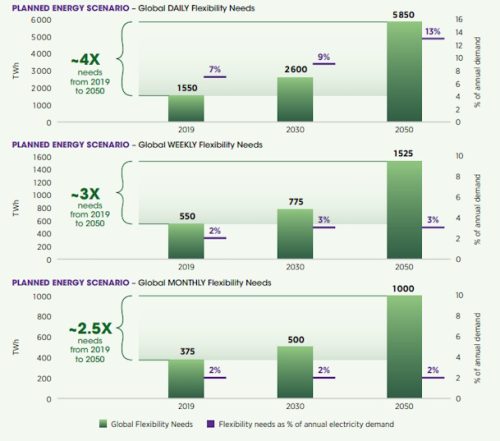
In IRENA’s Planned Energy Scenario at the global level, electricity system flexibility needs on a daily timescale are four times higher in 2050 than in 2019. In the weekly and monthly timescales, the energy required for the purpose grows by three and 2.5 times, respectively. As for the 1.5°C Scenario, implying a much higher share of renewables, the daily flexibility needs jump ten times by mid-century, versus six times for both remaining segments.

Electrification of end-use energy, large-scale deployment of distributed energy resources and the emergence of large new electricity loads from data centres are increasing demand and adding new layers of complexity. It means power systems will need stronger grids and more flexibility to ensure that electricity is available when and where needed and at the lowest possible cost, the International Renewable Energy Agency (IRENA) pointed out in a brief called Flexibility for a secure and affordable power sector transformation.

Aside from buildings and transportation, new demand is coming from the growing adoption of artificial intelligence (AI), driving the expansion of data center capacity. In 2024, data centers consumed 1.5% of electricity. The International Energy Agency expects the share to double by 2030.

The share of variable renewable energy is increasing – wind and solar power in particular. Demand patterns become more complex, so the potential for mismatches between supply and demand is likely to grow, becoming more frequent and significant. It highlights the increasing importance of system flexibility. It is the capacity to respond to expected and unexpected fluctuations in the demand for and supply of electricity in a cost-effective manner.

Some forms of flexibility act automatically to keep the system stable, while others can be scheduled and operate over hours, days or even seasons

Insufficient system flexibility can result in excessive curtailment or, in market-based systems, negative electricity prices. It can also result in shortages, jeopardising the reliable supply of electricity.

System flexibility is needed by the power system to adjust to the variability of generation and demand patterns across different timescales. Some forms of flexibility act automatically within seconds to keep the system stable, while others can be scheduled in anticipation and operate over hours, days or even seasons, through market adjustments and operational and resource planning.

Network flexibility, which isn’t covered in IRENA’s brief, is different. It is the capacity to adjust for grid availability by means of preventing or solving congestion or voltage issues.

Required flexibility depends on numerous factors

In the timescale of seconds to minutes, flexibility is needed to maintain the balance during sudden changes in demand or supply, such as the
disconnection of an interconnector or a major load or generator. The hours and days timescale has daily ups and downs of solar and wind generation alongside the peaks and troughs in demand throughout the day.

In the weeks and seasons segment, flexibility enables covering longer weather patterns caused by changes in the season or low-wind periods. In power systems mainly supplied by renewables, flexibility is also needed at inter-annual timescales. The main factors are climate-driven variations in resource availability. It especially concerns hydrology, but also wind and solar, as well as year-to-year differences in seasonal heating and cooling demand.

In power systems mainly supplied by renewables, flexibility is also needed at inter-annual timescales

Flexibility is not a single asset or function; instead it corresponds to a capability provided by a portfolio of different technologies, operational practices and market mechanisms. The required level of flexibility in a power system depends on, among other factors, the prevailing generation mix, geography, power sector structure and affected timescales.

Storage, demand-side management (DSM), interconnections and dispatchable resources each contribute differently.

Advances in forecasting and the introduction of shorter dispatch intervals, scheduled closer to real-time operation, allow more frequent and precise adjustments of generation and demand before electricity is delivered. One example are intraday markets complementing day-ahead markets.

Electricity must become main energy carrier by mid-century to keep global warming in check

In IRENA’s 1.5°C Scenario, the energy transition will be driven by the deployment of renewable energy, improvements in energy efficiency and the electrification of end-use sectors. The aim is to limit global warming to 1.5 degrees Celsius by 2100.

Electricity would need to become the main energy carrier by 2050. It would account for over half of total final energy consumption. The 2022 level was 23%.

Global electricity generation is projected to be 36% higher in 2030 and three times higher in 2050 than in 2023. Renewable resources would supply 68% of electricity in 2030 and 91% in 2050. Renewables would account for 77% of total installed power capacity in 2030 and 94% in 2050.

In the same setting, 70% of electricity generated in 2050 comes from wind and photovoltaics, taken together. In IRENA’s Planned Energy Scenario, not projecting full decarbonization, the level is 53%.

In IRENA’s 1.5°C Scenario, the share of electricity in total final energy consumption more than doubles by 2050, surpassing 50%

Flexibility needs are calculated as total cumulated annual energy deviation from the average net load (which excludes variable renewable energy generation).

In the 1.5°C Scenario, the power sector requires ten times more flexibility in 2050 than in 2019 to manage the daily variability of net load. In terms of share of annual electricity demand, the authors observed a surge to 30% from 7%. Flexibility needs for managing the variability in weekly and monthly timescales are both six times higher.

In IRENA’s Planned Energy Scenario, daily flexibility needs in 2050 are four times higher. In the weekly timescale, the level triples from 2019, and the monthly item is 2.5 times higher.

IRENA Global daily flexibility needs quadrupling by 2050
Photo: The height of bars indicates flexibility requirements in terawatt-hours per year. Purple horizontal markers show flexibility needs as a percentage of annual electricity demand. (IRENA)

Batteries perform best in daily segment

Battery energy storage is the most effective in addressing daily flexibility needs, the report finds. It is only 24% as effective at meeting weekly needs and 12% as effective for monthly needs.

Interconnections and LDES are effective on the weekly and monthly scales

Interconnections are the most effective in addressing weekly flexibility needs, but also 98% as effective for monthly needs. As for the daily segment, the coverage is just 28%.

The numbers for long-duration energy storage (LDES) solutions are similar. Compared with addressing weekly flexibility needs, LDES is 90% as effective for monthly needs and 34% as effective in the daily item.

by in News

Voice from beyond the centre

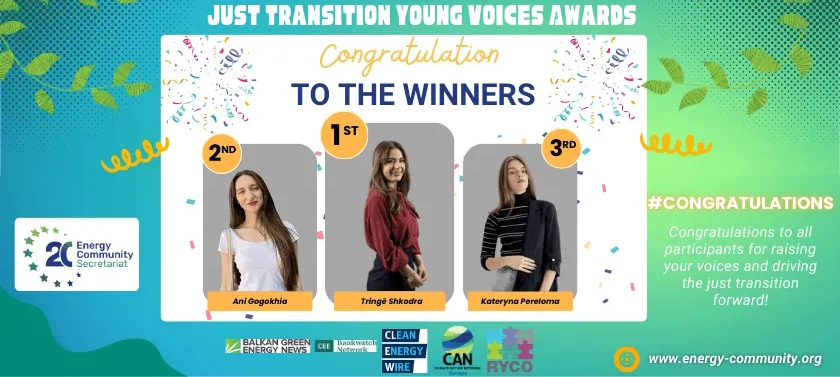
Balkan Green Energy News, the media partner of the 2025 Just Transition Young Voices Awards, is publishing the three winning articles. The Energy Community Secretariat organized the contest in collaboration with Bankwatch, CAN Europe, the CLEW Network, and the Regional Youth Cooperation Office. The aim is to promote young adults set to shape the climate, energy, and social landscape in the years ahead in the Energy Community region. 

Author: Ani Gogokhia

It is the summer of 2045  – unusually hot compared to previous years – but the unbearable heat is not the only problem. I wake up in my small apartment in western Georgia, open the window, and immediately see clouds of exhaust fumes. For me, this is just another part of everyday life.

After a quick breakfast, I step outside for a short walk to wake myself up. The buildings in the city are the only things that remain unchanged. The number of people on the streets is declining. I feel lonely – most of my peers have either moved to the capital, Tbilisi, or left for European countries.

Thinking of them inevitably leads me to reflect on my own career path. Unfortunately, I haven’t had the opportunity to make a meaningful impact in my region.

Not much choice for young woman

With those thoughts weighing on me, I walk quickly to my first job. I call it my first job because I’ll head to another one later in the afternoon. The commute is long, and public transport only slows me down – so I walk. As I pass the local market, I see vendors, most of them women, standing in the scorching sun.

My job is house cleaning. The pay is just enough to cover groceries and utility bills, but with the cost of living rising daily, I rush to a second cleaning job in the afternoon. Floors, windows, walls – it’s all the same. If you wonder why I chose this line of work, the answer is simple: there wasn’t much choice, especially for a young woman.

The scenario described above could become a regular part of life if we halt progress toward a just transition and neglect it

There’s little to say about the workday. I return home as the sun begins to set, carrying groceries in both hands. As I unpack, I wait for my family. Everyone works – my mother and father in a factory, and my sister at a hospital. We gather for dinner and talk about current events: rising tensions, protests over low wages, unemployment, and deepening poverty.

But these conversations always end the same way – with my mother’s cancer. She developed the disease after years of exposure to harmful substances at the factory, yet she still can’t stop working. We simply can’t afford her treatment otherwise.

The scenario described above could become a regular part of life if we halt progress toward a just transition and neglect it. For the energy transition to be truly just, it must include rural areas, too, creating fair opportunities for people across Georgia.

A just transition refers to a series of policies that ensure fair and equal opportunities for everyone as we shift to a greener economy in the fight against climate change. It’s a process meant to align energy systems with modern, sustainable standards. Local governments play a vital role, though many factors – such as geography and ethnicity – can affect how smoothly this transition occurs.

Just transition in Georgia

Georgia is working to stay aligned with global green trends through international cooperation. Hydropower dominates its energy sector, but the country is slowly incorporating wind and solar systems. Since joining the Energy Community in 2017, Georgia has made notable strides toward harmonizing its legislation with the European Union’s energy standards.

This alignment has attracted major investments in renewable energy. Projects like the Kartli wind farm and a national roadmap for a circular economy – supported by the EU4Environment program – are steps in the right direction.

The city of Zugdidi is among the trailblazers in Georgia in the energy efficiency segment, youth engagement and environmental education

These national achievements are significant, but what about rural areas far from the capital? Each region presents unique challenges and opportunities in the just transition. In western Georgia, Zugdidi has started participating in this process. Although large-scale renewable projects remain concentrated elsewhere, the city has seen pilot initiatives in energy efficiency, youth engagement, and environmental education supported by the EU.

The rural development programs of the United Nations Development Programme (UNDP) in Zugdidi focus on inclusive economic participation, especially for youth, and promote eco-tourism and sustainable agriculture to curb outward migration. One noteworthy initiative involved using hazelnut shells to heat school greenhouses – a clever use of a crop central to local livelihoods. Educational projects and international partnerships have also helped raise awareness about the green economy, yet challenges remain.

Chiatura craves economic diversification away from mining

Take, for example, Chiatura – a mining town east of Zugdidi, known for its manganese industry since Soviet times. Chiatura’s economy has long depended on mining, with consequences such as environmental degradation, poor working conditions, and economic stagnation when mining activity declines. Without economic diversification, residents remain vulnerable and largely excluded from sustainable development benefits.

In 2024, Georgian news outlets reported: The hunger strike entered its 22nd day on July 10, involving eight miners, three of whom have sewn their mouths shut. The unrest stems from decisions to shut down underground mining operations, leaving workers desperate and uncertain about their futures.

While Zugdidi explores decentralized, eco-friendly solutions like biomass heating, Chiatura still lags in implementing alternatives – clean industries, green technologies, or renewable energy – deepening the divide between regions.

Youth massively moving to capital Tbilisi

Unfortunately, Georgia’s development remains overly centralized. Most opportunities are clustered in Tbilisi, causing a massive youth outflow from other regions into the capital.

Geographic and infrastructural limitations in rural and mountainous areas also pose serious barriers. For example, eastern Georgia has high solar radiation – perfect for photovoltaic panels – but varied terrain complicates installation. Wind energy prospects are greater in the east, as western regions are less windy.

A just transition also demands inclusive participation, especially from women. As of 2024, women make up just 28% of the global STEM (science, technology, engineering and mathematics) workforce – a glaring underrepresentation. In Georgia, the meaningful inclusion of women in the just transition remains a significant challenge. Empowering women – politically, economically, and socially – is key.

A difficult past marked by political instability and conflict has left its mark, but the more women engage in public life, the greater their chances of economic empowerment, entry into traditionally male-dominated professions and establishing decent place in economy.

What must be done

While Georgia has made substantial headway towards its climate goals, it is key for the country to create a unified national policy that addresses all regions equitably. We need robust educational campaigns, targeted support for rural areas, and most importantly, greater inclusion of women and minority groups in the just transition.

Only then can we build a fair, resilient society capable of meeting the challenges of the 21st century.

Just transition Young Voices Awards articles Ani Gogokhia
Photo: Just Transition Young Voices Awards