by in News

PPC plans EUR 5.8 billion makeover of Western Macedonia coal region, including data centers

Public Power Corp. (PPC) presented a EUR 5.8 billion investment plan for the coal region of Western Macedonia in northern Greece. It held the ceremony in the retired Kardia 2 lignite-fired power plant.

According to PPC’s chairman and CEO George Stassis, the endeavor consists of the decommissioning of old assets and the rollout of new energy technologies.

Stassis: Western Macedonia can reinvent itself

PPC, or DEI in Greek, said it would return to the government 8,000 hectares of coal land that it no longer needs, after completely restoring it. All equipment, such as 400 kilometers of lignite conveyor belts, cooling towers and excavators, are planned to be recycled up to 95%.

According to the decarbonization timeframe, Ptolemaida 5 will be the last coal plant in the country, continuing to operate until the end of 2026. It is set to be converted to a gas power plant with a capacity of 350 MW. PPC is also open to upgrading it to 500 MW or even 1 GW.

New photovoltaics, storage underway

“Western Macedonia can reinvent itself using new technology,” said the CEO.

The group aims to install a total of 2.1 GW in photovoltaics across the region. A 550 MW solar power plant in the former lignite mine of Ptolemaida is almost complete. It will be the biggest in the Balkans. Separately, a group of clusters of 940 MW is under construction within the Meton joint venture with German RWE.

Energy storage is another major segment in PPC’s investment plan. Within the next three years, it aims to funnel EUR 940 million for a total capacity of 860 MW. It includes two pumped storage hydropower projects. The one in Kardia is for 320 MW and an eight-hour storage duration, and the other in the South Lignite Field – 240 MW and a 12-hour duration. The projects are worth EUR 430 million and EUR 310 million, respectively.

Equally important, battery storage units of 300 MW altogether would be installed in Amyndaio, Akrini, Meliti and Kardia in the country’s main coal region. The other one is Megalopolis in the Peloponnese.

PPC plans a 50 MW hydrogen production facility together with Motor Oil, as Hellenic Hydrogen, and a cogeneration plant to cover district heating needs from the end of 2026.

Large 300 MW data center

Last but not least, the Greek group aims to create a 300 MW data center, as part of an investment of EUR 2.3 billion. A subsidiary in fiber optic cables would upgrade the telecommunication links with Thessaloniki and Igoumenitsa to improve data flow in Greece and abroad.

If conditions are favorable, PPC would further upgrade the data center to 1 GW, increasing its investment by EUR 5.4 billion.

Greek Prime Minister Kyriakos Mitsotakis said at the event that existing infrastructure in Western Macedonia is a great advantage.

by in News

Kosovo* to subsidize solar panels for prosumers, solar thermal systems

Kosovo* is using an EU grant for public calls for families and firms to install solar power panels and solar thermal collectors. The subsidies for photovoltaics amount to EUR 250 per kW, or EUR 200 per kW for businesses that set up larger systems. There is a bonus for female-owned enterprises.

The Ministry of Economy of Kosovo* launched a mechanism to support households and micro, small, and medium-sized enterprises in investing in renewable energy. The measures are funded with a EUR 75 million grant from the European Union within its EUR 500 million direct budget aid package for the Western Balkans. It was approved at the height of the energy crisis, to subsidize the energy bills of households and businesses that were at high risk.

The authorities issued a call for photovoltaics for self-consumption for families and micro, small, and medium-sized enterprises. Households can apply for support for solar systems with capacities ranging from 3 kW to 7 kW. They will be subsidized with EUR 250 per kW to become prosumers but only up to EUR 1,750 overall.

Firms that build photovoltaic systems of 10 kW and more are entitled to as much as EUR 6,000 per beneficiary

For micro, small, and medium-sized enterprises, the subsidy will be EUR 250 per kW for capacities ranging from 3 kW to 9 kW. The maximum payment to one beneficiary is EUR 2,000. For capacities of 10 kW and above, future prosumers in the business sector will be subsidized with EUR 200 per kW or up to EUR 6,000 in total.

In cases where businesses are owned by women or are jointly owned by women holding at least 51% of ownership, the government will add EUR 200 to the subsidy.

The deadline for the first phase is May 31 or until all funds are reserved, on a first-come-first-served basis. Applications in the second phase will be accepted until September 30, according to the announcement.

Public call for solar thermal systems for firms expected in one week

The other call, which the ministry expects to be launched in mid-February, is for supporting micro, small, and medium-sized enterprises in investing in solar thermal systems, for water heating.

The share of subsidies is 40% of the investment value or up to EUR 4,000 in total.

Government promises pathways for investments

Kosovo’s Prime Minister Albin Kurti expressed commitment to the energy transition pathway.

“While we are working on projects with large capacities such as the solar auction, we are also pushing forward opportunities for our citizens to develop small-scale energy capacities for consumption and self-consumption. Not only are we reducing the burden on our system, but we are also empowering families and businesses to make sustainable and affordable choices,” he said.

The Law on Renewable Energy Sources has passed the first reading in parliament

It is a favorable time for investments in renewables, Minister of Economy Artane Rizvanolli claimed and highlighted the work on the Law on Renewable Energy Sources. It has passed the first reading in parliament.

The law will make the installation of solar systems more attractive and obligate operators to make it easier for citizens, she added. The energy strategy stipulates that citizens should be in the center with regard to development and benefit from the energy transition, Rizvanolli asserted.

Alessandro Bianciardi from the European Union Office in Kosovo* vowed to continue supporting the government’s initiatives in the sector. They are cooperating on the 2024-2027 agenda to boost the economy of Kosovo* and other Western Balkan countries with grants and subsidies in the energy sector, he stressed.

* This designation is without prejudice to positions onstatus and is in line with UNSCR 1244/99 and the ICJ Opinion on the Kosovo declaration of independence.
by in News

Kosovo* receives financing for 120 MW solar power plant on coal ash dump

The European Investment Bank is providing a EUR 33 million loan for a solar power plant of 120 MW in peak capacity. Government-controlled power utility KEK plans to install it on its former coal ash dump near Prishtina.

The European Investment Bank (EIB) signed a EUR 33 million investment loan for the construction of a photovoltaic plant in Kosovo* with a connection to the grid of up to 100 MW, translated to 120 MW in peak capacity.

The financing package for the Solar4Kosovo project is part of the European Union’s Economic and Investment Plan for the Western Balkans of EUR 9 billion in grants. It is aimed at mobilizing a total of EUR 30 billion.

Solar power project involves EUR 32 million EU grant

The proposed facility is expected to produce 169 GWh per year, EIB said. The location, owned by government-controlled Kosovo Energy Corp. (KEK), is on the former ash dump of its Kosovo A power plant. The electricity producer is also getting a EUR 32 million grant via the EU’s Western Balkans Investment Framework.

“As one of the largest renewable energy developments in the region under Team Europe, this project will help Kosovo* achieve its energy security and renewable energy goals. Together with the European Commission and other partners, we are glad to be able to jointly help Kosovo* lay the groundwork for the decarbonisation of the local economy and diversification of the energy mix, in line with the EU Green Agenda,” said EIB’s Vice-President Kyriacos Kakouris.

Investment valued at EUR 107 million in total

Germany’s KfW Development bank is providing a EUR 29 million loan. The project’s total value, including KEK’s own funds, is estimated at EUR 107 million. The solar power plant between the towns of Obiliq/Obilić and Fushë Kosova (called Kosovo Polje in Serbian), near Prishtina, would have an underground connection to the existing substation at the Kosovo A thermal power plant.

“This project, the largest of its kind in the region, not only guarantees a sustainable energy production method but also accelerates Kosovo’s shift from conventional energy sources,” according to Kosovo’s Minister of Finance, Labour and Transfers Hekuran Murati.

Kosovo* is dependent on obsolete Kosovo A and Kosovo B coal plants for almost all its electricity. Renewables projects are gradually gaining traction.

The other part of the Solar4Kosovo project is for a solar thermal facility for the nearby capital city’s district heating system. The site is in the village of Shkabaj (Orlović) in Obiliq municipality.

In other news, the government in Prishtina established Energy Storage Corp. or ESCorp. It will manage the project for batteries with total operating power of 125 MW and 250 MWh in capacity. It is funded by the Millennium Challenge Corp. (MCC) of the United States.

The remaining 45 MW (90 MWh) is expected to be owned by Transmission, System and Market Operator (KOSTT). The battery systems are envisaged to store surplus electricity and stabilize the frequency in the transmission system. They are valued at USD 180 million altogether.

* This designation is without prejudice to positions onstatus and is in line with UNSCR 1244/99 and the ICJ Opinion on the Kosovo declaration of independence.
by in News

Kosovo* completes first solar power auction at EUR 48.88 per MWh

A consortium led by Switzerland-based construction company Orllati was selected to build and operate a solar park of up to 105 MW in connection capacity for 30 years including a 15-year contract for difference. The group won the first renewable electricity auction in Kosovo* with a bid of EUR 48.88 per MWh.

Almost a year since the initial public call, the Ministry of Economy in Prishtina completed its pilot solar power auction. Even though it raised the ceiling price in late December to EUR 75 per MWh from EUR 65 per MWh amid repeated delays, it was closed at EUR 48.88 per MWh.

Switzerland-based Orllati leads the winning consortium, consisting of companies from Germany and Kosovo*. The construction firm is led by Kosovar diaspora, officials said.

The victory in the electronic auction translates to the right to take land on lease for a photovoltaic park of 90 MW to 105 MW in total connection capacity and up to 117 MW in peak terms. Orllati agreed to build and operate the facility for 30 years, of which the first 15 years it would sell electricity under a contract for difference (CfD) equalling the winning price.

The government-owned land is in the cadastral zones of Kramovik and Petković (Guri i Kuq) in the municipality of Rahovec or Orahovac.

Auction terms were amended ten times

Two Turkish consortia participated in the auction – Çalik and Limak, and Güri̇ş İnşaat ve Mühendislik (Güri̇ş Construction and Engineering) – together with Akuo Energy, headquartered in France, and Egypt-based Elswedy Electric. It consisted of four rounds, the ministry said. The first one, with 43 bids, drove the price down to EUR 57 per MWh while the final level was reached in the third one.

Kosovo* intends to launch auctions this year for 45 MW in battery storage and 150 MW in wind power

Minister of Economy Artane Rizvanolli said the competitive process is ensuring affordability for citizens, strengthening the security of supply and the sector’s sustainability and enabling private investments. She revealed that the auction terms were amended ten times in line with investors’ suggestions.

The winner will invest more than EUR 70 million, according to the government, which is preparing to issue calls for auctions this year for 45 MW in battery storage and 150 MW in wind power. There is 950 MW in total in the pipeline, Rizvanolli noted, saying the potential investments are valued at an overall EUR 1.2 billion.

Ceiling price at Albania’s next auction will be EUR 59.97 per MWh

The bidding was organized with the support of the United States Agency for International Development (USAID). The renewable electricity auction model was developed with the European Bank for Reconstruction and Development.

Kosovo* hosts just two operational wind power plants and some hydropower and photovoltaic capacities.

For comparison, Romania is preparing its first solar power auction for CfDs with a maximum price of EUR 91 per MWh. Amid weak participation, the lowest price at Serbia’s first solar power auction, held last year, was EUR 88.65 per MWh, just 35 eurocents below the starting level.

The maximum acceptable price in Albania’s upcoming auction is EUR 59.97 per MWh. The two previous auctions, in 2021 and 2020, were similar to the latest one in Kosovo*. The government secured land for one large-scale project at a time and for one investor each. Voltalia was the winner both for Spitalla (EUR 29.89 per MWh) and Karavasta (EUR 24.89 per MWh).

* This designation is without prejudice to positions onstatus and is in line with UNSCR 1244/99 and the ICJ Opinion on the Kosovo declaration of independence.
by in News

Turkey-based Yıldırım building 109 MW solar park in Kosovo* for its ferronickel plant

Yıldırım Energy laid the foundation stone in Kosovo* for the first phase of its 150 MW solar farm. The Turkish company intends to produce electricity for its ferronickel plant, which exports its entire output.

A renewable energy investment of more than EUR 43 million is underway in Gllogovc (also known as Glogovac and Drenas). Yıldırım Group’s subsidiary Yıldırım Energy marked its expansion to Kosovo* by inaugurating the construction works on a 109 MW solar park.

The facility will reduce electricity costs and facilitate sustainable production at the NewCo Ferronikeli plant, its General Manager Cemil Acar said. The ferronickel production complex exports all its products, he pointed out. The photovoltaic plant is due to come online early next year, he revealed.

Company’s solar park is among largest ones in construction in Western Balkans

Using renewable energy in production would enable the group to be exempted from paying the European Union’s CO2 import levy, imposed through the Carbon Border Adjustment Mechanism or CBAM. Ferronickel is a ferroalloy, consisting of iron and nickel.

With the new photovoltaic plant, the group will get cheap electricity for its production lines and it can also exempt it from the EU’s carbon border tax system

Separately, the government in Prishtina said the first section of the solar power plant would have over 54 MW in capacity. The company’s target is to reach 150 MW by 2026, it added. It would make it the biggest in the Western Balkans so far, though Solar Energy Group Europe (SEGE) said a year ago that it launched the construction of an agrisolar power plant of 150 MW in peak capacity in Gjakova (Đakovica), also in Kosovo*.

The Ministry of Economy recently completed its first solar power auction, for a plant of up to 117 MW in peak terms. In comparison, government-controlled power utility Kosovo Energy Corp. (KEK) has a PV project of 120 MW underway. The facility will be built at a former ash dump of its Kosovo A power plant.

Energy crisis knocked out Ferronikeli in 2021

NewCo Ferronikeli resumed production last June after a break of almost two years. It was caused by a surge in electricity prices amid the energy crisis. The group entered ownership in 2022.

Yıldırım Energy trades power and gas, conducts electrification services and produces renewable energy, focused on hydropower, solar and wind. The firm is building a solar panel plant in Kocaeli in Turkey, according to its website. It also operates in North Macedonia and Albania.

The group, founded in 1963, is active in 57 countries. Its operations are based in Istanbul and the financial headquarters are in Amsterdam.

* This designation is without prejudice to positions onstatus and is in line with UNSCR 1244/99 and the ICJ Opinion on the Kosovo declaration of independence.
by in News

Nofar Energy commissions Serbia’s largest solar park

Israeli company Nofar Energy said its photovoltaic park in northern Serbia of 27 MW in peak capacity began delivering electricity to the grid. The project consists of two adjacent units, Ada1 and Ada2, connected to the distribution grid.

After installing Romania’s largest solar power plant in a partnership, Nofar Energy now operates the largest photovoltaic park in Serbia as well. The Israel-based company, which nine months ago started building it the municipality of Ada in the country’s north, said the facility is online.

Notably, the solar park at the Utrine site consists of two units, Ada1 and Ada2. They have connection points of just under 10 MW each and operate within Serbia’s power distribution network. There is no PV system yet on the Balkan country’s transmission grid.

Project is worth EUR 25 million

The solar park spans 30 hectares on a 116-hectare plot, planned for the solar park’s expansion. Nofar Energy has launched the projects, worth EUR 25 million in total, via its subsidiaries Forest Energy and Energia Solis. The company estimated annual output at 33.2 GWh.

Turkish company Girişim Elektrik is the contractor.

Nofar Energy said its portfolio of operational and projects under construction amounts to 2.4 GW of solar power and 1.2 GWh of energy storage. The company secured an overall EUR 110 million loan in August in Romania for PV plants Ghimpați, which it started building in the meantime, and Iepurești. The two locations in the Iepurești area in Giurgiu county are envisaged for a combined 315 MW in peak capacity.

Serbia planning to add 177 MW in connection capacity through auction mechanism, 1 GW within strategic partnership

The Ministry of Mining and Energy of Serbia said in November that the country hosted 166 MW in solar power capacity. Last month, at its second round of wind and solar power auctions, it allocated the entire PV quota of 124.8 MW in grid connection capacity. The five winning projects are for 176.7 MW overall, also in alternating current or AC. They get contracts for difference (CfDs) and power purchase agreements (PPAs).

A strategic partnership is underway with Hyundai Engineering and UGT Renewables for a group of solar power plants of 1.2 GW in overall peak capacity. It translates to 1 GW in transmission grid terms. The companies are also tasked with installing battery energy storage systems with at least 200 MW in combined capability and a maximum of 400 MWh in capacity.

by in News

Race against time for Greece to avoid a blackout on Easter

Greek authorities are rushing to secure the electricity system against a possible blackout during Easter.

Greece currently produces much more electricity than it needs on certain days due to a high renewables penetration and insufficient energy storage. It should be noted that in 2024 the country became a net power exporter for the first time after two decades. Usually, extra power is no problem, as it is exported and curtailments ensure nominal system operation with no danger of a blackout.

However, this year there will be days when low demand combined with high renewable electricity production creates a problem. At Easter, demand traditionally craters.

Independent Power Transmission Operator (IPTO or Admie) estimates that on Easter Sunday the country’s interconnections would operate near their maximum safety limits. If even a single line goes offline, it would lead to a domino effect and the possible loss of all the connections with neighboring countries. As a result, the frequency will rise beyond safe limits in the Greek system, triggering the desynchronization of power plants and a blackout.

To avoid such a scenario, authorities have imposed adding telemetry systems in recent months to photovoltaic units of over 400 kW connected to the distribution network. Currently, the Hellenic Electricity Distribution Network Operator (HEDNO or DEDDIE) can curtail 1.9 GW of solar power capacity, but another 6 GW is unswitchable.

Telemetry must be enabled by April in small PV units

A deadline was given until February 13 to the owners within the latter category to add telemetry equipment so that HEDNO can curtail their production when needed. However, very few complied and the rest said they are still waiting for the systems to be delivered.

HEDNO estimates that 5,700 plants with capacities of 400 kW to 1 MW must be added to curtailments, as well as 600 plants with more than 1 MW apiece.

Based on the above, owners of solar power units and the two grid operators must add the ability by April to ensure system stability.

Gradual installation of energy storage facilities is expected to help significantly and bring curtailments down.

by in News

Terna Energy to build solar power plant of 130 MW in Bulgaria

Terna Energy is developing a project for a 130 MW photovoltaic plant near Burgas in Bulgaria. The company, owned by Masdar, plans to connect it to the grid already by the end of next year. Recently it also reached landmark points in the development of wind power projects in Greece.

Abu Dhabi Future Energy Co. (Masdar), which has high ambitions for its expansion in Southeastern Europe, relies to a great extent on its recently acquired subsidiary Terna Energy. The Greek company revealed that it is preparing to install a 130 MW solar park near the village of Vratitsa in eastern Bulgaria.

The project in the municipality of Kameno in Burgas province includes design and procurement, as well as grid connection works including a new 33/110 kV substation. Terna Energy Group said it is targeting completion by the end of 2026.

As part of the strategic cooperation with the former parent company, GEK Terna, its construction arm Terna SA was selected as the contractor, the announcement reads.

Terna Energy operates two wind farms in Bulgaria, with 30 MW in overall capacity.

With its recent share purchases, Masdar boosted its stake in the Greek company to 97.6% from 87.9%. The green energy giant based in the United Arab Emirates acquired Terna Energy last year.

Wind power projects in Evia progressing

In other recent news, Terna Energy received operating licenses for four projects for a wind power complex. The sites are in Karystos in Greece’s second largest island – Evia, also known as Euboea. It is one of the country’s wind power hubs and an important area for the company.

The Terna Energy Omalies subsidiary is responsible for the said investments, of 78 MW in total. They are part of an endeavor consisting of 11 wind farms.

The location for the biggest of the four, at 36 MW and with 12 turbines, is called Praro. The company ordered 3 MW machines from Enercon for all the sites. Molizeza 1 and Kalamaki 2 are for 18 MW each, and Kalamaki would have 6 MW.

Joint venture with MORE for Greece’s first offshore wind farm

Of note, the construction of wind parks in the Balkans has mostly slowed down. Moreover, Bulgaria has been at a standstill since the first wave of investments died down more than a decade ago, while Romania is struggling to pick up pace. Greece added only 125 MW last year.

Terna Energy is counting on opportunities in the offshore wind domain. In January, it joined forces with Greek refiner Motor Oil in the pilot project for the country’s first facility of the kind.

Motor Oil Renewable Energy (MORE) now holds 50% of joint venture Aioliki Provata Traianoupoleos. The project firm is tasked with developing a 400 MW offshore wind power plant on the Ionnian Sea between Alexandroupolis and the island of Samothrace. The two companies aim to complete it by the end of the decade.

by in News

PPC begins construction of 165 MW solar farm with BESS in Bulgaria

PPC Group is accelerating its expansion in the Balkans by laying the foundation stone for its Colosseum solar power project in Bulgaria. The facility will have 165 MW in peak capacity and include a battery energy storage system (BESS), the Greek state-controlled utility revealed. The company’s investment plan includes Italy, where it recently commissioned the first two solar parks.

Public Power Corp. – PPC Group said it commenced the construction of a photovoltaic plant in Stara Zagora in central Bulgaria. The project involves 260,000 bifacial solar panels with an expected annual power generation of more than 265 GWh. It is one of the biggest investments abroad for Greece’s government-controlled utility, which is expanding in Southeastern Europe and beyond.

The Colosseum solar park will have 165 MW in peak capacity and include a BESS facility of 25 MW in operating power and a capacity of 55 MWh. The liquid-cooled lithium iron phosphate (LFP) batteries will support the operation of the photovoltaic plant and contribute to the stability of the electricity system, the company added.

A 33/110 kV substation will be built on the site, the announcement reads. The solar power plant’s estimated output is equivalent to the electricity needs of more than 45,000 Bulgarian households.

PPC has 550 MW in project pipeline in Bulgaria

PPC Group runs an 18 MW wind farm called Garda in the country and another 550 MW in its renewables project pipeline. The company’s overall online green energy capacity is 5.5 GW.

According to its three-year strategic plan, by 2027, PPC Group will develop another 6.3 GW of renewables in Greece and the region. It revealed that more than 60% is under construction or ready for construction.

First PV units from strategic deal with Metlen in Italy came online in December

In December, PPC Group said it launched the operation of photovoltaic plants Carcarello and Luxenia, its first two facilities in Italy. They have 20 MW and 12 MW, respectively, in peak capacity. It translates to over 60 GWh of electricity per year in total from the two solar power units in central Italy.

The production can meet the demand of almost 15,000 households. The contractor for Carcarello and Luxenia was Metlen, formerly known as Mytilineos. The projects are part of a region-wide strategic agreement for photovoltaics, for 2 GW. Another 160 MW of PV capacity is under construction in the country.

Greek state-controlled power utility is largest renewables producer in Romania

PPC Group is the largest renewable energy producer in Romania, operating 25 wind, photovoltaic and hydroelectric facilities as well as battery storage units.

Its subsidiary Reţele Electrice România invested EUR 240 million last year in the expansion and modernization of its electricity distribution network. The firm plans to increase the number of smart meters in the three regions that it serves to two million by the end of 2025.

Gas-hydrogen CHP plant in Kardia to be completed by end-2026

As for its home market, the Greek utility said in January that it started the construction of a high-efficiency combined heat and power (CHP) plant. The future gas facility of 17 units is within the site of the former Kardia coal-fired power plant in the Western Macedonia province.

The company expects to complete the EUR 80 million cogeneration investment by the end of next year. According to earlier updates, the facility will have 105.3 MW in power capacity and 66.5 MW for thermal energy.

The project envisages the use of a mixture of fossil gas and hydrogen. The group is building another gas plant in Alexandroupolis.

by in News

Bulgaria aims to make Europe’s biggest energy community

The Ministry of Energy, Electricity System Operator (ESO) and the Bulgarian Development Bank (BDB) are launching a solar power program for municipalities, schools, kindergartens, hospitals and small businesses. There are no upfront costs and the installations become the beneficiary’s ownership within eight years.

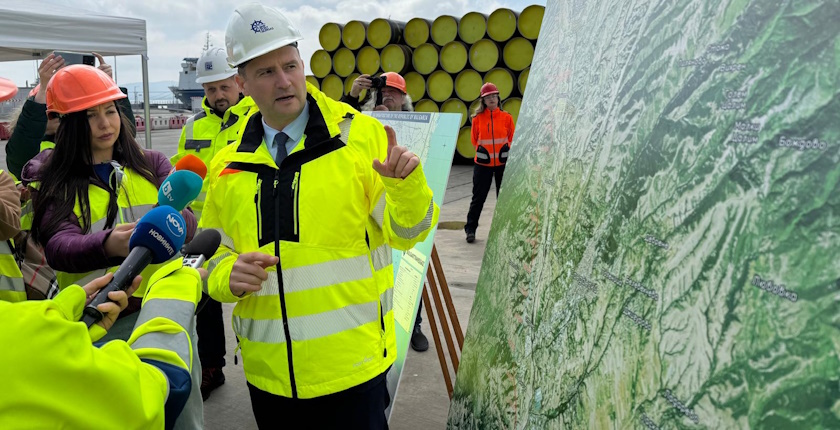
Minister Zhecho Stankov said the goal is to create the largest energy community in Europe and hinted that the government would finance the scheme with a green bond. He also declared the start of the regional Vertical Gas Corridor project in Bulgaria as the first pipes were delivered.

Every school and hospital in Bulgaria can become an electricity producer, Minister of Energy Zhecho Stankov stressed as he presented a financial support mechanism designed with the ambition to create the largest energy community in Europe. The model will benefit both the public sector and private business, he pointed out in the port city of Burgas at a ceremony marking the arrival of the first 4,000 pipes for the Bulgarian sections of the regional Vertical Gas Corridor.

The joint initiative with the country’s power transmission system operator ESO and the Bulgarian Development Bank is for the installation of solar panels with no upfront costs. Beneficiaries – municipalities, schools, kindergartens, hospitals and small businesses – would pay through energy savings and become owners in six to eight years, Stankov claimed.

Bulgaria mulls issuing green bond to finance sustainable energy

The minister also said the project could lead to the government’s first green bond to finance clean and locally produced energy available to a wide range of consumers.

For example, Burgas Municipality can equip all schools, hospitals, kindergartens and other facilities with photovoltaic panels without spending a penny from the local budget, Stankov explained.

Government to invest EUR 57 million in Vertical Gas Corridor

The Vertical Gas Corridor is envisaged to connect Greece, Bulgaria, Romania, Moldova and Ukraine. They plan to transport the fuel from liquefied natural gas (LNG) terminals Alexandroupolis and Revithoussa in Greece, and from the Caspian region, via the Southern Gas Corridor.

The government is fully funding the first stage of the project on Bulgarian territory, with EUR 57 million. The pipes for the pipelines came from India.

Stankov: Bulgaria will never again be left without natural gas

“Bulgaria will never again be left without natural gas,” said Minister Stankov. The capacity of the line between Kulata, on the border with Greece, and Kresna will be increased to 3.6 billion cubic meters per year from 2.3 billion, he added. The distance is 48.5 kilometers.

The most difficult part is between Mikrevo and Ribnik, where three kilometers will be built by horizontal drilling, the minister revealed. He explained there would be no aboveground work, so that nature and infrastructure wouldn’t be affected.

Another section, 80 kilometers, is from Rupcha to Vetrino. The purpose of the investment is to double the maximum annual flow toward Romania to 10 billion cubic meters, Stankov stressed. The last one, Tarnik-Piperovo, is 51 kilometers long.

The compressors on the corridor are reversible, allowing gas supply in both directions, the minister noted.