by in News

Dušan Jerković Primary School in Ruma – first prosumer school in Serbia’s Srem district

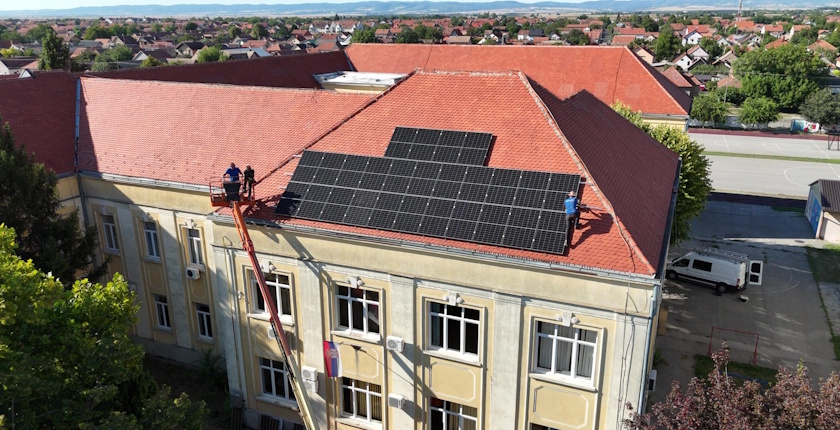
The Dušan Jerković Primary School in Ruma is the first school in the Srem (Syrmia) region, in Serbia’s north, with a solar power plant installed on its roof, and it is in the process of obtaining the prosumer status. The project was implemented in cooperation with the Elektropionir energy cooperative and funded by German Development Cooperation. The Deutsche Gesellschaft für Internationale Zusammenarbeit (GIZ) GmbH implemented the endeavor.

Although the number of prosumers in Serbia is growing, it still remains relatively small compared to the vast potential of rooftops and the abundance of sunshine that the country enjoys. According to recent data from electricity distribution system operator Elektrodistribucija Srbije (EDS), there were 5,310 registered prosumers, formally called buyers-producers.

Their total installed capacity was over 113 MW. Most were households (3,848), followed by legal entities (1,457), while the number of residential communities producing their own energy remains very small, only five.

A few years ago, upon an assessment of rooftop areas in Serbia suitable for solar panel installation, the surface was estimated at as much as 600 square kilometers. Installing solar panels on just 10% would translate to 6 GW of solar power capacity.

On a bright note, awareness of renewable energy sources and their importance is steadily increasing, as shown by the growing number of institutions — including kindergartens, primary and secondary schools — choosing to take steps toward energy independence and become prosumers. One such example is in the Syrmia area, locally called Srem, and specifically in Ruma, where the Dušan Jerković Primary School recently became the proud owner of a rooftop solar power plant. The town is located west of Belgrade.

[wpcc-iframe title=”Solarna elektrana na krovu škole Dušan Jerković u Rumi prva škola prozjumer u Sremu” width=”500″ height=”281″ src=”https://www.youtube.com/embed/9w4_aGTyiEU?feature=oembed” frameborder=”0″ allow=”accelerometer; autoplay; clipboard-write; encrypted-media; gyroscope; picture-in-picture; web-share” referrerpolicy=”strict-origin-when-cross-origin” allowfullscreen=””]

According to school principal Ivana Milojević, the idea was born in September 2024, when representatives of the energy cooperative Elektropionir first visited the school and proposed a partnership.

Elektropionir organized a series of lectures and workshops for students, parents, and school staff

Before the solar installation began, Elektropionir organized a series of lectures and workshops for students, parents, and school staff, focusing on renewable energy sources and the benefits of installing solar panels. The proposal to set up a photovoltaic system on the school’s roof was enthusiastically supported by both the school administration and the Municipality of Ruma, which owns the building.

Foto: Elektropionir

The power plant will significantly reduce the school’s electricity bill

The German Development Cooperation fully funded the installation of a 10 kW solar power plant in a project implemented by GIZ. The system was completed in late August, and the process of obtaining the prosumer status from DSO Elektrodistribucija Srbije (EDS) is underway.

It means that the generated electricity will be used to cover the building’s energy needs, and any surplus will be delivered to the grid, while the school will be able to utilize the excess energy later, when its consumption exceeds production.

“I am very proud that the Dušan Jerković Primary School is the first school in Srem to have a solar power plant. Our school, known for its yellow color, has now got a touch of green, symbolizing our commitment to protecting nature and raising environmental awareness among our students and fellow townspeople. We sincerely thank GIZ and the Elektropionir energy cooperative for their effort, work, and financial support in materializing a wonderful idea,” principal Ivana Milojević said.

The new solar plant will significantly reduce the school’s electricity bills, allowing it to use the savings for other improvements — such as upgrading classrooms or purchasing teaching materials to enhance the learning process.
by in News

City of Pirot in Serbia plans solar power plant on remediated unsanitary landfill

The City of Pirot plans to build a solar power plant on the site of a former unsanitary landfill when it is remediated. The move would strengthen its leadership position in Serbia regarding the use of renewable energy and environmental protection.

In 2013, Pirot opened a regional sanitary landfill, which cost EUR 11 million. It enabled the local authority to shut down an unsanitary landfill on the right bank of the Nišava river. However, the land still hasn’t been remediated and reclaimed.

Now the Ministry of Environmental Protection of Serbia has approved EUR 2 million for the works, Serbia’s public broadcaster RTS reported. With the completion of remediation, the possibility opens up for the six hectares of land in the country’s southeast to be repurposed.

Solar panels would be installed on three hectares

Mayor of Pirot Vladan Vasić said that the documentation for the remediation of the landfill is complete. The city intends to add EUR 500,000 to the EUR 2 million received from the government and complete the first phase. He plans for the second phase to be approved next year, to solve the decades-long issue in an environmentally acceptable way.

Vasić revealed one and a half to two hectares would be allocated for businesses, adding that the purpose of the remaining land is still under consideration.

A photovoltaic plant would be the most cost-effective solution

One idea is to install a 3 MW solar power plant that would supply electricity to the city authority, he pointed out.

Other ideas are a football stadium, a golf course, afforestation, and a park. The photovoltaic plant would be the most cost-effective solution, Vasić added.

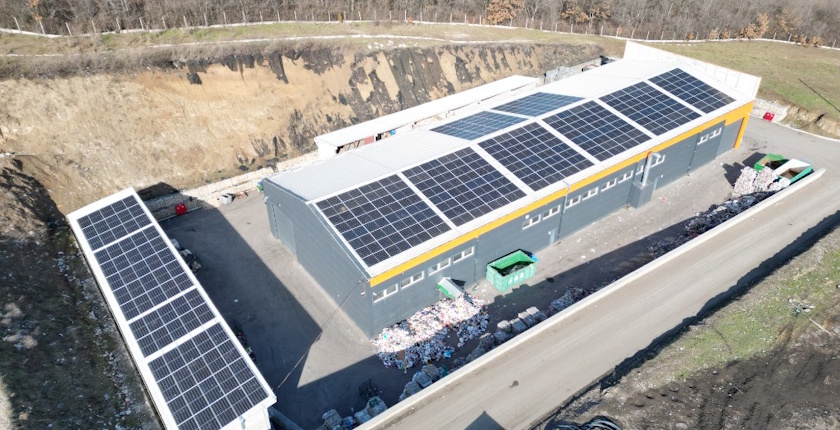
Of note, there is a solar power plant on the roof of the building of public waste utility Regional Landfill Pirot. The 150 kW facility began operating in August last year. The city officials claim it is the largest PV plant in Pirot county.

The first cooperative solar power plants in Serbia are located on the Stara Planina mountain

Pirot is also developing a regional waste management center. In 2022, the city signed a contract for the construction of the second landfill body, a composting plant, and a biogas facility.

The additional segment would extend the operation of the sanitary landfill by 20 years, while the biogas collection system would enable the collection of methane from the landfill.

A system for treating construction waste to enable material recycling is planned as well.

As for solar energy, not far from the city, the Stara Planina mountain is the home of the first cooperative solar power plants in Serbia. The local authority participated in the project. They were put into operation last year.

In mid-2023, PV projects were under development for over 125 MW in total capacity on the city’s territory. Of note, this year Pirot became the 13th local authority to join the Clean Air Regions Initiative, initiated by the Energy Community Secretariat.

by in News

Enery, Teva sign 15-year virtual PPA for solar, BESS in Bulgaria

Renewable energy firm Enery and Teva Pharmaceutical Industries have signed a 15-year hybrid power purchase agreement.

Under a financial or virtual power purchase agreement (PPA), a future solar power plant with two battery energy storage systems (BESS) will supply 60,000 MWh of electricity annually to Teva’s two plants in Bulgaria.

The landmark agreement is the first of its kind in the region to include green electricity supply from a newly built solar power plant with BESS and the longest one in Bulgaria so far, Enery said.

It is the Austrian company’s 15th PPA signed in the last four years across Central and Eastern Europe and the second one involving a Bulgaria-based offtaker.

The PPA sets a precedent for integrating storage within virtual PPA structures

Over the 15 years, the project is expected to avoid emissions of 15,840 metric tons of CO2 equivalent per year, supporting Teva’s goal to reduce scope 1 and 2 emissions by 46.2% by 2030.

The hybrid PPA also sets a precedent for integrating energy storage within virtual PPA (vPPA) structures, enhancing grid resilience and the value of renewable energy procurement, Enery stressed.

According to the company, the agreement will facilitate the construction of a photovoltaic park of 122 MW in peak capacity, equipped with two BESS installations at the site — one with a capacity of 70 MWh and another of 130 MWh. Located on non-arable land in the villages of Knizhovnik and Dolno Voyvodino in the Haskovo municipality, south Bulgaria, the Knizhovnik solar park is projected to produce 200 GWh of clean electricity per year.

Decktor: Teva is not only securing clean energy but also enhancing grid resilience and flexibility

“This agreement represents another significant step forward in our decarbonization journey,” said Josh Decktor, Teva’s Vice President and Global Head of Environment, Health, Safety and Sustainability.

By investing in a newly built solar asset with integrated storage, Teva is not only securing clean energy but also enhancing grid resilience and flexibility – key components of its strategy to meet its science-based targets, he added.

“We are proud that our projects are being realized thanks to an innovative partnership with companies that are proven leaders in their market niche, such as Teva, and demonstrate a strong commitment to the environment and society,” Enery’s Chief Commercial Officer Severin Vartigov stated.

by in News

Zen Energy Group kicks off construction of hybrid PV-BESS project in North Macedonia

Luxembourg-based Zen Energy Group has started the installation of a hybrid energy project in North Macedonia, combining a solar power plant and a battery energy storage system.

A solar power plant with a battery energy storage system (BESS) could become the country’s second hybrid power plant, with Fortis Energy installing energy storage near Oslomej solar park.

Zen Energy Group kicked off the construction of a landmark solar plus storage project in North Macedonia, Yossi Edelstein, Chief Executive Officer of Zen Energy Group, wrote on LinkedIn.

From concept to construction, Zen Energy Group is making the future of energy a reality in the country, he added.

“We are proud to share that our 82 MW utility-scale solar project with 50 MWh BESS in North Macedonia has officially entered the construction phase,” Edelstein stated.

The PV plant will use LONGi bifacial solar panels

The company’s team kicked off earthworks, development of access roada and cut-and-fill activities. The project is scheduled to start delivering green electricity to the national grid by late April 2026 and to achieve full commercial operation date in August 2026, according to Edelstein.

The project marks another significant step toward advancing clean energy generation in the region, he added.

According to the firm’s website, the photovoltaic plant will be located near Negotino. It will use LONGi bifacial solar panels for the expected annual production of 124,198 MWh.

The financing was secured from NLB bank, the website reads.

The developer revealed that it has signed a power purchase agreement (PPA) for 10 years in total, with a six-year fixed price period.

Seven projects in the pipeline

Works near Negotino (photo: Zen Energy Group/LinkedIn)

Zen Energy Group is developing seven energy investments – for three solar parks, two wind farms, a standalone BESS, and a commercial and industrial (C&I) portfolio in the UK.

Wind farms Unirea (102 MW) and Traian (78 MW) are located in Romania, while two PV facilities in North Macedonia would have a total capacity of 137 MW. The Negotino endeavor is for 82 MW and the Armatus investment envisages 55 MW.

Solar project Hajdučica of 125 MW is planned in Serbia. All three PV plants would have BESS. The company is developing the Lacu Sarat standalone battery facility in Romania. If it were in operation now, it would be the largest BESS in Europe.

by in News

Serbia’s power utility to take no loans in 2025, fund coal projects on its own

For the first time, Elektroprivreda Srbije (EPS) will not take out loans this year, but will finance all investments from its own resources, according to General Manager Dušan Živković. However, it has affected the financial performance of Serbia’s state-owned power utility, with profit in the first half of 2025 coming in lower than in the same period last year.

One of the major investments underway is in coal mining, including the construction of several systems needed to enable the opening of the Radljevo open pit mine in the Kolubara mining basin. However, since financial institutions are unwilling to finance fossil fuels, EPS must rely entirely on its own funds, Živković told national broadcaster RTS.

EPS is financing the coal mine on its own, as financial institutions are unwilling to invest in fossil fuels

To ensure sufficient coal supplies, EPS has contracted imports from Indonesia, which Živković explained as a strategy to diversify sources. He described it as the best way to ensure the security of supply.

He said that the installation of machinery at Radljevo is underway and that EPS expects the mine to start producing overburden and coal early next year.

EPS posted a RSD 27.4 billion (EUR 233.8 million) profit in the first half of 2025, compared to RSD 32.8 billion (EUR 280.3 million) in the same period last year.

Kostolac wind farm set to begin operation

Speaking about other key projects, Živković revealed that the commissioning of the 66 MW Kostolac wind power plant is in the final phase and expressed hope that electricity production would begin within a month. He also recalled that the 10 MW Petka solar power plant, built at the tailings dump in the Kostolac coal complex, was put into trial operation about a month ago.

He also said pumped storage hydropower plant Bistrica and the planned 1 GW of solar facilities could come online in the medium term.

Commenting on the announced 7% electricity price increase in October, Živković stressed the process has been initiated and that he expects it to be completed within one to one-and-a-half months.

Electricity consumption during the summer is lower than last year

On the surge in electricity consumption during the summer months, he said the situation this year has been “calmer” than in 2024, with consumption at around 90 GWh, compared to 114 GWh in 2024. It means total demand can be covered from EPS’s own capacities, according to him.

by in News

Econergy’s 87 MW Oradea solar park in Romania starts commercial operation

Econergy Renewable Energy connected its 87 MW Oradea solar power plant to Romania’s national grid and began commercial operation.

Oradea solar farm, with a capacity of 87 MW, is Econergy’s fourth photovoltaic plant in Romania. With the addition, the company’s operational and ready-to-connect capacity in the country has reached 447 MW. It is building another 788 MW and expects to start building another 559 MW by the end of 2025, according to the latest update.

Econergy operates Romania’s biggest PV plant, Rătești, in an equal partnership with Nofar Energy. They inaugurated the facility with 154.7 MW in peak capacity in 2023. The other two are the Părău solar park of 92 MW in peak capacity, near Brașov, developed in a 50:50 joint venture with RGreen Invest, and the Scurtu Mare facility of 55 MW in peak capacity, where Phoenix Holdings is a minority partner.

Econergy plans to add a 68 MW co-located battery energy storage system to the Oradea project

As part of its strategy to integrate storage solutions, Econergy plans to add a 68 MW co-located battery energy storage system (BESS) to the Oradea facility. The storage system is anticipated to increase the project’s economic value by generating new revenue streams, facilitating grid balancing services, and optimizing electricity sales through price arbitrage.

The Oradea solar power plant was developed in partnership with Israeli financial services firm Phoenix Holdings, which has invested more than EUR 225 million in Econergy’s Romanian and Polish projects.

“The successful connection of Oradea marks another important milestone for Econergy in Romania. This achievement underscores our ability to deliver large-scale renewable projects while advancing our strategy of integrating storage solutions to maximize value for our stakeholders. We are proud to strengthen our partnership with Phoenix Holdings as we continue to expand our renewable energy platform across Europe”, said Eyal Podhorzer, CEO of Econergy.

by in News

Serbia’s EPS reports EUR 234 million profit for first half of 2025

Elektroprivreda Srbije achieved a profit of RSD 27.4 billion (EUR 233.8 million) in the first half of 2025.

The financial result of the state-owned Elektroprivreda Srbije (EPS) is lower than in the same period of 2024, when profit amounted to RSD 32.8 billion (EUR 280.3 million). The company posted RSD 26.1 billion (EUR 222.8 million) in net income for the entire year.

The Ministry of Mining and Energy said the shareholder assembly of the Serbian joint stock company EPS has adopted the report on the implementation of its three-year business plan for the first six months of 2025, declaring a profit of RSD 27.4 billion (EUR 233.8 million).

Minister of Mining and Energy Dubravka Đedović Handanović, the sole shareholder assembly member, noted that the trend of continuous production and financial stability of the company has continued, and highlighted the importance of the results achieved in the mining sector.

The priority is to prepare machinery for the new Radljevo mine in the Kolubara basin

Coal production exceeded the plan by 8%, but more importantly, the year-over-year rise in coal production was 7%, according to Đedović Handanović.

However, in her words, it is crucial to continue the same pace, which is why great effort must be put into completing the machinery preparation project for the new Radljevo mine in Kolubara, so that overburden production can begin next year.

Reduced costs for coal procurement from outside the company

She said that through careful management of the electricity portfolio, coal stocks in depots have been maintained at a high level, around 1.68 million tons. The costs of purchasing coal from third parties are RSD 1.35 billion (EUR 11.5 million) lower than planned and significantly lower than in the past three years, Đedović Handanović said.

The minister highlighted the fact that hydrology has been unfavorable for the second consecutive year, affecting electricity production.

She recalled that in the first quarter of this year, the Petka solar power plant in Kostolac was put into trial operation. Soon, the blades of EPS’s first wind farm will be spun for testing, she Đedović Handanović added.

EPS investing in a subsidiary in Kosovo and Metohija

“It is essential to improve the management of investment activities, especially considering that work is underway on the most significant energy project – the construction of the Bistrica pumped storage hydropower plant. At the same time, it is important to continue efforts to reduce operational costs and improve customer relations,” the minister stressed.

She revealed that as part of the company’s transformation process, key performance indicators (KPIs) were introduced for executive and middle management.

The EPS assembly also approved the decision to invest in the capital of Elektrosever, the company’s subsidiary in Kosovo and Metohija.

That way it enables supplying Serbia’s citizens in four municipalities in the province’s north, she explained. More than 45% of consumers got smart meters by now from Elektrosever, the ministry stressed.

by in News

DRI secures financing for Vacaresti solar park in Romania

Renewable energy firm DRI has secured financing for the construction and operations of its Vacaresti solar park in Romania.

DRI, UniCredit and Garanti BBVA have signed an agreement for non-recourse loans of up to EUR 60 million to finance the construction and operations of the Vacaresti solar park in Romania.

DRI is Ukraine-based DTEK’s renewables subsidiary in the European Union.

The loan is inclusive of a long-term, fully amortizing construction and term loan, value-added tax, a debt service reserve facility, and the letter-of-credit facilities, according to the firm.

The project is expected to come online in the autumn

The loan structure is aligned with Green Loan Principles and the European Union’s Taxonomy Alignment Criteria, DRI added. It serves as a cornerstone of the EU’s sustainable finance framework and a key tool for market transparency, by providing clear guidelines for direct investments that support the green transition in line with the objectives of the European Green Deal, the press release reads.

The solar power plant will be located in the Văcărești area in Dâmbovița county. The project is for 126 MW in peak capacity, enough to power about 50,000 households and avoid 48,600 tonnes of carbon emissions per year. Construction kicked off in January 2025 and the project is expected to be online in the autumn.

The buyer of 50% of the electricity output is oil and gas company OMV Petrom. The deliveries will start in January 2027. It is a part of Romania’s largest physical solar power purchase agreement (PPA), signed last December, DRI noted.

Geliukh: DRI is demonstrating its capability to partner with globally renowned financial institutions

“With the signing of this project financing agreement, we have reached another important milestone: this is DRI’s first internationally led syndicated financing, our first certified green loan, and our first multi-currency loan,” DRI CEO Ivan Geliukh stressed.

In his words, it is an important achievement not only for DRI but also for Romania, contributing to the development of renewable energy in the country.

With the project, DRI is demonstrating its capability to partner with globally renowned financial institutions like UniCredit, and with Garanti BBVA, one of Romania’s leading local lenders, according to Geliukh.

DRI has three operational projects in Romania

In Romania, DRI has three operational projects with a total peak capacity of 173 MW. Solar parks Glodeni I and Glodeni II have a combined installed capacity of 113 MW. They are one of the largest renewable energy sites in the country, according to the company.

The 60 MW Ruginoasa wind farm was built in just 10 months. It was the first in the country after a decade, according to the firm.

DRI now has a 1.3 GW portfolio of projects in operation, construction and other stages of development. The company is also active in Croatia.

by in News

Slovenia’s HESS inks 9.2 MW deal for two solar power plants near HPP Brežice

Hydropower plant operator Hidroelektrarne na Spodnji Savi will build two solar power plants with a combined capacity of 9.2 MW near its Brežice hydropower plant. It picked Končar as the contractor.

Two new photovoltaic facilities in the pipeline are the continuation of investments in solar near the Brežice hydropower plant. Hidroelektrarne na Spodnji Savi (HESS), owned by GEN and HSE, installed a 6 MW PV plant in May 2023 next to the reservoir of its HPP Brežice’s.

At the time, it was the largest in Slovenia, and it remains the largest hybrid system in the country.

The existing PV plant is FEBR-D3, while the two new ones are called FEBR-D1 and FEBR-D2.

“We’re excited to announce a new chapter in our collaboration with HESS,” Croatia-based Končar said.

Končar will install the two solar power plants

Končar, an engineering company, signed a contract in July for the construction of FEBR-D1 and FEBR-D2. It said the endeavor extends the partnership established at HPP Brežice. Of note, it supplied generators for the 47.4 MW HPP, which began operating in 2017.

Located just a few kilometers upstream from HPP Brežice, on the left bank of the Sava River, the two units will have a combined peak capacity of 9.2 MW, powered by 14,790 PV modules, Končar added.

The Croatian firm revealed that the contract is worth EUR 4.5 million. It sets an ambitious goal: both plants are scheduled to be fully operational and handed over to the client by the end of next year, according to Končar.

The largest solar power plant in Slovenia has a capacity of 7.1 MW

In late May, on World Sun Day, HESS announced that it obtained construction permits for the FEBR-D1 and FEBR-D2 solar plants. It is the continuation of the story within which, on June 21, 2023, Slovenia’s largest hybrid solar power plant FEBR-D3 began production, it added.

Of note, the largest solar power plant in Slovenia has a capacity of 7.1 MW. It came online last month on the border with Italy.

Hydropower and solar energy make an excellent combination, so numerous power utilities, including the ones in the Western Balkans, decided to invest. The latest example comes again from Slovenia, where Soške Elektrarne Nova Gorica (SENG), part of HSE, commissioned its first PV unit at its Avče pumped storage hydropower plant.

by in News

RP Global gets EUR 12.2 million loan for Novalja solar project

RP Global has secured a EUR 12.2 million loan to build its Novalja solar power plant in Croatia.

In late April, Austrian company RP Global began the construction of the Novalja photovoltaic plant at the Zaglava site on the island of Pag.

The European Bank for Reconstruction and Development (EBRD) said it approved a senior non-recourse project finance loan of up to EUR 12.2 million to RP Global Novalja d.o.o., owned by RP Global Energy GmbH, for the development and construction of the 21 MW Novalja PV plant in Croatia.

The project has been approved under the EBRD InvestEU Framework for Sustainable Transition.

The loan is divided into two tranches

The loan is split into two tranches: one amounting to a maximum of EUR 7.2 million, and the second of up to EUR 5 million, benefiting from a 20% first loss coverage under the EBRD InvestEU Framework for Sustainable Transition, the bank’s decision reads.

The total project cost is estimated at EUR 16.3 million.

The endeavor includes the installation of 35,776 photovoltaic panels. The expected annual electricity production is around 31,000 MWh, enough to supply about 12,000 households.

According to the EBRD, the project supports innovative offtake arrangements. It will combine a national renewables support with a merchant exposure in later years.

RP Global won premiums for its project at auctions

Last July, the Croatian Energy Market Operator (HROTE) awarded premiums for solar and hydropower plants with a total capacity of 420 MW. RP Global’s Novalja was among them, with 15 MW.

Back in 2022, the company said it intended to build wind farms and solar parks of 500 MW overall in Croatia over the next five years.

RP Global has completed two renewable energy projects in Croatia: the Danilo wind farm near Šibenik and the Rudine wind park near Dubrovnik.

Of note, the island town of Novalja could become one of the first in Croatia to begin the production of green hydrogen, and a rare example in the region. A project was launched in May.