by in News

Satellite dishes get new life, hosting solar panels for data center

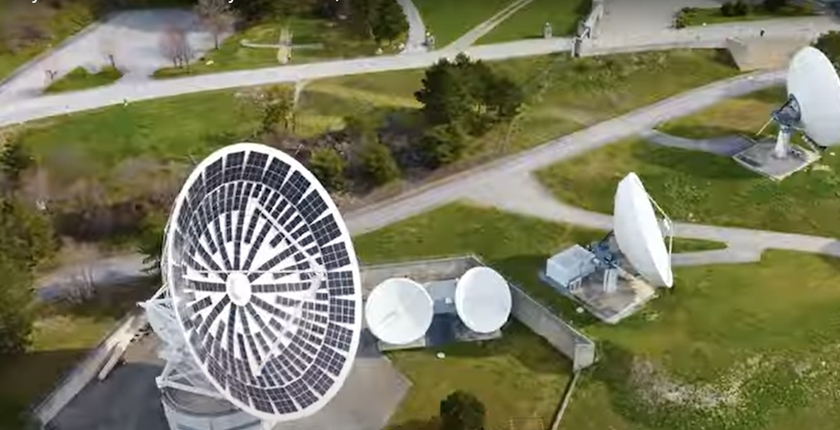
A Swiss telecom service provider converted unused satellite dishes into solar dishes, powering its data center’s rising energy needs. Smart energy tech firm SolarEdge provided its DC-optimized inverter solution, overcoming the challenge of shading.

CKW, a Swiss provider of integrated energy and building technology solutions, has transformed disused satellite dishes located on the premises of telecom service provider Leuk TDC. The project was developed in collaboration with smart energy technology company SolarEdge, highlighting the potential of repurposing infrastructure for solar.

Instead of disposing of the parabolic antennas, they now host photovoltaic systems. Axpo’s subsidiary CKW fitted two satellite dishes in Leuk, Switzerland, with 307 solar panels each.

The new design for the complex, constructed in 1972, enables meeting the energy requirements of Leuk TDC’s power-hungry data centre. Each dish generates an estimated 110 MWh of clean energy per year. The telecommunications firm has also installed a rooftop solar system on the main building of the computing and data centre, for a further 555 MWh.

The data centre is powered by hydroelectric plants as well, so its electricity demand is covered with 100% renewable energy.

[wpcc-iframe title=”Case study: Satellite Dish to PV System – Leuk, Switzerland” width=”500″ height=”281″ src=”https://www.youtube.com/embed/dR2ETrx3aJ0?feature=oembed” frameborder=”0″ allow=”accelerometer; autoplay; clipboard-write; encrypted-media; gyroscope; picture-in-picture; web-share” referrerpolicy=”strict-origin-when-cross-origin” allowfullscreen=””]

SolarEdge systems maximizing output of each pair of PV panels in satellite dishes

Given the complex orientation and inclination of the solar panels on the satellite dishes, shadows threatened to reduce the efficiency of the solar system. With traditional string solar inverters, they reduce the overall performance of the solar array to match the weakest-performing panel on the string, meaning one shaded panel could reduce energy yield considerably.

In a string structure, a photovoltaic unit in a satellite dish wouldn’t be cost-effective

SolarEdge’s DC-optimized inverter solution was used with Power Optimizers, attached to the underside of every pair of solar panels. It enables the solar system to mitigate the impact of module mismatch on the satellite dishes. Inverters turn the direct current (DC) from PV panels into alternating current (AC).

“Having design flexibility with a solar installation is a huge benefit for installers. In complex cases such as these, with uneven surfaces, without the use of power optimizers we simply would not have been able to achieve anywhere close to the level of energy being produced today. I recommend that others planning similar solar installations allocate sufficient time for planning and collaborate with trusted personnel to overcome any technical challenges,” said CKW’s Deputy Head of Solar Technology for Central Switzerland Manuel Jossi.

Making use of existing ability to track sun’s movement

The combination of PV and hydropower provides Leuk TDC with more financial stability by reducing its dependency on variable grid electricity costs. “The satellite dishes were becoming obsolete, so we always knew we wanted to make use of them in some way or another,” the company’s Chief Executive Officer John Harris explained.

One other advantage is that the parabolic antennas follow the sun’s path throughout the day, maximizing the solar power output.
by in News

Federation of BiH launches grants program for prosumers

The Federation of BiH, one of the two entities constituting Bosnia and Herzegovina, has launched a grants program to co-finance the installation of rooftop solar power plants, expected to cover around 500 households a year and lead to an increase of 4.2 GWh in renewable electricity production.

Operator for Renewable Energy Sources and Efficient Cogeneration – Operator za OIEiEK estimates that the average installed capacity of the solar power plants will be 6 kW, and that the grants will help reduce greenhouse gas emissions by 3,800 tons a year.

The program will be funded from renewable energy surcharges

The program will be funded from renewable energy surcharges paid through electricity bills by all consumers in FBiH. Grants will be approved for two categories of applicants. The first one is vulnerable households whose annual consumption exceeds 3,500 kWh. The second covers those who consume more than 5,500 kWh a year and whose connection power is equal to or less than the requested installed capacity of the solar installation, according to the decision of the Operator za OIEiEK.

The maximum grant amount per applicant is BAM 7,000 (EUR 3,580), or up to 60% of the investment cost for users in the second category.

Damir Miljević: People in extreme energy poverty will get solar power plants for free

Although the budget and the anticipated scope of the program are modest, one positive aspect is that part of it is intended to fully cover the cost of PV installations for people in extreme energy poverty. They will receive a rooftop system free of charge, eliminating, partially but permanently, some of the concerns about financing their energy needs, according to Damir Miljević, a member of the Board of the Center for Sustainable Energy Transition (RESET), a BiH think tank.

Prosumers were introduced in the FBiH legislation two years ago, with the passage of a set of reform energy bills, including the Law on the Use of Renewable Energy Sources and Efficient Cogeneration.

At the national level in Bosnia and Herzegovina, prosumer regulations have not been adopted yet. According to some estimates, the country could cover half of its electricity consumption by installing solar panels on about a million roofs.

by in News

Photovoltaics recycling gains traction in Greece with new facilities

Two recycling facilities for solar panels are complete in Greece, while another one is expected to follow soon.

The business case behind the investments in recycling is solid, as more and more older solar farms will reach the end of their operational life, which is 20-25 years. European and national laws stipulate that such equipment must be recycled to reduce pollution and reuse critical minerals as much as possible.

However, owners who prefer to replace their equipment even before the end date is reached are also interested in recycling. The reason is the much higher efficiency of modern photovoltaics.

The factor is gaining in importance as solar panel prices have dropped, while curtailments have been on the rise for two years.

Fotokiklosi is currently the only active licensed company in the sector. It exports photovoltaic waste to Italy for recycling and also specializes in appliances, bulbs and electronics.

However, new opportunities emerge, as other companies have invested in the country’s first recycling facilities. They are situated in Ritsona in Central Greece, in the island of Crete and in Kozani in the Western Macedonia province in northern Greece. The first two are already operational, while the third one is almost complete.

Massive drop in prices

Competition seems to be heating up. According to energypress.gr, Fotokiklosi was charging EUR 300 per ton of photovoltaic waste six years ago, EUR 150 per ton in 2023-2024, and after that only EUR 90 per ton.

It should be noted that the process begins with the payment of a fee from the retailer or importer of panels to the recycling system operator. The recycling company collects the money and pledges to handle the waste after the panels’ operational life has ended.

Fotokiklosi is currently awaiting a new license from the Hellenic Recycling Agency (HRA or EOAN), based a suggested price of EUR 90 per ton.

With the new plants in Greece, old panels will no longer have to be transferred to Italy for recycling. The lower overall cost makes the choice easier for Greek solar farm owners.

by in News

Significant step for citizen energy in BiH – Republic of Srpska enables establishment of first renewable energy communities in region

The recent adoption of the rulebook on renewable energy communities in the Republic of Srpska is a big step in enabling citizens, local authorities, and businesspeople in Bosnia and Herzegovina to join forces and produce electricity for their own needs. It was a key step in introducing citizen energy. The concept is a great opportunity for the Balkans, because it can provide many benefits like lowering bills for consumers, and a sustainable energy transition, according to Damir Miljević, a member of the Regional Center for Sustainable Energy Transition (RESET) from BiH.

The new rulebook on renewable energy communities in the Republic of Srpska, one of the two entities making up Bosnia and Herzegovina, defines the activities of renewable energy communities (REC).

Energy transition consultant Damir Miljević explained to Balkan Green Energy News that REC refers to the production of electricity from renewables, while citizen energy communities (CEC) include all types of energy. The rulebook adopted by the Republic of Srpska, in his words, is the first in the region. It is focused on enabling the production of electricity for self-consumption (prosumers) primarily from renewable energy sources such as solar, wind, and hydro energy.

Energy communities are an opportunity for citizens and businesspeople lacking suitable roofs for photovoltaics

He says the rulebook finally created the conditions at the local level – where the energy transition is supposed to be conducted in the first place – for citizens, local authorities, and businesspeople to join forces and produce electricity by installing a facility together. They can use some of the produced electricity for their own needs and inject the rest into the grid.

Citizens and small entrepreneurs who don’t have suitable roofs for solar power plants and municipal authorities with many roofs at their disposal as well as their own land can jointly finance and use such facilities. They will benefit both on the individual and collective level, Miljević pointed out. Without the communities framework, it wouldn’t be possible, in his opinion.

“In addition, conditions are created through RES communities to cede a part of the energy that the community’s facility generates, if the members of the community agree, to vulnerable categories of the population, contributing to the fight against energy poverty that way,” said Miljević, who is among the speakers at the upcoming Belgrade Energy Forum 2025 (BEF 2025).

Miljević: Elektroprivreda Republike Srpske needs to do its part

The rulebook’s entry into force enabled citizens, local firms and local communities to establish renewable energy communities, Miljević said and added that the only serious remaining obstacle is the refusal of government-owned power utility Elektroprivreda Republike Srpske (ERS) to sign new supply contracts.

Prosumers in the entity can’t fully exercise their rights, despite an order from the Regulatory Commission for Energy of the Republic of Srpska, as they haven’t yet received the new supply contracts from ERS, he pointed out.

Citizen energy is a great opportunity for Balkan states

Damir Miljević (photo: Balkan Green Energy News)

Miljević stressed that rulebooks are among the steps in introducing citizen energy. Miljević noted that the other parts of BiH haven’t established regulatory frameworks. The Brčko District has no bylaws, while the Federation of BiH has adopted the rules for renewable energy communities, but hasn’t simplified its rules for connecting prosumers and the communities to the grid.

Production onsite for consumption should become priority in energy policies and for decarbonization efforts in the Western Balkans

In Miljević’s opinion, the resistance is enormous and partly caused by the lack of recognition of the importance and role of citizen energy in countries such as the Balkans.

In contrast to developed countries – for instance, household consumption in the European Union has a 25% share in total final electricity consumption – in BiH and Serbia it is 42%, and in Montenegro it amounts to around 50%, he noted.

It means the concept of producing for consumption onsite should be a priority in energy policy and for decarbonization efforts in the Western Balkans, Miljević stressed. It implies putting solar panels on roofs on a significant scale, which is the essence of citizen energy, he added.

Citizen energy isn’t a priority in domestic and international policies implemented in the region

In addition to reducing electricity bills for customers, the concept contributes to reducing distribution and transmission losses and required investments in new grid capacities and new large power plants, and improves the security of supply and energy independence of a country, according to Miljević.

Citizen energy, in his words, is the only solution for a safe and sustainable energy transition and decarbonization of domestic power consumption, but unfortunately it isn’t a priority in domestic and international policies implemented in the region.

The lobbying effect of investors in the market shouldn’t be underestimated either, nor the fear and resistance within the politics and state-owned power utilities to the decentralization, democratization, and demonopolization of power generation that citizen energy brings, Miljević concluded.

by in News

Landmark report demonstrates safety, cybersecurity, higher yield of SolarEdge PV systems

VDE Renewables found in its new report that SolarEdge’s advanced safety capabilities minimize photovoltaic system risks and effectively prevent fire hazards, while exceeding international PV safety regulations. SolarEdge has robust cybersecurity mechanisms, essential to mitigating risks associated with cyberthreats, and its solutions bring higher energy yields for both simple and complex roofs.

A new report by VDE Renewables, a subsidiary of the VDE Group, has demonstrated that SolarEdge’s inverter and Power Optimizer-based PV systems deliver measurable advantages in advanced safety, cybersecurity and higher energy production across a wide range of installation types.

In its in-depth assessment of Module-Level Power Electronics (MLPE) topology and SolarEdge’s approach to PV systems, the report highlights how SolarEdge’s advanced safety features reduce PV system vulnerabilities and exceed international PV safety standards. Reviewed and validated by VDE Renewables, the integration of multiple protective mechanisms including Sense Connect proactively identifies and addresses faulty connections long before abnormal temperature is reached.

SafeDC™, rapid shutdown, and module-level monitoring was reported to provide a proactive approach to risk mitigation to ensure a significantly higher level of protection for system operators, maintenance personnel, and emergency responders.

Photo: SolarEdge’s inverter + Power Optimizer solution shown to produce higher energy yields for both simple and complex roofs (4% and 10.5% more power, respectively)

Unsecure PV systems becoming more vulnerable to cyberthreats

The VDE Renewables report also emphasizes cybersecurity as a top priority in PV systems, noting that as solar technology becomes increasingly digitized and interconnected, unsecure PV systems also become more vulnerable to cyberthreats.

With PV systems now integral to energy infrastructure, the consequences of cyberattacks can extend far beyond individual installations, raising wider concerns around grid security and resilience. In this context, VDE Renewables validated SolarEdge’s strong cybersecurity credentials, recognizing its comprehensive, built-in defence architecture and highlighting its robust cybersecurity mechanisms that mitigate risks associated with cyberthreats.

These mechanisms comply with leading international cybersecurity regulations, including IEC 62443, NIST Cybersecurity Framework, and ISO/IEC 27001. Additionally, SolarEdge’s solution includes encrypted communication protocols, secure remote firmware updates, multi-level access control, continuous monitoring, and penetration-tested system architecture.

SolarEdge provides residential solutions bolstering output on complex roofs by 10.5%

VDE Renewables also validated the performance of SolarEdge’s residential solution against leading traditional string inverter systems, even when using multiple MPPTs. The report confirms results that show a 4% increase in energy production on simple (single facet with no shading) rooftops and an impressive 10.5% increase on complex rooftops.

These gains are attributed to SolarEdge’s use of MLPE-based Power Optimizers and advanced Buck and Boost technology. The VDE Renewables report highlights the SolarEdge ONE energy optimization platform that helps maximize saving potentials with support for both fixed and dynamic electricity tariffs, as well as design advantages such as the ability to use longer strings, enabling lower BoS costs and larger systems within the same roof area – further contributing to overall energy yield.

Gruenewald: SolarEdge’s technology demonstrates its strategic market position in safety, cybersecurity, and performance

The report was sponsored by SolarEdge to evaluate its Power Optimizer-based PV system.

Arne Gruenewald, Project Manager Batteries and Energy Storage Systems, VDE Renewables: “Our assessment shows that SolarEdge’s technology demonstrates its strategic market position in safety, cybersecurity, and performance – criteria that are essential for the technology’s long-term viability and trust.”

VDE Group offers quality assurance services for the global renewable energy sector.

Christian Carraro, General Manager Europe, SolarEdge: “We welcome VDE Renewables’ validation of our technology, being a trusted partner for quality assurance, risk minimization and certification. As the solar industry grows and evolves, it’s essential that we continue to prioritize not just performance, but also safety and cybersecurity. This report encourages us to keep raising the bar and deliver technologies that support more powerful and secure energy solutions.“

About SolarEdge

SolarEdge is a global leader in smart energy technology. By leveraging world-class engineering capabilities and with a relentless focus on innovation, SolarEdge creates smart energy solutions that power our lives and drive future progress.

SolarEdge developed an intelligent inverter solution that changed the way power is harvested and managed in photovoltaic systems. The SolarEdge DC-optimized inverter seeks to maximize power generation while lowering the cost of energy produced by the PV system.

Continuing to advance smart energy, SolarEdge addresses a broad range of energy market segments through its PV, storage, EV charging, batteries, and grid services solutions.

by in News

Army joins forces with municipality, energy company, road firm to install solar panels in Slovenia

The Sunčana Vipava solar power project has brought together several key stakeholders in Slovenia – state electricity producer Soške Elektrarne Nova Gorica (SENG), the Ministry of Defense of the Republic of Slovenia (MORS), road management firm Družba za Avtoceste v Republiki Sloveniji (DARS), and the Municipality of Vipava.

The Sunčana (Sunny) Vipava project envisages installing solar power plants with a total capacity of 20 MW along highways, near military barracks, and on municipal land.

The initiative is seen as a strategic move towards achieving greater energy independence, enhancing energy supply security, and promoting sustainable development through advanced photovoltaic solutions, in both military and civilian areas, according to SENG.

The company operates 28 hydropower plants, with a combined capacity of 346 MW, on the Soča River and its tributaries, and is part of the Holding Slovenske Elektrarne (HSE) group.

In the Vipava municipality, SENG has identified several potential sites for harnessing solar energy, located adjacent to military barracks, along highways, and on municipal land.

The Vipava municipality intends to establish business zones in the vicinity of the future solar plants

The primary objective for all parties involved in the agreement is to maximize the utilization of solar potential, in conjunction with modern technologies such as hydrogen, SENG underlined.

The estimated potential at these sites is substantial, and it is currently financially viable to install solar panels with a total capacity of 20 MW. Additionally, the Municipality of Vipava plans to develop business zones in the vicinity of the future photovoltaic plants.

SENG and DARS have had a longstanding collaboration, initiated in July 2023, when the two state-owned companies agreed to develop solar power plants next to highways and signed a contract to build the first one in the southern region of Primorska.

SENG stressed the Sunčana Vipava project is one of its several green initiatives. The company plans to open its largest solar power plant at Kanalski Vrh before summer. The plant, located near the Avče pumped storage hydropower plant, will have a total capacity of 8 MW, and its first, 2.9 MW phase is nearing completion.

The official opening of the first phase is scheduled for early June.

Slovenia’s army involved in various energy projects

Photo: SENG

The involvement of the Ministry of Defense of the Republic of Slovenia (MORS) and Slovenian Armed Forces in energy projects is not a surprise.

In April 2023, a public-private partnership was initiated to build photovoltaic plants at the Edvard Peperko military barracks in Slovenia’s capital, Ljubljana. A year later, MORS launched the Defense Resilience Hub Network in Europe (RESHUB) project, which envisages establishing self-sufficient energy hubs.

In addition to highways and military barracks, Slovenia plans to install solar panels along railways, demonstrating its commitment to placing solar energy facilities in degraded or underutilized locations.

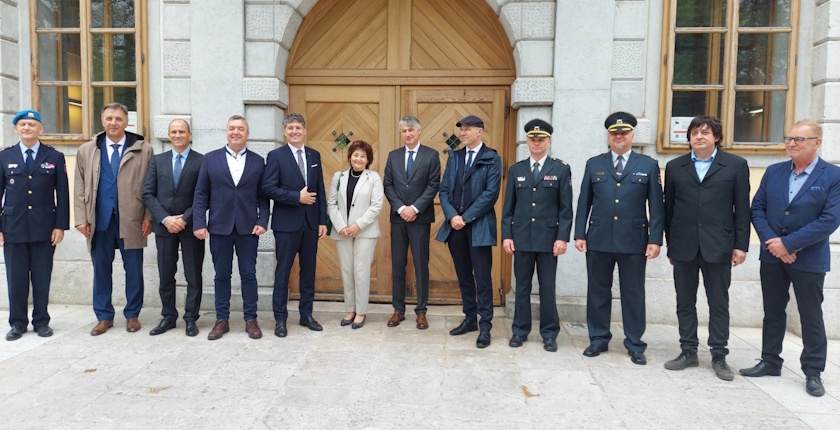
A cooperation agreement for this project was signed by Vipava Mayor Anton Lavrenčič, Slovenian Minister of Defense Borut Sajovic, DARS Board Member David Skornšek, and SENG CEO Mitja Gorjan.

Gorjan explained that SENG’s responsibilities include preparing project and investment documentation for the installation and construction of solar power plants at the Mlake military training ground, along military infrastructure and the highway, and in other locations within the Municipality of Vipava.

According to HSE CEO Tomaž Štokelj, the locations for energy facilities in the Vipava region present excellent opportunities for the multifunctional use of space.

by in News

Investors in BiH developing 3,800 MW of wind, 12,500 MW of solar

Wind farms with a capacity of 3,800 MW and solar power plants with a capacity of 12,500 MW are currently in various stages of development in Bosnia and Herzegovina, according to the indicative plan for the development of production  2026-2035, published by the Independent System Operator in Bosnia and Herzegovina.

The goal of the ten-year plan is to provide information on projects initiated for the construction of new production capacities to be connected to the transmission system, according to the transmission system operator (TSO), Independent System Operator in Bosnia and Herzegovina (NOSBiH).

The plan is supposed to prioritize covering domestic consumption and capacity needs with domestic resources.

NOSBiH said investors continued in 2024 to apply with their renewable energy projects. The interest in grid connections wasn’t affected by the significant reduction in electricity purchase prices, especially for the hours when solar power plants typically produce, it added in the plan

A lack of transmission capacities could become an obstacle to the export of electricity

According to the register of the applications for grid connections, which Elektroprenos BiH manages, there are about 3,800 MW of proposed wind farms and 12,500 MW of photovoltaic facilities in various stages of development, NOSBiH underlined.

Results of an adequacy assessment showed that increasing production makes it possible to increase exports. BiH’s TSO warned that in such a scenario, the currently planned transmission capacity expansion wouldn’t be sufficient.

Another 100 MW of solar is seen coming online in BiH by the end of 2025

With the current production development plans, the system could be left without sufficient balancing capacities. NOSBiH therefore called for developing balancing capacities in parallel.

The document shows that four solar power plants of 206 MW in total were added last year to the transmission network in BiH: FNE Zvizdan (28.5 MW), SE Bileća (55 MW), FNE Hodovo (92.47 MW), and FNE Deling invest 1 (29.75 MW), together with one wind farm, VE Ivovik, of 84 MW. In February of this year, the Ivan Sedlo wind farm (25 MW) was also put online.

By the end of 2025, the start of trial operation of another five PV plants is expected, the plan showed. They would have 100 MW altogether: FNE Hodovo F1-F4 (11.96 MW), FNE Brotnjo (9.98 MW), FNE Polog 1-8 (7.99 MW), FNE Plavo Sunce 1-2 (40 MW) and FNE Livno 1-6 (27.6 MW).

Batteries can bridge the period until the transmission grid capacity becomes adequate

The plan anticipates a similar tempo of grid connections for 2026, too.

In that case, along with the integration of renewables into the distribution network and similar power plants coming online in neighboring countries, a congestion can appear in the transmission network, together with complications in operating the country’s transmission system from a regulatory point of view, NOSBiH said.

Battery energy storage systems can solve both potential issues in the medium term, until investments get the transmission grid to an adequate level, it suggested.

BiH needs battery capability of 225 MW and 450 MWh in total capacity

The company recalled that a year ago it produced a study, together with the Deutsche Gesellschaft für Internationale Zusammenarbeit (GIZ), provisionally called Operational Models for Battery Energy Storage Systems in the Balancing Market of NOS BiH.

They estimated the need for additional balancing based on hour-by-hour production profiles for facilities of 1,500 MW in total photovoltaic capacity and 1,000 MW of wind. The authors said a combined 225 MW in battery operating power is required and an overall capacity of 450 MWh.

The study also explored revenue generation opportunities for BESS, particularly through participation in the ancillary services market.

by in News

Turkey to manufacture green hydrogen, nuclear, CCS equipment

The 2030 Industry and Technology Strategy includes setting up industrial facilities in Turkey for nuclear energy, green hydrogen, battery storage and carbon capture and storage (CCS). The country is planning to establish a value chain for critical raw materials. The government vowed to support the development of semiconductor technology, autonomous and flying vehicles and cybersecurity solutions, alongside innovations for electric vehicles and solar and wind power.

With its recently unveiled 2030 Industry and Technology Strategy, Turkey announced the ambition to upgrade its industrial production to one of the most advanced in the world. As Russia’s Rosatom is completing the country’s first nuclear reactor in Akkuyu, the government is planning to develop its own technology in the segment.

The strategy involves setting up industrial clusters for equipment and infrastructure. Among the possible technologies are molten salt reactors. The Scientific and Technological Research Council of Türkiye (TÜBİTAK), Turkish Energy, Nuclear and Mineral Research Agency (TENMAK) and Istanbul Technical University (İTÜ) are tasked with establishing a nuclear tech park.

Green hydrogen mostly needed for decarbonizing hard-to-abate industrial production

TÜBİTAK is responsible for developing domestic electrolyzers as well. The national hydrogen program is set to bring support for integrating the production of green hydrogen, storage, transportation and consumption. The last of the four is especially focused on energy-intensive industries such as steel, petrochemicals and fertilizers.

Another segment that would get incentives is the use of hydrogen in fuel cell vehicles including heavy vehicles. The strategy envisages setting up pilot zones for green hydrogen production, with electrolyzers powered by wind and solar energy.

Turkey has high ambitions for high-tech exports

Turkey has revealed the goal of tripling its high-tech exports to USD 30 billion by the end of the decade. It is part of an ambition to lift industrial exports to USD 400 billion from last year’s USD 247 billion. At the same time, the government’s target for the overall valuation of domestic tech startups is USD 100 billion.

The 2030 Industry and Technology Strategy has other chapters, too, like carbon capture, utilization and storage (CCUS or just CCS), access to critical raw materials, semiconductor and battery manufacturing and cybersecurity. Officials vowed to continue prioritizing domestic electric vehicles, but with investments in autonomous operation systems and even flying cars.

Cybersecurity solar and wind turbine technologies. Turkey apparently remains dedicated to expanding the industrial base for solar panels and wind turbines as well.

by in News

Zagreb on track to reach almost 20 MW of solar on public buildings

Zagreb operates solar power plants with a total capacity of 2.43 MW on public buildings, and an additional 16 MW is set to be installed on roofs, according to Mayor Tomislav Tomašević.

In 2021, the capital city of Croatia presented the Sunny Roofs program for the installation of photovoltaic plants with a combined capacity of 50 MW. Implementation began three years ago with the Solarization of Institutions of the City of Zagreb (SOLIZAG) project.

It was worth EUR 1,1 million. Within SOLIZAG, power plants were installed on eight city buildings – swimming pools Utrina, Svetice, and Jelkovec, kindergarten Trnsko, psychiatric hospital Sv. Ivan, homes for the elderly Trešnjevka 1 and 2 and waste management utility Čistoća. They have a total capacity of 1.6 MW.

The city currently has 2.43 MW of solar power plants in operation on public buildings

“In total, we currently have 2.43 MW of solar power plants in operation on public buildings owned by the City of Zagreb. It is three times the capacity we found in June 2021, only 0.7 MW,” Tomašević stated.

Currently, a total of 16 MW of solar power plants on city-owned buildings have been contracted or are in the process of being contracted. A firm has been selected for the design and construction of 10 MW of solar panels on approximately 200 city buildings, with implementation set to begin this year.

The mayor describes it as the largest investment in the solarization of public buildings in Zagreb’s history. In his view, it is a key step toward the goal of a more energy self-sufficient city.

Residents of Zagreb have a digital platform for assessing the solar potential of their roofs

In addition to the investments, commercial projects are being developed through the company Zagrebački Sunčani Krovovi. The PVMax project, supported by the North-West Croatia Regional Energy Agency (REGEA), is also underway for 41 MW in total on company buildings. So far, 6 MW has been installed.

Residents of Zagreb can assess the solar potential of their roof on a digital platform. It also calculates the cost-effectiveness.

Croatia’s capital is also participating in the Climate City Contract, which unites 100 cities committed to achieving climate neutrality by 2030. As part of the initiative, Zagreb is preparing a climate neutrality plan, expecting to adopt it this year.

Marking Earth Day, Mayor Tomašević visited one of the PV plants built within the SOLIZAG project, at the Svetice swimming pool complex. He was accompanied by his deputies Danijela Dolenec and Luka Korlaet.

Photo: City of Zagreb
by in News

Montenegro’s power consumption grows 25%

Electricity consumption in Montenegro has risen by 25% over the past four years, driven, among other factors, by solar power expansion. The installed capacity of photovoltaic plants amounts to around 80 MW, and it is expected to exceed 100 MW by the end of the year.

Jovan Kasalica, executive manager of the supply department in power utility Elektroprivreda Crne Gore (EPCG), attributed the surge in electricity consumption both to a low price of electricity and the growing contribution of solar power plants.

“The majority of this increase is linked to the heating sector, especially in central and northern Montenegro. We are making a significant contribution to decarbonization in the region, which we will document with precise data,” Kasalica noted at the international conference Energy 2025, held in the Zlatibor mountain in Serbia.

Rooftop solar is capacity is increasing

He said the development of the solar power segment was successful. Currently, nearly 80 MW of solar capacity is operational in Montenegro.

The Solari 3000+ and 500+ project brought online 30 MW of solar panels, and the second project, Solari 5000+, which aims for another 70 MW, is currently in advanced stages.

The initiatives focus on installing photovoltaics on the roofs of households and businesses, enabling citizens and entrepreneurs to produce electricity for self-consumption and become prosumers.

The Gvozd wind farm is set to be connected to the grid by the of the year

By the end of the year, it is anticipated that the total capacity of PV facilities in Montenegro will surpass the planned 100 MW, according to Kasalica.

He further noted that the company didn’t have any additional costs for the Solari 3000+ project, because the loans for the installation were switched to the funding facilities and consumers. The project has resulted in lower bills and greater energy efficiency, Kasalica said.

Additionally, he announced plans to connect the 54 MW Gvozd wind farm to the grid by the end of the year.

In addition to increasing the number of prosumers in Montenegro, EPCG plans to install ground-mounted solar power plants and to put online a total capacity of 200 MW within the next three years.

The company has also recently kicked off the main phase of the so-called ecological reconstruction of the Pljevlja thermal power plant. The only coal-fired facility in Montenegro won’t produce electricity until November.