by in News

Rörig (E.ON): Croatia charges up to six times higher e-waste fees on solar panels than other EU states

Croatia charges a waste fee on solar panels of EUR 300 per ton, up to six times more than other European Union countries. The levy slows down the expansion of solar energy, Andreas Rörig, president of the Management Board of E.ON Croatia, told Balkan Green Energy News.

In addition to the one-off e-waste management fee, hindering investments, another issue is that Croatia doesn’t have a system for collecting and recycling solar panels.

Andreas Rörig’s post on LinkedIn received a lot of public attention. He wrote that in Croatia high fees and regulatory barriers, including the ones related to waste, are holding back solar’s potential. With a waste fee of EUR 0.3 per kilogram (EUR 300 per ton), the profitability of solar investments is at risk, he added.

The fee in other EU countries ranges from EUR 50 to EUR 150

Rörig explained that a comparison with other EU member states demonstrates that fees in Croatia are significantly higher than in neighboring countries. For example, they range from EUR 50 to EUR 150 in the Netherlands, Belgium, Slovenia, and Hungary.

The fee is paid on total weight, which is more than 20 kilograms per panel, according to E.ON. Even more concerning is the disproportionate taxation: 80% to 90% of a solar panel’s mass consists of easily recyclable materials that aren’t classified as e-waste, yet the fee is charged on the total weight.

“This approach discourages investment, slows Croatia’s progress toward energy transition, and contradicts the country’s goals of reducing emissions and increasing energy efficiency. A practical example of why solar energy accounts for less than 2% of Croatia’s energy mix – far below its true potential,” Rörig stated.

There are signs that things are about to change

Therefore he recommended reducing the electronic waste management fee for solar panels and suspending the obligation until a functional disposal system is in place. He confirmed there is currently no functional system for the collection, processing, and recycling of e-waste from solar panels in Croatia.

“However, there are positive indications that the fee will be reduced and that the system will be established. We believe that the Environmental Protection and Energy Efficiency Fund or FZOEU has recognized the needs of the industry. E.ON supports such measures because we believe that they will fix the problem and enable easier waste management,” Rörig stressed.
by in News

Upgrade for prosumers to avoid grid curtailments costs up to EUR 1,000

To use electricity from their photovoltaic systems in periods when grid operators disconnect them to stabilize the system, citizens can install equipment that costs EUR 300 to EUR 1,000. Cyprus passed a bill enabling prosumers to switch to a zero-export mode.

Cyprus, the only non-interconnected European Union member state, is struggling to maintain the stability of its electricity system. Rapid growth of solar power capacity is increasing the episodes of overloads, when grid operators have to curtail their production. At the same time, sometimes sudden weather changes push production to a critically low level, which can also cause outages before oil-fired power plants step in to cover the deficit.

Still, the island country passed amendments last week to protect the right of prosumers to an interrupted power supply for their own needs. On the other hand, implementation isn’t cheap, and for some of them it would not be cost-effective.

Upgrading a PV system with a zero-export mode is not cost-effective if no one is usually home during work hours

Minister of Energy, Commerce and Industry George Papanastasiou said prosumers need to upgrade their photovoltaic systems to be able to keep consuming their electricity during curtailments. A switch for cutting off the solar panels from the grid, and leaving them directly connected to the home, costs some EUR 300, he added. But a prosumer will need to pay EUR 1,000 if the inverter doesn’t support the conversion, the minister explained.

Owners of PV systems need to calculate the curtailment costs and compare them to the investment that enables operating them in a so-called zero-export mode.

If no one is home on weekdays during work hours, when solar panels generate electricity, there are no substantial benefits, unless there is also a battery. And it makes the intervention much more expensive. Conversely, the new option is much more useful for most businesses.

Cyprus is rushing to introduce energy storage capacities and expand the curtailment systems throughout the power system.

by in News

Bulgaria suspends ill-designed solar energy support program

The Ministry of Energy of Bulgaria doesn’t intend to publish the second call for subsidies for households for solar panels with batteries and solar collectors. The program is partly covered by the European Union’s Recovery and Resilience Facility, so now the country risks losing the funds.

The Ministry of Energy of Bulgaria told Kapital that it does not plan to launch a second procedure to support households in purchasing and installing rooftop photovoltaic panels and solar water heaters. The measure was one of the few for citizens in the National Recovery and Resilience Plan (NRRP) rather than businesses or municipalities.

Through the first call, 1,500 households were selected for grants, worth some EUR 20.5 million in total. There is EUR 123 million for the entire scheme, called Support for Renewable Energy for Households. The solar power panel segment includes an option to install batteries as well.

Procedure too complicated

Initially there were fears that there would be more applications than the sum can cover, the article adds. But the procedure turned out to be so complicated that few people actually submitted documentation, the news outlet wrote. So now Bulgaria is about to lose the funds, after the European Commission already blocked the second NRRP tranche late last year.

The Ministry of Energy said it expects all the remaining contracts from the first round to be signed by the end of the month.

The program covers up to 70% of the costs for PV panels and 100% for solar collectors

According to Balin Balinov from Greenpeace, the government is once again demonstrating lack of commitment when it comes to energy poor households.

The program covers up to 70% of the costs for PV panels and 100% for solar collectors. But beneficiaries must buy them on their own and get reimbursed afterward. Notably, people who can afford such devices don’t want to deal with the bureaucracy, the report adds.

Installers struggling with backlogs amid tight deadlines

Moreover, Balinov said, there are hardly any firms available at the moment for installing solar panels, and the deadlines are short. Another issue is the lack of a net metering mechanism for rooftop and balcony photovoltaics. In such a setting, the electricity that beneficiaries generate would be subtracted from their bills.

The draft Law on Energy from Renewable Sources, currently in procedure in the National Assembly of Bulgaria includes the introduction of virtual net metering for prosumers and renewable energy communities. The deadline for approving an application for the installation of a solar power system of up to 20 kW would be just one month, the ministry pointed out.

Moreover, to get a grid connection, prosumers with up to 10.8 kW would only be required to notify the operator.

by in News

Kosovo* to subsidize solar panels for prosumers, solar thermal systems

Kosovo* is using an EU grant for public calls for families and firms to install solar power panels and solar thermal collectors. The subsidies for photovoltaics amount to EUR 250 per kW, or EUR 200 per kW for businesses that set up larger systems. There is a bonus for female-owned enterprises.

The Ministry of Economy of Kosovo* launched a mechanism to support households and micro, small, and medium-sized enterprises in investing in renewable energy. The measures are funded with a EUR 75 million grant from the European Union within its EUR 500 million direct budget aid package for the Western Balkans. It was approved at the height of the energy crisis, to subsidize the energy bills of households and businesses that were at high risk.

The authorities issued a call for photovoltaics for self-consumption for families and micro, small, and medium-sized enterprises. Households can apply for support for solar systems with capacities ranging from 3 kW to 7 kW. They will be subsidized with EUR 250 per kW to become prosumers but only up to EUR 1,750 overall.

Firms that build photovoltaic systems of 10 kW and more are entitled to as much as EUR 6,000 per beneficiary

For micro, small, and medium-sized enterprises, the subsidy will be EUR 250 per kW for capacities ranging from 3 kW to 9 kW. The maximum payment to one beneficiary is EUR 2,000. For capacities of 10 kW and above, future prosumers in the business sector will be subsidized with EUR 200 per kW or up to EUR 6,000 in total.

In cases where businesses are owned by women or are jointly owned by women holding at least 51% of ownership, the government will add EUR 200 to the subsidy.

The deadline for the first phase is May 31 or until all funds are reserved, on a first-come-first-served basis. Applications in the second phase will be accepted until September 30, according to the announcement.

Public call for solar thermal systems for firms expected in one week

The other call, which the ministry expects to be launched in mid-February, is for supporting micro, small, and medium-sized enterprises in investing in solar thermal systems, for water heating.

The share of subsidies is 40% of the investment value or up to EUR 4,000 in total.

Government promises pathways for investments

Kosovo’s Prime Minister Albin Kurti expressed commitment to the energy transition pathway.

“While we are working on projects with large capacities such as the solar auction, we are also pushing forward opportunities for our citizens to develop small-scale energy capacities for consumption and self-consumption. Not only are we reducing the burden on our system, but we are also empowering families and businesses to make sustainable and affordable choices,” he said.

The Law on Renewable Energy Sources has passed the first reading in parliament

It is a favorable time for investments in renewables, Minister of Economy Artane Rizvanolli claimed and highlighted the work on the Law on Renewable Energy Sources. It has passed the first reading in parliament.

The law will make the installation of solar systems more attractive and obligate operators to make it easier for citizens, she added. The energy strategy stipulates that citizens should be in the center with regard to development and benefit from the energy transition, Rizvanolli asserted.

Alessandro Bianciardi from the European Union Office in Kosovo* vowed to continue supporting the government’s initiatives in the sector. They are cooperating on the 2024-2027 agenda to boost the economy of Kosovo* and other Western Balkan countries with grants and subsidies in the energy sector, he stressed.

* This designation is without prejudice to positions onstatus and is in line with UNSCR 1244/99 and the ICJ Opinion on the Kosovo declaration of independence.
by in News

Number of prosumers in Romania spikes 79% in one year to 204,000

Prosumers in Romania operated 2.44 GW of capacity at the end of January or 63% more than one year before. Their number soared 79% to 203,984 and it is set to keep growing substantially with more government subsidies underway.

Once again, prosumers confirmed their role as the main pillar of Romania’s energy transition. Growth in the segment is fueled by government support, mostly through funds obtained via the European Union. The number of households, small firms and institutions with the status reached 203,984 by the end of January or a stunning 79% more than 12 months earlier. There were only 303 registered at the end of 2019!

Total capacity jumped 63% on an annual basis, to 2.44 GW, the National Energy Regulatory Authority (ANRE) said. Photovoltaic installations in Romania surged 57% last year, to 4.7 GW, according to the International Renewable Energy Agency (IRENA). It means prosumers still account for more than half.

The Environment Fund Administration (AFM) said it would propose a record EUR 442 million budget for the Casa Verde Fotovoltaice subsidy scheme for prosumers

The number of households was 180,617 two months ago, so roughly 2.4% are currently prosumers. They had 1.13 GW installed.

The remaining ones are legal entities, 23,277 of them, with 1.31 GW.

Most prosumers are in Ilfov county, almost 13,783, followed by Timiș (10,007) and Bihor (8,286).

The Environment Fund Administration (AFM) said it would propose a record EUR 442 million budget for Casa Verde Fotovoltaice. It is a subsidy program for the installation of solar panels, mostly for households. Last year the sum amounted to EUR 402 million.

This year the fund is introducing a scheme worth EUR 80.4 million for battery storage for prosumers. More than 66,000 candidates already applied for a maximum of EUR 6,000 per household for solar panels with storage systems.

President of the APCE association of prosumers and energy communities Dan Pîrșan said EUR 80.4 million for 2025-2026 enables one in four existing prosumers to install batteries and become almost energy independent.

by in News

Energy efficiency, renewables in rural communities in Serbia’s Zlatibor region

Author: Stevan Vujasinović

The population in rural areas in the municipalities of Priboj, Čajetina and Arilje in Serbia have been heavily affected for years with frequent and prolonged interruptions in electricity supply. The interruptions not only disturb everyday life but they also substantially hinder the development of family businesses, especially in tourism and agriculture. However, solutions do exist.

Regional Development Agency Zlatibor almost simultaneously marked World Energy Efficiency Day (March 5) and International Women’s Day (March 8) last week. On the occasion, it organized “energy discussions” with members of women’s associations in rural areas of these municipalities, and the main topics were energy efficiency and renewable energy sources for rural households.

The Zlatibor mountain is one of Serbia’s main tourist and skiing resorts. It partly spans the territories of Priboj, Čajetina and Arilje.

Energy needs and challenges in rural households

“We are without power for several hours at a time in the winter. It is not only discomfort, but a serious problem for heating and preserving food, and especially for us who have guests in rural tourism”, said one of the participants at a discussion in Čajetina. The event gathered the members of the Čajetina Rural Women’s Association and Zlata association.

It became clear from the discussions that there is great interest in installing solar panels, among private households as well as hospitality facilities. However, the access to these technologies is often difficult because of high initial costs and complex procedures for obtaining subsidies, which despite growth in the available volume for the purpose still don’t meet all the existing demand.

High initial expenses and complex procedures for obtaining subsidies make the availability of solar panel installations more difficult

The problem is exacerbated by the fact that many houses in the villages were built illegally, making it more difficult to access energy efficiency subsidies. Besides, the calls are too often only accessible for the beneficiaries that already have initial capital to invest, while the village population often doesn’t know about them.

The Municipality of Čajetina acknowledges the significance of energy efficiency. Last year it issued a public call for cofunding energy efficiency measures in family houses and apartments. However, targeted support for users with the vulnerable energy buyer statuses still hasn’t been provided. Assistance could additionally improve the availability of these measures to the wider population, and in fact the very people who need help the most.

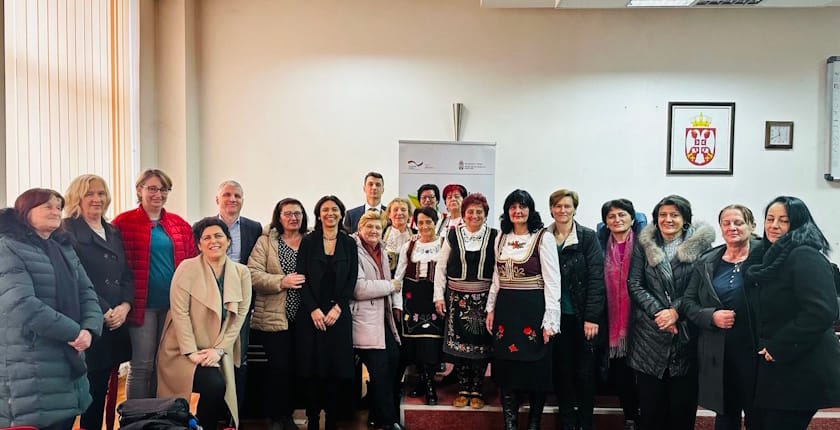
Photo: Members of the Čajetina Rural Women’s Association and Zlata association (Miloš Radojević)

Possibilities for using renewable energy sources

One of the key conclusions of the discussion was that solar panels and heat pumps can significantly improve the situation. Aleksandar Macura from RES Foundation pointed out that the law already enables households to produce their own energy and exchange it with state-owned power utility Elektroprivreda Srbije (EPS). “There are sufficient examples of good practice – around 2,500 households in Serbia already use rooftop power plants and work as buyers-producers,” Macura stated.

Buyers-producers are Serbia’s legal category for prosumers.

Nevertheless, solar panels still require initial investments of several thousand euros, which is an insurmountable obstacle for many. The participants in the discussion proposed solutions such as subsidized loans with delayed payment, in installments, to make the technology more accessible both to retirees and socially disadvantaged persons.

Assembling and energy communities

Another important aspect of the discussion was the possibility of establishing energy communities. In line with European regulations, Serbia is opening the space for joint production and use of solar energy within local communities.

It means any village council could install a solar power plant and distribute the energy among households. It would be especially useful for women running family businesses in agriculture and tourism, as it would provide them with a stable energy source without leaning on an unpredictable power distribution network.

Wood is traditional but inefficient energy source

Wood biomass usage still dominates in many rural households. Some said in Arilje: “Wood is irreplaceable” and “we believe in wood!” However, for people in villages, wood is almost never, even though it is the most accessible, never the most efficient solution for heating. It is partly because of moisture in the solid fuel, and mostly because of inefficient devices.

There are fewer and fewer people in the countryside, so it is getting more difficult and more expensive to timely obtain the wood felling and preparation service, even in one’s own forest. “We have been using wood for decades, but who today can afford quality dried wood? We often heat ourselves using wet wood, which only increases consumption and air pollution,” said one of the participants in an event in Arilje, describing her experience. It was attended by women from two associations: Sibirka and Ariljka.

Photo: Members of associations Sibirka and Ariljke (Miloš Radojević)

How to proceed?

It is clear that rural communities mustn’t be left behind in the energy transition process. Solar panels, energy communities and subsidies for more efficient heating are solutions that can bring concrete changes. However, the key to success lies in a greater accessibility of these solutions for all citizens, regardless of their financial situation or the place of residence.

Energy sustainability in rural communities is not just a matter of comfort but also of the survival and development of local communities. If we want villages to be vital and economically stable, it is necessary to facilitate a stable, sustainable and affordable energy source for them. Through smart investments, better subsidy organization and the development of energy communities it is possible to significantly improve the quality of life in these areas. In addition, additional training in the usage and maintenance of energy-efficient systems can contribute to a greater deployment of the technologies.

The energy discussions with the women of the Zlatibor county was organized within the project Improving the Use of Sustainable Energy in the Zlatibor region, financed by the German Organization for International Cooperation (GIZ) by order of the Government of the Federal Republic of Germany (Federal Ministry for Economic Cooperation and Development – BMZ).

by in News

Heliup wins European Solar Startup Award 2025 with solar panels 60% lighter than conventional ones

France-based Heliup has been awarded the Gold European Solar Startup Award 2025 for its Stykon solar PV panels for flat rooftops.

Following a successful online pitch, Heliup, Aevy and suena were nominated by the expert panel as finalists.

Yannick Veschetti, President and Co-founder of Heliup, Gautier Moulin, Co-founder and Chief Operating Officer of Aevy, and Felix Heimke, Senior Product Manager at suena, presented their work on stage at the SolarPower Summit 2025.

Yannick Veschetti stressed there is over four billion square meters of available large rooftop space in the European Union. Heliup wants to harness the potential of this available rooftop space and fast-track solar installations across Europe, he added.

Veschetti: The startup is committed to revolutionizing solar energy with lightweight solutions manufactured in Europe

The startup is committed to revolutionizing solar energy with lightweight solutions manufactured in Europe that unlock the potential of commercial and industrial rooftops, Veschetti pointed out.

According to the startup, solar panels have considerable weight which, combined with around 15 kilograms per square meter for the fixing structures, is not compatible with a large proportion of existing building roofs.

To address the issue, Heliup uses a patented CEA technology developed for over three years at France-based Institut National de l’Energie Solaire (INES).

The unique technology is based on the conservation of thin glass and on an innovative installation concept, the startup said.

The solar panel is 60% lighter than conventional panels

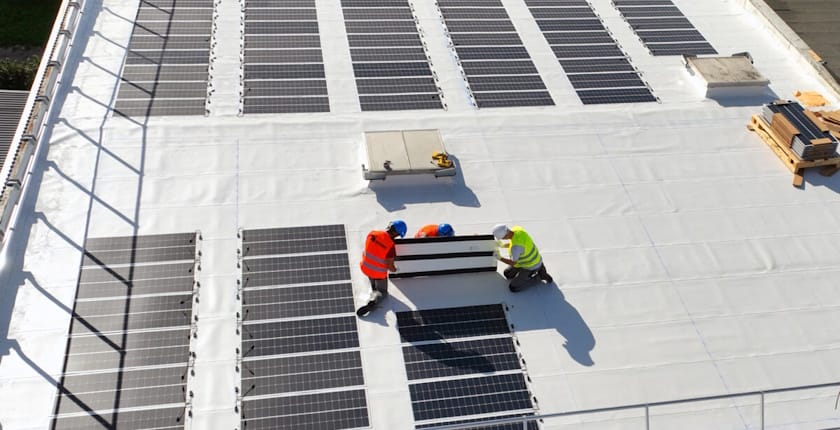
The Stykon range is intended for flat roofs, with an innovative, simple and quick installation system based on gluing the panel directly onto the roof’s waterproofing membrane. It is 60% lighter than conventional panels while maintaining the same level of performance and durability, Heliup added.

SolarPower Europe explained that Heliup’s panels are lightweight, at five kilos per square meter. They have an efficiency of 20% and are resistant to extreme weather conditions. The equipment is made in Europe and has an easy and fast installation process, the organization said.

“Only with these forward-thinking innovators can we strengthen Europe’s competitiveness and guarantee a swift energy transition,” SolarPower Europe CEO Walburga Hemetsberger stated.

The award jury panel comprised Jenny Chase, Solar Analyst at BloombergNEF; Stefan Müeller, Co-Founder, Shareholder and Board Member at Enerparc AG; Felix Krause, Managing Partner at Vireo Ventures; and Michael Schmela, Director of Market Intelligence at SolarPower Europe.

by in News

Renewables equipment factory to contribute to just transition of coal region in Romania

Monsson Group is preparing to build a manufacturing facility in Petrila for renewable energy equipment, including robots that clean solar panels. The project received funding to contribute to the just transition of Romania’s coal region Jiu valley – Hunedoara.

An investment of nearly EUR 10 million in the first phase is underway in Transylvania, in the town of Petrila, economically devastated after the closure of a coal mine. The project is aimed at reviving the area with a factory for renewable energy equipment such as enclosures for battery energy storage systems, wiring and robots that clean photovoltaic panels.

Monsson Group revealed its facility would also manufacture gear for monitoring environmental parameters and tracking fauna in the area. The Sweden-based company has said 70% of the investment would be covered from Romania’s Just Transition Program which is in turn part of the European Union’s Just Transition Facility.

Romania is planning to prolong the operation of its coal power plants and mines for a smoother switch to renewable sources, in terms of electricity supply. However, such facilities are becoming less financially viable by the day all across the EU. Coal regions are facing economic blows from early shutdowns of power plants and mines.

First major private investment in Petrila

According to Monsson, the new factory would employ more than fifty people in the first phase. It expects to begin construction mid-year.

It is the first major private investment in Petrila, Mayor Vasile Jurca said. He said the project enables reskilling and sustainable development. The local authority provided the land for the factory. Romania has earmarked substantial funding for the construction of renewable energy equipment plants.

The second part of the plan is to install a 20 MWh battery energy storage system to provide system services to the national grid, followed by a 50 MWh unit.

Reskilling program underway

The group, which includes Wind Power Energy and its RenewAcad network of renewable energy training centers, established cooperation with the University of Petroșani in getting skilled workers. Monsson is one of the biggest renewable energy investors in the country.

Petrila is part of the Jiu Valley in Hunedoara county, Romania’s main coal region. It is located near Oltenia, the other coal complex, in the counties of Gorj and Dolj.

Notably, the Maritsa East 3 coal power plant in neighboring Bulgaria ceased operations yesterday again after it was briefly brought back online to maintain energy security.