by in News

Slovenia opens its first highway solar power plant

Slovenia’s road management firm Družba za Avtoceste v Republiki Sloveniji has installed a solar power plant on a noise barrier alongside a highway. It is the first such photovoltaic system in the country.

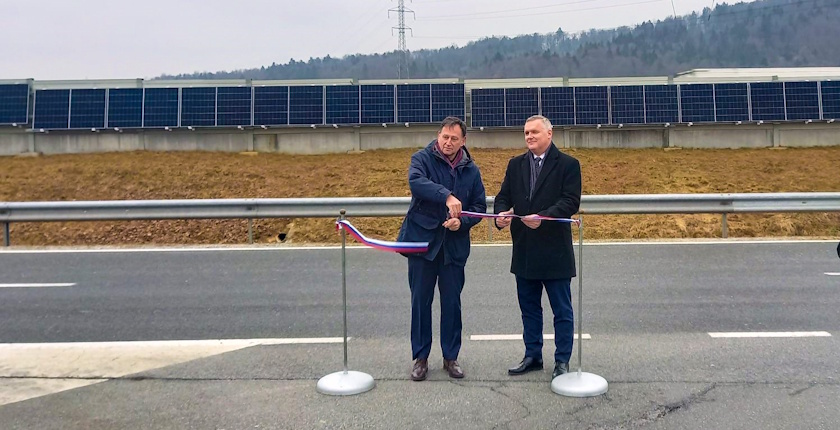
Družba za avtoceste v Republiki Sloveniji (DARS) has officially opened its first photovoltaic plant on a noise barrier at the Šmarje Sap West rest area. It is about ten kilometers from Ljubljana on the motorway connecting the Slovenian capital and Zagreb.

According to DARS, the project is part of a series of activities to achieve the company’s strategic goals in sustainable development, decarbonization, and efficient energy use.

The firm announced the development of such projects in July 2023. A pioneering idea in the region, it was later followed by Bosnia and Herzegovina, Montenegro, and Croatia.

Ribič: An example of thoughtful siting of renewable power plants

The opening ceremony was attended by the Chairman of the Management Board of DARS Andrej Ribič, Minister of the Environment, Climate and Energy Bojan Kumer, representatives of the contractor – Solvera Lynx, and representatives of distribution system operator Elektro Ljubljana.

Andrej Ribič stressed that the project is significant for electricity production but also as an example of thoughtful siting of renewable energy power plants without impacting traffic safety or routine highway maintenance.

The electricity generated by the PV system will be used for DARS’s own consumption, including public lighting and tunnel systems, he explained. This will ensure greater energy independence and more rational management of the energy system, Ribič added.

DARS plans to continue building PV plants

In line with its strategy, DARS aims to gradually reduce energy consumption from the grid and lower CO2 emissions in scopes 1 and 2. By 2030, the goal is to reduce energy consumption and carbon emissions by 30% from the 2024 levels, according to the firm.

Based on its revised strategy, DARS adopted several energy measures in 2024. They included the establishment of an energy department and the implementation of the first phase of solar installations across its five facilities, with a total capacity of 420 kW.

These plants can cover approximately 2% of the company’s annual electricity consumption.

DARS intends to further expand its solar energy projects. The plan includes building bigger plants in degraded areas and more PV systems on buildings and along highway tunnels.

The electricity produced would primarily power lighting and other road systems to ensure the safe and smooth operation of the motorway network, the company added.

Careful site selection for solar plants is crucial

In July 2023, DARS and state-owned hydropower operator Soške Elektrarne Nova Gorica (SENG) announced plans to build solar power plants along highways.

The first one was planned in the Slovenian Littoral and Coastal-Karst area. However, the new solar power plant is not located there.

The two firms later established similar cooperation with the Ministry of Defense and the Municipality of Vipava.

Solar energy use is expanding all over the planet. Experts warn that the optimal siting of PV panels is crucial to avoid occupying large areas of arable land or harming the environment. Therefore, the best solution is to install solar panels in locations that cannot be used for other purposes, such as alongside railways and roads, or on rooftops.

by in News

Semi-transparent solar systems not cost-efficient if transparency is above 50%

Semi-transparent solar systems are often presented as innovative and aesthetically appealing solutions. However, scientists from Spain warn that they are economically viable only up to a certain level of transparency. Levels above 50% have significantly lower system efficiency per unit area, resulting in higher electricity generation costs.

Researchers from the University of Jaén in Spain conducted a technical and economic analysis to assess the cost competitiveness of semi-transparent photovoltaic technologies (STPV). The study titled ‘Assessment of cost-competitiveness of semi-transparent photovoltaic systems’ and published in the journal Renewable Energy, shows that the costs are closely linked to the level of transparency.

“The paper introduces a cost framework that explicitly links transparency to module cost, structural cost, and system capex, using reference values from real utility-scale PV projects in Spain rather than idealized assumptions. The results explain why many STPV concepts look attractive on paper but struggle commercially, and where targeted policy instruments can realistically help without creating false expectations,” said the study’s lead author João Gabriel Bessa, in a statement to pv magazine.

The researchers analyzed a 1 MW semi-transparent ground-mounted solar system in Spain. The analysis examined total system costs, changes in module efficiency at different transparency levels, as well as the impact of increasing required surface area on the cost per watt and the levelized cost of electricity (LCOE).

Semi-transparent photovoltaic systems are commercially viable only with transparency of up to around 50%

LCOE represents the average cost of producing one unit of electricity over the entire lifetime of a power plant. It accounts for all project costs, from construction and financing to operation and maintenance, relative to total electricity generation, and is used as a key indicator for comparing the cost-effectiveness of different power generation technologies.

The researchers found that STPV remains commercially viable only up to transparency levels of about 50%. As transparency increases, the active solar cell area decreases, leading to lower electricity generation without a proportional reduction in the costs of non-cell materials.

The study’s authors also point out that balance-of-system (BOS) costs—which include all equipment, works, and infrastructure required for a photovoltaic plant to operate, excluding the solar modules themselves—increase with higher transparency levels. This is because the costs of mounting structures and direct current (DC) cabling scale with the physical area of the photovoltaic generators. By contrast, the costs of inverters, alternating current (AC) cabling, transformers, and other electrical equipment are largely independent of transparency levels.

Higher transparency, higher costs

To determine which financial and technical parameters have the greatest impact on LCOE, the researchers also conducted a sensitivity analysis.

Both analyses confirmed that total system costs rise as transparency increases. According to the study, a fully opaque system with zero transparency would have an installation cost of EUR 0.628 per W. As transparency increases, however, module efficiency declines, requiring a much larger area covered by photovoltaic modules to reach the same installed capacity.

At 50% transparency, module efficiency drops to around 10%, doubling the required surface area and increasing total system costs to EUR 0.904 per W. When transparency reaches 90%, efficiency falls to just 2%, requiring a fivefold increase in surface area and raising system costs to EUR 3.110 per W.

Bessa notes that with transparency above a band of 45% to 50%, LCOE rises sharply and exceeds typical market electricity prices, even in regions with high levels of solar irradiation, such as southern Spain.

“As transparency increases, power density declines faster than module costs, because non-cell components such as glass, encapsulation, framing, and logistics dominate the cost structure. This leads to a strong increase in EUR/W module costs, even when less silicon is used,” Bessa said.

The sensitivity analysis also showed that annual specific yield, expressed in kilowatt-hours per kilowatt of installed capacity, is the single most influential parameter affecting LCOE, outweighing even capital expenditure and financing conditions.

by in News

Semi-transparent solar systems not cost-efficient if transparency is above 50%

Semi-transparent solar systems are often presented as innovative and aesthetically appealing solutions. However, scientists from Spain warn that they are economically viable only up to a certain level of transparency. Levels above 50% have significantly lower system efficiency per unit area, resulting in higher electricity generation costs.

Researchers from the University of Jaén in Spain conducted a technical and economic analysis to assess the cost competitiveness of semi-transparent photovoltaic technologies (STPV). The study titled ‘Assessment of cost-competitiveness of semi-transparent photovoltaic systems’ and published in the journal Renewable Energy, shows that the costs are closely linked to the level of transparency.

“The paper introduces a cost framework that explicitly links transparency to module cost, structural cost, and system capex, using reference values from real utility-scale PV projects in Spain rather than idealized assumptions. The results explain why many STPV concepts look attractive on paper but struggle commercially, and where targeted policy instruments can realistically help without creating false expectations,” said the study’s lead author João Gabriel Bessa, in a statement to pv magazine.

The researchers analyzed a 1 MW semi-transparent ground-mounted solar system in Spain. The analysis examined total system costs, changes in module efficiency at different transparency levels, as well as the impact of increasing required surface area on the cost per watt and the levelized cost of electricity (LCOE).

Semi-transparent photovoltaic systems are commercially viable only with transparency of up to around 50%

LCOE represents the average cost of producing one unit of electricity over the entire lifetime of a power plant. It accounts for all project costs, from construction and financing to operation and maintenance, relative to total electricity generation, and is used as a key indicator for comparing the cost-effectiveness of different power generation technologies.

The researchers found that STPV remains commercially viable only up to transparency levels of about 50%. As transparency increases, the active solar cell area decreases, leading to lower electricity generation without a proportional reduction in the costs of non-cell materials.

The study’s authors also point out that balance-of-system (BOS) costs—which include all equipment, works, and infrastructure required for a photovoltaic plant to operate, excluding the solar modules themselves—increase with higher transparency levels. This is because the costs of mounting structures and direct current (DC) cabling scale with the physical area of the photovoltaic generators. By contrast, the costs of inverters, alternating current (AC) cabling, transformers, and other electrical equipment are largely independent of transparency levels.

Higher transparency, higher costs

To determine which financial and technical parameters have the greatest impact on LCOE, the researchers also conducted a sensitivity analysis.

Both analyses confirmed that total system costs rise as transparency increases. According to the study, a fully opaque system with zero transparency would have an installation cost of EUR 0.628 per W. As transparency increases, however, module efficiency declines, requiring a much larger area covered by photovoltaic modules to reach the same installed capacity.

At 50% transparency, module efficiency drops to around 10%, doubling the required surface area and increasing total system costs to EUR 0.904 per W. When transparency reaches 90%, efficiency falls to just 2%, requiring a fivefold increase in surface area and raising system costs to EUR 3.110 per W.

Bessa notes that with transparency above a band of 45% to 50%, LCOE rises sharply and exceeds typical market electricity prices, even in regions with high levels of solar irradiation, such as southern Spain.

“As transparency increases, power density declines faster than module costs, because non-cell components such as glass, encapsulation, framing, and logistics dominate the cost structure. This leads to a strong increase in EUR/W module costs, even when less silicon is used,” Bessa said.

The sensitivity analysis also showed that annual specific yield, expressed in kilowatt-hours per kilowatt of installed capacity, is the single most influential parameter affecting LCOE, outweighing even capital expenditure and financing conditions.

by in News

Why nobody in Slovenia bothers to remove snow from solar panels

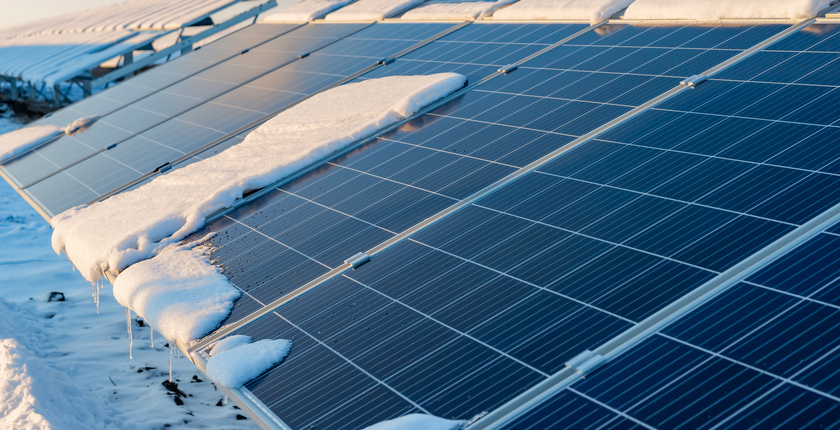
The snow that has blanketed much of Europe over the past few days has also covered solar panels, preventing the absorption of sunlight and, consequently, electricity production. However, Slovenian solar power plant operators are not attempting to remove the snow, as doing so would cause more harm than good.

The main reason for not clearing the snow is the risk of damage to solar panels. Primož Tručl, CEO of solar power plant operator Moja elektrarna and a member of the board of the Slovenian Photovoltaic Association (ZSFV), told Naš stik that removing snow from solar modules while avoiding scratching their surface would be time-consuming and expensive. It would outweigh the benefits of potential production given the low levels of sunshine in winter, according to him.

Removing snow without damaging solar panels would cost more than the electricity generated at this time of year

Stellar, the operator of a hybrid solar power plant near Črnomelj, also considers such an intervention economically unjustified, as production losses due to temporary snow cover are relatively small and short-lived.

In most cases, snow melts or slides off the surface quickly thanks to the inclination of the panels and the heating of the modules under sunlight, Naš stik was told at the company.

Snow slides off on its own very quickly and outages are short-lived

In addition, manually removing snow with shovels, brooms, scrapers, or other equipment can damage the glass on solar panels. Even softer tools can cause micro-scratches, reducing the efficiency of the panels.

“Any damage to the glass also means an increased risk of moisture ingress and, consequently, module failure,” the company explained.

State-owned energy utility GEN energija has told Naš stik that most of its solar power plants are built on slopes, allowing snow to slide off the modules relatively quickly when the sun shines.

Letting snow slide off on its own also has an upside, as it helps clean solar panels by carrying away most of the dirt accumulated on the surface, according to GEN energija.

by in News

Why nobody in Slovenia bothers to remove snow from solar panels

The snow that has blanketed much of Europe over the past few days has also covered solar panels, preventing the absorption of sunlight and, consequently, electricity production. However, Slovenian solar power plant operators are not attempting to remove the snow, as doing so would cause more harm than good.

The main reason for not clearing the snow is the risk of damage to solar panels. Primož Tručl, CEO of solar power plant operator Moja elektrarna and a member of the board of the Slovenian Photovoltaic Association (ZSFV), told Naš stik that removing snow from solar modules while avoiding scratching their surface would be time-consuming and expensive. It would outweigh the benefits of potential production given the low levels of sunshine in winter, according to him.

Removing snow without damaging solar panels would cost more than the electricity generated at this time of year

Stellar, the operator of a hybrid solar power plant near Črnomelj, also considers such an intervention economically unjustified, as production losses due to temporary snow cover are relatively small and short-lived.

In most cases, snow melts or slides off the surface quickly thanks to the inclination of the panels and the heating of the modules under sunlight, Naš stik was told at the company.

Snow slides off on its own very quickly and outages are short-lived

In addition, manually removing snow with shovels, brooms, scrapers, or other equipment can damage the glass on solar panels. Even softer tools can cause micro-scratches, reducing the efficiency of the panels.

“Any damage to the glass also means an increased risk of moisture ingress and, consequently, module failure,” the company explained.

State-owned energy utility GEN energija has told Naš stik that most of its solar power plants are built on slopes, allowing snow to slide off the modules relatively quickly when the sun shines.

Letting snow slide off on its own also has an upside, as it helps clean solar panels by carrying away most of the dirt accumulated on the surface, according to GEN energija.

by in News

EPS plans to build solar power plant on TENT A ash dump

Serbia’s state power utility, Elektroprivreda Srbije (EPS), has invited bids for producing a preliminary feasibility study and conceptual design for a solar power plant on the ash disposal site of the Nikola Tesla A (TENT A) thermal power plant in Obrenovac.

The study should assess the feasibility and viability of the project, as well as the total solar potential of the site. The estimated value of the contract is RSD 14.91 million, and the deadline to submit bids is 23 January 2026.

The document must clearly define the proposed capacity of the planned solar power plant, the grid connection method, and the expected operating regime, according to the public call.

The capacity of the future solar power plant will be determined by the study

The project aims to expand EPS’ renewable energy capacities, reduce dependence on fossil fuels, and remediate the ash disposal site.

In July, EPS connected to the grid its first larger photovoltaic facility, the 10 MW Petka solar power plant. The plant is located in the Kostolac coal mining complex east of Belgrade, next to a 66 MW wind farm, which was put into trial operation in late November.

The design of the planned solar power plant at the TENT A ash disposal site should allow for integration with TENT’s existing safety and SCADA systems, while energy stability should be ensured through backup power sources, including solar panels with battery storage and/or an uninterruptible power supply (UPS) system.

The project should envisage battery energy storage

The photovoltaic panels should have a minimum power of 600 Wp, a minimum efficiency of 24%, and guaranteed production over 30 years of operation, while the efficiency of the inverters must be around 98% by European standards.

The part of the TENT A ash disposal site allocated for the solar power plant is slated for closure, and its usable area is about 67.2 hectares. The exact usable area will be determined following the completion of the study.

The selected bidder will be required to complete the task within six months of receiving all necessary documentation from EPS.

by in News

EU4CAET project pre-selects 43 ideas for first renewable energy communities in BiH

A total of 43 project ideas from 28 local authorities for establishing the first renewable energy communities in Bosnia and Herzegovina have been pre-selected to receive assistance under the EU for Collective Action for Energy Transition project.

The EU for Collective Action for Energy Transition (EU4CAET) project is jointly financed by the European Union and the German Federal Ministry for Economic Cooperation and Development (BMZ). Under the slogan ‘Together for Energy Transition,’ the EUR 3 million project is implemented by GIZ.

The initiative aims to empower local municipalities, citizens, and private actors to develop sustainable energy solutions that create jobs, improve energy efficiency, and advance climate goals, according to the EU Delegation to Bosnia and Herzegovina.

A total of 51 municipalities submitted 89 project ideas

In the project’s development phase, 51 municipalities submitted a total of 89 project ideas, such as solar power plants, heat pumps, biomass heating systems, public lighting upgrades, and electric vehicle charging stations.

The proposed projects also included kindergartens, youth centers, sports halls, theaters, health centers, and other public facilities. Following the evaluation, 28 local self-governments submitted their first concept notes, and 43 ideas were pre-selected.

“The final selection, based on detailed concept notes, is currently ongoing. The number of final projects will depend on the quality of submitted concepts and available funding under EU4CAET,” the Communication Office of the Delegation of the EU to BiH & EU Special Representative in BiH told Balkan Green Energy News.

The evaluation will begin in January 2026

The deadline for the pre-selected local authorities to submit their detailed concept notes was December 20. The evaluation of the submitted concepts will begin in January 2026.

Selected local authorities will be invited to present and discuss their ideas in more detail, according to the Communication Office.

The strongest concepts will receive assistance for capacity development, business planning, feasibility studies, and the preparation of technical design documentation.

The 28 municipalities pre-selected for further evaluation are as follows: Bijeljina, Bileća, Centar Sarajevo, Doboj, Donji Vakuf, Drvar, Goražde, Ilijaš, Kakanj, Kalesija, Laktaši, Maglaj, Milići, Modriča, Mostar, Novi Grad, Novi Travnik, Novo Sarajevo, Šamac, Sokolac, Srebrenica, Teslić, Travnik, Višegrad, Vogošća, Zenica, Živinice, and Zvornik.

BiH does not yet have renewable energy communities, but one of its two entities – the Republic of Srpska – managed to adopt the necessary regulations for their establishment in May this year, becoming the first in the region to do so.

Hahr: The grant call is planned for February 2026 and 2027

Mareike Hahr, Head of EU4CAET, said the project is now focused on tailored technical assistance to further refine the ideas and prepare high-quality applications for the grant call, planned for February 2026 and 2027.

“What has been particularly encouraging is the remarkable level of interest and readiness shown by local communities from both entities to ‘enter new terrain’—to propose their own project concepts, explore innovative solutions, and actively shape their energy future,” she explained.

by in News

EPS plans to build solar power plant on TENT A ash dump

Serbia’s state power utility, Elektroprivreda Srbije (EPS), has invited bids for producing a preliminary feasibility study and a conceptual design for a solar power plant on the ash disposal site of the Nikola Tesla A (TENT A) thermal power plant in Obrenovac.

The study should assess the feasibility and viability of the project, as well as the total solar potential of the site. The estimated value of the contract is RSD 14.91 million, and the deadline to submit bids is 23 January 2026.

The document must clearly define the proposed capacity of the planned solar power plant, the grid connection method, and the expected operating regime, according to the public call.

The capacity of the future solar power plant will be determined by the study

The project aims to expand EPS’ renewable energy capacities, reduce dependence on fossil fuels, and remediate the ash disposal site.

In July, EPS connected to the grid its first larger photovoltaic facility, the 10 MW Petka solar power plant. The plant is located in the Kostolac coal mining complex east of Belgrade, next to a 66 MW wind farm, which was put into trial operation in late November.

The design of the planned solar power plant at the TENT A ash disposal site should allow for integration with TENT’s existing safety and SCADA systems, while energy stability should be ensured through backup power sources, including solar panels with battery storage and/or an uninterruptible power supply (UPS) system.

The project should envisage battery energy storage

The photovoltaic panels should have a minimum power of 600 Wp, a minimum efficiency of 24%, and guaranteed production over 30 years of operation, while the efficiency of the inverters must be around 98% by European standards.

The part of the TENT A ash disposal site allocated for the solar power plant is slated for closure, and its usable area is about 67.2 hectares. The exact usable area will be determined following the completion of the study.

The selected bidder will be required to complete the task within six months of receiving all necessary documentation from EPS.

by in News

EU4CAET project pre-selects 43 ideas for first renewable energy communities in BiH

A total of 43 project ideas from 28 local authorities for establishing the first renewable energy communities in Bosnia and Herzegovina have been pre-selected to receive assistance under the EU for Collective Action for Energy Transition project.

The EU for Collective Action for Energy Transition (EU4CAET) project is jointly financed by the European Union and the German Federal Ministry for Economic Cooperation and Development (BMZ). Under the slogan ‘Together for Energy Transition,’ the EUR 3 million project is implemented by GIZ.

The initiative aims to empower local municipalities, citizens, and private actors to develop sustainable energy solutions that create jobs, improve energy efficiency, and advance climate goals, according to the EU Delegation to Bosnia and Herzegovina.

A total of 51 municipalities submitted 89 project ideas

In the project’s development phase, 51 municipalities submitted a total of 89 project ideas, such as solar power plants, heat pumps, biomass heating systems, public lighting upgrades, and electric vehicle charging stations.

The proposed projects also included kindergartens, youth centers, sports halls, theaters, health centers, and other public facilities. Following the evaluation, 28 local self-governments submitted their first concept notes, and 43 ideas were pre-selected.

“The final selection, based on detailed concept notes, is currently ongoing. The number of final projects will depend on the quality of submitted concepts and available funding under EU4CAET,” the Communication Office of the Delegation of the EU to BiH & EU Special Representative in BiH told Balkan Green Energy News.

The evaluation will begin in January 2026

The deadline for the pre-selected local authorities to submit their detailed concept notes was December 20. The evaluation of the submitted concepts will begin in January 2026.

Selected local authorities will be invited to present and discuss their ideas in more detail, according to the Communication Office.

The strongest concepts will receive assistance for capacity development, business planning, feasibility studies, and the preparation of technical design documentation.

The 28 municipalities pre-selected for further evaluation are as follows: Bijeljina, Bileća, Centar Sarajevo, Doboj, Donji Vakuf, Drvar, Goražde, Ilijaš, Kakanj, Kalesija, Laktaši, Maglaj, Milići, Modriča, Mostar, Novi Grad, Novi Travnik, Novo Sarajevo, Šamac, Sokolac, Srebrenica, Teslić, Travnik, Višegrad, Vogošća, Zenica, Živinice, and Zvornik.

BiH does not yet have renewable energy communities, but one of its two entities – the Republic of Srpska – managed to adopt the necessary regulations for their establishment in May this year, becoming the first in the region to do so.

Hahr: The grant call is planned for February 2026 and 2027

Mareike Hahr, Head of EU4CAET, said the project is now focused on tailored technical assistance to further refine the ideas and prepare high-quality applications for the grant call, planned for February 2026 and 2027.

“What has been particularly encouraging is the remarkable level of interest and readiness shown by local communities from both entities to ‘enter new terrain’—to propose their own project concepts, explore innovative solutions, and actively shape their energy future,” she explained.

by in News

Solarpro and LONGi collaborate on Europe’s largest back-contact solar plant

European leading EPC and O&M contractor of PV and BESS systems Solarpro is building what will be the largest solar power plant in Hungary, using photovoltaic modules from industry leader LONGi. Located in the northern county of Heves, the 450-megawatt project will deploy nearly 700,000 modules from LONGi’s ultra-efficient Hi-MO9 product series. The plant also marks an expansion of Solarpro’s partnership with LONGi, following a 176 MW solar park the two companies partnered on last year in Studina, Romania.

With a peak capacity of 450 MW, the new plant is expected to generate 470 gigawatt-hours (GWh) per year, enough electricity to power around 106,000 households annually.

Replacing fossil fuel use, the project’s clean energy output can reduce greenhouse gas emissions by 415,000 tons every year, the equivalent of removing over 100,000 gas-powered cars from the road.

Solarpro chooses LONGi’s back contact technology for watershed project

The Hi-MO9 solar module offers the plant the advantage of LONGi’s back contact (BC) technology, a complex engineering and design upgrade that reduces micro-cracking in the glass by 50% compared to traditional modules, increases electricity generation by up to 8%, and safeguards the module’s long-term performance – particularly under the sometimes-tough conditions present in northern rural Hungary, like high heat, dust, and cloud cover.

The 450 MW photovoltaic plant will be Hungary’s biggest

The BC module’s benefits also compound over the three decades of the product’s lifespan, meaning Solarpro’s new plant can anticipate more efficient production as well as more cost-effective, more reliable clean power for the area’s energy consumers.

Leon Zhang, President of LONGi Europe, said: “It’s an honour to supply Solarpro the modules for this landmark Hungarian project. In partnering with one of Europe’s leading project developers, we’re able to contribute to the region’s clean energy future and, at the same time, to set a new technological standard. At LONGi and Solarpro, we’re both committed to innovation and long-term sustainability, so we’re looking forward to continuing the cooperation.”

Krasen Mateev, CEO of Solarpro, said: “We are proud to join forces with LONGi once again on this major project in Hungary. At 450 MW, the solar plant will be Europe’s largest back-contact installation and a milestone in Solarpro’s mission to deliver reliable, high-efficiency clean energy across the region. The advanced technology of the Hi-MO9 was a clear choice to maximize the project’s performance and long-term reliability. By combining Solarpro’s EPC expertise with LONGi’s innovation, we are setting a new standard for utility-scale solar in Europe.”

About LONGi

Founded in 2000, LONGi is committed to being the world’s leading solar technology company, focusing on customer-driven value creation for full scenario energy transformation. Under its mission of ‘making the best of solar energy to build a green world’, LONGi has dedicated itself to technology innovation and established several business sectors, covering mono silicon wafers cells and modules, commercial & industrial distributed solar solutions, green energy solutions and hydrogen equipment.

The company has honed its capabilities to provide green energy and has more recently, also embraced green hydrogen products and solutions to support global zero carbon development.

About Solarpro

Solarpro is part of Renalfa Solarpro Group GmbH, a Vienna-based clean energy and e-mobility investment group with a focus on renewable energy generation assets.

As a multi-technology integrator, Solarpro specializes in developing and delivering hybrid projects that combine photovoltaic (PV), wind, battery energy storage systems (BESS), and hydrogen solutions. With 18 years of experience and a team of more than 1,500 professionals, the company has designed, built, and integrated over 12 GW of solar capacity and more than 4 GWh of battery storage systems.

A recognized technology innovator, Solarpro leads in the design and digitalization of renewable energy projects, turning them into flexible and manageable assets that align with the dynamic energy market. The company’s expertise has been acknowledged internationally, winning the award for Best EU Project under 100MW, for the first large-scale energy storage system in the region (55 MWh).

Driven by sustainability, Solarpro also invests in circular economy practices, advancing the recycling of PV modules and batteries to support the clean energy transition.

For more information, please contact us at [email protected]