by in News

Econergy to assume 100% ownership of Romania’s biggest solar park, add batteries

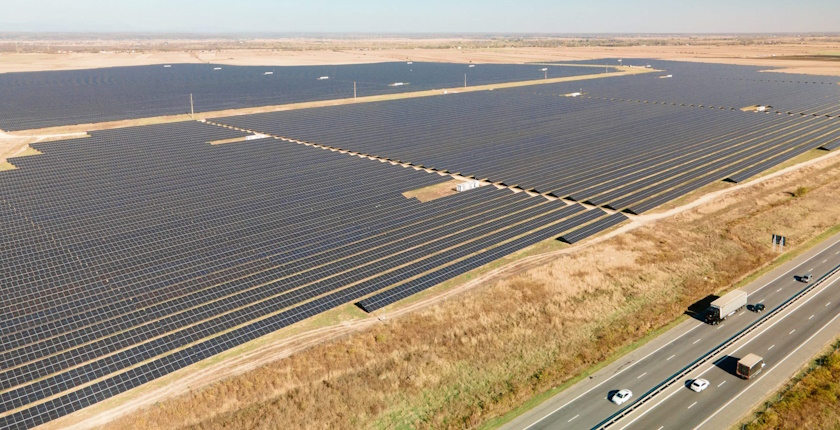
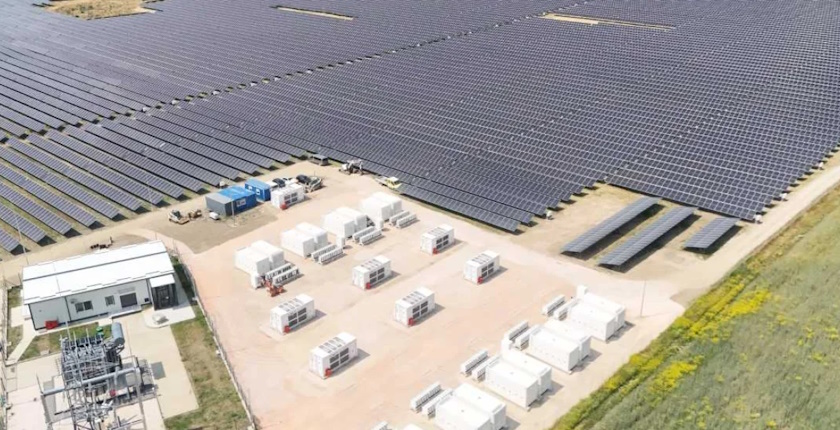
Econergy agreed to buy out Nofar’s 50% stake in the 155 MW Rătești photovoltaic plant, the largest in Romania. The next step is to add a 120 MW battery energy storage system.

Econergy Renewable Energy said its subsidiary Econergy International, in which it holds 75.2%, has signed an agreement with Nofar Energy to acquire the partner company’s entire 50% stake in the Rătești solar power plant. The facility northwest of Bucharest, in Argeș county, is the largest in Romania. It has 155 MW in peak capacity.

Following the transaction, Econergy will hold 100% ownership and assume control of the shareholder loan previously provided by Nofar, of EUR 14.9 million, according to the update. The total consideration for the transaction is €45.6 million, payable in three instalments through June 2026.

Both companies are based in Israel. Econergy expects a capital gain of EUR 13 million from the deal. Like with some of its other investments in Romania, it plans to add a 120 MW battery energy storage system (BESS). The operator values the investment at EUR 32 million.

The battery storage facility is expected to enter commercial operation in the second quarter of next year, Econergy revealed. It would generate an additional EUR 15 million in annual revenue and EUR 12 million in earnings before interest, taxes, depreciation and amortization – EBITDA, the announcement reads.

Econergy said its portfolio of solar, wind and storage projects in Romania amounts to 3.5 GW. It includes 473 MW in operation or facilities that are ready to connect, 763 MW under construction and 395 MW scheduled to begin construction by the end of the year. Total project pipeline exceeds 14 GW.
by in News

Romanian town signs partnership for 200 MW solar park with BESS

A firm recently established by Turkish and Romanian investors has launched a public-private partnership with the local authority in Târgu Lăpuș in northern Transylvania. They are planning a hybrid power plant worth EUR 100 million.

A public-private partnership in the making in northern Romania is aimed at building a 200 MW photovoltaic plant, the largest in Transylvania, with a battery energy storage system, 2Mnews reported. Global Energy Asset, a firm founded by Turkish and Romanian investors less than half a year ago, has signed a deal with the municipal authority in Târgu Lăpuș.

The investors value the project at EUR 100 million. They intend to install the facility on 200 hectares on the territory of the town, also known as Magyarlápos. Târgu Lăpuș is in Maramureș County.

The seat of Global Energy Asset, formerly known as Global Finance Asset, is Tunari in Ilfov county near Bucharest. In addition to financial benefits and covering the costs of electricity for street lighting, its representatives offered the local authority scholarships for children and sponsorship of events and institutions, the article reveals.

The project firm’s largest shareholder reportedly has ties with Feridun Geçgel of Astor Enerji

Muhammed Ishak Çiftçi, who has Romanian citizenship, controls 48% of the project firm. According to the news outlet, he is associated with Turkish billionaire Feridun Geçgel, Chairman of the Board of Astor Enerji.

It is the largest manufacturer of transformers in Turkey. Astor Enerji entered the Romanian photovoltaic market this year by acquiring four projects for 279 MW in total.

In August, Swiss energy storage provider Energy Vault agreed to supply up to 2 GWh of battery capacity for the Turkish company’s future solar power plants in Romania. Astor Enerji is listed on the Istanbul Stock Exchange (Borsa Istanbul).

Head of Global Energy Asset, lawyer Cătălin Iulian Marin, holds 25%, and there are four more co-owners.

Approving the proposal for the public-private partnership, Târgu Lăpuș town hall cited the need for business ventures amid economic difficulties. Namely, furniture manufacturer Taparo, which supplied IKEA and was the biggest business in the area, has become insolvent.

by in News

Sunterra RE equips its PV plants in Bulgaria with batteries totaling 156 MW

Bulgarian solar power plant operator Sunterra RE added co-located energy storage to its operational portfolio. The company’s three photovoltaic systems, with 524 MW in combined peak capacity, now also have batteries of 156 MW and 312 MWh in total.

With the ongoing solar boom in Bulgaria, investors have lately also been rushing to set up co-located and standalone battery energy storage systems (BESS). Bridging the gap between the peaks of daily photovoltaic production and power consumption is one of the key factors for the energy transition – stabilizing prices and the electricity system’s stability. Sunterra RE – Santera RE in Bulgarian – stands out with a large new operational solar and battery portfolio.

In its latest updates, the company revealed that it has put three BESS facilities into operation. They are co-located with its photovoltaic plants of 524 MW in total peak capacity.

There are 77 lithium-iron-phosphate (LFP) battery units now online. They have an overall capability of 156 MW and a duration of two hours. It translates to 312 MWh in storage capacity.

The investments received support through the National Recovery and Resilience Plan (NRRP), funded from the European Union’s Recovery and Resilience Facility – RRF. Sunterra RE said it completed them in less than a year.

Galabovo BESS accounts for half of battery operating power

The Kaloyan solar power plant of 208 MW, also known as Dalgo Pole, was the biggest in Bulgaria for a short while. It is backed with a 47 MW / 94 MWh facility, comprising 23 battery units.

The BESS investment at the site just north of Plovdiv was worth BGN 31.7 million (EUR 16.2 million).

The three subsidized battery projects were completed in less than a year

Accompanying the Galabovo solar power plant (201 MW) is a BESS with 75 MW in operating power. Sunterra RE said it consists of 37 battery containers. The Galabovo municipality is east of Plovdiv, Bulgaria’s second-largest city.

The remaining seventeen units, of 34 MW, make up the battery energy storage system at the Karlovo solar power plant. The PV facility in the eponymous municipality north of Kaloyanovo, has 115 MW.

The company’s fourth photovoltaic plant, in Pleven in the north, has only 9.6 MW.

Sunterra RE to expand its three new energy storage facilities by over 1 GWh altogether

Sunterra RE recently entered into a strategic partnership with Sungrow to expand the three BESS by more than 1 GWh in total. The deal is for the China-based partner’s MV-Power Titan 2.0 LFP units and accompanying equipment and software.

The city of Lovech, northeast of Sofia, hosts the strongest BESS in the Balkans – of 124.1 MW and 496.4 MWh. It is a standalone battery facility, part of a closed power distribution system.

Renalfa IPP and Eurowind Energy are installing a 315 MW / 760 MWh BESS at their Tenevo PV plant. They plan to turn it into the largest and most complex hybrid power plant in Bulgaria.

by in News

Serbia proposes taxes on greenhouse gas emissions, imported carbon-intensive products

The Ministry of Finance of Serbia launched public consultations on the draft Law on Greenhouse Gas Emissions Tax and Law on Carbon-Intensive Product Imports Tax, both at EUR 4 per ton of CO2 equivalent.

On January 1, importers of electricity, cement, iron and steel, aluminum, hydrogen and fertilizers to the European Union will start paying the CBAM carbon dioxide tax. If the country of origin also has a CO2 pricing system and the EU recognizes it, the sum will be deducted from CBAM.

The greenhouse gas emissions tax won’t be a new fiscal burden, but an incentive for modern and cleaner production, the Ministry of Finance of Serbia stressed in its public consultation call on what it said would be two key laws for the country’s green transition. It intends to charge producers and importers of certain goods EUR 4 per ton of CO2 equivalent.

The draft Law on Greenhouse Gas Emissions Tax and draft Law on Carbon-Intensive Product Imports Tax are intended to lower pollution, improve energy efficiency and secure a more equal position for the Serbian industry in the domestic and international markets, according to the announcement.

The public consultation process lasts until October 21, the deadline for submitting comments and suggestions. Presentations and discussions are scheduled for October 8 and October 15 in Belgrade, and online meetings are to be held on October 10 and October 17.

Both laws to enter into force on January 1, when EU also starts charging CBAM

The first of the two taxes is for big industrial emitters in the sectors of cement, fertilizers, iron and steel, aluminum and electricity. The ministry added that it is targeting January 1 for both laws to come into effect.

On the same date, the EU is set to start charging its Carbon Border Adjustment Mechanism (CBAM) tax on imported electricity, the other said goods as well as hydrogen. If the country of origin also taxes CO2 and the EU recognizes its system, the sum that was paid will be deducted from CBAM.

The CBAM tax is envisaged to rise every year until in 2034 it becomes equal as the prices of grenhouse gas emission certificates in the EU’s Emissions Trading System (EU ETS). Of note, the plan is also to expand the mechanism to other segments that EU ETS covers. The price has held above EUR 75 per ton of CO2 equivalent in the past month.

Institutional infrastructure isn’t sufficiently developed to roll out domestic ETS

The draft Law on Carbon-Intensive Product Imports Tax, envisaged as an equivalent to CBAM on the home market, doesn’t include hydrogen (and neither does the other draft), due to negligible production, while electricity wasn’t included because of technical limitations and a lack of a precise taxing methodology, the ministry explained.

The tax on imported carbon-intensive products would cover only the entities that import more than five tons of the designated products per year

Importers would be taxed based on emissions embedded in the production of the goods from abroad, but they will be able to use tax credits if an emissions levy has already been paid in the country of origin, similar to the EU system. The obligation is only for companies importing more than five tons of designated products per year.

The government opted for a tax instead of an ETS because “an emissions trading system requires a developed institutional infrastructure and market mechanisms that currently aren’t completely established,” an accompanying document reads.

Importantly, an independent verification system is under development.

The taxes would cover CO2, nitrous oxide (N2O) and perfluorocarbons (PFCs).

CO2 tax scope limited to certain larger producers

The ministry pointed out that the draft law wasn’t made to be applied extensively, but only to the firms obligated to have a license for emissions from their plants. Mostly they are large and medium-sized companies. The increase in administrative expenses would be limited, as the entities in the group already measure emissions data, in line with the Law on Climate Change, and send them to the Ministry of Environmental Protection.

The production of synthetic fertilizers and nitrogen compounds, cement, pig iron, steel and ferroalloys, aluminum and electricity accounts for over 57% of emissions in Serbia and more than 90% within the national monitoring and reporting system.

Tax deductions for large electricity producers that invest in decarbonization

A payer of the greenhouse emissions tax that predominantly generates electricity, accounting for at least 80% of its income in the previous annual tax period, is eligible for a tax credit amounting to 20% of the sum that it invested in decarbonization measures, the draft shows.

The deduction wouldn’t exceed 80% of the due tax. The government determines the said measures.

The draft greenhouse gas emissions tax envisages incentives for the taxpayers to finance green projects, the just transition and protection of vulnerable households

In addition, entities that pay the tax would be eligible for incentives, from the state budget, for financing climate and energy transformation through investing in renewables and energy efficiency, innovative low-carbon technologies, decarbonization of industrial production, green construction and support to the just transition and protection of vulnerable households.

In the short term, the new fiscal obligation can cause a moderate increase in production costs for facilities with significantly high emissions, the ministry said. Then there is a possibility, over the long term, for a moderate indirect effect on prices of some products, like construction materials and energy, but it would be limited and gradual, the law’s authors claim.

by in News

European day-ahead power market rolls out 15-minute trading intervals

The Single Day-Ahead Coupling area split its hourly units into 15-minute intervals for electricity trading. The change, affecting most European markets, is aimed at enhancing the integration of renewables by making flexibility and balancing more efficient.

After delays and intensive testing, the European wholesale electricity market switched to a 15-minute market time unit (MTU) from hourly blocks within the Single Day-Ahead Coupling (SDAC) mechanism. The transition was implemented across all bidding zones and bidding zone borders, according to the All NEMOs Committee, gathering nominated electricity market operators.

Thirty transmission system operators were involved in the move, aimed at creating an integrated pan-European cross-zonal day-ahead electricity market. Only Great Britain, Switzerland, the Western Balkans, Turkey and Cyprus, the European Union’s only non-interconnected member state, are outside of the SDAC region.

The first trading sessions were held at power exchanges yesterday, for delivery today. So far there were no indications of glitches with the quarter-hourly products.

A more than a year-long testing campaign for the 15-minute MTU solution included the validation of local, regional and cross-border functionalities, verification of connectivity between parties and confirmation of overall system readiness, the Market Coupling Steering Committee, MCSC, said last month.

Also of note, Cyprus launched its electricity exchange yesterday, with day-ahead, forward and balancing markets. In spot trading, the interval is 30 minutes.

Benefits from trading blocks with shorter intervals

The European Union is pushing the electricity market to improve efficiency by matching production and consumption more accurately. With the rising shares of solar and wind power in the energy mix, the frequency and intensity of fluctuations from weather changes are growing as well.

As the energy transition and digitalization progress, market time units could get shorter and shorter

The 15-minute interval captures the changes better than the one-hour block, reducing balancing needs and costs and freeing up capacity. As the energy transition and digitalization progress, market time units could get shorter and shorter. Importantly, it implies an exponential rise in computing power.

Wind and clouds aren’t very predictable, so unmatched production forecasts cause imbalances. It can burden the intraday market, where they are corrected. Shorter intervals lower the deviations.

Opportunity for battery storage deployment

With 15-minute products, more short-term fluctuations will already be captured in the day-ahead auction, Vattenfall said in a comment.

“Generation and demand can now be mapped much more precisely. We can submit more accurate forecasts, market renewables more effectively, deploy batteries and pumped storage more efficiently, and significantly increase system flexibility,” the company’s Head of Short-Term Asset Optimization Jörg Seidel pointed out.

Consumers could also benefit, according to the Swedish energy producer and supplier. More precise price signals open new savings potential through dynamic tariffs and smart meters, enabling households to use electricity when it is cheapest, it explained. It could make heat pumps, photovoltaic systems, batteries, and electric vehicle charging more efficient and affordable.

“Flexibility is becoming the currency of the energy transition,” Seidel stressed.

Nevertheless, nothing changes for small consumers including households until they get an electricity meter that can track quarter-hourly blocks.

With higher fluctuations in shorter intervals, opportunities arise for operators of battery energy storage systems (BESS) and other storage and balancing technologies, which stabilizes the electricity system. The switch to the 15-minute MTU is mostly beneficial for aggregators as well, reducing their exposure to penalties for failing to meet forecasted levels of production.

by in News

Bayraktar: Dongfang plans 2 GW wind turbine factory in Turkey

China-based Dongfang Electric plans to build a wind turbine production facility in Turkey, said Minister of Energy and Natural Resources Alparslan Bayraktar. It would have an annual capacity of 2 GW.

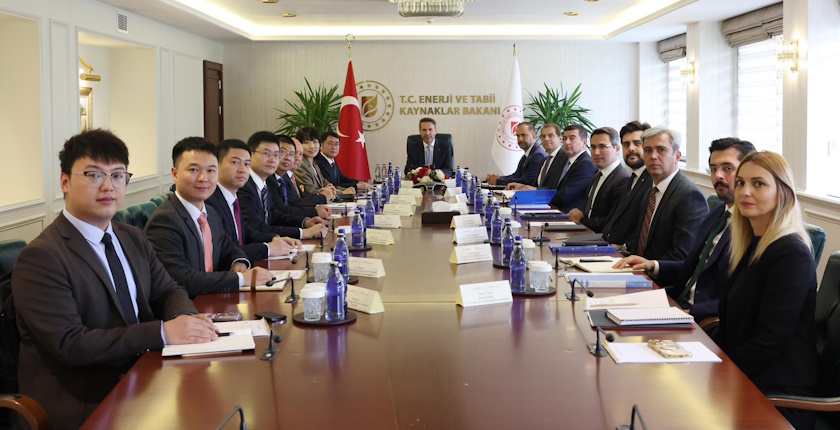
Turkey is pushing ahead with its ambition to reach 120 GW in combined solar and wind power capacity by 2035. Following a meeting with the top executives of Dongfang Electric Corp., Minister of Energy and Natural Resources Alparslan Bayraktar pointed out that, at the same time, the domestic manufacturing potential in the two segments needs to be increased.

“We evaluated the Chinese company’s plan to establish a wind turbine production facility with an annual capacity of 2,000 MW in our country, with an initial investment of approximately USD 250 million,” he revealed.

Dongfang Electric installed the world’s largest wind turbine last month for testing. The 26 MW behemoth is on the Bohai Sea at the coast of Shandong province in China’s east.

The company is also active in the Western Balkans. Dongfang Electric is leading the consortium reconstructing the Pljevlja coal power plant in Montenegro. In Bosnia and Herzegovina, it has built solar power plant Bileća, of 60 MW in peak capacity, and the Stanari coal plant, both for EFT.

Dongfang Electric could cover Turkey’s annual wind power capacity additions by itself with future factory

At the end of July, electricity capacity in Turkey totaled 120.2 GW. Hydropower accounted for 26.9% or 32.3 GW, compared to 23.4 GW of photovoltaics (19.5%) and 13.7 GW of wind power, translating to 11.4%.

There are 150 manufacturers of wind turbine components and accompanying gear in the country, covering 65% of the technology, according to a recent report. Data from early this year showed there were seven production facilities for towers, four plants were making blades, and another four were manufacturing generators and gearboxes.

Wind power plants of 1.3 GW in total were installed last year. The annual expansion could top 2 GW in 2026.

Government conditions renewable energy auction participants with high domestic sourcing rates

While awarding large wind and PV capacities through renewable energy auctions, the Ministry of Energy and Natural Resources requires high domestic content rates from the bidders.

As for PV panels, there were 75 active manufacturers at the beginning of 2025. Put together, their annual capacity was 44.5 GW. Three were making solar cells and their overall capacity was 6.1 GW per year.

The country is also strong in other technologies, like for geothermal power plants.

by in News

Corinth Pipeworks commissions Greece’s biggest industrial rooftop PV system

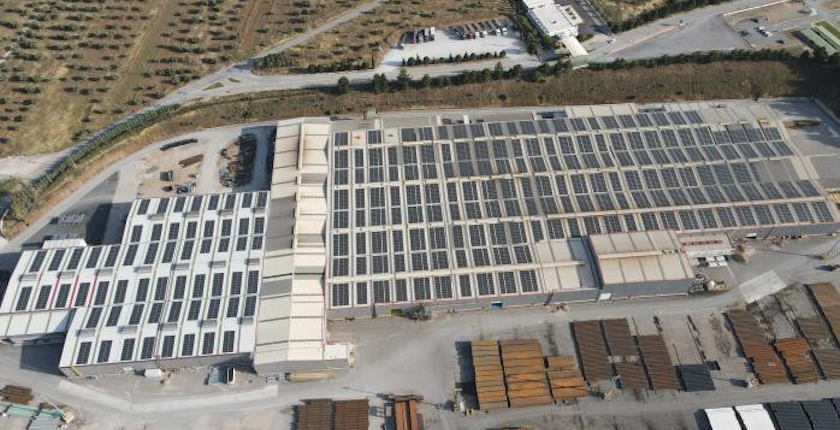
Steel pipe manufacturer Corinth Pipeworks has put into operation a 7.1 MW photovoltaic facility on its plant in the Thisvi Industrial Area. It is the largest industrial rooftop PV system in Greece, the company said.

A steel pipe factory northwest of Athens will cover an estimated 25% of its electricity needs with its new solar power plant, generating some 10 GWh per year. Corinth Pipeworks (CPW) revealed that it has commissioned the 7.1 MW system, pointing out it is the largest industrial rooftop photovoltaic facility in Greece.

The company, owned by Cenergy Holdings, conducted the endeavor under an ESCO scheme. The project was entirely designed and implemented by Survey Digital Photovoltaics. It was financed by investment firm Sirec Energy and Survey Digital Photovoltaics, in collaboration with Piraeus Bank.

Under the terms of the 10-year lease, the system will be transferred at no cost to Corinth Pipeworks. The behind-the-meter PV plant is for own consumption, injecting no electricity into the high-voltage grid.

Corinth Pipeworks surpassed its 2025 target of sourcing 80% of its energy consumption from renewables

The facility spans almost six hectares on two factories, at a height of ten meters. It consists of 12,000 solar panels.

With the photovoltaic plant and a power purchase agreement (PPA) for a wind farm, CPW surpassed its 2025 target of sourcing 80% of its energy consumption from renewables. The company’s portfolio includes pipes for hydrogen pipelines.

“This choice carries particular significance, as it comes from an organization with both the technical capacity to develop the photovoltaic system and manage the generated energy, as well as the financial capacity to finance the investment independently. Yet, it chose to move forward in collaboration with us and Survey Digital Photovoltaics, recognizing the value of strategic partnership,” said Vice President of Sirec Energy Vangelis Bardis.

A subsidiary of Viohalco, Belgium-based Cenergy Holdings also controls Hellenic Cables, which manufactures power and telecommunications cables.

by in News

Race against time to secure EU funding for waste-to-energy plants in Greece

Hostile reactions from citizens and the opposition by municipal authorities threaten to derail Greece’s efforts to build six waste-to-energy plants. Moreover, time is running out to secure EUR 800 million in European funding.

The Ministry of Environment and Energy is expected to publish a call for waste-to-energy projects planned in Attica, Western Macedonia, Rodopi, Peloponnese, Boeotia (Viotia) and Crete. Total investment would amount to EUR 1 billion, for 1.19 million tons in capacity. However, time is running out to secure EUR 800 million in European funding set aside for them and the accompanying recycling plants.

Greece has been warned several times by the European Commission and fined for failing to fulfil its obligations in waste management. The country still relies mostly on landfills to handle municipal waste, instead of modern solutions. Ideally, useful materials should be sorted for recycling before the waste gets burned in incinerators to produce energy.

Two of the proposed units, the ones in Rodopi and Western Macedonia, are expected to provide district heating. The Ptolemaida 5 lignite-fired plant supplies district heating in the coal region of Western Macedonia in the country’s north, but it is scheduled to be decommissioned by 2028 at the latest.

Its owner, Public Power Corporation (PPC or DEI) aims to complete a waste-to-energy plant by then. Other prospective investors include GEK Terna, Metlen, Aktor and Motor Oil Hellas, all big players in the country’s energy market.

High fees and pollution worry municipalities

Many local authorities have expressed their objections to hosting these plants, fearing a rise in municipal fees and pollution. A discussion is underway in numerous municipal councils. They could lodge appeals to the Supreme Court and delay the process.

Amanatidis: Cancel all waste-to-energy plans

The regional council of Western Macedonia recently voted overwhelmingly to reject the plan for PPC’s planned unit from the ministry’s strategic environmental assessment (SEA). Governor Giorgos Amanatidis called on the government to withdraw the study and cancel the project. Municipalities in the same region and other institutions are also against an incinerator.

European funding through the National Strategic Reference Framework (NSRF) ends in 2027. The government and investors have until mid-2026 for implementation, Newmoney reported, adding that waste-to-energy projects take two to three years to complete.

Recently, another initiative, the Apollo program, for investments in renewable energy to lower energy costs for vulnerable consumers, lost EUR 100 million from the EU’s Recovery and Resilience Facility (RRF).

by in News

Bulgarian capital Sofia to create its first energy community in Vitosha district

Citizens and businesses in Sofia will be able to invest in a photovoltaic system on a school rooftop as part of the first energy community. It would be a partnership between the city’s Vitosha District, individuals and legal entities.

Following a few early initiatives in Bulgaria, the capital city decided to establish its first energy community. The Sofia Municipal Council voted to call on individuals and firms to invest in the installation of a rooftop solar power plant of 74.8 kW in peak capacity.

The system, expected to become operational within a few months, would be on the Acad. Emilian Stanev secondary school in the district of Vitosha. The plan is to use the electricity for the building’s needs and for other municipal facilities.

Participants can invest EUR 260 to EUR 2,600 each

The project is worth BGN 90,000 (EUR 46,000), including value-added tax, according to the local authority. The Vitosha District has earmarked just over EUR 1,000 for the endeavor. Citizens and businesses in Sofia would be invited to invest between EUR 260 and EUR 2,600 per participant in the energy cooperative.

Dzhambazov: I believe that local government should be the driver for decentralized energy

“I believe that local government should be the driver for decentralized energy,” Deputy District Mayor Krasimir Dzhambazov said. There are 24 districts under the Sofia Municipality, also known as Stolichna (capital) Municipality. It provided the school roof free of charge.

After ten years, the city administration becomes the owner of the PV system. It unveiled the project almost a year ago. Bulgarian-Austrian Consulting Co. (BACC) and the Sofia Energy Agency (SOFENA) are consultants in the endeavor.

Vitosha energy community may integrate planned PV self-consumption systems for kindergartens

As 11 more units are about to be installed in Vitosha for self-consumption for kindergartens, including them in the energy community is under consideration, the update reveals.

Earlier this year, the Ministry of Energy, Electricity System Operator (ESO) and the Bulgarian Development Bank (BDB) agreed to introduce a solar power program for municipalities, schools, kindergartens, hospitals and small businesses, without any upfront costs. Minister of Energy Zhecho Stankov said the aim was to create the largest energy community in Europe.

Gabrovo and Burgas have launched the most notable municipal energy community initiatives in Bulgaria. The concept is gaining popularity across the European Union and beyond as an essential segment of the energy transition. In addition, households, small firms and local authorities, utilities and institutions can benefit from energy sharing or becoming prosumers.

Moreover, municipal and regional administrations have the opportunity to strengthen their energy self-sufficiency and achieve savings without burdening their public finances.

by in News

Serbia to sign agreement on gas power plant with Azerbaijan

Serbia has completed the negotiations with Azerbaijan on the construction of a natural gas power plant near the city of Niš, according to Ana Brnabić, the Speaker of the National Assembly. She also said an agreement has been reached on additional quantities of gas that would be supplied to Serbia from the Caucasian country.

The negotiations for the construction of a gas power plant in Niš have been completed, Ana Brnabić said. She added that the facility would be a joint project between Azerbaijan and Serbia, RTS reported.

In mid-November last year President of Serbia Aleksandar Vučić revealed that the government was starting talks with Azerbaijan on a possible joint construction of a 1 GW gas power plant in Niš, or two smaller units.

The agreement would likely be signed during the first meeting of the strategic cooperation council

Speaking during her visit to Azerbaijan, Ana Brnabić underlined that the signing of the gas power plant agreement would likely occur in the first meeting of the bilateral strategic cooperation council, when it is most convenient for the presidents, Aleksandar Vučić and Ilham Aliyev.

The investment near Niš would serve as an additional, significant stimulus and guarantee for Serbia’s energy security and stability, she stressed. The gas power plant will have a capacity of around 500 MW, which is of huge significance for Serbia, according to Brnabić.

The investment is estimated at EUR 600 million, she added.

An agreement reached on additional quantities of natural gas will be signed in the coming weeks

The country’s draft 2040 energy strategy includes a plan for a gas-fired cogeneration plant in Niš of 150 MW in electricity capacity and another 100 MW for heat. Another one would be built in Novi Sad. It is envisaged at 350 MW and 100 MW, respectively.

Earlier, Serbia’s Minister of Mining and Energy Dubravka Đedović Handanović stressed that the gas power plant project is important for generating baseload energy and providing the security of supply.

Brnabić also said an agreement on additional quantities of gas has been reached and that the plan was to sign it in the coming weeks. Serbia already has quantities contracted with Azerbaijan, but additional amounts have been secured at the request of President Aleksandar Vučić for the winter months, she explained.