by in News

WindEurope seeks next CEO as Giles Dickson to depart

Chief Executive Officer of WindEurope Giles Dickson has decided to step down after 10 years, to become a school teacher. The Board of Directors of WindEurope has initiated the process of finding his successor.

Giles Dickson has been instrumental in the expansion of wind energy in Europe – onshore and offshore – and played a key role in the development of Europe’s ambitious renewable energy plans, the organization said. The board established a nomination committee to find the new CEO. The current chief executive of WindEurope is remaining in his post throughout this process, until he steps down during the second half of 2025, the update adds.

“I’m incredibly proud of the progress wind energy has made in Europe in the past 10 years. I thank everyone at WindEurope for their engagement and support and the many people who have helped take wind energy forward during my tenure. Having spent most of my working life outside the UK, I look forward to going home and trying to put something back into the society I came from. But wind is a fantastic industry that it is a privilege to serve,” Giles Dickson said.

The number of jobs in the wind industry is expected to reach 600,000 in 2030

Chair of the Board of Directors Henrik Andersen praised the outgoing CEO for his contribution to WindEurope and the expansion of wind across the continent.

“It is a testament to Giles’ passion for and dedication to the energy transition that he will now help ensure a smooth succession and leave a stronger WindEurope than when he arrived. Europe is facing a generational challenge of becoming competitive and secure again, which wind energy plays a key role in, and I’m therefore very pleased we’ll have a wind energy champion like Giles to educate our future generations,” he stated.

Wind energy accounts for 20% of the electricity Europe consumes, and thanks to wind, the European Union avoids 100 billion cubic meters of fossil fuel imports, WindEurope pointed out.

The industry provides 370,000 jobs and the number is projected to reach 600,000 in 2030. The wind power sector contributes EUR 52 billion to Europe’s gross domestic product, the organization added. On average, each new wind turbine adds EUR 16 million to the European economy and the industry’s 250+ factories are all over Europe, including in economically-deprived regions, it stressed.
by in News

Foreign renewable energy investors remain committed to Romania as large plants coming online

Renewable energy companies from abroad aren’t intimidated by negative power prices in Romania, especially with the battery storage segment accelerating. Energy giants EDP Renewables and Engie have new solar power plants, and more renewable energy facilities are coming online, while the government is disbursing European grants.

The renewable energy market in Greece is consolidating and a number of foreign investors are leaving, but some other countries in the region that Balkan Green Energy News tracks remain attractive, especially Romania and Turkey. Big names from abroad keep coming, and the established ones are commissioning facilities and committing to more projects.

Like elsewhere in Europe and beyond, the increasing occurrence of low, zero and negative power prices are impacting the sentiment in Romania. But funding from the European Union, the government’s administrative support, renewable energy auctions and bets on battery storage seemingly outweigh the current risks.

EDPR’s new photovoltaic park Albina will generate 67 GWh per year

EDP Renewables (EDPR), subsidiary of Portuguese energy giant EDP, recently inaugurated its Albina photovoltaic plant. Located in western Romania, just outside of the city of Timisoara, the renewable energy unit came online late last year.

Albina has 60 MW in peak capacity and a 48.8 MW grid connection. The company expects it to generate 67 GWh per year. EDP said that with the new plant it reinforces its commitment to Romania. It operates wind and solar power plants in the country of over 570 MW in combined capacity.

Engie praises renewable energy potential in Romania

Engie Romania commissioned the sixth photovoltaic park in its portfolio. It is located in the commune of Ariceștii Rahtivani in Prahova county. Together with the new facility, of 37.2 MW in peak capacity, French Engie’s branch in Romania now has 248 MW in renewable energy in operation.

The site covers ​​57 hectares. Estimated annual output is 57 GWh. The firm owns three wind farms of 178 MW in total while its six PV systems have 70.3 MW in overall peak capacity. Last year it built one of the first hybrid power plants in the country.

Engie Romania said the new plant strengthened its position and praised the country’s “significant potential” in the renewable energy segment. The firm targets 1 GW in the country by 2030. It also distributes natural gas and supplies both gas and electricity, and offers energy services.

Rezolv building one of largest wind power plants in Europe

The Vifor wind farm in Buzău county, northeast of Bucharest, is almost half done. Rezolv Energy plans to finish it in 2027. The first phase is for 192 MW, with a planned expansion to a colossal 461 MW.

The company purchased Vestas turbines for the wind park, which is set to become the largest in Europe and the second-largest in Romania. The developer won a fixed electricity price for 15 years in the form of a contract for difference at the country’s renewable energy auction. The wind power plant will also benefit from a power purchase agreement (PPA).

Wind farm of 99.2 MW Galaţi in to launch operations next year

OX2 is building the Green Breeze wind farm, delivering the project as a turnkey construction project for the investor, Nala Renewables. The project involves 16 Vestas V162-6.2 MW turbines, or 99.2 MW altogether. Annual production at the future wind power plant in Galaţi in the eastern part of the country is 312 GWh, according to the estimate.

The facility is on schedule for the start of operations in the first half of next year. Together with Green Breeze, OX2 is working on 620 MW in five wind power projects. The Swedish company has said it intends to grow and diversify in the country.

Enery from Austria lining up renewable electricity plants in Romania

Romania-based Enevo announced that it started building a solar park of 54.2 MW in peak capacity for Enery Development.

Also in Dâmbovița county, Enery Element, the joint venture of the Austrian company with Element Power Group, has a project for a battery-backed PV park.

Total investment is some EUR 27.5 million, of which EUR 2.4 million is from the EU’s Modernisation Fund. The solar power component is 74 MW and the battery energy storage system (BESS) would provide 10.2 MWh in capacity. The location, formally run by project firm Gura Solar Plant, is in the Gura Ocniței commune.

Ecoener, headquartered in Spain, is developing an agrivoltaic project of 11 MW

A Spanish group with an annual turnover of almost EUR 100 million wants to build the first agrisolar park in Iași county, in the commune of Țibănești. Solar panels of 11 MW in total peak capacity would be placed 1.5 meters above ground. The investor, Ecoener, established a Romanian subsidiary for the endeavor: Ecoener Țibănești.

Greece’s PPC turning its wind, PV facilities into hybrid power plants with battery storage

Greek state-controlled Public Power Corp. (PPC) is developing a BESS investment through its firm Sun Challenge, which operates the Lumina solar power project in Călugăreni, Giurgiu county. The PV facility of 63 MW in peak capacity has been online for two years now. Lumina is PPC Renewables’ largest solar power unit in Romania.

It is one in a string of the Greek company’s energy storage projects. PPC plans BESS at its wind farms Topolog (27 MWh), Corugea (80 MWh) and Sălbatica (60 MWh) in Tulcea county. It slated another 120 MWh in total storage capacity at wind power plants Nicolae Bălcescu and Târgușor in Constanța county.

PPC operates wind, photovoltaic and hydropower capacity in Romania of 1.3 GW overall

The Fântânele-Cogealac-Gradina wind farm, which PPC took over from Macquarie Asset Management, already includes a BESS facility. The 600 MW facility is the largest in Romania of its kind.

In Prahova, PPC Renewables Romania plans a 10 MWh storage system at the Berceni 1 photovoltaic park, with an installed capacity of 9.8 MW. Another storage system, of 8 MWh, would be integrated with the Colibași photovoltaic park (7 MW) in Giurgiu county.

PPC operates wind, photovoltaic and hydropower capacity in Romania of 1.3 GW overall.

Turkey-based YEO Technologies, Danish company Eurowind Energy and Solarpro, a contractor from neighboring Bulgaria, all have new investment updates, too.

by in News

EU’s Modernisation Fund disburses EUR 3.66 billion for clean energy projects in nine countries

Energy modernization projects in nine member states of the European Union will receive a total of EUR 3.66 billion from the Modernisation Fund, in the largest disbursement to date from the facility financed by carbon pricing revenues, according to a press release from the European Commission. The selected projects focus on renewable energy, grid upgrades, energy storage, and energy efficiency.

The largest beneficiary of the latest disbursement is Poland, which will receive EUR 1.33 billion for its projects, followed by the Czech Republic, with EUR 1.05 billion, and Romania, with EUR 712.3 million. Hungary will get EUR 181.3 million, Croatia EUR 170 million, and Greece EUR 113.6 million. The rest will go to Latvia (EUR 40 million), Lithuania (EUR 37 million), and Slovenia (EUR 19.7 million).

Croatia will finance renewable heat production and zero-emission transportation, and Slovenia will upgrade power grid to integrate renewables

In Croatia, EUR 80 million will be used for the production and use of heat from renewable energy sources and energy efficiency improvement in heating and cooling systems. The rest will go to investments in zero-emission transportation. In Slovenia, the funding will facilitate renewables integration through the modernization and development of the electricity transmission and distribution network.

Greece, which became a Modernisation Fund beneficiary in January 2024, intends to replace urban diesel buses with new electric buses, improve energy efficiency in municipal swimming pools, and switch the heating and cooling systems in its greenhouse infrastructure to renewables.

In Romania, the funding will help improve the energy efficiency of facilities covered by the European Union’s Emissions Trading System (EU ETS), support the contract-for-difference (CfD) scheme for onshore wind and solar, and finance the installation of solar and wind power plants for self-consumption in the agricultural and food sectors and public institutions. It is also intended for investments in new solar, wind, and hydropower capacities and to support the modernization and rehabilitation of the district heating network.

In the Czech Republic and Lihtuania, the funding will support energy storage projects

Other example projects include investments in storage capacity for renewable electricity in the Czech Republic, investments in large-scale energy storage capacities in Lithuania, and a clean air program in Poland that focuses on energy efficiency improvements and heat source replacements in single-family houses, according to the press release.

The investments will reduce greenhouse gas emissions in the energy, industry, and transportation sectors, improve energy efficiency, and help the beneficiary states meet climate and energy targets, the commission said.

The projects will also help improve people’s everyday lives, by reducing bills, improving public services, creating jobs, and making the energy transition real, fair, and beneficial for all, according to Teresa Ribera, the European Commission’s Executive Vice-President for Clean, Just and Competitive Transition.

With this latest round of funding, the total disbursements from the Modernisation Fund since January 2021 have climbed to EUR 19.1 billion. The fund is financed by revenues from the auctioning of emission allowances under the EU ETS.

by in News

HELLENiQ Energy buys ABO Energy Hellas, adding 1.5 GW in renewables projects

With the acquisition of ABO Energy Hellas, HELLENiQ Energy strengthened its project pipeline for renewables and energy storage by a third, to 6 GW.

Amid a consolidation in the renewables sector in Greece, HELLENiQ Energy Holdings said it completed, through its HELLENiQ Renewables subsidiary, the acquisition of ABO Energy Hellas. The transaction includes six affiliated entities with a portfolio of 22 renewable energy project clusters.

Total capacity under development in Greece amounts to 1.5 GW. ABO Energy Hellas, part of Germany-based ABO Energy, also brings its renewable energy project development and construction platform, according to the update. HELLENiQ Energy pointed out that the portfolio comprises all renewables technologies.

It includes 340 MW of photovoltaic projects under development, classified under priority category B, and 550 MW in projects for battery energy storage systems (BESS) eligible for participation in the process of obtaining priority connection terms.

At the end of March, HELLENiQ Energy operated renewable electricity plants of an overall 494 MW

With ABO Energy Hellas, the company expanded its renewables pipeline to more than 6 GW. It accelerates the strategic objective to achieve at least 2 GW of installed renewable energy capacity by 2030, it said.

Purchase price to grow if projects reach milestones

The two sides didn’t disclose the purchase price. If projects from the 1.5 gigawatt pipeline achieve certain milestones, additional consideration will become due, ABO Energy revealed.  “The sale of the Greek subsidiary improves our chances of success, reduces complexity of the ABO Energy group, and helps to further focus our business,” said Managing Director Karsten Schlageter.

Between 2019 and 2023, ABO Energy developed and sold five solar parks in Greece with a total capacity of more than 100 MW. The largest one is Margariti in Epirus, of 50 MW. The company connected four of them to the grid on a turnkey basis.

ABO Energy stressed it would remain active in Greece as a service provider and continue to provide commercial and technical management for the solar parks already built.

Photo: Margariti solar park (ABO Energy)

HELLENiQ Energy had almost 500 MW in operation at end of March alongside just as much in mature projects

HELLENiQ Energy, formerly Hellenic Petroleum, produces fossil fuels and petrochemicals and operates service stations. The company is rapidly expanding in the green energy segment as well. Notably, it won state support for its projects at Greece’s BESS auctions.

At the end of March, HELLENiQ Energy operated renewable electricity plants of 494 MW altogether. Photovoltaics made up 59%, while the rest was in wind turbines. At the time, the company had half a gigawatt under construction or in the ready-to-build stage.

It is about to complete the purchase of the remaining 50% of Elpedison, its joint venture in Greece with Italy-based Edison. They operate two gas-fired combined cycle power plants.

by in News

Danish Eurowind Energy to build 220 MW solar park in Romania

Denmark-based renewable energy company Eurowind Energy has announced plans to develop a 220 MW solar park in Romania in an investment valued at EUR 174.8 million. It would be its largest solar park in Romania and one of the biggest in the country. In addition, the company ordered wind turbines from Vestas for its three projects in Romania.

Eurowind’s future solar park, located in Vișina in Dâmbovița County, will span 345 hectares, comprising over 400,000 photovoltaic panels. Its projected annual electricity output is 400 GWh, equivalent to the consumption of around 150,000 Romanian households.

The Vișina solar park is the fifth photovoltaic project developed by Eurowind in Romania, following those in Hălchiu, Măgurele, Pufești, and Teiuș. By the end of 2025, the company plans to operate a local portfolio of 124 MW, alongside a pipeline of about 7.5 GW of solar, wind, hybrid, and storage solutions, according to its website.

Vișina is Eurowind’s fifth solar project in Romania

The Teiuș Solar Park, with a capacity of 60.2 MW, was commissioned in April this year. The EUR 55 million project was developed in collaboration with local firm Teiuș Solar. Its planned annual production is 103.59 GWh of electricity.

Also in April, Eurowind signed a 12-year virtual power purchase agreement (PPA) in Romania for the supply of electricity from its Pecineaga wind park. The contract was signed with Sweden-based automotive manufacturer Autoliv.

Eurowind has ordered 143 MW of Vestas wind turbines for its wind farms in Romania

Wind turbine manufacturer Vestas said yesterday that Eurowind Energy has placed a 143 MW order for its Frumușița, Vector, and Pecineaga Northeast (NordEst) wind power projects in Romania. The contract includes the supply and installation of 23 wind turbines from the EnVentus platform, Vestas added.

In addition to wind and solar, Eurowind Energy’s portfolio includes hydrogen, biogas, power-to-heat, and battery storage projects. It operates in 16 markets across Europe and the United States, according to the Danish company’s website.

by in News

Montenegro publishes NECP for public consultation – sole coal plant planned for shutdown in 2041

State institutions, companies, organizations, and individuals have until August 6 to deliver their suggestions and comments about the draft National Energy and Climate Plan of Montenegro. It sets the provisional date for taking the Pljevlja coal power plant, the only one in the country, at 2041, but the authors pointed out that it primarily depends on a just transition and the security of electricity supply.

Montenegro’s long-awaited draft National Energy and Climate Plan (NECP) sets out the key 2030 targets for greenhouse gas emission cuts, share of renewable energy sources in gross final energy consumption, and energy efficiency.

The document, also known for its acronym INECP, in which the first letter stands for integrated, was published for the public consultation phase. It lasts until August 6. The Ministry of Energy and Mining called on the interested public – local authorities and other state institutions, the expert and scientific communities, associations, organizations, companies and individuals, to send their comments and suggestions.

“The energy and climate policy isn’t just a task for the government – it is a joint responsibility. That is why I am inviting all stakeholders, and especially nongovernmental organizations, to use this opportunity and contribute to the creation of a realistic, ambitious and just plan,” Minister Admir Šahmanović stated.

Renewables target can be surpassed

National goals match the ones adopted within the Energy Community. The targeted primary energy consumption in 2030 amounts to 0.92 million tons of oil equivalent. Under the business-as-usual scenario (with existing measures – WEM), the benchmark is expected to land at 1.04 million. With additional measures (WEM), the trajectory moves closer to the objective, projected at 0.97 million tons of oil equivalent.

The goal for final energy consumption is 0.73 million tons of oil equivalent. Existing measures result in 0.82 million, and added ones in 0.77 million tons of oil equivalent.

The share of renewable sources in transportation could reach 24.4% instead of only 7.2%

Montenegro fares better with its expected share of renewables in gross final energy consumption, against the 50% target. In the WEM scenario, it reaches 42.5%, and the WAM projection is 53.3%.

Without additional measures, renewable sources have a 66.3% share in electricity production. The document’s authors calculated that it could grow to 79.4%. As for transportation, the range is from 7.2% to 24.4%. In heating and cooling, the possible progress from the results of current measures is only 0.4 percentage points, reaching 49.2%.

The targeted reduction in emissions is 55%, the same as in the European Union. It translates to 2.42 million tons of carbon dioxide equivalent in the final year of the current decade. With existing measures, the curve touches 3.06 million in 2030, and with added ones the result is 2.4 million tons of CO2 equivalent.

Retirement of Pljevlja coal plant depends on socio-economic situation in northern region

Oil derivatives, which are all imported, participated in the 2022 final energy consumption with 47.3%, followed by electricity, 33.3%. Wood fuel is the next item, with 18.7%. The share of coal is only 0.7%, because almost the entire output goes to thermal power plant Pljevlja, the only such facility in Montenegro.

The overall electricity production capacity at the end of 2023 was 1.07 GW. The Pljevlja coal plant, which is currently under reconstruction, has 225 MW.

According to the projection, the Pljevlja coal plant is in cold reserve after 2040

The provisional date for its shutdown is 2041, but it primarily depends on the success of the just transition process and maintaining the security of electricity supply, the NECP reads. It also shows the Pljevlja coal plant in cold reserve after 2040.

In addition, taking it offline requires supplying end consumers under favorable conditions, while minding the overall socio-economic situation in the country’s northern region, where the coal mines and the power plant are, the authors explained. They noted as well that an energy storage pilot project is under consideration for the site of the Pljevlja facility.

Electricity sector’s self-sufficiency varying due to dependence on hydrological conditions

The country’s two large hydropower plants Piva and Perućica have 342 MW and 307 MW in capacity, respectively.

There are 38 other hydroelectric units in Montenegro, of which the smallest one is 200 kW. The biggest facility, Vrbnica (6.75 MW), is owned by a firm with the same name, registered in the capital Podgorica.

The high share of hydropower plants in electricity production, implying dependence on hydrology, is the main reason of the variability of the level of self-sufficiency of the national energy balance year after year, the NECP says.

There are two wind power plants on the grid: Krnovo (72 MW) and Možura (46 MW), while the third one, called Gvozd, is under construction. The project envisages 54.6 MW in the first phase.

There are only five independent solar power plants. The biggest one, Čevo, has 4.4 MW in nominal capacity and a 3.25 MW connection. Nevertheless, units operated by prosumers reached 75 MW altogether, according to one entry, though the numbers are lower in other parts of the NECP.

by in News

EDPR reportedly exiting Greece as all power plants, projects are on sale

EDP Renewables (EDPR) is about to divest of all its assets in Greece and leave next year, according to the domestic media. Market-oriented green electricity producers in the country are at a disadvantage, due to low and negative prices and curtailments, against companies involved in retail supply and with long-term power purchase agreements (PPAs) and feed-in tariff support.

Green energy giant EDP Renewables (EDP Renováveis) is expecting official bids for its four wind parks northwest of Athens, while also looking to sell all its other assets to MORE, the renewables subsidiary of oil refiner Motor Oil Hellas, according to news reports. The latter portfolio is said to include their joint venture.

EDPR, part of Portugal-based EDP Group, is apparently planning to exit the country next year, as early as the summer, and is already cutting jobs. The company entered Greece in 2018.

The wind parks, reportedly pursued by four domestic companies, are Livadi (45 MW) and Erimia (35 MW) in Malesina, Phthiotis, both commissioned last year, and new facilities Xironomi (36 MW)  and Chalcodonio (33.6 MW). They are located in Boeotia, Central Greece, and Magnesia, Thessaly, respectively.

Of note, EDP Renewables is headquartered in Spain, but traded on the Euronext Lisbon stock exchange.

Project portfolio includes major wind power clusters in Evia

The Greek press learned that MORE is likely to buy out EDPR’s 51% share in their projects for two wind farm clusters in Evia (Euboea), of 150 MW and 214 MW. Other assets that the oil refiner would pursue include another cluster under development for sites in the same island, of 156 MW, an operating 22 MW photovoltaic park in the Peloponnese and two wind farms under construction in Boeotia (also Beotia and Viotia).

In addition, the company has a pipeline of less mature projects for photovoltaics, standalone battery energy storage systems (BESS), hybrid power plants and wind power. They could all fit into one large package for sale.

EDPR is also exiting Hungary, Belgium, the Netherlands, Colombia, Brazil and a group of Asian countries.

Vertical integration or bust

Analysts have pointed out that the Greek market is no longer attractive to companies in the sector that are not vertically integrated. Namely, renewable energy producers oriented toward the market are exposed to curtailments and low, zero and negative power prices at electricity exchanges.

The ones also active in the supply and retail market have an advantage, as do the operators of power plants that receive subsidies like feed-in tariffs or have long-term PPAs.

The share of curtailed electricity in Greece is set to be more than doubled this year

Since the beginning of the year, over 860 GWh has been curtailed, Euro2day wrote. It is already more than all last year, when the share of lost electricity was 4%

But some companies seem dedicated to the Greek market.

France-based Valorem recently completed a wind park of 27 MW in Vlasti in the municipality of Eordaia. It is located in the Kozani regional unit in the region of Western Macedonia in northern Greece. The facility consists of six turbines, with an estimated annual output of 68 GWh overall.

Also in Kozani, Principia inaugurated a photovoltaic cluster of 95 MW. The firm is a joint venture between Enel and funds managed by Macquarie Asset Management. The Perasma facility, near the villages of Mavrodendri and Sidera, is set to generate 126.8 MW per year. It comprises seven solar power plants.

by in News

ENTSO-E proposes delaying CBAM on electricity by one year

The European Network of Transmission System Operators for Electricity suggested to the European Commission to prolong the transitional period of the Carbon Border Adjustment Mechanism (CBAM) for electricity by one year, to January 1, 2027. It recommended an additional impact assessment, an analysis of possible exemptions for third countries as well as to exempt transmission system operators (TSOs).

In its new position paper, ENTSO-E supported the general principles of CBAM, but it warned against creating disproportionate administrative burdens and costs for TSOs. The pan-European body recommended exempting TSO activities from the CBAM scope, arguing there is a minimal risk of carbon leakage and pointing to their role in keeping the lights on and ensuring the security of the power system.

Moreover, ENTSO-E said an additional impact assessment is needed before the completion of the transitional period for electricity overall. The European Commission should also review in depth the list of third countries eligible for exemption, pending their adjustment to the European Union’s Emissions Trading System (EU ETS), it added.

The current criteria to calculate the actual emissions embedded in electricity production are impossible for importers to implement

“ENTSO-E encourages policy makers to use the targeted revision of CBAM part of the Omnibus simplification package on sustainability to postpone the definitive period as of 1 January 2027. It should also be noted that in its current form, the application of the provisions under CBAM regulation would have a major impact on the Energy Community countries and the UK imports,” the update reads.

Carbon leakage occurs when companies based in the EU move carbon-intensive production to countries with less stringent climate policies, or when EU products get replaced by more carbon-intensive imports.

CBAM was devised to bring CO2 prices for imported cement, iron and steel, aluminum, fertilizers, hydrogen and electricity to the same level as in EU ETS. Under the current rules, the EU will start charging CBAM at the beginning of January next year and gradually increase the tariffs to reach 100% at the start of 2034.

No provisions regulating implicit electricity trading

ENTSO-E acknowledged the role of the carbon border tax in putting a fair price on carbon emissions from carbon-intensive goods entering the EU, and to promote cleaner industrial production globally. Nevertheless, there are still many questions even about the current reporting obligations, it pointed out.

“TSOs adjacent to EU external borders are the most exposed to the concerns raised in this paper. It concerns a significant number of ENTSO-E members, almost one third of the EU members of the association,” the paper adds. In specific cases, the measures may also lead to efficiency losses, reduce EU competitiveness and reduce incentives for building and connecting offshore wind, it underscored.

Obstacles to importing electricity from third countries could contradict the goal of efficiently importing cheap green electricity

CBAM only assumes that electricity is traded with third countries through explicit allocation, not taking into account implicit trading. Like implicit electricity trading within the internal electricity market, there is no nomination on the interconnectors, only anonymous trading between markets, ENTSO-E explained.

“These obstacles to importing electricity from third countries could contradict the goal of efficiently importing cheap green electricity into the EU if applied also to third countries with robust decarbonisation policies and renewable energy sources. The current criteria to calculate the actual emissions embedded in electricity production make it impossible for importers to implement, mainly due to impossibility to trace the origin of the electricity,” the TSO network stressed.

CBAM would tax historical instead of actual emissions

The current default CO2 levels are based upon the carbon intensity of the five-year average through 2020, even though third countries made tremendous efforts in decarbonising their energy mix in the meantime, according to ENTSO-E. It suggested allowing such countries to be exempted if they verify their progress through proper data platforms.

ENTSO-E invited the European Commission to envisage a revision aligned with the current delay in CBAM implementing acts, stressing that it is impossible for the market to digest them before the end of the year.

Energy Community contracting parties, including the Western Balkans, are eligible for exemption from CBAM on electricity until 2030. The condition for each one is to couple its electricity market with an EU neighbor.

by in News

Turkey-based Çalık Enerji secures financing for Zatriq wind farm in Kosovo*

Çalık Enerji, part of Turkey-based Çalık Holding, obtained EUR 112 million in financing for its 73 MW Zatriq wind power project in Kosovo*.

In a consortium with fellow Turkish company Limak, Çalık Holding took over Kosovo Electricity Supply Company (KESCO) and Electricity Distribution Services in Kosovo (KEDS) in 2013. The conglomerate is expanding to electricity production with a wind farm project. Çalık Enerji closed the financing for the Zatriq facility of 73 MW in planned capacity.

The deal is worth EUR 112 million, according to the company’s legal advisor Watson Farley and Williams. It is Çalık Renewables’ first renewable energy investment outside of Turkey and the first wind project supported by Swiss Export Risk Insurance (SERV), the law firm revealed.

Çalık Enerji secured financing from Helaba bank and Deutsche Bank

Calik Enerji Swiss, Çalık Enerji’s engineering, procurement and construction (EPC) subsidiary, acted as the EPC provider, while the financing was provided to project firm EV Wind Park. The lender is Landesbank Hessen-Thüringen Girozentrale (Helaba), headquartered in Frankfurt.

Zatriq or Zatrić is a village in the municipality of Rahovec-Orahovac. The wind potential at the site is one of the highest in Kosovo*.

Çalık Enerji said it established cooperation with wind turbine manufacturer GE Vernova for the project.

The financing package led by Helaba bank is for the construction period and another 14 years, and there is also a commercial uncovered tranche, the company added. Çalık Enerji said it received equity financing as well, from Deutsche Bank, under Japan’s Nippon Export and Investment Insurance (NEXI).

Çalik and Limak participated in the first solar power auction in Kosovo*. The first wind power auction is underway.

* This designation is without prejudice to positions onstatus and is in line with UNSCR 1244/99 and the ICJ Opinion on the Kosovo declaration of independence.
by in News

Montenegro preparing first renewable energy auction to accelerate green transition

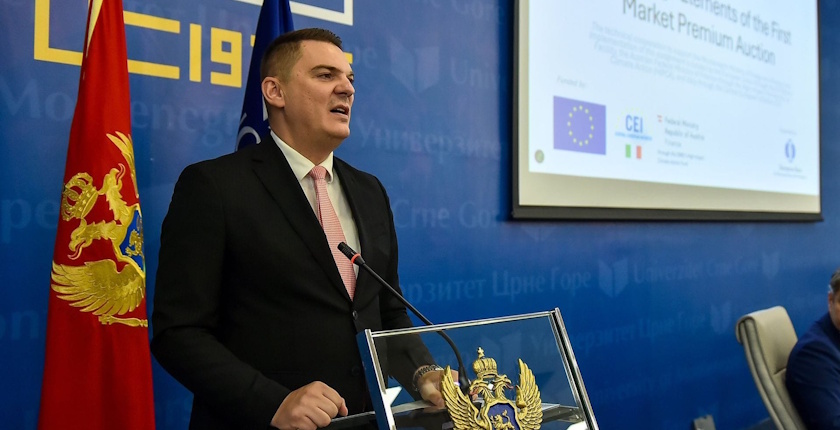
A model for Montenegro’s first auction for market premiums for solar power was outlined at an event in the capital Podgorica. The new legal framework for the green energy transition includes guarantees of origin, citizen energy communities and streamlined permitting. Stakeholders will be able to participate with their comments and suggestions in the renewables auction design.

The Ministry of Energy and Mining of Montenegro organized a conference today to present the key design elements of the first market premium auction for renewables. The competitive bidding process for wind and solar power is part of the reform agenda within the European Union’s Growth Plan for the Western Balkans.

The country’s new legal framework includes guarantees of origin, citizen energy communities and simplified permitting aimed at facilitating investment. They were defined with the new laws on energy and renewables.

The ministry said the first auction would be for photovoltaics. Solar power is the segment with the greatest potential and the lowest share in domestic electricity production, it explained.

EBRD’s Zakaria: First auction should match market needs

The Head of Montenegro in the European Bank for Reconstruction and Development (EBRD) Remon Zakaria urged stakeholders to send their comments and suggestions. The design of the first auction should match the needs of the market as much as possible, he argued.

EBRD participated in drafting the model. The ministry also thanked the Ministry of Finance of Austria, Central European Initiative (CEI) and other partners for their assistance.

At the event in Podgorica, a team of experts presented the technical matters concerning the upcoming auction.

Montenegro to boost renewables’ share in electricity output to 70% by 2030

This is not just the beginning of a technical process – it is a strategic leap, according to Minister of Energy and Mining Admir Šahmanović. He pointed out that Montenegro is transitioning from state incentives to a market-based support model, saying it aligns with the best European practices.

“We know our ambitions and goals for 2030 – a 50% share of renewable energy sources in final consumption and 70% of electricity to be produced from renewable sources. They are indeed demanding targets, but reachable – especially with support from international partners and the private sector,” Šahmanović added.

Montenegro has demanding, but achievable green energy targets, Minister Admir Šahmanović said

Montenegro doesn’t see itself isolated in its energy future but as an integral part of the European market, the minister asserted. With the forthcoming auction, the country is sending a clear message that it is ready for the next steps in the green transition, in his view.

The government is committed to decarbonization, digitalization and preparations for the European Union’s instruments like the emissions trading system (ETS) and Carbon Border Adjustment Mechanism (CBAM), Šahmanović underscored.

“We don’t see this process as a political goal – but as an economic opportunity and social imperative,” the minister said.