by in News

Romania risks blackouts if it shuts coal plants as scheduled

Minister of Energy Bogdan Ivan claims that energy poverty or even blackouts could hit Romania if it proceeds with the closure of coal plants. Namely, the gas power projects for replacing them are suffering severe delays.

The European Commission has become flexible for the first time in the last four years, said Romania’s Minister of Energy Bogdan-Gruia Ivan. He has asked for a postponement of the deadline for shutting down a group of coal power plants.

They need to be closed by the end of the year. If the coal plants, run by state-owned Complexul Energetic Oltenia (CE Oltenia) go before gas power plants Iernut and Mintia are commissioned, Romania is jeopardized, according to the minister.

Ivan told Digi24.ro he was negotiating with the European Commission on delaying the closure by “a few months.” Romgaz decided last week to cancel the contract with Duro Felguera, the contractor for the Iernut facility.

Energy poverty risk increasing

A study conducted with Romania’s transmission system operator Transelectrica has shown that Romania can otherwise end up in energy poverty and even risk a blackout, he underscored. “Especially in the winter, when we have no solar, when we have no wind power,” Minister Ivan explained.

Furthermore, Romania would like to keep three large coal units and another two in technical reserve for replacement them in case of damage, Ivan revealed. It would ensure a 1 GW minimum coal power supply, he asserted.

Romania requires at least 1 GW in baseload energy from coal for two more years, according to Minister Bogdan Ivan

Simulations showed that the group would need to operate for two years more, at least, until Iernut and Mintia are completed.

“We are pressed for time. We need to conclude contracts for next year. We need to conclude contracts for energy supply, contracts with suppliers, coal stocks. It is a complex of factors that must be organized very well from now on. It is already late, for Romania and for our energy companies,” Ivan stated.

Gas power projects in constant delay

Additionally, gas power plants Turceni (475 MW) and Ișalnița (850 MW) are supposed to replace some of the capacity in the Oltenia complex. The two projects suffered constant delays. The deadlines in the tenders for construction have been pushed back to September 30 and November 14, respectively.

Romania has received billions of euros from the European Union for gas power plants to substitute coal, the minister noted separately. He acknowledged that the projects are still on paper. That’s why today Romanians have almost the highest electricity price in Europe, Ivan claimed.
by in News

Turkish oil company Tüpraş to produce sustainable aviation fuel

Oil refiner Tüpraş is working on a technology for biofuel from algae and yeasts, using solar energy. The Sunfusion project involves processing into sustainable aviation fuel – kerosene – and green alternatives for vessels. It received EU support and includes partners from Greece, France, Germany, Norway and Serbia.

Istanbul-based Türkiye Petrol Rafinerileri AŞ (Tüpraş) has several decarbonization projects underway, counting on the expansion of green energy markets. One of the endeavors is Sunfusion – advancing biofuel production from purified microalgae and oleaginous yeasts by utilizing state-of-the-art solar technologies.

The project, which runs until the end of 2028, received EUR 3 million through the European Union’s Horizon Europe program. Centre for Research and Technology Hellas (CERTH), known also by its Greek acronym EKETA, is the coordinator.

Ten partners include the Middle East Technical University (METU/ODTÜ), located in Ankara, Aristotle University of Thessaloniki (AUTH) and Foodscale Hub (FSH), which is in Novi Sad, Serbia. The rest are from France, Germany and Norway.

Solar-to-biocrude efficiency must top 50%

Tüpraş, the largest oil refiner in Turkey, is majority-owned by Koç Holding and its related businesses. It launched Sunfusion to develop the conversion of microalgae and oleaginous yeasts using the hydrothermal liquefaction (HTL) method. Among the goals is to minimize costs, emissions and waste and achieve a solar-to-biocrude efficiency target of more than 50%.

The company and its partners intend to cultivate high-lipid, low-nitrogen microalgae and yeasts

The initiative involves photobioreactors, open raceway ponds and a solar thermal system supplying energy for the process. The company and its partners intend to cultivate high-lipid, low-nitrogen microalgae and yeasts.

Hydrotreatment units would have fractionation capabilities, for refining the biocrude into high-value fuels such as sustainable aviation fuel – kerosene – and alternative marine fuels.

First SAF supply deal in Turkey already in scope

In June, Tüpraş signed a letter of intent with Turkish Airlines for a sustainable aviation fuel (SAF) supply arrangement. They claimed that carbon emissions would be up to 87% lower than from conventional jet fuel.

“We will begin SAF production next year at our Izmir Refinery by leveraging our existing facilities. We aim to finalize the investment decision for a new unit that will increase our SAF production capacity to 300,000 tons by the end of this year. The use of SAF is becoming a necessity under both international and local regulations for the decarbonization of the aviation sector,” General Manager of Tüpraş Ibrahim Yelmenoğlu stated.

It would be both the first production and supply operations in Turkey. The company revealed at the time that it would make the SAF from bio-based feedstocks.

Tüpraş has seven projects with support from Horizon Europe

Tüpraş said it has completed 17 projects under Horizon 2020 and that seven are ongoing through Horizon Europe. The company updated its strategic transformation plan in April, placing the focus on sustainable refining, SAF, zero-carbon electricity and green hydrogen.

In the Horizon portfolio, it is conducting the Eastern Lights project for geological storage of carbon dioxide. ICO2nic is in the same segment, with carbon capture and electrochemical conversion of CO2, while the Hermes initiative is for the separation and purification of hydrogen with innovative membranes.

Also of note, one of the oil refiner’s subsidiaries took over a major solar power project in Romania early this year.

by in News

Coal plant operator KEK to begin construction of Solar4Kosovo PV plant

Government-controlled Kosovo Energy Corp. (KEK) said it is preparing to start building its Solar4Kosovo 1 photovoltaic plant near Prishtina. It informed the local community that agricultural and other activities weren’t allowed anymore on the designated land.

After four years of planning. a former coal ash dump is about to be turned into the biggest solar power plant in Kosovo*. KEK is running the Solar4Kosovo 1 project at a site near its Kosovo A power plant near Prishtina.

The area is in the municipalities of Obiliq (Obilić) and Fushë Kosovë (Kosovo Polje). The government-owned power utility said it is preparing to begin construction works. The project is for 100 MW in connection capacity, translating to 120 MW in peak capacity.

The update mainly affects residents of Dardhishtë and Mërlak in Kryshevc (Kruševac) in Obiliq municipality. Agricultural and other activities aren’t allowed anymore, the company announced. It explained that so far it tolerated the use of its property there by the local community.

KEK obtained EUR 32 million EU grant

The financing for the Solar4Kosovo facility is part of the European Union’s Economic and Investment Plan for the Western Balkans of EUR 9 billion in grants. The package is aimed at mobilizing a total of EUR 30 billion.

The European Investment Bank is providing a EUR 33 million loan. The EU has approved a EUR 32 million grant via its Western Balkans Investment Framework (WBIF), while Germany’s KfW Development Bank is lending EUR 29 million to KEK. The investment was earlier estimated at EUR 107 million overall.

Annual output estimated at 169 GWh

The proposed solar power plant is expected to produce 169 GWh per year. It would have an underground connection to the existing substation at the Kosovo A thermal power plant.

Notably, Kosovo* is dependent on the obsolete Kosovo A and Kosovo B coal plants for almost all its electricity.

The other part of the Solar4Kosovo project is for a solar thermal facility for the capital city’s district heating system. The site is in the village of Shkabaj (Orlović) in Obiliq municipality. The investment includes a 20 MW network extension.

* This designation is without prejudice to positions onstatus and is in line with UNSCR 1244/99 and the ICJ Opinion on the Kosovo declaration of independence.
by in News

Greece loses EU grant intended for renewable electricity for vulnerable consumers

The ambitious Apollo program, which the Greek government outlined in late 2023, is losing EUR 100 million. The European Union earlier approved the grant for investments in renewable energy and storage, intended to lower energy costs for vulnerable consumers through self-consumption.

The first phase of the Apollo program was envisaged to help vulnerable households. It aimed to support renewable energy projects, through auctions, of 400 MW to 500 MW overall, combined with battery systems.

Each of Greece’s 13 regions, also known as peripheries, would get a green power plant, and eligible consumers who join a local energy community get discounted electricity bills. Therefore, the program is in the form of virtual self-consumption. It is the first of its kind in the region that Balkan Green Energy News tracks.

Apollo fails to take off on time

The scheme was supposed to benefit from an EUR 100 million grant from the European Union’s Recovery and Resilience Facility (RRF). It is implemented via the National Recovery and Resilience Plan Greece 2.0.

However, Apollo was significantly delayed and now the deadlines are considered impossible to achieve, even if they are extended. It means RRF funds are going to be lost. Energypress reported that they have already been removed from the budget.

Namely, the issue is with the batteries. Now their costs would have to be covered entirely by the producers. In turn, they are expected to lock higher prices in Apollo’s auctions, possibly passing them on to end consumers and making the whole initiative less effective at combating energy poverty.

It should be noted that the rest of Apollo remains intact for the time being, despite the setback. The loss of funds concerns household consumers with special tariff A. Funding is still available, in theory, for the other category of vulnerable households, defined by different income criteria.

The entire initiative also aims to lower energy costs for municipal authorities, water utilities and irrigation associations. They haven’t been affected so far.

Standalone battery plants also at risk

Another Greek initiative, for subsidized standalone battery plants, faces very short deadlines. It is eligible for EUR 341 million in RRF funding. In total, projects for 900 MW overall have been selected through three auctions.

The first wave of investors should declare connection readiness this month, so their facilities can become operational by the end of 2025.

HAESS: Selected projects may not receive support

They have complained of a lengthy licensing process and logistical difficulties. The investors asked the Ministry of Environment and Energy for an extension.

In July, the Ministry of Finance submitted a request for the sixth RRF tranche, EUR 2.1 billion in grants, after completing 39 more targets. If it is approved by the administration in Brussels, Greece will have secured EUR 23.4 billion overall, or 65% of allotted funds.

by in News

Turkey launches solar, wind power auctions with November deadlines

The Ministry of Energy and Natural Resources of Turkey issued a public call for solar and wind power auctions for 2 GW in total. It will receive the applications on November 4 and November 18, respectively. One competitive bidding process is for a floating solar power project of 35 MW.

Following the successful auctions for renewable energy projects that were completed early this year, Turkey kicked off another round. It is also for 2 GW of overall connection capacity, in light of the country’s ambition to grow its combined solar and wind power capacity to 120 GW by 2035. The two technologies reached 37.1 GW together a month ago, out of 120.2 GW in total.

Auctions are held under the Renewable Energy Zones (REZ) state support mechanism. The scheme is better known by its Turkish acronym YEKA.

Ten solar power areas in eight provinces

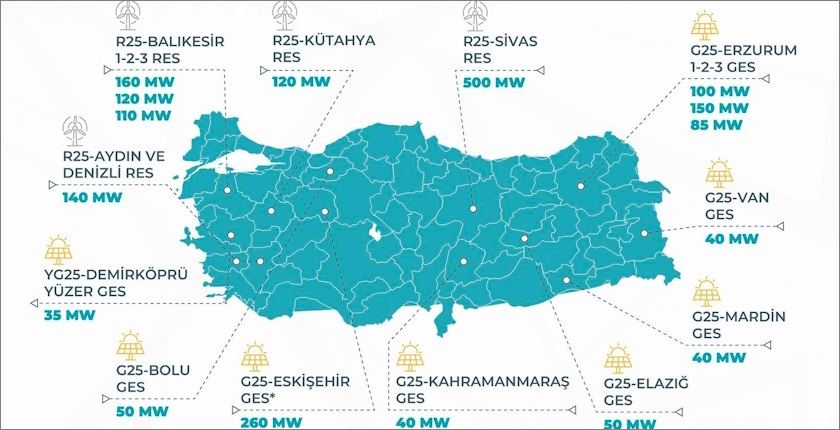
The upcoming solar energy auctions, REZ SPP 2025 (YEKA GES 2025), are for 850 MW altogether. There are ten areas in eight provinces designated for bidding: Kahramanmaraş, Mardin and Van, with 40 MW each, Bolu and Elazığ (50 MW each), Erzurum 1-3 (100 MW, 150 MW and 85 MW), Eskişehir (260 MW) and Demirköprü in Manisa province, with 35 MW.

The upcoming solar power auctions will include Turkey’s first bidding for a floating photovoltaic plant

Notably, the last one is for a planned floating solar power plant on the reservoir of the Demirköprü hydropower plant. The facility on the Gediz river, east of Izmir, is owned by state-owned Electricity Generation Corp. (EÜAŞ). Turkey now hosts only two small floating photovoltaic units, and the auction will be the first of its kind.

Applications will be received on November 4, the ministry said and added it would subsequently publish a schedule for bidding.

Wind power capacity quota is 1.15 GW

Participants can apply on November 18 for the wind energy round of auctions, REZ WPP 2025 (YEKA RES 2025). It is for an overall 1.15 GW in six areas.

Investors will compete for 500 MW in Sivas province, a 140 MW project in Aydın and Denizli, 120 MW in Kütahya and three areas in Balıkesir – 160 MW, 120 MW and 110 MW.

Winners to submit guarantees of EUR 75,000 per MW for PV projects, EUR 100,000 per MW for wind

Potential bidders will pay a fee of EUR 1,550 for each auction they apply for. They must submit letters of guarantee lasting one year and worth EUR 15,000 per MW for photovoltaics and EUR 20,000 per MW for wind power. Winners will submit 10-year guarantees before signing their contracts: EUR 75,000 per MW and EUR 100,000 per MW, respectively.

The ceiling or starting price is EUR 55 per MWh and the floor prices are EUR 32.5 per MWh for solar power and EUR 35 per MWh for wind. If bids hit the floor, another auction will be held between the competitors, like in the previous round. It is for a so-called contribution share that they are ready to pay. The minimum is EUR 10,000 per MW of planned capacity and the highest bid wins.

Successful participants can sell electricity on the free market for five years in the case of solar power plants, while the period lasts six years for wind. After that, both categories enter a 20-year scheme with a guaranteed price.

Turkey tops 120 GW in total electricity capacity

At the end of July, electricity capacity in Turkey totaled 120.2 GW, the ministry revealed. Hydropower accounted for 26.9% or 32.3 GW, compared to 23.4 GW in photovoltaics (19.5%) and 13.7 GW of wind power, translating to 11.4%.

The share of biofuel and waste was 1.9%, with 2.34 GW, and geothermal power plants had 1.73 GW altogether, which is 1.4%. Gas power plants in Turkey had 24.7 GW in combined capacity (20.6%). The remainder is coal: 21.9 GW or 18.3%.

by in News

Airport in Cluj-Napoca secures grant for battery-backed solar park

International Airport Avram Iancu Cluj will cover more than half of the costs for a 5 MW solar power plant, with a battery energy storage system of 12 MW, from European funds. It expects the facility to cover more than 60% of its electricity needs.

Civilian airports throughout Southeastern Europe are building dozens of solar parks and rooftop photovoltaic systems to increase their energy autonomy and achieve cost savings. Some of the capacity is backed up by battery energy storage systems (BESS). International Airport Avram Iancu Cluj in Romania is set to join the group with a project worth EUR 10.7 million including value-added tax.

The Ministry of Transport and Infrastructure declared it eligible for EUR 6 million grant from the European Union’s Modernisation Fund. The operator is controlled by the Cluj County Council.

Cluj International Airport to save EUR 1 million per year

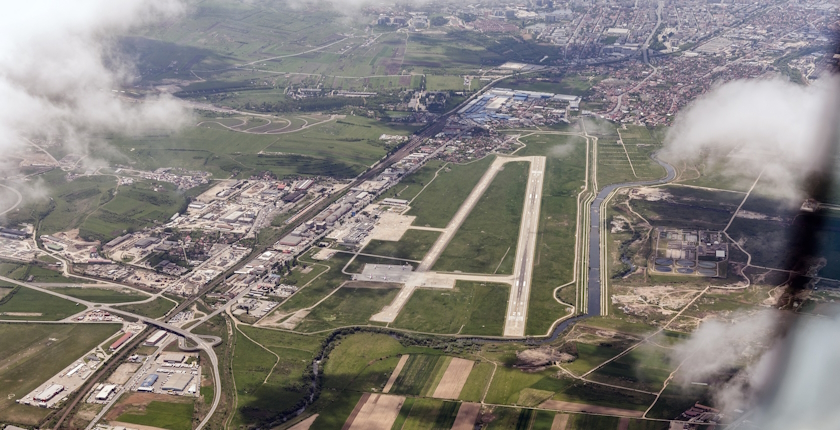
International Airport Avram Iancu Cluj in Transylvania serves Cluj-Napoca, Romania’s second-largest city. With the green light for EU funding, it can proceed with the PV project of 5 MW with an energy storage unit of 12 MW in operating power. The airport expects the facility to cover more than 60% of its electricity consumption.

The airport in northwestern Romania serves Cluj-Napoca, the country’s second-largest city

The system would span eight hectares and include more than 7,500 solar panels. It is intended only for self-consumption. Cost savings amount to an estimated EUR 1 million per year. The initially planned capacity of the solar park was 2 MW.

“In the context of rising energy prices and budgetary constraints, energy independence is one of the major objectives we are focusing on. The investment in a photovoltaic park at Cluj Airport, from non-reimbursable funds, is a notable achievement and creates the premises for financial stability and achieving energy independence,” said Cluj County Council President Alin Tișe.

Gearing up for rising emissions costs

The airport’s General Manager David Ciceo stressed that heat pumps are also part of the plan to decarbonize and increase energy autonomy. President of the Board of Directors Viorel Federiga noted it is an important step toward meeting new international requirements.

For instance, the EU plans to extend the EU Emissions Trading System (EU ETS) to all flights from the European Economic Area (EEA). Currently it only covers the flights within the region and toward the United Kingdom and Switzerland. A scheme called EU ETS 2, to be launched in 2027, will include buildings and road transportation.

Within its efforts to reduce carbon emissions, Cluj International Airport added another electric bus to its vehicle fleet, to take passengers to and from aircraft. It can carry 110 people. The bus, which cost EUR 830,000, features a battery that allows for an autonomy of over 300 kilometers.

The airport projected the number of its passengers this year at 3.4 million.

by in News

North Macedonia tackles energy poverty with free inverter air conditioners

North Macedonia’s Ministry of Energy, Mining and Mineral Resources has invited households in energy poverty to apply for free inverter air conditioners and financial aid to help cover electricity bills. The ministry issued two separate public calls under the 2025 program to assist households classified as vulnerable electricity consumers.

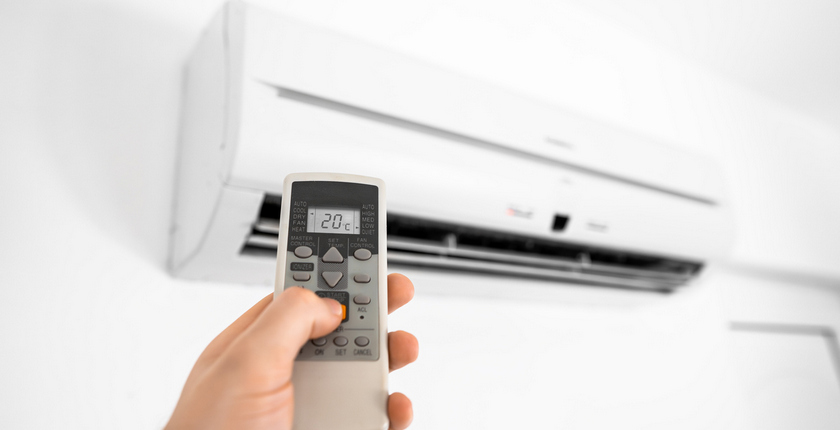
Inverter air conditioners (ACs) with a capacity of up to 3.5 kW and an energy class of at least A+, which improve energy efficiency, will be granted to low-income households. The aid includes free installation.

Eligible households are those whose total net monthly income in 2024 did not exceed MKD 25,000 (around EUR 406) for a single-person household, MKD 31,000 (around EUR 504) for a two-person household, MKD 37,000 (around EUR 601) for a three-person household, and MKD 43,000 (around EUR 699) for households with four or more members.

The budget allocated for inverter ACs for low-income households is MKD 120 million (around EUR 1.95 million), according to the public call.

Households whose only source of income is a pension are also eligible for this type of support, provided that in 2024 their monthly pension did not exceed MKD 15,700 (around EUR 255) for a single-person household, MKD 19,800 (around EUR 322) for a two-person household, and MKD 23,700 (around EUR 385) for households with three or more members. The total budget for this group is MKD 50 million (around EUR 813,000).

The overall budget for inverter ACs is around EUR 2.76 million

Households that have received a subsidy for purchasing an AC or a pellet stove in the past five years, and those connected to a district heating system, are not eligible for free inverter ACs, according to the public call. The application deadline is October 5, 2025.

For financial support to cover electricity bills, eligible households include those with one or more members who have severe intellectual disabilities, the most severe physical disabilities, total vision impairment, or complete hearing impairment.

The application deadline for this public call is the end of August 2025.

by in News

Croatia pauses applications for residential solar subsidies

High interest among Croatian citizens in subsidies for installing solar power plants for self-consumption has prompted the Environmental Protection and Energy Efficiency Fund to pause the application process.

The Environmental Protection and Energy Efficiency Fund (FZOEU) has announced that it will temporarily close the ongoing public call for incentives to install photovoltaic plants in family homes, which was opened on June 6. In just over two months, about 4,100 project applications have been received and are currently being processed, the FZOEU noted.

By mid-last year, 21,000 rooftop PV systems at households and businesses, with a total capacity of 642 MW, had been connected to the distribution network.

The large number of applications confirms that investing in renewables is a financially sound long-term decision

According to the FZOEU, the financing program encourages citizens to use renewable energy sources, reduce greenhouse gas emissions, and increase the energy independence of households.

The strong interest in this program demonstrates that citizens are taking the energy transition more seriously and want to actively participate in producing green energy, the fund claims.

With subsidies, solar installations become more accessible to the general public, and the high volume of applications confirms that investing in renewable energy sources is a financially sound long-term decision for households, FZOEU added.

Citizens can receive up to 50% of eligible costs

Only individuals—owners or co-owners of houses—who had residency at the address at the time the power plant was commissioned were eligible to apply. The fund co-finances facilities installed and commissioned from January 1, 2025, and citizens can receive up to 50% of the eligible costs, or up to EUR 600 per kW of installed power capacity.

Depending on available funds and the success rate of applications, the FZOEU will consider the possibility of relaunching the call for future prosumers.

Over the past two years, the fund has co-financed the installation of around 5,600 rooftop solar power plants in households.

In the first six months of last year alone, households and companies installed 5,504 PV facilities, according to data from Croatia’s distribution system operator, HEP-Operator Distribucijskog Sustava (HEP-ODS).

by in News

Bulgaria opens public consultation on subsidies for 1.9 GWh of battery projects

Bulgaria’s Ministry of Energy has launched a public consultation on a new round of its subsidy program for battery energy storage projects, aimed at facilitating the integration of renewable energy sources. The plan is to support the deployment of 1.9 GWh of new battery capacity with around EUR 118 million.

In the first round of the National Infrastructure for Storage of Electricity from Renewable Sources (RESTORE) program, Bulgaria approved EUR 587 million in subsidies for 82 battery energy storage system (BESS) projects totaling 9.71 GWh, with another 30 applicants falling below the threshold.

Draft application and implementation documents for RESTORE 2 will be available for comments and proposals until September 15, while a tentative date for inviting applications for grants is September 18.

The BESS systems are expected to be deployed throughout the country and connected to the transmission network or the distribution grid. A BESS system must have a minimum nominal AC capacity of 10 MW to qualify for the program.

The minimum required capacity is 10 MW

The maximum support is 50% of the eligible project costs, but not more than BGN 156,466 (EUR 80,000) per 1 MWh of usable energy capacity, according to the documents. In the previous round, the maximum support per 1 MWh was BGN 148,600 (around EUR 76,000), Economic.bg recalled.

The deadline to build and commission the BESS capacities is July 31, 2026. The battery systems selected in the first part of the program must come online by the end of March 2026.

The new round of RESTORE aims to finance projects in more advanced stages

Another difference from the previous call is that proposed projects must be in a much more advanced stage. In addition to a connection agreement, applicants must already have a construction permit or installation permit issued, a signed supply contract or orders and payments made for the equipment for the storage system, as well as secured financing for the investment, according to the draft documents.

by in News

Battery storage investors in Romania rapidly expanding project pipeline

In an accelerating investment wave, companies in Romania are combining BESS with solar power, hydropower and wind power, or building standalone energy storage facilities. The group includes R.Power, Hidroelectrica, Engie and more big names.

Recent updates about investments in battery energy storage systems (BESS) in Romania indicate the technology is becoming another pillar of the country’s energy transition alongside wind power. For several years now, photovoltaics, and prosumers in particular – including municipal authorities, have dominated the scene. Geothermal energy is another emerging segment.

The government has provided incentives both for households and utility-scale battery storage. Companies are combining batteries with solar and wind power as well as hydropower capacity.

Investing in BESS colocated with renewable electricity plants or as standalone facilities in Southeastern Europe enables income from high spreads between wholesale power prices in daily trading. It is especially significant given the increase in the occurrence of zero and negative prices.

Notably, neighboring Bulgaria has earmarked massive funds for support to BESS investments while also focusing on pumped storage hydropower projects. Greece also held several rounds of auctions for battery storage.

R.Power to start building 127 MW standalone battery

R.Power is investing in BESS in Romania, which is one of its strategic markets, together with Poland, where it is headquartered, and Italy, Germany, Spain and Portugal. Battery storage makes up 17.5 GW or more than half of its total development pipeline in Europe.

The company said it would hybridize its existing and future PV assets and scale the integrated capacity to several gigawatts in the coming years. It has over 1.2 GW of projects for standalone BESS in Romania. “And that’s just the beginning,” R.Power said.

It obtained EUR 15 million in funding for a future 127 MW facility. It is about to start building the BESS in Scornicești in Olt county, west of Bucharest. R.Power is planning to complete it in a year. The battery energy storage system would have a duration of two hours, translating to 254 MWh in capacity. The project received funding from the National Recovery and Resilience Plan (NRRP or, in Romanian, PNRR).

Still, in the company’s view, further legislative changes are needed to fully harness the potential of the technology.

Hidroelectrica to add large battery to Iron Gate 2 hydroelectric plant

State-owned Hidroelectrica, the largest electricity producer in Romania, wants to install a battery storage system at Iron Gate 2 (Porțile de Fier 2) on the Danube. Located on the border with Serbia, it is the second-largest hydroelectric plant in the country, at 252 MW in nominal capacity. The complex, which the two countries share, is known as Đerdap in Serbian.

The BESS would have 64 MW in nominal power and a four-hour duration (256 MWh), Profit.ro reported. Hidroelectrica plans to use it for providing balancing services to the national electricity system (SEN) and adjust the time intervals of its hydropower production.

The contract for the installation of the facility is estimated at EUR 61.2 million plus value-added tax, according to the article. It would be integrated with the hydroelectric plant. The company is receiving bids from potential contractors by August 28.

French Engie has BESS projects for its existing PV plant, wind park

France-based Engie’s subsidiary in Romania intends to install a BESS at its newest solar power plant, of 37.2 MW in peak capacity, in Ariceștii Rahtivani. It commissioned the PV facility in June. The location is north of Bucharest, in Prahova county.

The battery energy storage system project is for 20 MW in operating power and 80 MWh. It would consist of 16 containers, 192 inverters and four transformer units.

The wind park in Băleni will reportedly add a small BESS facility

Engie Romania is working on another investment, through its Alizeu Eolian project firm. It plans to add batteries to a 50 MW wind park in Băleni, Galați county, which was built in 2013.

The company obtained the building permit last year. It also got clearance two months ago for connecting the BESS with a 110/20 kV transformer station via an underground line. Economica.net learned that the battery storage facility would have 5 MW and a two-hour duration, costing the firm EUR 2 million.

Engie’s project was included in the reserve list last September after a public call for support to battery storage. The Ministry of Energy selected 13 applications for grants from NRRP. Another 25 passed, but remained below the line.

Government bolstering battery investments with grants

The state aid scheme was worth EUR 103.5 million, of which EUR 79.6 million came from the European Union’s Recovery and Resilience Facility (RRF).

Among the beneficiaries are Electrica, in which the government holds just under 50%. Renovatio Trading. OMV Petrom, Public Power Corp. (PPC) and Verbund have projects on the B list.

For its 65 MWh project in Toplița in Harghita county, in eastern Transylvania, Renovatio Trading is buying the equipment from Trina Storage. The firm is part of Trina Solar.

Visual Fan is winning major contracts for the procurement and installation of batteries

Allview Energy, part of Romanian company Visual Fan, is handling the alternating current (AC) side in Renovatio Trading’s investment.

In addition, Visual Fan became the contractor for a BESS within Eurowind Energy’s Teiuș solar park.

The Danish developer intends to deploy a 117 MWh energy storage unit with lithium-iron-phosphate (LFP) batteries, within a year. It valued the project at over EUR 16.6 million. The companies said they would carry out the works in partnership with TQM Services and Voltlink. The investment includes the battery management system and liquid cooling.

In June, the ministry approved a EUR 3.4 million grant from the EU’s Modernisation Fund to Termoficare Oradea. It has a project for a 10 MW solar park with a 15 MWh storage unit, worth EUR 18.6 million altogether.

Austria’s Verbund conducting EUR 22.7 million project

Verbund has almost all the permits for a BESS project at its 226 MW wind farm in Casimcea in Tulcea county. The company headquartered in Austria said it has secured financing as well and that it is already contracting the equipment.

The wind farm was commissioned in 2012. The energy storage segment would have up to 50 MW and up to 100 MWh. It would be located at the Alpha Wind Nord section of the existing facility, of 81 MW.

Still, the basic variant’s size will be 48.3 MW, with 76 MWh in capacity, according to Profit.ro. There would be 34 containers at the site selected for the BESS.

The majority government-controlled utility values the investment at EUR 22.7 million, of which more than EUR 10.7 million is for the storage facility itself. The location spans five hectares.

After coming up short in the public call, Verbund submitted the project for a grant from the Modernisation Fund.

In mid-May, Romania hosted 240.7 MW of battery capability and a total capacity of 404.9 MWh.