by in News

CMS committed to sustainability – first law firm in Belgrade with solar power plant on its rooftop

CMS is the first law firm in Belgrade to install a solar power plant on the roof of its own building. The plant has been in operation for nine months now.

Two months ago, it also obtained official status as a prosumer (buyer-producer) of electricity. It is an important milestone in CMS Belgrade’s transition to more sustainable energy use, according to the announcement.

Since reaching full operating capacity, the solar plant has covered around 50% of its total electricity consumption.

The long-term goal is ambitious yet achievable, according to CMS Belgrade: 70% of electricity consumption from solar by the end of 2025, and 100% within the next three years.

“Sustainability is not just a goal — it’s a responsibility, and one we are committed to integrating into every part of our business,” the announcement reads.

Radivoje Petrikić, the Managing Partner at CMS Belgrade (Petrikić & Partneri AOD in cooperation with CMS Reich-Rohrwig Hainz), said: “We are committed to integrating eco-friendly practices into every aspect of our business. By embracing sustainability in our daily operations, we are not only shaping a brighter future for our firm but also contributing to a greener planet for generations to come.”

The office is part of international law firm CMS CEE, based in Vienna.
by in News

Aurora: Romania’s third CfD auction is key for 2030 targets as solar outpaced wind

Aurora Energy Research expects strike prices at the additional renewable energy auction in Romania, for the remaining wind power quota, to land near the ceiling, set at EUR 80 per MWh. In the previous round, there was strong competition between the bidders for the photovoltaic segment, while developers of wind energy projects may have seen more value in PPAs and merchant options.

Increased costs and stricter eligibility rules constrained wind participation in Romania’s second contracts-for-difference (CfD) round in August, which fell short of the 2 GW wind target. Developers may have seen more value outside the CfD framework, according to Aurora experts, who stressed that power purchase agreements (PPAs) and merchant options offer higher returns than the capped CfD strike prices.

Solar projects showed stronger economics, with strike prices between EUR 35 per MWh and EUR 45 per MWh, compared to wind at EUR 65 per MWh to EUR 79.5 per MWh.

“Using the same commercial operation date for both PV and wind projects has disincentivised wind participation in CfD rounds, since wind developments are far more complex. Their permitting, grid connection, and EPC timelines are significantly longer than solar, making the uniform deadline misaligned with project realities,” said Project Leader at Research Associate at Aurora Energy Research Filippos Falieros.

Dedicated auctions can influence market dynamics

As wind is essential for achieving 2030 renewable targets, the Romanian Ministry of Energy invited developers to submit expressions of interest for mature wind projects only, with contracts expected to be signed by the end of 2025. The third auction will focus on wind energy solely, with a maximum strike price set at EUR 80 per MWh, and Aurora expects strike prices near the ceiling.

In the second auction, accepted wind power bids were between EUR 65 per MWh and EUR 79.5 per MWh

The move underscores the growing divergence in Romania between solar’s strong economics and wind’s slower progress, while also showing how policy adjustments – such as dedicated auctions – can influence market dynamics.

CfD state aid scheme was approved through Modernisation Fund

The overall CfD scheme is supported by EUR 3 billion in total state aid that the European Union approved through the Modernisation Fund, aiming to keep costs low for consumers.

Established in 2013, Aurora Energy Research provides power market forecasting and analytics for critical investment and financing decisions. Headquartered in Oxford, it operates out of 17 offices worldwide covering Europe, North and South America, Asia and Australia.

The firm’s comprehensive services include market outlook packages for energy industry participants, advisory support, and software solutions. Aurora fosters diversity with a team of one thousand experts with backgrounds in energy, finance, and consulting, offering expertise across power, renewables, storage, hydrogen, carbon, and fossil commodities.

by in News

Turkey starts building solar parks on former coal land

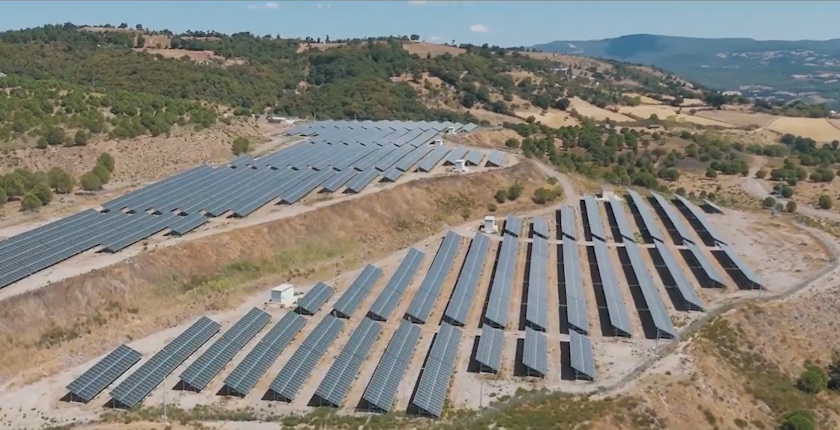
After the first two units of 5 MW each, state-owned Turkish Coal Enterprises (TKI) is planning two solar power plants of 14 MW in combined peak capacity at sites of its previous mining operations.

Former coal mines and their tailings dumps, together with the ash disposal fields of thermal power plants, are among the most convenient areas for solar power plants, unlike fertile agricultural land. In Southeastern Europe, Greece is leading the way by transforming its coal land into industrial hubs with cutting-edge technologies, with the focus remaining on energy – mostly solar power plants. Their capacity is among the highest in the world.

Other countries in the region are advancing slowly in such decarbonization projects, with the exception of North Macedonia, or are still in the planning stage, but Turkey announced that it intends to speed up the construction of photovoltaic units on sites of former coal mining operations.

The Ministry of Energy and Natural Resources said the capacity would reach 24 MW next year

Turkish Coal Enterprises (TKI) is revitalizing the areas of depleted open pit mines also through afforestation, the Ministry of Energy and Natural Resources said. The company planted just over 12 million trees on 6,265 hectares last year.

With photovoltaic projects, such areas are contributing to the country’s economy again. The state-owned company’s Aegean region subsidiary ELI operates a self-consumption unit of 5 MW in Manisa. Another firm, ÇLI, based in Çanakkale, further to the north, has installed a 5 MW solar park.

The two facilities generate 18 GWh of electricity per year, supplying businesses, the update adds.

Preparations are underway for the construction of a 5 MW photovoltaic plant in the Tavşanlı district of Kütahya province in Turkey’s west. Another project is for 9 MW in the Afşin district in Kahramanmaraş, in the Mediterranean region in the country’s south. TKI plans to complete them next year.

The four solar parks will produce some 41 GWh per year, according to the ministry.

by in News

YESS Power set to commission Western Balkans’ first large battery energy storage system

YESS Power said that in November it plans to commission a 60 MW battery energy storage system (BESS) in North Macedonia. The Turkey-based contractor is installing the facility for Mey Energy at the site of the client’s solar power plant in Novaci. It would be the first large BESS and hybrid power plant in the region.

While the Western Balkans still doesn’t host any utility-scale BESS, giant leaps forward are seen in North Macedonia. Fortis Energy intends to expand its Oslomej solar power plant with one such facility, while Zen Energy Group has started the installation of a hybrid energy plant of the same kind. In addition, Turkey-based engineering, procurement, installation, and commissioning contractor YESS Power is spearheading the project for the addition of a BESS to the Novaci photovoltaic plant.

When Mey Energy put the 55 MW solar park into operation two years ago, it was the biggest in the said region. Now YESS Power, in cooperation with battery manufacturer Cubenergy from China, is installing a BESS of 60 MW at the site for the client.

With the commissioning date scheduled for November, it is about to become the first large battery energy storage facility in North Macedonia and the Western Balkans.

Novaci was the biggest PV park in the region when it was built in 2023

YESS Power, Topkapı Endüstri’s new brand, is responsible for engineering, installation, technical services and maintenance of the battery segment of the future hybrid power plant.

Mey Energy’s Novaci solar power plant spans 57 hectares. It generates 85 GWh per year, equivalent to the electricity demands of 30,000 households in the country. Notably, the PV system is next to the open pit coal mines of the REK Bitola energy complex, which includes a thermal power plant.

YESS Power said it specializes in scalable, secure, turnkey energy storage solutions for solar plants, industrial facilities, grid support and microgrids. It revealed that the current project marks the beginning of a “a broader strategic partnership in the Turkish and Eastern European markets” with Cubenergy.

In the wider Southeastern European region, Romania, Bulgaria and Turkey are massively adding BESS capacity. The remaining countries remain slow with administrative changes, planning and investment.

by in News

Fortis Energy preparing to build solar-battery hybrid power plant in Serbia

Fortis Energy has obtained a construction permit for a solar park of 270 MW on the territory of the city of Sremska Mitrovica in Serbia, Mayor Branislav Nedimović said. The company plans to include a battery energy storage system (BESS) of 36 MWh.

Turkey-based Fortis Energy bought a solar power project in Serbia last year, which would have a 180 MW grid connection. At the time, the company announced that it also planned a battery energy storage system of 36 MWh. Chief Operational Officer Velimir Gavrilović said in May, at Belgrade Energy Forum (BEF 2025) that the projects Noćaj 1 and Noćaj 2 are nearing a ready-to-build status.

After his recent meeting with the representatives of Fortis Energy, Mayor of Sremska Mitrovica Branislav Nedimović said the company has obtained a construction permit for the solar park. The transmission permit is expected within three months, and the works are beginning in the spring, he revealed. Sremska Mitrovica is a city west of Belgrade.

The location is on private land just south of the river Sava, toward Drenovac village in the Mačva area, Nedimović asserted. He said the solar power plant’s capacity would be 270 MW.

Fortis Energy received a construction permit for a proposed solar park across the river from Sremska Mitrovica

In May, the company signed a contract for the connection of its planned solar park Erdevik in Šid, a municipality bordering Sremska Mitrovica. The plan is to install 110 MW in peak capacity, with a BESS system of 31.2 MWh.

The developer and engineering, procurement and construction (EPC) contractor is working on wind power projects Vranje, Gornjak and Juhor.

The company has five biogas facilities in Serbia of 21 MW altogether.

Last year in North Macedonia, Fortis Energy commissioned a photovoltaic plant of 79.9 MW in peak capacity in Oslomej in North Macedonia. The grid capacity is 68.7 MW.

The company said in February that it contracted the construction of a BESS of 62 MW at the same location. It opted for lithium ion batteries of 104 MWh in total capacity, which means that they can run at full power for two hours.

by in News

Maglizh solar power plant of 161 MW in Bulgaria enters commercial operation

Maglizh solar park in central Bulgaria has begun commercial operation, according to 360 Energy, which has built it in partnership with the majority shareholders of Eurohold (Evrohold). The facility has 160.5 MW in peak capacity. A project to add batteries is underway.

Bulgaria’s photovoltaic capacity is growing rapidly while the battery storage segment and other energy storage solutions are picking up speed. One of the biggest solar power plants, Maglizh, has just entered regular operation, 360 Energy said.

The company built the facility in parthership with the majority shareholders of Eurohold (Evrohold). Their project firm is called Belozem Solar Park 2. The project has overcome complex issues from permitting to environmental protection.

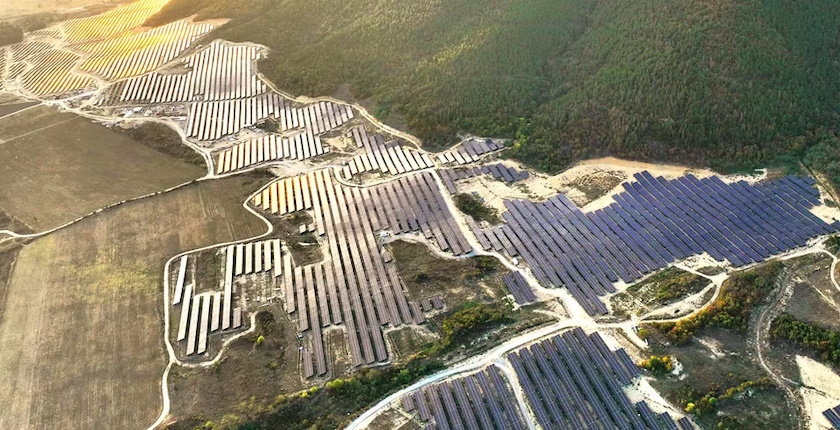
Maglizh spans 127 hectares at the foot of Mt. Stara planina in central Bulgaria. It has 160.5 MW in peak capacity.

The partners have built the grid connection facilities and handed them over to ESO

The facility cost EUR 100 million to build, according to earlier updates, of which the grid segment amounted to more than EUR 10 million. The connection facilities belong to Electricity System Operator (ESO), the country’s transmission system operator.

Bulgarian-German company Sunotec was the main contractor, under a turnkey deal. It also manufactured the metal structures for the solar panels.

Green Solar Energy was responsible for two overhead power lines and the reconstruction of another one and a substation. The companies partly covered the investment with a syndicated loan. They obtained it from UniCredit Bulbank Raiffeisen Bank International and United Bulgarian Bank Postbank (Eurobank Bulgaria).

Colocated BESS system to be completed in March

The PV plant in the municipality of Maglizh is on municipal land grade 9 and 10, the lowest levels on the agricultural scale. The project firm obtained the rights for 30 years and paid a one-off fee.

Eurohold’s subsidiary Electrohold is responsible for the sale of electricity, according to 360 Energy.

The solar park consists of Jinko Solar’s panels. The company revealed it would soon be complemented by a battery energy storage system (BESS). It expects to complete it in March.

ESCO Bulgaria is the contractor for the BESS of 80 MWh, made of Huawei batteries, the statement adds.

Biodiversity preservation efforts

After already passing environmental procedures, the investors detected a habitat of the protected European ground squirrel (Spermophilus citellus), also called European souslik. They introduced special measures including the exemption of an area of more than five hectares.

In 2023, the same partnership has commissioned Verila, Bulgaria’s biggest solar power plant at the time. The project firm is called Belozem Solar Park 3.

by in News

North Macedonia adopts Law on Energy Efficiency

North Macedonia’s new Law on Energy Efficiency brings a long-term strategy for the reconstruction of buildings and the obligation to set up solar collectors on public buildings. It envisages financial support for investments in solar panels, geothermal systems and smart technologies.

The Assembly of North Macedonia adopted the Law on Energy Efficiency at its last session. The new legal framework, aligned with European standards, will directly contribute to lowering bills for citizens and businesses, a cleaner environment and the creation of new green jobs, the Ministry of Energy, Mining and Minerals said.

The law is a substantial step forward in reducing energy consumption, integrating renewable sources and reducing greenhouse gas emissions, the statement reads. It will bring the country closer to fulfilling European climate goals and to a green transition, the ministry added.

The new legislation introduces the European Union’s principle “energy efficiency first,” according to the announcement. One of the novelties is a long-term strategy for the reconstruction of residential, public and commercial buildings.

At least 3% of public buildings must be reconstructed every year

The law mandates tripling energy savings in the public sector. At least 3% of public buildings must be reconstructed every year. In the construction or reconstruction of schools, kindergartens and public institutions, it will be obligatory to install solar collectors.

New measures include financial support for investments in solar panels, geothermal systems and smart technologies. The ministry said the law brings high standards in public procurement, digital transparency and professionalization of energy audits. Energy performance certificates will be included in the real estate cadastre.

The Law on Energy Efficiency is part of the package of reform laws that lay the foundation for a stable, sustainable and competitive energy sector – with energy security, better quality of life for citizens and accelerated accession to the European Union, the ministry underscored.

Of note, public calls are ongoing for households in energy poverty, for free inverter air conditioners and financial aid.

by in News

Coal plant operator KEK to begin construction of Solar4Kosovo PV plant

Government-controlled Kosovo Energy Corp. (KEK) said it is preparing to start building its Solar4Kosovo 1 photovoltaic plant near Prishtina. It informed the local community that agricultural and other activities weren’t allowed anymore on the designated land.

After four years of planning. a former coal ash dump is about to be turned into the biggest solar power plant in Kosovo*. KEK is running the Solar4Kosovo 1 project at a site near its Kosovo A power plant near Prishtina.

The area is in the municipalities of Obiliq (Obilić) and Fushë Kosovë (Kosovo Polje). The government-owned power utility said it is preparing to begin construction works. The project is for 100 MW in connection capacity, translating to 120 MW in peak capacity.

The update mainly affects residents of Dardhishtë and Mërlak in Kryshevc (Kruševac) in Obiliq municipality. Agricultural and other activities aren’t allowed anymore, the company announced. It explained that so far it tolerated the use of its property there by the local community.

KEK obtained EUR 32 million EU grant

The financing for the Solar4Kosovo facility is part of the European Union’s Economic and Investment Plan for the Western Balkans of EUR 9 billion in grants. The package is aimed at mobilizing a total of EUR 30 billion.

The European Investment Bank is providing a EUR 33 million loan. The EU has approved a EUR 32 million grant via its Western Balkans Investment Framework (WBIF), while Germany’s KfW Development Bank is lending EUR 29 million to KEK. The investment was earlier estimated at EUR 107 million overall.

Annual output estimated at 169 GWh

The proposed solar power plant is expected to produce 169 GWh per year. It would have an underground connection to the existing substation at the Kosovo A thermal power plant.

Notably, Kosovo* is dependent on the obsolete Kosovo A and Kosovo B coal plants for almost all its electricity.

The other part of the Solar4Kosovo project is for a solar thermal facility for the capital city’s district heating system. The site is in the village of Shkabaj (Orlović) in Obiliq municipality. The investment includes a 20 MW network extension.

* This designation is without prejudice to positions onstatus and is in line with UNSCR 1244/99 and the ICJ Opinion on the Kosovo declaration of independence.
by in News

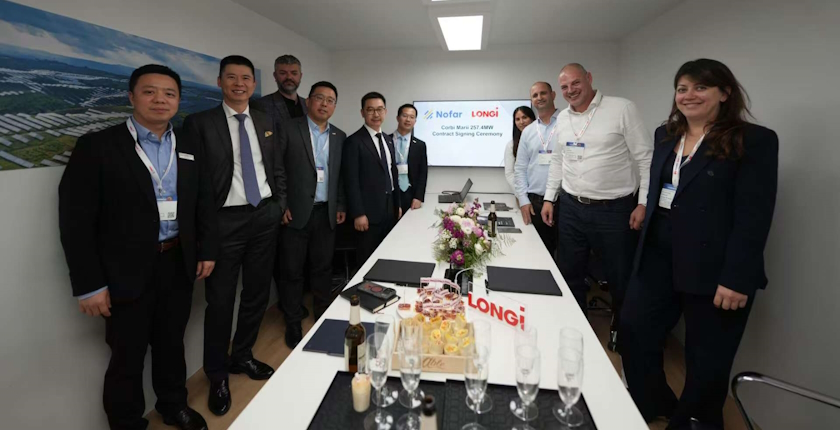
LONGi and Nofar Energy forge landmark partnership for Romania’s largest solar project using revolutionary BC technology

LONGi Solar, the global leader in solar innovation, and Israel’s premier renewable energy developer Nofar Energy have announced a historic partnership to develop one of Romania‘s largest solar installations – the 282 MW Corbii Mari project in Dâmbovița county. This pathbreaking collaboration will deploy over 430,000 Hi-MO 9 BC modules, establishing back contact technology as Europe’s definitive solution for utility-scale energy transformation while marking Nofar’s most ambitious international venture to date.

The Corbii Mari photovoltaic project of 282 MW will go into production in 2026. It represents a dual milestone in Europe’s renewable transition. As Nofar Energy’s largest overseas IPP investment, it anchors the Israeli leader’s strategic expansion into European markets. Simultaneously, the installation stands as Romania’s largest BC deployment, leveraging Hi-MO 9’s industry-leading 24.8% efficiency to overcome the region’s climatic challenges. The project’s seamless execution demonstrates how the BC technology of LONGi Solar delivers unparalleled bankability for developers navigating Europe’s complex energy landscape.

The two companies have agreed to deploy more than 430,000 Hi-MO 9 BC modules.

Leon Zhang, President of LONGi Europe, emphasized the project’s transformative impact: “Corbii Mari transcends conventional solar deployments – it’s a powerful validation that BC technology has matured into Europe’s utility-scale foundation. By choosing Hi-MO 9 for their flagship European venture, Nofar Energy demonstrates how visionary partners are accelerating the energy transition through technological leadership.”

The 282 MW Corbii Mari initiative positions back contact modules as Europe’s utility-scale standard

Mirel Jarnea, Strategic Accounts Manager SEE of LONGi Europe, added: “Nofar’s selection of Hi-MO 9 is a testament to the global energy sector’s recognition of BC technology as the ultimate frontier in solar innovation. This partnership reaffirms our commitment to delivering solutions that redefine efficiency, durability, and sustainability.”

Setting benchmark for sustainable innovation

Favi Stelian, Managing Partner Romania of Nofar Energy, stated: “The Corbii Mari project represents a defining moment for Nofar Energy’s European vision. By partnering with LONGi and deploying Hi-MO 9 BC technology, we are not only delivering Romania’s largest solar initiative but also setting a new benchmark for sustainable innovation across the continent.”

The project harnesses Hi-MO 9’s revolutionary back contact architecture to achieve exceptional performance in Romania’s variable climate. The modules’ temperature resilience and 30-year degradation guarantee ensure consistent energy generation, while the ultra-high power output minimizes land use – preserving Dâmbovița county’s agricultural ecosystems.

With an estimated annual output of 380 GWh, Corbii Mari will displace 220,000 tonnes of carbon emissions annually, equivalent to removing 48,000 combustion-engine vehicles from roads while powering over 50,000 Romanian households.

Positioned at the vanguard of Eastern Europe’s energy transition, Corbii Mari establishes a replicable model for Nofar’s expanding multi-GW European pipeline. The collaboration signals accelerating regional adoption of BC technology, with project insights informing solar development across emerging markets where efficiency and bankability are paramount.

About LONGi

Founded in 2000, LONGi is committed to being the world’s leading solar technology company, focusing on customer-driven value creation for full scenario energy transformation.

Under its mission of Making the Best of Solar Energy to Build a Green World, LONGi has dedicated itself to technology innovation and established several business sectors, covering mono silicon wafers cells and modules, commercial and industrial (C&I) distributed solar solutions, green energy solutions and hydrogen equipment. The company has honed its capabilities to provide green energy and, more recently, also embraced green hydrogen products and solutions to support global zero-carbon development.

About NOFAR Energy

Founded in 2011, Nofar Energy is a global leader in renewable energy investments. Since 2020, Nofar has been a public traded company (TASE: NOFR) at the Tel Aviv Stock Exchange. For the last 12 years, Nofar has been growing rapidly and consistently, with an extensive portfolio of projects and subsidiaries across nine territories, 200 employees worldwide, and major renewable energy and energy storage projects.

by in News

Turkey launches solar, wind power auctions with November deadlines

The Ministry of Energy and Natural Resources of Turkey issued a public call for solar and wind power auctions for 2 GW in total. It will receive the applications on November 4 and November 18, respectively. One competitive bidding process is for a floating solar power project of 35 MW.

Following the successful auctions for renewable energy projects that were completed early this year, Turkey kicked off another round. It is also for 2 GW of overall connection capacity, in light of the country’s ambition to grow its combined solar and wind power capacity to 120 GW by 2035. The two technologies reached 37.1 GW together a month ago, out of 120.2 GW in total.

Auctions are held under the Renewable Energy Zones (REZ) state support mechanism. The scheme is better known by its Turkish acronym YEKA.

Ten solar power areas in eight provinces

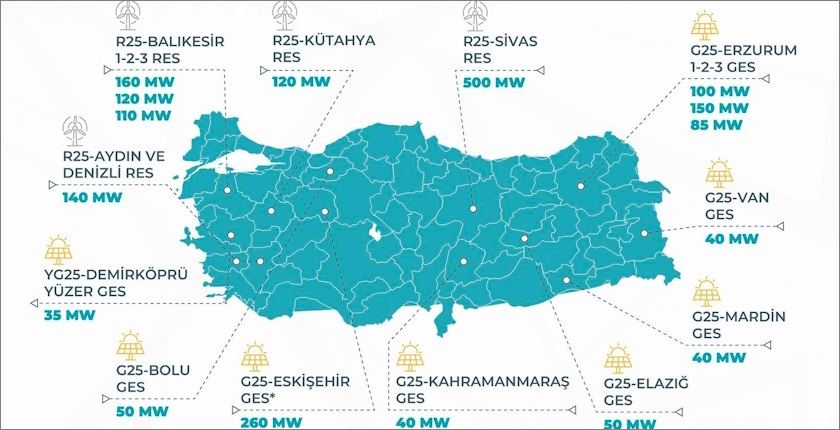
The upcoming solar energy auctions, REZ SPP 2025 (YEKA GES 2025), are for 850 MW altogether. There are ten areas in eight provinces designated for bidding: Kahramanmaraş, Mardin and Van, with 40 MW each, Bolu and Elazığ (50 MW each), Erzurum 1-3 (100 MW, 150 MW and 85 MW), Eskişehir (260 MW) and Demirköprü in Manisa province, with 35 MW.

The upcoming solar power auctions will include Turkey’s first bidding for a floating photovoltaic plant

Notably, the last one is for a planned floating solar power plant on the reservoir of the Demirköprü hydropower plant. The facility on the Gediz river, east of Izmir, is owned by state-owned Electricity Generation Corp. (EÜAŞ). Turkey now hosts only two small floating photovoltaic units, and the auction will be the first of its kind.

Applications will be received on November 4, the ministry said and added it would subsequently publish a schedule for bidding.

Wind power capacity quota is 1.15 GW

Participants can apply on November 18 for the wind energy round of auctions, REZ WPP 2025 (YEKA RES 2025). It is for an overall 1.15 GW in six areas.

Investors will compete for 500 MW in Sivas province, a 140 MW project in Aydın and Denizli, 120 MW in Kütahya and three areas in Balıkesir – 160 MW, 120 MW and 110 MW.

Winners to submit guarantees of EUR 75,000 per MW for PV projects, EUR 100,000 per MW for wind

Potential bidders will pay a fee of EUR 1,550 for each auction they apply for. They must submit letters of guarantee lasting one year and worth EUR 15,000 per MW for photovoltaics and EUR 20,000 per MW for wind power. Winners will submit 10-year guarantees before signing their contracts: EUR 75,000 per MW and EUR 100,000 per MW, respectively.

The ceiling or starting price is EUR 55 per MWh and the floor prices are EUR 32.5 per MWh for solar power and EUR 35 per MWh for wind. If bids hit the floor, another auction will be held between the competitors, like in the previous round. It is for a so-called contribution share that they are ready to pay. The minimum is EUR 10,000 per MW of planned capacity and the highest bid wins.

Successful participants can sell electricity on the free market for five years in the case of solar power plants, while the period lasts six years for wind. After that, both categories enter a 20-year scheme with a guaranteed price.

Turkey tops 120 GW in total electricity capacity

At the end of July, electricity capacity in Turkey totaled 120.2 GW, the ministry revealed. Hydropower accounted for 26.9% or 32.3 GW, compared to 23.4 GW in photovoltaics (19.5%) and 13.7 GW of wind power, translating to 11.4%.

The share of biofuel and waste was 1.9%, with 2.34 GW, and geothermal power plants had 1.73 GW altogether, which is 1.4%. Gas power plants in Turkey had 24.7 GW in combined capacity (20.6%). The remainder is coal: 21.9 GW or 18.3%.