by in News

North Macedonia’s ESM needs investments of EUR 3 billion to replace coal power

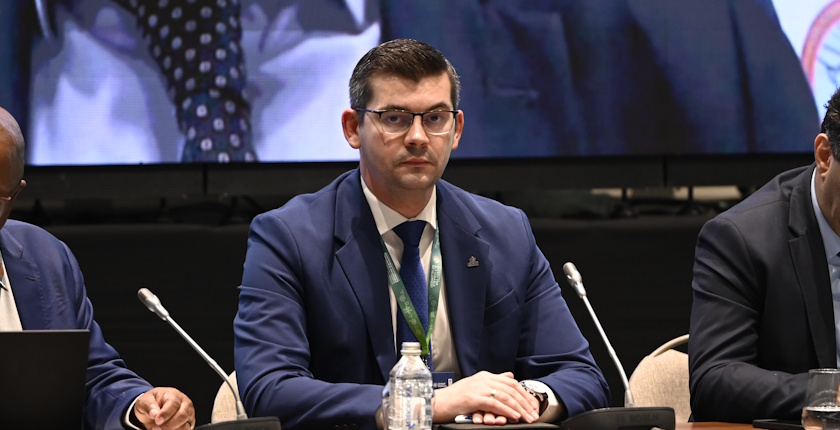
Power utility Elektrani na Severna Makedonija estimated that it requires EUR 3 billion by 2040 to replace electricity from its lignite-fired power plants. According to member of the Board of Directors Ivan Stojanovski, the state-owned company is preparing investments in gas power plants, solar, wind, hydropower and energy storage. He highlighted its plans for a 300 MWh battery and the Bogdanci hybrid energy park.

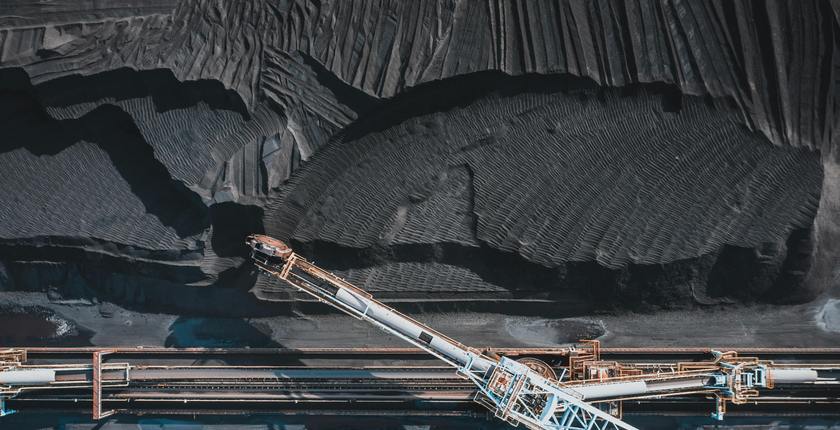
North Macedonia’s utility Elektrani na Severna Makedonija (ESM), the country’s main electricity producer, generated 60% of the 2024 output in the Bitola and Oslomej coal plants.

A rough estimate is that ESM would have to invest around EUR 3 billion in the next 15 years to replace its power production from lignite, which is baseload energy, Ivan Stojanovski, a member of the Board of Directors and the company’s Chief Financial Officer, told Balkan Green Energy News on the sidelines of the International Forum on Energy for Sustainable Development (IFESD-14).

He explained that the transition to green energy is quite expensive. ESM needs to replace the 840 MW in baseload production that the Bitola and Oslomej thermal power plants provide, the executive added.

Hydropower is a domestic electricity source, unlike natural gas

The company opted for investments in diverse energy sources to achieve it, Stojanovski stressed.

Gas power plants provide baseload energy, but at the same time, they turn the spotlight on national security as well as the security of supply, in his words.

Lignite is currently mined in North Macedonia while natural gas must be imported, so gas supply interruption is possible, ESM’s CFO added.

Gas power plants are required, but it is necessary to invest in hydropower as it is a domestic resource, Stojanovski said. On the other hand, hydroelectric plants are more expensive and it takes longer to build them, he noted.

ESM launched the Bitola 3 solar power project

ESM is developing wind and solar power projects as well. Stojanovski highlighted the planned expansion of its Bogdanci wind farm. The European Bank for Reconstruction and Development (EBRD) is participating in the development of the Miravci wind power project, of at least 100 MW, he recalled.

The company is working on solar power projects Oslomej 1 (10 MW), Oslomej 2 (10 MW), Bitola 1 (20 MW) and Bitola 2 (60 MW), Stojanovski asserted. Bitola 3 endeavor is underway, too, and the financing contract is expected to be signed by the end of the year, he revealed.

The photovoltaic system will have at least 100 MW, Stojanovski asserted.

“We plan to sign a contract next year with Agence Française de Développement (AFD) for a solar power plant in Bogdanci of at least 30 MW and to create a hybrid energy park there – wind, solar, and a battery,” he stated.

According to Stojanovski, the company is developing a battery energy storage project with the EBRD, for up to 300 MWh in capacity. The site is within the REK Bitola coal complex and the facility will be a systemic solution for all the solar power plants there, he explained.

Blended financing as a solution

“EUR 1 billion to EUR 1.3 billion is needed just for solar, wind and batteries. We will need between EUR 500 million and EUR 700 million for gas power plants. Another EUR 1 billion to EUR 1.3 billion would be for large hydropower plants such as Čebren and Vardar Valley, and some smaller projects,” Stojanovski explained.

Asked how the company plans to secure financing, he pointed to blended financing – own sources combined with some participation from international financial institutions. It is important to diversify the sources by opening cooperation with as many financial institutions as possible, in Stojanovski’s view.

ESM traditionally cooperates with the EBRD and KfW. Stojanovski announced that the company would diversify financing by launching cooperation with the World Bank, Italy’s development bank Cassa Depositi e Prestiti, and AFD.

“It will enable us to access more sources and complement them with financing from local banks. We also tend to obtain support from the state budget over a longer period, 10-15 years, and state guarantees, but also additional funds. This is a financial model that can secure long-term and sustainable financing of infrastructure projects,” Stojanovski said.
by in News

Božinovska: Solar overtakes hydro in North Macedonia

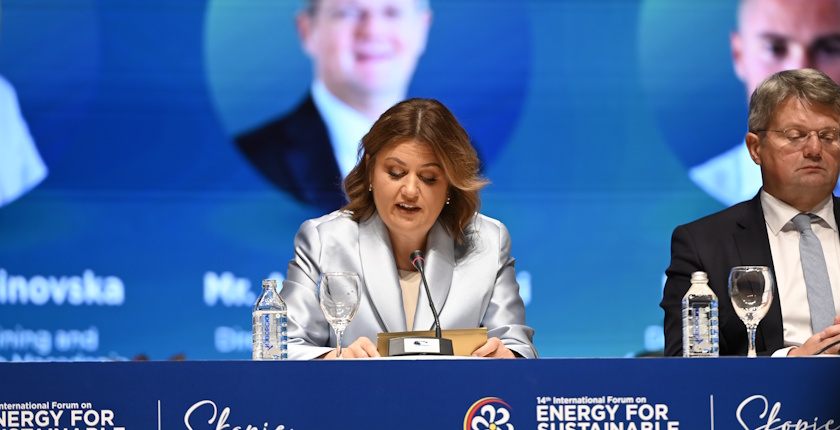
The share of solar power plants’ capacity in North Macedonia has surpassed hydropower plants in 2024, Minister of Energy, Mining and Mineral Resources Sanja Božinovska said at the 14th International Forum on Energy for Sustainable Development in Skopje.

The three-day International Forum on Energy for Sustainable Development (IFESD-14) started yesterday. Its theme is From Goals to Action: Powering the Future with Sustainable Energy. The event was organized by the Ministry of Energy, Mining and Mineral Resources of North Macedonia, in cooperation with the United Nations Development Programme (UNDP) and the UN’s five regional commissions – UNECE, UNESCAP, UNECLAC, UNECA, and UNESCWA.

According to Sanja Božinovska, Minister of Energy, Mining and Mineral Resources, North Macedonia has taken decisive steps in recent years to transform its energy system and align it with the principles of sustainability, security, and affordability.

The reforms are already delivering measurable results, with renewables now accounting for more than half of the country’s total installed electricity capacity – 56% in 2024, she noted.

North Macedonia is moving from goals to action

“The structure of that progress is even more striking. Photovoltaic power plants now represent 28% of installed capacity, surpassing large hydropower, which is at 24%. For the first time in our history, solar has overtaken hydro – a symbolic and practical milestone in our path toward decarbonization,” the minister stated.

In 2024 alone, solar output grew by 186%, she underlined at the first high-level plenary session.

Photo: Ministry of Energy, Mining and Mineral Resources

The numbers speak louder than words: they highlight a nation that is not just planning a transition, but living it, in Božinovska’s view.

Of note, at the end of 2024 the capacity of solar power plants was 848 MW. The year-on-year was higher than 340 MW. Hydropower capacity was 720 MW, at the end of last year.

Božinovska: We are supporting over 5,000 workers and communities affected by the coal phaseout

“The numbers confirm it — North Macedonia is moving from goals to action,” Božinovska stressed.

She added that the country is investing in new solar and wind projects, expanding energy storage, and modernizing the national grid to absorb growing renewable capacity. “These investments are essential for maintaining reliability and flexibility as we integrate more clean energy sources,” she explained.

Božinovska pointed out that the commitment to a just energy transition is equally important.

“We are supporting over 5,000 workers and communities affected by the coal phaseout, helping them to retrain, diversify local economies, and secure green jobs,” she underlined.

Joksimović: Serbia to reach 2030 renewables target

Sanja Božinovska and Jovana Joksimović (photo: Ministry of Energy, Mining and Mineral Resources)

According to Jovana Joksimović, Serbian Assistant Minister of Mining and Energy for International Cooperation and European Integration, coal is still the backbone of the energy system in Serbia, while the share of energy from renewables is significant and growing, and it reached 38% in 2023.

The government plans that one in two megawatt-hours would be produced from renewables by 2030, she underlined.

“Existing valuable resources will need to remain the foundation of Serbia’s electricity sector until renewable energy, transmission and distribution infrastructure, as well as storage capacities and ability to integrate renewables, are sufficiently developed and aligned to reliably and securely replace coal-based electricity generation,” the assistant minister told the audience during the second high-level plenary session.

It is necessary to diversify supply channels but also the energy mix

Joksimović stressed that the increased capacity for clean energy, secured from the two very successful rounds of the auctions, would contribute to reaching 2030 targets.

When it comes to advancing the energy transition and powering the future, it is necessary to think outside the box, she added. Supply channels should be diversified but so does the energy mix, to be as self-sustainable as possible, in Joksimović’s view.

There is huge support for it from relevant international financial institutions – IFIs, but more is needed, in her words.

“If we are going to reach the targets that we set for us, I believe that the European Commission would be partnering with us in all efforts that we are taking,” she concluded.

Photo: Ministry of Energy, Mining and Mineral Resources
by in News

Bulgaria’s coal regions to get further EUR 808 million for just transition

Bulgaria’s coal regions will receive BGN 1.58 billion (EUR 808 million) through the Just Transition program, under the European Union’s Just Transition Fund (JTF), for energy efficiency, renewable energy, and green hydrogen projects, as well as for converting mining areas for commercial use.

With a EUR 598 million program already underway, total investments in the economic transformation during and after the country’s coal phaseout would reach EUR 1.38 billion. They cover coal regions Stara Zagora, Kyustendil, and Pernik and the municipalities of Nova Zagora, Yambol, Simeonovgrad, Harmanli, Topolovgrad, Dimitrovgrad, Haskovo, Elhovo, Sliven and Tundzha.

Grants from the JTF are intended to help coal regions shut down mines and coal-fired power plants, rehabilitate land, switch to a circular and climate-neutral economy, and lift households out of energy poverty.

By the end of the year, the Bulgarian Ministry of Regional Development and Public Works will launch three new procedures for the allocation of grants, according to Deputy Minister Yura Vitanova.

One, worth EUR 153.4 million, will focus on energy communities and energy efficiency in public buildings. Another, worth EUR 72.6 million, will help small and medium-sized enterprises (SMEs) install solar panels and energy storage systems for both self-consumption and commercial use.

A third call, with a budget of EUR 242.9 million, will support the socio-economic transformation, including projects to convert mining areas into business and industrial zones.

Green hydrogen projects will be backed with EUR 134.5 million

Additionally, EUR 134.5 million will be used to fund the development of hydrogen production and transportation infrastructure in Stara Zagora. It includes the construction of a green hydrogen production complex and hydrogen charging stations, the procurement of hydrogen vehicles and hydrogen trailers, and the construction of supporting infrastructure, including photovoltaic systems and energy storage facilities.

The current JTF program in Bulgaria’s coal regions focuses on renovating residential buildings, supporting SMEs, and developing industrial and logistics parks. It also funds training and retraining programs for workers affected by the energy transition, as well as production investments in large enterprises.

by in News

Webinar summary: How to design PV and BESS in the Balkans faster and smarter with RatedPower software

RatedPower, a leading provider of software for PV plant and BESS design and engineering, has organized a webinar to present its solutions that make it faster and easier for developers and contractors to design and build PV and battery storage facilities, helping increase their efficiency and profitability. The online event included a step-by-step demonstration of how RatedPower’s cloud-based software tool creates simulations of PV plants, battery energy storage systems (BESS), and hybrid facilities to assess costs, performance, and profitability under various scenarios. The hosts also answered questions such as whether the software can be used for rooftop solar, how it accounts for terrain, what financial aspects it considers, and how user-friendly it is for non-technical staff. A recording of the webinar is available at this link.

The webinar opened with an overview of the main challenges that solar and BESS projects face in the Balkans, but also elsewhere in the world. These include a lack of collaboration between teams, difficulty finding investors for projects in the ready-to-build stage, insufficient documentation needed for permitting, lengthy manual calculations, and poor decision-making in feasibility studies.

Addressing common challenges in the Balkans

RatedPower was created precisely to address these problems, and today it provides services for a wide range of companies in the solar and BESS market, including well-known international players, it was explained at the webinar, hosted by Emil Trepin, Account Executive at RatedPower.

The company decided to expand to the Balkans because it is one of the fastest-growing regions in Europe when it comes to renewable energy projects. This, it was explained, is thanks to energy transition efforts, grid modernization, investment momentum, and state support for renewables across the region.

Much more than an engineering tool

RatedPower, part of Enverus, a global software-as-a-service (SaaS) platform for the energy sector, offers a cloud-based tool for designing ground-mounted PV plants of 1 MW and above, and up to 3-4 GW, as well as hybrid systems (PV plus BESS) and standalone battery storage projects.

The platform creates the fastest simulations in the industry, reducing design and engineering time by up to 90%, while helping increase project profitability by about 20%. It generates over 400 pages of ready-to-use documents, including bills of quantities, single-line diagrams, business plans, and much more.

The tool reduces design and engineering time by up to 90%

RatedPower’s software is much more than an engineering tool – it is a decision-making platform that combines the simulation of technical design, energy yield, and financial analysis, according to the hosts.

A step-by-step demonstration of how the platform works

During the demonstration, Matteo Menazzi, Technical Advisor at RatedPower, explained how the platform is used in practice. Since it is cloud-based, it can be accessed from any web browser and used simultaneously by several people working on the same project or on multiple projects.

The first step is to select a location on the map, taking into account various restrictions, such as roads, forests, and archaeological sites, and then add PV arrays, BESS, and other equipment.

Equipment, such as PV modules or battery containers, is selected from a pre-filled database or uploaded manually. The software then creates a full simulation in a matter of seconds, allowing users to test different modules or equipment and compare results.

Solar modules, batteries, and other equipment can be selected from a pre-filled database

In the layout phase, users can set the distance between rows, adapt the configuration to the terrain slope, and estimate the scope and cost of necessary earthworks.

The software also allows the customization of grid connection parameters, including voltage levels and line types (underground or overhead). It then automatically estimates substation size and electrical losses, and calculates the necessary cable lengths.

It calculates the amount of electricity that can be produced and injected into the grid, as well as financial performance. In addition, a large number of documents is automatically generated – from hourly energy yield and battery performance results to lists of necessary cables, bills of quantities, and 2D and 3D drawings.

Designs can be edited and saved as templates for future projects

It is important to note that any design created with the RatedPower software can be edited by moving, adding, or removing elements. Also, all inputs can be saved as a template, which can be used for another project, saving considerable time.

Designing battery storage systems with RatedPower

When it comes to batteries, users can choose a power conversion system and battery containers from the database, define the number of BESS blocks and their layout, and adjust the distances between containers to comply with fire safety regulations. They can also customize charging and discharging efficiency and use the optimization algorithm to adjust operations for maximum profitability.

It is also possible to choose between a fixed and a variable price. For variable prices, the software will upload the day-ahead price for the relevant market or allow users to upload their own price. The tool will also recommend the most profitable time to sell electricity.

Users can also choose whether to charge the batteries only from the PV plant or from the grid as well.

The software provides project cost estimates based on standard values or the user’s input

In the financial segment, RatedPower’s software will estimate the total cost of building a PV plant or battery system, based on standard values provided by the International Renewable Energy Agency (IRENA) and the US National Renewable Energy Laboratory (NREL).

However, input values can also be fully customized by the user, based on the price of solar modules, BESS units, or cables.

If you want to know more about RatedPower’s software, request a demo today.

by in News

Croatia allocates EUR 50 million for prosumers in business sector to install BESS

Croatia has allocated EUR 50 million to support businesses in installing batteries for storing energy from their existing solar power plants or ones they plan to install.

In recent years, many companies all over Europe have installed solar panels for self-consumption to reduce electricity costs. But battery energy storage systems (BESS) offer additional benefits for such prosumers.

Now Croatia’s Ministry of Economy and Sustainable Development has launched a public call for the allocation of grants to firms.

Small, medium, and large entrepreneurs are eligible to apply

The goal is to enable entrepreneurs to store the energy produced in their power plants and use it when it is most needed – delivering it to the grid later or for their own consumption.

The call is financed by funds from the National Recovery and Resilience Plan (NRRP). Small, medium, and large entrepreneurs are eligible to submit applications. The deadline is January 31, 2026.

The ministry’s goal is to continue investments in the power system, thereby ensuring the integration of an increasing amount of energy from renewable sources.

BESS has numerous advantages over other technologies: high efficiency, adaptability, reliability, economic viability, and fast response, the call reads.

The call targets installation of batteries with a total capacity of 60 MWh

All applicants must specify concrete benefits that would be achieved by implementing the project in their bids.

BESS projects with a total capacity of at least 60 MWh could be installed by the end of the second quarter of 2026, according to the call.

New energy storage capacities would significantly increase the flexibility and resilience of the domestic power system, the ministry said.

The minimum subsidy amount per project is EUR 60,000, and the highest is EUR 1.5 million. The minimum storage capacity eligible for grant is 1 MWh per facility.

Of note, Croatia has already implemented a call for the installation of batteries in firms.

However, the subsidies were allocated for joint installation of renewable power plants and batteries.

by in News

Spajić: Montenegro wants to be country of green data centers

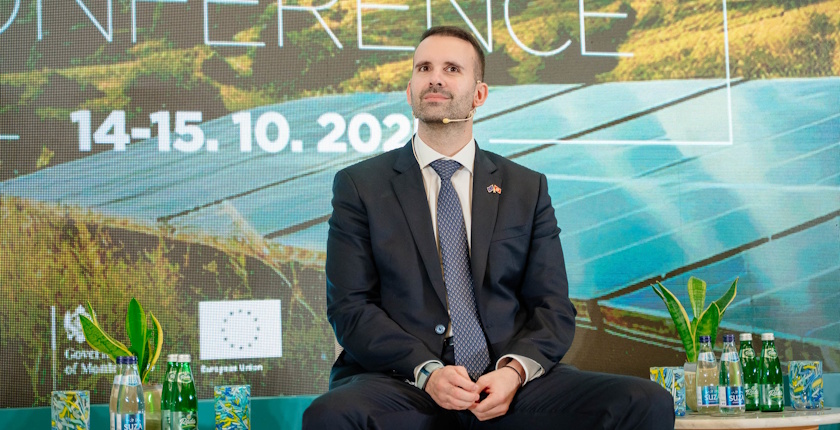
Montenegro plans to become a country of green data centers, according to Prime Minister Milojko Spajić.

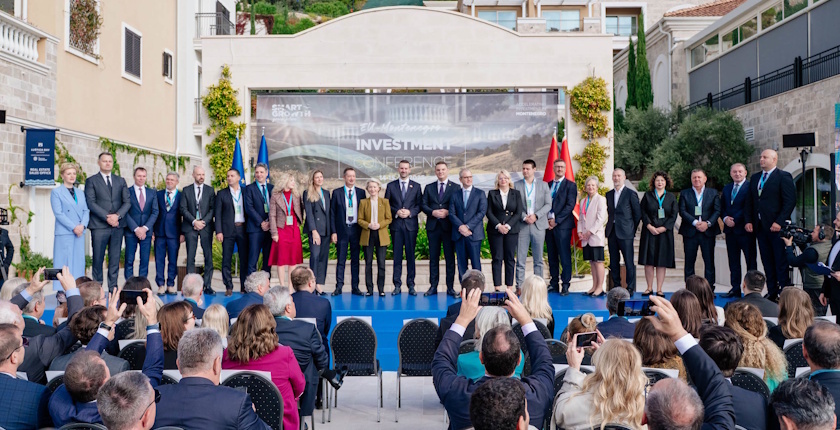
Milojko Spajić was one of the speakers at the keynote panel Accelerating the Western Balkans’ Green and Smart Growth, within the European Union – Montenegro Investment Conference in Luštica, near Tivat.

Earlier, European Commission President Ursula von der Leyen and the prime minister of Montenegro opened the two-day event, titled Smart Growth, Green Future: Accelerating Investment in Montenegro.

Spajić said energy is a cornerstone of the country’s strategy for connecting the region but also something in which Montenegro could be very competitive, helping the EU become even more competitive on the global stage.

Spajić: We can offer to Europe a possibility to get inexpensive electricity and stable supply

“We have dozens of amazing projects for hydro, wind, solar energy at very competitive rates. We can offer to Europe a possibility to get inexpensive electricity and stable supply. Baseload energy as well. For example, hydro is baseload energy,” he stated.

Photo: Bojan Gnjidić / Government of Montenegro

The prime minister recalled that his country is interconnected with Italy and that the project for the installation of the second line of the subsea cable is in the pipeline. But he also highlighted the significance of digital connections with Italy, where Milan is one of the biggest data center hubs in the EU, providing connections to Frankfurt and London.

Montenegro, in Spajić’s words, intends to be a part of the data highway. Data centers are basically the hardware for artificial intelligence, he explained and added that AI is going to be strong in big markets, not in small ones.

Partners from the US, UAE, and other countries, are interested in the development of the data centers

“But where we can actually be involved as a small country are data centers providing infrastructure for the EU’s AI to be strong and competitive,” Spajić underlined.

Therefore the country intends to focus on providing a very good environment for global data center operators, to come from all around the world. Spajić revealed that partners from the United States, United Arab Emirates, and other countries are interested in joining the opportunities for the development of the data centers.

“We want Montenegro to be the country of green data centers. We have water for hydropower. We have a lot of solar potential and a lot of wind. We are very fortunate to have such diversity,” Spajić said.

He invited investors to come to Montenegro: “Don’t waste your time, come as soon as possible.”

Participants at the panel included the Director of Enlargement Coordination, Strategy and Investments at the EU’s Directorate-General for Enlargement and Eastern Neighbourhood, Mathieu Bousquet, WizzAir CEO József Váradi, Akuo President Eric Scotto, and Charlotte Ruhe, Managing Director for Central and South-Eastern Europe in the European Bank for Reconstruction and Development (EBRD).

Of note, fourteen cooperation projects between Montenegrin and European companies have been initiated at the conference. Some of them involve investments in wind farms, solar parks, energy storage, and grids.

by in News

Montenegro building two solar plants at hydropower dams

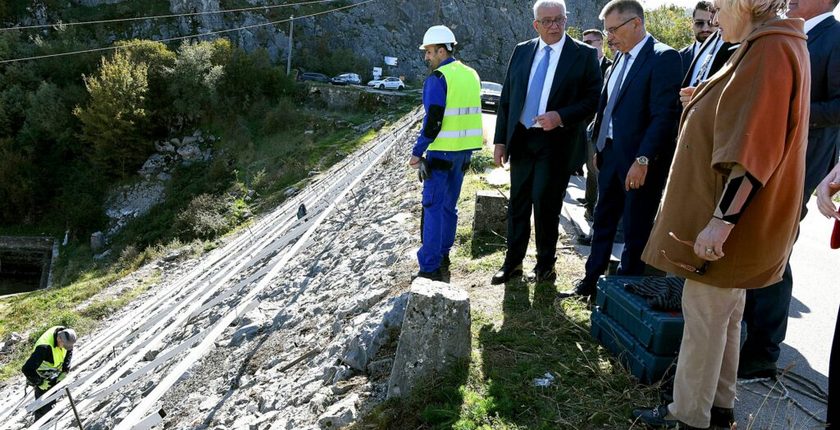
Montenegro’s state power utility, Elektroprivreda Crne Gore (EPCG), is installing a 2.5 MW solar plant at the Slano hydropower dam near Nikšić, while a photovoltaic plant is also being installed at the Vrtac dam. The project marks yet another step towards increasing the share of renewable sources and strengthening Montenegro’s energy independence, said EPCG-Solar gradnja, a subsidiary of EPCG.

The project is implemented by EPCG-Solar gradnja, which specializes in the procurement, design, installation, and maintenance of photovoltaic systems. Both dams belong to hydropower plant Perućica.

The works at the Slano dam are challenging, as the solar panels are being installed on very steep terrain, according to Marina Jočić, president of the board of EPCG-Solar gradnja. She was speaking during a tour of the site with EPCG management, Speaker of the Parliament of Montenegro Andrija Mandić, and Mayor of Nikšić Marko Kovačević.

The total planned capacity of the Slano and Vrtac solar plants is 3.7 MW

According to earlier announcements, the total installed capacity of the Slano and Vrtac solar power plants will be 3.7 MW. Works on the Vrtac power plant are in the final phase, said Miro Vračar, head of production at EPCG.

EPCG also plans to build the country’s first floating solar power plant at the Slano reservoir. Late last year, the investment valued at EUR 60 million was listed as one of 15 priority infrastructure projects in Montenegro’s energy sector.

EPCG also plans a floating solar plant at the Slano reservoir

Solar power plants on dams are also being built in other countries in the region. In Slovenia, one such facility was put into operation in June, installed on the reservoir wall of the Avče pumped storage hydropower plant.

When it comes to floating solar, North Macedonia plans to integrate such facilities into the national irrigation network.

by in News

EU-Montenegro Investment Conference: 14 partnerships, MoUs signed for energy, sustainable projects

A total of 14 cooperation projects between Montenegrin and European companies have been initiated at the ongoing European Union-Montenegro Investment Conference, including investments in wind farms, solar parks, energy storage, and grids.

The two-day conference, titled Smart Growth, Green Future: Accelerating Investment in Montenegro, was opened today in Luštica, near Tivat, by the President of the European Commission, Ursula von der Leyen, and the Prime Minister of Montenegro, Milojko Spajić.

Montenegro’s growing potential for strategic, green, and sustainable investments was presented through new partnerships between leading Montenegrin and European companies, according to a press release by the Government of Montenegro.

The Conference was jointly organized by the government and the European Commission, with the support of the Montenegro Investment Agency (MIA).

State power utility EPCG has signed three memoranda of understanding

State-owned power utility Elektroprivreda Crne Gore (EPCG) has signed three memoranda of understanding (MoUs). One was signed with Akuo for the development of several renewable energy projects, including floating solar, a photovoltaic plant, and energy storage.

The second MoU, signed with SS&A Power Group, envisages the development, manufacture, and installation of thermal energy storage, while the third, with Wind Fisher, concerns a new technology for high-altitude wind power generation.

Alcazar Energy signed a memorandum with the government’s project management office for the development and financing of renewable energy projects. CWP Europe and the Montenegrin Investment Agency (MIA) signed a memorandum on the development of the Montečevo solar farm project with battery storage. The company signed a similar agreement for its project in Albania yesterday.

A memorandum was also signed between Čevo Solar and Grawert Jenny & Partner on battery energy storage systems (BESS). A 20 MW/60 MWh battery is being considered.

Four sustainable investment partnerships were also signed

The Ministry of Energy and Mining and EDF will further discuss the issue of modernizing Montenegro’s power distribution network.

Among the signed documents is an MoU on collaboration between the European Bank for Reconstruction and Development (EBRD) and Erste on a Regional Energy Efficiency Program (REEP), as well as cooperation in the field of wastewater management between Suez and MIA.

In addition, four sustainable investment partnerships were also signed: Farm2Fork Montenegro, Station M, Green Logistics Hub, and Northern Investments Compact for Ecology & Resilience (NICER). Green Logistics Hub refers to the Port of Bar, which aims to become the first net-zero port on the Adriatic. NICER concerns the just transition and is led by the Pljevlja Coal Mine.

Von der Leyen: Do not wait for accession to invest in Montenegro

Photo: Bojan Gnjidić/Vlada Crne Gore

The event brought together senior representatives of the Government of Montenegro, the European Union, international financial institutions, as well as prominent European and Montenegrin investors.

“My message is very clear: do not wait for accession to invest in Montenegro, because by then you may miss the opportunities that others will seize,” Ursula von der Leyen noted.

She stressed that by continuing its European journey with determination and speed, Montenegro is making its goal of EU accession attainable.

“Today, we are opening a new chapter of development—we are beginning a major investment cycle, strengthening our ties with the European market even before formally joining the European family. Today, we are bringing our vision of green and smart growth to life. We are doing this together with our most important strategic partner—the European Union, which is also the largest investor in our country,” Prime Minister Milojko Spajić said.

He recalled that the country plans to close all negotiating chapters with the EU by the end of 2026 and become its 28th member state in 2028.

Photo: Bojan Gnjidić/Vlada Crne Gore
by in News

Apple signs PPAs in Greece, Romania as part of drive to green its devices’ consumption

As part of efforts to ensure that all electricity consumed by Apple devices is matched with green energy, the United States–based tech giant is facilitating 650 MW of renewables projects across Europe, including through power purchase agreements (PPA). By 2030, wind and solar power plants in Spain, Greece, Italy, Latvia, Poland, and Romania are expected to generate over 1 TWh of clean electricity on behalf of Apple users, the company said.

“By 2030, we want our users to know that all the energy it takes to charge their iPhone or power their Mac is matched with clean electricity,” said Lisa Jackson, Apple’s vice president of environment, policy, and social initiatives.

In Greece, Apple has signed a long-term PPA to procure power from a 110 MW solar project owned by HELLENiQ Energy. The plant, which is already fully operational, is located in Kozani in northern Greece.

Apple has signed a long-term power purchase agreement for a 110 MW solar plant in Greece

In Romania, the company plans to procure power from the 99 MW Green Breeze wind farm, located in Galați County, through a long-term virtual power purchase agreement (vPPA). The facility, which is scheduled to start operations in the first half of 2026, was initiated by Sweden-based OX2 and later sold to Nala Renewables.

In Italy, Apple is supporting the development of a 129 MW portfolio of solar and wind projects. The first of the facilities, a photovoltaic plant in Sicily, is expected to come online this month.

The project backed by Apple in Poland is for Econergy’s 40 MW solar array, which is expected to be operational later this year. In Latvia, the tech giant has signed one of the country’s first corporate PPAs. It will procure electricity from European Energy’s 110 MW solar power plant, set to be one of the largest in Latvia once completed.

The 131 MW Castaño solar farm in Spain came online earlier this year

The 131 MW Castaño solar farm in Segovia in Spain, operated by ib vogt, became operational earlier this year.

by in News

Rooftop solar on public buildings gains momentum in Slovenia

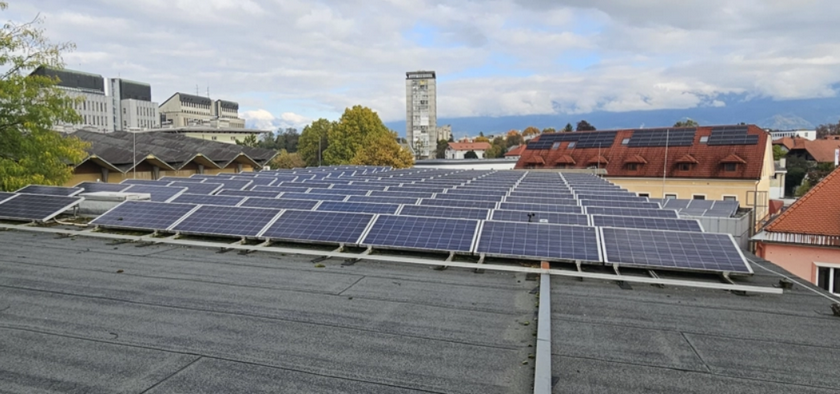
The trend of installing rooftop solar on public buildings to create energy communities is gaining momentum in Slovenia, with two more cities, Velenje and Kranj, joining the initiative. Similar projects were recently announced in Celje, Šoštanj, and Novo Mesto.

Velenje plans to install solar power plants on 13 public buildings in cooperation with ECE, a subsidiary of state power utility Holding Slovenske Elektrarne (HSE). The total capacity of the proposed installations is about 1.97 MW, with an estimated annual electricity output of more than 2.1 GWh.

The project, valued at EUR 1.97 million, is expected to save the municipality over EUR 157,000 in electricity costs annually. Financing is provided through the European Union’s Recovery and Resilience Facility (RRF) and the National Recovery and Resilience Plan. The municipality itself is contributing EUR 530,755.

This model involves the internal exchange of produced electricity, enabling municipalities to optimize consumption and reduce dependence on the market. Photovoltaic plants are installed on the roofs of structures such as sports facilities, administrative buildings, health centers, bus stations, schools, and kindergartens.

Energy communities help municipalities increase energy independence

In Kranj, 16 rooftop solar power plants, with a total capacity of 2 MW, will be installed on public buildings, in a EUR 1.5 million public-private partnership project carried out in cooperation with GEN-I. The municipality has obtained a state subsidy of EUR 700,000, while the remaining amount will be provided by the private partner.

The new solar power plants should be installed by next summer. They are expected to provide electricity for a total of 22 public buildings, cutting their electricity bills in half, according to a statement from the local authority. Kranj already has two rooftop solar plants on public buildings, installed in 2012 and 2013 respectively, it recalled.

In September, contracts were signed in Celje, Šoštanj, and Novo Mesto to install rooftop solar power plants on public facilities.

The project in Celje involves 11 installations with a total capacity of 1.4 MW, which is expected to bring about EUR 200,000 in annual savings. The contract in Šoštanj is for power plants at four public facilities, totaling 500 kW, with expected annual savings of EUR 70,000. In Novo Mesto, a private partner plans to build and operate ten new solar power plants on municipal land and structures.