by in News

MEMO Analysis Links Solar Output to Lower Day-Ahead Power Prices in North Macedonia

Electricity generation from solar power plants tends to push prices down on the power exchange, while reduced solar output is associated with price increases, according to an analysis by Ana Angelova, a market operations specialist at the National Electricity Market Operator (MEMO).

The analysis aimed to identify seasonal trends and highlight the relationship between photovoltaic (PV) generation, electricity consumption, traded volumes, and day-ahead prices on the North Macedonian power exchange. MEMO noted that the day-ahead market operates in an isolated mode.

Angelova used official power exchange data for 2024, focusing on hours when PV plant efficiency exceeded 30%.

Consumption remains broadly stable across the year

The findings point to a clear seasonal pattern. Electricity consumption stays relatively steady throughout the year, with only minor declines during spring and summer. PV generation, however, shows a pronounced seasonal swing—peaking in summer and reaching its lowest levels in winter.

Angelova also stressed that higher PV output coincides with increased traded volumes on the day-ahead market.

Prices bottom out in April, rise toward winter

According to the analysis, day-ahead prices are lowest in April, a period linked to milder weather, lower demand, and stronger solar production. From summer onward—and particularly during winter—prices trend higher, peaking in November.

The November price peak aligns with a combination of weak PV generation and higher consumption.

“Increased electricity generation from photovoltaic plants is associated with lower prices, while low generation leads to higher market prices, emphasizing the impact of renewable energy availability on price formation. The trend indicates that energy policies should focus on addressing weaknesses during the winter period and harnessing the potential of solar energy in summer,” Angelova wrote.

Proposed measures to strengthen renewables integration
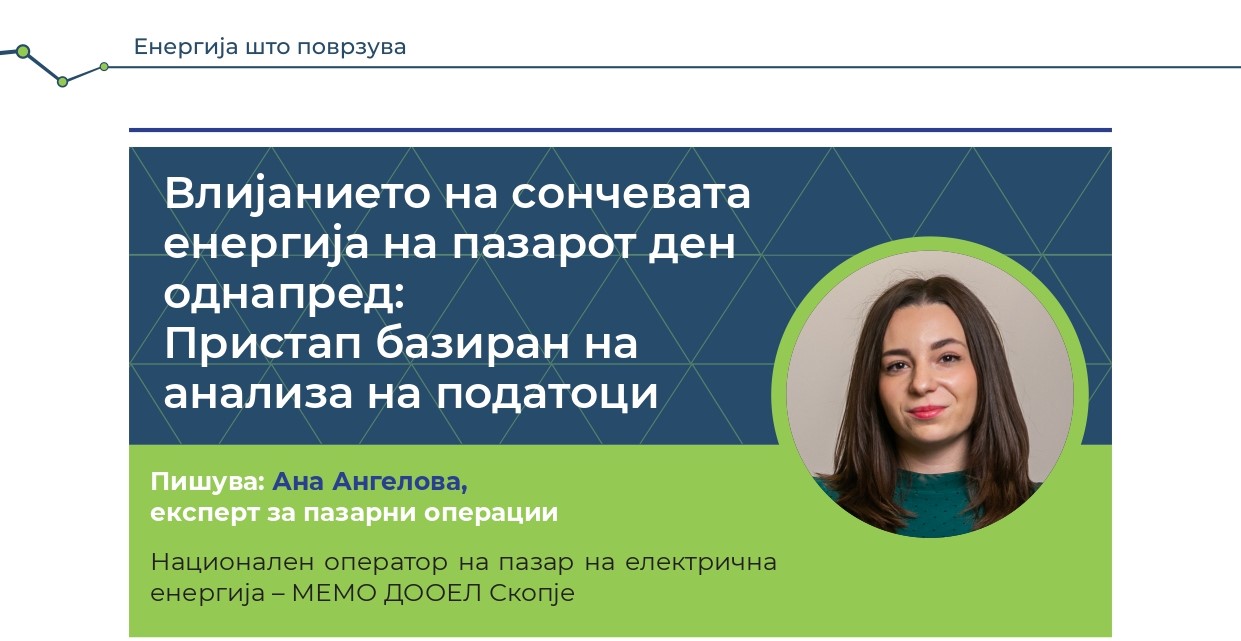
north macedonia solar analysis memo power exchange ana angelova

Photo: MEMO

Angelova outlined several options to improve the integration of renewables—especially solar—into the power system. The proposed mechanisms include:

  • Flexible market mechanisms: introduction of a 15-minute trading interval, creation of an intraday market, dynamic tariffs, and guarantees of origin.

  • Energy storage technologies: battery energy storage systems (BESS) and pumped-storage hydropower plants.

  • Alignment with the European energy framework: adoption of ENTSO-E grid codes, coupling with the single European electricity market, deployment of smart meters, and use of financial instruments such as contracts for difference (CfD) and power purchase agreements (PPA).

by in News

Enery secures EUR 250 million for hybrid power plants in four EU states

Austrian green energy producer Enery has secured financing for hybrid power plants in Czechia, Slovakia, Bulgaria, and Slovenia.

Enery said it has successfully raised more than EUR 250 million in long-term portfolio project financing.

Československá obchodní banka, a. s. (ČSOB) is acting as the sole lender, while United Bulgarian Bank AD and Československá obchodná banka, a.s. Slovakia are subparticipants. The financing has a tenor of 22 years.

The transaction is structured as portfolio project finance, featuring a single borrower and a single lender, and supported by several operating companies as guarantors, Enery explained.

Enery currently operates a portfolio with 566 MW of installed capacity

The financing will be used to support the development and operation of a cross-border renewable energy portfolio in Czechia, Slovakia, Bulgaria, and Slovenia, according to the announcement.

It includes 300 MW of solar capacity and 100 MW / 220 MWh of co-located battery energy storage systems (BESS) assets spanning four countries.

“Securing more than EUR 250 million through this long-term portfolio financing is another strong endorsement of our strategy and execution capabilities,” Enery CEO Richard König underscored.

König: Another strong endorsement of Enery’s strategy and execution capabilities

Teodor Filip, VP Financing at Enery, pointed to this long-term financing as a major milestone for the company. It strengthens its ability to scale renewable generation and storage solutions in the region and supports its contribution to long-term decarbonization goals, he added.

In early January, the company started the construction of one of the largest photovoltaic plants and hybrid power plants in Europe. The Ogrezeni facility will feature an installed peak capacity of 761 MW, coupled with a 1 GWh battery energy storage system.

Enery also intends to commission a four-hour battery storage system of 150 MW in central Bulgaria by the end of the first quarter.

The company currently operates a portfolio of 566 MW in installed capacity, 90% which is solar.

by in News

Slovenia opens its first highway solar power plant

Slovenia’s road management firm Družba za Avtoceste v Republiki Sloveniji has installed a solar power plant on a noise barrier alongside a highway. It is the first such photovoltaic system in the country.

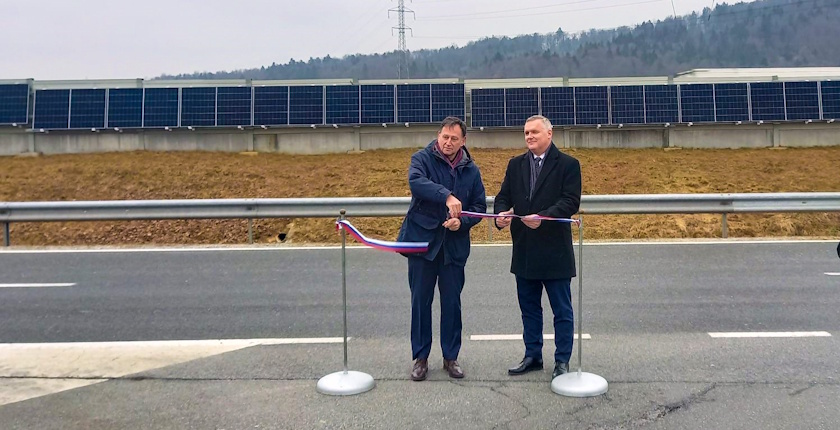
Družba za avtoceste v Republiki Sloveniji (DARS) has officially opened its first photovoltaic plant on a noise barrier at the Šmarje Sap West rest area. It is about ten kilometers from Ljubljana on the motorway connecting the Slovenian capital and Zagreb.

According to DARS, the project is part of a series of activities to achieve the company’s strategic goals in sustainable development, decarbonization, and efficient energy use.

The firm announced the development of such projects in July 2023. A pioneering idea in the region, it was later followed by Bosnia and Herzegovina, Montenegro, and Croatia.

Ribič: An example of thoughtful siting of renewable power plants

The opening ceremony was attended by the Chairman of the Management Board of DARS Andrej Ribič, Minister of the Environment, Climate and Energy Bojan Kumer, representatives of the contractor – Solvera Lynx, and representatives of distribution system operator Elektro Ljubljana.

Andrej Ribič stressed that the project is significant for electricity production but also as an example of thoughtful siting of renewable energy power plants without impacting traffic safety or routine highway maintenance.

The electricity generated by the PV system will be used for DARS’s own consumption, including public lighting and tunnel systems, he explained. This will ensure greater energy independence and more rational management of the energy system, Ribič added.

DARS plans to continue building PV plants

In line with its strategy, DARS aims to gradually reduce energy consumption from the grid and lower CO2 emissions in scopes 1 and 2. By 2030, the goal is to reduce energy consumption and carbon emissions by 30% from the 2024 levels, according to the firm.

Based on its revised strategy, DARS adopted several energy measures in 2024. They included the establishment of an energy department and the implementation of the first phase of solar installations across its five facilities, with a total capacity of 420 kW.

These plants can cover approximately 2% of the company’s annual electricity consumption.

DARS intends to further expand its solar energy projects. The plan includes building bigger plants in degraded areas and more PV systems on buildings and along highway tunnels.

The electricity produced would primarily power lighting and other road systems to ensure the safe and smooth operation of the motorway network, the company added.

Careful site selection for solar plants is crucial

In July 2023, DARS and state-owned hydropower operator Soške Elektrarne Nova Gorica (SENG) announced plans to build solar power plants along highways.

The first one was planned in the Slovenian Littoral and Coastal-Karst area. However, the new solar power plant is not located there.

The two firms later established similar cooperation with the Ministry of Defense and the Municipality of Vipava.

Solar energy use is expanding all over the planet. Experts warn that the optimal siting of PV panels is crucial to avoid occupying large areas of arable land or harming the environment. Therefore, the best solution is to install solar panels in locations that cannot be used for other purposes, such as alongside railways and roads, or on rooftops.

by in News

Concession agreement signed for 50 MW Vlašić wind farm in BiH

State-owned power utility Elektroprivreda Bosne i Hercegovine (EPBiH) and the Central Bosnia Canton have signed a concession agreement for the Vlašić wind farm near Travnik, along with annexes to the concession agreements for solar power plants Gračanica 1 and Gračanica 2 in the municipality of Bugojno.

The Vlašić wind farm will have up to nine wind turbines with a total capacity of 50 MW, installed at an elevation of 1,850 meters. The projected annual electricity output is between 112 GWh and 116 GWh, and the investment is estimated at EUR 90 million, according to a statement by EPBiH.

Wind farm Vlašić is expected to generate up to 116 GWh of electricity annually

Germany’s KfW Development Bank is providing a loan and grants for the project totaling EUR 38.43 million, and the Council of Ministers of Bosnia and Herzegovina, the country’s central government, adopted draft agreements for the arrangement in late December 2025.

The concession agreement, signed by EPBiH General Manager Sanel Buljubašić and Minister of Economy of the Central Bosnia Canton Sedžad Milanović, covers the construction, operation, and maintenance of the Vlašić wind power plant, reads the statement.

The first wind farm in Bosnia and Herzegovina, Mesihovina, was inaugurated in 2018, followed by Jelovača in 2019 and Podveležje in 2021.

Last year, wind farms Ivovik and Ivan Sedlo were put into operation. In addition, EPBiH plans to build a 90 MW wind park called Bitovnja, while Elektroprivreda Republike Srpske (ERS), the state-owned power utility of the Republic of Srpska, has reactivated the 60 MW Hrgud wind farm project.

Bosnia and Herzegovina consists of two entities: the Republic of Srpska and the Federation of BiH, which controls EPBiH.

Solar plants Gračanica 1 and Gračanica 2 will have a total capacity of 45 MW

The statement recalls that the Gračanica 1 and Gračanica 2 solar power plants would have a combined capacity of 45 MW and notes that a building rights agreement was concluded in December 2025. It also states that activities related to grid connection are currently underway, alongside procedures concerning land expropriation and repurposing.

EPBiH has secured loans for the project from the European Bank for Reconstruction and Development (EBRD) and UniCredit Bank’s subsidiary in BiH. The sites are at a rehabilitated tailings dump of the Gračanica coal mine.

As part of the EPBiH Solar Transition Programme, implemented in cooperation with the EBRD, the state-owned power utility plans to build 13 solar power plants with a total capacity of around 195 MW.

by in News

Romania plans to lease unproductive land for renewable energy projects

Romania is drafting legislation that would enable granting concessions for the construction of renewable energy plants on unproductive and degraded state-owned agricultural land. The initiative aims to establish fast-track areas for renewable energy projects, with all necessary permitting procedures limited to 12 months.

The legislation would allow the State Domains Agency (ADS), which manages state-owned agricultural land, to grant concessions on areas of land that are not suitable for agriculture, but can be used for green energy production, according to a report by Profit.ro. The initiative is part of the RePowerEU component of Romania’s National Recovery and Resilience Plan (NRRP).

These areas should be officially designated following a mapping process to identify available land, subsurface, marine, or inland water areas needed for developing renewable energy power plants, as well as related grids and energy storage facilities, including thermal storage, to support achieving the 2030 renewable energy target.

The areas for renewable energy projects will be designated after a mapping process

The deadline to designate these areas is February 21, but it is unlikely to be met, given that a contract to procure the necessary geospatial data management software has been partially cancelled. The ADS has now launched a new tender for the geospatial data system, valuing the job at RON 7.7 million (around EUR 1.51 million), according to Profit.ro.

In the so-called “areas suitable for accelerating renewable energy projects,” the procedures for granting all necessary legal authorizations would not take more than 12 months in total, according to the report.

The Romanian Government has long planned to amend the law on the ADS to give it the authority to award concessions to public and private entities for the purpose of producing energy from renewable sources such as hydro, solar, wind, biomass, and geothermal, the news portal recalled.

State-owned power utility Hidroelectrica, the largest electricity producer in Romania, intended to build a photovoltaic park of 1.5 GW on thousands of hectares of land managed by the ADS. It would be the largest in Europe.

by in News

Romania plans to lease unproductive land for renewable energy projects

Romania is drafting legislation that would enable granting concessions for the construction of renewable energy plants on unproductive and degraded state-owned agricultural land. The initiative aims to establish fast-track areas for renewable energy projects, with all necessary permitting procedures limited to 12 months.

The legislation would allow the State Domains Agency (ADS), which manages state-owned agricultural land, to grant concessions on areas of land that are not suitable for agriculture, but can be used for green energy production, according to a report by Profit.ro. The initiative is part of the RePowerEU component of Romania’s National Recovery and Resilience Plan (NRRP).

These areas should be officially designated following a mapping process to identify available land, subsurface, marine, or inland water areas needed for developing renewable energy power plants, as well as related grids and energy storage facilities, including thermal storage, to support achieving the 2030 renewable energy target.

The areas for renewable energy projects will be designated after a mapping process

The deadline to designate these areas is February 21, but it is unlikely to be met, given that a contract to procure the necessary geospatial data management software has been partially cancelled. The ADS has now launched a new tender for the geospatial data system, valuing the job at RON 7.7 million (around EUR 1.51 million), according to Profit.ro.

In the so-called “areas suitable for accelerating renewable energy projects,” the procedures for granting all necessary legal authorizations would not take more than 12 months in total, according to the report.

The Romanian Government has long planned to amend the law on the ADS to give it the authority to award concessions to public and private entities for the purpose of producing energy from renewable sources such as hydro, solar, wind, biomass, and geothermal, the news portal recalled.

State-owned power utility Hidroelectrica, the largest electricity producer in Romania, intended to build a photovoltaic park of 1.5 GW on thousands of hectares of land managed by the ADS. It would be the largest in Europe.

by in News

Why nobody in Slovenia bothers to remove snow from solar panels

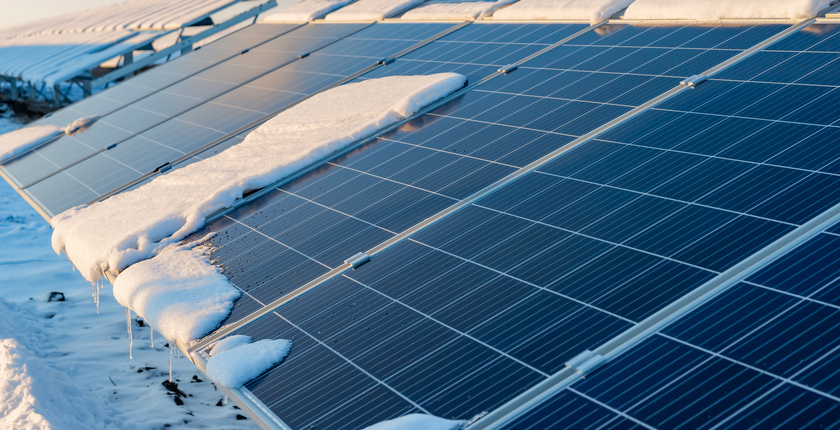
The snow that has blanketed much of Europe over the past few days has also covered solar panels, preventing the absorption of sunlight and, consequently, electricity production. However, Slovenian solar power plant operators are not attempting to remove the snow, as doing so would cause more harm than good.

The main reason for not clearing the snow is the risk of damage to solar panels. Primož Tručl, CEO of solar power plant operator Moja elektrarna and a member of the board of the Slovenian Photovoltaic Association (ZSFV), told Naš stik that removing snow from solar modules while avoiding scratching their surface would be time-consuming and expensive. It would outweigh the benefits of potential production given the low levels of sunshine in winter, according to him.

Removing snow without damaging solar panels would cost more than the electricity generated at this time of year

Stellar, the operator of a hybrid solar power plant near Črnomelj, also considers such an intervention economically unjustified, as production losses due to temporary snow cover are relatively small and short-lived.

In most cases, snow melts or slides off the surface quickly thanks to the inclination of the panels and the heating of the modules under sunlight, Naš stik was told at the company.

Snow slides off on its own very quickly and outages are short-lived

In addition, manually removing snow with shovels, brooms, scrapers, or other equipment can damage the glass on solar panels. Even softer tools can cause micro-scratches, reducing the efficiency of the panels.

“Any damage to the glass also means an increased risk of moisture ingress and, consequently, module failure,” the company explained.

State-owned energy utility GEN energija has told Naš stik that most of its solar power plants are built on slopes, allowing snow to slide off the modules relatively quickly when the sun shines.

Letting snow slide off on its own also has an upside, as it helps clean solar panels by carrying away most of the dirt accumulated on the surface, according to GEN energija.

by in News

Why nobody in Slovenia bothers to remove snow from solar panels

The snow that has blanketed much of Europe over the past few days has also covered solar panels, preventing the absorption of sunlight and, consequently, electricity production. However, Slovenian solar power plant operators are not attempting to remove the snow, as doing so would cause more harm than good.

The main reason for not clearing the snow is the risk of damage to solar panels. Primož Tručl, CEO of solar power plant operator Moja elektrarna and a member of the board of the Slovenian Photovoltaic Association (ZSFV), told Naš stik that removing snow from solar modules while avoiding scratching their surface would be time-consuming and expensive. It would outweigh the benefits of potential production given the low levels of sunshine in winter, according to him.

Removing snow without damaging solar panels would cost more than the electricity generated at this time of year

Stellar, the operator of a hybrid solar power plant near Črnomelj, also considers such an intervention economically unjustified, as production losses due to temporary snow cover are relatively small and short-lived.

In most cases, snow melts or slides off the surface quickly thanks to the inclination of the panels and the heating of the modules under sunlight, Naš stik was told at the company.

Snow slides off on its own very quickly and outages are short-lived

In addition, manually removing snow with shovels, brooms, scrapers, or other equipment can damage the glass on solar panels. Even softer tools can cause micro-scratches, reducing the efficiency of the panels.

“Any damage to the glass also means an increased risk of moisture ingress and, consequently, module failure,” the company explained.

State-owned energy utility GEN energija has told Naš stik that most of its solar power plants are built on slopes, allowing snow to slide off the modules relatively quickly when the sun shines.

Letting snow slide off on its own also has an upside, as it helps clean solar panels by carrying away most of the dirt accumulated on the surface, according to GEN energija.

by in News

Elektroprivreda BiH to invest EUR 885 million over next three years

Government-controlled power company Elektroprivreda BiH plans to invest BAM 1.73 billion (EUR 884.6 million) over the next three years, according to its 2026-2028 business plan.

The investments would be financed through loans, and BAM 538 million (EUR 275 million) from own funds of Elektroprivreda BiH (EPBiH), which operates in the Federation of BiH. Of note, it is one of the two entities making up Bosnia and Herzegovina. The other one is the Republic of Srpska.

In line with available funds and restructuring plans, the company intends to continue investing in coal mines within the EPBiH group over the three-year period.

The goal is a stable and sustainable coal production at the volume needed for the planned operation of the thermal power plants, the utility said.

The previous business plan, for the 2025-2027 period, provided for investments of BAM 2.1 billion (EUR 1.074 billion).

The three-year period should be marked by the construction of a large number of PV plants

EPBiH has highlighted the construction of new renewable energy power plants as a long-term strategic and priority goal. The construction of several solar power plants at already identified locations are particularly significant, the plan reads.

The upcoming three-year period should be marked by the construction of a large number of PV facilities at multiple locations on mining sites, company-owned land, on the roofs of its own facilities and those of its customers, EPBiH explained.

EPBiH also plans to acquire operational renewable energy facilities as well as projects in development. The plan envisages the purchase or lease of land suitable for the construction of solar power plants.

Positive business performance and maintaining the position as the dominant electricity supplier in BiH are also outlined in the business plan, adopted by the company’s assembly.

Desulfurization and denitrification of flue gases projects are planned for two thermal power plants

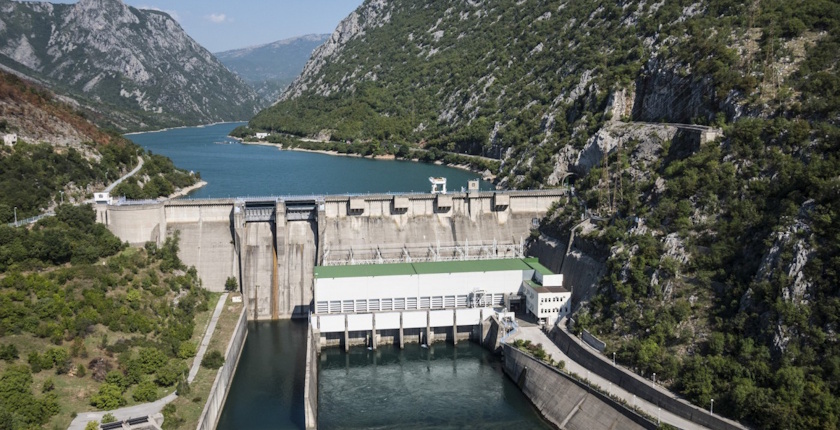
EPBiH has launched flue gas desulfurization and denitrification projects for its Tuzla and Kakanj coal-fired power plants. It would also upgrade unit 7 in Kakanj, unit 4 in Tuzla, and the Salakovac hydropower plant.

The document envisages the establishment of the distribution system operator (DSO), based on the provisions of the Law on Electricity of the Federation of BiH. It came into force in August 2023.

The law stipulates unbundling the distribution activity from EPBiH and establishing the DSO as a separate legal entity, a 100%-owned subsidiary, the company underlined.

by in News

Elektroprivreda BiH to invest EUR 885 million over next three years

Government-controlled power company Elektroprivreda BiH plans to invest BAM 1.73 billion (EUR 884.6 million) over the next three years, according to its 2026-2028 business plan.

The investments would be financed through loans, and BAM 538 million (EUR 275 million) from own funds of Elektroprivreda BiH (EPBiH), which operates in the Federation of BiH. Of note, it is one of the two entities making up Bosnia and Herzegovina. The other one is the Republic of Srpska.

In line with available funds and restructuring plans, the company intends to continue investing in coal mines within the EPBiH group over the three-year period.

The goal is a stable and sustainable coal production at the volume needed for the planned operation of the thermal power plants, the utility said.

The previous business plan, for the 2025-2027 period, provided for investments of BAM 2.1 billion (EUR 1.074 billion).

The three-year period should be marked by the construction of a large number of PV plants

EPBiH has highlighted the construction of new renewable energy power plants as a long-term strategic and priority goal. The construction of several solar power plants at already identified locations are particularly significant, the plan reads.

The upcoming three-year period should be marked by the construction of a large number of PV facilities at multiple locations on mining sites, company-owned land, on the roofs of its own facilities and those of its customers, EPBiH explained.

EPBiH also plans to acquire operational renewable energy facilities as well as projects in development. The plan envisages the purchase or lease of land suitable for the construction of solar power plants.

Positive business performance and maintaining the position as the dominant electricity supplier in BiH are also outlined in the business plan, adopted by the company’s assembly.

Desulfurization and denitrification of flue gases projects are planned for two thermal power plants

EPBiH has launched flue gas desulfurization and denitrification projects for its Tuzla and Kakanj coal-fired power plants. It would also upgrade unit 7 in Kakanj, unit 4 in Tuzla, and the Salakovac hydropower plant.

The document envisages the establishment of the distribution system operator (DSO), based on the provisions of the Law on Electricity of the Federation of BiH. It came into force in August 2023.

The law stipulates unbundling the distribution activity from EPBiH and establishing the DSO as a separate legal entity, a 100%-owned subsidiary, the company underlined.