by in News

World’s largest sand battery commissioned in Finland

The world’s first industrial-scale sand battery has been commissioned in Pornainen, Finland. It will use surplus renewable energy to generate heat, which will then be supplied to the local district heating network.

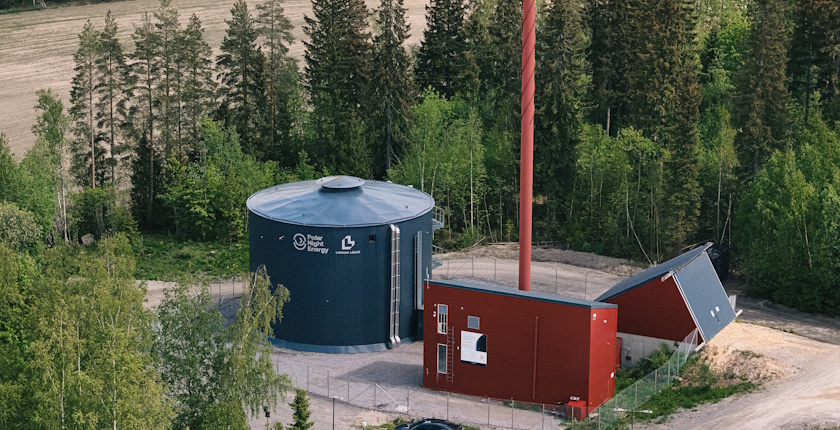
The sand battery, which delivers one megawatt of thermal energy and has a storage capacity of 100 megawatt-hours, was installed for the district heating system in the municipality of Pornainen, operated by Loviisan Lämpö.

A sand battery is a high-temperature thermal energy storage system, first developed by the start-up Polar Night Energy.

Finding ways to store energy from variable renewable sources is one of the biggest challenges of the energy transition. In the case of the battery developed by Polar Night Energy, the storage medium is sand or alternative sand-like materials.

The battery uses renewable electricity to power a heater, which then blows hot air into the sand. The sand is heated to between 500 and 600 degrees Celsius and retains that heat. The stored energy can be used for district heating, but also for industrial processes.

A prototype of the battery was installed in 2022 at the Valkeakoski power plant in the town of Kankaanpää, Finland. The new battery in Pornainen is ten times larger than the prototype and represents the first industrial-scale implementation of this technology.

It is 13 meters high and 15 meters wide, filled with 2,000 tons of crushed soapstone, a by-product from the production of fireplaces by Finnish company Tulikivi. During winter, the battery can cover heating needs for about a week.

Emissions in the district heating sector will be reduced by 70% thanks to the battery

“The Sand Battery means a lot to Loviisan Lämpö. It allows us to drastically reduce our emissions and improve the reliability of heat production,” says Mikko Paajanen, CEO of Loviisan Lämpö.

The company aims to become climate-neutral by 2035, and the battery will help it cut emissions by 160 tons of CO₂ equivalent – a reduction of nearly 70% in the district heating sector.

Thanks to the battery, the company will stop using oil for district heating completely, while the consumption of wood chips will be reduced by about 60%. A biomass boiler will be used as a backup during periods of peak demand, the company said.

“This project is a powerful example that effective solutions for mitigating climate change do exist. Loviisan Lämpö is a great example of a company bold enough to invest in new technologies,” says Liisa Naskali, Chief Operating Officer of Polar Night Energy.

Sand battery stabilizes the power grid and contributes to the circular economy

Advancing the circular economy and energy transition requires cross-sectoral cooperation, which the sand battery clearly demonstrates. It is not just a heat storage system – it’s a tool for grid balancing, emissions reduction, smart energy management, and better resource use.

A key factor in the sand battery’s cost-effectiveness lies in optimizing its operation according to electricity prices set by Finnish grid operator Fingrid. In this way, the battery also contributes to the stability of the power grid, which is essential for the further development of wind and solar power.

Thanks to its large storage capacity, the system enables optimization of electricity use over several days, or even weeks.

The thermal storage material in sand batteries can include by-products from industrial or mining processes, avoiding the exploitation of natural resources.

Polar Night Energy is currently in talks with partners in Finland and abroad about new projects. Earlier this year, it announced a pilot project in Valkeakoski to explore the possibility of converting stored heat back into electricity.

by in News

Global Wind Day 2025: Wind energy creates new jobs

Global Wind Day, celebrated every year on June 15, was first marked in 2007 as a joint initiative of WindEurope and the Global Wind Energy Council (GWEC). The European Union will need more than 200,000 trained workers in the wind energy sector in the future, which is why this year’s focus of Global Wind Day is on the people who work in the industry.

Global Wind Day aims to raise awareness of the importance of wind as a renewable energy source and its role in reshaping energy systems, decarbonizing the economy, and tackling climate change. The event is celebrated through various activities around the world, organized by international organizations, national associations, and companies operating in the wind energy sector.

Wind energy is now one of the most affordable forms of power generation in large parts of the world. In 2023, global wind energy capacity exceeded one terawatt. Last year alone, a record-breaking 127 gigawatts were added. According to the Global Wind Report published by GWEC, the countries with the most newly installed capacity last year were China, the United States, Brazil, India, and Germany.

The use of wind energy dates back to ancient Egypt. The first modern wind turbines were installed around four decades ago, standing 120 metres tall and placed on land. Today, the tallest wind turbine is fixed to the seabed and is 260 metres tall. Innovations in turbine technology have advanced to the point where we now have floating wind turbines, and soon, offshore wind catchers may become a reality.

Wind industry employs 370,000 people in Europe

This year, Global Wind Day shines a light on the people working in the wind industry. Around the world, children and adults alike are exploring how wind energy works, its potential to change the world, and the job opportunities it offers.

Today, wind farms produce around 20% of Europe’s electricity. The EU aims to increase this to 35% by 2030 and over 50% by 2050.

Currently, the wind industry in Europe employs 370,000 people – a number that could reach 600,000 by 2050. However, a major challenge lies ahead: Europe will need to train more than 200,000 workers to meet the growing demand in this field.

Share your experience in wind industry on Instagram and TikTok

Last year, the #WorkingInWind campaign was launched to raise awareness about the wide range of jobs available in the wind sector. This year, the goal is to inspire younger generations to pursue careers in wind energy.

An impressive 91% of Gen Z use Instagram, and 86% are on TikTok. Many turn to these platforms not only for news but also for inspiration and discovery.

WindEurope and GWEC have invited all current professionals in the wind industry to join the campaign by sharing stories about their career paths – how they got started, what they do, why their work matters, and what a typical day on the job looks like.

According to the campaign guidelines, the story should be shared on the mentioned social media platforms in the form of a photo with text or a short video, using the hashtags #GlobalWindDay and #WorkingInWind.

by in News

Interenergo launches its first wind farm in Bosnia and Herzegovina

The Ivan Sedlo wind farm, located on the mountain of the same name in the municipality of Hadžići, is the first power-generating wind facility in Sarajevo Canton. The project was developed by Slovenian company Interenergo, owned by Austria-based energy group Kelag. It is it’s first wind power plant in Bosnia and Herzegovina.

With a total installed capacity of 25 MW, the wind farm is equipped with five Siemens Gamesa 5.0 turbines. According to the company’s update, the wind farm will generate enough green electricity to power approximately 11,000 households in Bosnia and Herzegovina and prevent over 32,000 tons of CO2 emissions annually.

The construction of the Ivan Sedlo wind farm began in late September 2022, following more than six years of preparation. Interenergo acquired the project from the previous investor, Suzlon Energy BH, a company owned by Danish firm Suzlon Wind Energy.

“We’re proud to launch our first wind project in Bosnia and Herzegovina. Despite challenging site conditions, the project was delivered without major delays or compromises in quality. This achievement reflects the strong cooperation we’ve built with the Municipality of Hadžići and the surrounding communities, whose support was vital throughout the development process”, stated David Huber, Director of Interenergo.

According to him, the wind farm is expected to generate over 65 GWh annually, marking a significant milestone in the development of clean energy for Hadžići, Bosnia and Herzegovina, and the wider Balkan region.

Photo: Interenergo

“The importance of the investment for the local community is diverse — from a cleaner environment and new jobs to additional funds for the Municipality of Hadžići’s budget. I believe this is just the beginning, as we have a clear goal: the development of environmentally sustainable, long-term profitable, and socially responsible energy solutions. We also have the potential and the will to continue in that direction,” said Eldar Čomor, Mayor of Hadžići.

Nihad Uk, the prime minister of Sarajevo Canton, emphasized at the inauguration that projects like this are becoming increasingly important because, as he said, it’s not a question of years, but months before the European Union introduces so-called carbon taxes.

Interenergo has been active in the Bosnia and Herzegovina market since 2007.  Today, in addition to the wind park, the company operates eight hydropower plants with a total capacity of 43 MW and an average annual production of over 125 GWh — enough to supply more than 31,000 households and avoid 61,500 tons of CO2 emissions each year.

By 2032, Interenergo plans to develop new renewable energy projects across the region, aiming to add more than 300 MW of new capacity.

by in News

Citizens, activists in Bulgaria oppose wind farm project that would destroy forest

In the municipality of Avren in Bulgaria, citizens and activists will gather on May 18 to express their opposition to a plan to build a wind farm with 29 turbines, which implies the clearing of 30 hectares of forest.

The eastern Bulgarian municipality of Avren is home to valuable forest ecosystems and it lies along one of the most important bird migration routes in Europe – the Via Pontica. A local forest protection initiative, which is organizing a protest on May 18 against a wind farm project, said the decision to change the forest land designation was made without public consultation or an environmental impact assessment, arguing it was against the law.

The said natural resources are of both national and international importance for biodiversity conservation and maintaining the ecological balance of the Black Sea region, protest organizers claim. Although the wind farm project may appear green at first glance, the construction of 29 turbines would require cutting down 30 hectares of forest, they warned. Moreover, the project is located near protected areas within the Natura 2000 network and intersects a key migratory route for birds.

Nearly 9,000 citizens have signed a petition calling for a moratorium on projects affecting forests

Almost 9,000 citizens have signed a petition demanding a moratorium on all projects affecting forests in the area until a comprehensive assessment of cumulative environmental impacts is conducted. They are calling for the suspension of the procedure to amend the general urban development plan and for halting the project, which they deem illegal and harmful to both nature and people.

They are demanding a full and independent environmental impact assessment, including a compatibility evaluation with Natura 2000, the organization of a transparent public debate involving the local community, scientists, and environmentalists, as well as to consider alternative locations outside of sensitive ecological zones.

On the other hand, the company developing the project claims the turbines would be equipped with thermal cameras and sensors to detect approaching birds, and that the wind turbines would automatically shut down if necessary. It added that the minimum distance from residential areas would be between 850 and 1,200 meters, in line with regulations.

The local authority supports the wind farm project. Mayor Emanuel Manolov said about fifty jobs would be created and that the local budget would receive between EUR 1 million and EUR 1.5 million annually.

A protest was also held in Kyustendil against wind and solar projects in nearby mountain areas

Citizens of the Kyustendil municipality have also voiced their opposition to wind turbines. On April 30, a protest was held in Kyustendil against the construction of a wind farm on Osogovo mountain and the expansion of a solar power plant on the Konjavska mountain. The municipal leadership and assembly have supported the citizens’ demands.

Bulgarian citizens have been fighting wind turbines for over a decade

Since 2012, no new wind farms have been put into operation in Bulgaria, mainly due to administrative barriers and legal uncertainty. Late last year, citizens from four districts – Dobrich, Silistra, Shumen, and Varna – protested in Varna, demanding a referendum on the construction of solar and wind power plants on agricultural land.

Earlier, the municipal assembly of Dobrichka (also known as Dobrich-selska – Dobrich rural) voted to ban the conversion of agricultural land into construction land for wind farms. A similar decision was made by the local parliament in General Toshevo. German company wpd plans to install wind turbines in both municipalities.

In 2023, authorities in Vetrino blocked CWP’s massive wind energy project. That same year, a draft law on offshore wind power in Bulgaria sparked opposition from fishermen, the tourism industry, nongovernmental organizations, and local authorities in the coastal city of Varna and its surroundings. It contributed to the fall of the government at the time, and the legislative process didn’t get far.

Citizens in other countries covered by Balkan Green Energy News are also resisting wind power projects. Last year, residents of several villages near Livno in Bosnia and Herzegovina managed to halt the planned construction of the Orlovača wind farm. Around the same time in Serbia, the Ministry of Environmental Protection issued nature protection conditions that prevented the construction of the Čestobrodica wind farm.