by in News

Uncompetitiveness holding EU far behind green hydrogen targets

Several high-profile green hydrogen projects have been canceled in the past year, and major companies reduced their decarbonization ambitions, the European Union Agency for the Cooperation of Energy Regulators (ACER) said in its new report. The technology is four times more expensive than production from fossil gas through steam reforming.

Investments are far behind EU targets and trailing even the contracted demand. However, an acceleration of existing projects would change the picture substantially. On that note, the European Hydrogen Bank is receiving submissions for its third auction.

Electrolyser capacity in the EU jumped 51% last year to 308 MW, while 1.8 GW was under construction in October 2025, expected to be commissioned within two years. The numbers are from the European Hydrogen Markets – 2025 Monitoring Report, issued by the EU Agency for the Cooperation of Energy Regulators (ACER). It pointed out that the total falls well short of the trajectory toward the 2030 target of 40 GW, or the 48 GW to 54 GW range in member states’ plans.

Of note, while some other databases show similar figures, the Renewable Hydrogen Coalition has calculated that operational projects amount to 600 MW, though “across Europe,” and not just in the EU. Another 3 GW is under construction, its update reads.

The European Hydrogen Strategy aimed at 6 GW by 2024.

Sweden, Germany in strongest expansion

Sweden and Germany account for two thirds of the capacity under construction (742 MW and 414 MW, respectively), ACER said. In addition, EWE has just marked the start of construction of an electrolyzer facility of a whopping 320 MW, which would eclipse the fleet that is currently producing green or renewable hydrogen. The site is in Emden, in Germany.

Domestically produced renewable hydrogen contracted, 270,000 tons, would require 3.7 GW of electrolysers.

Several high-profile green hydrogen projects have been canceled in the past year, and major companies have reduced their decarbonization ambitions, the agency warned. Importantly, all existing projects, in any stage of development and with a 2030 target, are for 62 GW in total, indicating the potential for acceleration.

An electrolyzer under construction in Germany is set to surpass the combined capacity of the current EU fleet

As for Southeastern Europe, Romania targets 2.1 GW of electrolyzer capacity for 2030. Croatia is aiming for between 0.1 GW and 1.3 GW, while the remaining countries are at just 0.1 GW or 0.2 GW. Greece was the only country with any capacity in construction in October, 50 MW. Interconnections are planned between Greece, Bulgaria, Romania and Hungary.

Citing the European Hydrogen Observatory, ACER said Germany has added 46 MW last year. With Denmark (18 MW) and Hungary (11 MW), it was 72% of the annual growth.

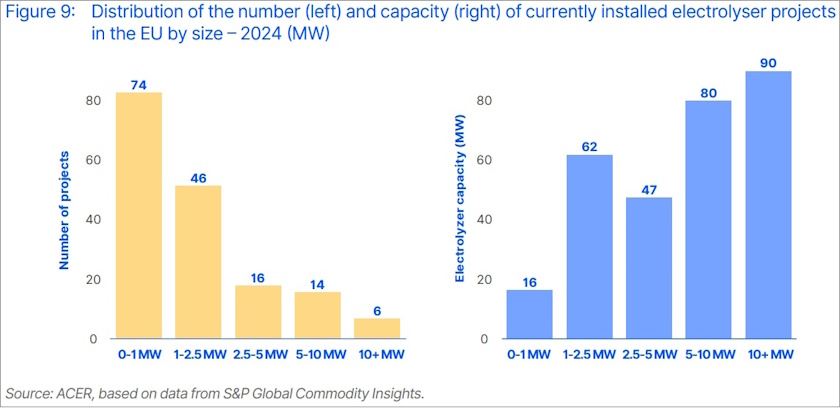
Only six plants were bigger than 10 MW at the end of 2024, amounting to 90 MW altogether.
ACER Uncompetitiveness holds EU far behind green hydrogen targets

Gray hydrogen remains dominant

Steam methane reforming (SMR) remains the dominant production technology, accounting for 89% of the total capacity in the EU. It is colloquially called gray hydrogen.

The share of electrolytic hydrogen, made using electricity from all sources, not necessarily renewables, is marginal. So is the overall capacity for blue hydrogen. It is also from fossil gas, but the process involves carbon capture and storage, CCS.

Green hydrogen, one of so-called renewable fuels of non-biological origin (RFNBO), costs some EUR 8 per kilogram, against just over EUR 2 per kilogram of conventional, gray hydrogen.

Expectations for liquefied natural gas (LNG) and carbon dioxide emission allowance price levels favor fossil fuel hydrogen in the short term, the report’s authors stressed. Meanwhile, slower deployment of electrolyzers limits economies of scale, delaying the anticipated reductions in related capital costs.

Projected prices of LNG and CO2 allowances are favoring fossil fuel hydrogen

With current production cost estimates at just below EUR 3 per kilo, low-carbon hydrogen with carbon capture is more competitive than renewable hydrogen. Nevertheless, the additional costs for CO2 transport and storage are highly uncertain.

“The buildout of CO2 infrastructure may pose additional challenges. Moreover, the long-term gas offtake contracts required for such projects could lock in fossil fuel dependence and exposure to price volatility in the global natural gas market,” the authors said.

By definition, low-carbon hydrogen results in at least 70% lower emissions than the conventional one from fossil fuels. The segment includes electrolysis running on nuclear power.

The EU also counts hydrogen from biogas and biomass processing as renewable, if the technology complies with sustainability requirements.

Electricity supply costs, excluding grid tariffs, may account for up to 50% of the levelized cost of renewable hydrogen, with substantial regional variations across the EU. Regions with abundant renewable resources and strong renewables integration, such as Spain, already provide advantageous conditions for renewable hydrogen production, the document adds.

Electricity accounts for 60% to 70% of renewable hydrogen cost

The Renewable Hydrogen Coalition said electrolyzer manufacturing capacity has surged from 1 GW within a few years. It expects it to hit 15 GW in 2026.

Electricity accounts for 60% to 70% of renewable hydrogen costs, with taxes and levies reaching 30% to 40% of the electricity cost itself, according to the group. It is also urging for incentives and an improvement in the legal framework.

“With the right enabling policies put in place, altogether, our coalition members could put online close to 18 GW of renewable hydrogen production projects between 2026 and 2032,” the declaration reads.

On that note, the European Hydrogen Bank has launched the call to its third auction for hydrogen production, worth EUR 1.3 billion. Spain is adding EUR 415 million, while Germany will match the EU with another EUR 1.3 billion within the auctions-as-a-service segment.

The IF25 Hydrogen Auction is designed to provide cost-efficient support for the production of RFNBO hydrogen or electrolytic low-carbon hydrogen. Producers of hydrogen with maritime or aviation offtakers can apply as well.

The call is part of a package under the Innovation Fund, using revenues from the EU Emissions Trading System (EU ETS). A EUR 2.9 billion segment for net-zero technologies, IF25 NZT, includes hydrogen production.

by in News

North Macedonia’s third wind farm enters trial operation

According to the Energy Regulatory Commission (ERC or RKE) of North Macedonia, a 44 MW wind power plant has entered trial operation in Demir Kapija. Almost three years ago, Kaltun Enerji hired YEO Technology, also based in Turkey, to build the first part of the Dren wind farm. It is the third such facility in the country, but another one was built nearby and is about to be commissioned.

North Macedonia added 210 MW from renewable sources to the electricity grid this year through November, of which 44 MW is a wind power plant in Demir Kapija that entered trial operation, President of RKE Marko Bislimoski revealed. According to the body, officially called the Energy, Water Services, and Municipal Waste Management Services Regulatory Commission, the rest are photovoltaics.

Given that solar power capacity amounted to 848 MW at the end of 2024, it means that it has recently surpassed 1 GW.

The share of renewables in production capacity was 55% last year, while they generated 40% of domestic electricity, Bislimoski added.

Dren wind power plant has nine turbines

In early 2023, Kaltun Enerji hired YEO Technology (YEO Teknoloji Enerji ve Endüstri) for its 44 MW wind power plant project in Dren in North Macedonia. Both companies are based in Turkey. The eponymous village is in the municipality of Demir Kapija, but parts of the area are in the neighboring Negotino and Gevgelija, which borders Greece.

Kaltun Enerji obtained licenses this year for the trial operation of Dren 1 (33.6 MW) and Dren 2 (9.6 MW). They consist of seven and two Goldwind turbines, respectively, of 4.8 MW each.

North Macedonia’s first wind power plant, Bogdanci, is nearby.

Nearby wind park awaiting commissioning

Project firm Park na veterni elektrani Perun, formerly known as Euroing, received a temporary license from RKE in April for electricity production for a 30 MW wind power plant, also known as Rosoman facility. The location is in the Bogdanci municipality, in the same area. The wind park comprises five Siemens Gamesa turbines. According to the latest updates, it was about to be commissioned.

The country’s second wind power plant, put into operation last year, is called Bogoslovec.

Alcazar Energy Partners held a groundbreaking ceremony in July for its Štip wind farm in North Macedonia. At 400 MW, it would be the biggest in the Western Balkans.

Of note, Bislimoski said that RKE has started amending the licenses for solar power plants that added battery storage, but also pointed out that he doesn’t expect power surpluses this winter. Consumption is increasing, especially among households, as a large share uses electricity for heating, he added.

by in News

EU considering Montenegro’s proposals for changes to CBAM

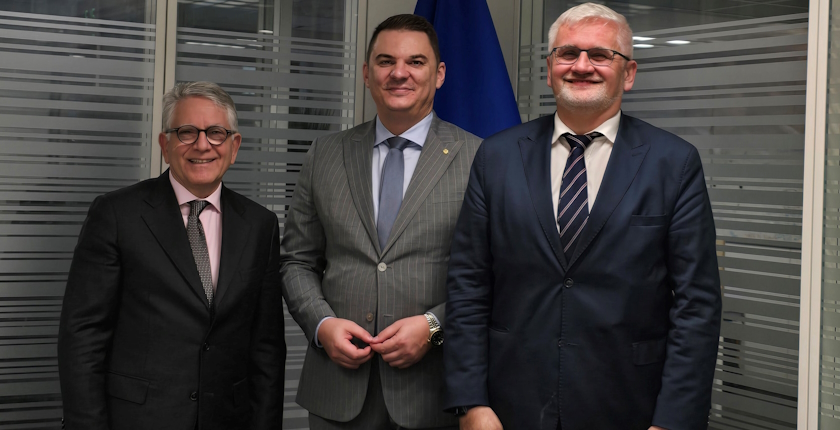
Minister of Energy and Mining of Montenegro Admir Šahmanović met with several senior officials of the European Commission. The messages in Brussels regarding the Carbon Border Adjustment Mechanism (CBAM) were encouraging – changes in the regulation are being considered, including Montenegro’s demands, according to the ministry.

Minister of Energy and Mining of Montenegro Admir Šahmanović led a delegation that visited the European Commission’s headquarters. They met with Director General for Taxation and Customs Union Thomas Gerassimos, Deputy Director-General for Climate Action Jan Dusík and Director for Western Balkans Valentina Superti and Head of the Unit for Bosnia and Herzegovina and Montenegro Barbara Jésus-Gimeno, both from the Directorate-General for Enlargement and Eastern Neighbourhood.

The focus of the discussions was on key processes in the energy sector and especially on the Carbon Border Adjustment Mechanism (CBAM), which is currently Montenegro’s main priority, the ministry said. Šahmanović presented the reforms that the country conducted and stressed that the government is almost entirely aligned with its European requirements in the legal and strategic sense.

CBAM is now Montenegro’s priority

Over the last eight months, Montenegro adopted a new Law on Energy alongside dozens of bylaws, including some tied to the Law on the Use of Energy from Renewable Sources. The government launched the first renewable energy auction, for solar power, and signed a memorandum of understanding on market coupling with Italy, with which talks continue on the construction of the second wire in the undersea cable. Laws on cross-border energy exchange and the construction of cross-border energy assets are drafted, the update adds.

The minister said Montenegro is finalizing its National Energy and Climate Plan.

More flexible models for CBAM to be considered

The European Commission’s representatives acknowledged Montenegro’s progress and asserted that it is in the lead in the region as concerns the degree of compliance in the energy sphere, the ministry said.

“Within the same context it was agreed that discussions would be continued on a technical level in the following weeks to consider the possible, more flexible models of applying CBAM and to enable candidate states to adjust to the mechanism faster and more efficiently. A special focus will be on the elaboration of compromise solutions – especially the ones that enable a gradual, just and predictable implementation, with a minimal burden on the Montenegrin energy sector, which is significantly reliant on electricity exports,” the update reads.

EU’s cross-border tax on greenhouse gases to have weaker impact than in earlier projections

The European Commission conveyed encouraging messages: a smaller impact from CBAM is expected than in earlier projections, and amendments to the regulation are being considered, including demands from Montenegro from the consultations, according to the ministry.

Minister Šahmanović said Montenegro is remaining fully dedicated to its European obligations, but that it expects an acknowledgment of the results that it achieved, so that the implementation of CBAM is harmonized with the realities of the country’s energy system and its strong renewables investment cycle.

by in News

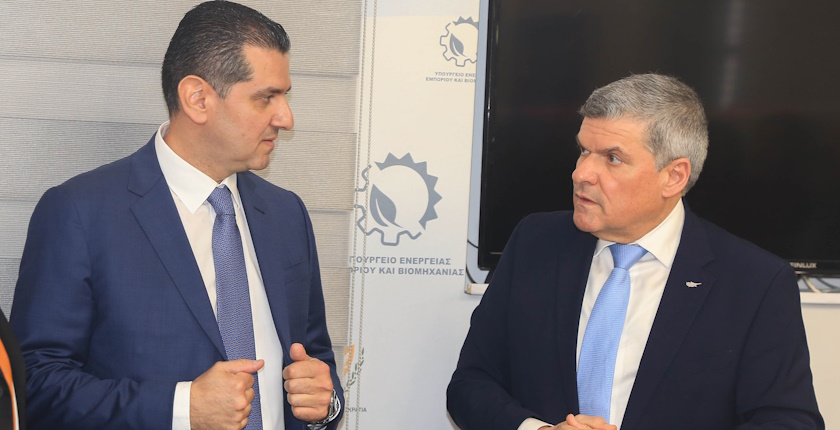
New Cypriot Minister of Energy, Commerce and Industry Michael Damianos takes office

A careful and organized course is required to achieve the energy transition in Cyprus, support the industry and strengthen the economy, ensuring sustainable solutions for the country’s energy future, new Minister of Energy, Commerce and Industry Michael Damianos said. He took over from his predecessor George Papanastasiou.

Five ministers were replaced in a cabinet reshuffle under President of Cyprus Nikos Christodoulides. Among them, the now former Minister of Health Michael Damianos took helm of the Minister of Energy, Commerce and Industry from George Papanastasiou.

Cyprus is assuming the presidency of the Council of the European Union on January 1 for six months. It means Damianos will chair the meetings of ministers responsible for the sectors in his portfolio, like the so-called Energy Council.

“We will work with innovation, excellence and sustainability in mind, to ensure that Cyprus continues to move in a direction that will serve the common good and future generations,” the new minister said at the handover ceremony.

Realistic, measurable goals for tangible results for all citizens

A careful and organized course is required to achieve the energy transition in Cyprus, support the industry and strengthen the economy, ensuring sustainable solutions for the country’s energy future, according to Damianos. He highlighted the importance of setting “realistic and measurable goals” to bring tangible results for all citizens.

Papanastasiou’s departure could be a signal from Nicosia about the fate of the Greece-Cyprus-Israel subsea power link

Some media is speculating that the switch is a signal from Cyprus about the embattled Great Sea Interconnector, a proposed underwater cable that would link Greece, via Crete, with Cyprus and Israel. Papanastasiou was apparently one of the few ardent supporters of the project in the country’s government.

The investment remains stuck over expenses and threats from Turkey.

University of Cambridge alum

Damianos studied law at the University of Southampton, from where he graduated with honours and received the best academic performance award. He earned a master of laws degree at the University of Cambridge, specializing in international law. The minister has received the best academic performance award from the Fitzwilliam College of the University of Cambridge.

The minister holds the professional title of a solicitor, granted by the Supreme Court of England and Wales. Damianos worked at the international law firms Simmons and Simmons and Hogan Lovells in London, specializing in corporate, commercial and energy matters.

In 2010 in Cyprus, he founded a law firm that bears his name. Damianos served as a municipal councillor in Strovolos Municipality from 2011 to 2016. Since 2018, he has been the vice president of the Democratic Party (DIKO).

Damianos became the minister of health in January 2024.

by in News

Greece’s first municipal energy community to be launched in its coal capital Kozani

The city of Kozani in northern Greece, home of the country’s dwindling lignite industry, is seeking a contractor for seven photovoltaic systems of 7 MW overall. The municipality said the power plants would supply its buildings, public lighting, pumps and drilling rigs as part of the country’s first energy community led by a local authority. Under a virtual net metering scheme, the facilities are also intended for combating energy poverty.

Energy communities are present all over Greece, but private capital is dominant – instead of individuals, local institutions and small firms. The concept can be especially beneficial for local authorities in coal regions, which are undergoing rapid decarbonization and turning toward cutting-edge technologies.

Job losses and a lack of skills jeopardize communities in such areas. The Municipality of Kozani, the capital of Greece’s coal land, the region of Western Macedonia, is one of them. It was among the first in the country that launched initiatives for energy communities led by local authorities.

Deadline for applications is January 12

Kozani has opened a tender for the selection of a contractor that would build seven photovoltaic plants. The municipal solar power units would operate under a virtual net metering scheme.

It would enable supplying municipal buildings, street lighting, schools, sports facilities, pumps and drilling rigs, but also the means to fight against energy poverty. The municipality received funding via the European Union for the project, under a just development and transition program.

The city claimed that it would be the country’s first energy community of its kind. Prospective candidates can apply by January 12, and the selection is scheduled for January 16. The budget amounts to EUR 6.25 million including value-added tax, and the local authority participates with 20%.

Kozani already invested EUR 650,000 in its energy community

The project is placing the Municipality of Kozani in the lead in energy self-sufficiency and autonomy in the country, Mayor Yiannis Kokkaliaris said.

He revealed that the local authority managed to secure grid connection terms in time not to lose the EUR 650,000 that it spent so far for the purpose.

The Kozani area is already hosting some of Greece’s largest photovoltaic plants and projects. It is envisaged for one of six waste incinerators in the country. Government-controlled Public Power Corp. (PPC Group) plans to build pumped storage hydropower plants on its depleted open pit coal mines in the region.

Of note, Greece recently lost EUR 100 million from the European Union’s Recovery and Resilience Facility (RRF) for the Apollo program. It was aimed for self-consumption for vulnerable households through forming an energy community.

by in News

Serbia rolls out taxes on greenhouse gas emissions, imported carbon-intensive products

The Serbian Law on Greenhouse Gas Emissions Tax and Law on Carbon-Intensive Product Imports Tax, both at EUR 4 per ton of CO2 equivalent, are coming into effect on January 1. It is the country’s answer to and equivalent of, respectively, the European Union’s Carbon Border Adjustment Mechanism (CBAM). Notably, several bylaws are still required for the new legislation to be enforced.

The National Assembly of Serbia passed the Law on Greenhouse Gas Emissions Tax and Law on Carbon-Intensive Product Imports Tax today, without accepting any of the opposition’s proposals for changes in the two bills.

On January 1, importers of electricity, cement, iron and steel, aluminum, hydrogen and fertilizers to the European Union will start paying the CBAM carbon dioxide tax. If the country of origin also has a CO2 pricing system and the EU recognizes it, the sum will be deducted from CBAM.

The domestic greenhouse gas emissions tax is Serbia’s answer to the cross-border levy, while with the new import tax it is establishing a corresponding mechanism. Both are EUR 4 per ton of CO2 equivalent, covering also nitrous oxide (N2O) and perfluorocarbons (PFCs).

They are intended to lower pollution, improve energy efficiency, incentivize the deployment of renewable energy and secure a more equal position for the Serbian industry in the domestic and international markets, according to the sidenotes.

Both laws to enter into force on January 1, when EU also starts charging CBAM

The first of the two taxes is for big industrial emitters in the sectors of cement, fertilizers, iron and steel, aluminum and electricity. Both laws are coming into effect on January 1, just like the CBAM charge. However, several bylaws are still required for Serbia to enforce the new legislation.

The CBAM tax is envisaged to rise every year until in 2034 it becomes equal as the prices of greenhouse gas emission certificates in the EU’s Emissions Trading System (EU ETS). Electricity is different, as the amount will from the start correspond to the carbon intensity of the country of origin’s entire production mix.

According to Special Advisor at Serbia’s Economics Institute Ljubo Maćić, charging CBAM will prevent power market coupling between Serbia, other Energy Community contracting parties and the European Union, and discourage investment in renewables.

Of note, the administration in Brussels plans to expand the mechanism to other segments that EU ETS covers.

No electricity in carbon imports tax

The Law on Carbon-Intensive Product Imports Tax doesn’t cover electricity because of technical limitations and a lack of a precise taxing methodology.

The tax on imported carbon-intensive products covers only the entities that import five or more tons of the designated products per year

Importers are taxed based on emissions embedded in the production of the goods from abroad, but they will be able to use tax credits if an emissions levy has already been paid in the country of origin, similar to the EU system. The obligation is only for companies importing five or more tons of designated products per year.

Serbia imports an estimated 3.5 million tons of carbon-intensive products per year.

CO2 tax scope limited to larger producers

The CO2 tax law will be applied to firms obligated to have a license for emissions from their plants. Mostly they are large and medium-sized companies. Fifty companies have obtained such licenses for 92 facilities. They measure emissions data, in line with the Law on Climate Change, and send them to the Ministry of Environmental Protection.

The production of synthetic fertilizers and nitrogen compounds, cement, pig iron, steel and ferroalloys, aluminum and electricity accounts for over 57% of emissions in Serbia and more than 90% within the national monitoring and reporting system.

Tax deductions for large electricity producers that invest in decarbonization

A payer of the greenhouse emissions tax that predominantly generates electricity, accounting for at least 80% of its income in the previous annual tax period, is eligible for a tax credit amounting to 20% of the sum that it invested in decarbonization measures, the law stipulated.

The deduction can’t exceed 80% of the due tax. The government determines the said measures.

The greenhouse gas emissions tax envisages incentives for the taxpayers to finance green projects, the just transition and protection of vulnerable households

In addition, entities that pay the tax are eligible for incentives, from the state budget, for financing climate and energy transformation through investing in renewables and energy efficiency, innovative low-carbon technologies, decarbonization of industrial production, green construction and support to the just transition and protection of vulnerable households.

Proceeds from the tax “can be invested in green transition projects,” the sidenote reads, while there is still no dedicated decarbonization fund.

by in News

Quota surpassed at Romania’s bonus wind power auction

Romania apparently achieved moderately lower prices at its additional wind power auction for contracts for difference (CfDs) than in the regular round. According to a media report, nine bids were approved, for seven proposed facilities, and the winners include OX2, Qair and Zen Energy Group.

All wind farm projects in Romania that obtained the right to state support at the latest renewable electricity auction need to be completed by 2028. The Ministry of Energy and transmission system operator Transelectrica have approved 315.8 MW, compared to the targeted minimum of 290 MW, Economica.net learned.

The bonus round was organized because of a weak turnout in the regular, second wind power auction. Winners are eligible for 15-year CfDs, in a EUR 3 billion scheme covered via the European Union’s Modernisation Fund.

According to the report, the prices were also more favorable for the government than in the previous auction: between EUR 59.95 per MWh and EUR 74.9 per MWh, against EUR 65.17 per MWh to EUR 79.5 per MWh. The ceiling was the same, EUR 80 per MWh.

Cheapest two lots are part of same project

Naxxar Wind Energy Project Zenon won two lots, at 64.8 MW each, for the same project – Tudor Vladimirescu in Brăila county, northeast of Bucharest. The strike prices are EUR 59.95 per MWh and EUR 61.05 per MWh.

Owners of the special purpose vehicle are Renewable Investors and Kaizer Gerhard, an individual, both from Germany.

Aukera Project Company Beta has won a CfD contract for 27.2 MW in the proposed Făurei wind farm. The price is EUR 67.12 per MWh. It is owned by AtlasInvest, headquartered in Belgium.

In Romania, it is working on the projects for the Delesti wind farm in Vaslui county and the Gura Ialomiței storage facility in Ialomița. The battery would have 250 MW in operating power and a capacity of 500 MWh.

The first phase, of 300 MWh, is under construction. The company obtained a EUR 9.9 million grant last year through the National Recovery and Resilience Plan (NRRP or, in Romanian, PNRR) and signed a loan facility of EUR 60 million with Kommunalkredit Austria for the storage system.

OX2 wins CfDs for additional capacity for its future wind farms

Brăila Green Energy qualified for 12.4 MW of its Urleasca wind power project, at EUR 69.86 per MWh. The firm is controlled by OX2, which already won a CfD for a part of the same future facility.

The Sweden-based company also snatched 25.6 MW for its Cerchezu project. It is another winner from the previous round. This time, the South Wind subsidiary secured a contract at EUR 74.49 per MWh.

Clever Power has obtained 21 MW and 14 MW by bidding EUR 69.88 per MWh and EUR 72.92 per MWh, respectively. Both lots are for the same project: Falciu wind farm, envisaged to include storage. The company is controlled by Romanian investor Barbu Cristian, the article adds, citing a businesses registry.

AZ Market Construction won just 8 MW for its Bordei Verde wind project. It is eligible for EUR 74.74 per MWh. The firm is owned by France-based Qair.

Traian Energy, a subsidiary of Zen Energy Group from Luxembourg, is getting the highest price from the bonus round. The wind park would receive EUR 74.9 per MWh for the entire 78 MW.

by in News

Wpd obtains wind power approvals in Greece for 225 MW

Wpd has won environmental approvals for a wind power project of 147.6 MW in Central Greece and one for 77 MW in Thrace, in the country’s northeast.

Some of Germany-based wpd’s wind power investments in Southeastern Europe are struggling with delays and controversies – like in Montenegro and Bulgaria, but it is gaining speed in Greece. Right after its subsidiary WPD Wind Energy 2 obtained environmental terms (AEPO) from the Ministry of Environment and Energy in Athens for a 77 MW facility in Boeotia (Viotia), WPD Wind Energy 1 reached the same milestone for a future 147.6 MW wind park near Alexandroupolis, Newmoney reported.

The latter project didn’t go smoothly. It went through numerous changes due to fire and bird protection issues. Nevertheless, the Natural Environment and Climate Change Agency issued a negative opinion a month ago.

Wpd is planning to install 26 wind turbines in Fera in the municipality of Alexandroupolis and in Soufli in neighboring Tychero. The sites, Kato Limnes, Makrylofos, Voskotopos and Kounia, are in the region of Eastern Macedonia and Thrace.

The German renewables developer has more than halved the planned number of turbines in Thrace while the capacity would be virtually the same

The initial design was for 59 units of 2.5 MW each. The developer eventually switched to 21 turbines of 6 MW, two of 4.5 MW and three of 4.2 MW, of which one would be limited to 4.1 MW. They would all be of the Vestas V150 type.

Road construction works would cover 45 kilometers, but including improvements to existing roads in the length of 42 kilometers. The project involves the construction of two 150/33 kV substations and underground cables of 40.5 kilometers for 33 kV and 7.7 kilometers for 150 kV power lines.

The 77 MW wind power project is for the locations of Megali Rachi, Kroniza and Kanavari in the Aliartos-Thespies municipality, in the central part of Greece. The facility would consist of 11 Siemens Gamesa turbines.

Wpd entered the Greek renewable energy market in 2020 and has since been developing wind and photovoltaic projects. It is also active in Croatia, Romania, North Macedonia and Bosnia and Herzegovina.

by in News

GGF’s new partnership powering sustainability of SMEs in Turkey

The Green for Growth Fund (GGF) has partnered with ING Leasing Türkiye, a subsidiary of ING Türkiye, through a EUR 20 million financing agreement to help small and medium-sized enterprises (SMEs) invest in cleaner, smarter, and more efficient technologies, from energy-efficient equipment and machinery upgrades to self-consumption photovoltaic systems and other low-carbon solutions.

GGF’s first collaboration with ING Leasing Türkiye is marking the start of a new strategic relationship. In addition, it is ING Leasing’s first direct access to international development financing supported by funding from international financial institutions and development finance institutions through the Green for Growth Fund, the update adds.

The deal is expected to deliver around 21,000 MWh of primary energy savings and avoid approximately 5,800 tonnes of CO₂ emissions each year, according to GGF.

The signing was attended by Onur Gul, General Manager of ING Leasing Türkiye, and Pınar Cumalı, Treasury and Financial Institutions Manager at ING Leasing Türkiye, alongside, representing GGF through its advisor Finance in Motion, the company’s Regional Director Burcu Karpuz and Investment Associate Mehmet Sena Bakar.

Luxembourg-based GGF has become one of the largest green blended-finance funds. It ended last year with EUR 1.09 billion in assets under management and an outstanding investment portfolio of EUR 1.03 billion.

by in News

Turkey earns EUR 84.8 million upfront from solar power auction

Investors in photovoltaic projects were mostly willing to pay large sums at Turkey’s latest YEKA auction to secure a minimum guaranteed price for five years, followed by 20-year power purchase agreements. The government earned EUR 84.8 million overall from the secondary bidding for 650 MW, split into six areas. One zone is for a floating solar power plant.

According to Turkey’s Minister of Energy and Natural Resources Alparslan Bayraktar, domestic electricity demand is on a trajectory to triple to 1.05 PWh in the next 30 years. It follows an almost threefold jump of the last two decades, while natural gas is rising even faster, he pointed out.

The minister has urged investors to keep up the momentum, noting that the national goal for 2035 for solar and wind power is 120 GW in total.

One of the pillars of the government’s measures to incentivize such endeavors are renewable energy auctions. Notably, the obligatory domestic content rates are high, to boost manufacturing in the sector.

The latest solar power auction under the Renewable Energy Zones (REZ) state support mechanism even brought substantial earnings for Turkey, for the second time. The bidding was initiated at the ceiling price, EUR 55 per MWh, and when the floor level was reached at EUR 32.5 per MWh, the remaining competitors were switched to another auction.

They offered so-called contribution shares, starting at a stunning 10,000 per MW of planned connection capacity. The quota for the REZ SPP 2025 (YEKA GES 2025) round was 650 MW, split into eight zones. Two zones were taken off the table after the call, due to delays in permitting.

Highest fee was EUR 285,000 per MW

In total, Turkey cashed in EUR 84.8 million or EUR 130,400 per MW of connection capacity, excluding value-added tax.

The Eskişehir zone, 260 MW, went for EUR 105,000 per MW to Efor Holding. The company was successful at the previous wind power auction as well, early this year.

Stone Enerji won the Erzurum 1 segment, of 100 MW, by pledging EUR 100,000 per MW. Sertaş Turizm took Erzurum 3, at 85 MW, for EUR 120,000 per MW.

The Ministry of Energy and Natural Resources included a floating solar power plant project for the first time

The 50 MW Bolu zone went to Ecogreen Enerji. The company is paying 44,000 per MW, the least of all winners.

Kahramanmaraş, of 40 MW, was awarded to Güçlü GES Enerji. It pledged EUR 285,000 per MW, which was the highest contribution fee. Aydede Enerji has obtained the Mardin zone for EUR 208,000 per MW while Zincir GES Enerji managed to win the Van solar power project for EUR 187,000 per MW. Both are for 40 MW.

The auction also featured the first zone for a floating solar power plant. Demirköprü Yüzer GES in Manisa province, for 35 MW, was taken by a firm with the same name. It is paying EUR 225,000 per MW, the ministry has revealed.

Solar power auction facilitates USD 400 million in investments

There were 77 applications altogether, from 38 companies.

The winners will be able to sell electricity on the free market for five years. However, they are guaranteed at least their contracted price, which in all cases is the floor price – EUR 32.5 per MWh. The second period, 20 years, is with a power purchase agreement.

Bayraktar estimated that the solar power auction facilitated investments worth a combined USD 400 million. The projected annual output is equivalent to the electricity needs of half a million households.

The minister pointed out that 8 GW of solar and wind power would come online this year in total. The combined capacity on the grid from the two technologies amounts to some 39 GW out of 121 GW overall.

Also of note, the Energy Storage Industries Association (EDEDER) has forecasted that 1.5 GWh of storage capacity would be commissioned next year in Turkey.