by in News

Nofar Energy commissions Serbia’s largest solar park

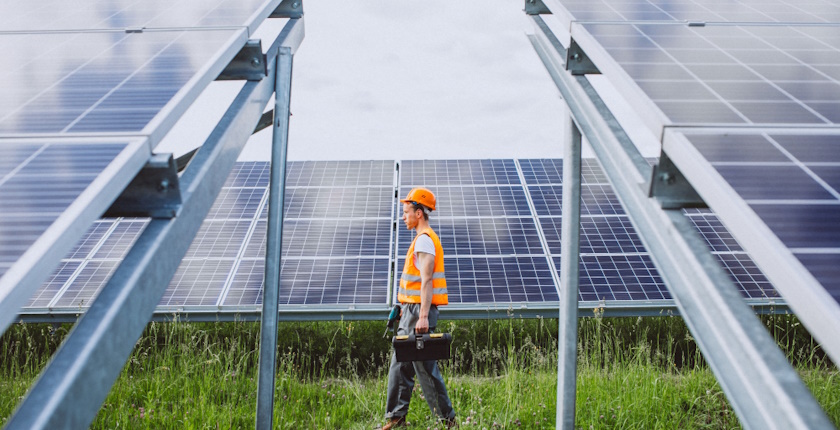
Israeli company Nofar Energy said its photovoltaic park in northern Serbia of 27 MW in peak capacity began delivering electricity to the grid. The project consists of two adjacent units, Ada1 and Ada2, connected to the distribution grid.

After installing Romania’s largest solar power plant in a partnership, Nofar Energy now operates the largest photovoltaic park in Serbia as well. The Israel-based company, which nine months ago started building it the municipality of Ada in the country’s north, said the facility is online.

Notably, the solar park at the Utrine site consists of two units, Ada1 and Ada2. They have connection points of just under 10 MW each and operate within Serbia’s power distribution network. There is no PV system yet on the Balkan country’s transmission grid.

Project is worth EUR 25 million

The solar park spans 30 hectares on a 116-hectare plot, planned for the solar park’s expansion. Nofar Energy has launched the projects, worth EUR 25 million in total, via its subsidiaries Forest Energy and Energia Solis. The company estimated annual output at 33.2 GWh.

Turkish company Girişim Elektrik is the contractor.

Nofar Energy said its portfolio of operational and projects under construction amounts to 2.4 GW of solar power and 1.2 GWh of energy storage. The company secured an overall EUR 110 million loan in August in Romania for PV plants Ghimpați, which it started building in the meantime, and Iepurești. The two locations in the Iepurești area in Giurgiu county are envisaged for a combined 315 MW in peak capacity.

Serbia planning to add 177 MW in connection capacity through auction mechanism, 1 GW within strategic partnership

The Ministry of Mining and Energy of Serbia said in November that the country hosted 166 MW in solar power capacity. Last month, at its second round of wind and solar power auctions, it allocated the entire PV quota of 124.8 MW in grid connection capacity. The five winning projects are for 176.7 MW overall, also in alternating current or AC. They get contracts for difference (CfDs) and power purchase agreements (PPAs).

A strategic partnership is underway with Hyundai Engineering and UGT Renewables for a group of solar power plants of 1.2 GW in overall peak capacity. It translates to 1 GW in transmission grid terms. The companies are also tasked with installing battery energy storage systems with at least 200 MW in combined capability and a maximum of 400 MWh in capacity.

by in News

EDP Renewables inaugurates two wind power plants in Greece

EDP Renewables declared its two new wind farms in Central Greece and Thessaly open, adding almost 70 MW to the transmission grid. The country expanded its wind power capacity by only 125 MW last year.

EDP and its subsidiary EDP Renewables held an inauguration ceremony for two wind parks in Greece. It secured government support for both in 2019 at renewable energy auctions, through 20-year contracts for difference (CfD). At the time, the Portugal-based utility expected to begin commercial operations in 2022.

The two facilities have almost 70 MW in combined capacity connected to the transmission grid. The expected annual output is 143 GWh. It is equivalent to the electricity needs of more than 37,000 Greek households. EDP Renewables estimated carbon dioxide emissions savings to be over 102,000 tons per year.

Greece increased its wind power capacity by only 125 MW last year.

EDP Renewables relies on 20-year CfDs in its wind power investments in Greece

The event was held at the Xironomi site in Boeotia (also Beotia and Viotia) in the region of Central Greece. The wind farm has a capacity of 36 MW and the CfD is for 33 MW.

The other facility is Chalcodonio. It is located in the Magnesia regional unit in Thessaly. The 33.6 MW wind farm project has won a 30 MW contract for difference.

“Greece is emerging as a regional leader in renewable energy, as its abundant wind and solar resources offer enormous potential. The country’s commitment to reduce carbon emissions by 55% by 2030, in line with EU targets, makes it an attractive market for clean energy investments,” said Country Manager of EDP Renewables Dionysios Andronas.

Company has four facilities online

The company has 150 MW online in Greece in four wind parks, positioning it among the top 10 operators in the segment, according to the announcement.

Last year EDP Renewables commissioned its Erimia wind power plant of 35 MW and an estimated annual production of 71 GWh. It entered the Greek market in 2018 with two 20-year CfDs.

The company later reached an agreement with infrastructure group Ellaktor for the joint development of onshore wind projects.

EDP plans 3 GW of renewable energy capacity per year, focusing on wind and solar power as well as energy storage. In its business plan for the period 2023-2026, the company earmarked EUR 12 billion for investments on a global scale.

by in News

Race against time for Greece to avoid a blackout on Easter

Greek authorities are rushing to secure the electricity system against a possible blackout during Easter.

Greece currently produces much more electricity than it needs on certain days due to a high renewables penetration and insufficient energy storage. It should be noted that in 2024 the country became a net power exporter for the first time after two decades. Usually, extra power is no problem, as it is exported and curtailments ensure nominal system operation with no danger of a blackout.

However, this year there will be days when low demand combined with high renewable electricity production creates a problem. At Easter, demand traditionally craters.

Independent Power Transmission Operator (IPTO or Admie) estimates that on Easter Sunday the country’s interconnections would operate near their maximum safety limits. If even a single line goes offline, it would lead to a domino effect and the possible loss of all the connections with neighboring countries. As a result, the frequency will rise beyond safe limits in the Greek system, triggering the desynchronization of power plants and a blackout.

To avoid such a scenario, authorities have imposed adding telemetry systems in recent months to photovoltaic units of over 400 kW connected to the distribution network. Currently, the Hellenic Electricity Distribution Network Operator (HEDNO or DEDDIE) can curtail 1.9 GW of solar power capacity, but another 6 GW is unswitchable.

Telemetry must be enabled by April in small PV units

A deadline was given until February 13 to the owners within the latter category to add telemetry equipment so that HEDNO can curtail their production when needed. However, very few complied and the rest said they are still waiting for the systems to be delivered.

HEDNO estimates that 5,700 plants with capacities of 400 kW to 1 MW must be added to curtailments, as well as 600 plants with more than 1 MW apiece.

Based on the above, owners of solar power units and the two grid operators must add the ability by April to ensure system stability.

Gradual installation of energy storage facilities is expected to help significantly and bring curtailments down.

by in News

Terna Energy to build solar power plant of 130 MW in Bulgaria

Terna Energy is developing a project for a 130 MW photovoltaic plant near Burgas in Bulgaria. The company, owned by Masdar, plans to connect it to the grid already by the end of next year. Recently it also reached landmark points in the development of wind power projects in Greece.

Abu Dhabi Future Energy Co. (Masdar), which has high ambitions for its expansion in Southeastern Europe, relies to a great extent on its recently acquired subsidiary Terna Energy. The Greek company revealed that it is preparing to install a 130 MW solar park near the village of Vratitsa in eastern Bulgaria.

The project in the municipality of Kameno in Burgas province includes design and procurement, as well as grid connection works including a new 33/110 kV substation. Terna Energy Group said it is targeting completion by the end of 2026.

As part of the strategic cooperation with the former parent company, GEK Terna, its construction arm Terna SA was selected as the contractor, the announcement reads.

Terna Energy operates two wind farms in Bulgaria, with 30 MW in overall capacity.

With its recent share purchases, Masdar boosted its stake in the Greek company to 97.6% from 87.9%. The green energy giant based in the United Arab Emirates acquired Terna Energy last year.

Wind power projects in Evia progressing

In other recent news, Terna Energy received operating licenses for four projects for a wind power complex. The sites are in Karystos in Greece’s second largest island – Evia, also known as Euboea. It is one of the country’s wind power hubs and an important area for the company.

The Terna Energy Omalies subsidiary is responsible for the said investments, of 78 MW in total. They are part of an endeavor consisting of 11 wind farms.

The location for the biggest of the four, at 36 MW and with 12 turbines, is called Praro. The company ordered 3 MW machines from Enercon for all the sites. Molizeza 1 and Kalamaki 2 are for 18 MW each, and Kalamaki would have 6 MW.

Joint venture with MORE for Greece’s first offshore wind farm

Of note, the construction of wind parks in the Balkans has mostly slowed down. Moreover, Bulgaria has been at a standstill since the first wave of investments died down more than a decade ago, while Romania is struggling to pick up pace. Greece added only 125 MW last year.

Terna Energy is counting on opportunities in the offshore wind domain. In January, it joined forces with Greek refiner Motor Oil in the pilot project for the country’s first facility of the kind.

Motor Oil Renewable Energy (MORE) now holds 50% of joint venture Aioliki Provata Traianoupoleos. The project firm is tasked with developing a 400 MW offshore wind power plant on the Ionnian Sea between Alexandroupolis and the island of Samothrace. The two companies aim to complete it by the end of the decade.

by in News

PPC begins construction of 165 MW solar farm with BESS in Bulgaria

PPC Group is accelerating its expansion in the Balkans by laying the foundation stone for its Colosseum solar power project in Bulgaria. The facility will have 165 MW in peak capacity and include a battery energy storage system (BESS), the Greek state-controlled utility revealed. The company’s investment plan includes Italy, where it recently commissioned the first two solar parks.

Public Power Corp. – PPC Group said it commenced the construction of a photovoltaic plant in Stara Zagora in central Bulgaria. The project involves 260,000 bifacial solar panels with an expected annual power generation of more than 265 GWh. It is one of the biggest investments abroad for Greece’s government-controlled utility, which is expanding in Southeastern Europe and beyond.

The Colosseum solar park will have 165 MW in peak capacity and include a BESS facility of 25 MW in operating power and a capacity of 55 MWh. The liquid-cooled lithium iron phosphate (LFP) batteries will support the operation of the photovoltaic plant and contribute to the stability of the electricity system, the company added.

A 33/110 kV substation will be built on the site, the announcement reads. The solar power plant’s estimated output is equivalent to the electricity needs of more than 45,000 Bulgarian households.

PPC has 550 MW in project pipeline in Bulgaria

PPC Group runs an 18 MW wind farm called Garda in the country and another 550 MW in its renewables project pipeline. The company’s overall online green energy capacity is 5.5 GW.

According to its three-year strategic plan, by 2027, PPC Group will develop another 6.3 GW of renewables in Greece and the region. It revealed that more than 60% is under construction or ready for construction.

First PV units from strategic deal with Metlen in Italy came online in December

In December, PPC Group said it launched the operation of photovoltaic plants Carcarello and Luxenia, its first two facilities in Italy. They have 20 MW and 12 MW, respectively, in peak capacity. It translates to over 60 GWh of electricity per year in total from the two solar power units in central Italy.

The production can meet the demand of almost 15,000 households. The contractor for Carcarello and Luxenia was Metlen, formerly known as Mytilineos. The projects are part of a region-wide strategic agreement for photovoltaics, for 2 GW. Another 160 MW of PV capacity is under construction in the country.

Greek state-controlled power utility is largest renewables producer in Romania

PPC Group is the largest renewable energy producer in Romania, operating 25 wind, photovoltaic and hydroelectric facilities as well as battery storage units.

Its subsidiary Reţele Electrice România invested EUR 240 million last year in the expansion and modernization of its electricity distribution network. The firm plans to increase the number of smart meters in the three regions that it serves to two million by the end of 2025.

Gas-hydrogen CHP plant in Kardia to be completed by end-2026

As for its home market, the Greek utility said in January that it started the construction of a high-efficiency combined heat and power (CHP) plant. The future gas facility of 17 units is within the site of the former Kardia coal-fired power plant in the Western Macedonia province.

The company expects to complete the EUR 80 million cogeneration investment by the end of next year. According to earlier updates, the facility will have 105.3 MW in power capacity and 66.5 MW for thermal energy.

The project envisages the use of a mixture of fossil gas and hydrogen. The group is building another gas plant in Alexandroupolis.

by in News

Eurowind Energy signs virtual PPA in Romania with automotive manufacturer

Denmark-based Eurowind Energy signed a 12-year virtual power purchase agreement (PPA) with Autoliv in Romania, for the supply of electricity from the Pecineaga wind park. The automotive manufacturer headquartered in Stockholm also signed one such deal for a solar park in Finland.

The strongest wind turbines in Romania will generate electricity for Autoliv, which makes safety systems for vehicles including airbags and seatbelts, as well as steering wheels and other components. Eurowind Energy will supply the energy from its Pecineaga wind power plant for 12 years under a virtual PPA. In addition, the Swedish automotive manufacturer has another new contract in Finland.

Eurowind Energy recently completed the construction of all eight SG 6.6-170 turbines at the site in Northern Dobruja (Dobrogea in Romanian). However, the 48 MW wind farm is expected to become operational by 2027, according to an update from Autoliv.

PPAs essential for project development for Eurowind Energy

Estimated annual output is 176 GWh, equivalent to the electricity needs of 48,000 Romanian households. The investment is worth EUR 79 million. Eurowind Energy, based in Hobro, Denmark, is one of the biggest wind and solar power developers in Romania.

The company is also a partner in the construction of a giant photovoltaic plant in Bulgaria. The Tenevo facility is planned to be combined with a future wind park and a battery energy storage system into a hybrid power plant.

“PPAs are essential in developing new energy parks. Power purchase agreements with large, ambitious companies like Autoliv ensure the continuous development of new parks and a cleaner future for all of us,” Commercial Director Jesper Schaumburg-Düring said. Eurowind Energy is 50% owned by EWE Holding while Norlys Holding controls the other half.

Autoliv is combining wind with solar in different countries to optimize electricity production

Autoliv’s other new virtual PPA, also for 12 years, is with Alight, for a proposed solar power plant of 100 MW in peak capacity. The two deals are important for ensuring a consistent and reasonably priced energy supply for the manufacturer’s activities in Europe, reducing the risks associated with potential future energy price fluctuations, the announcement reads.

“The innovative approach of combining solar and wind technologies ensures optimal energy generation during both day and night. This approach and the fact that the facilities are located in two different European countries provides flexibility in Autoliv’s physical operations and electricity procurement,” the company added.

The PV park in Eurajoki, Finland is supposed to come online in 2026. Autoliv revealed that it intends to “contract a majority of the clean electricity produced.” Construction is set to start during the spring, the statement adds.

“Through these initiatives, we support our ability to supply customers seeking sustainable products and we take a significant step forward in achieving our climate targets for the European operations,” said Autoliv Europe’s President Magnus Jarlegren. The company aims to achieve carbon neutrality in own operations by 2030 and net zero emissions across the supply chain by 2040.

by in News

Bulgaria aims to make Europe’s biggest energy community

The Ministry of Energy, Electricity System Operator (ESO) and the Bulgarian Development Bank (BDB) are launching a solar power program for municipalities, schools, kindergartens, hospitals and small businesses. There are no upfront costs and the installations become the beneficiary’s ownership within eight years.

Minister Zhecho Stankov said the goal is to create the largest energy community in Europe and hinted that the government would finance the scheme with a green bond. He also declared the start of the regional Vertical Gas Corridor project in Bulgaria as the first pipes were delivered.

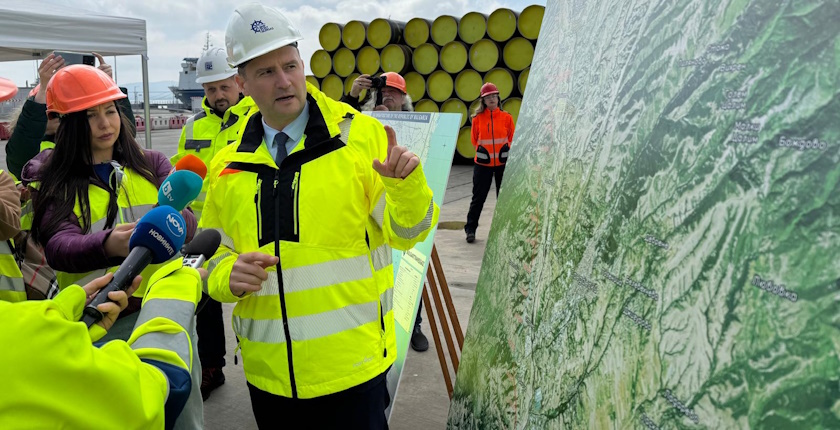
Every school and hospital in Bulgaria can become an electricity producer, Minister of Energy Zhecho Stankov stressed as he presented a financial support mechanism designed with the ambition to create the largest energy community in Europe. The model will benefit both the public sector and private business, he pointed out in the port city of Burgas at a ceremony marking the arrival of the first 4,000 pipes for the Bulgarian sections of the regional Vertical Gas Corridor.

The joint initiative with the country’s power transmission system operator ESO and the Bulgarian Development Bank is for the installation of solar panels with no upfront costs. Beneficiaries – municipalities, schools, kindergartens, hospitals and small businesses – would pay through energy savings and become owners in six to eight years, Stankov claimed.

Bulgaria mulls issuing green bond to finance sustainable energy

The minister also said the project could lead to the government’s first green bond to finance clean and locally produced energy available to a wide range of consumers.

For example, Burgas Municipality can equip all schools, hospitals, kindergartens and other facilities with photovoltaic panels without spending a penny from the local budget, Stankov explained.

Government to invest EUR 57 million in Vertical Gas Corridor

The Vertical Gas Corridor is envisaged to connect Greece, Bulgaria, Romania, Moldova and Ukraine. They plan to transport the fuel from liquefied natural gas (LNG) terminals Alexandroupolis and Revithoussa in Greece, and from the Caspian region, via the Southern Gas Corridor.

The government is fully funding the first stage of the project on Bulgarian territory, with EUR 57 million. The pipes for the pipelines came from India.

Stankov: Bulgaria will never again be left without natural gas

“Bulgaria will never again be left without natural gas,” said Minister Stankov. The capacity of the line between Kulata, on the border with Greece, and Kresna will be increased to 3.6 billion cubic meters per year from 2.3 billion, he added. The distance is 48.5 kilometers.

The most difficult part is between Mikrevo and Ribnik, where three kilometers will be built by horizontal drilling, the minister revealed. He explained there would be no aboveground work, so that nature and infrastructure wouldn’t be affected.

Another section, 80 kilometers, is from Rupcha to Vetrino. The purpose of the investment is to double the maximum annual flow toward Romania to 10 billion cubic meters, Stankov stressed. The last one, Tarnik-Piperovo, is 51 kilometers long.

The compressors on the corridor are reversible, allowing gas supply in both directions, the minister noted.

by in News

Number of prosumers in Romania spikes 79% in one year to 204,000

Prosumers in Romania operated 2.44 GW of capacity at the end of January or 63% more than one year before. Their number soared 79% to 203,984 and it is set to keep growing substantially with more government subsidies underway.

Once again, prosumers confirmed their role as the main pillar of Romania’s energy transition. Growth in the segment is fueled by government support, mostly through funds obtained via the European Union. The number of households, small firms and institutions with the status reached 203,984 by the end of January or a stunning 79% more than 12 months earlier. There were only 303 registered at the end of 2019!

Total capacity jumped 63% on an annual basis, to 2.44 GW, the National Energy Regulatory Authority (ANRE) said. Photovoltaic installations in Romania surged 57% last year, to 4.7 GW, according to the International Renewable Energy Agency (IRENA). It means prosumers still account for more than half.

The Environment Fund Administration (AFM) said it would propose a record EUR 442 million budget for the Casa Verde Fotovoltaice subsidy scheme for prosumers

The number of households was 180,617 two months ago, so roughly 2.4% are currently prosumers. They had 1.13 GW installed.

The remaining ones are legal entities, 23,277 of them, with 1.31 GW.

Most prosumers are in Ilfov county, almost 13,783, followed by Timiș (10,007) and Bihor (8,286).

The Environment Fund Administration (AFM) said it would propose a record EUR 442 million budget for Casa Verde Fotovoltaice. It is a subsidy program for the installation of solar panels, mostly for households. Last year the sum amounted to EUR 402 million.

This year the fund is introducing a scheme worth EUR 80.4 million for battery storage for prosumers. More than 66,000 candidates already applied for a maximum of EUR 6,000 per household for solar panels with storage systems.

President of the APCE association of prosumers and energy communities Dan Pîrșan said EUR 80.4 million for 2025-2026 enables one in four existing prosumers to install batteries and become almost energy independent.

by in News

Energy efficiency, renewables in rural communities in Serbia’s Zlatibor region

Author: Stevan Vujasinović

The population in rural areas in the municipalities of Priboj, Čajetina and Arilje in Serbia have been heavily affected for years with frequent and prolonged interruptions in electricity supply. The interruptions not only disturb everyday life but they also substantially hinder the development of family businesses, especially in tourism and agriculture. However, solutions do exist.

Regional Development Agency Zlatibor almost simultaneously marked World Energy Efficiency Day (March 5) and International Women’s Day (March 8) last week. On the occasion, it organized “energy discussions” with members of women’s associations in rural areas of these municipalities, and the main topics were energy efficiency and renewable energy sources for rural households.

The Zlatibor mountain is one of Serbia’s main tourist and skiing resorts. It partly spans the territories of Priboj, Čajetina and Arilje.

Energy needs and challenges in rural households

“We are without power for several hours at a time in the winter. It is not only discomfort, but a serious problem for heating and preserving food, and especially for us who have guests in rural tourism”, said one of the participants at a discussion in Čajetina. The event gathered the members of the Čajetina Rural Women’s Association and Zlata association.

It became clear from the discussions that there is great interest in installing solar panels, among private households as well as hospitality facilities. However, the access to these technologies is often difficult because of high initial costs and complex procedures for obtaining subsidies, which despite growth in the available volume for the purpose still don’t meet all the existing demand.

High initial expenses and complex procedures for obtaining subsidies make the availability of solar panel installations more difficult

The problem is exacerbated by the fact that many houses in the villages were built illegally, making it more difficult to access energy efficiency subsidies. Besides, the calls are too often only accessible for the beneficiaries that already have initial capital to invest, while the village population often doesn’t know about them.

The Municipality of Čajetina acknowledges the significance of energy efficiency. Last year it issued a public call for cofunding energy efficiency measures in family houses and apartments. However, targeted support for users with the vulnerable energy buyer statuses still hasn’t been provided. Assistance could additionally improve the availability of these measures to the wider population, and in fact the very people who need help the most.

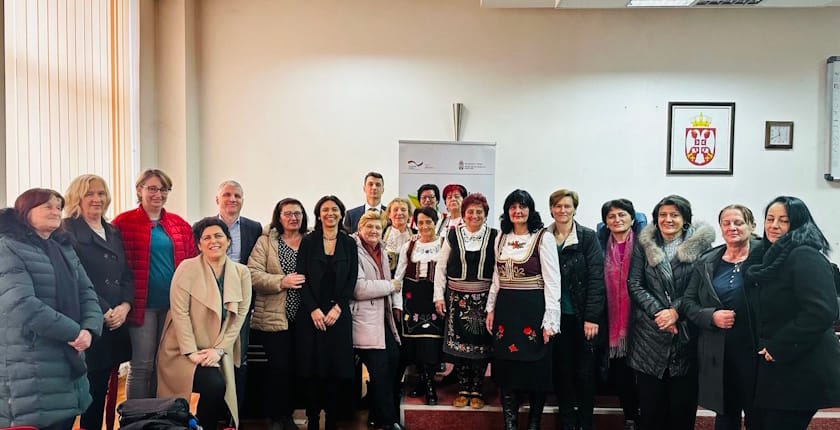
Photo: Members of the Čajetina Rural Women’s Association and Zlata association (Miloš Radojević)

Possibilities for using renewable energy sources

One of the key conclusions of the discussion was that solar panels and heat pumps can significantly improve the situation. Aleksandar Macura from RES Foundation pointed out that the law already enables households to produce their own energy and exchange it with state-owned power utility Elektroprivreda Srbije (EPS). “There are sufficient examples of good practice – around 2,500 households in Serbia already use rooftop power plants and work as buyers-producers,” Macura stated.

Buyers-producers are Serbia’s legal category for prosumers.

Nevertheless, solar panels still require initial investments of several thousand euros, which is an insurmountable obstacle for many. The participants in the discussion proposed solutions such as subsidized loans with delayed payment, in installments, to make the technology more accessible both to retirees and socially disadvantaged persons.

Assembling and energy communities

Another important aspect of the discussion was the possibility of establishing energy communities. In line with European regulations, Serbia is opening the space for joint production and use of solar energy within local communities.

It means any village council could install a solar power plant and distribute the energy among households. It would be especially useful for women running family businesses in agriculture and tourism, as it would provide them with a stable energy source without leaning on an unpredictable power distribution network.

Wood is traditional but inefficient energy source

Wood biomass usage still dominates in many rural households. Some said in Arilje: “Wood is irreplaceable” and “we believe in wood!” However, for people in villages, wood is almost never, even though it is the most accessible, never the most efficient solution for heating. It is partly because of moisture in the solid fuel, and mostly because of inefficient devices.

There are fewer and fewer people in the countryside, so it is getting more difficult and more expensive to timely obtain the wood felling and preparation service, even in one’s own forest. “We have been using wood for decades, but who today can afford quality dried wood? We often heat ourselves using wet wood, which only increases consumption and air pollution,” said one of the participants in an event in Arilje, describing her experience. It was attended by women from two associations: Sibirka and Ariljka.

Photo: Members of associations Sibirka and Ariljke (Miloš Radojević)

How to proceed?

It is clear that rural communities mustn’t be left behind in the energy transition process. Solar panels, energy communities and subsidies for more efficient heating are solutions that can bring concrete changes. However, the key to success lies in a greater accessibility of these solutions for all citizens, regardless of their financial situation or the place of residence.

Energy sustainability in rural communities is not just a matter of comfort but also of the survival and development of local communities. If we want villages to be vital and economically stable, it is necessary to facilitate a stable, sustainable and affordable energy source for them. Through smart investments, better subsidy organization and the development of energy communities it is possible to significantly improve the quality of life in these areas. In addition, additional training in the usage and maintenance of energy-efficient systems can contribute to a greater deployment of the technologies.

The energy discussions with the women of the Zlatibor county was organized within the project Improving the Use of Sustainable Energy in the Zlatibor region, financed by the German Organization for International Cooperation (GIZ) by order of the Government of the Federal Republic of Germany (Federal Ministry for Economic Cooperation and Development – BMZ).

by in News

Greek companies expand to Bulgaria with solar power investments

Greece’s government-controlled power utility PPC and Masdar’s subsidiary Terna Energy are separately building two photovoltaic plants in Bulgaria, worth an estimated EUR 190 million in total.

The biggest two renewable energy companies in Greece have taken over one major project each in neighboring Bulgaria, where domestic investors dominated the photovoltaics market until recently. Soon after government-controlled Public Power Corp. (PPC) said it began building a 165 MW solar power plant with batteries, Capital reported that Terna Energy plans to complete a 130 MW project by the end of next year.

The segment appears saturated, given the lack of energy storage capacities in Bulgaria to balance high PV output at times of abundant sunshine. Permits that the Sustainable Energy Development Agency (SEDA) issued show 4 GW in overall installed solar power capacity. Nevertheless, Executive Director of Electricity System Operator (ESO) Angelin Tsachev estimated there is as much as 5 GW, the media outlet noted.

In its annual statistics update, the International Renewable Energy Agency (IRENA) said Bulgaria hosted 3.9 GW of PV capacity at the end of 2024.

Terna Energy bought out initial developer one year ago

Terna Energy became a subsidiary of Abu Dhabi Future Energy Co. (Masdar) last year. The Greek company entered the ownership of the project firm Bio PD Solar Energy for the 130 MW facility three years ago with a 25% stake.

In mid-2024, Terna Energy Overseas Ltd., registered in Cyprus, became the sole owner. It invested some EUR 25 million and bought out Helios Construction Project. According to the article, the previous parent company is associated with businessman Ahmed Dogan. He was the founder and long-time leader of the Movement for Rights and Freedoms party, representing Muslim minorities.

Both projects are on municipal land

The project spanning more than 200 hectares was initially planned at 180 MW. The lot is on municipal land in Kameno in eastern Bulgaria.

According to the news website, the investment amounts to EUR 92 million. The location near the village of Vratitsa isn’t subject to an environmental impact assessment study except for the intended construction of a 33/110 kV substation.

Terna Energy said its former affiliate Terna, part of the GEK Terna conglomerate, is building the solar power plant in Burgas province.

New hybrid power plant in Bulgaria is part of PPC’s regional expansion

PPC is building its PV plant in the Chirpan municipality in Stara Zagora province. Having included a battery energy storage system in the project, and given the power links with its assets in Romania and Greece, the company is counting on a strategic advantage in the market with the new hybrid facility. PPC is pursuing major expansion in the region, including Italy.

The investment is valued at EUR 97 million, of which the energy storage segment accounts for EUR 10.2 million to EUR 12.8 million, the article adds.

The Colosseum site consists of 11 municipal properties formerly designated as agricultural land, on 200 hectares altogether. PPC bought the project from Enery. The company is headquartered in Austria and active in the renewables sector in Romania as well.