by in News

BiH’s power utility ERS sees EUR 14.8 million loss in 2025

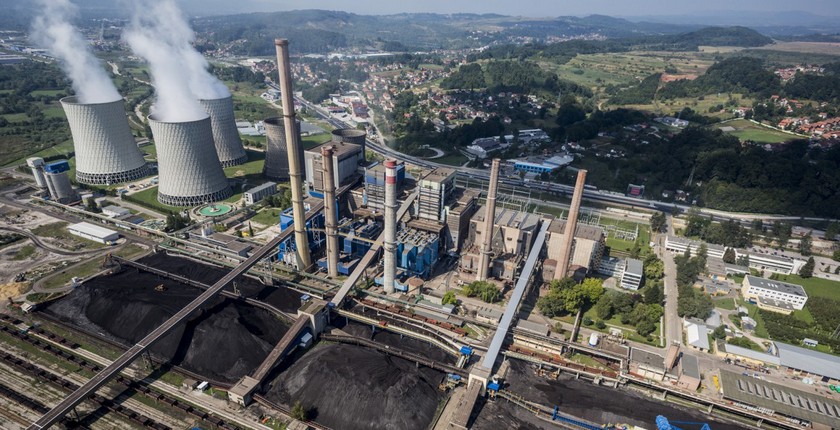
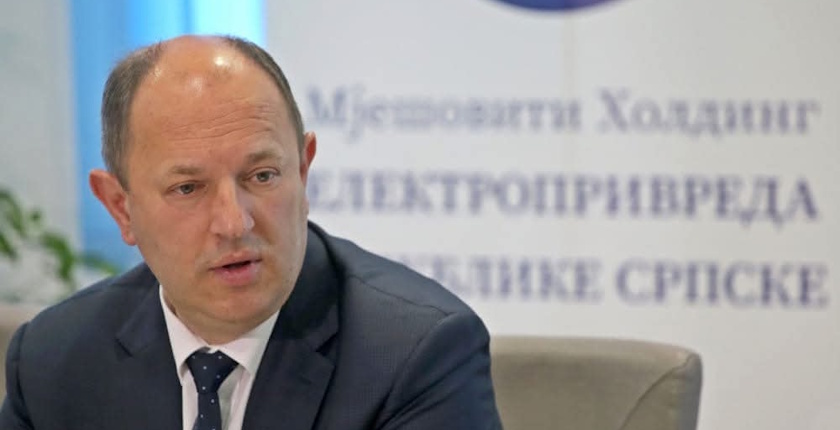
Elektroprivreda Republike Srpske expects a loss of BAM 29 million (EUR 14.8 million) this year, according to the power utility’s CEO Luka Petrović.

The reasons for the poor business results of Elektroprivreda Republike Srpske (ERS) are bad hydrological conditions and an increase in electricity imports, Luka Petrović said, as quoted by news agency Srna.

ERS is one of the three state-owned power utilities in Bosnia and Herzegovina. It is in charge of the electricity production and supply in the Republic of Srpska, one of the country’s two political entities.

Of note, a week ago, the new Prime Minister of the Republic of Srpska Savo Minić called the situation in the electricity sector extremely complex. He has also set a 15-day deadline for setting up plans to overcome the issues.

Petrović: Electricity is imported for EUR 72 per MWh and sold to citizens for EUR 34 per MWh

Following the meeting of ERS’s management in Trebinje, Luka Petrović emphasized that the company’s electricity production would be significantly reduced, to 4,500 GWh. He previously said hydropower output decreased by 50% this year on an annual basis.

He recalled that ERS already purchased about 13% of electricity for domestic supply at high prices. The difference between purchase and sales prices will produce a loss of about BAM 29 million (EUR 14.8 million), Petrović added.

He noted that in 2023, when the hydrological situation was good, ERS achieved a record profit of BAM 146 million (EUR 74.6 million).

Of note, the company recorded a BAM 3.2 million (EUR 1.6 million) profit in 2024.

Petrović stressed that the electricity deficit would have to be purchased on the power exchange, at EUR 72 per MWh, while it is sold to citizens for EUR 34 per MWh, compared to the price for businesses of EUR 75 per MWh.

Imports this year reached BAM 60 million to BAM 70 million (EUR 30.7 million to EUR 35.8 million)

Two consecutive years with drought can disrupt the cash flow because there is no export capacity, Petrović explained.

He asserted that ERS’s electricity exports over the past few years were worth BAM 100 million to BAM 200 million (EUR 51.1 million to EUR 102.2 million) per annum, while imports were between BAM 30 million and BAM 60 million. This year, electricity bought abroad amounted to between BAM 60 million and BAM 70 million (EUR 30.7 million to EUR 35.8 million).

Of note, in previous years, BiH was the largest net exporter of electricity in the region. However, imports were nearly 4.5 times higher in the first half of the year than in the same period of 2024. Another power utility, Elektroprivreda BiH (EPBiH), is increasing losses.

Government to hold a session about ERS

Petrović noted that the company has repaid a loan of BAM 78 million (EUR 39.9 million) and another of BAM 60 million (EUR 30.7 million).

A government session about ERS is planned. He will propose that it be held at the Ugljevik thermal power plant, from which a third of the electricity is delivered to Slovenia.

In addition, the management of ERS has requested further rationalization of all operating costs.
by in News

European electricity industry issues Paris Pledge on pumped storage hydropower

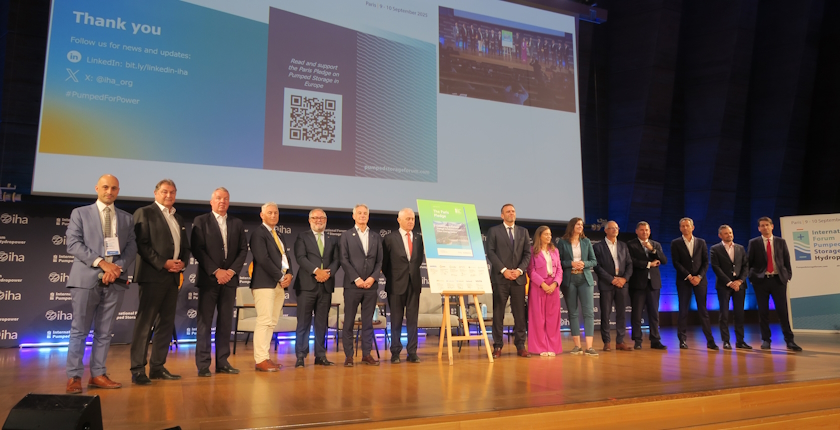
The International Hydropower Association (IHA) and Eurelectric launched the Paris Pledge. It is a collective call to action, aimed at unlocking the potential of pumped storage hydropower in Europe. The signatories urge the European Union and national governments to create the right conditions for long-duration storage to meet clean energy goals.

Over 50 utilities, hydropower suppliers and energy-focused associations have signed the Paris Pledge. The document’s alternative headline is Committing to Pumped Storage to Secure Europe’s Clean Energy Future.

The International Hydropower Association (IHA) and Eurelectric – Union of the Electricity Industry launched the initiative. They warned that Europe faces an urgent and growing need for long-duration electricity storage to secure a reliable, affordable and sustainable energy future.

Amid the transition to a renewables-dominated power system, the ability to store and dispatch electricity over long periods will be critical to balance variable generation from wind and solar, ensure grid stability and resilience, and reduce reliance on imported fossil fuels, the authors stressed. They called pumped storage hydropower or PSH the most important, scalable and cost-effective long-duration electricity storage solution available today. It still provides over 90% of the world’s long-duration electricity storage capacity.

PSH is currently the most important, scalable and cost-effective long-duration electricity storage solution, the industry pointed out

By 2050, around 86% of production capacity in Europe will come from variable sources, according to the material accompanying the Paris Pledge. Encouragingly, 78 pumped storage hydropower projects are under development, for 35 GW overall. The EU accounts for over 32 GW, and the rest is in Switzerland, Norway and Turkey.

The combined pipeline would provide storage capacity in excess of 700 GWh, equivalent to more than 10 hours of consumption of Italy and Spain taken together. There is 3.9 GW in the ready-to-build phase, and 2.8 GW is under construction. Of note, an earlier report showed 52.9 GW of PSH was under development.

The existing capacity amounts to 48 GW, compared to 190 GW globally. In the EU, pumped storage hydropower systems can store 1.2 TWh overall.

Photo: Types of pumped storage (IHA, Eurelectric)

Paris Pledge calls for separate legislation for long-duration energy storage

Among other proposals, the signatories are asking the EU for a dedicated initiative to boost the rollout of electricity storage. They suggested legislation to be separate for long duration, short duration and other solutions.

The Paris Pledge calls on member states to remunerate the provision of system services and security of supply for all time frames. They should eliminate double grid fees on electricity storage technologies and accelerate permitting for PSH, the document reads.

With strong political commitment, Europe can double its pumped storage hydropower capacity in the next 25 years, according to the Paris Pledge. In-person signatories represent EDP, EDF, Iberdrola, Andritz, Enel, Statkraft, Voith, Hydrogrid, Verbund, Landsvirkjun and GE Vernova.

Pumped storage hydropower’s contribution during Iberian Peninsula blackout

During the power blackout in Spain and Portugal on April 28, pumped storage played a pivotal role in balancing and supporting the recovery of the system. In Spain, PSH generated 11 GWh of electricity in the first 12 hours, instead of the planned 12 GWh recharge. Similarly, in Portugal, hydropower and pumped storage covered 80% of the demand in the first ten hours.

Such facilities also made a major contribution to restoring the electricity grid in the entire peninsula, thanks to their so-called black start capability. It allows the power plant to be restarted without relying on external power sources and to reenergise the power system.

“Very few technologies can provide this function. As a result, within a few minutes, the first pumped storage plants were ready for synchronization and awaiting dispatch instruction” from transmission system operators, notes the report published with the Paris Pledge.

by in News

Turkey launches solar, wind power auctions with November deadlines

The Ministry of Energy and Natural Resources of Turkey issued a public call for solar and wind power auctions for 2 GW in total. It will receive the applications on November 4 and November 18, respectively. One competitive bidding process is for a floating solar power project of 35 MW.

Following the successful auctions for renewable energy projects that were completed early this year, Turkey kicked off another round. It is also for 2 GW of overall connection capacity, in light of the country’s ambition to grow its combined solar and wind power capacity to 120 GW by 2035. The two technologies reached 37.1 GW together a month ago, out of 120.2 GW in total.

Auctions are held under the Renewable Energy Zones (REZ) state support mechanism. The scheme is better known by its Turkish acronym YEKA.

Ten solar power areas in eight provinces

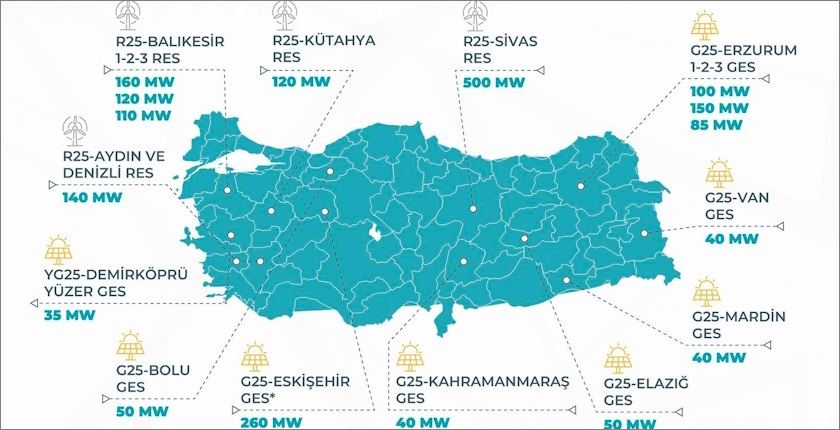
The upcoming solar energy auctions, REZ SPP 2025 (YEKA GES 2025), are for 850 MW altogether. There are ten areas in eight provinces designated for bidding: Kahramanmaraş, Mardin and Van, with 40 MW each, Bolu and Elazığ (50 MW each), Erzurum 1-3 (100 MW, 150 MW and 85 MW), Eskişehir (260 MW) and Demirköprü in Manisa province, with 35 MW.

The upcoming solar power auctions will include Turkey’s first bidding for a floating photovoltaic plant

Notably, the last one is for a planned floating solar power plant on the reservoir of the Demirköprü hydropower plant. The facility on the Gediz river, east of Izmir, is owned by state-owned Electricity Generation Corp. (EÜAŞ). Turkey now hosts only two small floating photovoltaic units, and the auction will be the first of its kind.

Applications will be received on November 4, the ministry said and added it would subsequently publish a schedule for bidding.

Wind power capacity quota is 1.15 GW

Participants can apply on November 18 for the wind energy round of auctions, REZ WPP 2025 (YEKA RES 2025). It is for an overall 1.15 GW in six areas.

Investors will compete for 500 MW in Sivas province, a 140 MW project in Aydın and Denizli, 120 MW in Kütahya and three areas in Balıkesir – 160 MW, 120 MW and 110 MW.

Winners to submit guarantees of EUR 75,000 per MW for PV projects, EUR 100,000 per MW for wind

Potential bidders will pay a fee of EUR 1,550 for each auction they apply for. They must submit letters of guarantee lasting one year and worth EUR 15,000 per MW for photovoltaics and EUR 20,000 per MW for wind power. Winners will submit 10-year guarantees before signing their contracts: EUR 75,000 per MW and EUR 100,000 per MW, respectively.

The ceiling or starting price is EUR 55 per MWh and the floor prices are EUR 32.5 per MWh for solar power and EUR 35 per MWh for wind. If bids hit the floor, another auction will be held between the competitors, like in the previous round. It is for a so-called contribution share that they are ready to pay. The minimum is EUR 10,000 per MW of planned capacity and the highest bid wins.

Successful participants can sell electricity on the free market for five years in the case of solar power plants, while the period lasts six years for wind. After that, both categories enter a 20-year scheme with a guaranteed price.

Turkey tops 120 GW in total electricity capacity

At the end of July, electricity capacity in Turkey totaled 120.2 GW, the ministry revealed. Hydropower accounted for 26.9% or 32.3 GW, compared to 23.4 GW in photovoltaics (19.5%) and 13.7 GW of wind power, translating to 11.4%.

The share of biofuel and waste was 1.9%, with 2.34 GW, and geothermal power plants had 1.73 GW altogether, which is 1.4%. Gas power plants in Turkey had 24.7 GW in combined capacity (20.6%). The remainder is coal: 21.9 GW or 18.3%.

by in News

PPC launches first tender for pumped storage hydropower plant in former lignite mine

Greek Public Power Corporation (PPC or DEI) is moving forward with a pumped storage hydroelectric project at the site of its former open pit lignite mine Kardia, in a coal region in Western Macedonia.

The government-controlled power utility is seeking a design, supply, construction and commissioning contractor.

PPC announced that another tender would take place as part of the EUR 430 million project, for the ground works and civil engineering.

The criteria are strict. The company said eligible firms have completed at least one pumped storage hydropower station in the European Union within the last ten years, with a capacity of at least 70 MW and a water head of 90-450 meters. Alternatively, the requirement is at least three facilities of the same size in the last 20 years.

Interested parties can submit their proposals until October 20.

PPC’s project in Kardia received an environmental license in May from the Ministry of Environment and Energy. According to the document, there would be one upper and one lower reservoir with tunnels and a 400 kV substation. The ministry approved an “average” 130 MW capacity with an eight-hour duration, and a “maximum” of 148 MW, without defining the two features.

However, the tender sets the capacity at 320 MW, consisting of four 80 MW reversible turbines.

Apart from Kardia, PPC is planning a pumped storage hydropower system in the South Field lignite mine of Kozani, also in the country’s north, with a capacity of 227 MW and a budget of EUR 310 million. The project has also received an environmental license.

The company unveiled a EUR 5.8 billion investment program in April for both coal regions in Greece. It includes 300 MW of battery storage, 2.1 GW in photovoltaics and a 300 MW data center.

by in News

Battery storage investors in Romania rapidly expanding project pipeline

In an accelerating investment wave, companies in Romania are combining BESS with solar power, hydropower and wind power, or building standalone energy storage facilities. The group includes R.Power, Hidroelectrica, Engie and more big names.

Recent updates about investments in battery energy storage systems (BESS) in Romania indicate the technology is becoming another pillar of the country’s energy transition alongside wind power. For several years now, photovoltaics, and prosumers in particular – including municipal authorities, have dominated the scene. Geothermal energy is another emerging segment.

The government has provided incentives both for households and utility-scale battery storage. Companies are combining batteries with solar and wind power as well as hydropower capacity.

Investing in BESS colocated with renewable electricity plants or as standalone facilities in Southeastern Europe enables income from high spreads between wholesale power prices in daily trading. It is especially significant given the increase in the occurrence of zero and negative prices.

Notably, neighboring Bulgaria has earmarked massive funds for support to BESS investments while also focusing on pumped storage hydropower projects. Greece also held several rounds of auctions for battery storage.

R.Power to start building 127 MW standalone battery

R.Power is investing in BESS in Romania, which is one of its strategic markets, together with Poland, where it is headquartered, and Italy, Germany, Spain and Portugal. Battery storage makes up 17.5 GW or more than half of its total development pipeline in Europe.

The company said it would hybridize its existing and future PV assets and scale the integrated capacity to several gigawatts in the coming years. It has over 1.2 GW of projects for standalone BESS in Romania. “And that’s just the beginning,” R.Power said.

It obtained EUR 15 million in funding for a future 127 MW facility. It is about to start building the BESS in Scornicești in Olt county, west of Bucharest. R.Power is planning to complete it in a year. The battery energy storage system would have a duration of two hours, translating to 254 MWh in capacity. The project received funding from the National Recovery and Resilience Plan (NRRP or, in Romanian, PNRR).

Still, in the company’s view, further legislative changes are needed to fully harness the potential of the technology.

Hidroelectrica to add large battery to Iron Gate 2 hydroelectric plant

State-owned Hidroelectrica, the largest electricity producer in Romania, wants to install a battery storage system at Iron Gate 2 (Porțile de Fier 2) on the Danube. Located on the border with Serbia, it is the second-largest hydroelectric plant in the country, at 252 MW in nominal capacity. The complex, which the two countries share, is known as Đerdap in Serbian.

The BESS would have 64 MW in nominal power and a four-hour duration (256 MWh), Profit.ro reported. Hidroelectrica plans to use it for providing balancing services to the national electricity system (SEN) and adjust the time intervals of its hydropower production.

The contract for the installation of the facility is estimated at EUR 61.2 million plus value-added tax, according to the article. It would be integrated with the hydroelectric plant. The company is receiving bids from potential contractors by August 28.

French Engie has BESS projects for its existing PV plant, wind park

France-based Engie’s subsidiary in Romania intends to install a BESS at its newest solar power plant, of 37.2 MW in peak capacity, in Ariceștii Rahtivani. It commissioned the PV facility in June. The location is north of Bucharest, in Prahova county.

The battery energy storage system project is for 20 MW in operating power and 80 MWh. It would consist of 16 containers, 192 inverters and four transformer units.

The wind park in Băleni will reportedly add a small BESS facility

Engie Romania is working on another investment, through its Alizeu Eolian project firm. It plans to add batteries to a 50 MW wind park in Băleni, Galați county, which was built in 2013.

The company obtained the building permit last year. It also got clearance two months ago for connecting the BESS with a 110/20 kV transformer station via an underground line. Economica.net learned that the battery storage facility would have 5 MW and a two-hour duration, costing the firm EUR 2 million.

Engie’s project was included in the reserve list last September after a public call for support to battery storage. The Ministry of Energy selected 13 applications for grants from NRRP. Another 25 passed, but remained below the line.

Government bolstering battery investments with grants

The state aid scheme was worth EUR 103.5 million, of which EUR 79.6 million came from the European Union’s Recovery and Resilience Facility (RRF).

Among the beneficiaries are Electrica, in which the government holds just under 50%. Renovatio Trading. OMV Petrom, Public Power Corp. (PPC) and Verbund have projects on the B list.

For its 65 MWh project in Toplița in Harghita county, in eastern Transylvania, Renovatio Trading is buying the equipment from Trina Storage. The firm is part of Trina Solar.

Visual Fan is winning major contracts for the procurement and installation of batteries

Allview Energy, part of Romanian company Visual Fan, is handling the alternating current (AC) side in Renovatio Trading’s investment.

In addition, Visual Fan became the contractor for a BESS within Eurowind Energy’s Teiuș solar park.

The Danish developer intends to deploy a 117 MWh energy storage unit with lithium-iron-phosphate (LFP) batteries, within a year. It valued the project at over EUR 16.6 million. The companies said they would carry out the works in partnership with TQM Services and Voltlink. The investment includes the battery management system and liquid cooling.

In June, the ministry approved a EUR 3.4 million grant from the EU’s Modernisation Fund to Termoficare Oradea. It has a project for a 10 MW solar park with a 15 MWh storage unit, worth EUR 18.6 million altogether.

Austria’s Verbund conducting EUR 22.7 million project

Verbund has almost all the permits for a BESS project at its 226 MW wind farm in Casimcea in Tulcea county. The company headquartered in Austria said it has secured financing as well and that it is already contracting the equipment.

The wind farm was commissioned in 2012. The energy storage segment would have up to 50 MW and up to 100 MWh. It would be located at the Alpha Wind Nord section of the existing facility, of 81 MW.

Still, the basic variant’s size will be 48.3 MW, with 76 MWh in capacity, according to Profit.ro. There would be 34 containers at the site selected for the BESS.

The majority government-controlled utility values the investment at EUR 22.7 million, of which more than EUR 10.7 million is for the storage facility itself. The location spans five hectares.

After coming up short in the public call, Verbund submitted the project for a grant from the Modernisation Fund.

In mid-May, Romania hosted 240.7 MW of battery capability and a total capacity of 404.9 MWh.

by in News

Slovenia’s HESS inks 9.2 MW deal for two solar power plants near HPP Brežice

Hydropower plant operator Hidroelektrarne na Spodnji Savi will build two solar power plants with a combined capacity of 9.2 MW near its Brežice hydropower plant. It picked Končar as the contractor.

Two new photovoltaic facilities in the pipeline are the continuation of investments in solar near the Brežice hydropower plant. Hidroelektrarne na Spodnji Savi (HESS), owned by GEN and HSE, installed a 6 MW PV plant in May 2023 next to the reservoir of its HPP Brežice’s.

At the time, it was the largest in Slovenia, and it remains the largest hybrid system in the country.

The existing PV plant is FEBR-D3, while the two new ones are called FEBR-D1 and FEBR-D2.

“We’re excited to announce a new chapter in our collaboration with HESS,” Croatia-based Končar said.

Končar will install the two solar power plants

Končar, an engineering company, signed a contract in July for the construction of FEBR-D1 and FEBR-D2. It said the endeavor extends the partnership established at HPP Brežice. Of note, it supplied generators for the 47.4 MW HPP, which began operating in 2017.

Located just a few kilometers upstream from HPP Brežice, on the left bank of the Sava River, the two units will have a combined peak capacity of 9.2 MW, powered by 14,790 PV modules, Končar added.

The Croatian firm revealed that the contract is worth EUR 4.5 million. It sets an ambitious goal: both plants are scheduled to be fully operational and handed over to the client by the end of next year, according to Končar.

The largest solar power plant in Slovenia has a capacity of 7.1 MW

In late May, on World Sun Day, HESS announced that it obtained construction permits for the FEBR-D1 and FEBR-D2 solar plants. It is the continuation of the story within which, on June 21, 2023, Slovenia’s largest hybrid solar power plant FEBR-D3 began production, it added.

Of note, the largest solar power plant in Slovenia has a capacity of 7.1 MW. It came online last month on the border with Italy.

Hydropower and solar energy make an excellent combination, so numerous power utilities, including the ones in the Western Balkans, decided to invest. The latest example comes again from Slovenia, where Soške Elektrarne Nova Gorica (SENG), part of HSE, commissioned its first PV unit at its Avče pumped storage hydropower plant.

by in News

Court suspends Hidroelectrica’s hydropower project by stopping deforestation

An almost complete hydropower project that was launched in the late 1980s in Romania is stuck again as a court in Cluj suspended a government’s decree that allowed clearing 31 hectares of forest. Hidroelectrica’s endeavor on the Răstolița river is for 35.2 MW.

What was labeled by the Romanian media as the last big investment of Nicolae Ceaușescu’s regime is again on an extended hold. The Cluj Court of Appeal suspended a government decree from earlier this year that allowed the deforestation of 31 hectares for a 35.2 MW hydropower plant on the Răstolița river in Transylvania.

The project, launched in 1989, is 90% finished. In June, the same court suspended the environmental permit.

Răstolița project has special status

The government declared Răstolița a renewable energy project of major public interest in 2022. It exempted it from the obligation to carry out an environmental impact assessment study and the ban on reducing the national forest fund.

Nongovernmental organizations Declic and Bankwatch Romania, which submitted the complaint, pointed out that deforestation continued between the two rulings. The location of the Răstolița hydropower project, run by state-owned Hidroelectrica, is part of the Călimani National Park.

The two groups have argued that the technical documentation is more than three decades old, ignoring climate change, biodiversity and public safety. The affected area is vital for flood prevention and the conservation of species, they pointed out.

Conversely, the government claimed the project would actually reduce the risk of flooding and enable water supply and the management of the Mureș river and its tributaries.

Romania already invested over EUR 200 million

The facility in Mureș county was planned to be commissioned in November. In January, the authorities approved the expropriation of 55 hectares of forest.

Average electricity production in the first phase is estimated at 46.3 GWh per year, and it would reach 117.5 GWh in the final stage. The reservoir would be 5.6 kilometers long. Investments made so far are valued at more than EUR 200 million.

Former Minister of Energy Sebastian Burduja reacted to the new ruling by calling it “economic sabotage.” He is a member of the Chamber of Deputies, the lower house of Romania’s parliament.


by in News

Bosnia and Herzegovina’s power utility keeps posting losses amid weak output, increased imports

State power utility Elektroprivreda Bosne i Hercegovine (EPBiH) failed to stabilize its operations and turn a profit in the first half of 2025, posting a loss of BAM 45.47 million (EUR 23.25 million) instead. The poor performance was largely due to reduced electricity production and increased imports caused by a coal shortage.

EPBiH’s target for the first six months of 2025 was BAM 11 million in profit. Instead, the state power utility generated a loss that was by BAM 18.76 million higher than in the same period of 2024, when the loss amounted to BAM 26.71 million, according to Biznisinfo.

EPBiH suffered a net loss of EUR 29.4 million in 2024, following a EUR 170 million loss in the previous year.

In the first half of this year, EPBiH’s hydropower plants generated 121.8 GWh less electricity than planned, while output at its thermal power plants fell short of the target by as much as 651.4 GWh amid a coal shortage. At the same time, due to the lower production in its own power plants, EPBiH’s expenditure on electricity purchases was several times higher than planned.

The lower production and losses were mainly due to the coal shortage

In H1 2025, Bosnia and Herzegovina imported almost 4.5 times more electricity than it did in the same period in 2024, reflecting the difficult state of EPBiH and the other two power utilities in the country – Elektroprivreda HZHB (EPHZHB) and Elektroprivreda Republike Srpske (ERS).

EPBiH recorded a loss despite higher revenues

EPBiH recorded the six-month loss despite an increase in total revenues, from BAM 561.8 million in H1 2024 to BAM 745.1 million in the first half of this year. Revenues from power purchase agreements grew from BAM 549.3 million to BAM 733.3 million.

Total expenditures, however, increased to BAM 790.6 million from BAM 588.5 million in the first half of last year.

by in News

BiH’s electricity imports up 4.5 times

Bosnia and Herzegovina’s electricity imports were nearly 4.5 times higher in the first half of the year than in the same period of 2024.

The step rise in power imports is another evidence of the difficult situation in the country’s utilities – Elektroprivreda BiH (EPBiH), Elektroprivreda HZHB (EPHZHB), and Elektroprivreda Republike Srpske (ERS).

The main issue is the drop in production in coal power plants and hydropower plants. For many years, BiH was the only net electricity exporter in the Western Balkans; however, it seems a change is underway. The country finished last year with 2.5 TWh in net exports – 36% less than in 2023.

Most imports occurred during the winter

According to data from the Agency for Statistics of BiH, electricity imports in the first half of last year amounted to BAM 78.8 million (EUR 40.3 million), while in the same period this year they reached BAM 344 million (EUR 175.9 million), Nezavisne novine reported. It is a 337% increase.

The data show that the majority of imports took place in the first quarter or during the winter. In the first three months of last year, import costs came in at BAM 33.7 million (EUR 17.2 million), and this year they soared to BAM 235.4 million (EUR 120.3 million) from January through March.

Exports also recorded an increase on an annual scale. In the first half of 2025, they were worth BAM 439.4 million (EUR 224.6 million), against BAM 289.3 million (EUR 147.9 million) in the equivalent period of last year. It is a 52% increase.

Coal and hydrology issues soured the foreign balance in the electricity sector

Just under half of exports were achieved in the first three months of the year.

ERS struggled with power generation in coal power plants due to longer maintenance and a lack of coal. EPBiH has also been facing coal supply problems for years. Both companies are unable to produce sufficient quantities of coal from their own mines.

An additional issue this year is the drought, which has reduced production in hydropower plants. Unfavorable hydrological conditions are affecting all three companies, but the largest pressure is on EPHZHB, which operates only hydropower plants.

Energy expert Almir Bečarević asserted that import figures reflect reality.

He explained that two thermal power plants in the Republic of Srpska were undergoing maintenance, and that EPBiH is facing issues with hydrology and its mines, which cannot supply sufficient quantities of coal.

by in News

Montenegro’s EPCG, NTE Energy sign memorandum of understanding

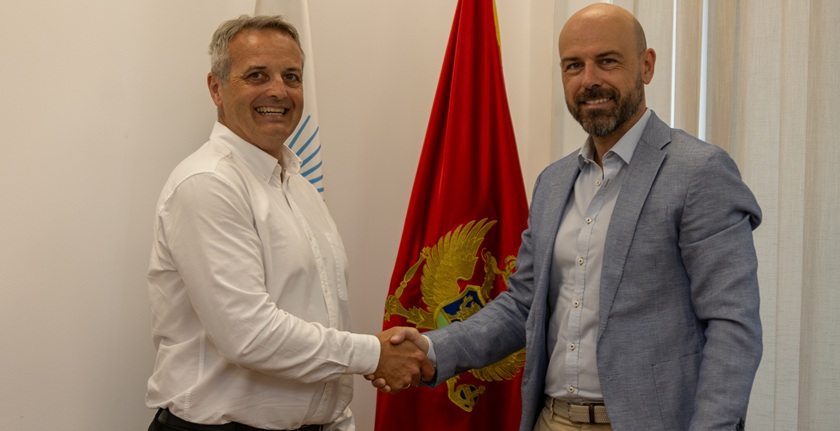
Power utility Elektroprivreda Crne Gore and Norwegian company NTE Energi AS have signed a memorandum of understanding confirming their mutual commitment to intensifying cooperation in the renewable energy sector in Montenegro.

The memorandum of understanding envisages the exchange of information, coordination of activities, and consideration of specific projects through joint venture Zeta Energy, established by state-owned Elektroprivreda Crne Gore (EPCG) and NTE Energi.

Zeta Energy operates small hydropower plants Glava Zete and Slap Zete, operational since 2021.

Bulatović: The MoU is an important step in EPCG’s ongoing transformation

The memorandum was signed by EPCG’s CEO Ivan Bulatović and NTE Energi’s CEO Inge Forseth.

According to Bulatović, the focus of the cooperation between the two companies will be the development of the hydropower potential of the rivers Ćehotina, Ibar, and Morača, with the possibility of expanding it to other renewable energy sources.

In the search for stable partnerships and the development of domestic renewable capacities, the memorandum represents a significant step forward in EPCG’s transformation, Bulatović asserted.

In his words, collaboration with a renowned company like NTE Energi aligns with EPCG’s goals.

Forseth: Zeta Energy provides a platform for implementing concrete projects

Inge Forseth, NTE Energi CEO, underlined that his company has an extensive track record in energy and decarbonization. He described Montenegro as an attractive market for sustainable energy development.

By signing the MoU, the two firms are opening a new chapter in their cooperation, he stressed.

Montenegro has enormous natural potential, and Zeta Energy serves as a platform to implement concrete projects for the benefit of the local community and partners, according to Forseth.

EPCG has four HPPs in the pipeline

EPCG recently said it planned to include an international partner in the development of the Komarnica hydropower project. The company cited the experiences of Norway, Austria, and France.

The company has four hydropower projects in the pipeline: Komarnica, Kruševo, Ćehotina, and Sutorina. The first two are the most advanced. Kruševo and Ćehotina could be implemented with EDF.