by in News

Athens International Airport builds biggest photovoltaic-BESS plant

Athens International Airport (AIA) Eleftherios Venizelos completed its comprehensive energy makeover program. It is now operating a photovoltaic facility of 51.5 MW and a battery energy storage system of 82 MWh. It is the largest hybrid power plant of its kind within the premises of any airport in Europe and, reportedly, even the entire world.

At the same time, the Bucharest Henri Coandă International Airport is about to build 12.6 MW in peak PV capacity and a BESS of 17.9 MWh, in the first phase of a larger project.

Following European and global trends, airports in Southeastern Europe are introducing resource, waste and wastewater management systems. Energy is the largest segment of the decarbonization push. With the completion of its Route 2025 program, Athens International Airport Eleftherios Venizelos covered all its electricity needs with photovoltaics, becoming the only such airport in Europe.

In the groundbreaking project, the operator extended the existing solar power plant by 35.5 MW in peak capacity, reaching 51.5 MW, and added a battery energy storage system. The facility has 124 MWh in nominal capacity, of which 82 MWh is usable.

The hybrid system is the largest of its kind inside the fence of any airport in Europe, while the Greek press has even called it the largest in the world. Some of the world’s largest airports are set to follow soon. For instance, IGA Istanbul Airport is investing EUR 212 million in an external solar power plant of 199.3 MW, in Eskişehir.
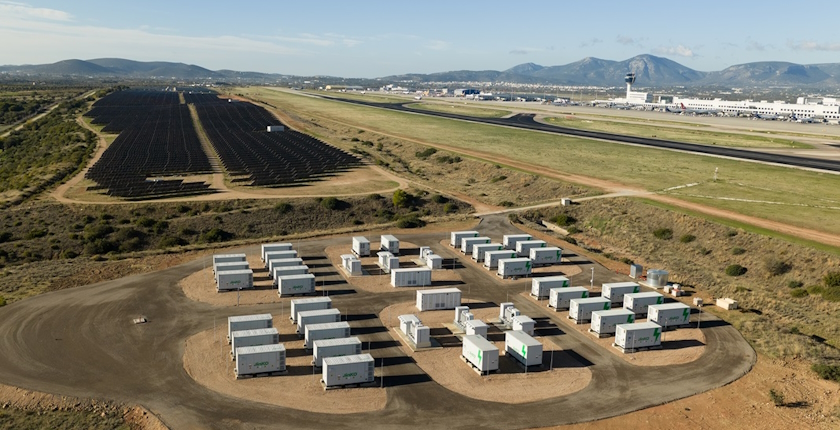
Athens International Airport builds biggest photovoltaic BESS plant
Photo: Athens International Airport

Hybrid power plant to keep Athens International Airport at net zero through 2046

AIA’s PV-BESS plant will generate an estimated 88 GWh per year, which is equivalent to the consumption of 22,000 households. The storage system is only for self-consumption. Importantly, the hybrid system can cover the entire planned expansion up to 2046, when the concession period ends.

AviAlliance, which controls 50.2% of the public-private partnership, is a wholly-owned subsidiary of Public Sector Pension Investment Board (PSP Investments) from Canada. The government holds 25.6% through Superfund, officially Growthfund – The National Fund of Greece.

AIA launched Route 2025 six years ago, with the aim to cut net greenhouse gas emissions to zero by the end of this year. It compares to the 2050 net zero goal of the European airports sector.

The Route 2025 program was worth EUR 70 million

The investments totaled EUR 70 million. A significant portion was financed through loans from the European Union’s Recovery and Resilience Facility (RRF), the update adds.

Heat pumps have eliminated the need for natural gas in buildings at AIA in normal winter conditions. The electric vehicle fleet consists of 19 buses, 13 follow-me vehicles and 29 vans. A network of chargers also serves passenger cars.

“In the airport company, we operate on the basis of the principle that sustainability, and environmental responsibility in particular, are and will increasingly be prerequisites for what we call the social license to operate and grow,” said outgoing Managing Director of AIA Yiannis Paraschis.

Two airports in Romania receive EU funds for solar-BESS projects

As for other recent developments in the Balkans, operators of two airports in Romania received grants via the European Union’s Modernisation Fund for solar power plants with battery storage.

National Company Bucharest Airports (CNAB) signed a contract for RON 132.04 million (EUR 25.9 million) excluding value-added tax. It is for 12.6 MW in peak PV capacity and a BESS of 17.9 MWh at the Bucharest Henri Coandă International Airport in Otopeni.

The entire investment amounts to RON 176.9 million (EUR 34.7 million) excluding VAT. The Romanian state-owned company said it is the first phase of a project for 31.5 MW and 30 MWh overall, valued at EUR 55.7 million.

Bacău International Airport George Enescu will build a solar power plant of 1.25 MW and a BESS of 2.06 MWh. Bacău County Council will also provide support for the on-site project on 2.2 hectares, worth more than EUR 4.9 million.
by in News

Polat Enerji completes largest wind-BESS hybrid power plant in Turkey

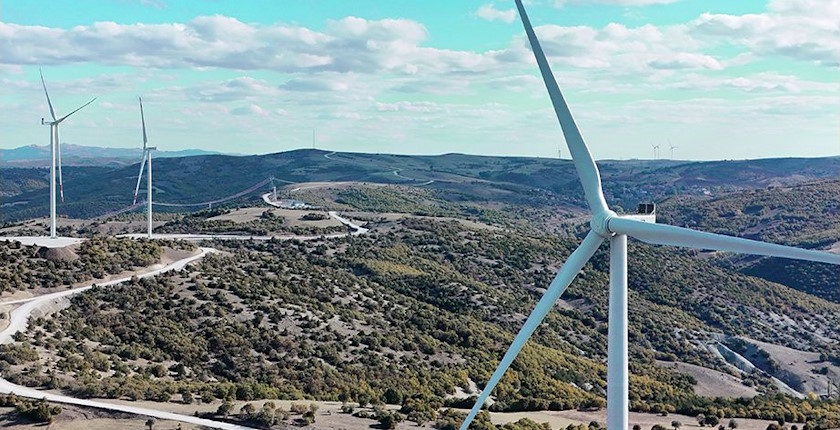
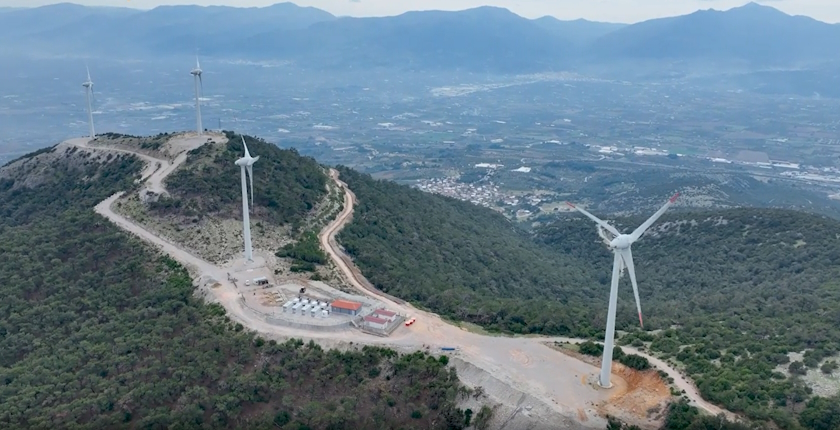
Polat Holding’s joint venture with İş Enerji has received the license for the 12.8 MW battery energy storage system (BESS) integrated with its Ege wind power plant of 15.2 MW in western Turkey. It is the largest hybrid power plant of its kind in the country.

In cooperation with SolarToday Türkiye and iNOVAT, Polat Enerji reached another milestone in combining renewable energy plants with battery storage. The Ministry of Energy and Natural Resources of Turkey has issued an approval for its BESS with 12.8 MW in operating power and a capacity of 15.2 MWh.

The facility is integrated with the company’s Ege wind power plant. They are located in the Kemalpaşa district of Izmir province in the country’s west. It is Turkey’s first DRES, an acronym for a licensed wind-storage system, of 10 MWh or more. The companies pointed out it is also the first hybrid power project of its kind to receive incentives.

Polat Enerji’s BESS consists of four 3.8 MWh units manufactured by Contemporary Amperex Technology Co. Ltd (CATL) from China. In the second phase, the capacity will reach 28.2 MWh, according to the update.

In the second phase, BESS capacity will reach 28.2 MWh

Electricity from wind turbines will be stored and delivered to the grid to cover production imbalances and stabilize the system. The companies signed the agreement about the battery project in January.

Ege was built in 2015. The wind park consists of eight turbines, of which the last two were connected almost two years ago. It has 15.2 MW in nameplate capacity and a 13 MW connection.

Earlier this month, Polat Enerji won a 160 MW project at a wind power auction under Turkey’s YEKA support mechanism. The company is a joint venture of Polat Holding and İş Enerji Yatirimlari, each holding 50%. The latter is a subsidiary of Türkiye İş Bankası, the largest private sector bank in Turkey.

The ministry said today that the country’s wind power capacity reached 14.5 GW in November, out of 121.8 GW in total. There was 24.7 GW of solar power in operation.

by in News

Quota surpassed at Romania’s bonus wind power auction

Romania apparently achieved moderately lower prices at its additional wind power auction for contracts for difference (CfDs) than in the regular round. According to a media report, nine bids were approved, for seven proposed facilities, and the winners include OX2, Qair and Zen Energy Group.

All wind farm projects in Romania that obtained the right to state support at the latest renewable electricity auction need to be completed by 2028. The Ministry of Energy and transmission system operator Transelectrica have approved 315.8 MW, compared to the targeted minimum of 290 MW, Economica.net learned.

The bonus round was organized because of a weak turnout in the regular, second wind power auction. Winners are eligible for 15-year CfDs, in a EUR 3 billion scheme covered via the European Union’s Modernisation Fund.

According to the report, the prices were also more favorable for the government than in the previous auction: between EUR 59.95 per MWh and EUR 74.9 per MWh, against EUR 65.17 per MWh to EUR 79.5 per MWh. The ceiling was the same, EUR 80 per MWh.

Cheapest two lots are part of same project

Naxxar Wind Energy Project Zenon won two lots, at 64.8 MW each, for the same project – Tudor Vladimirescu in Brăila county, northeast of Bucharest. The strike prices are EUR 59.95 per MWh and EUR 61.05 per MWh.

Owners of the special purpose vehicle are Renewable Investors and Kaizer Gerhard, an individual, both from Germany.

Aukera Project Company Beta has won a CfD contract for 27.2 MW in the proposed Făurei wind farm. The price is EUR 67.12 per MWh. It is owned by AtlasInvest, headquartered in Belgium.

In Romania, it is working on the projects for the Delesti wind farm in Vaslui county and the Gura Ialomiței storage facility in Ialomița. The battery would have 250 MW in operating power and a capacity of 500 MWh.

The first phase, of 300 MWh, is under construction. The company obtained a EUR 9.9 million grant last year through the National Recovery and Resilience Plan (NRRP or, in Romanian, PNRR) and signed a loan facility of EUR 60 million with Kommunalkredit Austria for the storage system.

OX2 wins CfDs for additional capacity for its future wind farms

Brăila Green Energy qualified for 12.4 MW of its Urleasca wind power project, at EUR 69.86 per MWh. The firm is controlled by OX2, which already won a CfD for a part of the same future facility.

The Sweden-based company also snatched 25.6 MW for its Cerchezu project. It is another winner from the previous round. This time, the South Wind subsidiary secured a contract at EUR 74.49 per MWh.

Clever Power has obtained 21 MW and 14 MW by bidding EUR 69.88 per MWh and EUR 72.92 per MWh, respectively. Both lots are for the same project: Falciu wind farm, envisaged to include storage. The company is controlled by Romanian investor Barbu Cristian, the article adds, citing a businesses registry.

AZ Market Construction won just 8 MW for its Bordei Verde wind project. It is eligible for EUR 74.74 per MWh. The firm is owned by France-based Qair.

Traian Energy, a subsidiary of Zen Energy Group from Luxembourg, is getting the highest price from the bonus round. The wind park would receive EUR 74.9 per MWh for the entire 78 MW.

by in News

Enery to start building Europe’s largest solar power plant in Romania

Austria-based Enery is preparing to begin construction works early next year on a photovoltaic facility of 750 MW in peak capacity just outside of Bucharest. It would currently be Europe’s largest solar power plant. A few other megaprojects are underway, too, but the Ogrezeni facility is planned with a battery energy storage system that would match its grid connection capacity.

Enery, which operates a range of wind, photovoltaic and small hydropower plants and battery storage across Romania, has only a few final steps before the start of construction of a giant solar farm in Giurgiu county, the company’s Head of Romania Liviu Gavrilă revealed to Profit.ro. The launch of the works is due early next year, he added.

With its 750 MW in peak capacity, the solar park in Ogrezeni, just west of the capital Bucharest, would be Europe’s largest at this moment. The company obtained a grid connection approval for 534 MW in 2023, the article adds.

Europe’s largest PV plant is Witznitz in Germany’s east. It has 650 MW in peak capacity. There is also an 850 MW cluster of 17 units in Spain, called Escatrón-Chiprana-Samper Solar Farm.

If the Asian part of Turkey is included, Kalyon Karapınar is at the top of the list. It has 1.35 GW in peak capacity and a 1 GW grid connection. Already one of the largest in the world outside China, the solar park is due for expansion into a complex of 1.85 GW in peak capacity.

Romania hosting two projects for Europe’s largest solar parks

Of note, Rezolv Energy and Monsson are about to build a solar farm in northwestern Romania of 1.04 GW in peak capacity. The site is in the communes of Pilu and Grăniceri in Arad. The Dama Solar system is envisaged with a battery energy storage system (BESS) of 500 MW.

But Austria-based Enery is planning a BESS with 534 MW in operating power, matching the grid connection. The unit would have a two-hour duration, translating to a storage capacity of 1.07 GWh.

Both Ogrezeni and Dama Solar are planned as hybrid power plants, with giant batteries

Both Dama Solar and Ogrezeni, also known as Baboia Solar Plant, won state support at Romania’s second solar power auction.

Spanish Iberdrola is preparing a bigger project, Fernando Pessoa in Portugal, though it has suffered delays over environmental concerns and disputed permits.

Enery to equip all its power plants in country with battery storage

Some negotiations remain to be completed before the groundbreaking, Gavrilă said. Enery is targeting a commercial operations date in the fourth quarter of 2027. In comparison, Dama Solar is scheduled to come online in the third quarter of 2028.

Enery has completed a PV plant of 54 MW in Titu, Dâmbovița county. The company is preparing it for a test run. It has 167 MW in operation in Romania, of which the Sărmășag solar park accounts for 51.4 MW in peak capacity.

“We want to install batteries for all our production capacities in Romania. But we are also active in the area of ​​stand-alone storage installations,” Gavrilă asserted.

In addition, the company manages electricity supply for others as a balance responsible party, using the SmartPulse platform.

by in News

LONGi enters energy storage market, redefining industry standards with Ultimate Safety

LONGi, the global leader in solar technology, unveiled its energy storage strategy in London, officially announcing its entry into the storage sector with the launch of the LONGi Energy Storage One-Stop Solution. This marks LONGi’s strategic evolution from a global photovoltaic leader to an integrated Solar-Storage-Hydrogen comprehensive energy solution provider.

Addressing the challenge of the projected doubling of global electricity demand by 2050, Dennis She, Vice President of LONGi, introduced for the first time the Stability Triangle energy framework centered on solar, energy storage, and hydrogen energy.

“Solar is the creator of clean energy, energy storage is the stabilizer of the power system, and hydrogen is the regulator that balances it all,” Mr. She stated to energy experts and investors from around the world. “The synergy of these three will build a truly widespread, highly resilient, and affordable zero-carbon energy system.”

From Solar to Solar-Storage-Hydrogen: building a Stability Triangle energy framework

Currently, LONGi possesses leading technologies in PV and hydrogen energy – with its HIBC cell efficiency reaching 27.81% and its ALK electrolyzer capacity ranking first globally.

This expansion into energy storage signifies the further enhancement of LONGi’s strategic layout, fully forming a closed-loop across the entire Solar-Storage-Hydrogen value chain.

Breaking new ground with Ultimate Safety: reshaping the logic of competition in energy storage

Energy storage is a crucial piece in the renewable energy system, and the industry is shifting from policy-driven to market-driven growth.

Dennis She pointed out, “The current development stage of the energy storage industry is very similar to the early days of solar – confidence-driven rapid growth, but also bringing disorderly competition. The future dimension of competition in energy storage has evolved from ‘having the technology’ to ‘value reliability.’”

He emphasized, “Safety, reliability, and stability are the yardsticks for measuring energy storage solutions, and are also the cornerstone for winning the long-term trust of the market and customers.”

To uphold the value proposition of Ultimate Safety, LONGi has chosen to engage in deep collaboration with PotisEdge, an expert in energy storage safety. Adhering to a three-pillar technical architecture of “intrinsic safety, active defense, and intelligent early warning,” and through its fully self-developed 5S energy storage system with unique BMS and iCCS designs, PotisEdge has maintained a safety record of “zero thermal runaway” incidents across more than 12 GWh of cumulative energy storage and power battery systems over the past decade. This will provide solid technical support for LONGi’s energy storage solutions.

Establishing the first Solar-Storage Technology Innovation Center in Europe

To accelerate Europe’s energy transition, LONGi officially announced the establishment of its first Solar-Storage Technology Innovation Center (Center of Excellence, CoE) in Europe. This center will integrate core functions including project consulting, technical training, O&M support, and spare parts services, dedicated to providing European customers with rapid-response, full-lifecycle localized professional services, comprehensively ensuring the safety, reliability, and long-term returns of integrated solar-storage assets.

Choosing London for this global strategy launch underscores LONGi’s high regard for the European market. “Europe’s urgent need for energy transition and its mature market mechanisms provide an ideal platform for practicing integrated Solar-Storage-Hydrogen solutions,” Mr. She stated during the launch.

The LONGi Energy Storage Solution will be deployed first in key markets such as the UK, Germany, Italy, and Spain, helping utilities and power companies build smarter and more efficient clean energy systems. In the future, LONGi will continue to explore viable pathways for the global zero-carbon transition through its Solar-Storage-Hydrogen integration strategy, working hand-in-hand with all parties towards a sustainable future powered by renewable energy.

About LONGi

Founded in 2000, LONGi is committed to being the world’s leading solar technology company, focusing on customer-driven value creation for full scenario energy transformation. Under its mission of “making the best of solar energy to build a green world”, LONGi has dedicated itself to technology innovation and established several business sectors, covering mono silicon wafers cells and modules, commercial & industrial distributed solar solutions, green energy solutions and hydrogen equipment.

The company has honed its capabilities to provide green energy and has more recently, also embraced green hydrogen products and solutions to support global zero-carbon development.

by in News

Renewables investors are seeking tailored financing services as they add BESS, adapt to risks

Market conditions have become challenging for renewables in the CEE region, alongside uncertainties in the regulatory sphere, which calls for advanced and tailored financing solutions, according to participants in UniCredit Serbia’s workshop on navigating capital flows in the segment, including mergers and acquisitions (M&A). Investors, UniCredit’s clients, highlighted the growing importance of battery energy storage systems – and especially adding co-located storage to photovoltaics.

The renewable energy market is evolving in Central and Eastern Europe, as large players join the game and developers emerge as producers. With its surge in photovoltaic capacity and the revival in the construction of wind power plants, Romania has become a frontrunner. In neighboring Bulgaria, the first power purchase agreements (PPAs) are indicating a strong perspective, while Serbia might become more relevant soon, investors agreed at an event that UniCredit Bank Serbia organized in Belgrade.

M&A and financing trends in the region were the central topics. The idea was to have an open discussion with industry players active in the region about their investment strategies and the bank support, said the Head of Specialized Lending in UniCredit Serbia Svetlana Cerović, who moderated a panel within the conference.

A stable top line and a legal framework is the key driver for investments, with a particular emphasis on grid connections

Cerović pointed out that volatility has been on the rise for the last couple of years, after a huge wave of investments that followed the Paris Agreement and the European Green Deal. Sound and predictable regulatory framework along with stable revenues is key. To assure market flexibility and grid stability, new investments in western Europe and in the region are supported with the government programs including investments in battery energy storage systems (BESS). Thus, one of the prerequisites for the execution of future projects in local market will be certainty regarding the third auction timeline and availability of the longer term PPAs.

The participants at the workshop on navigating capital flows in renewables said a stable legal framework is the key driver for investments – grid connections especially, and permitting as a whole. On that note, developers will lean on the slowly maturing PPA market, though support from banks is necessary in the equation. Battery energy storage systems are a game changer, particularly colocated with solar parks for the optimization of the project returns.

UniCredit is strongest player in renewables financing in Serbia

UniCredit has a wide set of tailor-made project finance loans as well as a full range of services from advisory to various financing solutions, Head of Project and Structured Finance in Serbia Jelena Nestorović said.

The Italy-based bank has financed a string of major wind power and photovoltaic projects in the region, including facilities with colocated BESS, like Sunterra RE’s Galabovo in Bulgaria.

As for Serbia, it is the strongest player in the renewable energy segment. UniCredit financed six wind parks in the country, of 430 MW in total, and of which three as the sole lender. Notably, Čibuk 1 and 2 are the largest in Serbia.

UniCredit Bank Serbia is financing the country’s biggest wind power plants – Čibuk 1 and 2

Some of the participants and winners at the first two domestic auctions for contracts for difference (CfDs) are among the bank’s clients as well. Nestorović stressed that Bank is financing in total 30MW of smaller scale solar power plants .

She pointed to one of the largest industrial rooftop solar power plants in the region. UniCredit provided EUR 3.1 million facility and acts as a hedging and account bank for CWP Europe and Resalta’s project company. It built a PV system of 6 MW on a rooftop of Henkel Serbia facility in Kruševac, under an ESCO (energy service company) model.

Since 2019, the bank has participated in the financing of first waste-to-energy cogeneration plant,  located just outside of Belgrade. UniCredit is financing energy efficiency projects in the country, too.

Jelena Nestorovic UniCredit Renewables investors tailored financing services BESS adapt risks
Photo: UniCredit’s Jelena Nestorović presenting

Priority in Europe shifted from energy transition to energy security

Maria Vastola, Managing Director of UniCredit’s Energy Advisory Team covering Power & Utilities across the Group’s core countries, said valuations for renewable energy stocks on public markets are strongly down compared to 2021-2022 period and below the 3Y historical average. Independent power producers (IPPs) are factoring in a great uncertainty related to the permitting process, the regulatory framework in certain countries and the macroeconomic environment, she explained.

The bottom line is the shift in the European paradigm from the energy transition to energy security, due to geopolitical tensions, Vastola underscored. On the other hand, M&A still has good valuations, she said at the panel discussion.

Investors are focusing on operational quality, meaning high-quality assets, returns and value creation, as opposed to growing at any cost, Vastola added.

“There are more investors ready to put capital in projects and in the region. Private capital flow is a good bridge and a complementary tool for banks’ balance sheets,” she asserted and placed an emphasis on large corporations, private equity and M&A.

Scale creates efficiency, and efficiency and flexibility create value in a challenging market, Vastola stressed, highlighting investments in hybrid power plants that include battery storage. Over the past few years, corporates, traders and utilities are flocking into the renewables realm in “a big shift from big oil to big energy,” she said.

Actis to invest in infrastructure projects across region

Vice President for Energy Charles Lachapelle from Actis agreed with the other panelists about the significance of hybrid power plants and underscored that the sustainable infrastructure investment firm is mostly doing very large projects as they are much more competitive.

“Definitely, for solar, I think having a BESS is a must,” he said and added that “it goes without saying at this point.” As for batteries with wind parks, they enable flexibility for offtake, Lachapelle noted.

Actis is a growth market investor in the infrastructure and energy space, best known in the region for Rezolv Energy. In Romania, the company obtained a financing package for the first phase of its giant Vifor wind farm via PPAs with companies in the commercial and industrial (C&I) sector. The second part was secured thanks to the CfD from a renewable energy auction.

The next chapter for Actis could involve more than a billion euros

Among other investments in Romania, Rezolv has the Dama Solar project for 1.2 GW in peak capacity. It would currently be one of the biggest in Europe. The company is also active in Bulgaria.

Actis is looking at a pipeline of projects across the region, including in Serbia, Lachapelle revealed. Asked about the next auction that the country is planning, he said a wind power project in the 200 MW range would be suitable.

Lachapelle specified that the next chapter may involve over EUR 1 billion and that Actis would require support in financing.

On the subject of power purchase agreements, he said the optimal tenure is longer than ten years, with more than 70% of output contracted. “However, we’ve done cross-border PPAs. We’ve looked at solutions, in the past, combining wind, solar and BESS. We can be creative on that front,” Lachapelle stated.

Regulatory stability is essential for investor-friendly countries

While the PPAs of 70% and at least 10 years are necessary for non-EU countries, banks in the EU are more risk-hungry, according to CWP Europe’s General Counsel Jovana Rubežić.

One of the most important factors is how investor-friendly a country is, she added. “When I say investor-friendly, I mean the regulatory framework… The next thing we look at is whether we can connect our project and can the power markets absorb the power,” Rubežić said.

The rules have basically stayed the same in all of CWP Europe’s key markets, except with respect to grid connection, as transmission system operators are becoming stricter, she underscored. The company is transitioning from project development to the IPP sector, Rubežić said. She pointed to the need for support in regulatory matters, especially in sleeved PPAs, both from the government and government-owned utilities such as Elektroprivreda Srbije (EPS) in Serbia.

Structured portfolio transactions are facilitating growth for companies with multiple projects

Bankers generally seem to prefer co-located batteries to standalone ones, UniCredit’s Head of Infrastructure and Export Financing Lazar Nikolić said.

The main reason is the more diversified revenue stack, as a combination of BESS and a renewable electricity plant is effectively a single asset. With global battery storage capacity on a steep growth trajectory, banks and investors will need to look for bankable solutions to enable that.

Firstcomers in the standalone battery segment may have an extremely short payoff period ahead, but the bank needs a revenue stack

Nikolić stressed that developers need advanced capital solutions such as structured portfolio transactions, saying that they pave the way for renewables platforms to grow. Namely, firstcomers in the standalone battery segment may have an extremely short payoff period ahead, however a solid revenue stack remains key for the bank to take on risk. Countries with strong state support schemes will enable standalone BESS faster, he added.

In structured portfolio financing, the client company has different BESS, power plants and projects grouped.

“The assets can be different in terms of technology, they can be different in terms of location, they can be different in terms of offtake, in terms of also the cycle of the assets. We pack them together, bundle assets and structure debt solution on top of them, significantly enhancing portfolio diversification,” Nikolić said.

Lazar Nikolic UniCredit
Photo: UniCredit’s Lazar Nikolić presenting structured portfolio financing options

Battery storage is natural hedge for green power production

Enery, headquartered in Austria, decided at one point to add battery storage across its power plants as well as both mature and greenfield projects in Romania, Vice President for Financing Sebastian Staicu said. BESS is “a natural hedge” and it has become very cheap, he noted.

UniCredit acted as the lead bank for the company’s 230 MW portfolio of wind, photovoltaics and battery storage in the country. “That’s a smart structure where, instead of having to negotiate financing for each project, you have this wholesale facility and you just bring in new projects, which contribute to the diversification element,” Staicu said.

by in News

GGF ushers in new wave of energy transition investments in Western Balkans with eight deals

The Green for Growth Fund has signed a series of agreements on green lending and support for major solar power and energy storage projects throughout the Western Balkans. The new commitments, backed by an investment from KfW, will lift its green financing portfolio in the region by up to EUR 176 million.

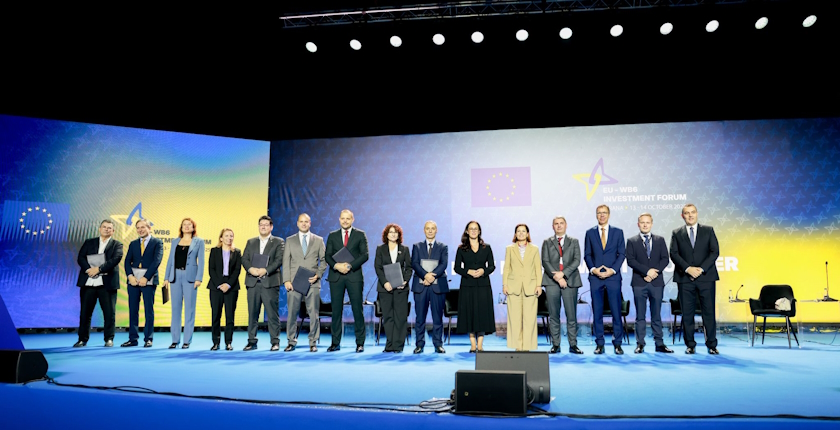
At the EU–Western Balkans Investment Forum in Tirana, held in October, GGF announced the European Union’s EUR 20 million investment in its class C shares, via Germany’s KfW Development Bank. It was accompanied by a EUR 4 million donation to the climate action fund’s capacity building and advisory facility, its advisor Finance in Motion said.

The proceeds are set to mobilize more private capital for renewable energy, energy efficiency and climate resilience across the region, the update revealed.

The Green for Growth fund signed a series of agreements at the forum for green lending, and for financing solar power and battery projects in North Macedonia, Kosovo* and Albania.

Von der Leyen: The time to invest in the Western Balkans is now

The event was attended by European Commission President Ursula von der Leyen and Albanian Prime Minister Edi Rama.

“Your economies are already set to grow rapidly in the coming years. We established the Western Balkans Growth Plan for exactly that. The EU opens sectors of its economy for your business. Together, we work on reforms for a level playing field. And alongside reforms comes investment. The Western Balkans Growth Plan aims at doubling regional GDP in the next decade. So my message to investors today is straightforward: Do not let this opportunity pass by. The time to invest in the Western Balkans is now,” Von der Leyen said.

The commitments signed within a special segment of the Tirana conference are boosting the fund’s cumulative investments into the region to more than EUR 850 million. Earlier it provided over EUR 675 million overall in green finance in the Western Balkans in support of climate action, energy security and sustainable industry.

The new commitments are expected to avoid emissions of some 175,000 tons of CO2. It is equivalent to 400,000 barrels of oil not being burnt.

Trailblazing investments ahead in photovoltaics, BESS

The Green for Growth Fund intends to provide funding for one of the first grid-scale battery projects in North Macedonia and the Western Balkans.

Renalfa IPP is about to expand its 50 MW photovoltaic plant in Oslomej, on the site of a former coal mine, with a 200 MWh battery energy storage system (BESS). GGF has already provided debt financing for the solar installation, and the two sides signed a mandate letter for EUR 24 million for the BESS investment. It is one of the investments for the transformation of the REK Oslomej coal mine and power plant complex.

Renalfa IPP’s pioneering PV plant Oslomej on coal land will get a battery facility

GGF also signed a term sheet for Quant Renewables’ solar power project in Kosovo* for 142.2 MW in peak capacity. It comprises PV plants Tucep (98.5 MW) and Veriq (43.7 MW) on land previously designated for lignite mining.

The Green for Growth Fund would support it with up to EUR 12 million in preferred equity, complementing senior debt financing led by the European Bank for Reconstruction and Development (EBRD). Set to become Kosovo’s* biggest solar park, its estimated annual output would match the electricity needs of 63,000 households.

The facility would save an estimated 168,138 tons of carbon dioxide equivalent per year (22,529 tons prorated to GGF’s investment).

The third renewables project is HD Solar Park in Albania. Through a letter of intent, GGF expressed its goal to provide up to EUR 30 million in senior debt financing. Bindi, the developer, has envisaged 60 MW of peak capacity and a co-located 120 MWh battery system. It would be one of the first large-scale solar-plus-storage initiatives in the country.

Five new deals with financial institutions for as much as EUR 110 million in total

The partner financial institutions that signed agreements with the Green for Growth Fund will channel the financing to their clients for investments in renewables, sustainable mobility, and energy and resource efficiency in buildings and industrial production.

There are five new deals for as much as EUR 110 million in credit lines and subordinated loans.

Two credit lines for partners in Kosovo*

The KRK microfinance institution in Kosovo* aims to utilize a new credit line, of EUR 5 million, for efficiency refurbishments and retrofits of the residential sector as well as small-scale renewable energy. It would be its sixth investment with the Green for Growth Fund since establishing the partnership in 2017.

BpB, the first bank in Kosovo* founded with fully local capital, finances households and small and medium-sized enterprises. Building on a previous partnership, it will channel GGF’s senior credit line of EUR 5 million into energy efficiency and renewable energy.

It will particularly benefit SMEs, including clients in the agricultural sector seeking to upgrade energy systems or invest in low-carbon vehicles, efficient equipment and modern irrigation systems, the fund added.

EUR 95 million in total for Serbian lenders

The Green for Growth Fund signed a loan agreement with UniCredit Bank Serbia for a EUR 50 million senior credit line. The focus is on commercial-scale solar and wind power, helping decarbonize Serbia’s coal-dependent electricity system.

GGF expects it to become one of the fund’s most impactful investments, by avoiding 84,550 tons of emissions in CO2 equivalent terms – equivalent to taking 44,500 cars off the road. The fund has invested EUR 115 million in UniCredit Bank Serbia to decarbonize the country’s electricity system.

Another Serbian lender in the group is AikBank, eligible for a EUR 45 million subordinated loan. The deal is for financing renewables and energy efficiency projects of corporate clients.

The bank will additionally benefit from GGF’s technical assistance for technical due diligence and environmental and social assessments, for the implementation of green energy projects in line with the best practices, the partners stressed.

ProCredit Bank in BiH is eyeing solar power projects

ProCredit Bank in Bosnia and Herzegovina is getting a subordinated loan of up to EUR 5 million, following two such facilities in 2022 and last year. The Green for Growth Fund’s investment is for maintaining the partner’s capital position and supporting the expansion of its green portfolio. The bank especially sees opportunities in solar power, where there is significant potential for BiH to catch up with regional leaders.

“We thank our investors for their continued confidence. This kind of catalytic capital drives tangible impact in Southeast Europe and shows how aligning investment with ambitious climate goals accelerates the green transition,” Finance in Motion said.

* This designation is without prejudice to positions onstatus and is in line with UNSCR 1244/99 and the ICJ Opinion on the Kosovo declaration of independence.
by in News

Eksim Energy launches production at its Yozgat wind park in central Turkey

Eksim Energy, which operates one of the biggest solar power plants in Turkey, commissioned the first part of its Yozgat wind farm. The company based in Istanbul has surpassed 1 GW in installed capacity.

Eksim Energy (Enerji) is accelerating its expansion in the green energy sector in Turkey – the company said it has received all permits for the first four turbines at its Yozgat wind farm in Central Anatolia. Now half of the planned 56 MW in capacity is online, less than a year since the start of construction.

The company, part of Eksim Holding and headquartered in Istanbul, revealed that 135 people worked 140,000 hours so far. Yozgat is its ninth wind power plant and thirteenth renewable energy facility, the update reads.

With the commissioning of the four turbines, Eksim Energy’s capacity topped 1 GW.

Just within the past year, the company also completed the expansion of its Gevye wind power plant, added a solar power segment to its Susurluk wind park and built the Viranşehir photovoltaic plant, one of the largest in Turkey.

Eksim Energy almost doubled its capacity since the end of 2024

Notably, Eksim Energy finished last year with only 569 MW, data from the annual MW100 Turkey report showed. The Uzundere hydropower plant accounts for 63 MW. The rest was wind power, making the company sixth in the segment in Turkey in 2024.

In the Gevye district in Sakarya in northwestern Turkey, the utility tripled its wind farm’s capacity to 150.2 MW. The additional investment amounted to EUR 80 million. The entire facility, which generated its first megawatt-hour in 2020, cost EUR 195 million in total.

The Viranşehir PV system in Şanlıurfa in the country’s southeast has 191.3 MW in peak capacity. The investment was worth USD 150 million.

“Our next focus will be to accelerate our integrated energy storage investments, in addition to our power plant projects, and to expand hybrid generation, where we combine solar and wind power in suitable locations, Chief Executive Officer Arkın Akbay.

by in News

North Macedonia’s ESM needs investments of EUR 3 billion to replace coal power

Power utility Elektrani na Severna Makedonija estimated that it requires EUR 3 billion by 2040 to replace electricity from its lignite-fired power plants. According to member of the Board of Directors Ivan Stojanovski, the state-owned company is preparing investments in gas power plants, solar, wind, hydropower and energy storage. He highlighted its plans for a 300 MWh battery and the Bogdanci hybrid energy park.

North Macedonia’s utility Elektrani na Severna Makedonija (ESM), the country’s main electricity producer, generated 60% of the 2024 output in the Bitola and Oslomej coal plants.

A rough estimate is that ESM would have to invest around EUR 3 billion in the next 15 years to replace its power production from lignite, which is baseload energy, Ivan Stojanovski, a member of the Board of Directors and the company’s Chief Financial Officer, told Balkan Green Energy News on the sidelines of the International Forum on Energy for Sustainable Development (IFESD-14).

He explained that the transition to green energy is quite expensive. ESM needs to replace the 840 MW in baseload production that the Bitola and Oslomej thermal power plants provide, the executive added.

Hydropower is a domestic electricity source, unlike natural gas

The company opted for investments in diverse energy sources to achieve it, Stojanovski stressed.

Gas power plants provide baseload energy, but at the same time, they turn the spotlight on national security as well as the security of supply, in his words.

Lignite is currently mined in North Macedonia while natural gas must be imported, so gas supply interruption is possible, ESM’s CFO added.

Gas power plants are required, but it is necessary to invest in hydropower as it is a domestic resource, Stojanovski said. On the other hand, hydroelectric plants are more expensive and it takes longer to build them, he noted.

ESM launched the Bitola 3 solar power project

ESM is developing wind and solar power projects as well. Stojanovski highlighted the planned expansion of its Bogdanci wind farm. The European Bank for Reconstruction and Development (EBRD) is participating in the development of the Miravci wind power project, of at least 100 MW, he recalled.

The company is working on solar power projects Oslomej 1 (10 MW), Oslomej 2 (10 MW), Bitola 1 (20 MW) and Bitola 2 (60 MW), Stojanovski asserted. Bitola 3 endeavor is underway, too, and the financing contract is expected to be signed by the end of the year, he revealed.

The photovoltaic system will have at least 100 MW, Stojanovski asserted.

“We plan to sign a contract next year with Agence Française de Développement (AFD) for a solar power plant in Bogdanci of at least 30 MW and to create a hybrid energy park there – wind, solar, and a battery,” he stated.

According to Stojanovski, the company is developing a battery energy storage project with the EBRD, for up to 300 MWh in capacity. The site is within the REK Bitola coal complex and the facility will be a systemic solution for all the solar power plants there, he explained.

Blended financing as a solution

“EUR 1 billion to EUR 1.3 billion is needed just for solar, wind and batteries. We will need between EUR 500 million and EUR 700 million for gas power plants. Another EUR 1 billion to EUR 1.3 billion would be for large hydropower plants such as Čebren and Vardar Valley, and some smaller projects,” Stojanovski explained.

Asked how the company plans to secure financing, he pointed to blended financing – own sources combined with some participation from international financial institutions. It is important to diversify the sources by opening cooperation with as many financial institutions as possible, in Stojanovski’s view.

ESM traditionally cooperates with the EBRD and KfW. Stojanovski announced that the company would diversify financing by launching cooperation with the World Bank, Italy’s development bank Cassa Depositi e Prestiti, and AFD.

“It will enable us to access more sources and complement them with financing from local banks. We also tend to obtain support from the state budget over a longer period, 10-15 years, and state guarantees, but also additional funds. This is a financial model that can secure long-term and sustainable financing of infrastructure projects,” Stojanovski said.

by in News

Cypriot firm preparing to build several solar parks with batteries

Public consultation is underway in Cyprus for environmental impact assessment (EIA) studies for three projects for photovoltaic units, of 14.5 MW in total peak capacity, with 40 MWh in battery storage. The developer, SAOLA, plans several such investments. It is facing opposition from the local population and environmentalists.

The electricity system in Cyprus is severely strained due to the lack of interconnections and energy storage and amid a photovoltaics boom and power demand surge. Even though the installation of the required battery capacity depends on substantial grid investments as well, investors are lining up to seize the opportunity in the budding market as soon as possible. Larnaca-based SAOLA opted for a group of hybrid power plants consisting of small photovoltaic units and battery energy storage systems (BESS) with a matching operating power.

Public consultation is underway for environmental impact assessment (EIA) studies that the firm submitted to the Department of Environment for three such projects. The sites are on the territory of the Agios Theodoros community, in Larnaca district.

SAOLA has vowed to apply a range of mitigation measures

One investment would involve the installation of a solar park of 5 MW in peak capacity together with a 5 MW / 15 MWh BESS. The second project is for 5.5 MW in photovoltaic panels and a battery system with a 5.5 MW capability and 15 MWh in storage capacity. The remaining facility would have 4 MW in peak PV capacity and BESS operating power, and 10 MWh of storage capacity.

The company owns the land. Suggestions and comments will be received until November 26.

Earlier, residents from the affected area raised concerns because the facilities would be on agricultural land, as well as about the impact on the rural landscape. Environmental groups and hunters pointed out that wildlife habitats would be affected.

SAOLA has vowed to conduct mitigation measures. According to the EIA studies, it would plant trees, preserve animal migration corridors and, after decommissioning, recycle equipment and return the area to its original state.

The company is preparing several other investments in photovoltaics with BESS, including in Alaminos and Anafotia in the same district.