by in News

Energy communities reduce power bills for members, improve electricity market

Citizen energy communities make the energy system greener and benefit society at a local level, Josh Roberts from European federation of energy communities REScoop said in his presentation, organized in Belgrade by Deutsche Gesellschaft für Internationale Zusammenarbeit (GIZ) GmbH. It is a form of association that also lowers costs for households, institutions and small firms and entrepreneurs, and contributes to the deployment of progressive technologies. Furthermore, it is a framework for democratic control.

The event included developers from the emerging segment of energy communities and cooperatives in Serbia. They outlined the current initiatives and pointed to challenges regarding market entry, financing and policies.

The establishment and operation of energy communities is arranged through the European Union’s latest legislation, as well as in Serbia and other Western Balkan countries, but they are not a new concept. For instance, such entities still accounted for almost half of wind power output in Denmark in late 1990s, according to Senior Policy Advisor Josh Roberts from REScoop, the European federation of energy communities and cooperatives.

Speaking at a gathering that GIZ organized in Belgrade he pointed to the benefits for citizens, small firms and entrepreneurs and for institutions from setting up or joining energy communities. Initiatives in Serbia were also presented, and their progress in the same field, and the event included dialogue on the necessary technical solutions for connecting to the distribution grid.

Brussels-based REScoop was founded in 2013. In its membership are organizations from 22 European countries. They include Serbian energy cooperative Elektropionir. It gained the most ground regarding association and the implementation of projects.

One coal town has put up signpost for energy communities in Slovenia

Among other examples, Roberts highlighted Slovenia’s first energy community with a rooftop solar power plant for joint use. The facility is on the roof of an elementary school. The project involves aid for people living in energy poverty and it is free to join the group.

It is in the town of Hrastnik in a former coal industry area. The participants already lowered their power bills by 30%, and the gains will be even greater when they pay off the loan, Roberts said.

There are more than 1,600 energy communities in Austria

The representative of the REScoop federation stressed that municipalities in the Belgian region of Wallonia have succeeded in obtaining the right for citizens to participate in investments in green energy projects. It resulted in the foundation of a range of energy communities.

Roberts especially commended Austria’s legal framework with regard to enabling citizens to participate. The country hosts more than 1,600 energy communities.
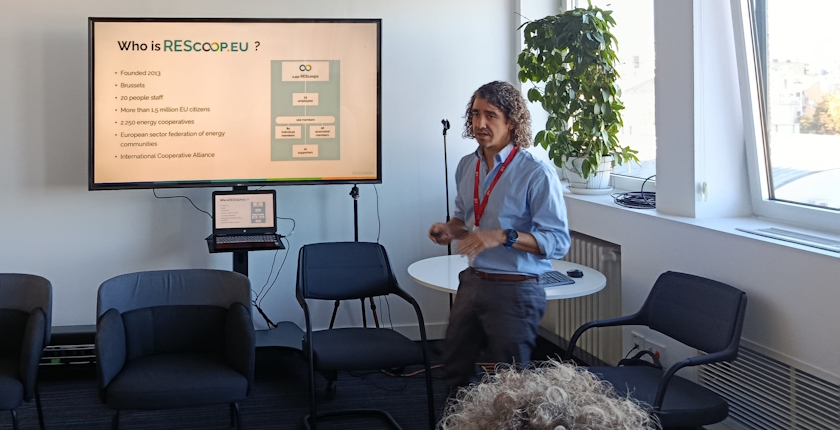
Udruzivanje energetske zajednice smanjuje troskove trziste elektricne energije Dzos Roberts Josh REScoop GIZ

Energy community eases grid operator’s job

Energy communities are envisaged to return the invested funds to society at the local level. Subsidies are especially favorable for that, Roberts explained. Income is directed to education, infrastructure and aid against energy poverty.

The essence is that the community controls the distribution of the proceeds. In addition, grid operators can communicate more easily with one entity than with a hundred prosumers, Roberts underscored. Prosumers – or buyers-consumers, as they are formally called in Serbia, generate electricity for their own needs.

Pooling together enables providing services in the market, where energy communities can supply and store energy as well as conduct energy efficiency services, among other activities.

It means an entity of such type can ease the evening grid load, in moments of the highest demand, using energy from its batteries. That way, price peak shaving is achieved.

Registration process must be separate from defining activity

As for the procedure, Roberts said registration needs to be only for acknowledgement, rather than for approving specific activities.

“It’s about acknowledging the legal form and it’s about checking about how that legal form ensures compliance with the eligibility criteria. We have found very complex registration procedures. This does not work. It needs to be simple,” he stressed.

There are many activities that energy communities can undertake and they need to be able to enter them gradually, without complex procedures for licenses and permits

Conversely, in some jurisdictions there are simplified ways to get a supplier license. It enables an energy community to enter the activity gradually, instead of having to fulfill the requirements for all segments, even without having a comprehensive business model, the members or a business case, Roberts said.

He mentioned at the same time that one of the basic ideas is promoting inclusiveness.

“It’s already hard to set up an energy community, but it’s even harder to involve members who may have a hard time paying their bills, or have a lot less disposable income. So we found that the best models at the moment are for energy communities either to front the membership fees or for local authorities to pay for this upfront. And in energy sharing, we’re seeing more and more of energy donated to vulnerable households,” he stated.

Energy cooperatives helping improve rural areas from which people are leaving

Energy communities are giving people an opportunity for climate action and to contribute to their community, Roberts said. He added that such projects improve the area where they are conducted, stressing that it is especially important for rural areas from which many people are leaving.

A key point is that they enable participants to control their costs, production, consumption and energy sharing.

 The main challenge in Serbia is how to obtain a grid connection, alongside the matter of accessibility of incentives and loans

Importantly, energy communities are linked to the tradition of cooperatives, for which Serbia used to be known, but there is still much left to do around the legal framework.

There was word at the said gathering with representatives of institutions about the complexity of adjusting the electricity network to the production’s decentralization, as well as about the possibility to streamline the procedure for the establishment of energy communities and their operation.

Serbia is yet to address the accessibility of subsidies and financing, while currently the main issue is how to get grid connection approvals.
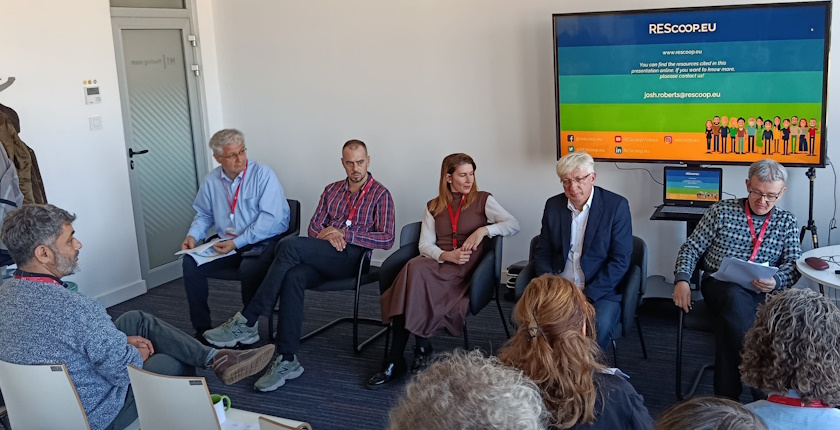
Energetsko zadrugarstvo smanjuje troskove trziste elektricne energije GIZ

Enterprise, association or cooperative

The speakers and other participants in the event agreed that the electricity market isn’t complete without energy communities, while that they modernize and democratize it.

When it comes to Serbian regulations, such legal entities have the right to conduct aggregation, but they need a license for it. Notably, aggregators have balancing responsibility, so they need to cover the deviations from the forecasted output.

Energy communities were introduced in the latest version of the Law on Energy. When they become regular in practice, the framework will need to be adjusted gradually to the situation. Citizens, firms and municipal authorities establish energy communities as enterprises, associations or cooperatives.

The bottom line is to enable citizens to take part in the clean energy transition and achieve local environmental, economic and social benefits, as opposed to prioritizing profits. It implies collective ownership, democratic control and reinvestment into the community with the goal of reducing energy poverty and promote energy independence.

The basic technical requirement for members is to have a smart electricity meter.

Elektropionir pioneering agrisolar in Serbia

The event’s organizers gathered the people who achieved the first steps in Serbia – from the Sunčani krovovi (Sunny Roofs) energy cooperative, created in 2019, to Platform for Energy Transition, which participated in uniting three residential buildings in Niš, which have a joint solar power plant and electric vehicle chargers. It is one of the first six prosumers in Serbia in the category of homeowner associations.

The Elektropionir energy cooperative managed through crowdfunding to install two cooperative-owned rooftop solar power systems on the territory of the City of Pirot, on the buildings of a local community council and a cultural center. As part of the Solarna Stara project, on Mt. Stara planina, the two villages receive the income from the sale of surplus electricity.

Srem is set to become the main region in Serbia for community energy

Next, the same organization built the first agrisolar power plant in Serbia. The 20 kV facility is at an organic farm, Organela, near the city of Valjevo.

Another recent undertaking is a rooftop photovoltaic unit on a school in the town of Ruma, envisaged to be the basis for an energy community. In the same area, Elektropionir is working on the installation of several prosumer power plants on house roofs and on aggregating them, inspired by the enthusiasm and the solar system of its member Nenad Maričić.

Owners and neighbors can jointly invest and they will be able to become an energy community and share energy among themselves.

Center for Sustainable Development to integrate string of energy systems of various technologies

Near Ruma, which is in the Srem (Syrmia) region, the City of Sremska Mitrovica and Regional Development Agency Srem have launched a major project. It is for the establishment of renewable energy communities (RECs), which are essentially a subset of citizen energy communities (CECs).

The local authority provided land for research and development. It is next to the regional waste landfill and a wastewater treatment plant. The plan is that the Center for Sustainable Development builds and integrates a string of energy systems.

They would include combined heat and power (CHP) production – cogeneration – from biomass, small wind turbines and a PV plant. The project also involves heat pumps and a storage facility assembled from old batteries.

There would be a facility running on biogas from the landfill within the center, and a magnet electric generator. Residents of the adjacent village of Jarak would be able to join the energy community.

Belgrade Energy Community is focused on equity, solidarity

Another group emerging in community energy is Belgrade Energy Community. It intends to apply a model of collective self-consumption in an urban area, with a focus on trust, equity and solidarity.

Its idea is to enable people to generate, share and use green energy. The plan is to map roofs and consumption and set up the first pilot installations.

According to the Belgrade Energy Community, it will donate 5% of the output to households affected by energy poverty. It consists of a cooperative, a civil society organization, two small enterprises, several prosumers and citizens.

by in News

3rd Conference on Advancing Renewable Investments – guarantees of origin could drive Europe’s green energy integration

As CBAM nears implementation, the Ljubljana conference highlighted market tools and partnerships to accelerate clean energy integration with the European Union, the Energy Community Secretariat said. It pointed out that as more renewables capacity is connected to the grid, storage and flexibility solutions would become increasingly vital to enable the sector’s continued growth and integration.

The rollout of national electronic registries for guarantees of origin was recognized as essential to verifying the low-carbon value of regional electricity exports and advancing market-based integration with the EU.

Ministers, regulators, investors, and private sector representatives from across South East and Eastern Europe gathered in Ljubljana for the 3rd Conference on Advancing Renewable Investments, hosted by the Energy Community Secretariat and the Government of Slovenia, to boost renewable investment and advance the region’s shift toward clean, interconnected energy systems.

“Energy Community contracting parties are advancing accelerated integration with the EU’s electricity market – a process that, thanks to the Energy Community framework, with market coupling nearing completion, can be achieved even ahead of full EU membership. Expanding renewables is central to this effort, enabling countries to align with EU policy targets and speed up decarbonisation,” the update reads.

Integration with the EU’s electricity market can be achieved ahead of full membership

The results are tangible, according to the Energy Community Secretariat’s 2025 CBAM Readiness Tracker. Renewable energy excluding large hydropower has increased by more than 50% since 2020 – reaching 5.1 GW, fuelled largely by governmental support schemes.

While it is a notable success, continued progress will depend on the contracting parties’ ability to build on this momentum and mobilize efforts beyond government support to fully meet the ambitious 2030 targets set out in their national energy and climate plans (NECPs) and achieve carbon neutrality by 2050. As more renewables capacity is connected to the grid, storage and flexibility solutions will become increasingly vital to enable the sector’s continued growth and integration, the organizers said.

Uncertanties emerging ahead of CBAM charge introduction

At the same time, as the definitive phase of the EU’s Carbon Border Adjustment Mechanism (CBAM) begins on January 1, uncertainties are emerging for renewable energy investors, the secretariat stressed.

Discussions at the conference highlighted stakeholders’ expectations for the European Commission to clarify CBAM implementation rules, while continuing to rely on the secretariat to raise concerns about potential risks to renewable energy investments arising from unintended CBAM impacts.

As a no-regret pathway, participants discussed measures to accelerate the shift toward market-driven renewable investments, strengthening the sector’s credibility and long-term financial stability. A matchmaking dialogue brought together renewables producers and corporate buyers, reflecting growing private-sector interest in long-term power purchase agreements (PPAs) to boost investment and market confidence.

Lorkowski: GOs turn transparency into trust, trust into investment

Finally, the rollout of national electronic registries for guarantees of origin (GOs) was recognized as essential to verifying the low-carbon value of regional electricity exports and advancing market-based integration with the EU.

“Guarantees of origin are the compass guiding Energy Community markets toward the EU’s clean energy future. They turn transparency into trust, and trust into investment, enabling regional producers to access new markets, attract financing, and build confidence in the energy transition,” said Energy Community Secretariat Director Artur Lorkowski.

Ongoing efforts to establish a mutual recognition framework with the EU are underway, in close coordination with the European Commission and the Association of Issuing Bodies (AIB), to enable cross-border trade in renewable electricity.

by in News

Europe’s energy storage capacity to reach 100 GW this year, more than double by 2030

Energy storage in Europe has been expanding rapidly since 2020, with the total installed capacity in the European Union, the United Kingdom, Norway, and Switzerland set to reach 100 GW by the end of November. Pumped hydro storage has the largest share of the existing capacity, 50.6 GW, followed by batteries, with 44.8 GW of operating power, according to an analysis by LCP Delta and Energy Storage Europe.

All energy storage technologies combined are expected to grow by 115%, to 215 GW, by 2030, expanding at a rate of 20 GW to 25 GW per year, according to the report, titled the European Market Monitor on Energy Storage. On November 1, the cumulative figure stood at 99.3 GW.

Battery storage capacity has seen stronger growth than pumped storage hydropower plants this year, with 4 GW of new utility-scale installations, and is projected to expand to 163 GW by 2030.

Battery storage capability is expected to reach 163 GW by 2030

Of the total 44.8 GW of battery capacity, large-scale systems connected to the grid (front of the meter) account for 17 GW, and systems installed on the customer’s side (behind the meter) for 27.8 GW.

According to the report, 18 million homes have a solar system, and four million have battery storage. Residential battery sales are now stabilizing following the 2022-2023 peak, with recovery expected from 2027, supported by a rebounding PV market, rising electrification of homes and transportation, dynamic tariffs, and new financing models.

Europe has 18 million solar homes and four million homes with batteries

Germany has the largest number of home battery systems, 2.1 million, followed by Italy, with 780,000, the UK, with 280,000, Austria, with 200,000, and Belgium, with 160,000.

Jacopo Tosoni, Head of Policy at Energy Storage Europe, hailed energy storage as the fastest-growing clean technology in Europe, with the potential to become the engine of its competitiveness, according to a press release from the association.

Silvestros Vlachopoulos, Energy Storage Research Lead at LCP Delta, said that reaching the 100 GW energy storage capacity marks a key moment for the industry, setting the stage for an even faster renewable energy growth in the coming years.

LCP Delta and Energy Storage Europe believe the energy storage industry is only just getting started and will continue to make a substantial contribution to Europe’s energy transition, according to a press release from the association.

by in News

EUSEW2026: Focus on clean, secure, competitive Energy Union

The European Sustainable Energy Week (EUSEW), Europe’s largest annual gathering dedicated to renewable energy and energy efficiency, will take place from June 9 to 11, 2026, under the theme ‘A clean, secure and competitive Energy Union’. The 20th edition of EUSEW will be held in a hybrid format, both in Brussels and online. The event will highlight the importance of building a secure, resilient Energy Union while ensuring clean and affordable energy for all.

EUSEW2026 will feature a diverse program of events, including the EUSEW Policy Conference, the EUSEW Awards, the Energy Fair, the seventh edition of the European Youth Energy Day, and Sustainable Energy Days.

The EUSEW Policy Conference will host over 60 engaging and innovative sessions organized by the clean energy community. The European Commission has opened a call for policy session proposals until January 22, inviting industry stakeholders, policymakers, civil society representatives, and academics to contribute their insights and expertise.

EUSEW Awards will be presented in three categories

The EUSEW Awards will recognize outstanding individuals and projects that drive progress in energy efficiency and renewable energy. This year, awards will be presented in three categories: Local Energy Action, Women in Energy, and, for the first time, Small and Medium-sized Enterprises (SMEs) Driving Energy Efficiency. Applications and nominations are open until January 29.

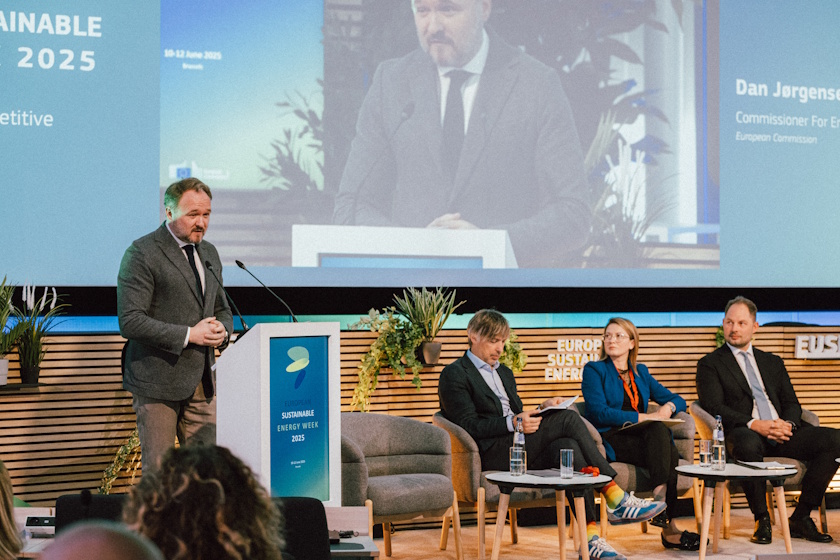
European Commissioner for Energy and Housing Dan Jørgensen at EUSEW 2025

Interested participants can also join an online info session on Wednesday, December 3, from 11:00 to 12:30 CET. Representatives of the European Commission will present this year’s theme, key milestones leading up to and during the conference, and the requirements and selection criteria for policy sessions and EUSEW Awards contributions. A timeline, Q&A, and a recording of the info session will be made available on the EUSEW2026 info page.

Additional opportunities to get involved will be announced in January and February, including options to exhibit at the Energy Fair, become a Young Energy Ambassador, or organize a local Sustainable Energy Day.

by in News

Maćić: Exempting Serbia from CBAM for electricity would mean disastrously fast decarbonization; carbon tax will also block market coupling with EU

Obtaining an exemption from the European Union’s Carbon Border Adjustment Mechanism (CBAM) for electricity would mean a rapid and unfeasible decarbonization of Serbia’s energy sector, which would be unacceptable for households and businesses alike, according to Ljubo Maćić, special advisor at Serbia’s Economics Institute. This is why Serbia never sought an exemption. He added that the implementation of the carbon border tax will prevent the coupling of electricity markets between Serbia, other Energy Community contracting parties, and the European Union, and discourage investment in renewable energy in the region.

CBAM will apply from January 1, 2026. Although the tax was announced at least five years ago and is set to take effect in less than two months, there are still many unknowns about its implementation and impact, particularly in the electricity sector.

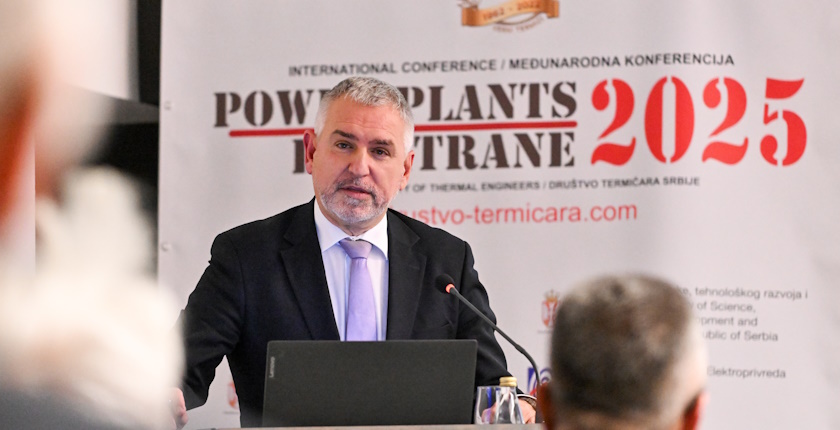
In preparation for its implementation, Serbia has drafted bills to tax greenhouse gas emissions and imports of carbon-intensive products, Ljubo Maćić noted at the Power Plants 2025 conference, organized by the Serbian Society of Thermal Engineers.

The law would allow electricity producers – primarily state-owned power utility Elektroprivreda Srbije (EPS), which will account for about 90% total GHG tax revenues and has the largest decarbonization needs – to receive a tax credit equal to 20% of investment in renewables.

The tax is set at EUR 4 per ton of CO2, which translates to about EUR 100 million annually in EPS’ case, not including the tax credit. The proposed rate is low compared to those in the EU, but many countries outside the bloc began with similar rates to protect the competitiveness of their industries, he said. Serbia’s tax would certainly increase in the coming years, Maćić warned.

The implementation of CBAM should not significantly affect EPS

The bill on the GHG emissions tax has two key shortcomings. First, the tax rate is set only for 2026, rather than for several years ahead. The second is that the tax revenues would not be allocated to a decarbonization fund but to the state budget. Maćić noted that tax revenues would go into the budget, but that the bill envisages the funds to be used for decarbonization. The solution is consistent with the revenue allocation model under the EU Emissions Trading System (EU ETS).

The bill is prudently designed, tailored to the circumstances and context, he said, adding that it would encourage changes in the right direction without jeopardizing energy security and energy prices.

“The implementation of CBAM should not significantly affect EPS, as the company doesn’t have the capacity for larger electricity exports and will likely seek to trade within this region, where the CBAM cost doesn’t apply. However, Serbia’s steel production will be particularly affected by CBAM, and this will be the hardest to address in terms of technology,” said Maćić.

Exemption for electricity

CBAM would reach its full effect over a transitional period from 2026 to 2034, aligned with the gradual rise in the CO2 price under the EU ETS. However, this will apply to all CBAM-covered goods except electricity, which will be subject to a full CBAM rate immediately.

This is why the Energy Community contracting parties were given the option to obtain an exemption for electricity until 2030, but only if they meet six conditions. A critical condition is that a country agrees to charge an emissions price equivalent to that under the EU ETS from 2030, according to Maćić. There is no indication that this doesn’t mean ‘the same price,’ he added.

Maćić explained how that would affect Serbia: The current CO2 price in the EU is EUR 80, but is expected to rise to above EUR 100, or even reach EUR 150, by 2030.

“Assuming that carbon emissions from power plants in Serbia decrease to about 22 million tons in 2030, the annual additional cost for EPS would be EUR 2.2 billion at a carbon price of EUR 100 per ton of CO2 and EUR 3.3 billion at EUR 150 per ton. If these costs were passed on to EPS’ consumers, the price would increase by about EUR 75 per MWh and EUR 110, respectively,” the expert stressed.

Of note, the market power price is currently around EUR 105.

However, not all of these costs can be passed on to end consumers, Maćić added. Households will likely be affected first if, by 2030, their electricity prices do not reach market levels. EPS cannot raise its electricity prices due to emissions costs above the market prices, because customers would switch to other, more competitive suppliers with lower emissions.

The European Commission is not willing to provide financial support for the region’s decarbonization

That is good for consumers, but it has its limits, because the production capacities of these suppliers are still far from sufficient, Maćić explained.

If other power companies in the region with a high coal share were to begin reducing their power generation, energy prices on the power exchanges would rise compared to the rest of the EU. This would result in faster price growth and volatility, in Maćić’s view.

These higher prices would affect power prices for businesses, further eroding their competitiveness, similar to what is already happening in the EU, he added.

Since the country must ensure enough electricity for all consumers, EPS would quickly incur huge financial losses, threatening the company’s operations and, more importantly, the security of the supply in Serbia.

“Such a rapid and costly decarbonization, even if it had begun earlier, would not be possible in Serbia without the ability to replace coal with other stable sources of supply. This is far from realistic, and the very idea of anyone undertaking such a fast and uncertain process is highly questionable,” Maćić stressed.

He underlined that the communication between the Ministry of Mining and Energy and European Commission institutions, the conclusions of the Energy Community Ministerial Council, and the documents within the Berlin Process for the Western Balkans six do not inidcate that the commission is ready to provide financial support for the region’s decarbonization above the level it has promised under the IPA and the Growth Plan, which is insufficient.

Three problems created by CBAM: market coupling will be blocked

According to Maćić, the European Commission has acknowledged that problems with applying CBAM to electricity exist, but has not yet offered solutions. There are three main problems, he added.

First, the existing solutions do not allow for the parallel functioning of CBAM and the coupled electricity markets of the Energy Community’s contracting parties and the EU, the expert claims.

“We have been talking about, preparing, and working on this integration for almost two decades. This, among other things, is one of the most important reasons why the Energy Community was established. CBAM will practically suspend the coupling,” Maćić insisted.

A second issue is that the costs of CBAM on electricity imports into the EU are based on the emissions factor of fossil fuel power plants, regardless of their share in the country’s power generation mix.

Maćić recalled that Serbia and other contracting parties have proposed that the emissions factor be equal to the national emissions factor, which corresponds to the electricity production mix. For Serbia, this factor is currently 1.04, but if the national power mix were taken into account, it would go down to 0.7, making the cost of CBAM about 40% lower, he explained.

All this will certainly affect trade and renewable energy investments in the region

Also, electricity producers in countries that export electricity to the EU cannot use either guarantees of origin or power purchase agreements (PPAs) to reduce the CBAM cost.

The third problem is that it is still unclear how electricity transit costs would be calculated, for example, from Bulgaria to Hungary via Serbia, and who would be required to cover them.

All this will certainly affect trade and renewable energy investments in the region, according to Maćić. This is already happening, and regardless of any potential solutions, the damage will remain, he warned.

Maćić also recalled that in June, similar issues were highlighted by the European Network of Transmission System Operators for Electricity (ENTSO-E), the European Federation of European Traders (EFET), and EUROPEX – Association of European Energy Exchanges.

They also proposed that the application of CBAM to electricity be postponed for at least a year, until solutions are found, he added.

Are there solutions?

A solution exists, according to Maćić, and it could be described as trivial: abolish CBAM for electricity.

He believes it is a legitimate question whether it was justified to introduce CBAM for electricity. The main reason for introducing CBAM is carbon leakage, which is not at all relevant in the case of electricity.

Second, total electricity imports from all Energy Community contracting parties are less than 1% of the EU’s production, and are declining. Ukraine was the only significant exporter, while imports from other countries are negligible.

“Applying CBAM to electricity would bring the EU modest climate and financial effects, while generating unsolvable problems, thwarting good intentions in market integration, and producing financial damage to the contracting parties and even larger damage to EU member states,” the expert asserted.

A less radical solution would be to postpone the implementation of CBAM, not by one but by ten years, to provide the power sector with additional long-term regulatory certainty and a stable business environment, in Maćić’s view.

Not everyone from the region can claim they have done everything they could

However, these issues do not concern the implementation acts, whose final versions are still pending, but for the CBAM regulation itself, whose amendments, as he understands, have already been implemented.

Maćić acknowledges that not everyone in the region can claim to have done everything in their power, but emphasizes that decarbonization ambitions and timelines must be realistic and supported by all necessary resources.

Maćić said he hopes the EU will show more understanding, a sense of reality, and a willingness to support the changes through solidarity. Such support could change the conditions and capacity for implementation, as well as the pace of decarbonization and changes to the energy mix, the expert underlined.

“The Energy Community Secretariat should also, when it comes to climate change, be more enthusiastic than it has been. It should be an advocate for the interests of the contracting parties in Brussels and more independent in its approach to the European Commission’s initiatives toward the contracting parties,” Maćić concluded.

by in News

Project pipeline in Greece for CO2 capture, storage nearing EUR 4 billion

Carbon capture and storage projects worth as much as EUR 3.6 billion are under development in Greece. Energean’s subsidiary EnEarth has launched a tender for drilling two wells for the Prinos site under the Aegean Sea, while DESFA won a EUR 169 million EU grant for a carbon dioxide liquefaction unit.

Investors in Greece are counting on demand from the domestic industry for carbon capture and storage (CCS), so that it can remain competitive with regard to carbon dioxide emission costs. Euro2day calculated that the project pipeline is worth up to EUR 3.6 billion as the endeavors are clearing major milestones.

The time for drilling in Prinos is approaching. EnEarth, a subsidiary of Energean, is working on the establishment of the storage facility offshore Kavala. Earlier this month it launched a tender for drilling two wells.

The Prinos project is valued at EUR 1.2 billion

Works are scheduled to begin in the first half of next year. The project is worth EUR 1.2 billion, of which the firm secured EUR 270 million in funding from the European Union. It is waiting for environmental terms (AEPO) from the Ministry of Environment and Energy, as well as for the storage permit.

Notably, a draft law covering the sector is reportedly complete.

DESFA seeks contractor to drill two wells in Prinos

Another step ahead was achieved with a project for a pipeline that would transport CO2 from energy-intensive industrial facilities to a liquefaction system in Revithoussa. The endeavor is called ApolloCO2. Greece’s National Natural Gas System Operator (DESFA) won EUR 169.3 million through the European Union’s Innovation Fund for the terminal.

The system would include temporary storage and transport by ships to permanent storage. The budget amounts to EUR 700 million in the first phase, with another EUR 60 million envisaged for an expansion.

ApolloCO2 is in a group of 61 projects in the Innovation Fund’s latest round for net zero technology, worth EUR 2.9 billion in total.

DESFA is working on the investment with Ecolog, a subsidiary of GasLog.

EU funding three major carbon capture projects that would be connected with Prinos storage site

AppoloCO2 would bring CO2 from three capture facilities also funded by the EU. There is a possibility to involve overseas customers as well.

Cement maker Heracles, part of Holcim Group, is developing the Olympus project worth EUR 400 million in Milaki, Aliveri. Its competitor Titan has a EUR 584 million endeavor underway in Kamari, Boeotia (Viotia). It is called Ifestos.

DESFA has applied for EUR 30 million from Connecting Europe Facility for the CO2 pipeline

Motor Oil Hellas aims to install a unit in its Agioi Theodoroi oil refinery costing EUR 300 million to EUR 400 million. The project is called IRIS – Innovative low caRbon hydrogen and methanol productIon by large Scale carbon capture. It is for the construction and operation of a CCUS and e-methanol production system that would cut the refinery’s CO2 emissions by a quarter. CCUS stands for carbon capture, utilization and storage.

DESFA is seeking EUR 30 million from the EU’s Connecting Europe Facility (CEF) for a 35-kilometer CO2 pipeline. The first part would go from Ifestos and branch out to HELLENiQ Energy’s oil refinery in Elefsina (Eleusis). In subsequent phases, pipelines would reach Heracles’ Olympus, Metlen’s aluminum complex in Aspra Spitia, Thisvi in Boeotia (for GEK Terna’s Heron and HELLENiQ’s subsidiary Elpedison), and eventually Motor Oil’s IRIS.

As capacities grow, larger ships would be required to lower transportation costs. According to the article, three such vessels would cost EUR 240 million overall.

by in News

OMV, Masdar to build 140 MW green hydrogen plant in Austria

OMV and Masdar are setting up a joint venture for the development and operation of the fifth-largest electrolyzer plant in Europe. The facility is already under construction in Austria. The UAE-based company would be a minority shareholder, with 49%.

Austrian integrated energy, fuels and chemicals company OMV and Masdar – Abu Dhabi Future Energy Co. signed a binding agreement to establish a joint venture for the financing, construction and operation of the 140 MW green hydrogen electrolyzer plant in Bruck an der Leitha, Austria.

It would be one of Europe’s largest green hydrogen production facilities, marking a major step in OMV’s commitment to decarbonizing its Schwechat refinery, the update adds. Construction of the facility began in September. The companies expect it to become operational in 2027.

OMV to procure electricity, own green hydrogen produced in Bruck an der Leitha

The JV will be majority-owned by OMV, with the clean energy giant from the United Arab Emirates holding 49%. The partnership combines the Austrian company’s integrated fuels and chemicals business and Masdar’s commercial, financial and technical expertise.

The two companies said they would explore opportunities for green hydrogen, e-SAF and synthetic chemicals

OMV, which is already running a 10 MW electrolyzer plant for green hydrogen in Schwechat, will procure the renewable electricity for production and own the green hydrogen produced in the new facility, the announcement reads. Bruck an der Leitha is near the borders with Hungary and Slovakia.

The partnership lays the foundation for strategic collaboration to explore green hydrogen, synthetic sustainable aviation fuels (e-SAF) and synthetic chemicals production in both the UAE and Central and Northern Europe, following the signing of a letter of intent in April. The joint venture would be set up early 2026, conditional on completion of final documentation, shareholders’ approvals and regulatory approvals.

Photo: OMV, Masdar

Hattmannsdorfer: Austria aims to become Europe’s leading hydrogen hub

The binding agreement was signed at the ADIPEC conference and exhibition in Abu Dhabi. The ceremony was held in the presence of UAE’s Minister of Industry and Advanced Technology and Chairman of Masdar Sultan Ahmed Al Jaber, Austria’s Federal Minister of Economy, Energy and Tourism Wolfgang Hattmannsdorfer, Chairman of the Executive Board and Chief Executive Officer of OMV Alfred Stern and CEO of Masdar Mohamed Jameel Al Ramahi.

“We can only secure jobs and prosperity in Austria if we stand firmly for open trade and build successful international partnerships. Together with strategic partnership between OMV and Masdar, we have brought one of the largest direct investments of recent years to Austria. OMV and Masdar are jointly constructing the fifth-largest hydrogen plant in Europe – right here in Austria. This project further strengthens Austria’s leading role in a key technology of the future. Our goal is clear: Austria aims to become Europe’s leading hydrogen hub,” Minister Wolfgang Hattmannsdorfer stated.

By combining Masdar’s global expertise in developing and scaling clean energy projects with OMV’s industrial and technological capabilities, the joint venture will accelerate the decarbonization of hard-to-abate industries, according to Masdar’s CEO Al Ramahi.

by in News

Serbia’s power utility EPS adopts Decarbonization Action Plan

Power utility Elektroprivreda Srbije has developed its Decarbonization Action Plan, said Executive Director for Investments and Development Aleksandar Jakovljević.

The Decarbonization Action Plan of Elektroprivreda Srbije (EPS) involves the gradual reduction of electricity production from coal, the construction of pumped storage hydropower plants, and over 20 GW of new capacity from renewable energy sources, Aleksandar Jakovljević explained.

For EPS, the energy transition is not only a challenge but also a great opportunity to improve the company in the process of Serbia’s industrial and technological transformation, in Jakovljević’s view.

The energy transition isn’t just a matter of adaptation and transformation of one company, but the entire energy sector, the economy, as well as society, he said at the Power Plants 2025 conference, organized by the Society of Thermal Engineers of Serbia.

Jakovljević: It is important to analyze the experiences of other countries that started the energy transition before us

Jakovljević noted that it is important to analyze the experiences of countries that started the energy transition before Serbia, to apply proven solutions and avoid mistakes. However, in his words, it is also necessary to consider the characteristics of Serbia’s power sector.

Photo: EPS/Danilo Mijatović

​The decarbonization of EPS is already underway with various projects, he asserted and added that by the end of the year, the company’s green portfolio would increase by 76 MW.

The 10 MW Petka solar power plant has been completed, and soon the trial operation of EPS’s first wind farm – Kostolac, with a capacity of 66 MW, will kick off.

Jakovljević recalled that the company is preparing to build pumped storage hydropower plant Bistrica, with a capacity of 650 MW, saying it is a key facility for the integration of renewable sources and for energy stability. He added it is also developing photovoltaic projects, including one for 1 GW and a 200 MW battery energy storage system (BESS).

From 2026, every ton of CO2 produced in EPS’s plants will be priced

EPS is developing renewable energy projects at locations near mines and coal power plants, where existing infrastructure can be utilized, and connections to transmission and distribution networks are available, Jakovljević explained.

He noted that Europe has set the climate neutrality goal for 2050, and that Serbia has committed to reducing carbon dioxide emissions by at least 33% and to produce 45% of its electricity from renewable sources by 2030.

From 2026, every ton of CO2 produced in EPS plants will be priced, exposing coal production to additional challenges, Jakovljević stressed.

However, in his words, EPS’s goal remains clear – reliable and sustainable energy for Serbia and a profitable EPS as a secure support for consumers, and energy independence in the future.

by in News

Romania to roll out flexibility market where you get paid to consume less power

Companies and, eventually, households will be able to participate in the Romanian flexibility services market, getting compensated for cutting their electricity use at a time scheduled one day earlier. The aim is to prevent power outages during peak loads in the transmission grid.

The National Energy Regulatory Authority (ANRE) of Romania published a draft regulation that would allow payments to electricity consumers – companies or, in the future, even households – for temporarily reducing their consumption. The mechanism is called the consumption flexibility service. Its purpose is to balance the grid and prevent power outages during peak consumption.

Romania’s transmission system operator Transelectrica would be able to purchase consumption reduction services from market participants: large companies, suppliers and aggregators. They would commit to temporarily limiting energy use.

Demand response also replaces expensive emergency power imports.

Day-ahead market for demand response

Transelectrica will schedule the service through auctions organized a day earlier. Market participants would be able to bid with available consumption capacity reductions and prices.

The proposed regulation requires providers or aggregators to transfer at least half of the revenues to their end customers who contributed to the consumption cut.

Renewable electricity production – especially solar – has increased significantly over the previous years. During the day, Romania sometimes produces more energy than it consumes, but in the evening, when people return home and consumption increases sharply, production no longer covers demand.

The trend is known as the duck curve, per the shape of the daily chart of demand and solar power production. It leads to imbalances and bolsters the risk of grid overload. Through flexibility services, Transelectrica will be able to shave the peaks.

Households to eventually join through their aggregators

In the first stage, the mechanism will involve large consumers such as factories, retail chains, logistics operators and office buildings. They would be able to bid with a minimum of 500 kW. Households could join at some point through so-called flexibility aggregators.

It is also important that demand response decreases balancing costs, which spill over to electricity bills.

The draft regulation is undergoing a public consultation process until December 3. According to the schedule, the flexibility market will be established in the spring.

by in News

Green light in Greece for expansion of future photovoltaic, green hydrogen complex

Greece approved the request of a firm developing a project for a giant solar park with a green hydrogen plant to double the electrolyzer capacity. The site is in the vicinity of the village of Mantasia in the Phthiotis regional unit.

The Ministry of Environment and Energy in Athens signed off on a proposed change in the project for a complex that would consist of a photovoltaic plant of a whopping 251.9 MW in peak capacity and a system for the production of green hydrogen, Newmoney reported. Mantasia Energeiaki, the project firm, is controlled by German companies Altus and Yamko Energy and France-based Omnes Capital, according to the article.

They can build a 100 MW green hydrogen unit, instead of the initially planned 50 MW. Altus is a subsidiary of Kraftwerke Mainz-Wiesbaden AG (KMW).

The project developers are planning to produce hydrogen in PEM electrolyzers

The site, Karahasan, is near Mantasia, a village in the municipality of Domokos in the Phthiotis (Fthiotida) regional unit. Most of the area is in the territory of the community of Fyliadonos. The proton exchange membrane (PEM) electrolysis facility would comprise ten units of 10 MW.

Total area envisaged for the project in Central Greece spans ​​427 hectares, of which 1.1 hectares for green hydrogen production. It would be stored in several units of 40 tons overall.

The project includes a 400/33 kV substation, with a capacity of 600 MVA, equivalent to 600 MW, as two similar projects would be connected through it. As for the PV plant, it would have 530 W monocrystalline silicon modules and 48 Sunny Central 4600 UP inverters.