by in News

OSSH Launches €4.4 Million Smart Meter Installation Project Across Albania

The Electricity Distribution System Operator (OSSH) plans to begin the installation of smart meters for end consumers.

This Thursday, the operator launched a procurement procedure through the public procurement system titled: “Installation of the Smart Metering System for End Consumers, within the Energy Balance Metering System in MV-LV Electrical Substations, and their integration into the OSSH metering platform,” with a total estimated fund of 432 million lekë, or approximately €4.4 million.

According to the tender documents, the investment will focus on areas with high electricity consumption and higher levels of network losses, with the aim of improving technical efficiency and strengthening control over electricity distribution.

As part of previous projects, OSSH has already installed thousands of smart meters in several regions across the country. In Durrës, during the 2023 investment phase, 1,752 intelligent energy balance metering systems were installed in MV-LV substations, while in 2024 an additional 848 smart meters were installed for end consumers supplied by these substations.

Meanwhile, in Tirana, on feeders F7 and F8 of the Kashar substation, 200 intelligent balance metering systems and 3,157 smart meters were installed for end subscribers.

According to OSSH, the expansion of the project is also linked to the growing number of consumers in these areas, driven by population growth and new urban developments, including construction projects carried out as part of the reconstruction efforts following the 2019 earthquake.

The company states that the investment is part of its strategy to gradually replace the analog metering system with smart technology, in accordance with the electricity law and the directives of the European Energy Community.

The operator emphasizes that maintaining the same communication technology is intended to ensure compatibility with existing investments and maximize the use of the infrastructure developed so far.

The tender foresees the installation of a total of 14,035 smart meters. The largest number will be installed at the Sallmone substation with 7,760 units, followed by Shkoza with 3,560 meters, Spitalla with 1,600, and Kashari with 1,115 smart meters.

by in News

Strengthening Europe’s Energy Sovereignty: The Imperative of a Clean Heat Transition

While often framed as a macroeconomic abstraction, Europe’s reliance on fossil fuel imports carries direct, tangible consequences for millions of households. Domestic energy security is fundamentally tied to the home; space and water heating account for 77.6% of the average EU household’s energy consumption, with approximately one-third of these homes relying on gas. By 2025, 90% of the EU’s gas supply was sourced from third countries, creating a strategic vulnerability to energy coercion that endangers the stability of millions of residences.

Diversification vs. Decarbonization: The REPowerEU Challenge

Historically, Russia served as the primary architect of Europe’s gas supply. In the wake of the full-scale invasion of Ukraine, the EU successfully pivoted, slashing Russian imports from 45% to 12%. This shift was codified through the REPowerEU Regulation, which aims to secure energy independence by permanently banning Russian fossil gas.

However, the broader imperative is not merely to swap suppliers, but to reduce gas demand entirely. This requires equal commitment to the other two pillars of the 2022 REPowerEU Plan: energy conservation and an accelerated clean energy transition. Current projections are sobering:

  • Heat Pump Shortfall: Europe is currently on track to meet only half of its deployment targets.

  • Demand Impact: This lag means fossil gas demand will likely only decrease by 60% of 2024 Russian import levels, rather than the intended 120%.

Bridging the €78 Billion Funding Gap

Achieving a clean heat transition requires significant capital. A study by LCP Delta for the Cool Heating Coalition identifies an annual investment gap of €78 billion through 2050. At present, combined public and private sector contributions cover only half of this requirement.

To close this disparity, Europe must look toward smarter fiscal reallocation:

  • Subsidy Realignment: The EU currently directs approximately €111 billion per year toward fossil fuel subsidies. Redirecting this capital toward renewable solutions would effectively bridge the clean heat funding gap.

  • Innovative Business Models: Policymakers should incentivize “social leasing” frameworks. This requires updating the Consumer Credit Directive to ensure these schemes are covered by robust consumer protection laws.

  • The Role of ETS2: The upcoming ETS2—which prices emissions from buildings and road transport—will be a pivotal market driver. When paired with the Social Climate Fund, it provides a mechanism to finance the transition while shielding the most vulnerable consumers.

The Path to Strategic Autonomy

The postponement of ETS2 for one year in December 2025 sent a confusing signal to the clean heat market. There is no longer room for delay. Member States must utilize this additional window to aggressively support the shift to decarbonized heating, remediate housing inadequacies, and reduce the energy load of the continent’s worst-performing buildings.

Since 2022, the EU has demonstrated remarkable resilience in reducing its dependence on Russian energy. However, as new geopolitical shocks emerge, Europe must prioritize the elimination of all strategic vulnerabilities. The legal framework exists; the transition now requires the political resolve to see it through.

by in News

Croatia, Serbia jointly install solar power plants at 30 public buildings

As part of a cross-border cooperation initiative, 30 public buildings in the Serbian city of Subotica and the Croatian municipalities of Vladislavci, Gorjani, and Strizivojna have installed solar power plants. The project also included the construction of smart bus stops and the upgrade of public lighting.

The investments were implemented through the Energy Efficient Communities – ENGAGE project, worth more than EUR 2 million. It was financed with the support of the European Union and implemented with expert support from the National Alliance for Local Economic Development (NALED).

Local authorities from Serbia and Croatia have demonstrated how cross-border cooperation can bring concrete and measurable benefits to citizens – from lower energy costs to cleaner air, NALED said.

serbia croatia solar engage project public buildings NALED eu

Panić: The most important result is a change in awareness about the role of institutions and citizens in energy efficiency

The total installed capacity of the photovoltaic plants within the project is 0.8 MW, of which 0.5 MW is in Subotica and 0.3 MW in the Croatian municipalities.

The City of Subotica has announced it would set up a renewable energy community, paving the way for citizens, institutions, and local businesses to jointly produce and consume energy from renewable sources.

Lulić: The project included training on energy communities

Zagorka Panić, City Manager and Deputy Mayor of Subotica, stressed that the most important result is a change in awareness about the role of institutions and citizens in energy efficiency. The completion of the project does not mean the end of cooperation, but rather a foundation for new joint steps toward a sustainable future, she added.

“The project included training on energy communities, sustainable energy sources, and the strengthening of local communities’ resilience. The key results include the development of a model and pilot activities for establishing energy-efficient communities in rural cross-border areas,” said Natali Lulić, Minister Plenipotentiary at the Embassy of the Republic of Croatia in Serbia.

Trifunović: A model that meets the real needs of local communities

According to Nataša Trifunović, Head of the Renewable Energy Sources Group at the Serbian Ministry of Mining and Energy, the project was implemented at a time of significant changes in the energy sector, both globally and nationally.

The world is undergoing a rapid energy transition, with a strong growth of renewables, especially solar and wind energy, she added.

Vasiljević: CO2 emissions reduced by about 520 tons annually

The project, in her view, is a good example of how cross-border cooperation and joint effort can be used to develop models that meet the real needs of local communities.

Trifunović said that one of the important strategic commitments is the further development of decentralized energy solutions, by encouraging the role of local authorities, citizens, and the business community in energy production and consumption.

Dušan Vasiljević, Director for Competitiveness and Investments at NALED, stressed that these investments contribute to reducing CO2 emissions by 520 tons annually. It is the amount of pollution produced by about 120 cars in a year, or the amount of CO2 that approximately 18,000 trees can absorb over the same period, he added.

by in News

Kosovo’s* just energy transition: greening the Kingdom of Coal

Author: Tringë Shkodra

Kosovo’s* energy transition has great potential but key players such as small and medium-sized enterprises (SMEs) and young people are facing structural exclusion.

Our energy system is still heavily dependent on dirty fossil fuels and overburdened by frequent outages, reliance on imports, and growing costs, particularly during the winter when demand is at its highest and most households and businesses can no longer afford to pay energy bills. While infrastructure upgrades are essential, they are not enough. In order to succeed, this transition must be just, meaning it needs to be inclusive and rooted in the lived experiences of the people it aims to serve.

Understanding Kosovo’s* distinct socio-economic landscape, with the country having the youngest population in Europe as well as a large number of SMEs, is essential for addressing its development challenges and unlocking its potential.

SMEs form the backbone of the Kosovan* economy but get structurally excluded from accessing energy-saving practices. Many studies shed light on energy efficiency within Kosovo’s* private sector – particularly among SMEs, and show that these businesses face serious barriers to adopting sustainable practices. While larger firms are more likely to invest in energy-saving technologies, SMEs struggle with access to finance, lack awareness, and get minimal institutional support.

Businesses require energy efficiency for survival

Yet energy audits show that many could reduce consumption by up to 40% with low-cost interventions. This isn’t about reluctance, but structural exclusion. Energy efficiency, in this context, is not just a technical fix but a survival strategy for businesses.

With the right incentives, this sector can become a driver of Kosovo’s* green transition, creating jobs and fostering innovation.

Youth rarely invited to table

Another overlooked potential for Kosovo’s* energy transition are the youth. Over half of Kosovo’s* population is under the age of 30, yet their involvement in environmental governance remains limited. A study of youth participation in environmental and climatic concerns across ten municipalities of Kosovo* found that, while 63% of young respondents reported a strong desire to contribute to environmental policymaking, only 15% had ever participated in such processes.

Youth-led initiatives, innovation hubs, and climate advocacy networks are lacking institutional trust and real influence

This isn’t a lack of engagement; it’s again a lack of access. Youth-led initiatives, innovation hubs, and climate advocacy networks are already active, but they need to be met with institutional trust and real influence. The potential of our youth is vast – from engineers developing solar microgrids to community organizers shaping local green agendas. However, without inclusion, this potential remains untapped. We are ready to lead, but we are rarely invited to the table.

Dependence on lignite is cause of public health crisis

Advancing fundamental reforms aligned with European values is a prerequisite for sustainable development. This includes harmonizing structural reforms outlined in the Economic Reform Programmes (ERPs), strengthening the rule of law, and embedding the energy transition within the European Union’s broader green agenda. Kosovo’s* overreliance on lignite coal poses not only environmental but social risks, and the outdated mindset of living in the Kingdom of Coal clashes with the urgent need for a clean, secure, and just energy future.

Data from Riinvest Institute outlines clearly that over 90% of Kosovo’s* electricity is still produced from coal, while renewable energy accounts for less than 6%. This dependence is more than an economic liability – it is a public health crisis. Around 300,000 to 400,000 people live within 30 kilometers of lignite-fired power plants Kosovo A and Kosovo B, which lack modern emission controls.

Air pollution and outdated technology put thousands at risk every day. The urgency to diversify the energy mix isn’t only environmental – it is humanitarian. Energy, when approached with justice in mind, can become a tool for dignity and equal opportunity.

Despite a myriad of strategies and policy documents, Kosovo* has made only partial progress in aligning with EU energy and environmental standards. The Energy Community Annual Implementation Report (2024) shows that implementation across clusters such as decarbonization and energy security ranges from just 40% to 66%. True transformation demands more than technical upgrades as it requires institutional coordination, transparency, and strong evidence-based policymaking.

We are transitioning lives

In a recent conversation, a national energy expert put it simply: “We are not just transitioning technologies. We are transitioning lives.” A just energy transition must therefore encompass more than grid modernization or solar farms. It requires tailored policies – legislation that removes bureaucratic bottlenecks, the rollout of incentives for low-income households to adopt renewables, and clear pathways for communities to become prosumers.

Kosovo’s* policy frameworks, such as the forthcoming National Energy and Climate Plan and the renewable energy law, must be instruments of real transformation – practical, inclusive, and focused on impact.

Permitting procedures for renewables need to be simplified

To catalyze a just energy transition, the country requires comprehensive investments across its energy infrastructure while ensuring that reforms are socially inclusive and environmentally sound. This begins with diversifying the energy mix by prioritizing renewables – particularly solar and wind – through competitive auctions and de-risked investment environments that attract private sector participation. Kosovo* must simplify permitting procedures, build institutional expertise, and enhance the grid’s technical capacity to absorb renewable inputs.

Alongside infrastructure upgrades, investments are needed in energy efficiency for public and private buildings, especially given the country’s high winter heating demand and grid losses. Carbon-free heating solutions and retrofitting programs can help reduce both emissions and energy poverty, especially among vulnerable groups.

Subsidies must be designed for low-income households

Financing this transformation requires a blended approach – mobilizing domestic resources, securing grants from the EU and the United States, and leveraging international financial institutions through loans with state guarantees. But energy justice is not only about technology or money, it is about who benefits. Subsidies and support schemes must be designed for low-income households to participate in renewable adoption as consumers and prosumers.

A just transition brings inclusive growth and long-term climate resilience

Moreover, Kosovo* must link its investment strategies to broader social objectives, like upskilling labor for green jobs, protecting coal-reliant communities, and embedding equity and participation in every step of reform.

Kosovo* needs to make use of its strengths, and supports its young population, smaller enterprises and low-income households. Without an integrated approach, it risks reinforcing existing inequalities, but if it creates an energy transition that is just for the people, the country can turn its transition into a platform for inclusive growth, and long-term climate change resilience.

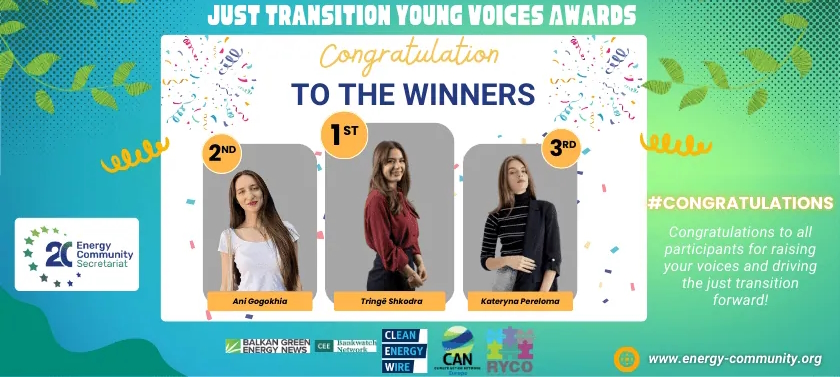
Tringe Shkodra Just Transition Young Voices Awards

* This designation is without prejudice to positions onstatus and is in line with UNSCR 1244/99 and the ICJ Opinion on the Kosovo declaration of independence.
by in News

Kosovo’s* just energy transition: greening the Kingdom of Coal

Author: Tringë Shkodra

Kosovo’s* energy transition has great potential but key players such as small and medium-sized enterprises (SMEs) and young people are facing structural exclusion.

Our energy system is still heavily dependent on dirty fossil fuels and overburdened by frequent outages, reliance on imports, and growing costs, particularly during the winter when demand is at its highest and most households and businesses can no longer afford to pay energy bills. While infrastructure upgrades are essential, they are not enough. In order to succeed, this transition must be just, meaning it needs to be inclusive and rooted in the lived experiences of the people it aims to serve.

Understanding Kosovo’s* distinct socio-economic landscape, with the country having the youngest population in Europe as well as a large number of SMEs, is essential for addressing its development challenges and unlocking its potential.

SMEs form the backbone of the Kosovan* economy but get structurally excluded from accessing energy-saving practices. Many studies shed light on energy efficiency within Kosovo’s* private sector – particularly among SMEs, and show that these businesses face serious barriers to adopting sustainable practices. While larger firms are more likely to invest in energy-saving technologies, SMEs struggle with access to finance, lack awareness, and get minimal institutional support.

Businesses require energy efficiency for survival

Yet energy audits show that many could reduce consumption by up to 40% with low-cost interventions. This isn’t about reluctance, but structural exclusion. Energy efficiency, in this context, is not just a technical fix but a survival strategy for businesses.

With the right incentives, this sector can become a driver of Kosovo’s* green transition, creating jobs and fostering innovation.

Youth rarely invited to table

Another overlooked potential for Kosovo’s* energy transition are the youth. Over half of Kosovo’s* population is under the age of 30, yet their involvement in environmental governance remains limited. A study of youth participation in environmental and climatic concerns across ten municipalities of Kosovo* found that, while 63% of young respondents reported a strong desire to contribute to environmental policymaking, only 15% had ever participated in such processes.

Youth-led initiatives, innovation hubs, and climate advocacy networks are lacking institutional trust and real influence

This isn’t a lack of engagement; it’s again a lack of access. Youth-led initiatives, innovation hubs, and climate advocacy networks are already active, but they need to be met with institutional trust and real influence. The potential of our youth is vast – from engineers developing solar microgrids to community organizers shaping local green agendas. However, without inclusion, this potential remains untapped. We are ready to lead, but we are rarely invited to the table.

Dependence on lignite is cause of public health crisis

Advancing fundamental reforms aligned with European values is a prerequisite for sustainable development. This includes harmonizing structural reforms outlined in the Economic Reform Programmes (ERPs), strengthening the rule of law, and embedding the energy transition within the European Union’s broader green agenda. Kosovo’s* overreliance on lignite coal poses not only environmental but social risks, and the outdated mindset of living in the Kingdom of Coal clashes with the urgent need for a clean, secure, and just energy future.

Data from Riinvest Institute outlines clearly that over 90% of Kosovo’s* electricity is still produced from coal, while renewable energy accounts for less than 6%. This dependence is more than an economic liability – it is a public health crisis. Around 300,000 to 400,000 people live within 30 kilometers of lignite-fired power plants Kosovo A and Kosovo B, which lack modern emission controls.

Air pollution and outdated technology put thousands at risk every day. The urgency to diversify the energy mix isn’t only environmental – it is humanitarian. Energy, when approached with justice in mind, can become a tool for dignity and equal opportunity.

Despite a myriad of strategies and policy documents, Kosovo* has made only partial progress in aligning with EU energy and environmental standards. The Energy Community Annual Implementation Report (2024) shows that implementation across clusters such as decarbonization and energy security ranges from just 40% to 66%. True transformation demands more than technical upgrades as it requires institutional coordination, transparency, and strong evidence-based policymaking.

We are transitioning lives

In a recent conversation, a national energy expert put it simply: “We are not just transitioning technologies. We are transitioning lives.” A just energy transition must therefore encompass more than grid modernization or solar farms. It requires tailored policies – legislation that removes bureaucratic bottlenecks, the rollout of incentives for low-income households to adopt renewables, and clear pathways for communities to become prosumers.

Kosovo’s* policy frameworks, such as the forthcoming National Energy and Climate Plan and the renewable energy law, must be instruments of real transformation – practical, inclusive, and focused on impact.

Permitting procedures for renewables need to be simplified

To catalyze a just energy transition, the country requires comprehensive investments across its energy infrastructure while ensuring that reforms are socially inclusive and environmentally sound. This begins with diversifying the energy mix by prioritizing renewables – particularly solar and wind – through competitive auctions and de-risked investment environments that attract private sector participation. Kosovo* must simplify permitting procedures, build institutional expertise, and enhance the grid’s technical capacity to absorb renewable inputs.

Alongside infrastructure upgrades, investments are needed in energy efficiency for public and private buildings, especially given the country’s high winter heating demand and grid losses. Carbon-free heating solutions and retrofitting programs can help reduce both emissions and energy poverty, especially among vulnerable groups.

Subsidies must be designed for low-income households

Financing this transformation requires a blended approach – mobilizing domestic resources, securing grants from the EU and the United States, and leveraging international financial institutions through loans with state guarantees. But energy justice is not only about technology or money, it is about who benefits. Subsidies and support schemes must be designed for low-income households to participate in renewable adoption as consumers and prosumers.

A just transition brings inclusive growth and long-term climate resilience

Moreover, Kosovo* must link its investment strategies to broader social objectives, like upskilling labor for green jobs, protecting coal-reliant communities, and embedding equity and participation in every step of reform.

Kosovo* needs to make use of its strengths, and supports its young population, smaller enterprises and low-income households. Without an integrated approach, it risks reinforcing existing inequalities, but if it creates an energy transition that is just for the people, the country can turn its transition into a platform for inclusive growth, and long-term climate change resilience.

Tringe Shkodra Just Transition Young Voices Awards

* This designation is without prejudice to positions onstatus and is in line with UNSCR 1244/99 and the ICJ Opinion on the Kosovo declaration of independence.
by in News

Spajić: Japanese company Itochu eyes Montenegro’s waste-to-energy project

Prime Minister of Montenegro Milojko Spajić said an incinerator of up to 50 MW is about to be built, resolving the municipal waste management issue. He added that Itochu from Japan is interested in the investment.

Following a public call for a feasibility study for a waste-to-energy facility in Podgorica, Prime Minister Milojko Spajić said Montenegro would soon build the first incineration plant. It will enable up to 50 MW of renewable energy from waste, sorting out the matter of municipal waste management in accordance with the European Union’s directives and in an environmentally friendly way, in his words.

The public-private partnership will facilitate the construction of an incinerator for the capital city, but it would also be an option for other municipalities, according to Spajić. The prime minister revealed that Japan-based engineering giant Itochu is among the companies interested in the project.

Deponija, the utility in charge of waste management in Podgorica, launched the public call in September. The contract was awarded last month to a consortium of local firms Vatreks Rescue CG and Medix, and Slovenia-based GP sistemi.

A consortium has won the contract for the feasibility study for the incineration facility in Podgorica

They are due to deliver the documentation within two months. The job is worth EUR 435,600 including value-added tax.

There was no indication in the project task about the preferred technology for the incinerator. Such facilities are usually cogeneration plants, combined heat and power (CHP).

In the Western Balkans, there is only one municipal waste incinerator that recovers energy. It is located in Belgrade, the capital of Serbia. Utilizing waste to generate energy is a component of the waste management hierarchy. Incinerators are present all over Europe.

Podgorica’s waste utility Deponija runs the city’s landfill. It already captures biogas, but it flares it without utilizing the energy.

Executive director Aleksandar Božović said the firm would soon obtain the licenses and documentation to build a biogas power plant. The study has been completed, and Deponija is working to secure a grant from an international financial institution, he asserted.

by in News

Spajić: Japanese company Itochu eyes Montenegro’s waste-to-energy project

Prime Minister of Montenegro Milojko Spajić said an incinerator of up to 50 MW is about to be built, resolving the municipal waste management issue. He added that Itochu from Japan is interested in the investment.

Following a public call for a feasibility study for a waste-to-energy facility in Podgorica, Prime Minister Milojko Spajić said Montenegro would soon build the first incineration plant. It will enable up to 50 MW of renewable energy from waste, sorting out the matter of municipal waste management in accordance with the European Union’s directives and in an environmentally friendly way, in his words.

The public-private partnership will facilitate the construction of an incinerator for the capital city, but it would also be an option for other municipalities, according to Spajić. The prime minister revealed that Japan-based engineering giant Itochu is among the companies interested in the project.

Deponija, the utility in charge of waste management in Podgorica, launched the public call in September. The contract was awarded last month to a consortium of local firms Vatreks Rescue CG and Medix, and Slovenia-based GP sistemi.

A consortium has won the contract for the feasibility study for the incineration facility in Podgorica

They are due to deliver the documentation within two months. The job is worth EUR 435,600 including value-added tax.

There was no indication in the project task about the preferred technology for the incinerator. Such facilities are usually cogeneration plants, combined heat and power (CHP).

In the Western Balkans, there is only one municipal waste incinerator that recovers energy. It is located in Belgrade, the capital of Serbia. Utilizing waste to generate energy is a component of the waste management hierarchy. Incinerators are present all over Europe.

Podgorica’s waste utility Deponija runs the city’s landfill. It already captures biogas, but it flares it without utilizing the energy.

Executive director Aleksandar Božović said the firm would soon obtain the licenses and documentation to build a biogas power plant. The study has been completed, and Deponija is working to secure a grant from an international financial institution, he asserted.

by in News

Applications open for EUSEW2026 Awards

Applications are now open for the European Sustainable Energy Awards (EUSEW) 2026. They recognise individuals, initiatives, and projects that promote best practices and raise awareness of the importance of sustainable energy solutions across Europe.

EUSEW is Europe’s largest event dedicated to renewable energy and energy efficiency. It features a wide range of activities, including the European Sustainable Energy Awards ceremony.

The EUSEW Awards recognise and celebrate people, projects, and initiatives that contribute to Europe’s transition to clean energy. They highlight achievements that support the goals of the EU’s Clean Industrial Deal and encourage others to adopt best practices in building a sustainable energy future.

The awards are presented in three categories: Local Energy Action, Women in Energy, and, for the first time, Small and Medium-Sized Enterprises (SMEs) as Energy Efficiency Leaders.

The competition showcases innovative approaches to shaping Europe’s energy future and culminates in an awards ceremony held during the EUSEW conference, which will take place from June 9 to 11 next year in a hybrid format. Participants and speakers will be able to attend both online and in person in Brussels. The slogan of this year’s edition, 20th EUSEW, is ‘A clean, secure and competitive Energy Union’.

Finalists will be selected by an expert jury, which will assess applications based on three criteria: concept, implementation, and impact. Each criterion carries a maximum of ten points. The winners will be chosen through a public vote.

Interested applicants may apply directly by January 29 or nominate someone who has made an outstanding contribution to the energy transition.

SMEs as energy efficiency leaders

This year, a new award category has been introduced to recognise the creativity and impact of small and medium-sized enterprises developing innovative business or financing models to improve energy efficiency.

Eligible applicants include SMEs operating in at least one EU member state that have a pilot or commercial project representing an innovation in energy efficiency or financing.

The European Commission and the European Investment Bank have announced a EUR 17.5 billion financing initiative aimed at improving energy efficiency among SMEs, which is expected to benefit around 350,000 businesses across the EU.

Local Energy Action Award

This category recognises clean energy initiatives that demonstrate the strength of community action. It includes associations, organisations, and groups of citizens delivering long-term, real-scale sustainable energy solutions through local and regional projects, with wider social, economic, and environmental benefits.

Last year’s winner was the Community Energy for Social Housing in Otterbeek. The project provides vulnerable residents with access to renewable energy in the Belgian city of Mechelen. Around 200 households in the Otterbeek social housing district have been equipped with solar panels and receive green electricity at a fixed price below market rates.

Women in Energy: leadership that transforms

The Women in Energy Award celebrates women who are shaping Europe’s clean energy transition and redefining leadership in the energy sector, with a particular focus on gender equality and equal opportunities.

Last year’s winner in this category was Stella Tsani, a scientist and associate professor at the University of Athens.

She was recognised for her work linking economics, sustainability, and social wellbeing to help shape fair and effective energy policies across Europe and the Mediterranean. In addition to her influential research, Tsani is a dedicated mentor to young women in the energy sector, contributing to an inclusive and future-oriented clean energy transition.

by in News

North Macedonia plans energy renovation of 14 major public buildings

North Macedonia’s Ministry of Energy, Mining, and Mineral Resources has finalized a plan for the reconstruction of 14 public buildings, describing it as the most extensive energy renovation of the country’s institutions to date.

The plan for the reconstruction of buildings used by the state administration for the period 2025–2028 establishes a clear, three-year framework for the most extensive energy renovation of institutions in the country to date, the Ministry of Energy, Mining, and Mineral Resources said.

The program covers 14 public buildings with a total usable area of nearly 103,000 square meters. They host 33 institutions with 5,000 employees.

The estimated value of the program is about EUR 11.11 million, including technical inspections, projects, supervision, and implementation, according to the ministry.

The plan aims to ensure less pollution, better air quality, and more efficient spending of public funds

The ministry pointed out that the goal of the energy renovation is to reduce energy costs, improve working conditions, reduce emissions, and modernize the public sector in line with European standards.

Less pollution, better air quality, and more efficient use of public money are the benefits that will be felt by both institutions and citizens, the ministry stressed.

This strategic document is envisaged by the reform agenda and represents a legal obligation to renovate at least 3% of the total usable area of public buildings each year.

The ministry recalled that the plan marks an important step in the transposition of European Union legislation on energy efficiency – Directive 2018/2002/EU and Regulation 2018/1999/EU – and that it is aligned with the country’s obligations towards the Energy Community.

The plan covers three groups of buildings

The plan groups buildings into three categories according to their condition and the urgency of renovation.

The first group includes the buildings used by the Ministry of Health (along with the Institute for Public Health and the state sanitary and health inspectorate), the State Statistical Office, the Agency for Real Estate Cadastre, and the hydrometeorological administration.

The second group includes part of the Ministry of Economy, the building housing the administration agency, the state inspectorate for energy, mining and mineral resources, as well as a broad administrative bloc — including the Ministry of Public Administration, the Ministry of Education and Science, the Ministry of Local Self‑Government, the State Election Commission, the Agency for Medicines, and the secretariat for legislation.

The third group includes eight buildings that were previously renovated but require energy upgrades and modern systems.

Each building will undergo an energy audit, after which specific measures will be defined – ranging from thermal insulation of façades and window replacement to the installation of solar thermal systems, PV panels on roof structures, and modern heating, lighting, and automated consumption-control systems, the ministry explained.

by in News

Serbia rolls out taxes on greenhouse gas emissions, imported carbon-intensive products

The Serbian Law on Greenhouse Gas Emissions Tax and Law on Carbon-Intensive Product Imports Tax, both at EUR 4 per ton of CO2 equivalent, are coming into effect on January 1. It is the country’s answer to and equivalent of, respectively, the European Union’s Carbon Border Adjustment Mechanism (CBAM). Notably, several bylaws are still required for the new legislation to be enforced.

The National Assembly of Serbia passed the Law on Greenhouse Gas Emissions Tax and Law on Carbon-Intensive Product Imports Tax today, without accepting any of the opposition’s proposals for changes in the two bills.

On January 1, importers of electricity, cement, iron and steel, aluminum, hydrogen and fertilizers to the European Union will start paying the CBAM carbon dioxide tax. If the country of origin also has a CO2 pricing system and the EU recognizes it, the sum will be deducted from CBAM.

The domestic greenhouse gas emissions tax is Serbia’s answer to the cross-border levy, while with the new import tax it is establishing a corresponding mechanism. Both are EUR 4 per ton of CO2 equivalent, covering also nitrous oxide (N2O) and perfluorocarbons (PFCs).

They are intended to lower pollution, improve energy efficiency, incentivize the deployment of renewable energy and secure a more equal position for the Serbian industry in the domestic and international markets, according to the sidenotes.

Both laws to enter into force on January 1, when EU also starts charging CBAM

The first of the two taxes is for big industrial emitters in the sectors of cement, fertilizers, iron and steel, aluminum and electricity. Both laws are coming into effect on January 1, just like the CBAM charge. However, several bylaws are still required for Serbia to enforce the new legislation.

The CBAM tax is envisaged to rise every year until in 2034 it becomes equal as the prices of greenhouse gas emission certificates in the EU’s Emissions Trading System (EU ETS). Electricity is different, as the amount will from the start correspond to the carbon intensity of the country of origin’s entire production mix.

According to Special Advisor at Serbia’s Economics Institute Ljubo Maćić, charging CBAM will prevent power market coupling between Serbia, other Energy Community contracting parties and the European Union, and discourage investment in renewables.

Of note, the administration in Brussels plans to expand the mechanism to other segments that EU ETS covers.

No electricity in carbon imports tax

The Law on Carbon-Intensive Product Imports Tax doesn’t cover electricity because of technical limitations and a lack of a precise taxing methodology.

The tax on imported carbon-intensive products covers only the entities that import five or more tons of the designated products per year

Importers are taxed based on emissions embedded in the production of the goods from abroad, but they will be able to use tax credits if an emissions levy has already been paid in the country of origin, similar to the EU system. The obligation is only for companies importing five or more tons of designated products per year.

Serbia imports an estimated 3.5 million tons of carbon-intensive products per year.

CO2 tax scope limited to larger producers

The CO2 tax law will be applied to firms obligated to have a license for emissions from their plants. Mostly they are large and medium-sized companies. Fifty companies have obtained such licenses for 92 facilities. They measure emissions data, in line with the Law on Climate Change, and send them to the Ministry of Environmental Protection.

The production of synthetic fertilizers and nitrogen compounds, cement, pig iron, steel and ferroalloys, aluminum and electricity accounts for over 57% of emissions in Serbia and more than 90% within the national monitoring and reporting system.

Tax deductions for large electricity producers that invest in decarbonization

A payer of the greenhouse emissions tax that predominantly generates electricity, accounting for at least 80% of its income in the previous annual tax period, is eligible for a tax credit amounting to 20% of the sum that it invested in decarbonization measures, the law stipulated.

The deduction can’t exceed 80% of the due tax. The government determines the said measures.

The greenhouse gas emissions tax envisages incentives for the taxpayers to finance green projects, the just transition and protection of vulnerable households

In addition, entities that pay the tax are eligible for incentives, from the state budget, for financing climate and energy transformation through investing in renewables and energy efficiency, innovative low-carbon technologies, decarbonization of industrial production, green construction and support to the just transition and protection of vulnerable households.

Proceeds from the tax “can be invested in green transition projects,” the sidenote reads, while there is still no dedicated decarbonization fund.