by in News

Firms from Croatia, BiH, Serbia to build power line in North Macedonia

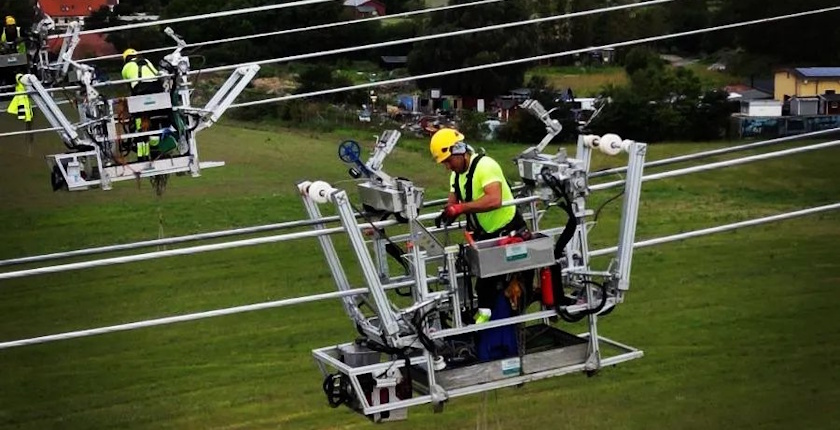
Croatia-based Dalekovod, Elnos from Bosnia and Herzegovina, and Serbian Kodar Energomontaža will jointly build electricity transmission infrastructure in North Macedonia.

Dalekovod said it signed a EUR 19.7 million contract with MEPSO, the transmission system operator of North Macedonia, as the lead member of a consortium that includes Elnos BL and Kodar Energomontaža.

The contracted works include the delivery and construction of a 400 kV power line from the 400/110 kV Bitola 2 substation, via the 400/110 kV Ohrid substation, to the North Macedonia – Albania border.

The project ensures long-term stability of the electricity system in the wider region

The new Ohrid substation is currently under construction, with Končar, another Croatian company, as contractor. Končar is the majority shareholder of Dalekovod since 2022.

The Croatian firm pointed out that the new power line in North Macedonia represents a significant infrastructure project ensuring long-term stability of the electricity system in the wider region.

Dalekovod: Strengthening position in the regional and European market

Construction is scheduled for completion by mid-2028.

Of note, all three companies are active on the territory of former Yugoslavia, as well as across Europe and even worldwide. The owners of Elnos and Kodar are individuals from Bosnia and Herzegovina and Serbia, respectively, while the largest shareholders of Dalekovod are the Government of Croatia and three foreign banks operating in the country.

Operations in the region, Europe, Africa

Dalekovod has subsidiaries in six countries, including Namibia. In October, the company concluded a EUR 100 million deal for the construction of a 400 kV power line in Sweden.

Elnos BL is part of Elnos Group based in Banja Luka, Bosnia and Herzegovina. The company, which recently marked a remarkable dual jubilee – 80 years of tradition and 30 years of modern business development, operates in 18 countries.

A week ago, it signed a contract with Power China Construction Group to build a connection to the transmission grid for the 300 MW Vetrozelena wind farm in Serbia.

Kodar Energomontaža, headquartered in Serbia’s capital Belgrade, has carried out numerous projects across Europe – from southeastern Balkans to Scandinavia, as well as in West Africa.

In March, the company inked a deal with Serbia’s transmission system operator Elektromreža Srbije (EMS) for the construction of a two-system 400 kV transmission line, part of the Trans-Balkan Electricity Corridor.
by in News

Montenegro adopts National Energy and Climate Plan

The Government of Montenegro has adopted the National Energy and Climate Plan, along with a bill on cross-border electricity and natural gas exchange.

The National Energy and Climate Plan (NECP) of Montenegro is the overarching strategy that clearly defines what the country should achieve by 2030: a 55% reduction in emissions, a renewable energy share of at least 50%, and substantial progress in energy efficiency, according to the Ministry of Energy and Mining.

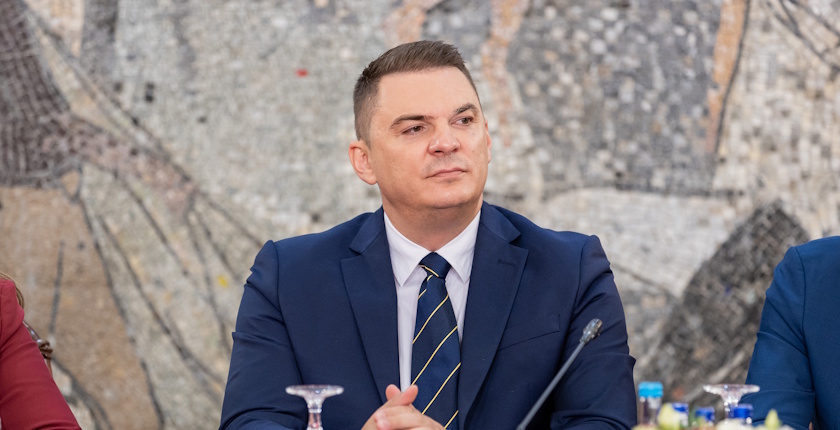
“Over the past eight months, we have made a tremendous effort to finalize two key documents that have been awaited for years and are crucial for our European commitments,” Minister Admir Šahmanović stressed.

This is a plan that enables new investments, new renewable energy power plants, modern grid infrastructure, and a secure transition for the Pljevlja coal region, he explained.

Šahmanović: The latest European Commission report confirms Montenegro’s progress

The ministry noted that the bill on cross-border electricity and natural gas exchange is among the most important energy laws proposed by this government. Šahmanović recalled that this is not merely a technical issue.

The bill, in his words, opens the door to the single European market, directly impacts the closure of Chapter 15 of the accession negotiations with the EU, and gives full meaning to the electricity interconnection with Italy and the EU market.

It would provide greater energy security, better competition, more stable prices, and a stronger position for the country’s economy, he added.

“The latest report from the European Commission confirms that we have made progress. Today’s decisions by the government are the best confirmation of this. These are the foundations for a more energy-secure, modern, and European Montenegro, and we have reason to be satisfied with the progress we have achieved,” Šahmanović underscored.

The bill represents the most extensive reform of energy legislation in the past decade

According to the ministry, by adopting these two strategic documents, Montenegro has taken a significant step forward in aligning with EU energy rules.

The NECP integrates energy, climate, and development policies into a single framework for the first time, sets clear and measurable goals, and lays the foundation for Montenegro’s long-term energy transition.

The law on cross-border electricity and natural gas exchange represents the most extensive reform of energy legislation in the past decade, transitioning from a basic regulatory framework to a full European system of market, technical, and security rules.

Together, these two documents represent the most important reform package in the energy sector in recent years, fully aligned with European legislation and the EU’s strategic priorities, the ministry concluded.

by in News

Turkey awards 1.15 GW in wind power auctions – all at just EUR 35 per MWh

The six winners from the latest round of wind power auctions under the YEKA state support mechanism in Turkey will have at least EUR 35 per MWh guaranteed from the sale of electricity in the first six years. It was the floor price in the bidding. After it was reached for each zone, the remaining participants had to compete by offering to pay for the right to sign the contract.

Delays and the lack of money for the construction of high-voltage, transmission lines is one of the main hurdles slowing the uptake of wind and solar power. Turkey’s approach has turned out to be successful, as it allows investors to compete to pay one-off fees for available predetermined projects in auctions. At the same time, the beneficiaries get guaranteed prices for the future sales of their electricity.

The country has earned EUR 530 million overall this year from two rounds for solar and two for wind power, Minister of Energy and Natural Resources Alparslan Bayraktar said. It includes EUR 208 million just from the latest bidding under the Renewable Energy Zones (REZ) state support mechanism, he claimed. It is better known by its Turkish acronym YEKA.

The winners are getting grid connections for 49 years

The ministry awarded zones for six projects for 1.15 GW in total connection capacity. The winners are getting grid connections for 49 years, a minimum price during the six-year open market sale period and power purchase agreements (PPAs) at the same level for another 20 years.

Entire capacity allocated at floor price

In the bidding in the REZ WPP 2025 (YEKA RES 2025) round, the ceiling price was EUR 55 per MWh. With 75 applications altogether, 30 companies participated – between six and 20 per zone.

In all cases, the bottom price of EUR 35 per MWh was reached, so the remaining bidders were switched to the second phase. The YEKA auctions are broadcast live.

The winners need to pay between EUR 56,000 per MW and a stunning EUR 312,000 per MW of capacity, or from EUR 23.8 million to EUR 34.3 million for each zone. Combined, the contribution fees amount to EUR 173 million, or some EUR 470 million for all auctions held this year.

Bayraktar estimated total investments in projects involved in the last wind power round at USD 1.1 billion.

Eksim, Polat among winners

The Kütahya zone of 120 MW went to İçdaş Elektrik Enerjisi, for EUR 222,000 per MW. Stone Enerji snatched the Aydın-Denizli project of 140 MW with a winning bid of EUR 170,000 per MW. The firm was a winner at the recent solar power auctions as well.

For the Sivas area, the largest of all (500 MW), Kanat Rüzgar Enerji will be required to pay EUR 56,000 per MW, which is the lowest level.

Three zones are in Balıkesir province. Eksim Energy (Enerji) committed the most of all winners, EUR 312,000 per MW, for the Balıkesir-3 project. It is for 110 MW. Balıkesir-2, of 120 MW, was won by Balıkesir Elektrik. It offered a contribution fee of EUR 218,000 per MW.

The Balıkesir-1 area is for 160 MW in connection capacity. Polat Enerji’s subsidiary Soma Enerji was the best bidder, with EUR 212,000 per MW.

Turkey hosts wind power plants of more than 14 GW combined, of more than 121 GW in total electricity capacity.

by in News

Energy Community: Serbia best in Western Balkans in alignment with EU regulations

Integration with the European Union is advancing in practice, and the decade ahead must sustain the momentum with focus and determination, Energy Community Secretariat Director Artur Lorkowski pointed out in this year’s Annual Implementation Report.

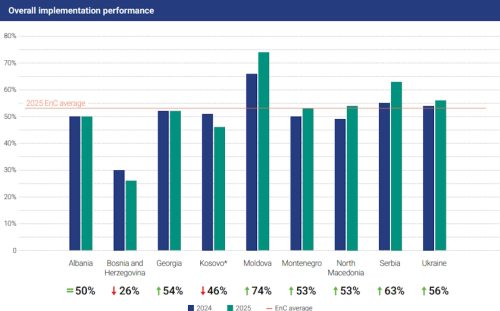
Serbia fares best in the Western Balkans, as it advanced to 63% from 55%. Bosnia and Herzegovina is at the bottom of the entire Energy Community chart, with alignment at just 26%.

Following the 2025 CBAM Readiness Tracker, the Energy Community Secretariat also published its Annual Implementation Report 2025. The international organization marked its 20th anniversary this year.

“The message from Athens was clear: integration with the European Union is advancing in practice, and the decade ahead must sustain this momentum with focus and determination. The 2025 Implementation Report reflects this direction. It shows a region taking decisive steps toward alignment with the EU acquis and strengthening the foundations required for accelerated integration. It also highlights where further effort is needed for gradual integration with the EU energy markets – completing the electricity market coupling, boosting the cross-border trade in renewables, eliminating bottlenecks for gas flows, synchronising energy infrastructure development and gradual alignment of carbon pricing mechanisms,” Energy Community Secretariat Director Artur Lorkowski stressed.

He added that electricity integration remains central. Several contracting parties completed the required transposition of the European Union’s Electricity Integration Package (EIP), while others advanced significantly.

Deadline for requests for 2028 market coupling to expire in seven months

Intensive market coupling efforts throughout 2025 by contracting parties and EU stakeholders have laid the groundwork for a compliant and sustainable integration process, according to the Annual Implementation Report. Of note, market coupling is the requirement for an exemption from the EU’s Carbon Border Adjustment Mechanism (CBAM) for electricity.

Contracting parties aiming to go live in 2028 must submit a formal request by July, the secretariat warned.

Energy Community Serbia best score Western Balkans
Photo: Energy Community Secretariat

Montenegro, North Macedonia advance slightly to match average

Five main indicators measure the integration with the EU energy markets and they are combined into an overall score. The Energy Community as a whole is at 53%.

Moldova has advanced the most in the process by far, climbing eight points from last year to reach 74%. Serbia fares best in the Western Balkans, as it advanced to 63% from 55%. It ranked the highest last year as well. Bosnia and Herzegovina is at the lowest level again. It retreated four points, to just 26%.

Montenegro and North Macedonia advanced slightly, both to 53%, to match the Energy Community average. Kosovo* has weakened to 46% while Albania remained at 50%.

At 61%, North Macedonia is in the lead in the Western Balkans in the markets and integration segment. Serbia reached the highest level in the Energy Community in energy sector decarbonization, 83%.

* This designation is without prejudice to positions onstatus and is in line with UNSCR 1244/99 and the ICJ Opinion on the Kosovo declaration of independence.
by in News

Bulgarian firm Hydrogenera gets electrolyzer order from Volkswagen

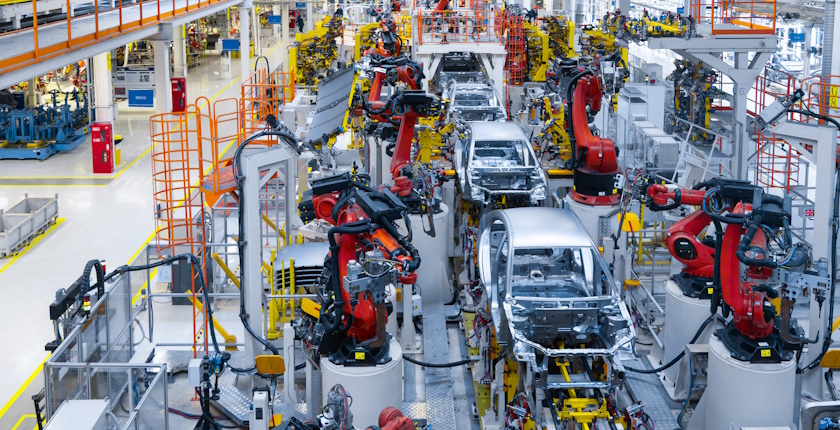
Hydrogenera will integrate its electrolyzer with a gas burner at Volkswagen Poznań’s automotive factory in western Poland with the aim of cutting the consumption of the fuel as well as related emissions by up to 30%. The produced hydrogen and oxygen would both be utilized within the system, the Bulgarian company said.

Hydrogenera, which was listed on the Bulgarian Stock Exchange (BSE) in July, is one of the few companies in Southeastern Europe designing and manufacturing proprietary equipment for cutting-edge energy technologies. Its parent company Green Innovation recently became Volkswagen’s authorised supplier and obtained the giant automotive giant’s Sustainability Rating, setting the stage for a new order.

In addition to mixing it with gas for combustion, industrial producers are gradually introducing hydrogen and electrolyzers into other processes. Collaboration is underway with Volkswagen Poznań for a hydrogen-oxygen system at the carmaker’s plant in Września, in western Poland.

Hydrogenera explained that the challenge is to enhance the combustion efficiency of a natural gas burner with 1.5 MW in nameplate capacity. The 90 kW electrolyzer would operate as a non-intrusive add-on to the existing equipment – not affecting installations, automation or safety systems, according to the update.

Oxygen produced in the electrolyzer will be utilized as well, improving combustion

Hydrogen and oxygen are supplied separately to optimize the flame. Hydrogen is mixed with natural gas directly before the burner, while oxygen is introduced into the air stream directed to the combustion chamber. It enables complete fuel combustion, minimizing losses, Hydrogenera said.

The company claimed the solution can reduce fuel consumption by 30%, alongside a corresponding cut in emissions at the facility near Poznań.

Of note, green or renewable hydrogen is produced using electricity only from renewable sources, therefore without greenhouse gas emissions.

Green Innovation has raised BGN 7.96 million (EUR 4.1 million) in the initial public offering in Sofia. Its market capitalization has slipped 2% to BGN 92.1 million (EUR 47.1 million) since listing on July 29 under the ticker HYDR.

by in News

Borusan EnBW puts 80 MW Pelit wind farm online in Turkey

Borusan EnBW Enerji’s first wind investment in Central Anatolia, the Pelit wind power plant, began production. Located near Sivas, it has 80 MW in capacity.

The joint venture of Borusan Holding and Energie Baden-Württemberg increased its wind power portfolio in Turkey to 212 turbines in operation and 776 MW. Its tenth facility, Pelit, is located near Sivas and is the first in Central Anatolia.

Borusan EnBW’s new wind park consists of 14 Nordex machines, of which 13 have 5.7 MW each, according to project documentation. The remaining one is of 5.9 MW.

At 80 MW, Pelit is the firm’s fifth-largest wind park in Turkey. It said it would and prevent 178,000 tons of carbon dioxide emissions, equivalent to the carbon sequestration of 4.6 million trees.

Estimated annual output, 280 GWh, is sufficient for the needs of 122,000 households. The partners, which established the firm in 2009, initially intended to install 40 turbines of 2 MW apiece.

Due to its location, the Pelit wind farm creates seasonal and regional diversity in Borusan EnBW Enerji’s generation portfolio, the update reads. The largest wind power plant is Saros, at 143 MW, in Çanakkale. A 94 MW photovoltaic system was built and integrated with it, creating a hybrid power plant.

The joint venture has two other small solar power plants and the Yedigöl Aksu hydropower system, of 50.3 MW. It is also active in electricity sales and trading, as well as the operation of an electric vehicle charger network.

Turkey hosts wind power plants of more than 14 GW in combined capacity.

by in News

Uncompetitiveness holding EU far behind green hydrogen targets

Several high-profile green hydrogen projects have been canceled in the past year, and major companies reduced their decarbonization ambitions, the European Union Agency for the Cooperation of Energy Regulators (ACER) said in its new report. The technology is four times more expensive than production from fossil gas through steam reforming.

Investments are far behind EU targets and trailing even the contracted demand. However, an acceleration of existing projects would change the picture substantially. On that note, the European Hydrogen Bank is receiving submissions for its third auction.

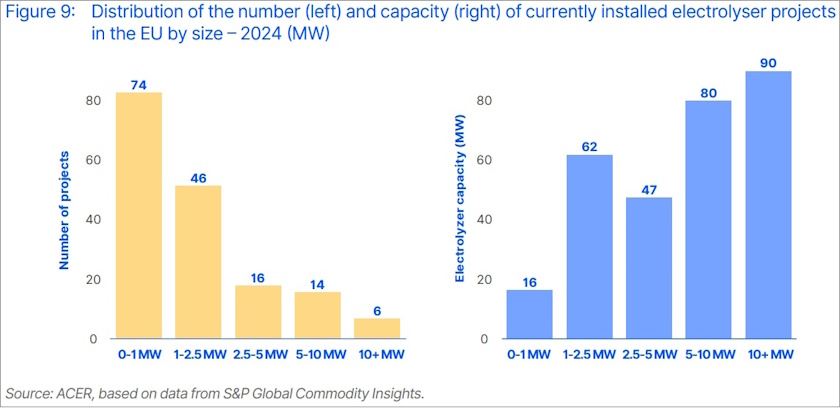
Electrolyser capacity in the EU jumped 51% last year to 308 MW, while 1.8 GW was under construction in October 2025, expected to be commissioned within two years. The numbers are from the European Hydrogen Markets – 2025 Monitoring Report, issued by the EU Agency for the Cooperation of Energy Regulators (ACER). It pointed out that the total falls well short of the trajectory toward the 2030 target of 40 GW, or the 48 GW to 54 GW range in member states’ plans.

Of note, while some other databases show similar figures, the Renewable Hydrogen Coalition has calculated that operational projects amount to 600 MW, though “across Europe,” and not just in the EU. Another 3 GW is under construction, its update reads.

The European Hydrogen Strategy aimed at 6 GW by 2024.

Sweden, Germany in strongest expansion

Sweden and Germany account for two thirds of the capacity under construction (742 MW and 414 MW, respectively), ACER said. In addition, EWE has just marked the start of construction of an electrolyzer facility of a whopping 320 MW, which would eclipse the fleet that is currently producing green or renewable hydrogen. The site is in Emden, in Germany.

Domestically produced renewable hydrogen contracted, 270,000 tons, would require 3.7 GW of electrolysers.

Several high-profile green hydrogen projects have been canceled in the past year, and major companies have reduced their decarbonization ambitions, the agency warned. Importantly, all existing projects, in any stage of development and with a 2030 target, are for 62 GW in total, indicating the potential for acceleration.

An electrolyzer under construction in Germany is set to surpass the combined capacity of the current EU fleet

As for Southeastern Europe, Romania targets 2.1 GW of electrolyzer capacity for 2030. Croatia is aiming for between 0.1 GW and 1.3 GW, while the remaining countries are at just 0.1 GW or 0.2 GW. Greece was the only country with any capacity in construction in October, 50 MW. Interconnections are planned between Greece, Bulgaria, Romania and Hungary.

Citing the European Hydrogen Observatory, ACER said Germany has added 46 MW last year. With Denmark (18 MW) and Hungary (11 MW), it was 72% of the annual growth.

Only six plants were bigger than 10 MW at the end of 2024, amounting to 90 MW altogether.

ACER Uncompetitiveness holds EU far behind green hydrogen targets

Gray hydrogen remains dominant

Steam methane reforming (SMR) remains the dominant production technology, accounting for 89% of the total capacity in the EU. It is colloquially called gray hydrogen.

The share of electrolytic hydrogen, made using electricity from all sources, not necessarily renewables, is marginal. So is the overall capacity for blue hydrogen. It is also from fossil gas, but the process involves carbon capture and storage, CCS.

Green hydrogen, one of so-called renewable fuels of non-biological origin (RFNBO), costs some EUR 8 per kilogram, against just over EUR 2 per kilogram of conventional, gray hydrogen.

Expectations for liquefied natural gas (LNG) and carbon dioxide emission allowance price levels favor fossil fuel hydrogen in the short term, the report’s authors stressed. Meanwhile, slower deployment of electrolyzers limits economies of scale, delaying the anticipated reductions in related capital costs.

Projected prices of LNG and CO2 allowances are favoring fossil fuel hydrogen

With current production cost estimates at just below EUR 3 per kilo, low-carbon hydrogen with carbon capture is more competitive than renewable hydrogen. Nevertheless, the additional costs for CO2 transport and storage are highly uncertain.

“The buildout of CO2 infrastructure may pose additional challenges. Moreover, the long-term gas offtake contracts required for such projects could lock in fossil fuel dependence and exposure to price volatility in the global natural gas market,” the authors said.

By definition, low-carbon hydrogen results in at least 70% lower emissions than the conventional one from fossil fuels. The segment includes electrolysis running on nuclear power.

The EU also counts hydrogen from biogas and biomass processing as renewable, if the technology complies with sustainability requirements.

Electricity supply costs, excluding grid tariffs, may account for up to 50% of the levelized cost of renewable hydrogen, with substantial regional variations across the EU. Regions with abundant renewable resources and strong renewables integration, such as Spain, already provide advantageous conditions for renewable hydrogen production, the document adds.

Electricity accounts for 60% to 70% of renewable hydrogen cost

The Renewable Hydrogen Coalition said electrolyzer manufacturing capacity has surged from 1 GW within a few years. It expects it to hit 15 GW in 2026.

Electricity accounts for 60% to 70% of renewable hydrogen costs, with taxes and levies reaching 30% to 40% of the electricity cost itself, according to the group. It is also urging for incentives and an improvement in the legal framework.

“With the right enabling policies put in place, altogether, our coalition members could put online close to 18 GW of renewable hydrogen production projects between 2026 and 2032,” the declaration reads.

On that note, the European Hydrogen Bank has launched the call to its third auction for hydrogen production, worth EUR 1.3 billion. Spain is adding EUR 415 million, while Germany will match the EU with another EUR 1.3 billion within the auctions-as-a-service segment.

The IF25 Hydrogen Auction is designed to provide cost-efficient support for the production of RFNBO hydrogen or electrolytic low-carbon hydrogen. Producers of hydrogen with maritime or aviation offtakers can apply as well.

The call is part of a package under the Innovation Fund, using revenues from the EU Emissions Trading System (EU ETS). A EUR 2.9 billion segment for net-zero technologies, IF25 NZT, includes hydrogen production.

by in News

North Macedonia’s third wind farm enters trial operation

According to the Energy Regulatory Commission (ERC or RKE) of North Macedonia, a 44 MW wind power plant has entered trial operation in Demir Kapija. Almost three years ago, Kaltun Enerji hired YEO Technology, also based in Turkey, to build the first part of the Dren wind farm. It is the third such facility in the country, but another one was built nearby and is about to be commissioned.

North Macedonia added 210 MW from renewable sources to the electricity grid this year through November, of which 44 MW is a wind power plant in Demir Kapija that entered trial operation, President of RKE Marko Bislimoski revealed. According to the body, officially called the Energy, Water Services, and Municipal Waste Management Services Regulatory Commission, the rest are photovoltaics.

Given that solar power capacity amounted to 848 MW at the end of 2024, it means that it has recently surpassed 1 GW.

The share of renewables in production capacity was 55% last year, while they generated 40% of domestic electricity, Bislimoski added.

Dren wind power plant has nine turbines

In early 2023, Kaltun Enerji hired YEO Technology (YEO Teknoloji Enerji ve Endüstri) for its 44 MW wind power plant project in Dren in North Macedonia. Both companies are based in Turkey. The eponymous village is in the municipality of Demir Kapija, but parts of the area are in the neighboring Negotino and Gevgelija, which borders Greece.

Kaltun Enerji obtained licenses this year for the trial operation of Dren 1 (33.6 MW) and Dren 2 (9.6 MW). They consist of seven and two Goldwind turbines, respectively, of 4.8 MW each.

North Macedonia’s first wind power plant, Bogdanci, is nearby.

Nearby wind park awaiting commissioning

Project firm Park na veterni elektrani Perun, formerly known as Euroing, received a temporary license from RKE in April for electricity production for a 30 MW wind power plant, also known as Rosoman facility. The location is in the Bogdanci municipality, in the same area. The wind park comprises five Siemens Gamesa turbines. According to the latest updates, it was about to be commissioned.

The country’s second wind power plant, put into operation last year, is called Bogoslovec.

Alcazar Energy Partners held a groundbreaking ceremony in July for its Štip wind farm in North Macedonia. At 400 MW, it would be the biggest in the Western Balkans.

Of note, Bislimoski said that RKE has started amending the licenses for solar power plants that added battery storage, but also pointed out that he doesn’t expect power surpluses this winter. Consumption is increasing, especially among households, as a large share uses electricity for heating, he added.

by in News

EU considering Montenegro’s proposals for changes to CBAM

Minister of Energy and Mining of Montenegro Admir Šahmanović met with several senior officials of the European Commission. The messages in Brussels regarding the Carbon Border Adjustment Mechanism (CBAM) were encouraging – changes in the regulation are being considered, including Montenegro’s demands, according to the ministry.

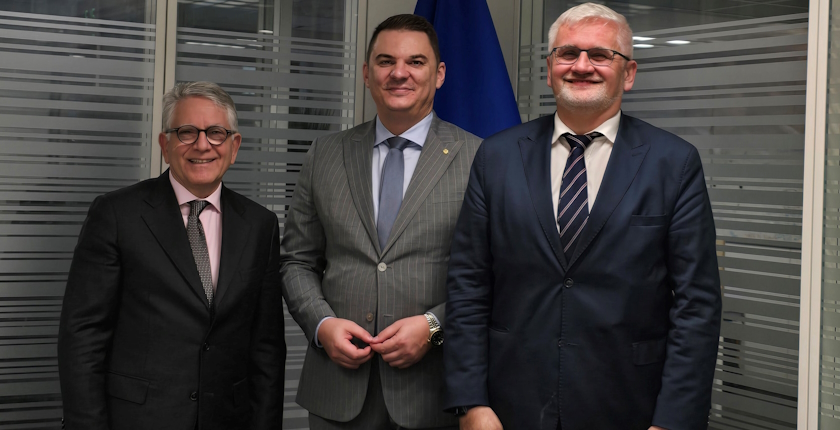
Minister of Energy and Mining of Montenegro Admir Šahmanović led a delegation that visited the European Commission’s headquarters. They met with Director General for Taxation and Customs Union Thomas Gerassimos, Deputy Director-General for Climate Action Jan Dusík and Director for Western Balkans Valentina Superti and Head of the Unit for Bosnia and Herzegovina and Montenegro Barbara Jésus-Gimeno, both from the Directorate-General for Enlargement and Eastern Neighbourhood.

The focus of the discussions was on key processes in the energy sector and especially on the Carbon Border Adjustment Mechanism (CBAM), which is currently Montenegro’s main priority, the ministry said. Šahmanović presented the reforms that the country conducted and stressed that the government is almost entirely aligned with its European requirements in the legal and strategic sense.

CBAM is now Montenegro’s priority

Over the last eight months, Montenegro adopted a new Law on Energy alongside dozens of bylaws, including some tied to the Law on the Use of Energy from Renewable Sources. The government launched the first renewable energy auction, for solar power, and signed a memorandum of understanding on market coupling with Italy, with which talks continue on the construction of the second wire in the undersea cable. Laws on cross-border energy exchange and the construction of cross-border energy assets are drafted, the update adds.

The minister said Montenegro is finalizing its National Energy and Climate Plan.

More flexible models for CBAM to be considered

The European Commission’s representatives acknowledged Montenegro’s progress and asserted that it is in the lead in the region as concerns the degree of compliance in the energy sphere, the ministry said.

“Within the same context it was agreed that discussions would be continued on a technical level in the following weeks to consider the possible, more flexible models of applying CBAM and to enable candidate states to adjust to the mechanism faster and more efficiently. A special focus will be on the elaboration of compromise solutions – especially the ones that enable a gradual, just and predictable implementation, with a minimal burden on the Montenegrin energy sector, which is significantly reliant on electricity exports,” the update reads.

EU’s cross-border tax on greenhouse gases to have weaker impact than in earlier projections

The European Commission conveyed encouraging messages: a smaller impact from CBAM is expected than in earlier projections, and amendments to the regulation are being considered, including demands from Montenegro from the consultations, according to the ministry.

Minister Šahmanović said Montenegro is remaining fully dedicated to its European obligations, but that it expects an acknowledgment of the results that it achieved, so that the implementation of CBAM is harmonized with the realities of the country’s energy system and its strong renewables investment cycle.

by in News

New Cypriot Minister of Energy, Commerce and Industry Michael Damianos takes office

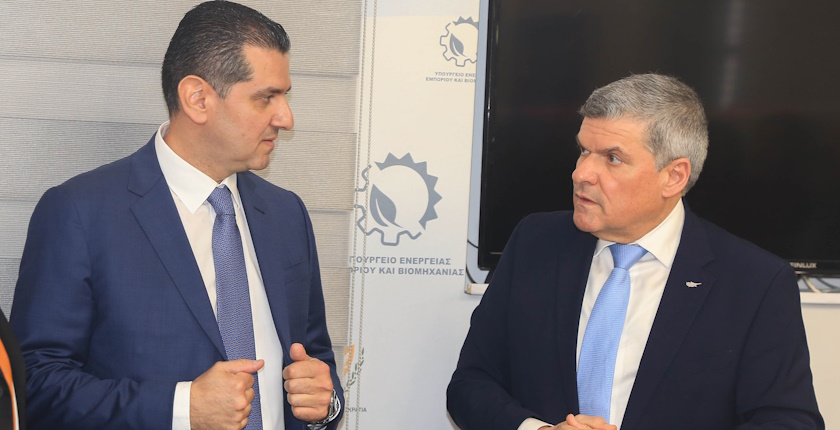
A careful and organized course is required to achieve the energy transition in Cyprus, support the industry and strengthen the economy, ensuring sustainable solutions for the country’s energy future, new Minister of Energy, Commerce and Industry Michael Damianos said. He took over from his predecessor George Papanastasiou.

Five ministers were replaced in a cabinet reshuffle under President of Cyprus Nikos Christodoulides. Among them, the now former Minister of Health Michael Damianos took helm of the Minister of Energy, Commerce and Industry from George Papanastasiou.

Cyprus is assuming the presidency of the Council of the European Union on January 1 for six months. It means Damianos will chair the meetings of ministers responsible for the sectors in his portfolio, like the so-called Energy Council.

“We will work with innovation, excellence and sustainability in mind, to ensure that Cyprus continues to move in a direction that will serve the common good and future generations,” the new minister said at the handover ceremony.

Realistic, measurable goals for tangible results for all citizens

A careful and organized course is required to achieve the energy transition in Cyprus, support the industry and strengthen the economy, ensuring sustainable solutions for the country’s energy future, according to Damianos. He highlighted the importance of setting “realistic and measurable goals” to bring tangible results for all citizens.

Papanastasiou’s departure could be a signal from Nicosia about the fate of the Greece-Cyprus-Israel subsea power link

Some media is speculating that the switch is a signal from Cyprus about the embattled Great Sea Interconnector, a proposed underwater cable that would link Greece, via Crete, with Cyprus and Israel. Papanastasiou was apparently one of the few ardent supporters of the project in the country’s government.

The investment remains stuck over expenses and threats from Turkey.

University of Cambridge alum

Damianos studied law at the University of Southampton, from where he graduated with honours and received the best academic performance award. He earned a master of laws degree at the University of Cambridge, specializing in international law. The minister has received the best academic performance award from the Fitzwilliam College of the University of Cambridge.

The minister holds the professional title of a solicitor, granted by the Supreme Court of England and Wales. Damianos worked at the international law firms Simmons and Simmons and Hogan Lovells in London, specializing in corporate, commercial and energy matters.

In 2010 in Cyprus, he founded a law firm that bears his name. Damianos served as a municipal councillor in Strovolos Municipality from 2011 to 2016. Since 2018, he has been the vice president of the Democratic Party (DIKO).

Damianos became the minister of health in January 2024.