AEA-Albania Energy Association
  • Main
  • About Us
  • Services
  • Sectors
  • News
  • EventsEvents
  • PublicationPublication
  • Contact Us
AEA-Albania Energy Association
  • Main
  • About Us
  • Services
  • Sectors
  • News
  • EventsEvents
  • PublicationPublication
  • Contact Us
AEA-Albania Energy Association
  • Home Page
  • About Us
  • Sectors
  • Our Services
  • News
  • Contact Us
October 30, 2025
by AEA in News

Mingyang presents ultralarge floating twin wind turbine concept

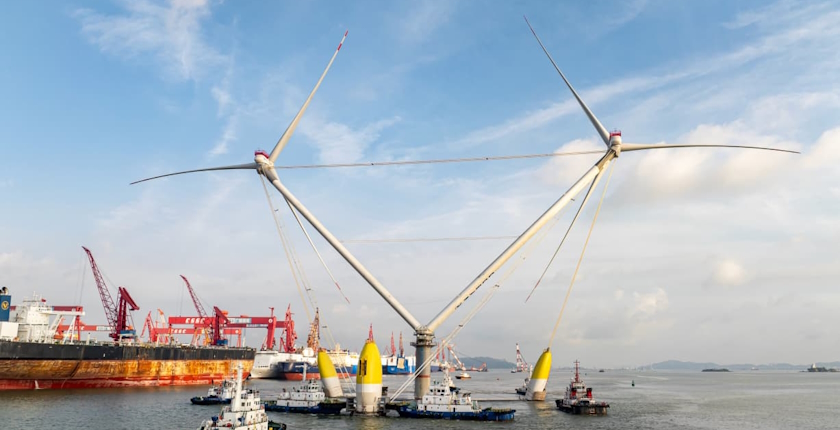
Within its OceanX platform for dual floating wind turbines, Ming Yang Smart Energy is designing a machine for 50 MW. It would be almost two times more than the currently strongest wind turbine.

Manufacturers in China keep pushing the limits in renewable energy technology. Dongfang Electric installed the world’s largest wind turbine for testing just two months ago, and Ming Yang Smart Energy already revealed that it is developing a floating machine that would be almost two times stronger. The company, also known as Mingyang, presented the concept for a 50 MW unit, though it is actually a double turbine.

It is designing it within its OceanX platform for V-shaped floaters. The foundation for the dual rotor will be engineered for waters deeper than 40 meters, according to Mingyang.

Twin floating turbines could turn out to be the new frontier in renewable energy technology

The company said it would provide typhoon resistance, for up to 260 kilometers per hour, and open an entirely new solution for tapping deep sea wind potential. The ultralarge twin turbine is envisaged with 290-meter rotors.

Targeted cost is below USD 1,300 per kW, or almost five time less than the European average. It compares to between USD 3,000 per kW and USD 4,300 per kW in China. OceanX is currently available at 16.6 MW at most.

Mingyang recently said it would build a manufacturing facility in Scotland for floating technology. It valued the project at GBP 1.5 billion.

The largest floating wind power turbine so far has 20 MW. It was manufactured by China Railway Rolling Stock Corp. (CRRC).
Post Views:44
October 30, 2025
by AEA in News

Second phase of Gvozd wind farm gets green light from environment agency

The Environmental Protection Agency of Montenegro has determined there is no need for an environmental impact assessment report for the second phase of the Gvozd wind farm, and allowed the project to proceed. It is for three additional wind turbines with a total capacity of 21 MW, bringing the wind farm’s overall capacity to 75.6 MW.

Within the same decision, the firm implementing the Gvozd 2 project is instructed to conduct a one-year survey of birds and bats at the project site by November 1, 2026, and to submit the findings to the Environmental Protection Agency, which reserves the right to order additional measures if necessary.

During construction, the project developers must take steps to reduce noise and use the existing road network to avoid the destruction of bird and bat habitats. It is also necessary to monitor bird nesting and take measures to protect nesting sites, while minimizing forest clearance and reducing the risk of vehicle collisions, according to the agency’s decision.

Special attention must be paid to bird and bat habitats

The second phase of the Gvozd wind farm project is financed by a EUR 25 million loan from the European Bank for Reconstruction and Development (EBRD), signed with Montenegro’s state-owned power utility Elektroprivreda Crne Gore (EPCG). Its subsidiary in charge of the project, Green Gvozd WPP Second Phase, is registered in Podgorica.

Once completed, Gvozd will be the largest of Montenegro’s three wind farms, with a capacity to generate over 210 GWh of electricity annually. It would be enough to supply around 36,000 households, with CO₂ emissions expected to be reduced by nearly 137,000 tons per year, EPCG said after signing the loan agreement.

The first phase should be completed by the end of this year, and the entire project before the end of 2026

The first phase of Gvozd will have eight wind turbines with a total capacity of 54.6 MW. Construction began in November 2024. EPCG expects the plant to be put into trial operation by the end of this year. Its annual electricity output is estimated at 150 GWh.

EBRD financed the first phase as well, with an EUR 82 million loan. Gvozd will be EPCG’s first large-scale power generation facility built in more than 40 years.

The EBRD previously announced that all 75.6 MW should be online before the end of 2026.

Post Views:40
October 30, 2025
by AEA in News

International Forum on Energy for Sustainable Development kicks off in Skopje: reliance on single supplier is risk of past

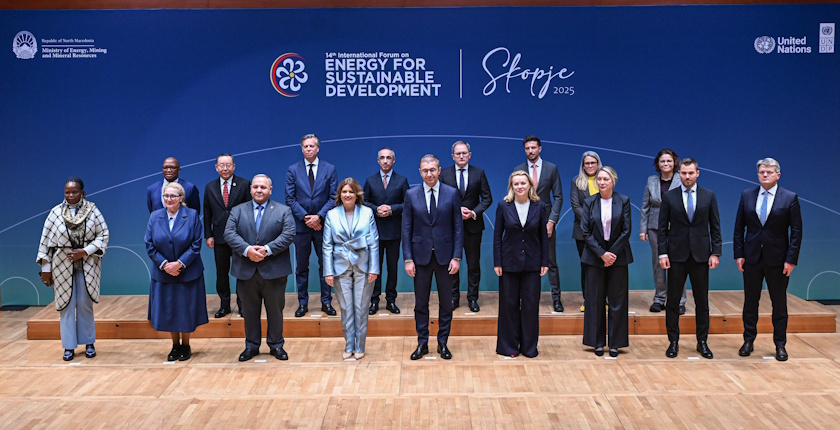
Reliance on a single source or supplier is a risk of the past – the future belongs to diversified, sustainable, and safe energy solutions, Minister of Energy, Mining and Mineral Resources of North Macedonia Sanja Božinovska said at the opening of the 14th International Forum on Energy for Sustainable Development in Skopje.

The three-day International Forum on Energy for Sustainable Development (IFESD-14), with the theme From Goals to Action: Powering the Future with Sustainable Energy, gathered more than 500 participants from more than 70 countries, including high-level representatives of international institutions, companies, as well as academics and experts.

The meeting is organized by the Ministry of Energy, Mining and Mineral Resources of North Macedonia, in cooperation with the United Nations Development Programme (UNDP) and the UN’s five regional commissions – UNECE, UNESCAP, UNECLAC, UNECA, and UNESCWA.

The Skopje Declaration will be signed at the forum. The document will remain as an important permanent record of the commitment of the participating countries to a sustainable, safe, and inclusive energy future, according to the ministry.

Sanja Božinovska, Minister of Energy, Mining and Mineral Resources, underlined that North Macedonia would be the center of the global energy dialogue for the next three days.

Božinovska: Energy transition is not a race between countries​

Energy resilience today is the ability of the system to withstand, adapt, and continue to function stably even in conditions of global uncertainty and geopolitical upheaval, she said.

“In this new era, technology and artificial intelligence are our allies, not a threat. They can help us forecast demand, optimize consumption, and improve energy accessibility. But energy must be used wisely, focusing on people, not just machines,” Božinovska stated.

Sanja Božinovska (photo: Ministry of Energy, Mining and Mineral Resources)​

​Energy transition is not a race between countries but a shared journey, in the minister’s view. No country, regardless of size, can handle climate challenges alone, she added.

“Our role, as ministers and leaders, is to create conditions for this transition to be fair, sustainable, and inclusive and to ensure that no one is left behind; no country, no community,” Božinovska stressed.

The actions of the Government of North Macedonia confirm the stance, she asserted and highlighted the construction of natural gas interconnectors with Greece and Serbia. The investment will enable supplying thousands of households and businesses and help Europe achieve better connectivity and security of gas supply, she explained.

Grid modernization and investments in digitalization and energy storage are the country’s policy as well, she added.

Mickoski: Energy is high on the government’s agenda

Hristijan Mickoski (photo: Ministry of Energy, Mining and Mineral Resources)

Prime Minister Hristijan Mickovski said the forum is an opportunity for North Macedonia to show that a small country can have a big impact – when it has a clear vision, determination, and leadership.

He highlighted the role and vision of Minister Božinovska, saying she is determined to move things forward even in the short term, to accelerate processes and not let Macedonia fall behind in the race against time.

“As someone who comes from the energy sector, I know very well how important that feeling of constant movement, change, and responsibility is. That’s why energy is high on the government agenda – not as a technical matter, but as a national priority and state strategy,” he asserted.

Every solar panel, every wind farm, every new power plant fueled by clean energy – this is part of the modern struggle for the independence of North Macedonia, he explained.

“Our vision is clear: to prepare the country for the future – for climate challenges, technological changes and global risks. To make an example in the region of a stable, clean and independent energy economy,” Mickoski said.

Molcean: The forum has developed into a leading global platform for the promotion of sustainable energy

Tatiana Molcean, United Nations Under-Secretary-General and Executive Secretary of the United Nations Economic Commission for Europe (UNECE), pointed out that the forum, which was launched in 2010, has evolved into a leading global platform for advancing sustainable energy.

“Today, we stand at a crossroads when it comes to multilateralism in energy. The global energy transition represents not only a historic opportunity for sustainable development but also a profound responsibility. We must build resilient energy systems that ensure a secure, affordable, and environmentally sustainable supply of energy,” she stressed and added: “None of us will succeed if we work in isolation.”

Tatiana Molcean (photo: Ministry of Energy, Mining and Mineral Resources)

​UNECE is here together with other UN partners to help make energy not only a driver of just transition and economic growth, but also a catalyst for sustainability and resilience, Molcean told the audience.

In the view of Resident Representative of UNDP in North Macedonia Armen Grigoryan, the forum’s theme, From Goals to Action: Powering the Future with Sustainable Energy, reflects urgency and growing consensus among nations that sustainable energy solutions are urgent.

Grigoryan: We have to move from commitments to concrete implementation

“Now we have to move from commitments to concrete implementation and steps. Sustainable energy stands as a cornerstone of our collective sustainable future. Around the world, the UNDP programme is deeply engaged in advancing this agenda,” he stressed.

Grigoryan recalled that the work of UNDP in North Macedonia, but also elsewhere, through the green finance facility and tackling air pollution initiatives, is about the people.

“By helping families heat their homes with green and affordable energy, enabling businesses to invest in green solutions, we are creating healthier communities and new opportunities for growth,” he asserted.

Photo: Ministry of Energy, Mining and Mineral Resources
Post Views:69
October 30, 2025
by AEA in News

Von der Leyen: EU is guarantee that Serbian families will be warm in winter

The European Union is connecting Serbia to its energy market, and it is the true guarantee that Serbian families will be safe and warm in winter, European Commission President Ursula von der Leyen said in Belgrade. She expressed preparedness to invest further in the country’s gas interconnector with Bulgaria.

In her speech during the visit to Serbia, European Commission President Ursula von der Leyen didn’t address the looming energy crisis caused by the sanctions that the United States imposed on Russian-owned oil company NIS. Moreover, she demanded greater alignment with the EU foreign policy from President of Serbia Aleksandar Vučić, including on sanctions against Russia.

“The EU membership offer is an opportunity. It is the promise of peace. Of prosperity. And of solidarity. Especially in times of crisis. You have seen this in practice,” she stated and pointed to the energy crisis of 2022.

EU showed equal solidarity with Western Balkans

After Russia invaded Ukraine, the EU introduced the same measures of solidarity to its Western Balkan partners as to its own member states, Von der Leyen stressed. “This is what it means to be a reliable partner. You can continue to count on us. We are connecting Serbia to the EU’s energy market. This is the true guarantee that Serbian families will be safe and warm in winter,” she stated.

The head of the 27-member bloc’s executive body pointed to ongoing investments like the Trans-Balkan Electricity Corridor. The mostly completed route stretches from Romania to Bosnia and Herzegovina and Montenegro and its MONITA undersea link with Italy.

Von der Leyen: Collective market power to secure better energy prices

Von der Leyen highlighted the Serbia-Bulgaria gas interconnector as well. The pipeline was completed almost two years ago. “We are prepared to invest further in it. We also invited Serbia to join the EU’s joint gas procurement mechanism. Together we are using our collective market power to secure better energy prices,” she said.

The administration in Brussels introduced the AggregateEU platform for joint procurement of gas in 2023. It expired earlier this year, but the EU is preparing another mechanism.

Serbia is planning an oil interconnector with Hungary and gas links with Romania and North Macedonia. Vučić said the upcoming winter would not be an easy one for Serbia.

Post Views:153
October 30, 2025
by AEA in News

EU allows Romania to delay shutdown of coal plants until end-2029

Amid severe delays in projects for gas power plants, the European Commission approved Romania’s request to push back the closure of several coal-fired systems. The country is increasingly risking electricity shortages due to the lack of baseload capacity.

Romania will be able to keep three coal plants in operation until the end of 2029, following the renegotiation with the European Commission of the decarbonization calendar for electricity production, Minister of Energy Bogdan Ivan said. In a social media post, he announced that 900 MW would remain online.

Two other coal plants can operate at least until the end of August next year, Ivan revealed earlier at a press conference, where he first said the closure of 990 MW would be postponed until the end of 2029.

Turceni, Ișalnița gas power plants must be completed by 2029

State-owned Complexul Energetic Oltenia (CE Oltenia) remains fully active until the end of the summer, he added. “We will continue to have active coal-fired units in the city of Craiova, in order to continue to supply heat to the population, electricity, and steam to the Ford company. And those in Govora, which will produce heat for the inhabitants this winter, until the summer, when the municipality’s [Râmnicu Vâlcea] new energy system comes into operation,” the minister stated, as quoted by Profit.ro.

Romania was supposed to take 1.76 GW of coal power capacity offline at the end of this year. Ivan earlier warned of the risk of energy poverty and even blackouts. He explained that the European Commission accepted the 2029 deadline for the commissioning of CCGT (combined-cycle gas turbine) power plants in Turceni and Ișalnița.

Ivan: Romania will have 1.5 GW of coal power available in the winter season

The two new facilities of 1.33 GW would replace the coal plants in the same two towns. Their projects have suffered massive delays. Tender procedures are still ongoing for contracting the works.

Romania will have 1.5 GW of coal power available this winter, the minister claimed. In the amended National Recovery and Resilience Plan (NRRP or PNRR), the Rovinari and Turceni coal plants in Gorj county and one in the Jiu Valley in Hunedoara remain, together with the units in Craiova and Râmnicu Vâlcea.

Deal with EU to halve estimated nominal gap in winter

In a document from the beginning of October, National Energy Dispatcher (DEN), a unit of transmission system operator Transelectrica, said it counted on 850 MW from lignite for the upcoming winter. The season lasts from November through March. It would be one unit in Turceni, of 250 MW, with another one in technical reserve, and two units of 600 MW in total in Rovinari, having a third one as backup.

The electricity production deficit in the peak evening hours would range from 1.12 GW in the moderate scenario, to a stunning 3.8 GW.

The minimum required reserve is 1,000 MW, but only 520 MW would be available, so the expected gap was actually 1.6 MW – or 4.3 GW in the pessimistic version! The report puts transmission capacity at 4.5 GW for exports and 4.2 GW for imports.

Notably, Turceni, a small town in southwestern Romania dependent on the local coal power plant, is kickstarting a EUR 380 million project. The municipal authority is turning to agrivoltaics, energy storage and green hydrogen to replace it.

Post Views:84
October 30, 2025
by AEA in News

Webinar summary: How to design PV and BESS in the Balkans faster and smarter with RatedPower software

RatedPower, a leading provider of software for PV plant and BESS design and engineering, has organized a webinar to present its solutions that make it faster and easier for developers and contractors to design and build PV and battery storage facilities, helping increase their efficiency and profitability. The online event included a step-by-step demonstration of how RatedPower’s cloud-based software tool creates simulations of PV plants, battery energy storage systems (BESS), and hybrid facilities to assess costs, performance, and profitability under various scenarios. The hosts also answered questions such as whether the software can be used for rooftop solar, how it accounts for terrain, what financial aspects it considers, and how user-friendly it is for non-technical staff. A recording of the webinar is available at this link.

The webinar opened with an overview of the main challenges that solar and BESS projects face in the Balkans, but also elsewhere in the world. These include a lack of collaboration between teams, difficulty finding investors for projects in the ready-to-build stage, insufficient documentation needed for permitting, lengthy manual calculations, and poor decision-making in feasibility studies.

Addressing common challenges in the Balkans

RatedPower was created precisely to address these problems, and today it provides services for a wide range of companies in the solar and BESS market, including well-known international players, it was explained at the webinar, hosted by Emil Trepin, Account Executive at RatedPower.

The company decided to expand to the Balkans because it is one of the fastest-growing regions in Europe when it comes to renewable energy projects. This, it was explained, is thanks to energy transition efforts, grid modernization, investment momentum, and state support for renewables across the region.

Much more than an engineering tool

RatedPower, part of Enverus, a global software-as-a-service (SaaS) platform for the energy sector, offers a cloud-based tool for designing ground-mounted PV plants of 1 MW and above, and up to 3-4 GW, as well as hybrid systems (PV plus BESS) and standalone battery storage projects.

The platform creates the fastest simulations in the industry, reducing design and engineering time by up to 90%, while helping increase project profitability by about 20%. It generates over 400 pages of ready-to-use documents, including bills of quantities, single-line diagrams, business plans, and much more.

The tool reduces design and engineering time by up to 90%

RatedPower’s software is much more than an engineering tool – it is a decision-making platform that combines the simulation of technical design, energy yield, and financial analysis, according to the hosts.

A step-by-step demonstration of how the platform works

During the demonstration, Matteo Menazzi, Technical Advisor at RatedPower, explained how the platform is used in practice. Since it is cloud-based, it can be accessed from any web browser and used simultaneously by several people working on the same project or on multiple projects.

The first step is to select a location on the map, taking into account various restrictions, such as roads, forests, and archaeological sites, and then add PV arrays, BESS, and other equipment.

Equipment, such as PV modules or battery containers, is selected from a pre-filled database or uploaded manually. The software then creates a full simulation in a matter of seconds, allowing users to test different modules or equipment and compare results.

Solar modules, batteries, and other equipment can be selected from a pre-filled database

In the layout phase, users can set the distance between rows, adapt the configuration to the terrain slope, and estimate the scope and cost of necessary earthworks.

The software also allows the customization of grid connection parameters, including voltage levels and line types (underground or overhead). It then automatically estimates substation size and electrical losses, and calculates the necessary cable lengths.

It calculates the amount of electricity that can be produced and injected into the grid, as well as financial performance. In addition, a large number of documents is automatically generated – from hourly energy yield and battery performance results to lists of necessary cables, bills of quantities, and 2D and 3D drawings.

Designs can be edited and saved as templates for future projects

It is important to note that any design created with the RatedPower software can be edited by moving, adding, or removing elements. Also, all inputs can be saved as a template, which can be used for another project, saving considerable time.

Designing battery storage systems with RatedPower

When it comes to batteries, users can choose a power conversion system and battery containers from the database, define the number of BESS blocks and their layout, and adjust the distances between containers to comply with fire safety regulations. They can also customize charging and discharging efficiency and use the optimization algorithm to adjust operations for maximum profitability.

It is also possible to choose between a fixed and a variable price. For variable prices, the software will upload the day-ahead price for the relevant market or allow users to upload their own price. The tool will also recommend the most profitable time to sell electricity.

Users can also choose whether to charge the batteries only from the PV plant or from the grid as well.

The software provides project cost estimates based on standard values or the user’s input

In the financial segment, RatedPower’s software will estimate the total cost of building a PV plant or battery system, based on standard values provided by the International Renewable Energy Agency (IRENA) and the US National Renewable Energy Laboratory (NREL).

However, input values can also be fully customized by the user, based on the price of solar modules, BESS units, or cables.

If you want to know more about RatedPower’s software, request a demo today.

Post Views:58
October 30, 2025
by AEA in News

European Commission: Russian gas ban doesn’t include transit to Serbia, BiH

The proposed ban on importing Russian natural gas to the European Union doesn’t apply to the transit of Russian gas, so it doesn’t affect the supply of Serbia and Bosnia and Herzegovina, the European Commission’s spokesperson Anna-Kaisa Itkonen told Balkan Green Energy News.

After the Council of the European Union on Monday adopted its negotiating position on the European Commission’s draft regulation to phase out imports of Russian natural gas by January 1, 2028, reports emerged that Bulgaria would halt the transit of Russian gas to Serbia from January 1, 2026. The council agreed with the initiative to prohibit imports of Russian gas, starting on January 1, 2026, while maintaining a transition period for existing contracts.

Notably, Bulgaria’s Prime Minister Rosen Zhelyazkov announced in late September that his country would suspend Russian gas transit for short-term contracts in 2026 as part of EU plans to cut off Russian gas imports completely, Reuters reported.

Serbia receives natural gas from Russia via the Balkan Stream. The pipeline is an extension of TurkStream that passes through Bulgaria and Serbia. TurkStream delivers gas from Russia across the Black Sea to Turkey.

Bosnia and Herzegovina and Hungary, Serbia’s neighbors, are also supplied via Balkan Stream.

With regards to transit via EU territory, the EU proposal only requires more transparency on transited volumes to third countries

Balkan Green Energy News asked the European Commission to clarify if the supply of Russian gas to Serbia and BiH via Bulgaria would be halted as of January 1, 2026, but also how the EU could assist Serbia and BiH in that case.

The European Commission’s spokesperson Anna-Kaisa Itkonen noted that its REPowerEU proposal foresees a prohibition of the import of Russian gas into the EU.

“The EU import prohibition doesn’t concern the transit of Russian gas through the EU territory to third countries – including to Serbia and BiH. It doesn’t therefore affect Serbia’s or BiH gas supply,” she stressed.

With regards to transit via EU territory, in her words, the EU proposal only requires more transparency on transited volumes to third countries.

EU candidate countries are expected to progressively align their legislation with the EU acquis and rules

However, EU candidate countries are expected to progressively align their legislation with the EU acquis and rules as part of the accession process, Itkonen pointed out and added that it includes REPowerEU regulation once it becomes EU law.

Of note, the draft regulation to phase out imports of Russian natural gas constitutes a central element of the EU’s REPowerEU roadmap to end the EU’s dependency on Russian energy.

According to Itkonen, as a way to ensure security of supply, candidate countries including Serbia should diversify away from unreliable energy suppliers such as Russia. Following Russia’s war of aggression on Ukraine, it became evident how important this is and what problems it can create for any European country, she asserted.

“The EU is supporting the WB countries for diversifying their energy supplies”

Anna-Kaisa Itkonen (photo: European Commission)

“The EU is supporting the Western Balkan countries for diversifying their energy supplies and for closer integration into the EU’s energy networks, both for electricity and gas, as well as through investments in renewable energy and decarbonization efforts,” Itkonen underlined.

After energy ministers in the Council of the EU have agreed on the institution’s negotiating position on the European Commission’s draft regulation, the next step is the adoption of the European Parliament’s position.

The council and the parliament would then start negotiations on the regulation. When the two institutions approve a regulation, it directly applies to all member states.

The meeting of the so-called Energy Council highlighted several issues and concerns among EU member states about the proposed ban on Russian natural gas.

Post Views:110
October 30, 2025
by AEA in News

Negative prices to form so-called bathtub curve in Greece as photovoltaics keep growing

The latest modeling for the wholesale electricity market in Greece shows ever-decreasing prices at times when solar power output is the strongest within the day. The trend points to the formation of a so-called bathtub curve in the daily price charts at the power exchange, as a result of the expected continuation of the photovoltaic capacity surge.

Greece experienced its first negative prices this year. They intensified in August and September, weakening the profitability of investments in the production of renewable electricity.

This year, market participants expect at least 2 GW of photovoltaics to connect to the grid, along with the first standalone battery storage units.

Currently, prices usually fall to a negative EUR 1 per MWh at the most. However, the pace of installations indicates that prices will go even lower. According to the Hellenic Association of Photovoltaic Energy Producers (SPEF), analytical models indicate that for every 1,000 MW of new solar capacity, the so-called system marginal price (SMP) at noon is lowered by EUR 10 per MWh.

Storage acts as a shield against price drops. But even if as many batteries are added as photovoltaics, the wholesale price is seen at a negative EUR 5 per MWh on average during the hours of maximum solar production, the organization’s Chairman Stelios Loumakis said. The level would fluctuate depending on the season and conditions in the system.

With the addition of 500 MW of wind energy per year, the price is at EUR 7.5 per MWh below zero. If system demand also rises, then the level is slightly higher, at EUR 5 per MWh in negative territory.

Loumakis: The duck curve will eventually become the bathtub curve

Especially concerning is that such price formation would turn systematic, almost daily. Loumakis expects more than 1,000 MW of annual solar installations in the following years. Therefore, the actual price could be much lower.

As things stand today, the daily power price curve resembles a duck in markets with high renewable energy penetration. Medium prices in the morning are followed by a drop at noon and a great rise later in the day. A much more pronounced curve is expected in the near future, looking more like a bathtub, he explained.

Loumakis warned years ago about the repercussions from a rapid rise in solar energy, saying that the market would overheat and lower profits.

Up to 3 GW expected this year

Other market players echoed his concerns. CEO of MGD Energy Panagiotis Mourtopalas said at the Renewable and Storage Forum that business plans are under pressure because of curtailments and negative prices. This year, 2,000 jobs have been lost in the renewable energy market as a result.

The Hellenic Association of Photovoltaic Companies (HELAPCO) estimates that new capacities this year would amount to between 2.6 GW and 3 GW, with no sign of slowing down.

Post Views:71
October 30, 2025
by AEA in News

Romania issues call for additional wind power auction for 290 MW

Wind farm project developers in Romania can bid by November 24 for state aid in the form of contracts for difference (CfDs). The call was issued for an additional auction, for 290 MW, after the regular round was completed with more than a third of the quota remaining unallocated.

The Ministry of Energy of Romania and transmission system operator Transelectrica formally launched their third auction today under the CfD state aid scheme for renewable energy. The additional round is only for wind power projects.

Only 1.26 GW was allocated of the available 2 GW in the second, regular auction. It was held within a EUR 3 billion renewable energy program under the European Union’s Modernisation Fund and Romania’s National Recovery and Resilience Plan (NRRP or PNRR).

Aurora Energy Research has interpreted the lack of interest as an indication that developers may have seen more value outside the CfD framework: in power purchase agreements (PPAs) and merchant options. The firm recently said it expected strike prices near the EUR 80 per MWh ceiling.

Financial offers will be opened on December 2, the calendar shows

The maximum price is the same as the last time. Notably, the quota for the additional auction is just 290 MW. Developers have until November 24 to apply with projects of at least 5 MW each. In addition to the bid, they need to submit a technical offer proving eligibility.

Transelectrica, the CfD scheme operator, is due to open the technical offers on November 17. Financial offers of the qualified applicants will be opened on December 2, according to the schedule. The winners would need to sign their contracts for difference by December 18.

The CfDs are for a 15-year period. When the market price of electricity is lower than the price in the contract, the government pays the private operator the difference for the electricity that the beneficiary sells. When it’s the other way around, the producer returns the difference.

Post Views:89
October 30, 2025
by AEA in News

Montenegro, Italy sign memorandum on electricity market coupling

A memorandum of understanding on Italy and Montenegro’s electricity market coupling was signed in Rome. It also paves the way for the installation of the second cable of the Monita interconnector, which runs under the Adriatic Sea.

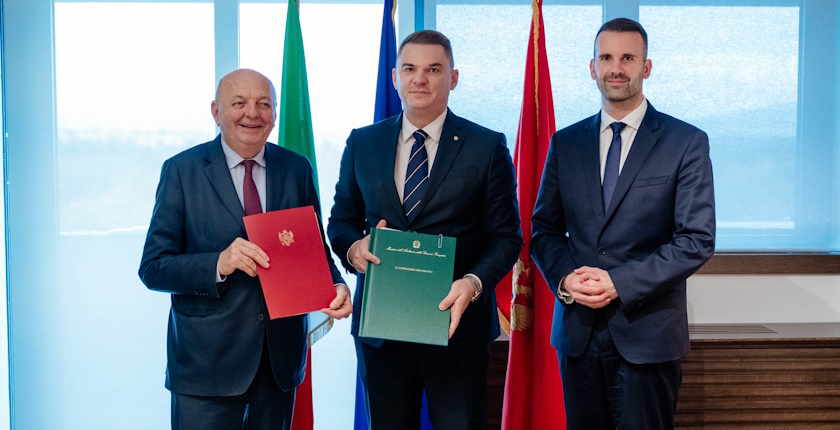
Minister of Energy and Mining of Montenegro Admir Šahmanović (pictured middle) and Italian Minister of the Environment and Energy Security Gilberto Pichetto Fratin (left) pointed out that energy links mean a more secure future, more stable supply and more development possibilities. They signed a bilateral memorandum of understanding on electricity market coupling.

Montenegrin Prime Minister Milojko Spajić (right) attended the ceremony together with Minister of Public Works, Spatial Planning and State Property Majda Adžović. The agreement is opening a new chapter in cooperation between the two countries and further strengthens Montenegro’s position on the European energy map, the Ministry of Energy and Mining said.

Market coupling alongside strengthening interconnection with second cable

Montenegro and Italy are linked with the Monita electricity interconnector, laid below the Adriatic Sea. In the new phase of their cooperation, they intend to couple their electricity markets for a freer power flow and safer functioning of the system, the ministry’s announcement reads.

“With this agreement, Montenegro is confirming its status as a reliable partner and energy bridge between the region and Europe. After several years of stagnation, this is a bit step forward, as it enables us to initiate the continuation of the project and the construction of the second wire of the subsea cable toward Italy. It opens the possibilities for our green, clean energy to become a distinguished export product, which means new income for companies and greater competitiveness in the European market. Today we once again confirmed good neighborly relations with Italy and we are showing that Montenegro is, slowly but firmly, entering the European family through concrete projects and partnerships. This is a step that brings our citizens long-term energy security and new opportunities for development to our companies,” Šahmanović stated.

Trade at Montenegro’s wholesale electricity market is expected to triple

There are 29 companies from 13 countries participating in Montenegro’s electricity market. Since the day-ahead market was established at the Montenegrin Power Exchange (MEPX or Belen) in April 2023, some 900 GWh of electricity changed hands, while the entire volume, together with the long-term market, amounts to about 3 TWh, the statement adds.

The memorandum’s implementation will create the conditions for at least three times higher trading volume, clearer price signal for new investments and a direct contribution to improving the security of supply, the ministry claimed.

National transmission system operators (TSOs) Terna and CGES have commissioned the first part of the interconnection in 2019. The current plan is to double the capacity to 1.2 GW. Šahmanović recently said the second line should be installed by 2031.

The project is valued at EUR 500 million. A double cable enables a two-way exchange at the same time.

Post Views:117
  • 1
  • …
  • 44
  • 45
  • 46
  • 47
  • 48
  • …
  • 140

AEA – Albania Energy Association is a industry association dedicated to representing the interests of Albanian and West Balkan for energy producers and consumers. AEA works to advance the development and adoption of sustainable energy solutions in Albania and the Western Balkans, supporting the region’s transition toward a cleaner, more secure, and more competitive energy future. AEA is registered by decision of the Court of Tirana, DECISION NO. 3032, (VAT:L11827451K).

[email protected]

Address
Blv Zogu 1
Tirana
1057
ALBANIA

LinkedIn  |  Facebook
Events
May 25, 2022 Connecting Green Hydrogen Europe 2022
May 25, 2022 Energy Week Western Balkans 2022
Copyright © Albania Energy Association