AEA-Albania Energy Association
  • Main
  • About Us
  • Services
  • Sectors
  • News
  • EventsEvents
  • PublicationPublication
  • Contact Us
AEA-Albania Energy Association
  • Main
  • About Us
  • Services
  • Sectors
  • News
  • EventsEvents
  • PublicationPublication
  • Contact Us
AEA-Albania Energy Association
  • Home Page
  • About Us
  • Sectors
  • Our Services
  • News
  • Contact Us
October 30, 2025
by AEA in News

Bulgaria’s coal regions to get further EUR 808 million for just transition

Bulgaria’s coal regions will receive BGN 1.58 billion (EUR 808 million) through the Just Transition program, under the European Union’s Just Transition Fund (JTF), for energy efficiency, renewable energy, and green hydrogen projects, as well as for converting mining areas for commercial use.

With a EUR 598 million program already underway, total investments in the economic transformation during and after the country’s coal phaseout would reach EUR 1.38 billion. They cover coal regions Stara Zagora, Kyustendil, and Pernik and the municipalities of Nova Zagora, Yambol, Simeonovgrad, Harmanli, Topolovgrad, Dimitrovgrad, Haskovo, Elhovo, Sliven and Tundzha.

Grants from the JTF are intended to help coal regions shut down mines and coal-fired power plants, rehabilitate land, switch to a circular and climate-neutral economy, and lift households out of energy poverty.

By the end of the year, the Bulgarian Ministry of Regional Development and Public Works will launch three new procedures for the allocation of grants, according to Deputy Minister Yura Vitanova.

One, worth EUR 153.4 million, will focus on energy communities and energy efficiency in public buildings. Another, worth EUR 72.6 million, will help small and medium-sized enterprises (SMEs) install solar panels and energy storage systems for both self-consumption and commercial use.

A third call, with a budget of EUR 242.9 million, will support the socio-economic transformation, including projects to convert mining areas into business and industrial zones.

Green hydrogen projects will be backed with EUR 134.5 million

Additionally, EUR 134.5 million will be used to fund the development of hydrogen production and transportation infrastructure in Stara Zagora. It includes the construction of a green hydrogen production complex and hydrogen charging stations, the procurement of hydrogen vehicles and hydrogen trailers, and the construction of supporting infrastructure, including photovoltaic systems and energy storage facilities.

The current JTF program in Bulgaria’s coal regions focuses on renovating residential buildings, supporting SMEs, and developing industrial and logistics parks. It also funds training and retraining programs for workers affected by the energy transition, as well as production investments in large enterprises.

Post Views:42
October 30, 2025
by AEA in News

Number of electric vehicles in Serbia reaches 6,000

There are about 6,000 registered electric vehicles in Serbia, according to Filip Mitrović, coordinator of the Emobility cluster of the Serbian Chamber of Commerce and Industry (PKS).

The fleet of 6,000 electric vehicles (EVs) in Serbia is small compared to Europe, Filip Mitrović stressed at the Belgrade Energy Days conference, as quoted by Tanjug. He also identified two obstacles to further growth.

First of all, regulatory inconsistencies make it impossible to accurately charge for the electricity consumed by electric vehicles at charging stations. Billing is currently based only on the duration of e-charger use, rather than the actual amount of electricity consumed, he added.

Complex documentation is required to install an electric charger

He underlined that there is no legal way to charge for the electricity consumed per kilowatt-hour. Therefore, a time-based charging method is used for electric vehicles.

“That’s not fair,” he said, and added that anyone who has used an EV knows it is standard to be charged based on the amount of electricity consumed. Mitrović noted that different models of EVs draw varying amounts of energy from the e-charger in the same period.

The second problem, in his words, is the procedure for the installation of EV chargers. Very often, complex documentation is required, which slows down and complicates the entire process, making investors give up on the project, Mitrović stressed.

In recent years, the Government of Serbia has been awarding subsidies for what it officially calls “ecological vehicles.” Last year, it decided to stop subsidizing hybrid (HEVs) and plug-in hybrid (PHEVs) electric vehicles and to provide funding only for 100% EVs or battery electric vehicles (BEVs).

Subsidies were granted for approximately 3,300 vehicles

The criteria remained the same this year. On August 8, the Ministry of Environmental Protection said it ended approving subsidies for the purchase of new EVs for 2025. All the allocated funds have been granted, it explained.

However, the government then secured more money and resumed the procedure on August 28.

In mid-September, the ministry said that the government backed the purchase of 2,834 eco-friendly vehicles since 2020. With the applications received this year, the number has reached 3,305.

Post Views:125
October 30, 2025
by AEA in News

Shanghai Electric becomes contractor for Romania’s largest solar park with batteries

Israeli company Econergy, owner of the largest photovoltaic park in Romania, has selected Shanghai Electric as the engineering, procurement, and construction contractor for a facility with a two times higher capacity and a 150 MW battery energy storage system.

After building the solar park in Romania’s Brașov county for Econergy, Shanghai Electric also won the contract for Părău 2. “Building on our successfully completed projects in Romania, we aim to further strengthen our presence across Central and Eastern Europe and deliver tailored solutions that accelerate Romania’s energy transformation,” Chairman of Shanghai Electric Group Wu Lei said.

The company’s photovoltaics portfolio in the country has reached 550 MW, according to the update. The investor behind Părău and Părău 2 is Israel-based Econergy. The first part, of 91.4 MW in peak capacity, was commissioned a year ago.

Econergy operates Romania’s largest solar park, Rătești. It has 155 MW in peak capacity. Părău 2 is for 342 MW, together with a 150 MW battery energy storage system (BESS).

Shanghai Electric is the EPC contractor for Econergy’s four PV parks, of which two are already operational

The investment is valued at EUR 275 million altogether. Părău 2, on 337 hectares in central Romania, has won a 15-year contract for difference (CfD) in December at the country’s first round of renewable energy auctions.

Econergy bid EUR 49.4 per MWh for 125 MW in connection terms or 150 MW in peak capacity. It was the biggest project on the list. The developer expects to put it into operation in 2027.

The solar park will supply both residential and commercial users, according to Shanghai Electric. Its Romanian portfolio includes Econergy’s Scurtu Mare 56 MW photovoltaic plant, which was provisionally cleared for the start of operations in June. Another one is the Ovidiu project for the same client, with 60 MW in peak capacity under construction.

Econergy has hinted that it could invite a partner for Părău 2. The Israeli company noted that it normally holds a 49% or 50% stake in Romania. It revealed that it could pick a previous partner such as Phoenix, headquartered in Israel, or RGreen Invest, a French investment fund.

Post Views:36
October 30, 2025
by AEA in News

Several EU member states face uncertainty amid looming Russian gas ban

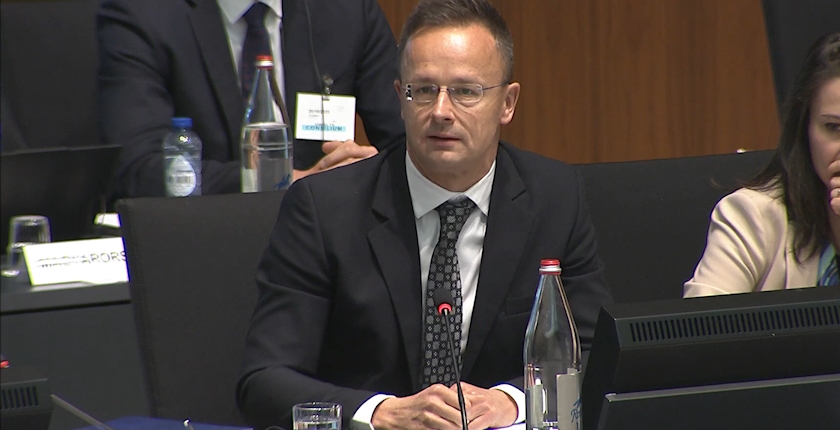
The European Union’s proposed measures to phase out imports of Russian oil and gas would destroy Hungary’s security of supply, according to Minister of Foreign Affairs and Trade Péter Szijjártó, who spoke at the meeting of energy ministers in Luxembourg. Slovakia is in a similar situation, while Romania pointed to the difficulty of proving the origin of foreign gas.

The draft regulation that the Council of the EU adopted doesn’t explicitly call for a ban on the transit of gas to third countries, while it foresees a temporary suspension for member states in case of supply disruption. The proposal also allows the possibility of importing non-Russian gas through the TurkStream pipeline.

The meeting of the so-called Energy Council highlighted several issues and concerns among EU member states about the proposed ban on Russian natural gas, including liquefied natural gas (LNG). Energy ministers in the Council of the EU adopted their position ahead of negotiations with the European Parliament on measures that they plan to introduce on January 1.

There would be a transition period for existing contracts for Russian fossil gas. Short-term ones concluded before June 17 this year would remain in force until June 17, 2026. Long-term contracts may run until January 1, 2028. It is also the targeted date for ending imports of Russian oil.

Szijjártó: The remaining infrastructure, physically and capacity-wise, is not able to supply Hungary

“The real impact of this regulation is that our safe supply of energy in Hungary is gonna be killed,” the country’s Minister of Foreign Affairs and Trade Péter Szijjártó stressed at the meeting.

He clarified that he wasn’t speaking about prices, and warned of damage from the proposed regulation – in the name of diversification.

“As now we are phasing out supply routes towards Hungary, the remaining infrastructure, physically and capacity-wise, is not able to supply the country. This has nothing to do with politics. This has nothing to do with Russia. This has nothing to do with the war in Ukraine. This is mathematics and physics,” Szijjártó stressed.

He also reiterated that his country would be left dependent on one oil supply route, via Croatia. It would leave Hungary “totally defenseless to a monopoly” as the transit fee doubled since the start of the war and it is five times higher than the current European benchmark, the minister underscored.

Bulgaria asks for protection from arbitration for gas TSOs

Slovak Deputy Prime Minister and Minister of Economy Denisa Saková said the supply of gas to her country is limited. There are interconnections with all neighbors, but external capacity bottlenecks remain, she argued. Bulgaria asked for provisions protecting gas transmission system operators (TSOs) from arbitration and financial penalties.

Romania voted for the draft regulation, but warned that identifying the origin of imported gas would be difficult

Secretary of State in Romania’s Ministry of Energy Cristian Bușoi urged for a workable and harmonized verification system and for the development of clear guidelines.

“This is not a matter of energy policy, but of strategic autonomy and European solidarity. At the same time, as we move from political vision to implementation, we believe it is important that the new authorization and verification system remains practical, transparent and proportionate. The additional requirements to demonstrate the exact country of production represent a new level of responsibility that, while understandable, and we support this in principle, may be difficult to fulfill in practice, particularly for pipeline [and] natural gas traded on hubs, and shipments transport, including LNG cargos that involve multiple sources and blending,” Bușoi told the ministers.

Council of EU proposes suspension clause

Notably, the Energy Council’s position, part of the REPowerEU plan and sanctions against Russia, is that the regulation should contain a suspension clause. The European Commission could temporarily lift the ban on Russian gas and LNG in case of significant disruptions of supply.

Another important element is the possibility of importing non-Russian gas through the TurkStream pipeline if the fuel’s origin is proven.

Gas transit through EU not subject to prohibition

Energy ministers said the EU should ensure that natural gas which crosses the 27-member bloc under a transit procedure is not ultimately entering into free circulation in the union.

It would imply that Serbia, Bosnia and Herzegovina and North Macedonia, non-EU countries, could continue to buy Russian gas that is delivered through Balkan Stream. It is the extension of TurkStream running through Bulgaria and Serbia to Hungary.

“Any gas which, before its import into the EU, was exported from the Russian Federation, either via direct export from Russia to the EU or via indirect export through a third country, should, except in case of transit, be subject to the prohibition”, the document reads.

Serbia still hasn’t signed a long-term gas supply contract with the Russian side, and the previous one expired in May. Moreover, the United States have imposed sanctions on Gazprom-controlled NIS, Serbia’s national oil importer, refiner and operator of a chain of service stations.

On top of it all, hydropower output is at a record low due to chronic drought, while coal is being imported as domestic mines don’t produce enough lignite.

Post Views:103
October 30, 2025
by AEA in News

First merchant battery projects in Greece to be highly profitable, study shows

Standalone battery units in Greece are expected to be profitable both in the short and the long term, according to a new study by the Aristotle University of Thessaloniki (AUTh).

The results were based on a simulation carried out for a variety of battery types, with storage durations between two and five hours. A maximum of two charge-discharge cycles per day was taken into account.

The study concerns merchant projects that rely exclusively on the market for their profitability. This means that they can generate revenue in three ways: through the daily arbitrage between the lowest and highest hourly wholesale power prices, from balancing the system and providing reserves.

Storage duration determines revenues

In the case of a battery with a capability of 10 MW and five hours of storage, the results showed a revenue of EUR 2.6 million in 2026. The amount falls after 2030 to EUR 1.6 million, which is still sufficient for investments. It remains near the same level all the way to 2037.

Revenues for a 10 MW facility with a two-hour duration are much lower. They begin at EUR 1.5 million in 2026 and decline to EUR 800,000 after 2030.

Projects will rely mostly on arbitrage after 2028

In comparison, a 10 MW project costs between EUR 2.5 and EUR 5 million to develop, depending on storage duration, according to current battery prices. Therefore, it is evident that investors would return the investment in less than 10 years. Typical systems have an operational life expectancy of 20-25 years.

“Batteries will benefit initially from high revenues through balancing and reserves provision. After the first few years, they will rely mostly on arbitrage,” said Pantelis Biskas, professor at AUTh.

Greece published a plan earlier this year to develop 4.7 GW in commercial battery storage systems. Businesses are currently moving to secure licenses and the first installations are expected to come online by 2028.

It means the projects will probably miss the initial high returns that AUTh expects. However, they will still be profitable, especially the ones with long storage duration.

Post Views:42
October 30, 2025
by AEA in News

WindEurope to Greece: Accelerate licensing, reintroduce wind energy auctions

WindEurope has advice for Greece to accelerate wind power installations, given the country’s sluggish performance.

WindEurope expects Greece to add 300 MW of wind capacity in 2025, after 152 MW came online in the first six months. It is an improvement from the mere 108 MW of the entire 2024, but still far below previous years. For example, in 2023, the country added 544 MW of wind power. WindEurope’s Director of Advocacy and Messaging Viktoriya Kerelska has suggested solutions to increase the pace.

Greece needs to integrate the latest version of the European Union’s Renewable Energy Directive – RED3 – to facilitate faster and simpler licensing, she said at the Renewable and Storage Forum in Athens.

Other member states are behind schedule with the legislation as well. The European Commission opened infringement procedures in July by sending letters of formal notice to 26 of them – all except Denmark.

Kerelska: Do it like Germany

Furthermore, WindEurope believes that the concept of superior national interest must be applied in Greece, according to Kerelska.

Based on European law, it would allow easier wind farm deployment, while overriding unjustified public reactions that delay the process.

Kerelska added that Germany already applied the principle with great success.

Power purchase agreements (PPAs) are underutilized in Greece.

Therefore, the country should reintroduce wind power auctions, which it held until 2022, for support under contracts for difference (CfDs), according to the association.

One last issue is the delay in the national offshore wind program, which the government has not submitted yet to parliament for adoption, Kerelska noted.

HWEA: Time is running out

Easy times for renewable energy are over, Chairman of the Hellenic Wind Energy Association (HWEA or ELETAEN) Panagiotis Ladakakos said. The sector faces difficult decisions and potential hidden costs, while time is running out to make changes in the regulatory and legal framework, he claimed.

HWEA called on the government to introduce a curtailment allocation mechanism within which curtailed energy would be calculated. Namely, the cuts are not spread evenly, and wind farms connected to the transmission network suffer higher costs. The government has promised to introduce a mechanism by the end of 2025.

The organization said energy storage facilities should be able to have joint grid connection points with renewable energy plants. It referred to projects where the battery’s capability or operating power can be as high as the installed capacity for electricity production.

HWEA added that Greece requires to enact its national offshore wind plan and a special purpose vehicle (SPV) to carry out offshore studies. Moreover, it urged for the development of a new renewable energy spatial plan and more incentives for consumers in areas hosting renewable energy plants.

Post Views:54
October 30, 2025
by AEA in News

Alerion to begin construction of wind parks in Romania totaling 336 MW

Italy-based Alerion Clean Power has obtained all permits for three wind farms in Romania. All the sites, for a combined 336 MW, are in Constanța county, the country’s wind power hub, and in a small area swarming with renewable energy projects.

When Alerion struck a deal with Monsson Alma for three wind power projects in Romania in 2021, the country was just beginning to revive the sector following several completely dormant years. The Italian company’s investments are entering the construction phase, Profit.ro reported, at a time when investors are preparing to break ground for dozens of such facilities, and some are soon coming online.

The sites are in Crucea, Saraiu and Vulturu in Constanța county, part of the historic Dobruja (Dobrogea) region. It is the heart of Romania’s wind energy production.

Furthermore, there are numerous other projects and facilities in the same area northwest of the port city of Constanța and bordering Tulcea county. The article adds that Italy-based Alerion Clean Power took over the wind power projects from Emanuel Muntmark, who controls Monsson Group. His company has a significant presence in the ongoing investments in and around the territory of the Crucea commune, in the country’s southeast.

Alerion has received the so-called establishment authorization or permit from the National Energy Regulatory Authority (ANRE). The three projects are for 336 MW altogether, consisting of a 108 MW unit and two twin investments of 114 MW each.

Monsson Group has developed several major projects in and around the territory of the Crucea commune

They will all be connected to the grid via a 400/110 kV transformer station that the Italian company needs to build, the update revealed. The estimated commissioning date is 2027.

Alerion expects the future wind parks to generate an overall 1.1 TWh per year, bringing EUR 85 million in earnings before interest, tax, depreciation and amortization (EBITDA).

The company operates 15 solar parks in Romania, with 165 MW in combined peak capacity. Alerion took out an EUR 18 million loan earlier this year from Banca Comercială Română (BCR), part of Erste Group, for a photovoltaic project of 35 MW in Călărași county. The project was valued at EUR 26.8 million.

In neighboring Bulgaria, Alerion operates the Krupen wind power plant of 12 MW.

Post Views:56
October 30, 2025
by AEA in News

Croatia finally close to removing major obstacle to investments in renewables

After three years of delays, Croatia is finally close to adopting a methodology for the calculation of the grid connection fee for renewable power plants. Investors have repeatedly urged the authorities to enact the document, arguing it was the main obstacle to investments in renewable energy sources.

The Croatian Energy Regulatory Agency (HERA) said it has developed a draft methodology for determining the electricity grid connection fee. The public discussion, which began on October 23, lasts until November 21.

According to HERA, the effect of required investments in the transmission network on the network usage fee depends on the share of the connection fee in the total costs of developing the high and very high voltage network, as well as on the amount of grants.

It is possible to connect to the grid even before all technical conditions are met

The effect on the network usage fee will become evident when the relevant network reinforcements are completed, for example, in 10 to 15 years, the agency said.

The costs of developing the transmission network to achieve goals from the National Energy and Climate Plan (NECP) will be financed partly from the grid connection fee and partly from the network usage fee.

HERA pointed out that the legislative framework allows network users to connect even before all technical conditions met, by signing flexible connection agreements, which envisage the possibility of operational restrictions regarding connection capacity.

Personnel decisions have delayed the process of determining the fee

The Renewable Energy Sources of Croatia (RES Croatia) association repeatedly warned that the failure to determine the grid connection fee has halted projects worth around EUR 3 billion overall.

In mid-September, together with SolarPower Europe and WindEurope, RES Croatia sent a letter to the European Commission to raise concerns about the crisis in the country’s renewable energy sector.

According to domestic media, one of the main reasons for the delay in determining the grid connection fee was that HERA’s Management Board was incomplete for two years.

Post Views:105
October 30, 2025
by AEA in News

Share of private power producers in Albania tops 50%

Since last year, there is more electricity generation capacity in private ownership in Albania than in the system under state-controlled utility KESH. Growth in the solar power segment is the biggest factor for the switch. Its share of capacity has reached 10%.

Government-owned KESH in Albania lost its monopoly in electricity production in 2007 with the introduction of hydropower concessions. According to the Energy Regulatory Authority (ERE), power plants in private ownership account for the majority of the capacity since last year, Monitor reported.

The total grew by 537 MW in 2024 to 3.21 GW, mainly due to a surge in the photovoltaic segment. KESH operated 1.56 GW or 48.6%, against 1.65 GW run by private companies. One year earlier, the state-owned utility held 56%, the article adds. Nevertheless, a hydropower plant usually generates three times more electricity than a PV plant of the same size.

Diversification into photovoltaics, wind, gas, storage

Albania is specific in the Western Balkans region for having no coal power plants and producing almost all its electricity in hydroelectric systems, which makes it vulnerable to droughts. KESH has dominated the sector mainly with its cascade on the Drin (Drim) river.

Private solar parks are leading the way in capacity additions in Albania, but a hydropower plant normally generates three times more electricity than a PV park of the same capacity

Norway-based Statkraft stands out among the largest private companies, with its projects on the Devoll, together with Turkish company Ayen Enerji’s endeavors in the Fan river basin and Austrian Verbund’s Ashta complex, also on the Drin.

Efforts are underway to diversify the country’s mix with solar and wind energy and introduce storage capacity. However, not a single wind turbine has been built yet. In addition, there is an opportunity for strengthening the electricity supply using gas from the Trans Adriatic Pipeline – TAP.

Two major solar power plants commissioned this year

ERE’s data show that in the first eight months of this year, Albania added two solar power plants of an overall 150 MW and a hydropower facility of 48.9 MW to its transmission grid.

The country hosts Karavasta, the biggest photovoltaic park in the region, at 140 MW in peak capacity. Its operator Voltalia, headquartered in France, is building Spitalla, a 100 MW facility. It won both projects at Albania’s renewable energy auctions.

Deputy Prime Minister and Minister of Infrastructure and Energy Belinda Balluku said today that solar power reached 10% of capacity.

In other recent news, CWP Europe recently signed a joint declaration with the European Commission and the Albanian Investment Development Agency in support of its Tropoja wind farm project.

Post Views:50
October 30, 2025
by AEA in News

Domac: No energy transition without much stronger grid investments

Croatia is investing only half as much in the electricity network as Slovenia and Austria, said Managing Director of North-West Croatia Regional Energy and Climate Agency (REGEA) Julije Domac. He warned that without an acceleration in grid investments, there are no renewable sources and no energy transition.

Croatia is about to overcome one of the biggest obstacles to investments in green energy, with its proposed methodology for the grid connection fee. However, there are several more bottlenecks in the sector, and they mostly also concern the electricity network.

The grid is apparently not among priority segments in Croatia, which depends to a large extent on electricity imports. The situation is similar throughout the Balkans and Europe, and beyond, and the basic question is who will cover the expenses as well as which projects are the most important for enabling the deployment of renewables. Among other difficulties, the administrative capacity for permitting for grid improvements and expansion is too weak, alongside complex environmental and spatial planning requirements.

Managing Director of REGEA Julije Domac outlined his view on the matter in a LinkedIn post. “Without an electricity network, there are no grid connections, no RES, no transition… There is more than 13 GW of solar and wind power projects under development today, but the network cannot integrate it without accelerated investments,” he wrote.

Photo: Julije Domac (REGEA)

Grid operators reacting with emergency measures instead of long-term strategy

The free capacity in the power distribution grid is estimated at 3.7 GW, but a large part is in areas with low interest for investing, Domac pointed out. Of note, he is also Croatian President Zoran Milanović’s special advisor on energy and climate.

“In the coastal area and Dalmatia, where the resources are the best, the network is near the maximum load in many parts – it means a malfunction of one element could jeopardize the system’s stability. To avoid that, the operators are already often turning to emergency measures in dispatching now: shutting down parts of the network, redirecting flows, pausing works. It is ‘putting out fires’ – and not a long-term strategy,” the head of REGEA said.

The regulated income from tariffs limits investments as the transition’s urgency isn’t acknowledged

Domac stressed that Croatia is investing less than EUR 20 per customer per year, only half as much as Slovenia and Austria. In his opinion, the tariff-based methodology is limiting investments. Namely, Croatian Transmission System Operator (HOPS) and HEP-ODS, the national distribution system operator, are funded through regulated income under the Croatian Energy Regulatory Agency (HERA), and the mechanism doesn’t acknowledge the urgency of the transition, according to the energy expert.

Another point is delayed digitalization, as Croatia has a much lower share of smart meters than neighboring Slovenia, where it surpassed 99%, or Italy, where the level is around 95%, he underscored. There is no domestic market for flexibility and no contracts with batteries and with consumers that could help ease the pressure on the grid, Domac claims.

In addition, he highlighted the sluggish grid connection procedure, saying it lasts ten years for wind power plants and four years for photovoltaics, the most in all European Union.

Grid connection costs can be covered with EU funding, green bonds

Domac is recommending to the authorities to introduce temporary connection points, with a controlled power delivery – limited until network enhancements are completed. HERA did envisage such a possibility in its draft methodology.

The grid connection fee for renewable electricity plants should be abolished, which was already promised, Domac recalled. It is an obstacle blocking 60 projects for 3.5 GW in total, he noted. It is the grid operator that should bear the cost and, aside from the tariff items, it can finance them through EU funds and green bonds, like most member states do, Domac added.

He expressed the belief that ten or so most important grid interventions should be accelerated – transformer stations and transmission lines in particular and especially in Dalmatia. Pilot projects for batteries and flexibility would pave the way for more grid connections without the wires, and public procurements need to be streamlined as well for works worth up to EUR 1 million, for instance, so that the replacement of one transformer doesn’t last twelver months, Domac asserted.

Post Views:43
  • 1
  • …
  • 43
  • 44
  • 45
  • 46
  • 47
  • …
  • 140

AEA – Albania Energy Association is a industry association dedicated to representing the interests of Albanian and West Balkan for energy producers and consumers. AEA works to advance the development and adoption of sustainable energy solutions in Albania and the Western Balkans, supporting the region’s transition toward a cleaner, more secure, and more competitive energy future. AEA is registered by decision of the Court of Tirana, DECISION NO. 3032, (VAT:L11827451K).

[email protected]

Address
Blv Zogu 1
Tirana
1057
ALBANIA

LinkedIn  |  Facebook
Events
May 25, 2022 Connecting Green Hydrogen Europe 2022
May 25, 2022 Energy Week Western Balkans 2022
Copyright © Albania Energy Association