AEA-Albania Energy Association
  • Main
  • About Us
  • Services
  • Sectors
  • News
  • EventsEvents
  • PublicationPublication
  • Contact Us
AEA-Albania Energy Association
  • Main
  • About Us
  • Services
  • Sectors
  • News
  • EventsEvents
  • PublicationPublication
  • Contact Us
AEA-Albania Energy Association
  • Home Page
  • About Us
  • Sectors
  • Our Services
  • News
  • Contact Us
December 16, 2025
by AEA in News

Montenegro adopts National Energy and Climate Plan

The Government of Montenegro has adopted the National Energy and Climate Plan, along with a bill on cross-border electricity and natural gas exchange.

The National Energy and Climate Plan (NECP) of Montenegro is the overarching strategy that clearly defines what the country should achieve by 2030: a 55% reduction in emissions, a renewable energy share of at least 50%, and substantial progress in energy efficiency, according to the Ministry of Energy and Mining.

“Over the past eight months, we have made a tremendous effort to finalize two key documents that have been awaited for years and are crucial for our European commitments,” Minister Admir Šahmanović stressed.

This is a plan that enables new investments, new renewable energy power plants, modern grid infrastructure, and a secure transition for the Pljevlja coal region, he explained.

Šahmanović: The latest European Commission report confirms Montenegro’s progress

The ministry noted that the bill on cross-border electricity and natural gas exchange is among the most important energy laws proposed by this government. Šahmanović recalled that this is not merely a technical issue.

The bill, in his words, opens the door to the single European market, directly impacts the closure of Chapter 15 of the accession negotiations with the EU, and gives full meaning to the electricity interconnection with Italy and the EU market.

It would provide greater energy security, better competition, more stable prices, and a stronger position for the country’s economy, he added.

“The latest report from the European Commission confirms that we have made progress. Today’s decisions by the government are the best confirmation of this. These are the foundations for a more energy-secure, modern, and European Montenegro, and we have reason to be satisfied with the progress we have achieved,” Šahmanović underscored.

The bill represents the most extensive reform of energy legislation in the past decade

According to the ministry, by adopting these two strategic documents, Montenegro has taken a significant step forward in aligning with EU energy rules.

The NECP integrates energy, climate, and development policies into a single framework for the first time, sets clear and measurable goals, and lays the foundation for Montenegro’s long-term energy transition.

The law on cross-border electricity and natural gas exchange represents the most extensive reform of energy legislation in the past decade, transitioning from a basic regulatory framework to a full European system of market, technical, and security rules.

Together, these two documents represent the most important reform package in the energy sector in recent years, fully aligned with European legislation and the EU’s strategic priorities, the ministry concluded.
Post Views:75
December 16, 2025
by AEA in News

IEA: Employment in energy sector grows two times faster than in global economy

A new report from the International Energy Agency (IEA) shows that the rate of employment growth in the energy sector was two times higher in 2024 than in the overall global economy. On the other hand, the organization is warning of a serious shortage of skilled workers in key sectors. Renewable energy sources, especially solar power, and the broader process of electrification play a key role in the expansion.

The energy sector employed 76 million people last year, according to the IEA’s World Energy Employment 2025 report. Investments in energy infrastructure contributed to employment growth, which came in at 2.2%, nearly double the global 1.3% rate.

The shift toward electrification is significantly transforming the structure of the workforce. It has led to the electricity sector surpassing the fuel supply sector in employment for the first time.

The number of people working in electricity generation, transmission, distribution, and storage has increased by 3.9 million over the previous five years, reaching 22.6 million—representing nearly three-quarters of all new jobs created in the energy sector.

Renewable energy sources, particularly solar power, are the strongest drivers of job creation. Solar alone accounts for 50% of all new power sector jobs since 2019. Last year, solar employment grew by 310,000, almost half of global power generation job growth. The total number of solar jobs is estimated at five million.

Nuclear power, grid expansion, and energy storage collectively accounted for one quarter of new energy sector jobs since 2019, despite challenges such as rising component costs and shortages of skilled labor, the report notes.

Wind sector stagnates

Employment in the wind sector grew by 3% in 2024, reaching 1.7 million jobs, compared to a compound annual growth rate of 5% over the previous five years. Rising procurement costs and declining government subsidies have slowed project development and delayed new investments, according to the latest data.

The slowdown is most visible in manufacturing, where employment fell by 6% due to reduced demand for new turbines and components as projects were delayed or cancelled.

Investors in offshore wind have significantly scaled back investment plans in response to rising project costs. Europe recorded the largest decline in offshore wind employment last year, with a 4% drop.

The automotive sector also recorded solid growth last year, driven by an increase in jobs related to electric vehicles (EVs) and batteries.

Oil and gas employment returns to 2020 levels

Employment in coal supply has fallen by 20% in advanced economies since 2019, but due to expansion in India, China, and Indonesia, global coal employment increased by 8%.

The report also notes that the number of workers in the oil and gas supply has returned to 2020 levels. “However, it now appears that many firms are entering a new period of retrenchment in the face of lower oil prices and revenues, with a number of major oil companies announcing job cuts in 2025,” the report states.

Shortage of skilled labour deepens

Despite job growth, the report highlights an acute shortage of skilled labour. Applied technical occupations—including electricians, pipefitters, lineworkers, plant operators, and nuclear engineers—are in particularly short supply.

In the IEA’s Energy Employment Survey, 60% of companies reported labour shortages. This bottleneck threatens countries’ ability to maintain energy security, expand grids, scale clean energy manufacturing, refurbish nuclear power plants, and attract investments.

The number of graduates with energy-relevant training is not keeping pace with rising demand. According to the report, to prevent further skill misalignment by 2030, the number of graduates entering the energy sector would need to increase globally by around 40%. Expanding training capacity to this level would cost an estimated USD 2.6 billion annually.

Limited impact of artificial intelligence

Companies are increasingly turning to workers from related industries and reskilling programs to fill labour gaps. Although 50% of surveyed fossil fuel workers said they would remain in the energy sector if alternative employment existed, not all workers have equal opportunities for retraining.

The report also examines the role of artificial intelligence. While AI brings benefits, its impact remains limited, as it cannot reduce the demand for manual technical labour—precisely the occupations in shortest supply.

Policy interventions can significantly influence the ability to attract new workers into the energy sector. According to the IEA, the biggest barriers to entering training programs include high costs, income loss during training, and limited awareness of available programs. Effective measures include targeted financial incentives, expanded vocational programs, greater industry involvement in curriculum development, and investments in training centres, while reskilling within the sector remains essential.

Working conditions also play an important role. Pay, job security, and a safe work environment are the most important factors for workers, the report shows, and these issues are increasingly at the centre of social dialogue.

Post Views:56
December 16, 2025
by AEA in News

Turkey awards 1.15 GW in wind power auctions – all at just EUR 35 per MWh

The six winners from the latest round of wind power auctions under the YEKA state support mechanism in Turkey will have at least EUR 35 per MWh guaranteed from the sale of electricity in the first six years. It was the floor price in the bidding. After it was reached for each zone, the remaining participants had to compete by offering to pay for the right to sign the contract.

Delays and the lack of money for the construction of high-voltage, transmission lines is one of the main hurdles slowing the uptake of wind and solar power. Turkey’s approach has turned out to be successful, as it allows investors to compete to pay one-off fees for available predetermined projects in auctions. At the same time, the beneficiaries get guaranteed prices for the future sales of their electricity.

The country has earned EUR 530 million overall this year from two rounds for solar and two for wind power, Minister of Energy and Natural Resources Alparslan Bayraktar said. It includes EUR 208 million just from the latest bidding under the Renewable Energy Zones (REZ) state support mechanism, he claimed. It is better known by its Turkish acronym YEKA.

The winners are getting grid connections for 49 years

The ministry awarded zones for six projects for 1.15 GW in total connection capacity. The winners are getting grid connections for 49 years, a minimum price during the six-year open market sale period and power purchase agreements (PPAs) at the same level for another 20 years.

Entire capacity allocated at floor price

In the bidding in the REZ WPP 2025 (YEKA RES 2025) round, the ceiling price was EUR 55 per MWh. With 75 applications altogether, 30 companies participated – between six and 20 per zone.

In all cases, the bottom price of EUR 35 per MWh was reached, so the remaining bidders were switched to the second phase. The YEKA auctions are broadcast live.

The winners need to pay between EUR 56,000 per MW and a stunning EUR 312,000 per MW of capacity, or from EUR 23.8 million to EUR 34.3 million for each zone. Combined, the contribution fees amount to EUR 173 million, or some EUR 470 million for all auctions held this year.

Bayraktar estimated total investments in projects involved in the last wind power round at USD 1.1 billion.

Eksim, Polat among winners

The Kütahya zone of 120 MW went to İçdaş Elektrik Enerjisi, for EUR 222,000 per MW. Stone Enerji snatched the Aydın-Denizli project of 140 MW with a winning bid of EUR 170,000 per MW. The firm was a winner at the recent solar power auctions as well.

For the Sivas area, the largest of all (500 MW), Kanat Rüzgar Enerji will be required to pay EUR 56,000 per MW, which is the lowest level.

Three zones are in Balıkesir province. Eksim Energy (Enerji) committed the most of all winners, EUR 312,000 per MW, for the Balıkesir-3 project. It is for 110 MW. Balıkesir-2, of 120 MW, was won by Balıkesir Elektrik. It offered a contribution fee of EUR 218,000 per MW.

The Balıkesir-1 area is for 160 MW in connection capacity. Polat Enerji’s subsidiary Soma Enerji was the best bidder, with EUR 212,000 per MW.

Turkey hosts wind power plants of more than 14 GW combined, of more than 121 GW in total electricity capacity.

Post Views:59
December 11, 2025
by AEA in News

Energy Community: Serbia best in Western Balkans in alignment with EU regulations

Integration with the European Union is advancing in practice, and the decade ahead must sustain the momentum with focus and determination, Energy Community Secretariat Director Artur Lorkowski pointed out in this year’s Annual Implementation Report.

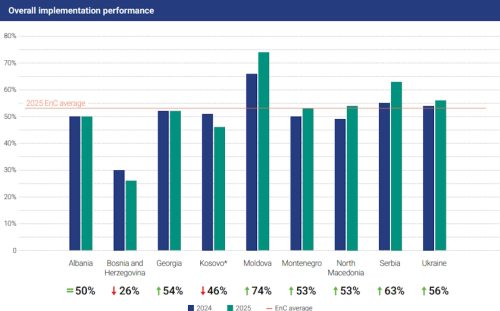
Serbia fares best in the Western Balkans, as it advanced to 63% from 55%. Bosnia and Herzegovina is at the bottom of the entire Energy Community chart, with alignment at just 26%.

Following the 2025 CBAM Readiness Tracker, the Energy Community Secretariat also published its Annual Implementation Report 2025. The international organization marked its 20th anniversary this year.

“The message from Athens was clear: integration with the European Union is advancing in practice, and the decade ahead must sustain this momentum with focus and determination. The 2025 Implementation Report reflects this direction. It shows a region taking decisive steps toward alignment with the EU acquis and strengthening the foundations required for accelerated integration. It also highlights where further effort is needed for gradual integration with the EU energy markets – completing the electricity market coupling, boosting the cross-border trade in renewables, eliminating bottlenecks for gas flows, synchronising energy infrastructure development and gradual alignment of carbon pricing mechanisms,” Energy Community Secretariat Director Artur Lorkowski stressed.

He added that electricity integration remains central. Several contracting parties completed the required transposition of the European Union’s Electricity Integration Package (EIP), while others advanced significantly.

Deadline for requests for 2028 market coupling to expire in seven months

Intensive market coupling efforts throughout 2025 by contracting parties and EU stakeholders have laid the groundwork for a compliant and sustainable integration process, according to the Annual Implementation Report. Of note, market coupling is the requirement for an exemption from the EU’s Carbon Border Adjustment Mechanism (CBAM) for electricity.

Contracting parties aiming to go live in 2028 must submit a formal request by July, the secretariat warned.

Energy Community Serbia best score Western Balkans
Photo: Energy Community Secretariat

Montenegro, North Macedonia advance slightly to match average

Five main indicators measure the integration with the EU energy markets and they are combined into an overall score. The Energy Community as a whole is at 53%.

Moldova has advanced the most in the process by far, climbing eight points from last year to reach 74%. Serbia fares best in the Western Balkans, as it advanced to 63% from 55%. It ranked the highest last year as well. Bosnia and Herzegovina is at the lowest level again. It retreated four points, to just 26%.

Montenegro and North Macedonia advanced slightly, both to 53%, to match the Energy Community average. Kosovo* has weakened to 46% while Albania remained at 50%.

At 61%, North Macedonia is in the lead in the Western Balkans in the markets and integration segment. Serbia reached the highest level in the Energy Community in energy sector decarbonization, 83%.

Post Views:52
* This designation is without prejudice to positions onstatus and is in line with UNSCR 1244/99 and the ICJ Opinion on the Kosovo declaration of independence.
December 11, 2025
by AEA in News

Bulgarian firm Hydrogenera gets electrolyzer order from Volkswagen

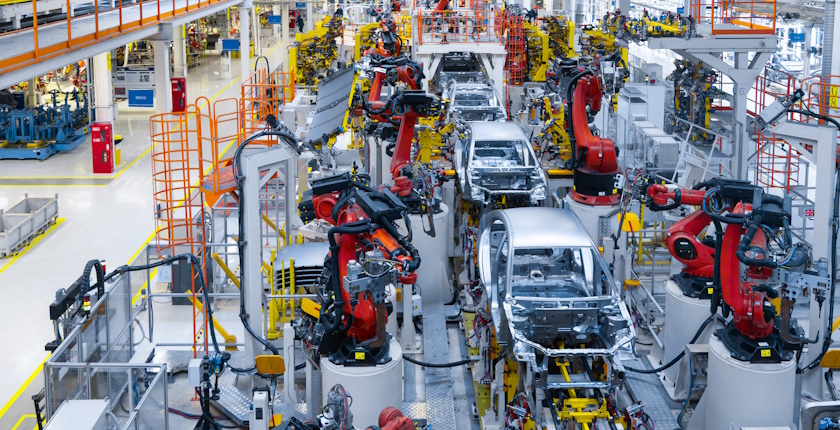
Hydrogenera will integrate its electrolyzer with a gas burner at Volkswagen Poznań’s automotive factory in western Poland with the aim of cutting the consumption of the fuel as well as related emissions by up to 30%. The produced hydrogen and oxygen would both be utilized within the system, the Bulgarian company said.

Hydrogenera, which was listed on the Bulgarian Stock Exchange (BSE) in July, is one of the few companies in Southeastern Europe designing and manufacturing proprietary equipment for cutting-edge energy technologies. Its parent company Green Innovation recently became Volkswagen’s authorised supplier and obtained the giant automotive giant’s Sustainability Rating, setting the stage for a new order.

In addition to mixing it with gas for combustion, industrial producers are gradually introducing hydrogen and electrolyzers into other processes. Collaboration is underway with Volkswagen Poznań for a hydrogen-oxygen system at the carmaker’s plant in Września, in western Poland.

Hydrogenera explained that the challenge is to enhance the combustion efficiency of a natural gas burner with 1.5 MW in nameplate capacity. The 90 kW electrolyzer would operate as a non-intrusive add-on to the existing equipment – not affecting installations, automation or safety systems, according to the update.

Oxygen produced in the electrolyzer will be utilized as well, improving combustion

Hydrogen and oxygen are supplied separately to optimize the flame. Hydrogen is mixed with natural gas directly before the burner, while oxygen is introduced into the air stream directed to the combustion chamber. It enables complete fuel combustion, minimizing losses, Hydrogenera said.

The company claimed the solution can reduce fuel consumption by 30%, alongside a corresponding cut in emissions at the facility near Poznań.

Of note, green or renewable hydrogen is produced using electricity only from renewable sources, therefore without greenhouse gas emissions.

Green Innovation has raised BGN 7.96 million (EUR 4.1 million) in the initial public offering in Sofia. Its market capitalization has slipped 2% to BGN 92.1 million (EUR 47.1 million) since listing on July 29 under the ticker HYDR.

Post Views:35
December 11, 2025
by AEA in News

Croatia drafts EUR 1.68 billion Social Climate Plan

Croatia has prepared a Social Climate Plan for the period 2026-2032, worth EUR 1.68 billion. It would introduce measures for the buildings and road transport sectors aimed at supporting households and small businesses.

The draft of Croatia’s Social Climate Plan is under public discussion, which will last until December 22.

The process of adopting the most important national instrument for protecting citizens from the adverse effects of climate transition and the introduction of the European Union’s Emissions Trading System 2 (EU ETS 2) has begun, the Ministry of Environmental Protection and Green Transition stressed.

The plan will be financed with EUR 1.26 billion from the EU’s Social Climate Fund, and the remainder from Croatia’s national budget. Essentially, all the funds are coming from the auctions of emission allowances in the EU and Croatia under the EU ETS 2. It is an expansion of the EU ETS to the buildings sector (heating and cooling) and road transport.

The EU established the Social Climate Fund in May 2023 to protect households and small businesses

The expansion could increase the costs of heating, cooling, and transport. In May 2023, the EU established the Social Climate Fund to protect low-income households, micro enterprises, and transport users that could be affected by the cost increase.

The measures and investments also contribute to the implementation of the goals of the National Energy and Climate Plan (NECP).

The Social Climate Plan allocates EUR 658.1 million (39%) for the buildings sector, and EUR 958.4 million (57%) for road transport. Technical assistance is the third component, with EUR 42 million (2.5%).

The measures planned for the buildings sector include support for the establishment of energy communities and subsidies for the energy renovation of family homes. In the road transport sector, the plan envisages investments in cycling, on-demand mobility services, zero-emission vehicles, and railway infrastructure.

Vučković: Restoration planned for 180 kilometers of bike trails

croatia social climate policy plan EU ets 2 marija vuckovic plenkovic
Photo: Government of Croatia

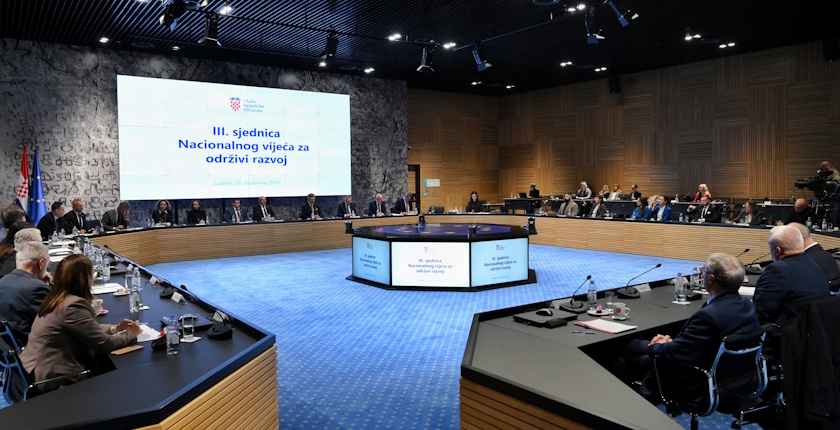
​While presenting the draft plan at a session of the National Council for Sustainable Development, Minister of Environmental Protection and Green Transition Marija Vučković said it identifies two groups: the energy poor or vulnerable, and transport poor or vulnerable.

“The plan provides for 10 measures, four of which relate to so-called stationary or energy poverty, and the remaining six to achieving affordable and favorable mobility and reducing the risk of transport poverty,” she explained.

According to the ministry, the plan provides for the renovation of 180 kilometers of bicycle paths, 80 kilometers of railway lines, as well as the procurement of 30 electric trains, 80 electric buses, and 3,000 electric cars.

Prime Minister Andrej Plenković stressed that the plan isn’t just a technical and administrative document, arguing that it determines what Croatia would become in ten, twenty, and fifty years.

“And we want a Croatia that is economically strong, socially just, and sovereign,” Plenković underlined.

Post Views:113
December 10, 2025
by AEA in News

More than 330,000 Europeans died due to air pollution in 2023

Air pollution remains one of the greatest threats to the health of Europeans. According to the latest report by the European Environment Agency (EEA), 333,000 cases of premature death in 2023 were linked to exposure to particulate matter, ozone, and nitrogen dioxide. The Western Balkans are among the most affected regions, with more than 22,000 premature deaths caused by air pollution, despite an average 50% decrease in PM2.5-related mortality between 2005 and 2023.

The European Environment Agency has published the report Harm to human health from air pollution in Europe: burden of disease status, 2025.

The report analyses three pollutants—particulate matter (PM2.5), nitrogen dioxide (NO2), and ozone (O3)—and their contribution to premature mortality and health impacts in 41 European countries.

In 2023, Europeans were exposed to concentrations of these pollutants far exceeding the levels recommended by the World Health Organization (WHO). Recommended maximum concentrations are 5 micrograms of PM2.5 per cubic metre of outdoor air, 60 micrograms for O3, and 10 micrograms per cubic metre for NO2.

The number of premature deaths in the EU linked to fine particulate matter decreased by 57% between 2005 and 2023

The number of premature deaths associated with fine particulate matter in the EU fell by 57% between 2005 and 2023, surpassing the EU Zero Pollution Action Plan target for 2030, set at 55%. The revised Ambient Air Quality Directive (AAQD), which entered into force last year, brings the EU’s limit values more in line with WHO recommendations.

Still, 95% of residents in European cities remain exposed to levels above these guidelines.

At the EU level alone, compliance with WHO guidelines in 2023 would have prevented 182,000 deaths linked to PM2.5, another 63,000 caused by ozone, and 34,000 resulting from NO2 exposure.

Across the 40 countries covered by the report, 206,000 deaths were attributed to PM2.5 concentrations above recommended levels. Turkey was excluded because the number of monitoring stations with available data was too low to create concentration maps. O3 exposure caused 71,000 deaths, and nitrogen dioxide caused 56,000.

Across the whole of Europe, a total of 333,000 people died prematurely.

People in Southeastern Europe suffer the greatest health impacts due to high pollution levels

Across all 40 countries, the highest number of PM2.5-related deaths in 2023 occurred in Italy, Poland, and Germany. However, the highest relative impact—measured in years of life lost per 100,000 inhabitants over 30 years—was recorded in Southeastern Europe. Years of life lost represent the estimated average number of additional years people would statistically live if they did not die before reaching life expectancy.

Residents of North Macedonia, Bosnia and Herzegovina, and Albania lost the most years of life. Among EU member states, Bulgaria ranked first, followed by Greece and Romania.

The highest absolute number of NO2-related deaths in 2023 was recorded in Turkey, Italy, and Germany. In terms of years of life lost, the greatest burden fell on populations in Turkey, Cyprus, Greece, Serbia, and Italy.

Germany, Italy, and France recorded the highest number of deaths linked to O3 emissions. The highest number of years of life lost per 100,000 inhabitants over 25 years occurred in Bosnia and Herzegovina, Montenegro, Albania, Croatia, and Hungary.

In the Western Balkans, particulate matter caused 22,426 premature deaths

In the Western Balkans, exposure to particulate matter caused 22,426 premature deaths. The highest number was recorded in Serbia (8,735), followed by Bosnia and Herzegovina (4,783), Albania (3,551), North Macedonia (2,667), Kosovo* (2,135), and Montenegro (555).

However, significant progress has been recorded since 2005. Mortality linked to PM2.5 fell the most in North Macedonia (57.2%), followed by Kosovo* (55.3%), Montenegro (53.6%), Albania (53.2%), and Serbia (50.2%). The smallest improvement was observed in Bosnia and Herzegovina (34.8%). On average, across all six Western Balkan countries, mortality associated with PM2.5 decreased by 50.72% during this period.

Air pollution can cause dementia

In addition to premature mortality, the report analyses diseases linked to air pollution and their impact on quality and length of life.

According to the findings, PM2.5 contributes the most to the burden of ischaemic heart disease, stroke, diabetes, lung cancer, chronic obstructive pulmonary disease (COPD), and childhood asthma. For NO2, the greatest health impacts occur in diabetes, followed by stroke, COPD, and asthma in both children and adults. Ozone exposure is linked to 7,000 deaths from COPD—the only disease included in the analysis for this pollutant.

Each additional 10 micrograms of PM2.5 per cubic metre increases the risk of dementia by 17%

For diseases caused or worsened by pollution, such as asthma, the primary impact is reduced health and well-being. For others, such as ischaemic heart disease and lung cancer, the result is premature death.

New evidence shows that air pollution may also cause dementia, whose burden is estimated to be greater than that of other relevant diseases. Research conducted this year by scientists at the University of Cambridge found that the risk of dementia increases by 17% for every additional 10 micrograms of PM2.5 per cubic metre of air.

Post Views:75
* This designation is without prejudice to positions onstatus and is in line with UNSCR 1244/99 and the ICJ Opinion on the Kosovo declaration of independence.
December 10, 2025
by AEA in News

Brazil’s COP of Truth leaves out fossil fuels, deforestation from final deal

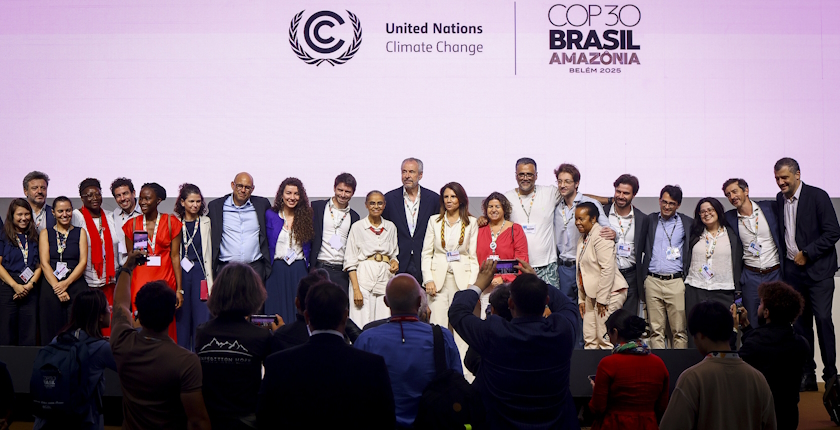
The United Nations Climate Change Conference COP30 was concluded with a deal to keep the world’s ambitions similar, after modest progress on some issues. In a last-minute compromise between the delegates of the wealthy, the poor and the countries most in jeopardy, the declaration from the so-called COP of Truth contains no explicit reference to fossil fuels and deforestation.

Participants at the Conference of the Parties of the UN Framework Convention on Climate Change (UNFCCC) in Belém, Brazil, acknowledged that the world is heading for a temporary overshoot above 1.5 degrees Celsius in warming, according to UN Secretary-General António Guterres.

“I cannot pretend that COP30 has delivered everything that is needed. The gap between where we are and what science demands remains dangerously wide. I understand many may feel disappointed – especially young people, indigenous peoples and those living through climate chaos. The reality of overshoot is a stark warning: we are approaching dangerous and irreversible tipping points,” he stated.

It’s difficult to reach a consensus in a period of deep geopolitical divide, Guterres pointed out. Nevertheless, he praised the final agreement for “delivering progress and showing that multilateralism works.”

Global Mutirão

The hosts nicknamed COP30, this year’s UN Climate Change Conference, the COP of Truth. Ironically, due to a last-minute compromise, or maybe consensus, the declaration contains no explicit reference to a fossil fuel phaseout and halting and reversing deforestation. They were left for separate roadmaps.

In the document, the signatories only refer to the COP28 decision, also known as the UAE Consensus, which called for transitioning away from fossil fuels.

The headline of the overarching deal adopted in Belém is Global Mutirão: Uniting humanity in a global mobilization against climate change. The Portuguese word mutirão originates from the indigenous Tupi-Guarani language and roughly means collective effort.

UN’s Stiell vows to keep up climate fight

All in all, delegates from all over the world, except the United States, left the desired decarbonization trajectory little changed. The countries most at risk of the climate disaster are generally poor. They depend on mitigation aid and investments from the wealthy part of the world.

“We knew this COP would take place in stormy political waters. Denial, division and geopolitics has dealt international cooperation some heavy blows this year,” UN Climate Change Executive Secretary Simon Stiell said at the closing.

Denial, division and geopolitics has dealt international cooperation some heavy blows this year, UN Climate Change Executive Secretary Simon Stiell said

In his view, nations chose solidarity, science, and economic common sense.

“COP30 showed that climate cooperation is alive and kicking, keeping humanity in the fight for a livable planet, with a firm resolve to keep 1.5 Celsius within reach. I’m not saying we’re winning the climate fight. But we are undeniably still in it, and we are fighting back,” Stiell stated.

The world’s top climate official noted that, for the first time, 194 countries agreed that the global transition to low greenhouse gas emissions and climate resilience is irreversible and the trend of the future, referring to a line from the deal.

COP30 pledges to triple adaptation funds by 2035

In the decision, the signatories kept the target USD 1.3 trillion per year that needs to be mobilized for climate action by 2035. USD 300 billion would be mostly grants and subsidized loans, while private financing and climate taxation dominate the rest.

The parties voted for a goal to provide three times more per year for climate adaptation from the smaller pot by 2035, instead of the initially proposed 2030 deadline. They failed to determine a figure, but it is mostly estimated at USD 120 billion per year.

One of the novelties is a pledge to promote information integrity regarding climate, which would also imply countering disinformation.

Post Views:79
December 10, 2025
by AEA in News

North Macedonia plans energy renovation of 14 major public buildings

North Macedonia’s Ministry of Energy, Mining, and Mineral Resources has finalized a plan for the reconstruction of 14 public buildings, describing it as the most extensive energy renovation of the country’s institutions to date.

The plan for the reconstruction of buildings used by the state administration for the period 2025–2028 establishes a clear, three-year framework for the most extensive energy renovation of institutions in the country to date, the Ministry of Energy, Mining, and Mineral Resources said.

The program covers 14 public buildings with a total usable area of nearly 103,000 square meters. They host 33 institutions with 5,000 employees.

The estimated value of the program is about EUR 11.11 million, including technical inspections, projects, supervision, and implementation, according to the ministry.

The plan aims to ensure less pollution, better air quality, and more efficient spending of public funds

The ministry pointed out that the goal of the energy renovation is to reduce energy costs, improve working conditions, reduce emissions, and modernize the public sector in line with European standards.

Less pollution, better air quality, and more efficient use of public money are the benefits that will be felt by both institutions and citizens, the ministry stressed.

This strategic document is envisaged by the reform agenda and represents a legal obligation to renovate at least 3% of the total usable area of public buildings each year.

The ministry recalled that the plan marks an important step in the transposition of European Union legislation on energy efficiency – Directive 2018/2002/EU and Regulation 2018/1999/EU – and that it is aligned with the country’s obligations towards the Energy Community.

The plan covers three groups of buildings

The plan groups buildings into three categories according to their condition and the urgency of renovation.

The first group includes the buildings used by the Ministry of Health (along with the Institute for Public Health and the state sanitary and health inspectorate), the State Statistical Office, the Agency for Real Estate Cadastre, and the hydrometeorological administration.

The second group includes part of the Ministry of Economy, the building housing the administration agency, the state inspectorate for energy, mining and mineral resources, as well as a broad administrative bloc — including the Ministry of Public Administration, the Ministry of Education and Science, the Ministry of Local Self‑Government, the State Election Commission, the Agency for Medicines, and the secretariat for legislation.

The third group includes eight buildings that were previously renovated but require energy upgrades and modern systems.

Each building will undergo an energy audit, after which specific measures will be defined – ranging from thermal insulation of façades and window replacement to the installation of solar thermal systems, PV panels on roof structures, and modern heating, lighting, and automated consumption-control systems, the ministry explained.

Post Views:102
December 10, 2025
by AEA in News

Tens of thousands of new smart meters in Greece deemed inadequate

The rollout of smart meters in Greece has been plagued by delays and even technical mistakes in their procurement, affecting up to 250,000 measuring points.

The country is close to last in the European Union when it comes to the penetration of smart meters. In 2024, only 11% of consumers had such systems, versus 58% in Europe as a whole.

The Hellenic Distribution Network Operator (HEDNO or DEDDIE) began a gradual large-scale deployment a few years ago, with the goal of closing the gap. So far, 1.3 million smart meters have been installed in homes and businesses. The budget stands at EUR 1.4 billion up to the year 2030.

However, there appears to be a significant problem with the first meters that were procured and deployed in previous years. A few days ago, HEDNO published its proposal for the technical changes needed in the retail market codes, in order to activate dynamic pricing schemes from February 2026.

Utilizing smart metering, consumers will be able to benefit from lower prices during the day. Wholesale prices often reach zero around noon in Greece, as a result of high solar production.

Based on the document, the first batches of smart meters are not able to process real-time data and transmit them properly to HEDNO and the suppliers. It makes dynamic pricing impossible.

In total, up to 250,000 smart meters already installed and operational could be inadequate. A part of them can be adjusted through additional hardware, while for the rest no viable solution is seen except their replacement.

Complaints about wrongful power theft accusations

HEDNO also became the target of consumer complaints recently, regarding the lack of timely and proper power metering. Last year the metering period was reduced to a monthly interval. However, people complain of the operator not doing its job right, resulting in unfair charges.

Furthermore, HEDNO has been blamed of wrongly accusing consumers of power theft. Many such complaints have been filed, with claims that the operator is “trigger-happy” and that it identifies theft in cases where a simple change of consumption was located or a seal was damaged on the outside of a meter.

The Regulatory Authority for Energy, Waste and Water (RAEWW or RAAEY) has promised to take action to rectify the issues and restore balance and transparency in the market.

Post Views:41
  • 1
  • …
  • 31
  • 32
  • 33
  • 34
  • 35
  • …
  • 140

AEA – Albania Energy Association is a industry association dedicated to representing the interests of Albanian and West Balkan for energy producers and consumers. AEA works to advance the development and adoption of sustainable energy solutions in Albania and the Western Balkans, supporting the region’s transition toward a cleaner, more secure, and more competitive energy future. AEA is registered by decision of the Court of Tirana, DECISION NO. 3032, (VAT:L11827451K).

[email protected]

Address
Blv Zogu 1
Tirana
1057
ALBANIA

LinkedIn  |  Facebook
Events
May 25, 2022 Connecting Green Hydrogen Europe 2022
May 25, 2022 Energy Week Western Balkans 2022
Copyright © Albania Energy Association