AEA-Albania Energy Association
  • Main
  • About Us
  • Services
  • Sectors
  • News
  • EventsEvents
  • PublicationPublication
  • Contact Us
AEA-Albania Energy Association
  • Main
  • About Us
  • Services
  • Sectors
  • News
  • EventsEvents
  • PublicationPublication
  • Contact Us
AEA-Albania Energy Association
  • Home Page
  • About Us
  • Sectors
  • Our Services
  • News
  • Contact Us
August 17, 2015
by AEA in News

TAP vital to European energy security

The Trans-Adriatic Pipeline project, which envisages the transportation of gas from the second stage of development of Azerbaijan's giant Shah Deniz gas condensate field in the Caspian Sea to the European Union countries, has already ensured its strategic role in the EU's energy security.The Trans-Adriatic Pipeline project, which envisages the transportation of gas from the second stage of development of Azerbaijan’s giant Shah Deniz gas condensate field in the Caspian Sea to the European Union countries, has already ensured its strategic role in the EU’s energy security.

Recently, the TAP project, which is the western part of the Southern Gas Corridor that goes from the Greek/Turkish border to Italy through Albania, has been included in the European Commission’s list of 33 priority energy security Projects of Common Interest.

The EC, in a positive decision to grant exemption to the pipeline from third party access, highlighted the “overall positive impact for the EU of this investment as it is responding directly to the Security of Supply objective of diversification of gas sources, routes and counterparties”.

Also, the European Investment Bank reported that it is considering providing a 2 billion euro loan to the TAP project, pending approval from the Board of Directors of the bank.

All of these facts show EU desires for the implementation of TAP. As the pipeline’s fame increases by the day, countries show great interest in acquiring shares in the project.

In July, a source in the Turkish government told Trend that Turkey intends to acquire shares in the TAP project. The source said that the acquisition of a stake in TAP is a historic opportunity for Turkey, and Ankara is not going to miss it. Currently the issue is being considered, according to the source.

TAP is meant to transport gas from the Caspian region via Greece, Albania, and the Adriatic Sea to southern Italy and further to Western Europe. The pipeline’s total length is about 870 kilometers.

The construction of the pipeline is scheduled to start on May 16, 2016. TAP’s initial capacity will be 10 billion cubic meters per year, expandable to 20 billion cubic meters per year.

The construction of TAP will not only provide European countries with Azerbaijani gas, but also pave the way for establishing a significant gas pipeline and infrastructure network in the region.

Shares of TAP are held by BP (20 percent), SOCAR (20 percent), Statoil (20 percent), Fluxys (19 percent), Enagás (16 percent), and Axpo (5 percent).

By Aynur Karimova

August 4, 2015
by AEA in News

Albania picks bids by Shell, Delek unit for oil exploration

Albania has picked a venture led by Royal Dutch Shell and a company owned by Israeli’s Delek Group to carry out onshore oil exploration projects, subject to final contract agreements, an official told Reuters on Monday.

Shell Upstream Albania BV and Canada’s Petromanas will now negotiate with Albania’s National Resources Agency to get the final go-ahead to explore in sector four of the country, southeast of their current drilling site at Shpirag.

Navitas Petroleum, controlled by Israeli’s Delek, made the winning bid to explore the area of Dumre in central Albania.

The two successful bids followed more than two years of preparations by Albania to auction off more blocks, after it postponed the auctions of some onshore blocks because companies required more time.

The auction of offshore blocks was also delayed, because of Albania’s dispute with Greece over the division of their continental shelf in the Ionian Sea.

Promising initial results from a well in Shpirag by the Shell-Petromanas partnership has increased Shell’s interest in Albania and drawn international interest, despite low oil prices and the failure of previous exploration attempts in the country following the toppling of communism in 1991.

Reuters


July 28, 2015
by AEA in News

What Does Greek Crisis Mean for Azerbaijan’s Energy Interests?

greek-crisis-2The near collapse of Greece’s economy has raised pressing questions for energy power Azerbaijan, which had viewed the country as a potential turbo boost for its energy ambitions in the European Union. Now, as Athens cleans house financially and talks deeper energy ties with Russia, Azerbaijan, which has an agreement to purchase a majority share in Greece’s gas distribution network, needs to protect its own interests, energy analysts say.
 
Azerbaijan’s entry point into Greece comes via the Trans-Adriatic Pipeline (TAP), an 870-kilometer-long gas pipeline which, by around 2019, will bring Greece, Albania and Italy 10 billion cubic meters of Azerbaijani gas per year – part of a 3,500-kilometer-plus-long pipeline network from the Caspian Sea called the Southern Gas Corridor.
 
In 2013, the State Oil Company of the Azerbaijani Republic (SOCAR) further strengthened its European targets by agreeing to pay 400 million euros (then $524.2 million) for a 66-percent stake in Greece’s state-owned gas distribution network, DESFA, its first such European acquisition. Via DESFA, which will operate the Greek section of the TAP pipeline, SOCAR also would obtain half ownership in a planned 182-kilometer-long branch to Bulgaria.
 
But Greece, since the beginning of 2015, has indicated that it wants to reduce SOCAR’s share of the network to 49 percent. And that it wants cheaper prices for the 1 bcm of gas it will receive annually from TAP.
 
SOCAR has resisted both requests, but, now, with a question mark over all of Greece’s assets, much less its ability to pay for gas, Baku may need to change its expectations.
 
“Greece’s huge debts stand to jeopardize the Southern Gas Corridor and Azerbaijan being a major shareholder in DESFA,” commented Mehmet Öğütçü, chairperson of the Istanbul-based Bosphorus Energy Club, a networking group of which SOCAR is a member.
 
For one, further delay on SOCAR’s acquisition of DESFA is likely. Under the terms of Greece’s bailout deal with the EU, a newly created fund may obtain control over Greece’s gas grid and the national gas company DEPA, but not until after October, Hellenic Shipping News reported on July 27.
 
One energy executive quoted by the publication, Aegean Gas Chief Executive Officer Theodore Theodoropoulos, said that, consequently, he does not think SOCAR’s purchase of DESFA “will proceed in its current form.”
 
At the same time, Baku’s own enthusiasm for DESFA may be growing cold.
 
Thanks to lower oil prices, SOCAR and Azerbaijan both have seen their revenue shrink. Furthermore, in January, the European Commission suspended deliberations about whether to approve SOCAR’s purchase of DESFA.
 
Reasons for the delay are not clear – some sources say the EU, others SOCAR – but energy expert Marco Giuli of Brussels’ European Policy Center, an independent think-tank, believes Russia inadvertently plays a role here.
 
EU legislation bars Russia’s Gazprom, the source of most of Greece’s gas imports and SOCAR’s distant rival in the campaign for European markets, from taking over DESFA. Gazprom in 2013 withdrew from a bid for DESFA’s parent company, DEPA.
 
“This is a matter of credibility. The EU does not want to be seen as allowing SOCAR to get what Gazprom couldn’t get,” Giuli said.
 
SOCAR, by contrast, holds only a 20-percent stake in TAP, a six-partner project which is exempt from EU rules requiring third-party access to pipelines.
 
SOCAR has not commented publicly on DESFA since the EU’s July 13 bailout deal with Greece, but on July 19, Azernews.az, an Azerbaijani-government mouthpiece, underlined that SOCAR’s takeover of the network would inject much needed cash into the Greek economy.
 
The original June 2013 purchase deal, however, allows SOCAR to opt out of DESFA if the sale is not concluded within two years, Greek and Azerbaijani media outlets have reported.
 
Yet even if the DESFA deal falls through, analysts believe that Greece and Azerbaijan will remain energy partners.
 
If Greece opts out of the TAP pipeline, it will incur penalties. “So, it concerns Europe, rather than Baku,” noted Ilham Shaban, director of the Baku-based Caspian Barrel, an energy research center.
 
Shaban, however, sees no risk for such a prospect. Greece needs to promote its own energy security. “Athens will hang on to Azerbaijan so that it chooses Greece for its resources to flow into central Europe,” he predicted.
 
For Greece, the construction contracts, thousands of jobs and related investment from the TAP pipeline are “godsent gifts,” agreed Öğütçü.
 
Greece earlier had expressed interest in also taking a share in TAP, and in receiving annual transit fees. Azerbaijan welcomed the first proposal and rejected the second.
 
But, at the same time, Greece, led by the left-wing Syriza Party, also is quite happy to hold on to Russia, the source of most of its gas and oil imports.
 
On July 12, as Greece debated the EU bailout deal, Russia, which signed an agreement in June with Athens to run its proposed 47-bcm Turkish Stream gas pipeline across Greece, pledged to consider “direct energy supplies” to Greece.
 
Details have not emerged, though Moscow recently reemphasized its commitment to the pipeline agreement.
 
Energy analyst Giuli, citing EU legislation, plays down the prospect of such a partnership, however. “One can, of course, speculate about Greece looking for Russian financial support, but, in the end, Greece cannot commit exclusively to one single source [of gas]…”
 
The EU, meanwhile, recently underlined its support for Azerbaijan’s energy ties to Europe. “Azerbaijan is our reliable and strategic partner in the energy field, and we want to take this partnership further,” European Council President Donald Tusk said in Baku on July 22.
 
Nonetheless, Azerbaijan still feels the need to downplay Turkish Stream.
 
Writing on July 24, Azernews.az noted that Russia will need “many years” to find the funds for the $50-$60-billion pipeline. By contrast, it boasted, Azerbaijani gas from TAP would be “finding clients long before … Russian gas arrives…”

By: Lamiya Adilgizi is a freelance Azerbaijani reporter.

July 24, 2015
by AEA in News

Italy grants Albania 16.5 mln euros to empower energy system

Duke-Energy-Power-Lines-5-720x288TIRANA, July 23 – The Albanian ministry of energy and industry and the Italian government represented by the Italian ambassador to Tirana Massimo Gaiani signed on Thursday a 16.5 million euro (about 18.2 million U.S. dollars) agreement on behalf of a “Memorandum of Cooperation” for the energy sector.

The grant comes as the last part of this memorandum reached between the two governments last year. The agreement was signed by Albanian minister of energy and industry Damian Gjiknuri and the Italian ambassador to Tirana, Massimo Gaiani while present in the ceremony were also the chairmen of Albanian Transmission System Operator (OST) and Albanian Operator of Electricity Distribution (OSHEE).

This grant will be invested in the transmission and distribution system of the electrical energy while it aims the increase of efficiency in this sector and conclusion within the deadline of the new dispatcher center of OST.

The Albanian minister of energy and industry stressed the importance of the support from the Italian government in the implementation of several projects in the electrical energy sector in the country.

“We will invest in Himara and Saranda cities in the transmission and distribution systems, in order to improve the network in these touristic areas,” the minister was quoted by Albanian daily news as saying.

On his part, Gaiani declared that “With this grant we enclose projects which we started several years ago, at a total worth of 93 million euros.”

This grant will empower the energy potential in Albanian southern areas and will expand the data control system in all substations 110 KV.

“These two projects will make the electrical energy system more reliable and integrated with the European one,” the Italian ambassador said.

He added that this financing represents the completion of the technical aspects for the projects that will be realized by Italian embassy, ministry of energy and industry, OST and OSHEE. (1 euro = 1.10 U.S. dollars)

July 24, 2015
by AEA in News

Shell bids to drill two Albanian onshore blocks

shell albaniaA venture between Royal Dutch Shell and Canada’s Petromanas has applied to drill two onshore blocks in central Albania close to another promising well they are drilling further south, an official said on Thursday.

The official said three bids had been submitted for the blocks – from Shell Upstream Albania B.V with Petromanas Albania GmbH, Israel’s Delek Group Limited and Interland Investments SA.

The National Resources Agency has forwarded the bids to the Energy Ministry, which will pick a winner and instruct the agency to start negotiations.

Shell’s bid signals renewed interest in Albania, a NATO nation seeking to join the European Union, after many oil majors failed to strike oil there in the decade after it toppled communism in 1990.

The Shell-Petromanas venture in Albania is now drilling two wells to size up the output potential after very promising initial results at their Shpirag well, half a mile from the spot where Occidental found very little oil in 2001 and quit.

July 21, 2015
by AEA in Events, News

Croatia – Expect Oil & Gas Developments Soon

Croatia - Expect Oil & Gas Developments SoonGlobal Summits organiser, IRN is delighted to announce that the 4th Balkans Oil & Gas Summit will be held in Dubrovnik, Croatia.

This year’s event, originally to be held in Athens, Greece, will now be hosted in Dubrovnik, Croatia with the full support of the Croatian Ministry of Economy and the Croatian Hydrocarbon Agency to bring to the Summit’s delegation a highly valuable Balkans Summit on 23rd-25th September 2015.

The 4th Balkans Oil & Gas Summit will also be held under the endorsement of the Ministry of Energy and Industry of Albania, the Ministry of Economy of Montenegro and the Federal Ministry of Energy, Mining and Industry of Bosnia-Herzegovina with Government Officials joining from all over the Balkans region.

Croatia has been attending and supporting the senior level meeting since its origination in 2012. Here’s what Alen Leveric, Deputy Minister of Economy said about the Balkans Oil & Gas Summit;
“Since 2012, we had the unique opportunity to annually report and promote all development stages of one of the most important Croatian strategic projects – exploration and exploitation of hydrocarbons (onshore and offshore).
In June 2015, Croatian government published that three companies (Vermilion Zagreb Exploration, INA and Oando PLC) will share six licences to explore for oil and gas in Croatia’s northern Drava river basin and in the east of the country.
In January 2015, Croatia awarded 10 offshore oil and gas exploration licences for drilling in the Adriatic. Seven licences went to a consortium of Marathon Oil and OMV, two to INA and one to a consortium of ENI and Medoilgas.
With this in mind, Croatia is definitely on their way of becoming an energy leader in the south-eastern Europe.” Alen Leveric, Deputy Minister, Ministry of Economy, Croatia

Many international and national oil companies have already confirmed their participation in the Summit with the organisers expecting the attendance of 200 senior level executives.

Highlights of last year’s Summit can be viewed at the official YouTube Channel of the organiser, https://www.youtube.com/user/irnInternational.

More information about the Summit is available on the website: www.balkanssummit.com and released bimonthly in the Summit’s newsletter to which someone can subscribe here.

(END)

NOTES TO THE EDITOR
• The 4th Balkans Oil & Gas 2015 Summit will be held in Dubrovnik, Croatia on 23rd-24th September 2015.
• The Summit is organised by International Research Networks, a leading business intelligence group, transmitting information through highly topical Conferences, Summits, Meetings and Reports. To find out more please visit www.irn-international.com
• For all media and press enquiries please contact Xenia Sapanidi at [email protected], +44 (0) 207 111 1615.


July 20, 2015
by AEA in News

Statoil to leave TAP gas pipeline project – Azerbaijan’s SOCAR

TAP and StatoilNorway’s Statoil is to sell its 20-percent stake in the Trans Adriatic Gas Pipeline (TAP) project that will carry gas from Azerbaijan to Europe, the president of Azeri state energy firm SOCAR said.

“Statoil has decided to leave the TAP project completely, and there is a company which is ready to buy its stake,” Rovnag Abdullayev told Azeri ANS TV late on Friday.

“Several companies have expressed an interest in buying Statoil’s stake, and it would be better if several companies would buy it,” he added.

Statoil did not comment on the news.

“We generally do not comment on speculations on adjustments to our portfolio,” Statoil’s spokesman told Reuters.

The TAP pipeline is a part of project that is designed to transport 16 billion cubic metres (bcm) of gas from Azerbaijan’s Shah Deniz II field in the Caspian Sea, one of the world’s largest gas fields, by the end of the decade.

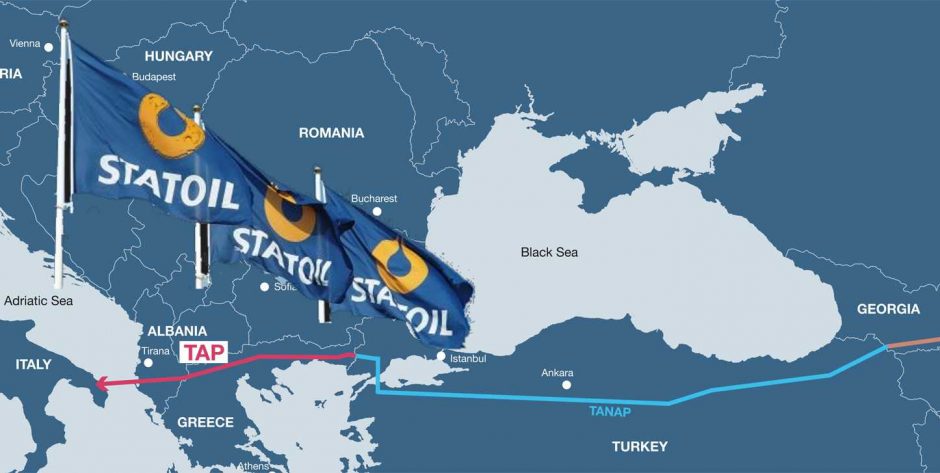
The 870 kilometre (545 mile) pipeline will connect with the Trans Anatolian Pipeline (TANAP) near the Turkish-Greek border at Kipoi, cross Greece and Albania and the Adriatic Sea, before reaching southern Italy.

Statoil has already sold its shares in Azerbaijan’s Shah Deniz gas field as well as the South Caucasus Pipeline (SCP) to SOCAR, BP and Malaysia’s Petronas.

Italian gas infrastructure company Snam said last month that it could take a stake of up to 20 percent in the TAP project that is designed to reduce Europe’s reliance on Russian gas.

CEO Carlo Malacarne said that as gas buyers are signing binding, long-term ship-or-pay contracts for the Azeri gas, the transmission revenue is guaranteed and this opened the way for regulated infrastructure players like Snam to enter the project.

Officials decline to comment on the price, but insiders say a 20 percent TAP stake could be valued at around 400 million euros ($433.72 million).

TAP’s shareholders are BP (20 percent), SOCAR (20 percent), Statoil (20 percent), Belgium’s Fluxys (19 percent), Spain’s Enagas (16 percent) and Swiss company Axpo (5 percent). ($1 = 0.9223 euros)

Source:Reuters

July 15, 2015
by AEA in News

Snam: 20-percent interest in TAP would cost around 400 mln euros

Chi_siamo_SRG_en_1A 20-percent interest in the Trans Adriatic Pipeline (TAP) project would cost around 400 million euros, Natural Gas Europe reported with the reference to Italian Snam’s CEO Carlo Malacarne. The price has also to do with the current market conditions.

Malacarne also confirmed that there are TAP’s stakeholders willing to sell their shares to the Italian company.

“We will not witness an increase in gas consumption in Europe by 2030. It will be necessary to substitute the current production from the depleting fields with new sources” he said to Italian daily newspaper Corriere della Sera.

He explained Europe has not to decrease its imports from Russia, but find new partners to import new gas.

“We have to get gas where there is some, in the Caucasus, prospectively in Iran, in North Africa. And here we come into play” he said, adding that Italy should take a more central role in the Mediterranean, and especially in Algeria.

TAP project is a part of the Southern Gas Corridor that will allow Europe to diversify its hydrocarbon supply sources and strengthen energy security. Azerbaijani gas is designed to open the Southern Gas Corridor.

TAP will transport natural gas from the giant Shah Deniz II field in Azerbaijan to Europe. The approximately 870 km long pipeline will connect with the Trans Anatolian Pipeline (TANAP) at the Turkish-Greek border at Kipoi, cross Greece and Albania and the Adriatic Sea, before coming ashore in Southern Italy.

July 15, 2015
by AEA in News

Bankers Petroleum provides operational update for Q2 2015

Bankers-petroleum
Bankers Petroleum Ltd. (TSX: BNK, AIM: BNK) is pleased to announce the Company’s second quarter operational update.

Production

Average production from the Patos-Marinza and Kuçova oilfields in Albania for the second quarter of 2015 was 20,045 barrels of oil per day (bopd), an increase of 1.4% compared to the first quarter 2015 average of 19,767 bopd.

The Bubullima reservoir continues to exceed expectations, with four producing wells averaging 220 bopd at an 85% water cut, over the last thirty days of the quarter. The average API of the Bubullima production is 15 – 17 degrees, helping to further offset diluent costs. The production history of these four wells ranges from four months to over two years, with minimal decline rates to date. Bankers has one additional well to be tied-in pending the completion of sour treating facilities in Q3 and plans to drill up to three additional Bubullima wells in the second half of 2015.

Sales and Oil Prices

Oil sales during the quarter averaged 19,599 bopd, 3.4% lower than the previous quarter average of 20,283 bopd. Crude oil inventory at June 30, 2015, was 307,000 barrels, up from 270,000 barrels at March 31, 2015.

The Patos-Marinza second quarter average oil price was approximately $47.98 per barrel (representing 77% of the Brent oil price of $61.92 per barrel), as compared with the first quarter average oil price of $39.66 per barrel (representing 74% of the Brent oil price of $53.94 per barrel). Sales to the export market during the second quarter of 2015 represented 78% of total sales, at an average export price of 80% of the Brent oil price. Domestic sales were lower in the quarter as Bankers targets the seasonally higher demand of the export market.

For the six months ended June 30, 2015, average oil sales were 19,899 bopd compared to 20,036 bopd for the first six months of 2014. The six month average oil price was approximately $43.74 per barrel (representing 75% of the Brent oil price of $57.95 per barrel) as compared to $87.00 per barrel (representing 80% of the Brent oil price of $108.93 per barrel) for the first six months of 2014.

Bankers realized $9.9 million (representing $5.53 per barrel) during the second quarter in proceeds from corporate hedge proceeds. Additionally, Bankers received $1.4 million (representing $0.76 per barrel) in legacy accounts receivable realization as part of its domestic sales program.

For the six months ended June 30, 2015, Bankers realized $24.0 million (representing $6.66 per barrel) in proceeds from corporate hedge proceeds. Additionally, Bankers received $4.9 million (representing $1.37 per barrel) in legacy accounts receivable realization as part of its domestic sales program.

Bankers has hedged 6,000 bopd at a Brent price of $80.00 per barrel for 2015. The remaining 2015 hedge program at June 30, 2015 is valued at $21.3 million.

Drilling Update

Bankers drilled a total of twelve wells in the second quarter: ten horizontal producers, one water disposal well, and one suspended well following the release incident at the beginning of the quarter. Five of the producing wells are on production, the remaining five will be placed on production early in the third quarter following the completion of drilling on the same well pad.

In the second half of 2015, Bankers plans to drill the remaining twenty-six of the total sixty wells planned in 2015, including one multilateral and one Kuçova well. As previously reported, Bankers reduced its active rig count to two in February in response to decreased commodity prices.

Secondary Recovery Program

The twenty-six polymer and five water flood patterns operational in the Patos-Marinza oilfield at the end of the second quarter 2015 continue to meet or exceed model expectations, producing an incremental 2,390 bopd in the month of June, 12% of Bankers total production.

In Q2, Bankers converted seven additional wells to injectors: 6 polymer flood and 1 water flood. As of June 30, 2015, four of these wells are currently injecting with the remaining three wells expected to begin injection early in the third quarter, pending facilities tie-in. The Company continues to be strongly encouraged by the results to date and Bankers plans to convert an additional eleven to sixteen patterns in the second half of the year.

Infrastructure Development

Bankers infrastructure projects in the second quarter continued to focus on margin expansion with construction of the northern gathering system. This construction is nearly complete and will be commissioned in the third quarter following the completion of the associated increase in the inlet capacity at the Satellite 3 treating facility. Construction on the west gathering system, previously delayed due to the commodity price environment, has now commenced along with the expansion of the inlet facilities at Pad D for which equipment is now being sourced and procured. This project has been re-initiated to accommodate sour production from the Bubullima and to further reduce trucking and operating costs.

The installation of vapor recovery units at Pad H and Pad D commenced late in the second quarter and are expected to be commissioned late in the third quarter. These projects target a reduction in energy costs by utilizing produced gas to create electricity thereby reducing the need for external fuel sources.

The majority of the equipment associated with the polymer secondary recovery program arrived in country during the second quarter and installation is now underway in conjunction with the remaining planned conversions in 2015. These facilities expansions will allow for up to 28 additional conversions.

July 13, 2015
by AEA in News

European countries join forces to create an integrated gas market

gas market europeA well connected EU energy market where energy flows freely across borders and no Member State remains isolated from the EU energy networks is a precondition for creating a resilient Energy Union with a forward looking climate policy, according to the European Commission. This will ensure secure, affordable and sustainable energy for all EU citizens and businesses.

15 EU and Energy Community countries in the Central Eastern Europe and South East European regions have agreed to work together to accelerate the building of missing gas infrastructure links and to tackle the remaining technical and regulatory issues that hamper security of supply and the development of a fully integrated and competitive energy market in the region.

A Memorandum of Understanding, which formally launches this initiative, was signed on 10 July in Dubrovnik. This will pave the way for the closer integration of the EU and Energy Community energy markets. By creating a stable regulatory and market framework, it will help improve the investment climate in the involved EU and Energy Community countries and territories.

“This region is very important for Europe, in particular when we look at security of energy supply,” said EU Commission Vice President for Energy Union Maroš Šefcovic. “The improvement of infrastructure through realistic and feasible projects is crucial to diversify energy resources and strengthen the region’s resilience to supply shocks. Cooperation among the countries of the region is key in this regard. I myself and the entire commission support this process, notably in the framework of the European Energy Union Strategy.”

“Regional cooperation is a cornerstone of our work on closer integration of energy markets,” noted EU Commissioner for Climate Action and Energy Miguel Arias Cañete, “Therefore effective cooperationbetween the countries in Central Eastern and South East Europe is key to ensuring secure energy supplies and affordable prices for consumers in the region. Whilst every country has to face its specific energy issues, addressing them together can offer cheaper and more effective solutions.”

The joint work under the European Commission initiative on Central Eastern and South Eastern European Gas Connectivity (CESEC) will not only focus on building new gas pipelines, but also on making the best use of existing infrastructure for example by allowing reverse flow. A number of infrastructure projects, such as the Trans Adriatic Pipeline (TAP), LNG terminal in Croatia and evacuation system, system reinforcement in Bulgaria and Romania, interconnectors between Greece and Bulgaria and between Serbia and Bulgaria, have been identified as top priorities in the Action Plan annexed to the Memorandum. They will help to diversify supply sources; ultimately, each Member State in the region should have access to at least three different sources of gas. These priority projects will be closely monitored to ensure their timely and resource efficient implementation. It is also important that EU rules that foster fair competition between all market players are fully implemented in the region.

In general, infrastructure projects should be financed by the market participants, but where necessary for their timely completion, the involvement of the European Investment Bank (EIB) and the European Bank for Reconstruction and Development (EBRD) will be considered by the CESEC countries. Project promoters are also encouraged in particular to make use of the opportunities offered by the new European Fund for Strategic Investment (EFSI).

The Memorandum of Understanding and its Action Plan were signed by EU Commission Vice President Maroš Šefcovic and EU Commissioner Miguel Arias Cañete and by the Energy Ministers andtheir representatives from Austria, Bulgaria, Croatia, Greece, Hungary, Italy, Romania, Slovakia, Slovenia, Albania, Former Yugoslav Republic of Macedonia, Serbia and Ukraine (Bosnia and Herzegovina and Republic of Moldova will sign at a later stage).

  • 1
  • …
  • 130
  • 131
  • 132
  • 133
  • 134
  • …
  • 140

AEA – Albania Energy Association is a industry association dedicated to representing the interests of Albanian and West Balkan for energy producers and consumers. AEA works to advance the development and adoption of sustainable energy solutions in Albania and the Western Balkans, supporting the region’s transition toward a cleaner, more secure, and more competitive energy future. AEA is registered by decision of the Court of Tirana, DECISION NO. 3032, (VAT:L11827451K).

[email protected]

Address
Blv Zogu 1
Tirana
1057
ALBANIA

LinkedIn  |  Facebook
Events
May 25, 2022 Connecting Green Hydrogen Europe 2022
May 25, 2022 Energy Week Western Balkans 2022
Copyright © Albania Energy Association