AEA-Albania Energy Association
  • Main
  • About Us
  • Services
  • Sectors
  • News
  • EventsEvents
  • PublicationPublication
  • Contact Us
AEA-Albania Energy Association
  • Main
  • About Us
  • Services
  • Sectors
  • News
  • EventsEvents
  • PublicationPublication
  • Contact Us
AEA-Albania Energy Association
  • Home Page
  • About Us
  • Sectors
  • Our Services
  • News
  • Contact Us
October 5, 2015
by AEA in News

Turkey to compensate for lack of Russian gas via TANAP

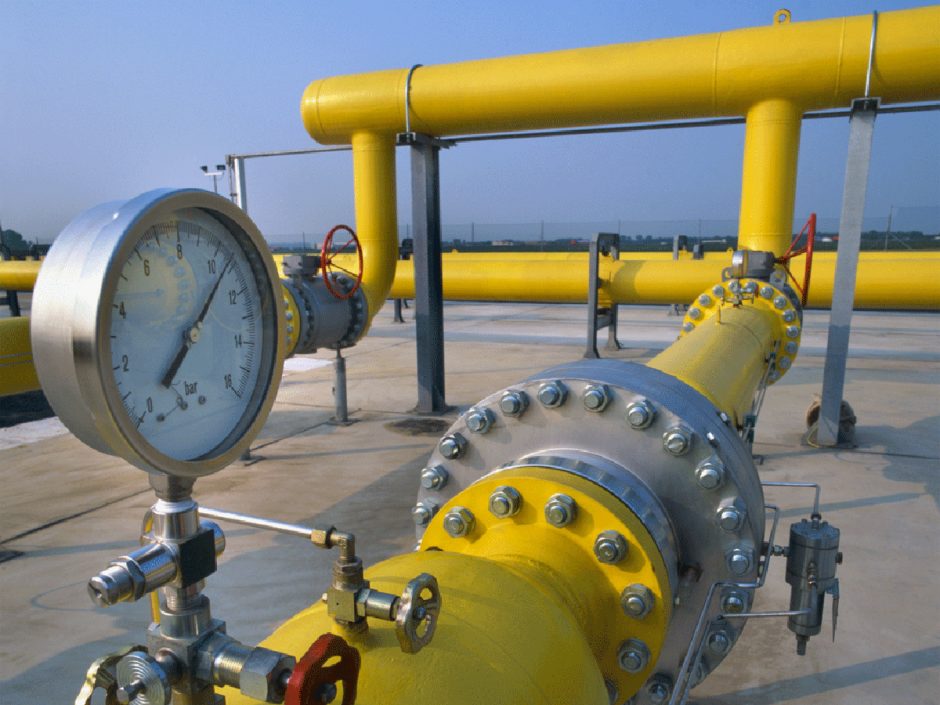
gas-pipelines_140215If Russia limits supplies of natural gas, Turkey is going to compensate for this by the gas delivered through the Trans-Anatolian (TANAP) pipeline, Minister of Energy and Natural Resources of Turkey Ali Rıza Alaboyun said Oct.5.

“I don’t think that Russia will limit the supply of natural gas in the winter months,” said the minister.

He went on to add that in 2019, Russia will limit supplies of natural gas through Ukrainian territory. “Every year we get 14 billion cubic meters of gas through this territory,” the minister said. “Therefore, in 2019 we may face a shortage of gas. Turkey also plans to compensate for the lack of natural gas through TANAP in 2019.”

TANAP project envisages transportation of gas of Azerbaijan’s Shah Deniz field from Georgian-Turkish border to the western borders of Turkey. The project’s total cost is estimated at $10 billion.

The initial capacity of TANAP pipeline is expected to reach 16 billion cubic meters of gas per year. Around six billion cubic meters of this gas will be delivered to Turkey and the remaining volume will be supplied to Europe.

Turkey will get gas in 2018 and after completing the construction of Trans-Adriatic Pipeline (TAP), it will be delivered to Europe in early 2020.

BP with 12 percent became one of the shareholders of the pipeline in accordance with the agreement signed with the TANAP consortium in April.

Currently, the shareholders of TANAP are: the State Oil Company of Azerbaijan (SOCAR) – 58 percent, Botas – 30 percent and BP – 12 percent.

TAP envisages transportation of gas from the Azerbaijani gas condensate Shah Deniz II field to the EU countries.

The approximately 870 km long pipeline will connect with the Trans Anatolian Pipeline (TANAP) at the Turkish-Greek border at Kipoi, cross Greece and Albania and the Adriatic Sea, before coming ashore in Southern Italy.

The pipeline construction is to be launched in 2016.

TAP’s initial capacity will be 10 billion cubic meters per year, expandable to 20 billion cubic meters per year.

The first gas as part of the Shah Deniz-2 project will be transported to Europe via TAP in early 2020.

TAP’s shareholding is comprised of BP (20 percent), SOCAR (20 percent), Statoil (20 percent), Fluxys (19 percent), Enagás (16 percent) and Axpo (5 percent).


October 5, 2015
by AEA in News

TAP project progressing according to schedule

gas_pipeline_construction_130215The Trans Adriatic Pipeline (TAP) project, designed to transport gas from the giant Shah Deniz II field in Azerbaijan to Europe, is progressing well and is on schedule to transport gas in early 2020, Lisa Givert, TAP Head of Communications told Trend.

“TAP will begin construction next year as we are aligned to Shah Deniz’s schedule,” Givert said adding that the overall construction phase will take approximately 3.5 years.

She also mentioned that some large contracts are expected to be awarded within TAP by the end of this year.

“While the contracts for access roads and bridges, turbo compressors and ball valves have already been concluded, TAP aims to award several large contracts by the end of 2015, including onshore and offshore pipeline construction as well as line pipes,” Givert said.

Recently TAP launched pre-qualification contracts for the supply and delivery of the Supervisory Control and Data Acquisition (SCADA) system and fibre optic cable, which are the final large package contracts to be awarded by TAP for project construction as company provided items.

TAP’s initial capacity will be 10 billion cubic meters per year, expandable to 20 billion cubic meters per year.

The approximately 870 km long pipeline will connect with the Trans Anatolian Pipeline (TANAP) at the Turkish-Greek border at Kipoi, cross Greece and Albania and the Adriatic Sea, before coming ashore in Southern Italy.

TAP’s shareholding is comprised of BP (20 percent), SOCAR (20 percent), Statoil (20 percent), Fluxys (19 percent), Enagás (16 percent) and Axpo (5 percent).

October 2, 2015
by AEA in News

TransAtlantic Petroleum Provides Operational Update

TransAtlantic Petroleum_f960x260HAMILTON, Bermuda, Oct 01, 2015 (GLOBE NEWSWIRE via COMTEX) —

TransAtlantic Petroleum Ltd. (nyse mkt:TAT) (TNP) (the “Company” or “TransAtlantic”) today provided an operational update on its current production and drilling program.

Production Update

TransAtlantic’s current average 7-day net production rate is approximately 6,220 BOEPD, comprised of approximately 5,360 BOPD and approximately 5.2 MMCFPD of natural gas. Daily net oil equivalent production increased approximately 10% (net oil production increased 20%) from the end of the second quarter of 2015, primarily due to re-work operations in Southeast Turkey, which commenced in September 2015. Natural gas production was lower in the last week of September 2015, compared with the third quarter average of 6.4 MMCFPD, mainly due to a national holiday in Turkey.

In the third quarter of 2015, TransAtlantic had average net production of approximately 5,340 BOEPD, a 3% increase over net production in the third quarter of 2014 and a 9% decrease from net production in the second quarter of 2015. Net production for the third quarter of 2015 was comprised of approximately 4,270 BOPD and 6.4 MMCFPD of natural gas.

Drilling and Completion Update

In September 2015, the Company began a planned re-work program to install artificial lift, open behind-pipe-pay and increase artificial lift capacity on several wells in Southeast Turkey. In the Bahar field, commercial production was established from the Hazro F3 sand, which was previously neither productive nor reserved. TransAtlantic expects to continuously re-work wells to increase production through year end.

In the third quarter of 2015, TransAtlantic drilled the Bahar-7 well (100% working interest). The well was drilled to a total depth of 10,850 feet with two strings of cemented casing, and is the first well drilled to the Bedinan formation with this efficient casing design. Initial log analysis indicates prospective pay in the Bedinan, Dadas and Hazro zones, as projected. The well was structurally lower in the Bedinan than offsetting wells in the area and from what was projected by the Company. If successfully completed, the well may significantly expand the oil productive area in the Bedinan to the west of the currently mapped closure. Following the completion of the drilling of the Bahar-7 well, the rig was released. TransAtlantic expects to spud the Guney Resideri well (50% working interest), a gas exploration well in the Thrace Basin, in November 2015.

In the third quarter of 2015, the Company drilled and began completion operations, which are ongoing, on the Bahar-9 well (100% working interest). The South Goksu-1 well (50% working interest), a 5,900 foot exploratory well drilled two miles south of the Goksu field, is currently undergoing completion, but has tested non-commercial amounts of hydrocarbons to date. The Company expects all drilled wells to be completed during the fourth quarter of 2015.

Share Buyback

As of September 30, 2015, the Company has repurchased 323,079 shares for an aggregate amount of $943,075 (approximately 0.8% of the Company’s outstanding shares). During the third quarter of 2015, TransAtlantic initiated the repurchasing of shares through its share repurchase program, which was approved by the Company’s board of directors in March 2015. Under the share repurchase program, Transatlantic may repurchase shares in open-market purchases in accordance with all applicable securities laws and regulations, including Rule 10b-18 of the Securities Exchange Act of 1934, as amended. The repurchase program may be suspended or discontinued at any time.

Hedge Update

On September 14, 2015, TransAtlantic monetized a portion of its hedges, resulting in net proceeds of $12.8 million. The proceeds were used to pay down debt under the Company’s senior secured credit facility (the “Senior Credit Facility”) with BNP Paribas (Suisse) SA and the International Finance Corporation. Pursuant to requirements under the Senior Credit Facility, the Company acquired Brent puts with a $50 strike price in replacement of a portion of the unwound volumes. On September 30, 2015, the overall hedge portfolio was valued at approximately $32 million.

Third Quarter 2015 Earnings Call

TransAtlantic will provide additional operational and financial results on its third quarter 2015 earnings call, which it expects to host in early November 2015.

About TransAtlantic Petroleum Ltd.

TransAtlantic Petroleum Ltd. is an international oil and natural gas company engaged in the acquisition, exploration, development and production of oil and natural gas. The Company holds interests in developed and undeveloped properties in Turkey, Albania and Bulgaria.

(NO STOCK EXCHANGE, SECURITIES COMMISSION OR OTHER REGULATORY AUTHORITY HAS APPROVED OR DISAPPROVED THE INFORMATION CONTAINED HEREIN.)

Forward-Looking Statements

This news release contains statements concerning the drilling, completion and cost of wells, the production and sale of oil and natural gas, secondary recovery operations, the hosting of an earnings conference call, as well as other expectations, plans, goals, objectives, assumptions or information about future events, conditions, results of operations or performance that may constitute forward-looking statements or information under applicable securities legislation. Such forward-looking statements or information are based on a number of assumptions, which may prove to be incorrect. In addition to other assumptions identified in this news release, assumptions have been made regarding, among other things, the ability of the Company to continue to develop and exploit attractive foreign initiatives.

Although the Company believes that the expectations reflected in such forward-looking statements or information are reasonable, undue reliance should not be placed on forward-looking statements because the Company can give no assurance that such expectations will prove to be correct. Forward-looking statements or information are based on current expectations, estimates and projections that involve a number of risks and uncertainties which could cause actual results to differ materially from those anticipated by the Company and described in the forward-looking statements or information. These risks and uncertainties include, but are not limited to, market prices for natural gas, natural gas liquids and oil products; estimates of reserves and economic assumptions; the ability to produce and transport natural gas, natural gas liquids and oil; the results of exploration and development drilling and related activities; economic conditions in the countries and provinces in which the Company carries on business, especially economic slowdowns; actions by governmental authorities, receipt of required approvals, increases in taxes, legislative and regulatory initiatives relating to fracture stimulation activities, changes in environmental and other regulations, and renegotiations of contracts; political uncertainty, including actions by insurgent groups or other conflict; outcomes of litigation; the negotiation and closing of material contracts; shortages of drilling rigs, equipment or oilfield services.

The forward-looking statements or information contained in this news release are made as of the date hereof and the Company undertakes no obligation to update publicly or revise any forward-looking statements or information, whether as a result of new information, future events or otherwise, unless so required by applicable securities laws.

Note on BOE

Barrels of oil equivalent, or BOE, are derived by the Company by converting natural gas to oil in the ratio of six thousand cubic feet (“MCF”) of natural gas to one barrel of oil. A BOE conversion ratio of 6 MCF to 1 barrel is based on an energy equivalency conversion method primarily applicable at the burner tip and does not represent a value equivalency at the wellhead. BOE may be misleading, particularly if used in isolation.

October 2, 2015
by AEA in News

SOCAR’s buying stake in DESFA runs smoothly.

logo_desfa__040215
The process of acquisition of a 66 percent stake in the Greek DESFA gas operator by SOCAR (State Oil Company of Azerbaijan) runs smoothly, Greek Productive Reconstruction, Energy and Environment Minister Panos Skourletis said, the Greek media reported Oct.1.

Skourletis made the remarks at a meeting with Azerbaijani Ambassador to Greece Rahman Mustafayev, Adviser to the SOCAR President Murad Heydarov and head of SOCAR Energy Greece Anar Mammadov.

Skourletis went on to add that one should expect the concrete results on the sale of DESFA’s stake to SOCAR in the coming months.

“This process is developing in a way which would meet the requirements of the European Commission’s Directorate-General, and it runs smoothly,” said Skourletis.

In addition, the sides discussed the implementation of the TAP pipeline project during the meeting.


The Greek minister told at the meeting about the overall progress achieved during discussions with the TAP representatives on resolving the issue regarding the gas pipeline route on the Greek territory.

Earlier, SOCAR President Rovnag Abdullayev said that SOCAR is ready for talks with European companies on selling the 16-percent share in Greek DESFA gas transmission system operator.

SOCAR won a tender in December 2013 on the sale of 66-percent share in DESFA for 400 million euros.

The European Commission started an inquiry into the compliance of the deal on acquisition of a stake in DESFA with the EU’s regulations In November 2014. Currently, the deal is being considered by European Commission’s Directorate-General for Competition, and the procedure will last until late 2015.

SOCAR is the sole producer of oil products in Azerbaijan. It has two oil refineries and filling stations in Azerbaijan, Georgia, Ukraine, Romania and Switzerland. The company is the co-owner of the largest Turkish petrochemical complex, Petkim, and other assets in Turkey.

The company is currently carrying out work as part of ensuring the Azerbaijani gas supplies to Europe. Work is underway in this regard within the second stage of development of the Shah Deniz offshore gas and condensate field, and for expansion of the South Caucasus Pipeline.

Moreover, projects are being developed for construction of the Trans Anatolian Natural Gas Pipeline (TANAP) and the Trans Adriatic Pipeline (TAP).

TAP will transport natural gas from the giant ‘Shah Deniz 2’ field in Azerbaijan to Europe.

The approximately 870 km long pipeline will connect with the Trans Anatolian Pipeline (TANAP) at the Turkish-Greek border at Kipoi, cross Greece and Albania and the Adriatic Sea, before coming ashore in Southern Italy.

The pipeline’s construction is expected to start in 2016.

TAP’s initial capacity will be 10 billion cubic meters per year, expandable to 20 billion cubic meters per year.

TAP’s shareholding is comprised of BP (20 percent), SOCAR (20 percent), Statoil (20 percent), Fluxys (19 percent), Enagás (16 percent) and Axpo (5 percent).
 

September 29, 2015
by AEA in News

Albanian Prosecutors to Quiz Former Energy Chief

Arben-Seferi-480x288The former director of Albania’s electricity distribution network operator, Arben Seferi, is being referred to prosecutors on suspicion of costing the state 9.7 million euros through suspect energy purchases.

The Supreme State Audit said in a statement on Saturday that Seferi, former director of Albania’s electricity distribution network operator OSHEE, and two other former high-ranking officials at the form are being referred to prosecutors for further investigations after an audit found procedural irregularities in procurements of electricity from private companies in 2014.

“Due to the lack of adequate implementation of the procedures for the purchase of the electricity… during the January-July 2014 period, we have identified 9.7 million euros in costs [to the state],” the statement said.

“The purchase of the electricity was made higher prices than those of the market,” it added.

BIRN revealed in October 2014 that the Competition Authority of Albania had launched a probe into the power utility OSHEE following complaints filed by another electricity trading company.

Electricity trading company GEN-I Tirana claimed that OSHEE’s uncompetitive and illegal practices cost taxpayers millions of euros.

GEN-I Tirana alleged that OSHEE secured illegal profits for two other energy firms, GSA and EFT, “by helping the two operators to harmonise their bids… and by exchanging confidential information with these operators on the latest and best offers placed by other operators, among them also GEN-I Tirana,” it claimed.

The Supreme State Audit said in its report that electricity procurements and other irregularities had cost Albanian taxpayers about 32 million euros. It also said that had encountered resistance from OSHEE during the 2014 audit and was only able to complete it this year.

Arben Seferi was nominated CEO of the utility on October 2013 and resigned on December 2014.

The procurement of electricity imports had been rife with allegations of corruption since 2000, when Albania become a net electricity importer for the first time.

Albania imported 2.8 billion kWh during 2014 at a total cost of 155 million euros.

Since 2002, Albania has spent 1.3 billion euros on electricity imports.

September 17, 2015
by AEA in News

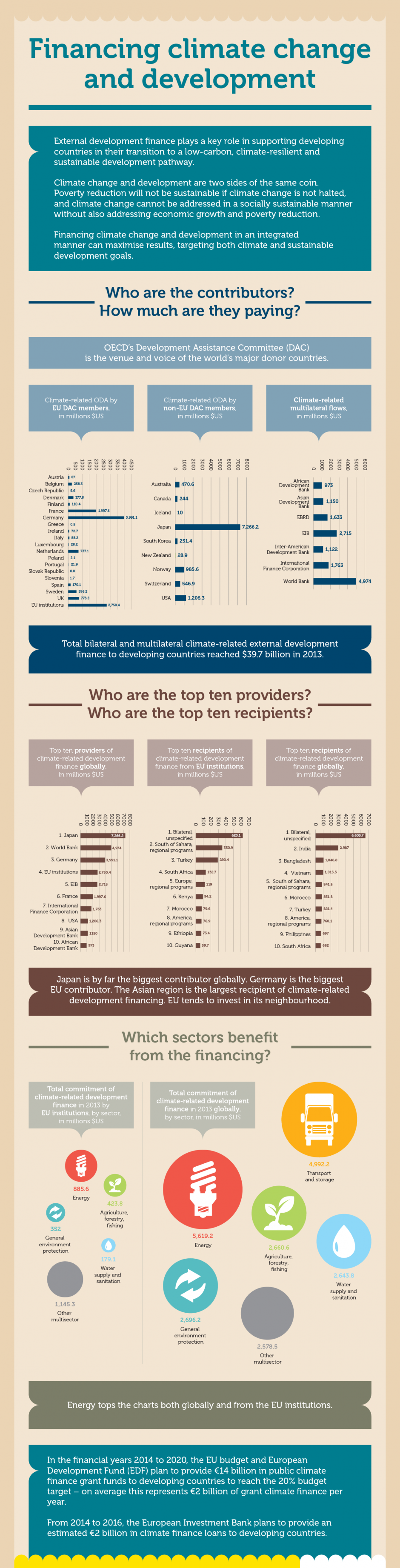
INFOGRAPHIC: Financing climate change and development

financing-25082015-en

September 15, 2015
by AEA in News

Race to renewable: five developing countries ditching fossil fuels

Costa Rica

Costa Rica is well on its way to becoming the first developing country to have 100% renewable electricity. Thanks to our hydro, wind and geothermal resources, 98% of our power is already renewable according to official data (Spanish website). This year, Costa Rica had 100% renewable power for 94 consecutive days. This achievement took several decades to build and the next milestone is to ensure that our electricity system is 100% renewable the whole year. This will require us to replace distributed diesel generators – that are used as a back-up source – with distributed, renewable energy resources.

The state-owned Costa Rican Institute of Electricity (ICE) plans to add more hydro, wind and geothermal power plants and retirie the heavy fuel oil-powered Moin plant in 2017. ICE also plan to improve the efficiency of existing plants that run on fossil fuels. For example, by using German technology to increase efficiency at the Garabito plant, it will go from producing 200MW to 280MW.

With Costa Rican citizens and entrepreneurs excited about solar panels, wind turbines, batteries and bioenergy, the country is now on track to have a fossil-free power system by 2025 – probably earlier.

Afghanistan

Ironically, some of Afghanistan’s most challenging characteristics support the growth of renewable energy. The fragmented nature of the country – geographically and politically – means that it will always be a big ask to build and maintain the sort of large-scale electricity grid typically powered by coal or gas. Such things depend on good governance and a central authority – not much in evidence in Afghanistan. So decentralised power generation – owned and controlled by local people – which can harness local sources of energy, is more favourable.

Secondly, Afghanistan has renewable energy sources in abundance. Much of the country enjoys high levels of sunshine; its upland areas have decent wind potential, and its rivers can be harvested by small-scale hydro plants. These don’t involve large, damaging dams, but small diversions of enough water to drive turbines producing electricity for a few villages.

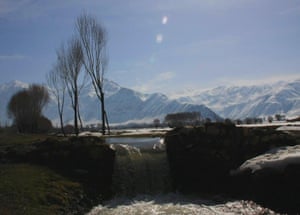
Baharak road

That may all sound a little optimistic, but there’s practical work underway. In the northern provinces of Badakhshan and Takhar, more than 12,000 homes, schools, markets, local businesses and hospitals are currently being supplied with power by a mix of hydro and solar plants. These were installed by the German development agency, GiZ, in close collaboration with both the government and, more importantly, local people, who are trained to operate and run them as semi-independent enterprises. The scheme won an Ashden Award for sustainable energy.

China

China has emerged as the world’s renewables superpower in less than a decade of highly focused development – the country is the world’s largest producer and user of renewable energy technologies. The official target of the Chinese government is for non-fossil fuels to grow to 20% of total energy consumption by 2030, rising from the current level of 11%. Meanwhile coal consumption is to becapped at 4.2bn tons by 2020. China is also committed to a significant increase of the electricity generating capacity based on renewable sources, doubling wind and quadrupling solar by 2020.

Those targets are likely to be achieved, given China’s track record to date. In fact consumption of coal has already started to decline, a Great Reversal of the trend for the past decade. As a result, revenues, profit, and stock prices of coal and oil companies have all fallen sharply.

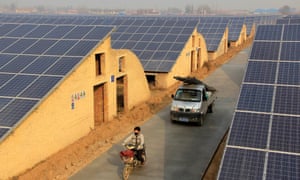
Solar panels on the roof of greenhouses growing mushrooms in Neihuang county, Henan province

There are divergent views in China over the future for renewables beyond 2030. A recent study by the Energy Research Institute within China’s central planning body has made a strong case for renewables to account for 60% of the total energy consumption and 85% of electricity by 2050; while the China Academy of Engineering projects that renewables will account for just over 40% of total energy consumption by 2050 (Chinese article). One conclusion is clear across many studies, though, that it is both technically and economically feasible for China to phase out fossil fuels with cleaner energy sources such as solar and wind.

China is building pipelines to transport oil and gas from all over the world, the lock-in effect will be a challenge

The trajectory of China’s future energy system is determined by competitive dynamics between the old and the new. China’s coal-fired power stations, currently of about 900GW of capacity, need to be decommissioned over the next decades. China is also building projects such as pipelines that transport oil and gas from all over the world, and the lock-in effect will be a challenge for renewables to overcome.

On the other hand, China continues to invest in renewables at a scale that dwarfs that of other countries. China invested nearly $90bn in clean energy in 2014, or 73% more than the US, building large solar parks in Qinghai and wind farms in Xinjiang and Inner Mongolia, just to name a few. China also leads the world in some key areas of infrastructure, such as high speed railways and smart grid technologies, which will facilitate a new model of energy consumption and supply, and one that makes a break with the system based on fossil fuels.

Hao Tan is a senior lecturer at the faculty of business and law, University of Newcastle, Australia.

India

With more than 20% of India’s population currently coping without access to electricity, the government has promised to provide all households with constant power supply before the next national election in 2019. Meanwhile, the Make in India campaign seeks an expansion of manufacturing capabilities in the country, which will also depend heavily on – and increase the demand for – access to power.

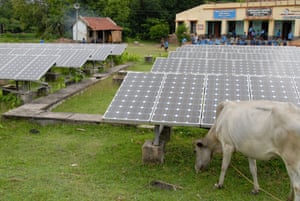
Off-grid solar power station in West Bengal

Development for all is dependent on electricity for all, which will simply not be possible without decentralised solutions, best served by renewable energy sources. Earlier this year, the central government announced an ambitious target of 175GW of renewable energy of which 100GW would come from solar alone, by 2022. But growth in the sector has been relatively slow, considering the immense potential: according to the Indian ministry of renewable energy, the total installed solar capacity crossed over 3GW for the first time in December last year, adding only 886MW in 2014 – in contrast, Tata Solar Power, in a report released in 2014, estimated that India could reach 145GW of solar by 2024. This good news has further positive implications: as solar power rapidly becomes a mainstream energy option, the industry could create over 670,000 new, clean-energy jobs in India.

These positives however, would be impossible to achieve without a paradigm shift in policies that boost the rapidly improving business of renewables. It will be important to ensure that this shift from polluting power to clean renewables is done in a way where citizens are in greater control over their own power supply, as virtually infinite potential from wind and solar energy can truly democratise the generation of, and access to, power.

Albania

Albania has among the highest number of sunshine hours per year in Europe

Albania, a small country of 2.77 million inhabitants, has big potential and an exciting future for renewable energy. Driven by a desire to reduce dependence on imported fossil fuels and promote a secure supply of energy, the government of Albania has been very eager to encourage increased investment in renewable energy and in 2013 a law was passed to promote renewable energy.

The new renewable energy law sets a nationally binding target for renewable energy (non-hydro) of 38% by the year 2020. In addition, it provides for priority grid access for renewable energy projects, for streamlined licensing procedures, for the ability to sign sale and purchase agreements for renewable energy for up to 15 years and for preferential feed-in-tariffs, to be established by the regulator. This package of measures should provide greater confidence to investors that their investments in renewable energy in Albania offer an attractive rate of return in a country that, for its size, has abundant renewable energy resources.

Blue Eye hot spring in southern Albania

Water is Albania’s most important natural resource. At least eight large rivers run through the country, fed by hundreds of smaller streams and total hydropower resources are estimated at 4500MW. In addition, solar energy potential (for both photovoltaics and solar hot-water heaters) is excellent as the country has among the highest number of sunshine hours per year inEurope (an average of 2,400). Wind energy potential for Albania is also very good along the Adriatic coast.

 The law on renewable energy was passed two years ago but investment in non-hydro renewable energy in the country is yet to take off. Partly this is because secondary legislation is not yet in place and partly because of lack of private sector awareness of the possibilities available.

Over the longer term, the potential for increased investment in renewable energy in Albania is excellent as the country becomes an energy exporter. Albania plans to spend over $200m to build power cables to Italy, a country with excess energy demand. This should help drive additional investment in renewable energy.

September 15, 2015
by AEA in News

Bankers Petroleum, Albania to pick auditor to settle tax spat

Canada’s Bankers Petroleum has agreed with Albania’s national resources watchdog to pick a third-party auditor to resolve a tax dispute over its 2011 spending, the company and Albanian officials said on Monday.

Bankers Petroleum has been extracting oil for 11 years in the Patos-Marinza oil field under an output-sharing contract which allows it to recover costs before paying profit tax. It has paid royalties and other taxes but no profit tax.

An audit of Bankers’ books for 2011 by the Agency for National Resources (AKBN) disputed some $250 million dollars in expenditure, triggering a $57 million profit tax demand by the Finance Ministry.

The international auditor is expected to be selected in a matter of weeks but its ruling will take several months.

“This represents a significant step towards enhancing transparency in the administration and regulation of oil and gas activities in Albania,” David French, President and Chief Executive Officer of Bankers Petroleum, said in a statement.

“Bankers views this commitment by the authorities as an important milestone in the ongoing improvement of our operations,” French said, adding he expected it to resolve the tax demand dispute.

Dael Dervishi, the head of Albania’s National Resources Agency, said the two sides had agreed to turn to a third-party and take all other steps before taking the dispute to an international arbitration court.

“We agreed to allow a third party to review all the audit findings for 2011 to advise both parties, because either we were too harsh or the company was not diligent enough”, Dervishi told Reuters. The third party would tell them “which of us should give in,” he added.  //Reuters


September 14, 2015
by AEA in News

Albania gasification, interested expressed by SOCAR..

SOCAR gasificationWhile TAP pipeline construction has started, Albania will become part of the international gas network, paving the need for gasification of the country with a network of special and brand new. This project requires huge investments that lie in years, while the master plan for the gasification is underway and expected to be ready next October.

Official sources at the Ministry of Economy of Albania stated that the Azeri company has expressed interest to implement the gasification infrastructure, since it is one of the main shareholders of the oil field and gas transmission by TAP.

The same sources indicated that the master plan ends in autumn next year. Then, they provided the financial support to continue with the detailed planning, which means you will study potential areas of Albania where possible will be the construction of gas distribution networks.

Experts at the Ministry of Energy of Albania say that Albania can have a consumption of about 1 billion cubic meters of gas, an amount one tenth of the initial capacity of the pipeline.

The goals of the Master Plan and further feasibility studies aimed at introducing the element of gas consumption by households.

Sources in the Ministry of Energy stated that the law on public-private partnership leaves room to find strategic investors for the gasification process. The same sources indicated that SOCAR Azerbaijan has expressed interest, but other countries have expressed interest, as have the opportunities because of the possession of gas.

September 9, 2015
by AEA in News

Approved the law for the natural gas sector that paves the way for TAP

trans adriatic pipeline tapProductive Activities Commission today approved the draft of the natural gas sector, which aims to improve the management of this strategic sector for the Albanian economy. This law also will ensure the development of strategic projects in the gas sector, such as the TAP project, IAP project, etc.

During the design phase are taken into account and are reflected recent developments in the Albanian legislation that directly or indirectly related to the gas sector.
It is especially taken into consideration and found reflection legal and regulatory framework for the development of the Trans Adriatic Pipeline project (TAP project), ensuring in this new bill continuity and stability in legislative terms.

As concerns the gas sector legislation, the scope of its activity is not included for the production of gas, in terms of a regulated activity and to be licensed by the ERE. In the case of gas, given that we are dealing with a natural energy source involved in hydrocarbons (whether natural gas or as accompanying gas) for its production activity is regulated by law “On the research and production of hydrocarbons”.

The draft law “On Natural Gas Sector” aimed at amending the existing law of 2008, under the implementation of the Third Energy Package of the European Union, in terms of development, liberalization and market sector and the interconnection of natural gas. This legislative initiative was prepared with the assistance of the Energy Community Secretariat, but has been considered and included almost entirely existing gas law.

This bill (with 9 chapters and 117 articles) consists of two main pillars:

-. The organization and functioning of the gas market as a regulated market, which according to the Third Energy Package of the EU’s natural gas sector, will be a market “fully open / liberalized”.

-. Construction and operation of infrastructure and installations of gas (including technical and technological) for the supply, transportation, storage and distribution of natural gas, which is essentially the main role in terms of organization and the executive but also has supervisory Ministry and the structures and institutions composed and under its supervision.

Through this new bill are predicting significant changes in the legal framework for the gas sector, changes that include:
– Conservation and ensuring legal and institutional stability.
– Specification of responsibilities and powers of the PM and the Ministry responsible for energy sector.
– Increasing the role and responsibilities of Commissioners mainly about the monitoring of the market, competition and consumer protection. ERE in this bill is designed in a new dimension by cooperating closely with the Ministry in connection with monitoring the market but always without interfering with the powers of another institution.
– Review and revision of some articles of the current gas law (eg “Combined operator”, “Measurement of natural gas”), also due to considering the specifications, connections and size of developments that may this gas sector in Albania.
– Definitions for the preparation of regulations for the activity of underground gas storage and liquefied natural gas.
– Regulation of ownership issues in the activity of natural gas, setting exactly the rights group affected, as dealing with infrastructure and related installations.
– Increased cooperation between the entities, state bodies involved in this law.
– Re-evaluation of the report of the central executive bodies in some activities more clearly defining the authority of the Council of Ministers, the Ministry responsible for energy, or ERE.

– Determination Program Officer and compliance, which is a new and more important to formulate for the first time in this bill, as required by EU legislation, setting out the rules to guarantee the transparency of transactions, independence of operators (TSOs and DSO).
– Has been added as a new chapter, “The market natural gas and market regulations and the system”, where in addition to organizing the market and trade of natural gas in an article on its own are also included measures to promote the market opening that and it constitutes one of the main goals of the Third Energy Package of the EU.

In terms of organization and functioning of the gas sector in Albania, in this bill has some specific features that make up the difference from other areas of the energy sector, thus:
– There is only one operator Transmission System (TSO) for gas at the country level, but provided and enable the existence and functioning of some s TSOs gas, so the System Operator (DSO) of gas to forecast some such nationwide.

– It included the role of function “combined Operator”, which reflects how relevant and concrete developments in the gas sector in Albania, as well as specifics on the size and capacity is expected to have gas market in Albania.

– They are fully involved and issues of oversight and inspection in terms of technical and technological safety for construction, use and maintenance of plant and gas infrastructure sector including supply, transportation, storage, and distribution of natural gas. It is not only clearly defined the role of the Ministry in this regard, but also the role and function of the State Inspectorate responsible for the gas sector.

It is taken into consideration and reflected the fact that activities associated with natural gas, but are activities related to fuels, as are the activities dealing with equipment, installations and plants under pressure.

Also in the preparation of this bill have been considered and are reflected in the measure that was considered reasonable and was rated in accordance with legal logic, the comments of stakeholders and ministries, for which we can say that they are taken into account most of the comments made.

  • 1
  • …
  • 128
  • 129
  • 130
  • 131
  • 132
  • …
  • 140

AEA – Albania Energy Association is a industry association dedicated to representing the interests of Albanian and West Balkan for energy producers and consumers. AEA works to advance the development and adoption of sustainable energy solutions in Albania and the Western Balkans, supporting the region’s transition toward a cleaner, more secure, and more competitive energy future. AEA is registered by decision of the Court of Tirana, DECISION NO. 3032, (VAT:L11827451K).

[email protected]

Address
Blv Zogu 1
Tirana
1057
ALBANIA

LinkedIn  |  Facebook
Events
May 25, 2022 Connecting Green Hydrogen Europe 2022
May 25, 2022 Energy Week Western Balkans 2022
Copyright © Albania Energy Association