by in News

Low consumption causes grid failure, power outage in North Macedonia

A grid failure caused a brief power outage in North Macedonia in the early hours on Sunday, May 18. Disruptions at the affected 400/110 kV transformer stations were triggered by high voltage levels in the grid, caused by low consumption, typical for nighttime hours and weekends at this time of year, according to a statement by the country’s transmission system operator, MEPSO.

MEPSO said its teams restored normal electricity supply in about an hour and were working to fully normalize the stability of the power system.

According to the update, grid instability caused by low consumption at nighttime and on weekends is a problem shared by almost all transmission system operators in the region and around Europe.

Bulgaria’s energy minister: Bulgaria played the crucial role in stabilizing North Macedonia’s grid

At the same time, Bulgarian Minister of Energy Zhecho Stankov said that a grid failure had affected several countries in Southeast Europe, though not Bulgaria. He added that his country’s balancing facilities were crucial in stabilizing North Macedonia’s grid, restoring supply, and preventing the crisis from spreading further. In Bulgaria, the Electricity System Operator (ESO) is responsible for the transmission network.

He claimed Serbia and Croatia have also experienced problems due to a lack of balancing facilities. “The colleagues from Serbia also had certain difficulties in the morning hours, and we managed to balance them out,” Stankov stated.

EMS has denied that any disruptions or outages occurred in Serbia

However, Serbia’s transmission system operator Elektromreža Srbije (EMS) told Balkan Green Energy news that the country’s grid did not experience any disruptions or outages and that there was no need for assistance from Bulgaria. EMS said it would not specifically comment on the Bulgarian minister’s statement because it was unclear what it was referring to.

In its reply to Balkan Green Energy News, EMS underscores that there were no consequences for the transmission system of the Republic of Serbia, explaining that EMS, at the request of MEPSO, to facilitate the repairs in North Macedonia, temporarily shut down the 400 kV transmission line between the Vranje 4 transformer station and the North Macedonian border.

Renewables had no share in the problem, according to Stankov

Stankov also stressed that solar power plants did not play a role in the crisis, unlike in Portugal and Spain in late April. The grid failure occurred in the early morning hours and amid low renewable energy generation, he said, adding that “renewable energy had no share in the problem.”

Bulgaria plans to build three new pumped storage hydropower plants

Bulgaria’s system remained stable thanks to its generating and balancing capacities, in Stankov’s view. He told the press that the country possesses 90% of all the reactive energy compensation capabilities in Southeast Europe.

Bulgaria is working with the European Investment Bank (EIB) to build at least three pumped storage hydropower plants in the Rhodope region, aimed at further enhancing regional grid resilience, Stankov pointed out. The minister vowed to keep the country’s grid on standby to support other regional networks in need of stabilization.

Stankov revealed that one such project is being developed for the Vacha dam. The other two pumped storage hydropower plants are planned to be built on the Dospat and Batak dams.


by in News

Works beginning on North Macedonian side of gas interconnector with Greece

The North Macedonian section of the gas interconnector with Greece is expected to be completed by early 2027. The construction contract was signed by the Ministry of Energy, Mining and Mineral Resources, domestic contractor Rapid Build and the country’s gas transmission system operator Nomagas.

The construction of the gas pipeline connecting North Macedonia with Greece is set to begin in a month, according to officials. Land expropriation is 90% complete. The initial capacity of the interconnector would be 1.5 billion cubic meters per year, with a potential to double it. The works are expected to be completed within 22 months.

„With the signing of the contract for the construction of the Macedonian section of the gas interconnector with Greece, we are marking the beginning of the largest energy investment in North Macedonia in the last ten years. The interconnector is proof that when there is political will, regional trust, and professional dedication – the results are real and tangible,” said Minister of Energy, Mining and Mineral Resources Sanja Božinovska.

The contract was signed by the ministry, contractor Rapid bild, based in Kumanovo in North Macedonia, and the country’s gas transmission system operator Nomagas. The future pipeline would be able to carry both natural gas and hydrogen.

Repeated tender slashes price by EUR 12 million

The winning bid was EUR 59.9 million or EUR 12 million less than in the initial tender, which was annulled.

The project is worth over MKD 5.1 billion (EUR 82.9 million). It is financed by the European Investment Bank (EIB) and the European Bank for Reconstruction and Development (EBRD). It includes grants of EUR 2.5 million for technical assistance and another EUR 9.9 million via the Western Balkans Investment Framework (WBIF).

The project is financed by the EIB and EBRD

„This contract ensures diversification and access to a greater number of natural gas sources, enables economic development, progress and environmental protection, and contributes to the security of energy supply,” said Executive Director of Nomagas Muhamet Elmazi.

Gasification would significantly improve air quality, especially in areas where wood and fuel oil are currently used for heating.

Greek section of interconnector under construction since February

On the North Macedonian side, the interconnector route is 68 kilometers long, out of a total of 123 kilometers. It will run from Nea Mesimvria in Greece through Evzoni (Mačukovo) and Gevgelija at the border, to Negotino. The next phase involves building gas links from Gostivar to Kičevo (34 kilometers) and from Sveti Nikole to Veles (28 kilometers).

Greek company Terna began constructing its country’s section of the pipeline in February.

Nomagas and Greece’s National Natural Gas System Operator (DESFA) made their final investment decision a year and a half ago.

The companies leaned the investment on the project for the Alexandroupolis LNG Terminal. The liquefied natural gas facility in northeastern Greece was opened on October 1. However, due to a malfunction, it has been out of operation for more than three months. According to the latest update, gradual reactivation is expected to begin by the end of May.

by in News

Electricity system in Spain, Portugal collapses

Power was out today throughout Spain and Portugal as well as in Andorra and parts of southern France, in one of the most serious such incidents so far, on a European scale. The European Commission’s Executive Vice President Teresa Ribera and other officials from the EU and the affected countries said there are no indications of sabotage or cyberattack.

Grid operators and electricity producers are gradually restoring the power supply after a massive outage struck the Iberian peninsula today. Prime Minister of Spain Pedro Sánchez convened the National Security Council. It is one of the most serious blackouts in Europe in many years. The outage spread throughout Spain and Portugal.

Power was out in Andorra and, briefly, in parts of southern France. Transportation and telecommunications were heavily affected.

Spanish TSO Red Eléctrica de España called it a “collapse of the Iberian electricity network.” The company said it would take six to ten hours to restore it. Notably, the production system is relying almost completely on photovoltaics and wind farms at the moment, so just a few hours of solar power production remain.

The outage paralyzed major cities including Madrid, Barcelona and Lisbon and caused disturbances in the European grid. The European Commission’s Executive Vice President for Clean, Just and Competitive Transition and Commissioner for Competitiveness Teresa Ribera said there were no indications that “any kind of sabotage or cyberattack” was behind the grid collapse.

According to the Government of Portugal, the incident started from outside the country

According to the Government of Portugal, the incident started from outside the country and, apparently, in Spain.

Shares of solar, wind power production in Spain breaking records

In the spring and autumn, when there is little to no demand for heating or cooling, electricity grids in most of Europe are sometimes strained from surges in high solar and wind power production, amid a lack of energy storage and flexibility capabilities that would balance the surplus.

On April 16, the Spanish electricity system achieved total coverage for the first time with renewable energy sources. At one point during the day, wind and solar met 100.6% of demand. Then on April 21, solar power generation was equivalent to a record 78.6% of domestic demand for a moment.

Reid: The massive outage occurred while prices are negative in electricity markets across Europe

“Spanish grid operator Red Eléctrica has so far blamed a power ‘oscillation’ on the power outage. We still don’t know the cause but it looks like problems at the Spanish-French power interconnector led to the Spanish grid operator islanding their power system and I would say at this point they lost control,” said Gerard Reid, investor and strategic advisor in energy, finance and geopolitics.

It has also proven difficult to restore power with multiple black start (restart) procedures taking place, but the issue is that at the time of the blackout there were no conventional power units in operation, he pointed out. Reid added it makes the restart complicated and stressed that Europe requires enhanced grid-scale battery storage solutions, including for black start capabilities.

He also highlighted the fact that the massive outage occurred while prices are negative in electricity markets across Europe.

Of note, a grid incident last summer left much of the Western Balkans and parts of Croatia out of power for several hours.

by in News

CEO of Kosovo* TSO KOSTT dismissed amid allegations of abuse of office

The Board of Directors of Transmission, System and Market Operator (KOSTT) of Kosovo* fired Chief Executive Officer Evetar Zeqiri after a complaint that former board members sent to the Special Prosecutor’s Office surfaced in the media. The company appointed Shaban Neziri as acting CEO.

Evetar Zeqiri is dismissed from the top position in KOSTT, the transmission system operator (TSO) of Kosovo*, but also fired. The board deposed the CEO, who led the government-controlled company since October 2022, and replaced him with Shaban Neziri, in an acting capacity.

Just before the announcement, the Dukagjini television station showed criminal charges that former board members allegedly filed with the Special Prosecutor’s Office against Zeqiri for abuse of office. KOSTT denied the connection between its move and “the reports published in some media.”

Allegations of interfering in procurements

According to the document, the former CEO violated his obligations regarding finance, interfered in procurement, set discriminatory criteria and demanded that all technical specifications for the company’s projects be sent to him in advance. The allegations include influence to make illegal decisions and failing to properly inform the board, causing financial damages to the company. Zeqiri has asked legal entities to withdraw their bids, during evaluation, according to the report.

The authors of the complaint, who weren’t named, said they raised concerns several times, but that they were a minority within the board and that both its then-Chairman Jeton Mehmeti and CEO Zeqiri blocked them.

KOSTT cites poor personnel management, investment

The same media outlet obtained the decision to remove Zeqiri. The board said his personnel changes impacted the functioning of the enterprise’s operational structures and the motivation of the staff. It cited unsatisfactory capital investment and improper planning of projects in the budget.

Acting CEO Neziri is an electrical engineer, in KOSTT since its establishment.

From 2021 to 2024, Kosovo* imported electricity worth nearly EUR 590 million in total, according to Klan Kosova. One of the main importers is Noa Energy Trade, a company with an apparently unknown address and owner.

Notably, government-owned Kosovo Energy Corp. (KEK) has been led by acting CEOs for the past two years, since CEO Nagip Krasniqi was arrested. The current interim head is Gramos Hashani.

* This designation is without prejudice to positions onstatus and is in line with UNSCR 1244/99 and the ICJ Opinion on the Kosovo declaration of independence.
by in News

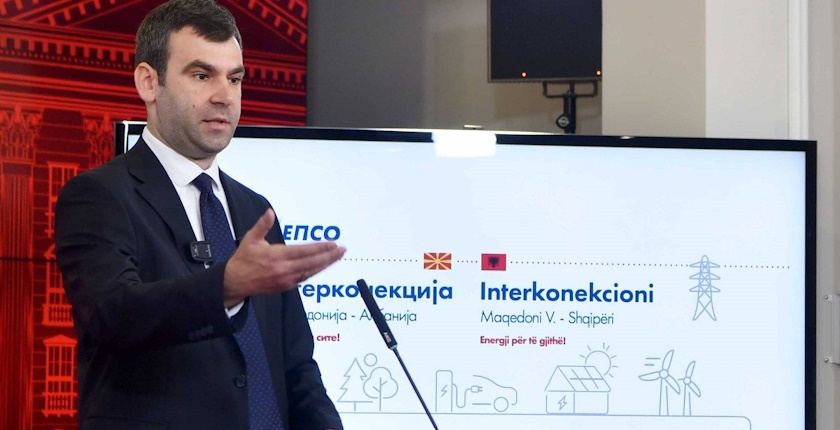
North Macedonia’s MEPSO seeks contractor for power line to Albanian border

Transmission system operator MEPSO launched an international tender for the construction of a 400 kV transmission line, the North Macedonian part of a planned interconnection with Albania. The company earlier canceled the contract with Energoinvest, which began building it four years ago.

State-owned MEPSO said the project is of great importance for the energy stability of North Macedonia and regional integration. The tender is for the construction of an overhead transmission line of one hundred kilometers from the Bitola 2 transformer station to the North Macedonian – Albanian border.

The call was issued after the cancellation of the contract under which construction initially began in 2021.

North Macedonia, Albania waiting over three decades for electricity interconnection

The investment is valued at EUR 17 million. The project is funded through a loan from the European Bank for Reconstruction and Development (EBRD) and grants from the European Union.

The North Macedonian part of the interconnector with Albania is scheduled to be completed by the end of 2027

„I regret that for more than three decades, despite political pluralism and democratic changes, there was no institutional courage and vision to establish an electricity connection with Albania. Today, we are correcting this historical omission,” said Burim Latifi, Director-General of MEPSO.

The transmission line is expected to be completed by the end of 2027, with construction set to begin in early 2026, according to the country’s electricity transmission system operator (TSO).

The deadline for submitting bids is 45 days, and the selection of the most favorable bidder is expected in the third quarter of 2025, MEPSO added.

Latifi: Energoinvest jeopardized power line project

The company claimed the previous contractor, Energoinvest from Bosnia and Herzegovina, jeopardized the project and public interest through unjustified requests for additional funds and by unilaterally abandoning the site, leading to the termination of the contract.

So far, only a small portion of the planned towers for the transmission line has been constructed.

„We encountered a seriously neglected project. Out of 269 planned foundations for transmission towers, only 24 were completed, clearly showing the lack of seriousness in completing the project,” Latifi stated.

The funds spent so far were used for equipment procurements

Energoinvest has received EUR 5.8 million, of which EUR 2.5 million was recovered through bank guarantees, he added. Latifi clarified that the funds were used for procuring equipment, now owned by MEPSO.

The company pointed out that the power line would be part of the proposed East-West energy corridor, connecting Bulgaria, North Macedonia, Albania and Montenegro, which is linked with Italy by an undersea cable.

„The construction of this interconnector will position our system as an essential part of European electric power infrastructure, enabling stable participation in regional markets, access to system and balancing services, and providing more secure and economical energy supply for all citizens,” MEPSO states.

by in News

Electricity system in Spain, Portugal collapses amid extreme temperature variations

Power was out today throughout Spain and Portugal as well as in Andorra and parts of southern France, in one of the most serious such incidents so far, on a European scale. The European Commission’s Executive Vice President Teresa Ribera and other officials from the EU and the affected countries said there are no indications of sabotage or cyberattack.

REN, the transmission system operator (TSO) of Portugal, said extreme temperature variations inside Spain led to anomalous oscillations in 400 kV lines.

Grid operators and electricity producers are gradually restoring the power supply after a massive outage struck the Iberian peninsula today. Prime Minister of Spain Pedro Sánchez convened the National Security Council. It is one of the most serious blackouts in Europe in many years. The outage spread throughout Spain and Portugal.

Power was out in Andorra and, briefly, in parts of southern France. Transportation and telecommunications were heavily affected.

Spanish TSO Red Eléctrica de España called it a “collapse of the Iberian electricity network.” The company said it would take six to ten hours to restore it. Notably, the production system is relying almost completely on photovoltaics and wind farms at the moment, so just a few hours of solar power production remain.

Outage could have originated from power line in France damaged by fire

The outage paralyzed major cities including Madrid, Barcelona and Lisbon and caused disturbances in the European grid. The European Commission’s Executive Vice President for Clean, Just and Competitive Transition and Commissioner for Competitiveness Teresa Ribera said there were no indications that “any kind of sabotage or cyberattack” was behind the grid collapse.

According to the Government of Portugal, the incident started from outside the country

According to the Government of Portugal, the incident started from outside the country and, apparently, in Spain.

Portuguese transmission system operator REN first suggested that damage to a high-voltage line in southwestern France from a fire was a possible cause. The company later blamed extreme temperature variations inside Spain for anomalous oscillations in 400 kV lines.

Shares of solar, wind power production in Spain breaking records

In the spring and autumn, when there is little to no demand for heating or cooling, electricity grids in most of Europe are sometimes strained from surges in high solar and wind power production, amid a lack of energy storage and flexibility capabilities that would balance the surplus.

On April 16, the Spanish electricity system achieved total coverage for the first time with renewable energy sources. At one point during the day, wind and solar met 100.6% of demand. Then on April 21, solar power generation was equivalent to a record 78.6% of domestic demand for a moment.

Reid: The massive outage occurred while prices are negative in electricity markets across Europe

“Spanish grid operator Red Eléctrica has so far blamed a power ‘oscillation’ on the power outage. We still don’t know the cause but it looks like problems at the Spanish-French power interconnector led to the Spanish grid operator islanding their power system and I would say at this point they lost control,” said Gerard Reid, investor and strategic advisor in energy, finance and geopolitics.

It has also proven difficult to restore power with multiple black start (restart) procedures taking place, but the issue is that at the time of the blackout there were no conventional power units in operation, he pointed out. Reid added it makes the restart complicated and stressed that Europe requires enhanced grid-scale battery storage solutions, including for black start capabilities.

He also highlighted the fact that the massive outage occurred while prices are negative in electricity markets across Europe.

Of note, a grid incident last summer left much of the Western Balkans and parts of Croatia out of power for several hours.

by in News

Episodes of negative power prices in Slovenia, Romania spread to workdays

Romania registered the first negative day-ahead electricity price for a workday. The phenomenon, which only used to occur on holidays and weekends, has emerged in Slovenia as well.

In spring and autumn, most of Europe occasionally faces periods of excessive power grid loads. The rapid rise in solar and wind power production and the lack of accompanying energy storage and flexibility capabilities are straining the system at times when demand is low. Advanced electricity markets countered the issue by introducing negative prices.

When prices hit zero or go below zero, the seller delivers electricity without compensation or even has to pay to the buyer, respectively. The phenomenon was normally reserved for holidays and weekends, but more day-ahead markets are now experiencing it for workdays as well.

Downward pressure in Romania from strong inflow of negatively priced electricity via Hungary

Romania saw its first such episode yesterday, on Sunday, in the session for today, Profit.ro reported. Prices in its day-ahead market are negative in five out of 24 periods of one hour, between 11:00 and 16:00.

The country is importing at almost 2 GW via Hungary and exporting at up to 1.5 GW to Bulgaria, the news website added. The article notes that renewable energy producers, especially in Germany, where prices are also negative, are exporting to other markets to ease the impact. They usually benefit from subsidies, so generating electricity isn’t necessarily unprofitable even when they sell at a loss.

In addition, shutting down and restarting power plants can be more costly than paying the other side to take excess output.

The level in Romania went to as low as EUR 6.18 per MWh below zero. But the daily average is EUR 76.54 per MWh. The peak, is EUR 198.16 per MWh, between 20:00 and 21:00, when there is no sunlight and prosumers only consume.

Negative prices turn Slovenia’s HSE into electricity consumer

Prices in Slovenia for today also came in negative between 11:00 and 16:oo, which is very rare for a workday, Naš stik reported. Among other factors, the two-day May 1 holiday shortens the current workweek. The lowest, between 14:00 and 15:00, is EUR 6.18 euros per MWh below zero.

In comparison, the lowest price for Sunday on the BSP Southpool exchange was EUR 104 per MWh under zero.

At one point during the Easter holiday, virtually all HSE’s production capacities were offline and the Avče pumped storage hydropower plant was storing electricity from the grid

“Last year, we had 219 hours in Slovenia when prices were negative. This year, we are already at number 72, and we have only just entered the critical period,” said Deputy Director of System Operations of ELES Aleš Donko. The company is Slovenia’s transmission and distribution system operator.

State-owned power utility Holding Slovenske elektrarne (HSE) found itself in an unusual situation during the Easter holidays because of negative prices.

“For a while, we were actually an energy consumer, not a producer, which is our core mission… Virtually all our power plants were shut down, and the Avče pumped storage hydropower plant was pumping water into the upper reservoir at full capacity,” Head of Operation Planning and Management Jernej Brglez said.

Portugal and Spain, which suffered major outages today together with France, both registered negative prices every day in the third week of April.

Also of note, Greece is preparing to introduce negative prices in the balancing market.

by in News

Feasibility study complete for Romania’s East-West underground high-voltage line

A project for underground high-voltage power link East-West across Romania entered a new phase with the completion of the feasibility study. It would run alongside existing energy infrastructure.

A year and a half after Minister of Energy Sebastian Burduja declared the project for a high voltage direct current (HVDC) line across Romania “the number one priority,” the feasibility study is complete. Notably, he estimated at the time that it would be done within six months and that the interconnection had to be installed by 2029.

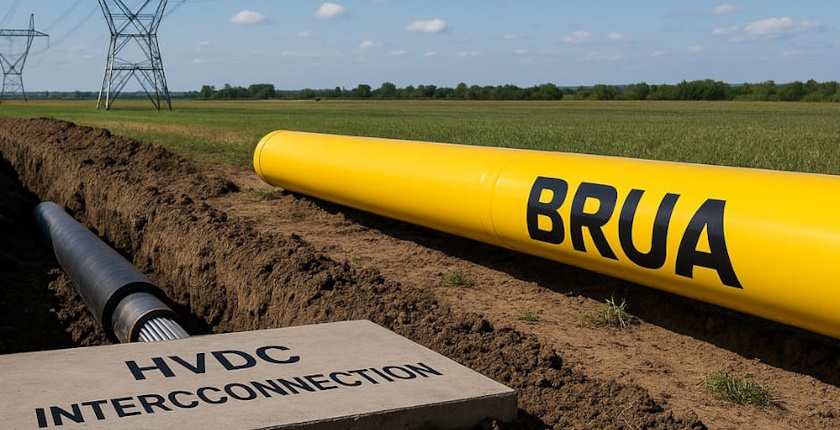
The East-West Interconnector (Est-Vest) project is entering the next phase. It is planned to run underground from the Black Sea coast to the border with Hungary. The endeavor includes utilizing existing infrastructure corridors such as the BRUA and Tuzla-Podișor gas pipelines.

It saves significant time on permits, lowers costs and reduces environmental impact, the ministry pointed out. The project partners are Romania’s transmission system operator Transelectrica, Abu Dhabi National Energy Co. (TAQA) from the United Arab Emirates, the French Meridiam and domestic company E-Infra.

Italian consultancy and engineering services provider CESI conducted the study. It launched the task in May last year.

Burduja: No time to waste in making Romania net exporter of electricity

Minister Sebastian Burduja said it is one of the most ambitious energy infrastructure projects in Central and Eastern Europe. The new study marks an essential stage in Romania’s transformation into a regional energy hub and a strategic actor in Europe’s energy security, he claimed.

“We have no time to waste. We will accelerate all the necessary steps for Romania to become a net exporter of clean energy and a pillar of stability in the region. Moreover, the project is vital for the modernization and balancing of Romania’s electricity transmission network and will ensure the evacuation of significant quantities of electricity that will be generated following the completion of Romania’s strategic investments in units 3 and 4 of the Cernavodă nuclear power plant, as well as in the offshore and onshore wind projects in the Dobruja area,” Burduja stated.

The East-West HVDC will be able to cary electricity from the Cernavodă nuclear power plant as well as from future wind projects in the east

Internationally, the project contributes to strengthening the integration of the regional and European energy market and increasing the security of supply to consumers in the southeastern part of Europe, according to the minister. It contributes to the possibilities for exporting electricity to neighboring countries, he noted.

The project is an integral part of the Green Corridor, which is supposed to connect Azerbaijan, Georgia, Romania and Hungary, as well as other countries in the region. The project includes the proposal for an HVDC cable that would run under the Black Sea.

Energy security comes first

The ministry’s objectives are a secure energy supply, at affordable prices, and for Romanians and the economy, and the energy to be green – all in the same order.

HVDC is currently the prevailing technology for long-distance power transmission. The East-West interconnector is supposed to pass through Bucharest.

The cable would allow the transmission of green energy produced in Romania – including from future offshore wind farms in the Black Sea – to domestic and consumers in other European Union member countries. It will also allow Romania to get green energy from Azerbaijan when there is a deficit in the national power system, the ministry added.

by in News

Delta Green launches platform in CEE for households to provide grid balancing

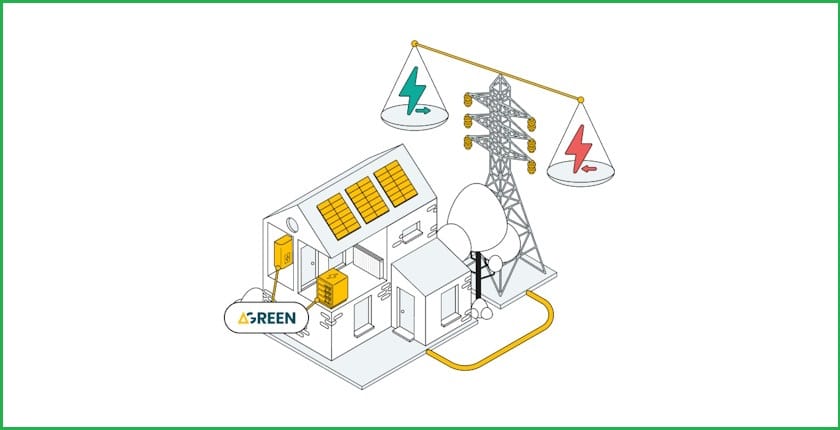
Czech energy startup Delta Green has launched a platform enabling households to provide grid balancing for transmission system operators. The company claims it is the first in Central and Eastern Europe and among the first in Europe to implement such a solution.

Delta Green said it just became the first in the CEE region to launch a platform that lets ordinary households help stabilize the energy grid, arguing it’s never been done before at this scale in the region.

The startup stressed the innovation comes at a critical time when European flexibility needs are projected to more than double, from 220 TWh in 2025 to 530 TWh by 2033, according to the latest projections by ENTSO-E.

Flexibility could bring benefits to consumers, and savings to grid operators, but also reduce electricity prices and grid investments.

The platform transforms ordinary households into active participants in the energy market

The platform transforms ordinary households into active participants in the energy market, allowing them to adjust electricity consumption or supply power in response to grid demands – a capability that directly addresses Europe’s growing flexibility challenges, the company underlined.

“A standard home solar system with battery storage can save up to EUR 40 per month. In Germany and France, where millions of homes have solar setups, 10% participation could offset the output of several power plants, reducing fossil fuel reliance and boosting grid resilience,” co-owner and Chief Product Officer of Delta Green Jan Hicl said.

Delta Green says its platform is the Airbnb of grid balancing

The company added its tech is already saving consumers money and reducing fossil fuel reliance. One can think of it as the Airbnb of grid balancing, Delta Green said.

The company is now working on expanding its services beyond the Czech Republic to both Western and Eastern Europe, for example the DACH region (Germany, Austria, and Switzerland), Italy, and Romania.

Delta Green was established in 2008 as Nano Green under the Nano Energies group. It rebranded itself last year. The company is jointly owned by David Brožík, Prokop Čech, Lukáš Beneš, and Jan Hicl.

Demand-side flexibility could deliver over EUR 300 billion in benefits for European consumers

A recent study from the Smart Energy Europe Association (smartEn) demonstrates that demand-side flexibility could deliver over EUR 300 billion in benefits for European consumers by 2030. Grid flexibility from available assets, including household systems, could contribute a projected EUR 4 billion in annual savings for European grid operators.

According to the European Agency for the Cooperation of Energy Regulators (ACER), grid expansion and flexibility measures potentially could reduce electricity prices by 11% by 2035 and by 30% in 2040 in a net zero scenario.

The European Union needs EUR 584 billion in grid upgrades by 2030. Flexibility solutions, combined with grid optimization, could lower the much needed grid investments from an anticipated EUR 67 billion to EUR 55 billion annually between 2025 and 2050.

by in News

Cypriot minister not optimistic about cable project with Greece amid Turkish intimidation

Cypriot Minister of Finance Makis Keravnos said the Great Sea Interconnector (GSI) project still faces very serious political obstacles. He highlighted the pressure from Turkey, alongside the financing disputes with Greece regarding the EU-backed bilateral investment to lay an undersea electricity cable that would connect the two countries.

Following a second incident this month when Turkish navy intimidated ships researching the seabed, Minister of Finance of Cyprus Makis Keravnos expressed doubt in the feasibility of the Great Sea Interconnector (GSI). It is a project to connect his country’s electricity system with Greece’s through Crete, by laying a cable under the sea.

“I can’t say I’m optimistic, especially when there are still very serious political obstacles, namely those posed by Turkey,” the official said, as quoted by domestic media. Namely, Turkish corvette TCG Bartın has approached Ievoli Relume and NG Worker, Italian vessels conducting research for the interconnection, in international waters just north of Crete.

GSI investment concerns now have to be addressed

Nevertheless, a recent due diligence study by a hired foreign consultancy showed the draft bilateral deal heavily favors Greece’s Independent Power Transmission Operator (IPTO or, in Greek, Admie). The authors warned of an “unnecessary additional layer of risks for any equity investors in GSI.”

Keravnos said the document confirms his concerns and that they must be discussed. While the two sides are working to overcome their financing dispute, the project is suffering delays, increasing the risk of cancellation.

Keravnos said in October that the total cost could well surpass EUR 2 billion. The Crete-Cyprus part is substantially leaning on funding from the European Union. The idea was to later extend the interconnector to Israel.

Turkey has been obstructing both GSI surveys and hydrocarbon exploration around Cyprus. There were several incidents involving gunboats.

Cyprus craves interconnections, flexibility sollutions

Meanwhile, Cyprus is struggling to maintain the stability of its isolated electricity system. Oil-fired power plants are increasingly working near their upper limits in peak hours. Conversely, storage capacities, flexibility systems and digital controls are needed for mitigating the pressure on the grid at times of weather-induced jumps in the production of wind and solar power, but also sharp drops.

It is the only noninterconnected country in the European Union. Moreover, Cyprus has no access to natural gas yet.

GSI was formerly known as EuroAsia Interconnector.