by in News

Athens International Airport builds biggest photovoltaic-BESS plant

Athens International Airport (AIA) Eleftherios Venizelos completed its comprehensive energy makeover program. It is now operating a photovoltaic facility of 51.5 MW and a battery energy storage system of 82 MWh. It is the largest hybrid power plant of its kind within the premises of any airport in Europe and, reportedly, even the entire world.

At the same time, the Bucharest Henri Coandă International Airport is about to build 12.6 MW in peak PV capacity and a BESS of 17.9 MWh, in the first phase of a larger project.

Following European and global trends, airports in Southeastern Europe are introducing resource, waste and wastewater management systems. Energy is the largest segment of the decarbonization push. With the completion of its Route 2025 program, Athens International Airport Eleftherios Venizelos covered all its electricity needs with photovoltaics, becoming the only such airport in Europe.

In the groundbreaking project, the operator extended the existing solar power plant by 35.5 MW in peak capacity, reaching 51.5 MW, and added a battery energy storage system. The facility has 124 MWh in nominal capacity, of which 82 MWh is usable.

The hybrid system is the largest of its kind inside the fence of any airport in Europe, while the Greek press has even called it the largest in the world. Some of the world’s largest airports are set to follow soon. For instance, IGA Istanbul Airport is investing EUR 212 million in an external solar power plant of 199.3 MW, in Eskişehir.
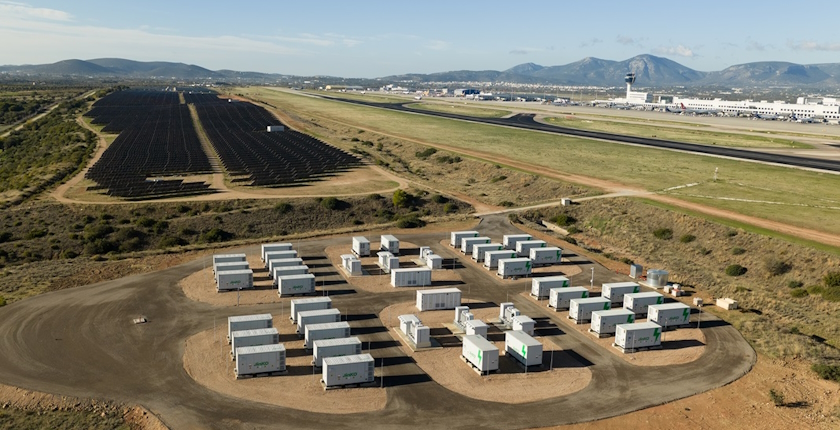
Athens International Airport builds biggest photovoltaic BESS plant
Photo: Athens International Airport

Hybrid power plant to keep Athens International Airport at net zero through 2046

AIA’s PV-BESS plant will generate an estimated 88 GWh per year, which is equivalent to the consumption of 22,000 households. The storage system is only for self-consumption. Importantly, the hybrid system can cover the entire planned expansion up to 2046, when the concession period ends.

AviAlliance, which controls 50.2% of the public-private partnership, is a wholly-owned subsidiary of Public Sector Pension Investment Board (PSP Investments) from Canada. The government holds 25.6% through Superfund, officially Growthfund – The National Fund of Greece.

AIA launched Route 2025 six years ago, with the aim to cut net greenhouse gas emissions to zero by the end of this year. It compares to the 2050 net zero goal of the European airports sector.

The Route 2025 program was worth EUR 70 million

The investments totaled EUR 70 million. A significant portion was financed through loans from the European Union’s Recovery and Resilience Facility (RRF), the update adds.

Heat pumps have eliminated the need for natural gas in buildings at AIA in normal winter conditions. The electric vehicle fleet consists of 19 buses, 13 follow-me vehicles and 29 vans. A network of chargers also serves passenger cars.

“In the airport company, we operate on the basis of the principle that sustainability, and environmental responsibility in particular, are and will increasingly be prerequisites for what we call the social license to operate and grow,” said outgoing Managing Director of AIA Yiannis Paraschis.

Two airports in Romania receive EU funds for solar-BESS projects

As for other recent developments in the Balkans, operators of two airports in Romania received grants via the European Union’s Modernisation Fund for solar power plants with battery storage.

National Company Bucharest Airports (CNAB) signed a contract for RON 132.04 million (EUR 25.9 million) excluding value-added tax. It is for 12.6 MW in peak PV capacity and a BESS of 17.9 MWh at the Bucharest Henri Coandă International Airport in Otopeni.

The entire investment amounts to RON 176.9 million (EUR 34.7 million) excluding VAT. The Romanian state-owned company said it is the first phase of a project for 31.5 MW and 30 MWh overall, valued at EUR 55.7 million.

Bacău International Airport George Enescu will build a solar power plant of 1.25 MW and a BESS of 2.06 MWh. Bacău County Council will also provide support for the on-site project on 2.2 hectares, worth more than EUR 4.9 million.
by in News

OMV Petrom, CE Oltenia building solar parks of 550 MW in total

Coal land of Romanian state-owned CE Oltenia is undergoing transformation with the beginning of construction of four photovoltaic plants. The projects, which the company is conducting with OMV Petrom, are for 550 MW in combined capacity. In a separate partnership, with Tinmar Energy, 280 MW more is in development.

Almost four years after the European Union approved the grants from the Modernisation Fund and the start of negotiations between Complexul Energetic Oltenia (CE Oltenia) and OMV Petrom about a partnership, their four solar power projects of 550 MW in total peak capacity reached the construction phase. They would cover the equivalent of an estimated 410,000 Romanian households’ annual consumption, the update adds.

The largest integrated energy company in Southeastern Europe and Romania’s main coal power producer are building the photovoltaic systems in Ișalnița, Tismana, and Rovinari in the coal region in the counties of Dolj and Gorj. CE Oltenia and OMV Petrom expect the facilities to become operational next year.

OMV Petrom, CE Oltenia partnership receives first tranche of EU funding

Total investment is over EUR 400 million, with 70% financed through the Modernisation Fund. There are four joint ventures, in which the partners hold 50% each. Just this month, they received the first EUR 16 million, the announcement reveals.

The locations are on CE Oltenia’s coal land. They are aimed at partly substituting the power plants there, as Romania is heading for a coal exit by 2032.

“Through these projects, OMV Petrom reaffirms its commitment to a low-carbon energy future, contributing to Romania’s and the EU’s climate objectives. We are transforming a region with a long-standing tradition in coal-based energy into a renewable energy hub,” said Franck Neel, member of OMV Petrom’s Executive Board responsible for Gas and Power.

Ameresco and Sunel won three contracts together, and Turkey-based Girişim is in charge of the fourth one

Following tenders, contractors for the design and execution were picked in April. The consortium of United States–based Ameresco and Sunel is tasked with the projects Rovinari Est, Tismana 1, and Tismana 2. The latter company is registered in the United Kingdom, but its operational headquarters are in Athens, Greece. The capacity amounts to 460 MW.

Turkish company Girişim Elektrik is in charge of the fourth endeavor. The site is a slag deposit at the CE Ișalnița coal-fired power plant. Per earlier documentation, the contractors will operate the solar power systems for three years and transfer them to the owners.

Coal miners becoming PV installers

OMV Petrom said it is supporting the RenewAcad program in the nearby city of Târgu Jiu, where CE Oltenia is seated.

In the past two years, over 200 mining technicians have been retrained as photovoltaic system installers. The initiative is part of a broader effort. It involved training over 10,000 professionals for Romania’s energy transition, the company added.

Another 280 MW of solar power is in pipeline

CE Oltenia, also known as CEO, runs another four PV projects totaling 280 MW in planned peak capacity with its partner Tinmar Energy. They received 13 bids and the procedure is ongoing.

The partnership model is the same, and so is the share of investment that the Modernisation Fund covers. The locations are slag and ash deposits at coal plants Rovinari and Turceni, and external dumps Pinoasa and Bohorelu.

The fifth partnership between CE Oltenia and Tinmar is for a CCGT (combined-cycle gas turbine) power plant of 475 MW in Turceni. It is suffering heavy delays. The Modernisation Fund has approved a grant for 50% of the investment.

by in News

Engie Romania to double its renewables capacity with 253.1 MW wind farm project

Engie Romania, a subsidiary of French energy giant Engie, has bought a 253.1 MW wind farm project in Ialomiţa County. The wind farm, currently under construction, will double the company’s renewable energy portfolio in Romania to over 500 MW.

The Ialomiţa Nord wind farm project was acquired from the Romanian subsidiary of Portugal-based Greenvolt, owned by US investment fund KKR. The value of the transaction was not disclosed. According to earlier reports, the project is valued at EUR 400 million.

With 42 turbines, Ialomiţa Nord will be among the largest wind farms in Romania. It is expected to become fully operational in 2027, local media reported, and sell electricity through a 15-year contract for difference (CfD).

The project will benefit from a 15-year contract for difference

Engie Romania currently owns and operates a total of 248 MW of renewable energy facilities – three wind farms, with a total capacity of 178 MW, and six solar power plants, totaling 70 MW. Ialomiţa Nord will increase its total renewables generation capacity in the country to 501.1 MW.

“With this acquisition, Engie continues to make significant progress in achieving its development plans in Romania, doubling its installed capacity for renewable energy production and consolidating its position in a market with remarkable potential,” said Cristian Buzan, Executive Vice President of Engie Romania.

The company has also secured CfDs for two other projects – one wind farm and one solar park – with a combined capacity of 224 MW. Earlier this year, it completed the acquisition of a 54 MW wind power project. The site is in Mereni in central Romania.

Engie plans to boost its renewables production and energy storage capacity in Romania to 1 GW

Engie’s objective is to increase its renewable energy production and storage capacity in Romania to 1 GW by 2030. The company supplies natural gas and electricity to over 2.3 million customers in Romania.

by in News

Applications open for first wind power auction in Kosovo*

The Ministry of Economy of Kosovo* invited the three prequalified entities to submit bids for a wind power auction for a targeted capacity of up to 100 MW. The authorities didn’t declare any deadline.

Eight months after the prequalifications process was completed, when Minister of Economy Artane Rizvanolli said the next phase would start soon, eligible bidders can now submit proposals within the first wind power auction in Kosovo*. They are France-based Akuo Energy, consortium of Notus Energy from Germany and domestic firm Stublla Energy, and a consortium led by Güri̇ş, headquartered in Turkey.

The prequalifications call was launched one whole year ago. The Ministry of Economy said it intends to award up to 100 MW. According to earlier updates, the plan is to support 150 MW in total in two rounds. Participants will bid for 15-year power purchase agreements (PPAs) and contracts for difference (CfDs).

Maximum bidding price is EUR 80.2 per MWh

Interestingly, no deadline was published in the announcement. Rizvanolli earlier said the request for proposals would last half a year.

The lowest price per megawatt-hour wins and the upper limit is EUR 80.2 per MWh.

Investments envisaged as public-private partnerships

Wind projects would be run by special purpose vehicles (SPVs), firms where the government would have a share of up to 49%, as per initial documentation. The Ministry of Economy intended to use the funds from the International Monetary Fund’s Resilience and Sustainability Facility (RSF) in the development of the 150 MW.

The purpose of the public-private partnership scheme is to reduce risk for the private investors. They will be obligated to design, build, operate, maintain and decommission wind parks.

Balancing responsibility is limited to imbalance volumes greater than 10%. Curtailment is subject to financial compensation.

Funded by Germany, International Finance Corp. – IFC, which is part of World Bank Group, has provided support for organizing the first wind power auction in Kosovo*, alongside the now defunct United States Agency for International Development (USAID), Luxembourg Development Cooperation Agency – LuxDev, and the European Bank for Reconstruction and Development (EBRD).

Kosovo* hosts just three wind power facilities: Selac, also known as Bajgora (104.1 MW), Kitka (32.4 MW) and Golesh (1.35 MW).

The first solar power auction was held last year.

* This designation is without prejudice to positions onstatus and is in line with UNSCR 1244/99 and the ICJ Opinion on the Kosovo declaration of independence.
by in News

KEK seeks contractor for 100 MW solar power project near Prishtina

Government-controlled Kosovo Energy Corp. (KEK) launched the prequalifications call for its Solar4Kosovo photovoltaic project. The area is in the municipalities of Obiliq (Obilić) and Fushë Kosovë (Kosovo Polje), northwest of Prishtina.

After more than four years of planning the project, KEK is receiving applications for the design and construction of its first solar power plant, on a former coal ash dump. The government-owned power utility operates coal plants Kosovo A and Kosovo B, which account for some 90% of domestic electricity.

The location for the first part of the Solar4Kosovo project is in the municipalities of Obiliq (Obilić) and Fushë Kosovë (Kosovo Polje). The area, northwest of Prishtina, is in the Sitnica river valley, near Kosovo A.

The facility is planned for a grid connection of at least 100 MW. It translates to 120 MW in peak capacity, according to earlier updates. It would be the biggest PV plant in Kosovo*.

KEK is receiving prequalification bids until January 22, within the process of selecting contractors for the project. Companies apply through the exficon (exfitender) platform. Three months ago, the utility said agricultural activities on the designated land weren’t allowed anymore.

KEK obtained EUR 32 million EU grant

The financing for the Solar4Kosovo facility is part of the European Union’s Economic and Investment Plan for the Western Balkans of EUR 9 billion in grants. The package is aimed at mobilizing a total of EUR 30 billion.

The European Investment Bank is providing a EUR 33 million loan. The EU has approved a EUR 32 million grant via its Western Balkans Investment Framework (WBIF), while Germany’s KfW Development Bank is lending EUR 29 million to KEK. The investment was earlier estimated at EUR 107 million overall.

Annual output estimated at 169 GWh

The proposed solar power plant is expected to produce 169 GWh per year. It would have an underground connection to the existing substation at the Kosovo A thermal power plant.

The other part of the Solar4Kosovo project is for a solar thermal facility of 30 MW for the capital city’s district heating system. The site is in the village of Shkabaj (Orlović) in Obiliq municipality. Another segment of the investment is for a further network extension of 20 MW with supply from Kosovo B.

* This designation is without prejudice to positions onstatus and is in line with UNSCR 1244/99 and the ICJ Opinion on the Kosovo declaration of independence.
by in News

Turkey awards 1.15 GW in wind power auctions – all at just EUR 35 per MWh

The six winners from the latest round of wind power auctions under the YEKA state support mechanism in Turkey will have at least EUR 35 per MWh guaranteed from the sale of electricity in the first six years. It was the floor price in the bidding. After it was reached for each zone, the remaining participants had to compete by offering to pay for the right to sign the contract.

Delays and the lack of money for the construction of high-voltage, transmission lines is one of the main hurdles slowing the uptake of wind and solar power. Turkey’s approach has turned out to be successful, as it allows investors to compete to pay one-off fees for available predetermined projects in auctions. At the same time, the beneficiaries get guaranteed prices for the future sales of their electricity.

The country has earned EUR 530 million overall this year from two rounds for solar and two for wind power, Minister of Energy and Natural Resources Alparslan Bayraktar said. It includes EUR 208 million just from the latest bidding under the Renewable Energy Zones (REZ) state support mechanism, he claimed. It is better known by its Turkish acronym YEKA.

The winners are getting grid connections for 49 years

The ministry awarded zones for six projects for 1.15 GW in total connection capacity. The winners are getting grid connections for 49 years, a minimum price during the six-year open market sale period and power purchase agreements (PPAs) at the same level for another 20 years.

Entire capacity allocated at floor price

In the bidding in the REZ WPP 2025 (YEKA RES 2025) round, the ceiling price was EUR 55 per MWh. With 75 applications altogether, 30 companies participated – between six and 20 per zone.

In all cases, the bottom price of EUR 35 per MWh was reached, so the remaining bidders were switched to the second phase. The YEKA auctions are broadcast live.

The winners need to pay between EUR 56,000 per MW and a stunning EUR 312,000 per MW of capacity, or from EUR 23.8 million to EUR 34.3 million for each zone. Combined, the contribution fees amount to EUR 173 million, or some EUR 470 million for all auctions held this year.

Bayraktar estimated total investments in projects involved in the last wind power round at USD 1.1 billion.

Eksim, Polat among winners

The Kütahya zone of 120 MW went to İçdaş Elektrik Enerjisi, for EUR 222,000 per MW. Stone Enerji snatched the Aydın-Denizli project of 140 MW with a winning bid of EUR 170,000 per MW. The firm was a winner at the recent solar power auctions as well.

For the Sivas area, the largest of all (500 MW), Kanat Rüzgar Enerji will be required to pay EUR 56,000 per MW, which is the lowest level.

Three zones are in Balıkesir province. Eksim Energy (Enerji) committed the most of all winners, EUR 312,000 per MW, for the Balıkesir-3 project. It is for 110 MW. Balıkesir-2, of 120 MW, was won by Balıkesir Elektrik. It offered a contribution fee of EUR 218,000 per MW.

The Balıkesir-1 area is for 160 MW in connection capacity. Polat Enerji’s subsidiary Soma Enerji was the best bidder, with EUR 212,000 per MW.

Turkey hosts wind power plants of more than 14 GW combined, of more than 121 GW in total electricity capacity.

by in News

Croatia drafts EUR 1.68 billion Social Climate Plan

Croatia has prepared a Social Climate Plan for the period 2026-2032, worth EUR 1.68 billion. It would introduce measures for the buildings and road transport sectors aimed at supporting households and small businesses.

The draft of Croatia’s Social Climate Plan is under public discussion, which will last until December 22.

The process of adopting the most important national instrument for protecting citizens from the adverse effects of climate transition and the introduction of the European Union’s Emissions Trading System 2 (EU ETS 2) has begun, the Ministry of Environmental Protection and Green Transition stressed.

The plan will be financed with EUR 1.26 billion from the EU’s Social Climate Fund, and the remainder from Croatia’s national budget. Essentially, all the funds are coming from the auctions of emission allowances in the EU and Croatia under the EU ETS 2. It is an expansion of the EU ETS to the buildings sector (heating and cooling) and road transport.

The EU established the Social Climate Fund in May 2023 to protect households and small businesses

The expansion could increase the costs of heating, cooling, and transport. In May 2023, the EU established the Social Climate Fund to protect low-income households, micro enterprises, and transport users that could be affected by the cost increase.

The measures and investments also contribute to the implementation of the goals of the National Energy and Climate Plan (NECP).

The Social Climate Plan allocates EUR 658.1 million (39%) for the buildings sector, and EUR 958.4 million (57%) for road transport. Technical assistance is the third component, with EUR 42 million (2.5%).

The measures planned for the buildings sector include support for the establishment of energy communities and subsidies for the energy renovation of family homes. In the road transport sector, the plan envisages investments in cycling, on-demand mobility services, zero-emission vehicles, and railway infrastructure.

Vučković: Restoration planned for 180 kilometers of bike trails

croatia social climate policy plan EU ets 2 marija vuckovic plenkovic
Photo: Government of Croatia

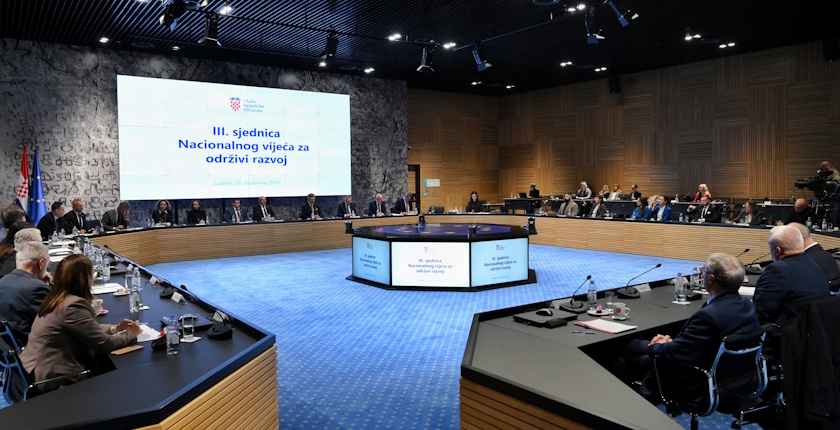
​While presenting the draft plan at a session of the National Council for Sustainable Development, Minister of Environmental Protection and Green Transition Marija Vučković said it identifies two groups: the energy poor or vulnerable, and transport poor or vulnerable.

“The plan provides for 10 measures, four of which relate to so-called stationary or energy poverty, and the remaining six to achieving affordable and favorable mobility and reducing the risk of transport poverty,” she explained.

According to the ministry, the plan provides for the renovation of 180 kilometers of bicycle paths, 80 kilometers of railway lines, as well as the procurement of 30 electric trains, 80 electric buses, and 3,000 electric cars.

Prime Minister Andrej Plenković stressed that the plan isn’t just a technical and administrative document, arguing that it determines what Croatia would become in ten, twenty, and fifty years.

“And we want a Croatia that is economically strong, socially just, and sovereign,” Plenković underlined.

by in News

Uncompetitiveness holding EU far behind green hydrogen targets

Several high-profile green hydrogen projects have been canceled in the past year, and major companies reduced their decarbonization ambitions, the European Union Agency for the Cooperation of Energy Regulators (ACER) said in its new report. The technology is four times more expensive than production from fossil gas through steam reforming.

Investments are far behind EU targets and trailing even the contracted demand. However, an acceleration of existing projects would change the picture substantially. On that note, the European Hydrogen Bank is receiving submissions for its third auction.

Electrolyser capacity in the EU jumped 51% last year to 308 MW, while 1.8 GW was under construction in October 2025, expected to be commissioned within two years. The numbers are from the European Hydrogen Markets – 2025 Monitoring Report, issued by the EU Agency for the Cooperation of Energy Regulators (ACER). It pointed out that the total falls well short of the trajectory toward the 2030 target of 40 GW, or the 48 GW to 54 GW range in member states’ plans.

Of note, while some other databases show similar figures, the Renewable Hydrogen Coalition has calculated that operational projects amount to 600 MW, though “across Europe,” and not just in the EU. Another 3 GW is under construction, its update reads.

The European Hydrogen Strategy aimed at 6 GW by 2024.

Sweden, Germany in strongest expansion

Sweden and Germany account for two thirds of the capacity under construction (742 MW and 414 MW, respectively), ACER said. In addition, EWE has just marked the start of construction of an electrolyzer facility of a whopping 320 MW, which would eclipse the fleet that is currently producing green or renewable hydrogen. The site is in Emden, in Germany.

Domestically produced renewable hydrogen contracted, 270,000 tons, would require 3.7 GW of electrolysers.

Several high-profile green hydrogen projects have been canceled in the past year, and major companies have reduced their decarbonization ambitions, the agency warned. Importantly, all existing projects, in any stage of development and with a 2030 target, are for 62 GW in total, indicating the potential for acceleration.

An electrolyzer under construction in Germany is set to surpass the combined capacity of the current EU fleet

As for Southeastern Europe, Romania targets 2.1 GW of electrolyzer capacity for 2030. Croatia is aiming for between 0.1 GW and 1.3 GW, while the remaining countries are at just 0.1 GW or 0.2 GW. Greece was the only country with any capacity in construction in October, 50 MW. Interconnections are planned between Greece, Bulgaria, Romania and Hungary.

Citing the European Hydrogen Observatory, ACER said Germany has added 46 MW last year. With Denmark (18 MW) and Hungary (11 MW), it was 72% of the annual growth.

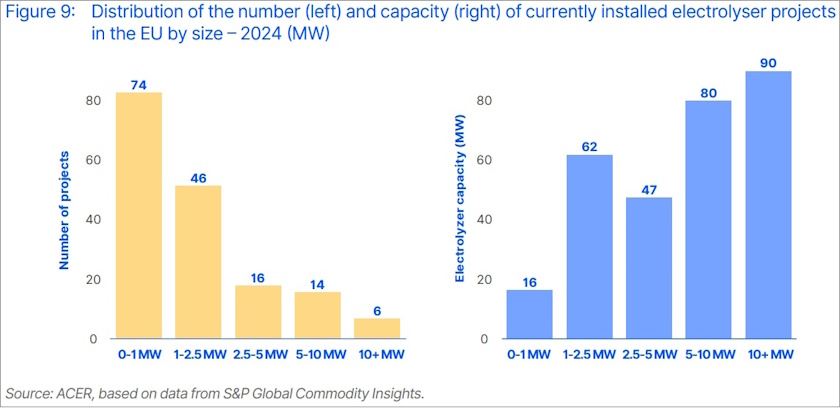
Only six plants were bigger than 10 MW at the end of 2024, amounting to 90 MW altogether.

ACER Uncompetitiveness holds EU far behind green hydrogen targets

Gray hydrogen remains dominant

Steam methane reforming (SMR) remains the dominant production technology, accounting for 89% of the total capacity in the EU. It is colloquially called gray hydrogen.

The share of electrolytic hydrogen, made using electricity from all sources, not necessarily renewables, is marginal. So is the overall capacity for blue hydrogen. It is also from fossil gas, but the process involves carbon capture and storage, CCS.

Green hydrogen, one of so-called renewable fuels of non-biological origin (RFNBO), costs some EUR 8 per kilogram, against just over EUR 2 per kilogram of conventional, gray hydrogen.

Expectations for liquefied natural gas (LNG) and carbon dioxide emission allowance price levels favor fossil fuel hydrogen in the short term, the report’s authors stressed. Meanwhile, slower deployment of electrolyzers limits economies of scale, delaying the anticipated reductions in related capital costs.

Projected prices of LNG and CO2 allowances are favoring fossil fuel hydrogen

With current production cost estimates at just below EUR 3 per kilo, low-carbon hydrogen with carbon capture is more competitive than renewable hydrogen. Nevertheless, the additional costs for CO2 transport and storage are highly uncertain.

“The buildout of CO2 infrastructure may pose additional challenges. Moreover, the long-term gas offtake contracts required for such projects could lock in fossil fuel dependence and exposure to price volatility in the global natural gas market,” the authors said.

By definition, low-carbon hydrogen results in at least 70% lower emissions than the conventional one from fossil fuels. The segment includes electrolysis running on nuclear power.

The EU also counts hydrogen from biogas and biomass processing as renewable, if the technology complies with sustainability requirements.

Electricity supply costs, excluding grid tariffs, may account for up to 50% of the levelized cost of renewable hydrogen, with substantial regional variations across the EU. Regions with abundant renewable resources and strong renewables integration, such as Spain, already provide advantageous conditions for renewable hydrogen production, the document adds.

Electricity accounts for 60% to 70% of renewable hydrogen cost

The Renewable Hydrogen Coalition said electrolyzer manufacturing capacity has surged from 1 GW within a few years. It expects it to hit 15 GW in 2026.

Electricity accounts for 60% to 70% of renewable hydrogen costs, with taxes and levies reaching 30% to 40% of the electricity cost itself, according to the group. It is also urging for incentives and an improvement in the legal framework.

“With the right enabling policies put in place, altogether, our coalition members could put online close to 18 GW of renewable hydrogen production projects between 2026 and 2032,” the declaration reads.

On that note, the European Hydrogen Bank has launched the call to its third auction for hydrogen production, worth EUR 1.3 billion. Spain is adding EUR 415 million, while Germany will match the EU with another EUR 1.3 billion within the auctions-as-a-service segment.

The IF25 Hydrogen Auction is designed to provide cost-efficient support for the production of RFNBO hydrogen or electrolytic low-carbon hydrogen. Producers of hydrogen with maritime or aviation offtakers can apply as well.

The call is part of a package under the Innovation Fund, using revenues from the EU Emissions Trading System (EU ETS). A EUR 2.9 billion segment for net-zero technologies, IF25 NZT, includes hydrogen production.

by in News

Serbia rolls out taxes on greenhouse gas emissions, imported carbon-intensive products

The Serbian Law on Greenhouse Gas Emissions Tax and Law on Carbon-Intensive Product Imports Tax, both at EUR 4 per ton of CO2 equivalent, are coming into effect on January 1. It is the country’s answer to and equivalent of, respectively, the European Union’s Carbon Border Adjustment Mechanism (CBAM). Notably, several bylaws are still required for the new legislation to be enforced.

The National Assembly of Serbia passed the Law on Greenhouse Gas Emissions Tax and Law on Carbon-Intensive Product Imports Tax today, without accepting any of the opposition’s proposals for changes in the two bills.

On January 1, importers of electricity, cement, iron and steel, aluminum, hydrogen and fertilizers to the European Union will start paying the CBAM carbon dioxide tax. If the country of origin also has a CO2 pricing system and the EU recognizes it, the sum will be deducted from CBAM.

The domestic greenhouse gas emissions tax is Serbia’s answer to the cross-border levy, while with the new import tax it is establishing a corresponding mechanism. Both are EUR 4 per ton of CO2 equivalent, covering also nitrous oxide (N2O) and perfluorocarbons (PFCs).

They are intended to lower pollution, improve energy efficiency, incentivize the deployment of renewable energy and secure a more equal position for the Serbian industry in the domestic and international markets, according to the sidenotes.

Both laws to enter into force on January 1, when EU also starts charging CBAM

The first of the two taxes is for big industrial emitters in the sectors of cement, fertilizers, iron and steel, aluminum and electricity. Both laws are coming into effect on January 1, just like the CBAM charge. However, several bylaws are still required for Serbia to enforce the new legislation.

The CBAM tax is envisaged to rise every year until in 2034 it becomes equal as the prices of greenhouse gas emission certificates in the EU’s Emissions Trading System (EU ETS). Electricity is different, as the amount will from the start correspond to the carbon intensity of the country of origin’s entire production mix.

According to Special Advisor at Serbia’s Economics Institute Ljubo Maćić, charging CBAM will prevent power market coupling between Serbia, other Energy Community contracting parties and the European Union, and discourage investment in renewables.

Of note, the administration in Brussels plans to expand the mechanism to other segments that EU ETS covers.

No electricity in carbon imports tax

The Law on Carbon-Intensive Product Imports Tax doesn’t cover electricity because of technical limitations and a lack of a precise taxing methodology.

The tax on imported carbon-intensive products covers only the entities that import five or more tons of the designated products per year

Importers are taxed based on emissions embedded in the production of the goods from abroad, but they will be able to use tax credits if an emissions levy has already been paid in the country of origin, similar to the EU system. The obligation is only for companies importing five or more tons of designated products per year.

Serbia imports an estimated 3.5 million tons of carbon-intensive products per year.

CO2 tax scope limited to larger producers

The CO2 tax law will be applied to firms obligated to have a license for emissions from their plants. Mostly they are large and medium-sized companies. Fifty companies have obtained such licenses for 92 facilities. They measure emissions data, in line with the Law on Climate Change, and send them to the Ministry of Environmental Protection.

The production of synthetic fertilizers and nitrogen compounds, cement, pig iron, steel and ferroalloys, aluminum and electricity accounts for over 57% of emissions in Serbia and more than 90% within the national monitoring and reporting system.

Tax deductions for large electricity producers that invest in decarbonization

A payer of the greenhouse emissions tax that predominantly generates electricity, accounting for at least 80% of its income in the previous annual tax period, is eligible for a tax credit amounting to 20% of the sum that it invested in decarbonization measures, the law stipulated.

The deduction can’t exceed 80% of the due tax. The government determines the said measures.

The greenhouse gas emissions tax envisages incentives for the taxpayers to finance green projects, the just transition and protection of vulnerable households

In addition, entities that pay the tax are eligible for incentives, from the state budget, for financing climate and energy transformation through investing in renewables and energy efficiency, innovative low-carbon technologies, decarbonization of industrial production, green construction and support to the just transition and protection of vulnerable households.

Proceeds from the tax “can be invested in green transition projects,” the sidenote reads, while there is still no dedicated decarbonization fund.

by in News

Quota surpassed at Romania’s bonus wind power auction

Romania apparently achieved moderately lower prices at its additional wind power auction for contracts for difference (CfDs) than in the regular round. According to a media report, nine bids were approved, for seven proposed facilities, and the winners include OX2, Qair and Zen Energy Group.

All wind farm projects in Romania that obtained the right to state support at the latest renewable electricity auction need to be completed by 2028. The Ministry of Energy and transmission system operator Transelectrica have approved 315.8 MW, compared to the targeted minimum of 290 MW, Economica.net learned.

The bonus round was organized because of a weak turnout in the regular, second wind power auction. Winners are eligible for 15-year CfDs, in a EUR 3 billion scheme covered via the European Union’s Modernisation Fund.

According to the report, the prices were also more favorable for the government than in the previous auction: between EUR 59.95 per MWh and EUR 74.9 per MWh, against EUR 65.17 per MWh to EUR 79.5 per MWh. The ceiling was the same, EUR 80 per MWh.

Cheapest two lots are part of same project

Naxxar Wind Energy Project Zenon won two lots, at 64.8 MW each, for the same project – Tudor Vladimirescu in Brăila county, northeast of Bucharest. The strike prices are EUR 59.95 per MWh and EUR 61.05 per MWh.

Owners of the special purpose vehicle are Renewable Investors and Kaizer Gerhard, an individual, both from Germany.

Aukera Project Company Beta has won a CfD contract for 27.2 MW in the proposed Făurei wind farm. The price is EUR 67.12 per MWh. It is owned by AtlasInvest, headquartered in Belgium.

In Romania, it is working on the projects for the Delesti wind farm in Vaslui county and the Gura Ialomiței storage facility in Ialomița. The battery would have 250 MW in operating power and a capacity of 500 MWh.

The first phase, of 300 MWh, is under construction. The company obtained a EUR 9.9 million grant last year through the National Recovery and Resilience Plan (NRRP or, in Romanian, PNRR) and signed a loan facility of EUR 60 million with Kommunalkredit Austria for the storage system.

OX2 wins CfDs for additional capacity for its future wind farms

Brăila Green Energy qualified for 12.4 MW of its Urleasca wind power project, at EUR 69.86 per MWh. The firm is controlled by OX2, which already won a CfD for a part of the same future facility.

The Sweden-based company also snatched 25.6 MW for its Cerchezu project. It is another winner from the previous round. This time, the South Wind subsidiary secured a contract at EUR 74.49 per MWh.

Clever Power has obtained 21 MW and 14 MW by bidding EUR 69.88 per MWh and EUR 72.92 per MWh, respectively. Both lots are for the same project: Falciu wind farm, envisaged to include storage. The company is controlled by Romanian investor Barbu Cristian, the article adds, citing a businesses registry.

AZ Market Construction won just 8 MW for its Bordei Verde wind project. It is eligible for EUR 74.74 per MWh. The firm is owned by France-based Qair.

Traian Energy, a subsidiary of Zen Energy Group from Luxembourg, is getting the highest price from the bonus round. The wind park would receive EUR 74.9 per MWh for the entire 78 MW.