by in News

D.Trading to offtake 200 MW of solar in PPA with Econergy in Romania

D.Trading, the pan-European trading arm of DTEK Group, signed a renewable electricity offtake deal for 200 MW of installed solar power capacity in Romania with renewable energy developer and operator Econergy. The power purchase agreement (PPA) includes the country’s largest photovoltaic plant.

D.Trading announced that it would purchase electricity from solar power plants Rătești and Părău in Romania. The deal for Econergy’s assets is for 200 MW. The PPA reflects growing market demand for structured renewable offtake products and marks an important milestone in the commercialisation of the two photovoltaic facilities, the announcement adds.

“Partnering with leading companies such as Econergy supports our long-term strategy of expanding renewable energy integration across the region. This agreement strengthens our green power portfolio and represents another step more towards becoming the leading provider of solutions for renewable assets and battery storage in Eastern Europe,” said Head of D.Trading Power Desk EU Stanislav Dudka.

The company operates in Central, Eastern, and Southeastern Europe. D.Trading is the pan-European trading arm of DTEK Group, which also owns DRI.

Econergy is planning to add a 120 MW battery energy storage system to its Rătești solar power plant

As Romania’s power market continues to evolve, shaped by price volatility, regulatory development, and the growing need for flexible solutions to support grid stability, Econergy has successfully executed multiple bankable commercial agreements, the update reads.

Rătești, Romania’s largest solar power plant, was completed in late 2023. The facility northwest of Bucharest, in Argeș county, has 155 MW in peak capacity. Econergy is planning to add a 120 MW battery energy storage system.

Părău was commissioned in late 2024. The PV plant of 92 MW is in Brașov county in the central part of Romania.

The Părău 2 project is for 342 MW, together with 150 MW of battery storage. It won a 15-year contract for difference (CfD) at the country’s first round of renewable energy auctions.
by in News

Electrica issues call for contractors for large PV parks in Romania

Romanian electricity supplier and distributor Electrica, in which the government holds almost 50%, published tenders via its subsidiaries for the second time for ready-to-build solar power projects. The peak capacities are 62.5 MW and 77.6 MW, and the second investment also involves battery storage. The company launched production in November at its Satu Mare 2 solar power plant, also known as Sunwind, of 27 MW.

Companies with the most advantageous offers from the technical and economic point of view will get the contracts for the construction of photovoltaic systems Satu Mare 3 and Bihor 1. Electrica, the investor, issued both calls a year ago, but canceled them in the meantime.

The Romanian Government owns 49.8% of the company, a power supplier and distributor, which also invests in renewables.

Electrica’s subsidiary New Trend Energy is responsible for the Satu Mare 3 project, of 62.5 MW in peak capacity. It is located in the commune of Doba in the Satu Mare county in the northwest. Inverters would enable the delivery of 57.9 MW to the grid.

The investment is estimated at RON 176.6 million (EUR 34.7 million) excluding value-added tax. Electrica expects to generate 70.2 MWh per annum. The deadline for applications is February 17.

BESS project is for 16.5 MWh in capacity and a 4 MW in operating power

Foton Power Energy, another subsidiary of Electrica, is seeking a contractor for a turnkey deal for Bihor 1. The PV plant would have 77.6 MW in peak capacity, and 77.4 MW in alternating current terms. It would consist of Trina’s bifacial solar panels of 595 W each.

The selected company will need to build a battery energy storage system as well, together with a transformer and fences, according to the document.

Both projects, with sites in northwestern Romania, have won subsidies from the Modernisation Fund

The BESS project is for 16.5 MWh in capacity and a 4 MW in operating power, earlier documents show. It would consist of eight Huawei units with a nominal size of 2.06 MWh each, the special purpose vehicle said. The project envisages the possibility of expansion of the battery storage facility to 75 MW and 150 MWh.

Total expected annual output amounts to 87.5 GWh. Foton Power Energy estimated the project at RON 220 million without VAT, which is EUR 43.2 million. Its site is in the communes of Cefa and Mădăraș in Bihor county, also in Romania’s northwest. Interested firms can submit bids by February 12.

Both Satu Mare 3 and Bihor 1 received state support via the European Union’s Modernisation Fund.

Electrica completed its third PV plant last month

In November, the company completed its Satu Mare 2 solar farm of 27 MW in peak capacity. The project firm is called Sunwind Energy. Electrica also operates PV plants Stănești and Vuturul with peak capacities at 7.5 MW and 12 MW, respectively.

The Crucea Est wind power project, worth eur 253 million, is for up to 138 MW and a BESS of 15 MW and 60 MWh.

In the report on the first nine months of 2025, Electrica wrote that it was developing four energy storage projects of 169.5 MWh altogether. In mid-October it initiated the procedures for 15 BESS facilities of 1 GWh in total.

Before that, in early September, the company signed a memorandum of understanding with Romgaz on the development of 400 MW in solar and storage. Electrica would be the main partner and the other company would hold a minority interest.

The projects are financed from a green bond issuance, which was the largest in Romania.

by in News

China completes grid connection of world’s largest open sea PV plant

CHN Energy declared a 1 GW solar power system that it built off the coast of China’s Shandong province, on the open sea, fully connected to the grid. The facility consists of steel truss platforms on bottom-fixed piles. Just in the past month, the state-owned company commissioned solar power plants of 600 MW and 425 MW, a coal power station of 4 GW and China’s largest gas power unit.

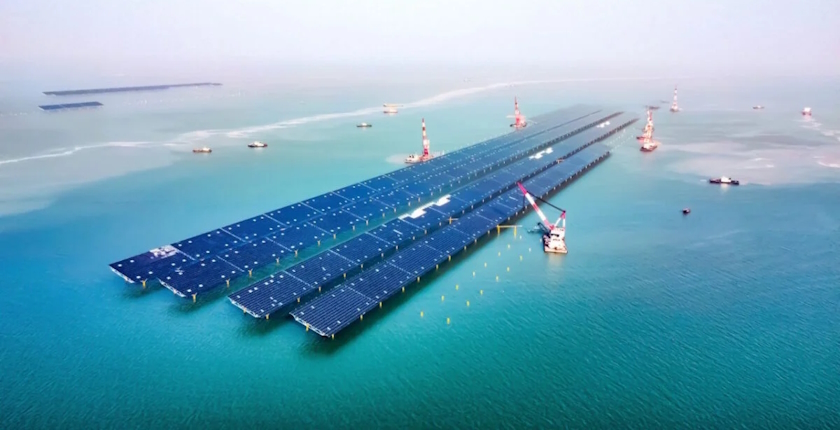
China continues to dominate the energy realm with the world’s largest projects and innovative design. The latest example, on the open sea, is eight kilometers from Kenli district in the city of Dongying in the country’s east. It is a giant solar power plant, but not a floating one.

The Shandong Dongying Kenli (Guohua HG14) facility is on steel truss platforms on bottom-fixed piles. China Energy Investment Corp., also known as CHN Energy, declared the photovoltaic system fully connected to the grid. The initial project of the state-owned enterprise was for 1 GW.

China State Construction Engineering Corp. (CSCEC) so far installed 930 platforms out of 2,934 planned. Each is on four piles, at water depth of one to four meters.

The project on the open sea off Shandong province spans 1,223 hectares. Its developer is CHN Energy’s subsidiary Guohua Energy Investment Co.

Project involves 100 MW in battery storage

According to the latest reports, Guohua HG14 consists of bifacial double-glass modules of 710 W and the annual output, when the facility is completed, is estimated at 1.78 TWh. In earlier updates, 2.37 million monocrystalline solar panels of 550 W each were planned, translating to 1.3 GW in peak capacity. Total investment was valued at CNY 8.1 billion (USD 1.16 billion).

The company reportedly switched to stronger, bifacial solar modules for the project offshore Dongying

The offshore solar power plant on the open sea is connected to the mainland grid with a 66 kV cable. Its first segment came online in November 2024. The project involves a battery energy storage system of 100 MW in capability and 200 MWh in capacity.

Giant solar plant comes online at altitude of 3,000 meters

Just in the past month, CHN Energy commissioned several landmark facilities. A new 600 MW solar power plant is in the Xinjiang province in the west, in Qitai county, near the border with Mongolia.

The company completed another PV system, of 425 MW, via Qinghai Gonghe Co. Part of a 1 GW project with storage, called Guoneng Canadian Solar Hainan, it is located in Gonghe county in Qinghai Province. It is at an altitude of 3,000 meters and above.

Just last week, CHN Energy put into operation the fourth and last 1 GW unit of its coal-fired Guangxi Beihai Power Plant. The complex in Guangxi province in southern China includes a 27.3 MW solar power plant for electric car chargers.

The utility has also launched regular production of the first of two units in its gas power plant Anji in Zhejiang province. It is the largest and most efficient in the country, CHN Energy pointed out. When the second unit comes online in early 2026, the power plant will have 1.69 GW in capacity.

by in News

Electrica issues call for contractors for large PV parks in Romania

Romanian electricity supplier and distributor Electrica, in which the government holds almost 50%, published tenders via its subsidiaries for the second time for ready-to-build solar power projects. The peak capacities are 62.5 MW and 77.6 MW, and the second investment also involves battery storage. The company launched production in November at its Satu Mare 2 solar power plant, also known as Sunwind, of 27 MW.

Companies with the most advantageous offers from the technical and economic point of view will get the contracts for the construction of photovoltaic systems Satu Mare 3 and Bihor 1. Electrica, the investor, issued both calls a year ago, but canceled them in the meantime.

The Romanian Government owns 49.8% of the company, a power supplier and distributor, which also invests in renewables.

Electrica’s subsidiary New Trend Energy is responsible for the Satu Mare 3 project, of 62.5 MW in peak capacity. It is located in the commune of Doba in the Satu Mare county in the northwest. Inverters would enable the delivery of 57.9 MW to the grid.

The investment is estimated at RON 176.6 million (EUR 34.7 million) excluding value-added tax. Electrica expects to generate 70.2 MWh per annum. The deadline for applications is February 17.

BESS project is for 16.5 MWh in capacity and a 4 MW in operating power

Foton Power Energy, another subsidiary of Electrica, is seeking a contractor for a turnkey deal for Bihor 1. The PV plant would have 77.6 MW in peak capacity, and 77.4 MW in alternating current terms. It would consist of Trina’s bifacial solar panels of 595 W each.

The selected company will need to build a battery energy storage system as well, together with a transformer and fences, according to the document.

Both projects, with sites in northwestern Romania, have won subsidies from the Modernisation Fund

The BESS project is for 16.5 MWh in capacity and a 4 MW in operating power, earlier documents show. It would consist of eight Huawei units with a nominal size of 2.06 MWh each, the special purpose vehicle said. The project envisages the possibility of expansion of the battery storage facility to 75 MW and 150 MWh.

Total expected annual output amounts to 87.5 GWh. Foton Power Energy estimated the project at RON 220 million without VAT, which is EUR 43.2 million. Its site is in the communes of Cefa and Mădăraș in Bihor county, also in Romania’s northwest. Interested firms can submit bids by February 12.

Both Satu Mare 3 and Bihor 1 received state support via the European Union’s Modernisation Fund.

Electrica completed its third PV plant last month

In November, the company completed its Satu Mare 2 solar farm of 27 MW in peak capacity. The project firm is called Sunwind Energy. Electrica also operates PV plants Stănești and Vuturul with peak capacities at 7.5 MW and 12 MW, respectively.

The Crucea Est wind power project, worth eur 253 million, is for up to 138 MW and a BESS of 15 MW and 60 MWh.

In the report on the first nine months of 2025, Electrica wrote that it was developing four energy storage projects of 169.5 MWh altogether. In mid-October it initiated the procedures for 15 BESS facilities of 1 GWh in total.

Before that, in early September, the company signed a memorandum of understanding with Romgaz on the development of 400 MW in solar and storage. Electrica would be the main partner and the other company would hold a minority interest.

The projects are financed from a green bond issuance, which was the largest in Romania.

by in News

China completes grid connection of world’s largest open sea PV plant

CHN Energy declared a 1 GW solar power system that it built off the coast of China’s Shandong province, on the open sea, fully connected to the grid. The facility consists of steel truss platforms on bottom-fixed piles. Just in the past month, the state-owned company commissioned solar power plants of 600 MW and 425 MW, a coal power station of 4 GW and China’s largest gas power unit.

China continues to dominate the energy realm with the world’s largest projects and innovative design. The latest example, on the open sea, is eight kilometers from Kenli district in the city of Dongying in the country’s east. It is a giant solar power plant, but not a floating one.

The Shandong Dongying Kenli (Guohua HG14) facility is on steel truss platforms on bottom-fixed piles. China Energy Investment Corp., also known as CHN Energy, declared the photovoltaic system fully connected to the grid. The initial project of the state-owned enterprise was for 1 GW.

China State Construction Engineering Corp. (CSCEC) so far installed 930 platforms out of 2,934 planned. Each is on four piles, at water depth of one to four meters.

The project on the open sea off Shandong province spans 1,223 hectares. Its developer is CHN Energy’s subsidiary Guohua Energy Investment Co.

Project involves 100 MW in battery storage

According to the latest reports, Guohua HG14 consists of bifacial double-glass modules of 710 W and the annual output, when the facility is completed, is estimated at 1.78 TWh. In earlier updates, 2.37 million monocrystalline solar panels of 550 W each were planned, translating to 1.3 GW in peak capacity. Total investment was valued at CNY 8.1 billion (USD 1.16 billion).

The company reportedly switched to stronger, bifacial solar modules for the project offshore Dongying

The offshore solar power plant on the open sea is connected to the mainland grid with a 66 kV cable. Its first segment came online in November 2024. The project involves a battery energy storage system of 100 MW in capability and 200 MWh in capacity.

Giant solar plant comes online at altitude of 3,000 meters

Just in the past month, CHN Energy commissioned several landmark facilities. A new 600 MW solar power plant is in the Xinjiang province in the west, in Qitai county, near the border with Mongolia.

The company completed another PV system, of 425 MW, via Qinghai Gonghe Co. Part of a 1 GW project with storage, called Guoneng Canadian Solar Hainan, it is located in Gonghe county in Qinghai Province. It is at an altitude of 3,000 meters and above.

Just last week, CHN Energy put into operation the fourth and last 1 GW unit of its coal-fired Guangxi Beihai Power Plant. The complex in Guangxi province in southern China includes a 27.3 MW solar power plant for electric car chargers.

The utility has also launched regular production of the first of two units in its gas power plant Anji in Zhejiang province. It is the largest and most efficient in the country, CHN Energy pointed out. When the second unit comes online in early 2026, the power plant will have 1.69 GW in capacity.

by in News

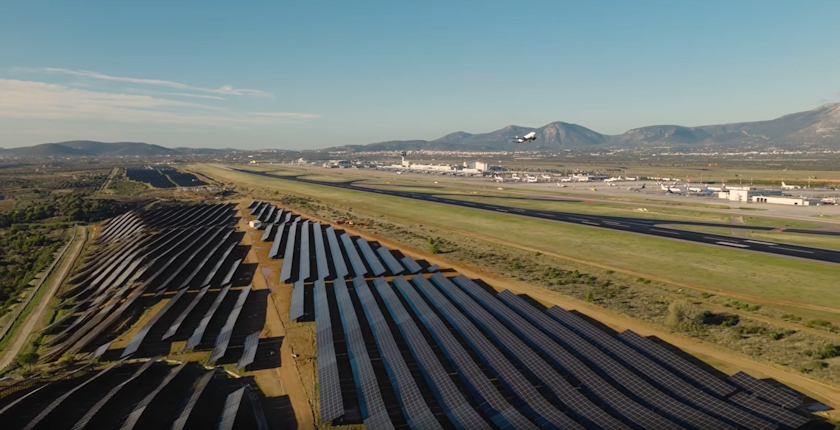
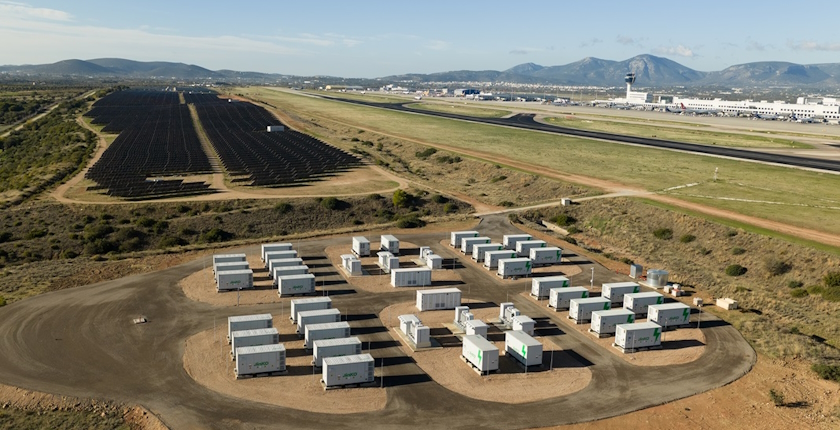
Athens International Airport builds biggest photovoltaic-BESS plant

Athens International Airport (AIA) Eleftherios Venizelos completed its comprehensive energy makeover program. It is now operating a photovoltaic facility of 51.5 MW and a battery energy storage system of 82 MWh. It is the largest hybrid power plant of its kind within the premises of any airport in Europe and, reportedly, even the entire world.

At the same time, the Bucharest Henri Coandă International Airport is about to build 12.6 MW in peak PV capacity and a BESS of 17.9 MWh, in the first phase of a larger project.

Following European and global trends, airports in Southeastern Europe are introducing resource, waste and wastewater management systems. Energy is the largest segment of the decarbonization push. With the completion of its Route 2025 program, Athens International Airport Eleftherios Venizelos covered all its electricity needs with photovoltaics, becoming the only such airport in Europe.

In the groundbreaking project, the operator extended the existing solar power plant by 35.5 MW in peak capacity, reaching 51.5 MW, and added a battery energy storage system. The facility has 124 MWh in nominal capacity, of which 82 MWh is usable.

The hybrid system is the largest of its kind inside the fence of any airport in Europe, while the Greek press has even called it the largest in the world. Some of the world’s largest airports are set to follow soon. For instance, IGA Istanbul Airport is investing EUR 212 million in an external solar power plant of 199.3 MW, in Eskişehir.

Athens International Airport builds biggest photovoltaic BESS plant
Photo: Athens International Airport

Hybrid power plant to keep Athens International Airport at net zero through 2046

AIA’s PV-BESS plant will generate an estimated 88 GWh per year, which is equivalent to the consumption of 22,000 households. The storage system is only for self-consumption. Importantly, the hybrid system can cover the entire planned expansion up to 2046, when the concession period ends.

AviAlliance, which controls 50.2% of the public-private partnership, is a wholly-owned subsidiary of Public Sector Pension Investment Board (PSP Investments) from Canada. The government holds 25.6% through Superfund, officially Growthfund – The National Fund of Greece.

AIA launched Route 2025 six years ago, with the aim to cut net greenhouse gas emissions to zero by the end of this year. It compares to the 2050 net zero goal of the European airports sector.

The Route 2025 program was worth EUR 70 million

The investments totaled EUR 70 million. A significant portion was financed through loans from the European Union’s Recovery and Resilience Facility (RRF), the update adds.

Heat pumps have eliminated the need for natural gas in buildings at AIA in normal winter conditions. The electric vehicle fleet consists of 19 buses, 13 follow-me vehicles and 29 vans. A network of chargers also serves passenger cars.

“In the airport company, we operate on the basis of the principle that sustainability, and environmental responsibility in particular, are and will increasingly be prerequisites for what we call the social license to operate and grow,” said outgoing Managing Director of AIA Yiannis Paraschis.

Two airports in Romania receive EU funds for solar-BESS projects

As for other recent developments in the Balkans, operators of two airports in Romania received grants via the European Union’s Modernisation Fund for solar power plants with battery storage.

National Company Bucharest Airports (CNAB) signed a contract for RON 132.04 million (EUR 25.9 million) excluding value-added tax. It is for 12.6 MW in peak PV capacity and a BESS of 17.9 MWh at the Bucharest Henri Coandă International Airport in Otopeni.

The entire investment amounts to RON 176.9 million (EUR 34.7 million) excluding VAT. The Romanian state-owned company said it is the first phase of a project for 31.5 MW and 30 MWh overall, valued at EUR 55.7 million.

Bacău International Airport George Enescu will build a solar power plant of 1.25 MW and a BESS of 2.06 MWh. Bacău County Council will also provide support for the on-site project on 2.2 hectares, worth more than EUR 4.9 million.

by in News

Athens International Airport builds biggest photovoltaic-BESS plant

Athens International Airport (AIA) Eleftherios Venizelos completed its comprehensive energy makeover program. It is now operating a photovoltaic facility of 51.5 MW and a battery energy storage system of 82 MWh. It is the largest hybrid power plant of its kind within the premises of any airport in Europe and, reportedly, even the entire world.

At the same time, the Bucharest Henri Coandă International Airport is about to build 12.6 MW in peak PV capacity and a BESS of 17.9 MWh, in the first phase of a larger project.

Following European and global trends, airports in Southeastern Europe are introducing resource, waste and wastewater management systems. Energy is the largest segment of the decarbonization push. With the completion of its Route 2025 program, Athens International Airport Eleftherios Venizelos covered all its electricity needs with photovoltaics, becoming the only such airport in Europe.

In the groundbreaking project, the operator extended the existing solar power plant by 35.5 MW in peak capacity, reaching 51.5 MW, and added a battery energy storage system. The facility has 124 MWh in nominal capacity, of which 82 MWh is usable.

The hybrid system is the largest of its kind inside the fence of any airport in Europe, while the Greek press has even called it the largest in the world. Some of the world’s largest airports are set to follow soon. For instance, IGA Istanbul Airport is investing EUR 212 million in an external solar power plant of 199.3 MW, in Eskişehir.

Athens International Airport builds biggest photovoltaic BESS plant
Photo: Athens International Airport

Hybrid power plant to keep Athens International Airport at net zero through 2046

AIA’s PV-BESS plant will generate an estimated 88 GWh per year, which is equivalent to the consumption of 22,000 households. The storage system is only for self-consumption. Importantly, the hybrid system can cover the entire planned expansion up to 2046, when the concession period ends.

AviAlliance, which controls 50.2% of the public-private partnership, is a wholly-owned subsidiary of Public Sector Pension Investment Board (PSP Investments) from Canada. The government holds 25.6% through Superfund, officially Growthfund – The National Fund of Greece.

AIA launched Route 2025 six years ago, with the aim to cut net greenhouse gas emissions to zero by the end of this year. It compares to the 2050 net zero goal of the European airports sector.

The Route 2025 program was worth EUR 70 million

The investments totaled EUR 70 million. A significant portion was financed through loans from the European Union’s Recovery and Resilience Facility (RRF), the update adds.

Heat pumps have eliminated the need for natural gas in buildings at AIA in normal winter conditions. The electric vehicle fleet consists of 19 buses, 13 follow-me vehicles and 29 vans. A network of chargers also serves passenger cars.

“In the airport company, we operate on the basis of the principle that sustainability, and environmental responsibility in particular, are and will increasingly be prerequisites for what we call the social license to operate and grow,” said outgoing Managing Director of AIA Yiannis Paraschis.

Two airports in Romania receive EU funds for solar-BESS projects

As for other recent developments in the Balkans, operators of two airports in Romania received grants via the European Union’s Modernisation Fund for solar power plants with battery storage.

National Company Bucharest Airports (CNAB) signed a contract for RON 132.04 million (EUR 25.9 million) excluding value-added tax. It is for 12.6 MW in peak PV capacity and a BESS of 17.9 MWh at the Bucharest Henri Coandă International Airport in Otopeni.

The entire investment amounts to RON 176.9 million (EUR 34.7 million) excluding VAT. The Romanian state-owned company said it is the first phase of a project for 31.5 MW and 30 MWh overall, valued at EUR 55.7 million.

Bacău International Airport George Enescu will build a solar power plant of 1.25 MW and a BESS of 2.06 MWh. Bacău County Council will also provide support for the on-site project on 2.2 hectares, worth more than EUR 4.9 million.

by in News

TotalEnergies sells half of 424 MW portfolio in Greece

Paris-based TotalEnergies agreed to divest of 50% of its 424 MW wind and solar portfolio in Greece. The sale to investment management firm Asterion Industrial Partners, part of a global savings strategy, values the assets at EUR 508 million.

Multinational energy giant TotalEnergies is proceeding with a plan from last year to raise cash through renewables divestment. The company said it closed the sale of 50% of its 424 MW renewables portfolio in Greece to Asterion Industrial Partners, headquartered in Spain.

The world’s biggest fossil fuel producers have been stepping back from a major green energy push, partly pressured by the weakening of oil prices over the past year and a half. In addition, TotalEnergies has doubled its debt in the first half of this year, to USD 26 billion, after several large acquisitions.

It prompted the launch of a savings strategy involving capital and operational expenditure and share buybacks. TotalEnergies said in September that it was selling 50% of its 1.4 GW photovoltaics portfolio in the United States to KKR for USD 950 million.

TotalEnergies earlier agreed to sell 50% of its PV portfolio in the US of 1.4 GW to KKR

The transaction in Greece, which concerns wind and solar power assets, values them at EUR 508 million combined, or EUR 1.2 million per MW.

The French company clarified that it retained a 50% stake and remained the operator of the power plants. It said it intends to offtake and market most of the electricity when their regulated tariffs expire.

“TotalEnergies is building a competitive portfolio that combines renewables (solar, onshore wind, offshore wind) and flexible assets (CCGT, storage) to deliver clean firm power to its customers. To achieve its profitability objectives and share risks, TotalEnergies divests up to 50% of its interests in renewable assets, enabling the company to maximize the value of its portfolio,” the announcement reads.

Founded in 2018, Asterion Industrial Partners is an independent investment management firm focused on European infrastructure in the mid-market. With USD 10 billion under management, it invests in essential infrastructure across the energy, digital, utilities and mobility sectors.

by in News

OMV Petrom, CE Oltenia building solar parks of 550 MW in total

Coal land of Romanian state-owned CE Oltenia is undergoing transformation with the beginning of construction of four photovoltaic plants. The projects, which the company is conducting with OMV Petrom, are for 550 MW in combined capacity. In a separate partnership, with Tinmar Energy, 280 MW more is in development.

Almost four years after the European Union approved the grants from the Modernisation Fund and the start of negotiations between Complexul Energetic Oltenia (CE Oltenia) and OMV Petrom about a partnership, their four solar power projects of 550 MW in total peak capacity reached the construction phase. They would cover the equivalent of an estimated 410,000 Romanian households’ annual consumption, the update adds.

The largest integrated energy company in Southeastern Europe and Romania’s main coal power producer are building the photovoltaic systems in Ișalnița, Tismana, and Rovinari in the coal region in the counties of Dolj and Gorj. CE Oltenia and OMV Petrom expect the facilities to become operational next year.

OMV Petrom, CE Oltenia partnership receives first tranche of EU funding

Total investment is over EUR 400 million, with 70% financed through the Modernisation Fund. There are four joint ventures, in which the partners hold 50% each. Just this month, they received the first EUR 16 million, the announcement reveals.

The locations are on CE Oltenia’s coal land. They are aimed at partly substituting the power plants there, as Romania is heading for a coal exit by 2032.

“Through these projects, OMV Petrom reaffirms its commitment to a low-carbon energy future, contributing to Romania’s and the EU’s climate objectives. We are transforming a region with a long-standing tradition in coal-based energy into a renewable energy hub,” said Franck Neel, member of OMV Petrom’s Executive Board responsible for Gas and Power.

Ameresco and Sunel won three contracts together, and Turkey-based Girişim is in charge of the fourth one

Following tenders, contractors for the design and execution were picked in April. The consortium of United States–based Ameresco and Sunel is tasked with the projects Rovinari Est, Tismana 1, and Tismana 2. The latter company is registered in the United Kingdom, but its operational headquarters are in Athens, Greece. The capacity amounts to 460 MW.

Turkish company Girişim Elektrik is in charge of the fourth endeavor. The site is a slag deposit at the CE Ișalnița coal-fired power plant. Per earlier documentation, the contractors will operate the solar power systems for three years and transfer them to the owners.

Coal miners becoming PV installers

OMV Petrom said it is supporting the RenewAcad program in the nearby city of Târgu Jiu, where CE Oltenia is seated.

In the past two years, over 200 mining technicians have been retrained as photovoltaic system installers. The initiative is part of a broader effort. It involved training over 10,000 professionals for Romania’s energy transition, the company added.

Another 280 MW of solar power is in pipeline

CE Oltenia, also known as CEO, runs another four PV projects totaling 280 MW in planned peak capacity with its partner Tinmar Energy. They received 13 bids and the procedure is ongoing.

The partnership model is the same, and so is the share of investment that the Modernisation Fund covers. The locations are slag and ash deposits at coal plants Rovinari and Turceni, and external dumps Pinoasa and Bohorelu.

The fifth partnership between CE Oltenia and Tinmar is for a CCGT (combined-cycle gas turbine) power plant of 475 MW in Turceni. It is suffering heavy delays. The Modernisation Fund has approved a grant for 50% of the investment.

by in News

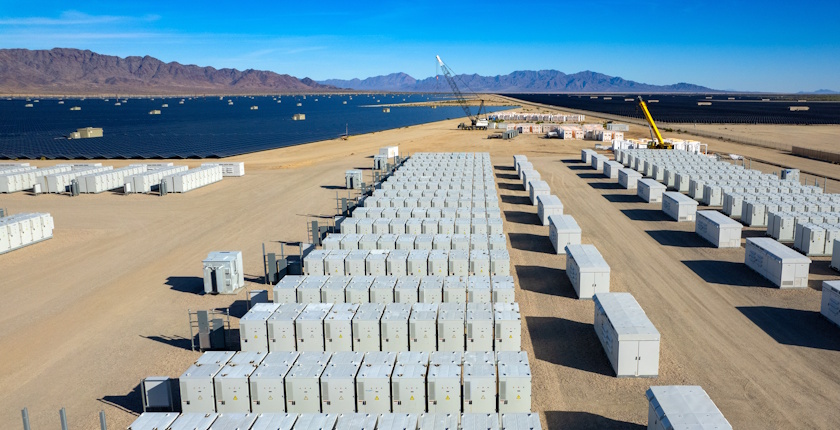
Solar power has become dispatchable anytime at low cost

Turning cheap daytime solar electricity into a dispatchable profile results in a total electricity cost of USD 76/MWh, according to the latest analysis by Ember.

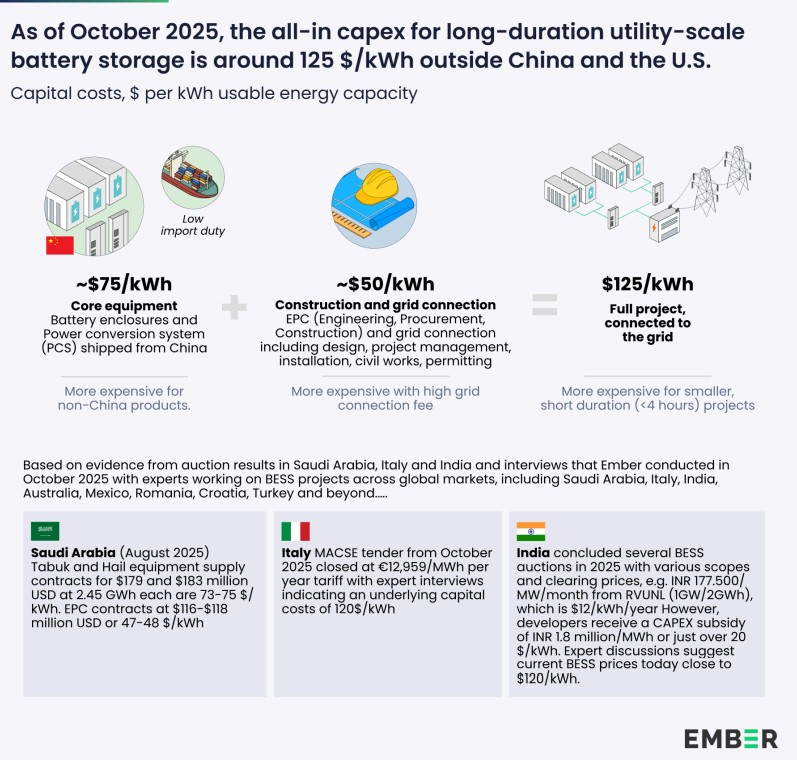
Ember’s assessment of storage costs is based on recent auctions in Italy, Saudi Arabia and India and on expert interviews.

Across global markets outside China and the United States, the total capex to build a long-duration (four hours or more) utility-scale battery energy storage system (BESS) project is around USD 125/kWh, the study reads.

The price combines USD 75/kWh for the core equipment shipped from China and USD 50/kWh to install and connect the battery.

world ember bess energy storage cost capex

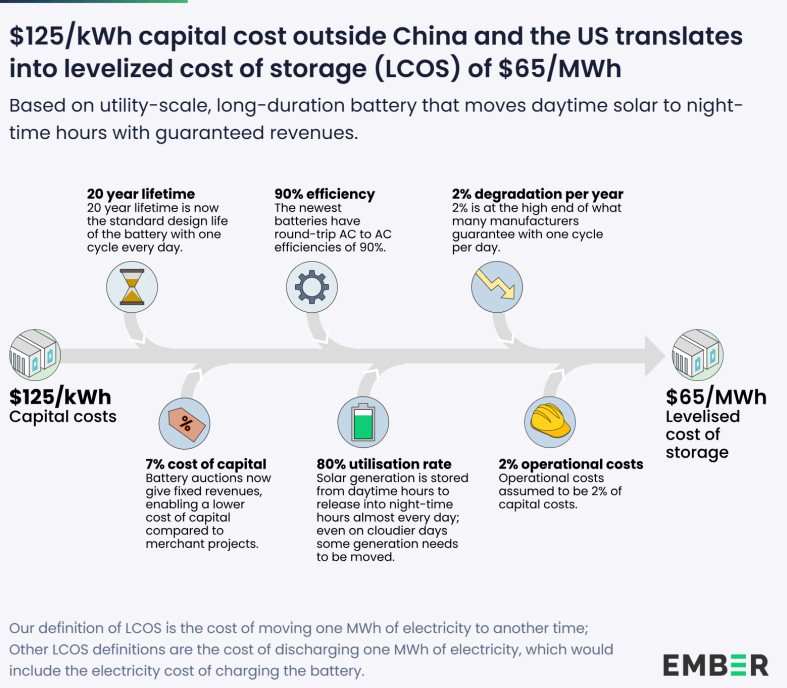
The authors of the analysis calculated a levelized cost of storage (LCOS) to be USD 65/MWh.

The metric reflects the cost of shifting one megawatt-hour to another time, such as moving daytime solar to nighttime. It doesn’t include the cost of electricity to charge the battery.

This low LCOS is not only the result of cheaper batteries, given that longer lifetimes, higher efficiencies and lower financing costs thanks to clearer revenue models like auctions have all helped to push the indicator down sharply, according to the analysis.

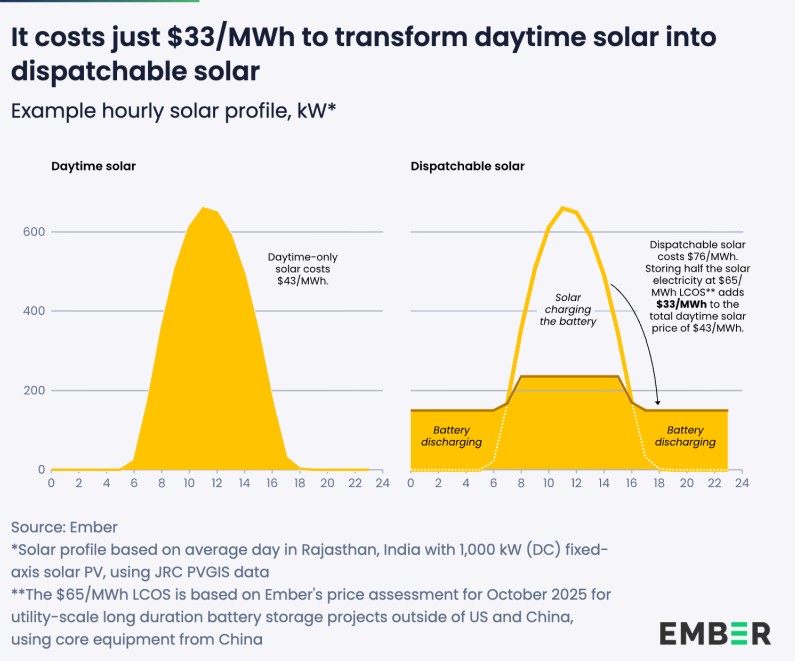
With the cost of storing electricity at USD 65/MWh, storing 50% of a day’s solar generation for consumption in nighttime hours adds USD 33/MWh to the total cost of solar. The authors used IRENA’s global average price of solar in 2024 of USD 43/MWh.

Delivering constant power every hour of the year requires solar overbuild and more battery storage

Turning this cheap daytime electricity into a dispatchable profile that is closer to an actual demand profile, would therefore result in a total electricity cost of USD 76/MWh, the analysis reads.

The authors stressed that this isn’t the same as baseload solar. Delivering constant power every hour of the year, including cloudy weeks and seasonal lows, requires solar overbuild and more battery storage, they added.

However, shifting half of daytime solar is a major step that aligns solar generation more closely with a typical demand profile, meaning solar can meet a much larger share of the evening and nighttime demand, the authors explained.

world ember bess energy storage cost lcos

Kostantsa Rangelova, ‍Global Electricity Analyst at Ember, pointed out that after a 40% fall in 2024 in battery equipment costs, another major drop is clearly on track in 2025.

“The economics for batteries are unrecognizable, and the industry is only just getting to grips with this new paradigm. Solar is no longer just cheap daytime electricity, solar is now anytime dispatchable electricity. This is a game-changer for countries with fast-growing demand and strong solar resources,” she is convinced.

Cheap batteries will enable solar to meet the majority of global energy growth

world ember bess energy storage cost lcos dispatchable solar

The analysis cited a projection from the IEA’s latest World Energy Outlook that in the next decade, 80% of global energy demand growth would come from regions with high-quality solar irradiation.

For these countries, combining solar with storage is now the most affordable path to meet soaring demand, improve energy security and reduce dependence on fossil fuel imports, according to the analysis.

It is an opportunity to develop clean industries

Dispatchable solar with a price of USD 76/MWh is cheaper and quicker than building a new gas power plant, especially if the country relies on more expensive LNG imports, they stressed.

The authors also pointed out that the installation of BESS could help the development of clean industries.

Even when core BESS equipment is imported, roughly 40% of total project value (about USD 50/kWh out of USD 125/kWh) remains local through engineering, civil works, grid connection and other EPC activities, the analysis reads.