by in News

Turkey launches solar, wind power auctions with November deadlines

The Ministry of Energy and Natural Resources of Turkey issued a public call for solar and wind power auctions for 2 GW in total. It will receive the applications on November 4 and November 18, respectively. One competitive bidding process is for a floating solar power project of 35 MW.

Following the successful auctions for renewable energy projects that were completed early this year, Turkey kicked off another round. It is also for 2 GW of overall connection capacity, in light of the country’s ambition to grow its combined solar and wind power capacity to 120 GW by 2035. The two technologies reached 37.1 GW together a month ago, out of 120.2 GW in total.

Auctions are held under the Renewable Energy Zones (REZ) state support mechanism. The scheme is better known by its Turkish acronym YEKA.

Ten solar power areas in eight provinces

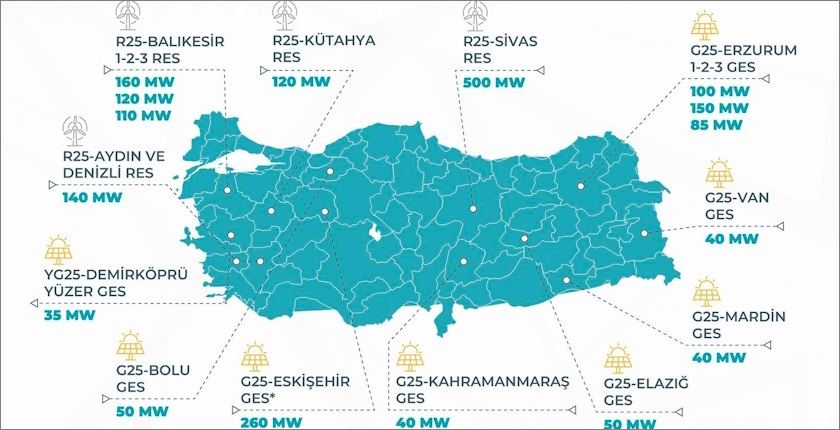
The upcoming solar energy auctions, REZ SPP 2025 (YEKA GES 2025), are for 850 MW altogether. There are ten areas in eight provinces designated for bidding: Kahramanmaraş, Mardin and Van, with 40 MW each, Bolu and Elazığ (50 MW each), Erzurum 1-3 (100 MW, 150 MW and 85 MW), Eskişehir (260 MW) and Demirköprü in Manisa province, with 35 MW.

The upcoming solar power auctions will include Turkey’s first bidding for a floating photovoltaic plant

Notably, the last one is for a planned floating solar power plant on the reservoir of the Demirköprü hydropower plant. The facility on the Gediz river, east of Izmir, is owned by state-owned Electricity Generation Corp. (EÜAŞ). Turkey now hosts only two small floating photovoltaic units, and the auction will be the first of its kind.

Applications will be received on November 4, the ministry said and added it would subsequently publish a schedule for bidding.

Wind power capacity quota is 1.15 GW

Participants can apply on November 18 for the wind energy round of auctions, REZ WPP 2025 (YEKA RES 2025). It is for an overall 1.15 GW in six areas.

Investors will compete for 500 MW in Sivas province, a 140 MW project in Aydın and Denizli, 120 MW in Kütahya and three areas in Balıkesir – 160 MW, 120 MW and 110 MW.

Winners to submit guarantees of EUR 75,000 per MW for PV projects, EUR 100,000 per MW for wind

Potential bidders will pay a fee of EUR 1,550 for each auction they apply for. They must submit letters of guarantee lasting one year and worth EUR 15,000 per MW for photovoltaics and EUR 20,000 per MW for wind power. Winners will submit 10-year guarantees before signing their contracts: EUR 75,000 per MW and EUR 100,000 per MW, respectively.

The ceiling or starting price is EUR 55 per MWh and the floor prices are EUR 32.5 per MWh for solar power and EUR 35 per MWh for wind. If bids hit the floor, another auction will be held between the competitors, like in the previous round. It is for a so-called contribution share that they are ready to pay. The minimum is EUR 10,000 per MW of planned capacity and the highest bid wins.

Successful participants can sell electricity on the free market for five years in the case of solar power plants, while the period lasts six years for wind. After that, both categories enter a 20-year scheme with a guaranteed price.

Turkey tops 120 GW in total electricity capacity

At the end of July, electricity capacity in Turkey totaled 120.2 GW, the ministry revealed. Hydropower accounted for 26.9% or 32.3 GW, compared to 23.4 GW in photovoltaics (19.5%) and 13.7 GW of wind power, translating to 11.4%.

The share of biofuel and waste was 1.9%, with 2.34 GW, and geothermal power plants had 1.73 GW altogether, which is 1.4%. Gas power plants in Turkey had 24.7 GW in combined capacity (20.6%). The remainder is coal: 21.9 GW or 18.3%.
by in News

Montenegro’s power utility gets EUR 25 million loan to expand Gvozd wind farm

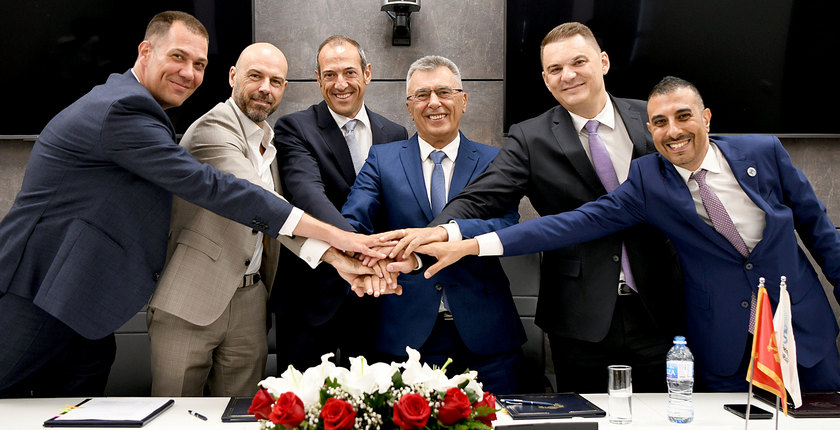
Montenegrin state-owned power utility Elektroprivreda Crne Gore (EPCG) said it signed a EUR 25 million loan contract with the European Bank for Reconstruction and Development (EBRD) for expanding the Gvozd wind farm to 75.6 MW. Once fully operational, it will be the largest wind farm in Montenegro.

The Gvozd 2 project involves the installation of three additional wind turbines, with a combined capacity of 21 MW. It will increase the wind farm’s total projected annual production to over 210 GWh, enough to cover the needs of about 36,000 households and reduce CO2 emissions by almost 137,000 tons a year, EPCG said following the signing of the loan agreement.

The expansion project involves three additional wind turbines with a combined capacity of 21 MW

An EUR 82 million loan for the first, 54.6 MW phase of the wind farm, including the grid connection infrastructure, was signed with the EBRD in June 2023. Gvozd will be EPCG’s first large-scale power generation facility built in more than 40 years.

Construction on the first phase, featuring eight turbines, began in November 2024. EPCG expects the power plant to enter trial operation by the end of this year, with a projected annual electricity output of 150 GWh.

Construction on the first, 54.6 MW phase of wind farm Gvozd was launched in late 2024

Commissioning of the full 75 MW capacity is expected by the end of 2026, according to a press release from the EBRD.

A key step in Montenegro’s energy transition

Milutin Đukanović, President of EPCG’s Board of Directors, described the expansion of Gvozd as a key step in Montenegro’s energy transition. In the press release, EPCG stated that the wind park would significantly contribute to achieving the European goal to produce electricity exclusively from clean sources by 2050 at the latest.

Minister of Energy and Mining Admir Šahmanović noted that the Gvozd project would strengthen Montenegro’s energy security, reduce CO2 emissions, and pave the way for sustainable development.

Francesco Corbo, the EBRD’s Regional Head of Energy for the Western Balkans and Croatia, recalled that the bank, through its Renewable Energy Market Accelerator (REMA) program, helped the Montenegrin authorities organize the country’s first renewable energy auction, for solar projects totaling 250 MW.

by in News

Šahmanović: Montenegro expects first large private wind and solar plants to be online in 2026

Over the past year, Montenegro has adopted two reform laws – on energy and on renewable energy sources – and scheduled its first auctions for market premiums. Admir Šahmanović, Minister of Energy and Mining, told Balkan Green Energy News that the new regulations fully align the sector with the European Union acquis, sending a clear signal to investors that Montenegro now has a stable regulatory framework and market-based prices that safeguard citizens’ interests. Becoming part of the European energy space, he added, is not only a political goal but also the path Montenegro should follow to ensure cleaner and more secure energy for future generations.

Admir Šahmanović served as Minister of Mining, Oil and Gas in the government of Prime Minister Milojko Spajić. In February this year, he became the coordinator of the Ministry of Energy, and since April, he has served as Montenegro’s Minister of Energy and Mining. In an interview with Balkan Green Energy News, Šahmanović discusses his plans to mobilize larger investments, Montenegro’s timeframe for coupling its electricity market with Italy and the EU, the ministry’s steps to prepare the country for the EU’s carbon border tax, and plans for investments in the natural gas sector.

What are the key innovations introduced by Montenegro’s law on renewable energy sources?

The law on renewable energy sources introduced, for the first time, a clear, competitive and fully transparent support mechanism for green energy production – an auction scheme.

Over the past months, we have worked hard to ensure the law really takes hold. We have prepared about 15 by-laws that enabled us to launch the first auctions. I believe this is one of the most important contributions of the new law, as it sends a clear message to investors that Montenegro has a stable framework and market-based prices that safeguard citizens’ interests.

In this way, we are laying a solid foundation for a rapid energy transition, which is both our strategic choice and our responsibility to future generations.

Montenegro has also adopted a new law on energy. What does this regulation bring?

The Law on Energy is our umbrella regulation, providing a framework that fully aligns the sector with the EU acquis. It introduces stricter standards, greater protection of end consumers, better competition, and stronger institutional oversight.

It also opens Montenegro’s energy sector to the European market and creates a stable, predictable environment. This is important not only for investors but also for all consumers, as people are ultimately the ones affected by any change in the system.

You stated that these reforms set a clear strategic path for Montenegro, which sees its energy future within the European market. What will this future bring to Montenegro, its economy, and its citizens?

Our ambition is to make Montenegro a country with clean energy and a stable system. Being part of the European energy space ensures greater security of supply, lower costs in the long term, and a strong inflow of investments. Our economy will have access to a larger market, and our citizens will benefit from safe, sustainable, and environmentally friendly energy.

It is not just a political goal – it is a path I want us to follow in our development, so that we leave our children a country with cleaner and more secure energy.

Admir Šahmanović visiting northern Montenegro with EPCG Director Ivan Bulatović

Applications have been invited for Montenegro’s first auctions for market premiums. What benefits do you expect from auctions?

The auction mechanism allows us to select the most favorable and serious investors through a fair and competitive process. Projects are implemented without budget subsidies and with minimal risk to the state.

We expect auctions to ensure new capacities, create jobs, improve the use of our natural resources, and strengthen overall energy stability. These are the benefits citizens will feel, both on their electricity bills and through new opportunities that will open up in local communities.

Investor interest in wind and solar is strong, with requests to build power plants totaling around 5.5 GW. When do you expect these projects to be realized?

Such strong interest is the best proof that the reforms are yielding results. We expect the first large projects to be online in 2026, with significant capacities ready by 2030. Transparent procedures, good cooperation with local communities, and improved grid infrastructure will be key to making these investments a reality.

What are the main obstacles to these projects? How to remove them?

The biggest challenges are administrative procedures, transmission network limitations, and spatial planning documents. We are working to address them through interdepartmental cooperation, digitalization of processes, and the state’s commitment.

We are strengthening capacities, speeding up permitting, and modernizing regulations. I want to ensure that investors coming to Montenegro know they can work in a clear, predictable, and fair environment.

Admir Šahmanović at the ministerial panel at Belgrade Energy Forum 2025 in May

Preparations are underway to link Montenegro’s electricity market with the EU via Italy, with 2027 featuring as the target year.

Yes, we are working diligently on institutional and market integration. This involves harmonizing the rules, passing the remaining by-laws, and preparing the market operator. With the support of the EU and the Energy Community, I am confident that 2027 will remain the year when we will fully open our market to Europe.

All countries in the region are facing CBAM. How prepared is Montenegro?

CBAM will change the rules for electricity exports to the EU, bringing new costs as well as opportunities. We are aware that it will be a financial burden on our economy, but that is precisely why we view it as an additional incentive to accelerate the implementation of renewable energy projects and increase our own production of green electricity.

We are working on adjusting the regulatory framework, harmonizing economic activities, and ensuring the largest possible share of clean energy to remain competitive and maintain full access to the European market while reducing emissions.

Montenegro also has ambitious plans in the natural gas sector – a gas pipeline, a terminal for liquefied natural gas (LNG), and gas-fired power plants. How far along are these projects?

I see gas as a development opportunity – to ensure greater security of supply, diversification, and new opportunities for the economy. But I also believe that such strategic projects must be developed through dialogue with local communities, with full respect for their views.

We are currently preparing and developing the Ionian Adriatic Pipeline (IAP) project and assessing the potential for an LNG terminal. We are doing this responsibly, one step at a time, and in line with the EU’s energy transition goals.

by in News

North Macedonia’s draft law envisages renewable energy auctions for CfDs

North Macedonia drafted the Law on the Use of Energy from Renewable Sources to facilitate a decrease in fossil fuel consumption and a rise in the share of green energy. The legislation introduces market premiums under two-way contracts for difference (CfDs), which would be approved through renewable energy auctions. It also regulates net metering and net billing for prosumers and defines renewable energy communities.

The Ministry of Energy, Mining and Minerals of North Macedonia called on citizens, experts and stakeholders to submit opinions and proposals for the draft Law on the Use of Energy from Renewable Sources. It will regulate the segment separately for the first time, “following the example of a large number of countries in the region and the EU,” the statement adds.

The public debate lasts until August 30. According to the ministry, the most significant novelty is the two-way contract for difference (CfD). It is defined in Macedonian as contract for market settlement of the price difference. The bill envisages awarding such market premiums through renewable energy auctions.

It is a mechanism that guarantees financial stability for renewable energy producers and protects consumers from extreme price fluctuations, the ministry argued. The draft is fully aligned with the European Union’s energy legislation including the Renewable Energy Directive (RED3), the update adds.

Basis for renewables deployment in heating, cooling, transportation

The proposed measures aim to lower the use of fossil fuels and grow the share of renewables in gross energy consumption, the ministry added. They facilitate support for long-term investments and faster deployment of renewable energy in heating, cooling and transportation, it underscored.

Guarantees of origin of electricity are included in the bill, together with a framework for international cooperation and energy markets.

The draft establishes the basis for the establishment of renewable energy communities of citizens and companies and other legal entities such as local authorities. The scope also involves net metering and net billing for prosumers – “consumers-producers.”

Multiapartment structures can become prosumers with units up to 50 kW

While the ministry earlier said it would raise the upper capacity limit for prosumers in the segment of households to 10 kW, the ceiling in the draft law is 10.8 kW for individual homes and 50 kW for multiapartment structures. The draft also introduces the collective prosumer, a group of citizens and commercial entities residing in the same building or apartment complex.

Prosumers with units up to 16 kW would be in the net metering mechanism. Net billing is for 16 kW to 50 kW, and larger facilities are envisaged for a commercial supply scheme.

Notably, prosumers operating power plants of over 300 kW are obligated to cover the balancing expenses, the text reads.

by in News

Romania completes second round of renewable energy auctions – third of wind quota unallocated

Companies that participated in the second round of auctions in Romania for contracts for difference (CfDs) for wind and solar power projects received the ranking list. The target quota for photovoltaics was slightly surpassed, with 1.49 GW approved. Conversely, only 1.26 GW was allocated in the wind project segment, against the available 2 GW. Average winning prices were EUR 40.35 per MWh and EUR 73.89 per MWh, respectively.

Winners include Rezolv Energy’s Dama Solar, which at 1.04 GW in total would currently be by far the largest PV system in Europe, excluding Turkey.

Romania’s Ministry of Energy and transmission system operator Transelectrica have conducted the country’s second wind and solar power auctions for government support in the form of CfDs. They imply fixed prices for beneficiaries for 15 years. If the producer sells its electricity in the market at a higher price, the government receives the difference. It works the other way around as well. The average winning price for wind power was EUR 73.89 per MWh, compared to EUR 40.35 per MWh for photovoltaics.

There was 2 GW available for wind power projects, but the authorities selected only 1.26 GW, within 23 qualified projects. It means their bids were lower than the ceiling of EUR 80 per MWh. Romanian media learned most of the details, while the official report is yet to be issued.

Rezolv, OX2, OMV Petrom, among winners in wind power segment

In the wind power auction, the participants secured less than two thirds of the quota. There are 23 projects of 21 companies on the list, with 1.26 GW accepted overall of the available 2 GW.

Midmar Callatis passed with the lowest bid, EUR 65.17 per MWh, for the Dunărea East project in Constanța county. The entity, controlled by Rezolv Energy, is eligible for a CfD for 211.2 MW. It is the largest proposed capacity that participated in the auction. The Dunărea East and West project is for 600 MW altogether.

The firm signed the grid connection contract last year. It expects to complete the wind park in 2030, to meet the deadline, like almost all other auction winners in both segments.

OX2 has split its project and won three contracts

The second winner by size is the Cerchezu wind power project. The owner, OX2, has split it into chunks, so 128 MW, 25.6 MW and 25.6 MW earned entry into the market incentives scheme. The special purpose vehicle (SPV), called South Wind, has bid EUR 69.87 per MWh, EUR 74.5 per MWh and EUR 76.5 per MWh, respectively, for a combined capacity of 179.2 MW.

Coming in third in terms of selected capacity, with 111.6 MW, is the future Poiana wind power project. The developer is Green Labs, which operates under Electrocentrale Borzești, part of the Renovatio group, under OMV Petrom.

Through its project firm CEF Pelicanu, Renovatio also won a CfD for 103.7 MW for its Alexandru Odobescu project. It bid EUR 76.9 per MWh.

Winning prices in second wind power auction higher amid demand drop

Ecoener Carpatica’s Miroslovești project in Iași county can sign a contract for 54.4 MW, at a price of EUR 68.75 per MWh. The Urleasca project passed with EUR 71.93 per MWh for 31 MW.

Eurowind Energy’s Cheap Energy Company was successful with a bid of EUR 78.5 per MWh for the Pecineaga Northeast (Nord Est or NordEst) endeavor. It applied for 48 MW.

Engie Romania passed with its Falcon wind power project

Falcon Wind of Engie Romania secured a CfD for 52.4 MW with a price of EUR 72.7 per MWh. It was the first under the line in the first round, with a bid that was EUR 5 higher. The location is in Mereni in Constanța county.

The accepted prices in the wind power auction are between EUR 65.17 per MWh and EUR 79.5 per MWh, compared to a range of EUR 54.59 per MWh to EUR 77.33 per MWh in the first round.

Accepted bids for solar power projects significantly lower than in first round

Conversely, solar power prices were much lower than last time. They landed at EUR 35.77 per MWh to EUR 45.2 per MWh, against a range of EUR 45.05 per MWh to EUR 54.19 per MWh in December. This time, the ceiling was EUR 73 per MWh. The commission accepted 26 bids of 1.49 GW in total, extending the quota by 16 MW.

The largest capacity, 520 MW, was awarded to special purpose vehicle West Power Investments for its Dama Solar project. It is for 1.04 GW in total peak capacity, which would make it the biggest solar power plant in Europe excluding Turkey. Rezolv Energy developed the project, together with Monsson. It won the incentives through two equal lots, with bids of EUR 42.2 per MWh each, on a rounded basis.

Enery Element gets almost 460 MW for its two PV projects

Other companies also partitioned their projects for the auction. Enery Element won 11 out of the 26 contracts, for its proposed Baboia PV plant, also called Ogrezeni. The bids were between EUR 35.77 per MWh and EUR 42 per MWh.

In the previous round, it failed to make the quota with EUR 56.82 per MWh. The combined capacity is 350.1 MW. According to Economica.net, the developer may have opted for splitting the PV plant to avoid surpassing the 50-hectare threshold per lot. The Ogrezeni project in Giurgiu county is for more than 500 MW overall, the media outlet noted.

The company also succeeded with four lots of its Dumbrava 2 project. Enery Element’s subsidiary Siret Solar Plant has bid EUR 38.76 per MWh to EUR 38.79 per MWh. The combined capacity is 108.6 MW.

Engie Romania is now eligible for a CfD for 170 MW in peak capacity, for its proposed Cornățelu photovoltaic facility. Its bid was the highest on the list, EUR 45.2 per MWh. The site is in Dâmbovița county

Of note, the government has so far signed contracts with 21 firms that won in the first solar and wind power auctions.

by in News

WindEurope urges Germany to drop negative bidding in wind auctions, switch to CfDs

Germany’s second offshore wind auction in 2025 failed to attract bids from developers, sending a clear signal that the country’s wind auction design, which relies on negative bidding, is not fit for purpose, WindEurope has warned. Instead of swimming against the tide, Germany should follow in the footsteps of other European countries and switch to contracts for difference (CfDs), according to the European wind industry association.

The auction covered two offshore wind sites in the North Sea with a combined capacity of 2.5 GW, but no developer placed a bid. That should be a wake-up call for the German government, according to Viktoriya Kerelska, Director of Advocacy & Messaging at WindEurope.

In negative bidding, developers offer the amount of money they are willing to pay for the right to build a wind farm, with the highest bid most likely to win. In the CfD model, on the other hand, they bid the electricity price they need, and receive compensation from the government if the market price falls below that level.

Kerelska: Negative bidding reduces the number of companies willing to participate in auctions

Negative bidding does not offer any revenue stabilization and exposes bidders to risks that go beyond their control. The uncapped negative bidding further intensifies the financial pressure on offshore wind developers by asking them to pay high sums for the right to develop an offshore wind farm, according to WindEurope.

“Negative bidding adds costs that make offshore wind more expensive and reduces the number of companies willing and able to participate in auctions,” Kerelska stated, adding it is time to amend the auction model so Germany can deliver on its offshore wind targets and industrial competitiveness.

Wind energy provides 30% of all electricity consumed in Germany, making it crucial for ensuring competitive prices for households and industry as well as energy security, WindEurope noted.

CfDs ensure lower financing costs and more predictable revenues

Most countries in Europe have introduced two-sided CfDs as a revenue stabilization mechanism for offshore wind development. It ensures lower financing costs and more visibility on future revenues, WindEurope said, noting that Denmark was the latest country to switch to CfDs after its 3 GW negative bidding offshore wind tender failed to attract any bids last December.

by in News

Bulgaria preparing more BESS subsidies amid boom in construction of large facilities

The Ministry of Energy of Bulgaria is reportedly working on a public call for EUR 120 million in state aid for investments in battery energy storage systems of 1.5 GWh overall. Many projects have been stuck since the European Union suspended funding, but major deals are underway nevertheless, alongside the construction of large facilities.

Bulgaria has managed to renegotiate the terms of the National Recovery and Resilience Plan (NNRP) with the European Commission, allocating another EUR 120 million for support for battery energy storage systems (BESS). Instead of awarding the grants to the projects that didn’t meet the quota in the National Infrastructure for Storage of Electricity from Renewable Sources (RESTORE) call for standalone facilities, the Ministry of Energy is preparing a separate competitive procedure, Kapital reported.

The EUR 120 million is apparently intended for supporting 1.5 GWh, compared to EUR 587 million last time, for 9.7 GWh. The move is far-fetched, as all battery facilities under the NRRP are required to come online already by the end of March.

The EU has blocked payments to Bulgaria from its Recovery and Resilience Facility (RRF), adding to the crunch. It’s why the winners from the RESTORE procedure still haven’t signed their contracts. However, the next tranche could be released soon.

Developers, contractors counting gigawatt-hours in BESS projects in Bulgaria

Small players are stretched the most by the lack of financing. On the other hand, many projects are advancing even before or without the grants.

Sunterra Re has entered into a strategic partnership with Sungrow to add the China-based company’s BESS solutions to its largest three solar power plants in Bulgaria. Total storage capacity is envisaged at more than 1 GWh. The Bulgarian operator said it already has 300 MWh.

Sunotec has struck massive deals for the deployment of its BESS solutions in Bulgaria

The deal is for the MV-Power Titan 2.0 lithium-iron-phosphate batteries and accompanying equipment and software. Sunterra Re owns PV plants Dalgo Pole (208 MW) Galabovo (201.4 MW) Karlovo (115 MW) and Pleven (9.6 MW).

Sungrow has just achieved another massive deal, with Sunotec.

Solaris Holding, a joint venture of the Bulgarian-German Sunotec and the main shareholders of Eurohold Bulgaria (Evrohold), recently commissioned a large hybrid power plant.

Bulgaria is among EU’s strongest BESS markets

Two months ago, a BESS facility of 124.1 MW in operating power, the largest in the country, was inaugurated in Lovech. At the time, the Ministry of Energy claimed it was the biggest in the EU.

Of note, Bulgarian company International Power Supply (IPS) is opening a factory for battery energy storage systems near Sofia. However, the Association for Production, Storage and Trading of Electricity (APSTE) warned that the government’s recycling levy for the installation of photovoltaic panels and BESS is five to 10 times higher than EU averages.

Bulgaria is one of the most lucrative markets for battery storage in Europe, given its wide range between the highest and lowest intraday wholesale electricity price.

by in News

Production starts at new 38.4 MW wind farm northeast of Bucharest

Eximprod, which installed the first wind turbine in Romania more than two decades ago, delivered the first megawatt-hours to the grid from its new wind farm in the country’s east. In addition, it is about to receive a commercial operating license for a 49.5 MW solar park in Prahova county.

Several other wind parks are also under construction amid a revival in investments in Romania. Rezolv recently secured financing for phase 2 of its Vifor wind power plant, set to become one of the largest in Europe.

Romania has been enjoying a solar power boom for the past three years, and the pace of the construction of battery energy storage facilities (BESS) is accelerating. On the wind energy front, the country’s capacity has barely held above 3 GW for a long time after the 3.24 GW peak in 2014, due to the failure of an incentives mechanism. But the investment momentum is strengthening – notably, Eximprod said it launched the operation of its 38.4 MW wind power plant in the Galați area.

The company actually installed the first wind turbine in Romania. In 2003, it put online the Vestas V 47 machine of 660 kW in Topolog in Tulcea County in the country’s east.

Eximprod Group (EPG) also provides equipment and services in the energy sector. The company’s contractor Lemacons poured concrete less than half a year ago for the foundation of the first wind turbine in the new Cudalbi 2 facility. It is located in Galați county in eastern Romania, in the Western Moldavia region.

Eximprod received support through National Recovery and Resilience Plan

Cudalbi 2 is the first wind park in the country with Enercon turbines in 12 years. The model is E-160 EP5 E2, of 5.5 MW. Eximprod has won state support for the project northeast of Bucharest via the National Recovery and Resilience Plan (NRRP or, in Romanian, PNRR). The funds are approved under the European Union’s Recovery and Resilience Facility (RRF).

The company has also built the nearby Cudalbi 1 wind farm of 54 MW, consisting of nine turbines.

In addition, Eximprod is about to receive the commercial operating license from National Energy Regulatory Authority (ANRE) for its Solar System Project photovoltaic plant. It completed the facility with 49.5 MW in connection capacity in April. According to its documentation, the facility has 65 MW in peak capacity. It consists of five units with grid connections of 9.9 MW each.

The solar park is in Ciorani, Prahova county, north of the capital city. The endeavor was reportedly worth EUR 56.2 million including a grant of EUR 13.4 million from the NRRP. The company plans to add a BESS unit of 21 MW in operating power. The said final permit will allow the project firm to sell electricity.

Lenders indicate confidence in Romania’s wind power market with financing package for Vifor

In other recent news, Rezolv secured a EUR 331 million financing package for the 269 MW second phase of its Vifor wind farm in Buzău county. It includes EUR 44 million from the European Bank for Reconstruction and Development (EBRD).

Erste Group, UniCredit Group, International Finance Corp. (IFC), Intesa Sanpaolo Group, OTP Bank and Raiffeisenlandesbank Niederösterreich-Wien all participate in the arrangement.

The Vifor wind park would consist of 72 turbines of 6.4 MW each

The first part of Vifor is under construction and scheduled for commissioning in the spring. Rezolv plans to complete phase two in late 2027.  The wind park would be one of the biggest in Europe, at 461 MW. The company is installing 72 Vestas V162 turbines of 6.4 MW.

Rezolv won a contract-for-difference (CfD) at the country’s first renewable energy auctions for phase 2, for 240 MW. The government approved 1.1 GW for wind power. The qualifications phase is ongoing for the second round of auctions, for 2 GW for wind park projects and 1.47 GW for photovoltaics.

Several wind farms under construction

According to the International Renewable Energy Agency (IRENA), Romania had just under 3.1 GW in wind power capacity in operation at the end of 2024.

Eurowind Energy built the turbines earlier this year at its Pecineaga wind park. Greece-based Public Power Corp. (PPC) is supposed to connect its Deleni facility to the grid before the end of the year.

OX2 is building the Green Breeze wind farm as the turnkey contractor for the investor, Nala Renewables.

by in News

Faria Renewables secures financing for 49.9 MW battery project in Greece

Faria Renewables has signed a loan agreement with Attica Bank for the construction of a battery energy storage system (BESS). The project is worth EUR 28 million. In addition, Cero Generation passed a milestone toward a 250 MW battery storage investment.

A BESS project selected last year in Greece’s second battery storage auction is now a step closer to materialization, Faria Renewables revealed. The company signed a loan deal with Attica Bank for the construction of the system. It would have 49.9 MW in capability and a capacity of 134.2 MWh.

The investment is worth EUR 28 million, the company added. Its first BESS unit, for which it earlier signed a contract with Huawei, would be connected to a 150/20 kV substation, currently under construction. Construction is expected to be completed before the end of September, the update adds.

BESS project benefitting from EU funds

The project is being implemented under the National Recovery and Resilience Plan Greece 2.0, with funding from the European Union – the NextGenerationEU and its Recovery and Resilience Facility (RRF) segment.

“Our collaboration with Attica Bank for the implementation of this significant energy storage project marks another crucial step in delivering sustainable energy solutions that support the country’s energy transition goals. We share a common vision to contribute to a greener society by designing and carrying out energy solutions that combine expertise, sustainability, and innovation,” Faria Renewables’ Chair and Chief Executive Officer Thalia Valkouma stated.

The renewables and energy storage developer has a portfolio in Greece exceeding 3 GW. It said it is exploring opportunities in new markets in Europe.

One of largest energy storage investments in Greece

According to Attica Bank’s Chief of Asset and Specialized Financing Christos Iliopoulos, the new agreement is for one of the largest investments in the energy storage sector in Greece.

“Attica Bank remains strategically committed to supporting the green transition and energy security of the country by financing projects that enhance the transformation and resilience of the energy system. Our partnership with Faria Renewables for the construction of a storage project is fully aligned with this philosophy,” he said.

The investment will help the integration of renewable sources into the national grid and enhance system flexibility, the announcement reads.

Greece has held a series of three auctions for subsidizing standalone BESS to get the market segment rolling, on the path toward its 2030 target of 4.7 GW.

Cero Generation makes progress toward 250 MW battery storage investment

In other news, Cero Generation Holdings, a subsidiary of Macquarie Asset Management, won an approval from Greece’s Ministry of the Environment and Energy for five BESS stations. Each would have 50 MW in operating power and 153 MWh in effective capacity (or 170 MWh nominally).

Project firms Energy Ventures 6 and Energy Ventures 10, in which Cero Generation holds 85%, received environmental terms (AEPO) for the proposed investment in Pelinnaioi, in the municipality of Farkadona in Trikala, Thessaly.

by in News

Montenegro sets November 10 deadline for first solar power auction

Legal entities and entrepreneurs in Montenegro are preparing to compete for market premiums with their solar power projects. The quota for the first such auction in the country is 250 MW, and applications close on November 10.

Following the completion of the legal framework with laws and decrees, the Montenegrin Ministry of Energy and Mining issued a public call for investors to participate in an auction for market premiums with their solar power projects. The government would provide support for 12 years.

Legal entities and entrepreneurs have until November 10 to send the envelopes with bank guarantees, documents proving that they are qualified, and their financial bids. The address is: Ministarstvo energetike i rudarstva, Rimski trg 46, 81000 Podgorica. The first such auction in Montenegro will be held for “unspecified locations,” which means that the planned photovoltaic systems can be located in any area in the country.

The available capacity is 250 MW, and eligible projects are for at least 400 kW each. There is no nominal upper limit for project capacity for which a potential participant bids, except the total quota itself.

However, the quota can be extended, by a maximum of 20%. The government said there is an extra 50 MW available for the inclusion of an entire eligible project that entered the quota only partially, or more such projects, in case the bids for them were equal. But if the part of the capacity that surpassed the quota is larger than the possible extension, the commission would award a market premium only for the part that did fit the quota.

Price to be adjusted for inflation every year

The accepted price, from the financial offer of a participant that obtained the status of a temporarily privileged producer through the auction, will be adjusted for the Eurozone inflation rate once per year.

Some of the qualification conditions are that the project didn’t or doesn’t benefit from government incentives, that construction works haven’t begun and that the developer hasn’t secured financing for their completion.

The lowest bids win, and the maximum allowed price is EUR 65 per MWh. The market premium is awarded via a contract for difference (CfD).

Namely, the operator of a renewable electricity plant has a guaranteed price, approved through the auction. When the firm sells electricity in the market at a higher price, it must return the difference. And vice versa: when the beneficiary gets less per megawatt-hour than the contract price, they are reimbursed.

Bank guarantees are EUR 20 per kW or EUR 40 per kW

As for the bank guarantees, they are determined at EUR 20 per kW (EUR 20,000 per MW) of the offered capacity for participants that have signed a contract for the construction of the infrastructure for a grid connection and for connecting the facility, or EUR 40 per kW for ones that have at least obtained an analysis of the possibility for a grid connection, from the transmission or distribution system operator, according to the documentation.

Upon the expiration of the deadline, the commission conducts the process of determining the eligibility of the bidders and projects, after which it opens and ranks the financial bids.

Minister of Energy and Mining Admir Šahmanović said the competitive bidding process is in the public interest: for the security of supply, opening the way for investments in other sectors and for investor confidence. He told the Mina-business news agency that the auction would bring more stable prices in the long run.

Conducting renewable electricity auctions is one of the commitments toward the European Union that were defined by the Reform Agenda of Montenegro 2024-2027. It contains the conditions for the approval of up to EUR 383 million from the Growth Plan for the Western Balkans and the Reform and Growth Facility (RGF).