by in News

Turkey awards 1.15 GW in wind power auctions – all at just EUR 35 per MWh

The six winners from the latest round of wind power auctions under the YEKA state support mechanism in Turkey will have at least EUR 35 per MWh guaranteed from the sale of electricity in the first six years. It was the floor price in the bidding. After it was reached for each zone, the remaining participants had to compete by offering to pay for the right to sign the contract.

Delays and the lack of money for the construction of high-voltage, transmission lines is one of the main hurdles slowing the uptake of wind and solar power. Turkey’s approach has turned out to be successful, as it allows investors to compete to pay one-off fees for available predetermined projects in auctions. At the same time, the beneficiaries get guaranteed prices for the future sales of their electricity.

The country has earned EUR 530 million overall this year from two rounds for solar and two for wind power, Minister of Energy and Natural Resources Alparslan Bayraktar said. It includes EUR 208 million just from the latest bidding under the Renewable Energy Zones (REZ) state support mechanism, he claimed. It is better known by its Turkish acronym YEKA.

The winners are getting grid connections for 49 years

The ministry awarded zones for six projects for 1.15 GW in total connection capacity. The winners are getting grid connections for 49 years, a minimum price during the six-year open market sale period and power purchase agreements (PPAs) at the same level for another 20 years.

Entire capacity allocated at floor price

In the bidding in the REZ WPP 2025 (YEKA RES 2025) round, the ceiling price was EUR 55 per MWh. With 75 applications altogether, 30 companies participated – between six and 20 per zone.

In all cases, the bottom price of EUR 35 per MWh was reached, so the remaining bidders were switched to the second phase. The YEKA auctions are broadcast live.

The winners need to pay between EUR 56,000 per MW and a stunning EUR 312,000 per MW of capacity, or from EUR 23.8 million to EUR 34.3 million for each zone. Combined, the contribution fees amount to EUR 173 million, or some EUR 470 million for all auctions held this year.

Bayraktar estimated total investments in projects involved in the last wind power round at USD 1.1 billion.

Eksim, Polat among winners

The Kütahya zone of 120 MW went to İçdaş Elektrik Enerjisi, for EUR 222,000 per MW. Stone Enerji snatched the Aydın-Denizli project of 140 MW with a winning bid of EUR 170,000 per MW. The firm was a winner at the recent solar power auctions as well.

For the Sivas area, the largest of all (500 MW), Kanat Rüzgar Enerji will be required to pay EUR 56,000 per MW, which is the lowest level.

Three zones are in Balıkesir province. Eksim Energy (Enerji) committed the most of all winners, EUR 312,000 per MW, for the Balıkesir-3 project. It is for 110 MW. Balıkesir-2, of 120 MW, was won by Balıkesir Elektrik. It offered a contribution fee of EUR 218,000 per MW.

The Balıkesir-1 area is for 160 MW in connection capacity. Polat Enerji’s subsidiary Soma Enerji was the best bidder, with EUR 212,000 per MW.

Turkey hosts wind power plants of more than 14 GW combined, of more than 121 GW in total electricity capacity.
by in News

Uncompetitiveness holding EU far behind green hydrogen targets

Several high-profile green hydrogen projects have been canceled in the past year, and major companies reduced their decarbonization ambitions, the European Union Agency for the Cooperation of Energy Regulators (ACER) said in its new report. The technology is four times more expensive than production from fossil gas through steam reforming.

Investments are far behind EU targets and trailing even the contracted demand. However, an acceleration of existing projects would change the picture substantially. On that note, the European Hydrogen Bank is receiving submissions for its third auction.

Electrolyser capacity in the EU jumped 51% last year to 308 MW, while 1.8 GW was under construction in October 2025, expected to be commissioned within two years. The numbers are from the European Hydrogen Markets – 2025 Monitoring Report, issued by the EU Agency for the Cooperation of Energy Regulators (ACER). It pointed out that the total falls well short of the trajectory toward the 2030 target of 40 GW, or the 48 GW to 54 GW range in member states’ plans.

Of note, while some other databases show similar figures, the Renewable Hydrogen Coalition has calculated that operational projects amount to 600 MW, though “across Europe,” and not just in the EU. Another 3 GW is under construction, its update reads.

The European Hydrogen Strategy aimed at 6 GW by 2024.

Sweden, Germany in strongest expansion

Sweden and Germany account for two thirds of the capacity under construction (742 MW and 414 MW, respectively), ACER said. In addition, EWE has just marked the start of construction of an electrolyzer facility of a whopping 320 MW, which would eclipse the fleet that is currently producing green or renewable hydrogen. The site is in Emden, in Germany.

Domestically produced renewable hydrogen contracted, 270,000 tons, would require 3.7 GW of electrolysers.

Several high-profile green hydrogen projects have been canceled in the past year, and major companies have reduced their decarbonization ambitions, the agency warned. Importantly, all existing projects, in any stage of development and with a 2030 target, are for 62 GW in total, indicating the potential for acceleration.

An electrolyzer under construction in Germany is set to surpass the combined capacity of the current EU fleet

As for Southeastern Europe, Romania targets 2.1 GW of electrolyzer capacity for 2030. Croatia is aiming for between 0.1 GW and 1.3 GW, while the remaining countries are at just 0.1 GW or 0.2 GW. Greece was the only country with any capacity in construction in October, 50 MW. Interconnections are planned between Greece, Bulgaria, Romania and Hungary.

Citing the European Hydrogen Observatory, ACER said Germany has added 46 MW last year. With Denmark (18 MW) and Hungary (11 MW), it was 72% of the annual growth.

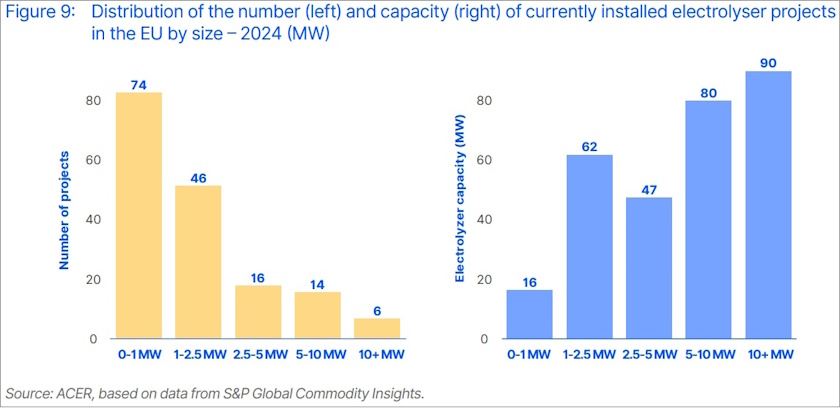
Only six plants were bigger than 10 MW at the end of 2024, amounting to 90 MW altogether.

ACER Uncompetitiveness holds EU far behind green hydrogen targets

Gray hydrogen remains dominant

Steam methane reforming (SMR) remains the dominant production technology, accounting for 89% of the total capacity in the EU. It is colloquially called gray hydrogen.

The share of electrolytic hydrogen, made using electricity from all sources, not necessarily renewables, is marginal. So is the overall capacity for blue hydrogen. It is also from fossil gas, but the process involves carbon capture and storage, CCS.

Green hydrogen, one of so-called renewable fuels of non-biological origin (RFNBO), costs some EUR 8 per kilogram, against just over EUR 2 per kilogram of conventional, gray hydrogen.

Expectations for liquefied natural gas (LNG) and carbon dioxide emission allowance price levels favor fossil fuel hydrogen in the short term, the report’s authors stressed. Meanwhile, slower deployment of electrolyzers limits economies of scale, delaying the anticipated reductions in related capital costs.

Projected prices of LNG and CO2 allowances are favoring fossil fuel hydrogen

With current production cost estimates at just below EUR 3 per kilo, low-carbon hydrogen with carbon capture is more competitive than renewable hydrogen. Nevertheless, the additional costs for CO2 transport and storage are highly uncertain.

“The buildout of CO2 infrastructure may pose additional challenges. Moreover, the long-term gas offtake contracts required for such projects could lock in fossil fuel dependence and exposure to price volatility in the global natural gas market,” the authors said.

By definition, low-carbon hydrogen results in at least 70% lower emissions than the conventional one from fossil fuels. The segment includes electrolysis running on nuclear power.

The EU also counts hydrogen from biogas and biomass processing as renewable, if the technology complies with sustainability requirements.

Electricity supply costs, excluding grid tariffs, may account for up to 50% of the levelized cost of renewable hydrogen, with substantial regional variations across the EU. Regions with abundant renewable resources and strong renewables integration, such as Spain, already provide advantageous conditions for renewable hydrogen production, the document adds.

Electricity accounts for 60% to 70% of renewable hydrogen cost

The Renewable Hydrogen Coalition said electrolyzer manufacturing capacity has surged from 1 GW within a few years. It expects it to hit 15 GW in 2026.

Electricity accounts for 60% to 70% of renewable hydrogen costs, with taxes and levies reaching 30% to 40% of the electricity cost itself, according to the group. It is also urging for incentives and an improvement in the legal framework.

“With the right enabling policies put in place, altogether, our coalition members could put online close to 18 GW of renewable hydrogen production projects between 2026 and 2032,” the declaration reads.

On that note, the European Hydrogen Bank has launched the call to its third auction for hydrogen production, worth EUR 1.3 billion. Spain is adding EUR 415 million, while Germany will match the EU with another EUR 1.3 billion within the auctions-as-a-service segment.

The IF25 Hydrogen Auction is designed to provide cost-efficient support for the production of RFNBO hydrogen or electrolytic low-carbon hydrogen. Producers of hydrogen with maritime or aviation offtakers can apply as well.

The call is part of a package under the Innovation Fund, using revenues from the EU Emissions Trading System (EU ETS). A EUR 2.9 billion segment for net-zero technologies, IF25 NZT, includes hydrogen production.

by in News

Quota surpassed at Romania’s bonus wind power auction

Romania apparently achieved moderately lower prices at its additional wind power auction for contracts for difference (CfDs) than in the regular round. According to a media report, nine bids were approved, for seven proposed facilities, and the winners include OX2, Qair and Zen Energy Group.

All wind farm projects in Romania that obtained the right to state support at the latest renewable electricity auction need to be completed by 2028. The Ministry of Energy and transmission system operator Transelectrica have approved 315.8 MW, compared to the targeted minimum of 290 MW, Economica.net learned.

The bonus round was organized because of a weak turnout in the regular, second wind power auction. Winners are eligible for 15-year CfDs, in a EUR 3 billion scheme covered via the European Union’s Modernisation Fund.

According to the report, the prices were also more favorable for the government than in the previous auction: between EUR 59.95 per MWh and EUR 74.9 per MWh, against EUR 65.17 per MWh to EUR 79.5 per MWh. The ceiling was the same, EUR 80 per MWh.

Cheapest two lots are part of same project

Naxxar Wind Energy Project Zenon won two lots, at 64.8 MW each, for the same project – Tudor Vladimirescu in Brăila county, northeast of Bucharest. The strike prices are EUR 59.95 per MWh and EUR 61.05 per MWh.

Owners of the special purpose vehicle are Renewable Investors and Kaizer Gerhard, an individual, both from Germany.

Aukera Project Company Beta has won a CfD contract for 27.2 MW in the proposed Făurei wind farm. The price is EUR 67.12 per MWh. It is owned by AtlasInvest, headquartered in Belgium.

In Romania, it is working on the projects for the Delesti wind farm in Vaslui county and the Gura Ialomiței storage facility in Ialomița. The battery would have 250 MW in operating power and a capacity of 500 MWh.

The first phase, of 300 MWh, is under construction. The company obtained a EUR 9.9 million grant last year through the National Recovery and Resilience Plan (NRRP or, in Romanian, PNRR) and signed a loan facility of EUR 60 million with Kommunalkredit Austria for the storage system.

OX2 wins CfDs for additional capacity for its future wind farms

Brăila Green Energy qualified for 12.4 MW of its Urleasca wind power project, at EUR 69.86 per MWh. The firm is controlled by OX2, which already won a CfD for a part of the same future facility.

The Sweden-based company also snatched 25.6 MW for its Cerchezu project. It is another winner from the previous round. This time, the South Wind subsidiary secured a contract at EUR 74.49 per MWh.

Clever Power has obtained 21 MW and 14 MW by bidding EUR 69.88 per MWh and EUR 72.92 per MWh, respectively. Both lots are for the same project: Falciu wind farm, envisaged to include storage. The company is controlled by Romanian investor Barbu Cristian, the article adds, citing a businesses registry.

AZ Market Construction won just 8 MW for its Bordei Verde wind project. It is eligible for EUR 74.74 per MWh. The firm is owned by France-based Qair.

Traian Energy, a subsidiary of Zen Energy Group from Luxembourg, is getting the highest price from the bonus round. The wind park would receive EUR 74.9 per MWh for the entire 78 MW.

by in News

Turkey earns EUR 84.8 million upfront from solar power auction

Investors in photovoltaic projects were mostly willing to pay large sums at Turkey’s latest YEKA auction to secure a minimum guaranteed price for five years, followed by 20-year power purchase agreements. The government earned EUR 84.8 million overall from the secondary bidding for 650 MW, split into six areas. One zone is for a floating solar power plant.

According to Turkey’s Minister of Energy and Natural Resources Alparslan Bayraktar, domestic electricity demand is on a trajectory to triple to 1.05 PWh in the next 30 years. It follows an almost threefold jump of the last two decades, while natural gas is rising even faster, he pointed out.

The minister has urged investors to keep up the momentum, noting that the national goal for 2035 for solar and wind power is 120 GW in total.

One of the pillars of the government’s measures to incentivize such endeavors are renewable energy auctions. Notably, the obligatory domestic content rates are high, to boost manufacturing in the sector.

The latest solar power auction under the Renewable Energy Zones (REZ) state support mechanism even brought substantial earnings for Turkey, for the second time. The bidding was initiated at the ceiling price, EUR 55 per MWh, and when the floor level was reached at EUR 32.5 per MWh, the remaining competitors were switched to another auction.

They offered so-called contribution shares, starting at a stunning 10,000 per MW of planned connection capacity. The quota for the REZ SPP 2025 (YEKA GES 2025) round was 650 MW, split into eight zones. Two zones were taken off the table after the call, due to delays in permitting.

Highest fee was EUR 285,000 per MW

In total, Turkey cashed in EUR 84.8 million or EUR 130,400 per MW of connection capacity, excluding value-added tax.

The Eskişehir zone, 260 MW, went for EUR 105,000 per MW to Efor Holding. The company was successful at the previous wind power auction as well, early this year.

Stone Enerji won the Erzurum 1 segment, of 100 MW, by pledging EUR 100,000 per MW. Sertaş Turizm took Erzurum 3, at 85 MW, for EUR 120,000 per MW.

The Ministry of Energy and Natural Resources included a floating solar power plant project for the first time

The 50 MW Bolu zone went to Ecogreen Enerji. The company is paying 44,000 per MW, the least of all winners.

Kahramanmaraş, of 40 MW, was awarded to Güçlü GES Enerji. It pledged EUR 285,000 per MW, which was the highest contribution fee. Aydede Enerji has obtained the Mardin zone for EUR 208,000 per MW while Zincir GES Enerji managed to win the Van solar power project for EUR 187,000 per MW. Both are for 40 MW.

The auction also featured the first zone for a floating solar power plant. Demirköprü Yüzer GES in Manisa province, for 35 MW, was taken by a firm with the same name. It is paying EUR 225,000 per MW, the ministry has revealed.

Solar power auction facilitates USD 400 million in investments

There were 77 applications altogether, from 38 companies.

The winners will be able to sell electricity on the free market for five years. However, they are guaranteed at least their contracted price, which in all cases is the floor price – EUR 32.5 per MWh. The second period, 20 years, is with a power purchase agreement.

Bayraktar estimated that the solar power auction facilitated investments worth a combined USD 400 million. The projected annual output is equivalent to the electricity needs of half a million households.

The minister pointed out that 8 GW of solar and wind power would come online this year in total. The combined capacity on the grid from the two technologies amounts to some 39 GW out of 121 GW overall.

Also of note, the Energy Storage Industries Association (EDEDER) has forecasted that 1.5 GWh of storage capacity would be commissioned next year in Turkey.

by in News

Voltalia receives license for Spitalla PV plant in Albania

French renewable energy company Voltalia obtained a 30-year license for its Spitalla solar park at the Albanian port city of Durrës. It won the project at a renewable energy auction in 2021.

In its latest update, the Energy Regulatory Authority (ERE) of Albania authorized Spitalla Solar to generate electricity from a photovoltaic plant of 90 MW. France-based Voltalia has established the firm for a project for which it won state support in 2021.

The solar power auction for the Spitalla site, just north of Durrës, a port city on the Adriatic Sea, was for 100 MW in peak capacity. The renewable energy company started construction works late last year. At the time, it scheduled the commissioning of the facility for the second half of 2027.

Similarly, Voltalia developed and built its Karavasta PV plant of 140 MW in peak terms, won at a previous solar power auction. It is the largest in Albania.

The auctions are for contracts for difference (CfDs), but the winners are actually working with power purchase agreements (PPAs) with fixed prices. A procedure is underway to secure market liquidity, which would enable the switch. Notably, the Albanian Power Exchange (ALPEX) was launched already in April 2023.

Spitalla’s CfD is for 15 years and 70 MW in peak capacity. Voltalia, headquartered in Paris, earlier said it would sell the rest of the output under a long-term contract with buyers in the private sector.

Since last year, there is more electricity generation capacity in private ownership in Albania than in the system under state-controlled utility KESH. Growth in the solar power segment is the biggest factor behind the change.

by in News

Romania issues call for additional wind power auction for 290 MW

Wind farm project developers in Romania can bid by November 24 for state aid in the form of contracts for difference (CfDs). The call was issued for an additional auction, for 290 MW, after the regular round was completed with more than a third of the quota remaining unallocated.

The Ministry of Energy of Romania and transmission system operator Transelectrica formally launched their third auction today under the CfD state aid scheme for renewable energy. The additional round is only for wind power projects.

Only 1.26 GW was allocated of the available 2 GW in the second, regular auction. It was held within a EUR 3 billion renewable energy program under the European Union’s Modernisation Fund and Romania’s National Recovery and Resilience Plan (NRRP or PNRR).

Aurora Energy Research has interpreted the lack of interest as an indication that developers may have seen more value outside the CfD framework: in power purchase agreements (PPAs) and merchant options. The firm recently said it expected strike prices near the EUR 80 per MWh ceiling.

Financial offers will be opened on December 2, the calendar shows

The maximum price is the same as the last time. Notably, the quota for the additional auction is just 290 MW. Developers have until November 24 to apply with projects of at least 5 MW each. In addition to the bid, they need to submit a technical offer proving eligibility.

Transelectrica, the CfD scheme operator, is due to open the technical offers on November 17. Financial offers of the qualified applicants will be opened on December 2, according to the schedule. The winners would need to sign their contracts for difference by December 18.

The CfDs are for a 15-year period. When the market price of electricity is lower than the price in the contract, the government pays the private operator the difference for the electricity that the beneficiary sells. When it’s the other way around, the producer returns the difference.

by in News

Energy Community’s CBAM Readiness Tracker: Western Balkans still far from exemption as full implementation nears

With less than three months remaining until the European Union’s Carbon Border Adjustment Mechanism (CBAM) is fully implemented, none of the Energy Community’s contracting parties has yet qualified for an exemption in the electricity segment, according to the 2025 CBAM Readiness Tracker. However, the Energy Community’s report suggests that efforts to meet the are gaining momentum, with Serbia, Moldova, North Macedonia, and Montenegro leading the way to market coupling with the EU, and almost all contracting parties planning to introduce carbon pricing.

These efforts signal a growing readiness across the Energy Community to turn CBAM into a catalyst for deeper regional energy market integration and decarbonization, according to the annual report.

“The progress reflected in this year’s tracker underlines that CBAM can drive – not deter – regional cooperation on the energy transition,” Energy Community Secretariat Director Artur Lorkowski stressed and added that the scheme should “serve as a bridge into the EU, not a barrier.”

Lorkowski: CBAM should serve as a bridge into the EU

Starting on January 1, 2026, the EU will charge fees on the CO2 emissions of goods imported from countries that don’t apply matching carbon pricing schemes. In addition to electricity, the carbon border tax will cover cement, iron and steel, aluminum, fertilizers, and hydrogen.

Serbia faces the highest exposure to CBAM costs

Estimates based on 2024 data show the CBAM exposure of EU electricity importers could reach around EUR 1.17 billion a year. Serbia accounts for the largest share, with an estimated EUR 612.5 million in annual CBAM costs, followed by North Macedonia, with about EUR 200 million, Montenegro, EUR 190 million, and Bosnia and Herzegovina, EUR 158 million. Moldova’s exposure is about EUR 6 million, while Albania, which has an electricity mix almost entirely dominated by renewables, faces no CBAM-related costs, according to the report.

The estimated average CBAM cost per megawatt-hour is EUR 33.14 for Moldova, EUR 59.71 for North Macedonia, EUR 62.45 for Montenegro, EUR 66.71 for Serbia, and EUR 73.37 for Bosnia and Herzegovina.

The criteria for a CBAM exemption for electricity include integrating the power market with the EU and introducing a carbon pricing system. A contracting party must also adopt EU regulations on energy, electricity, environment, and competition, increase the share of renewables in its energy mix to align with the EU’s 2030 targets, commit to climate neutrality by 2050 and submit a related roadmap to the EU, and implement measures to prevent indirect electricity imports from non-compliant countries.

Advances evident in emissions, renewables, and market coupling

The 2025 CBAM Readiness Tracker shows that last year alone, carbon intensity across the contracting parties’ power sectors fell by an average of 11%. At the same time, capacity from renewables, excluding large hydro, surged to 5.1 GW from 2 GW between 2020 and 2024. The expansion was driven almost entirely by solar and wind, helped by renewable energy auctions.

When it comes to electricity market integration, no contracting party has completed market coupling with the EU. However, Serbia, Moldova, North Macedonia, and Montenegro are approaching a “point of no return,” which represents a full transposition of EU regulations relevant for market coupling, according to the tracker.

The energy transition unfolding across the Energy Community contracting parties is both tangible and measurable, Adam Cwetsch, Head of the Green Deal Unit at the Energy Community Secretariat, told Balkan Green Energy News. “Carbon intensity in electricity production and economic output continues to fall, while renewable energy deployment accelerates through competitive auctions. This progress reflects a clear commitment to European decarbonisation goals and lays the foundation for deeper energy market integration and long-term climate neutrality,” he stressed.

The secretariat remains committed to ensuring the process continues smoothly – without obstacles from possible unintended impacts of CBAM, Cwetsch said.

Even though no contracting party has introduced a carbon pricing instrument for electricity, almost all of them have outlined plans to establish domestic systems that reflect their specific circumstances.

“This is a crucial step toward alignment with the EU’s carbon pricing framework under CBAM. The rollout of monitoring, reporting, and verification systems across the region is laying the groundwork for implementation and demonstrates growing readiness and credibility, even as timelines remain tight and challenges persist,” Cwetsch stated.

Available carbon pricing models are carbon taxes, ETS and a combination of the two

The available models are a carbon tax, an emissions trading system (ETS), and a hybrid version. The only contracting party that has no plans to introduce carbon pricing is Kosovo*, according to the report.

All contracting parties have concluded agreements to apply EU law in the fields of energy, electricity (including renewable energy), the environment, and competition. In each of them, the implementation of renewable energy legislation is either underway or showing visible progress, the report shows.

No Western Balkan country has included the EU’s 2050 climate goals into national legislation

On the other hand, Ukraine and Moldova are the only ones that have included the 2050 climate neutrality objective in national legislation, while no contracting party has submitted a corresponding roadmap to the EU.

Another requirement that no one has yet fulfilled is the establishment of an effective system to prevent indirect import of electricity into the EU from other third countries or territories that do not meet the CBAM exemption criteria for electricity.

* This designation is without prejudice to positions onstatus and is in line with UNSCR 1244/99 and the ICJ Opinion on the Kosovo declaration of independence.
by in News

Eurowind Energy’s solar power project in Romania gets CfD thanks to auction list dropouts

Eurowind Energy’s Ewe Solar Project in Romania, of 110 MW, is now eligible for government support in the form of a contract for difference (CfD), even though it landed just below the line in the last renewable energy auction. It got upgraded from the reserve list as the developer of two winning photovoltaic endeavors has decided to exclude some sections.

Depending on the policy framework and market conditions, renewable energy investors sometimes opt for power purchase agreements (PPAs) or the electricity exchange instead of locking in a fixed price for the long term in a government support scheme. Enery Element, which won CfDs in Romania’s last solar power auction, decided not to sign some of the contracts. It means Eurowind Energy, the first in the reserve list with its Ewe Solar Project, can now fill the quota instead of its competitor.

Enery Element has obtained the rights to the CfDs with two projects that it conveniently split into several sections each. It enabled it to withdraw only parts of the future photovoltaic plants.

Enery Element cancels three sections of 46 MW altogether

Enery Element pulled away two of the 11 lots that its subsidiary Baboia Solar Plant won for a facility in Ogrizeni in Giurgiu county.

They were the lowest strike prices in the entire auction: EUR 35.77 per MWh and EUR 36.33 per MWh. The proposed two sections, for a combined capacity of 25.9 MW, lowered the total to 324.2 MW.

According to an earlier update, the solar power plant would have 535 MW in peak capacity. The project firm also won a grant of EUR 6.1 million for a 121.9 MWh battery energy storage system.

Baboia Solar Plant, also known as Ogrizeni, would include a subsidized BESS of 121.9 MWh

Enery Element is a joint venture between Austrian renewable energy company Enery Development and its Bulgarian partner Element Power Group.

Conversely, with Siret Solar Plant, Enery Element canceled the part with the highest strike price of the four that were selected. The levels were from EUR 38.76 per MWh to EUR 38.79 per MWh.

It slashed the part of the capacity qualified for CfDs in the Dumbrava 2 project to 88.5 MW from 108.6 MW. The developer didn’t reveal the reason for its move.

Eurowind Energy lifts auction’s highest strike price to EUR 46 per MWh

The Ministry of Energy said it would replace the canceled capacity with Ewe Solar Project of 110 MW. It is a special purpose vehicle, working under Denmark-based Eurowind Energy.

The accepted price is EUR 46 per MWh, while the new lowest level on the list is EUR 36.69 per MWh, for a segment of the Baboia Solar Plant.

by in News

Aurora: Romania’s third CfD auction is key for 2030 targets as solar outpaced wind

Aurora Energy Research expects strike prices at the additional renewable energy auction in Romania, for the remaining wind power quota, to land near the ceiling, set at EUR 80 per MWh. In the previous round, there was strong competition between the bidders for the photovoltaic segment, while developers of wind energy projects may have seen more value in PPAs and merchant options.

Increased costs and stricter eligibility rules constrained wind participation in Romania’s second contracts-for-difference (CfD) round in August, which fell short of the 2 GW wind target. Developers may have seen more value outside the CfD framework, according to Aurora experts, who stressed that power purchase agreements (PPAs) and merchant options offer higher returns than the capped CfD strike prices.

Solar projects showed stronger economics, with strike prices between EUR 35 per MWh and EUR 45 per MWh, compared to wind at EUR 65 per MWh to EUR 79.5 per MWh.

“Using the same commercial operation date for both PV and wind projects has disincentivised wind participation in CfD rounds, since wind developments are far more complex. Their permitting, grid connection, and EPC timelines are significantly longer than solar, making the uniform deadline misaligned with project realities,” said Project Leader at Research Associate at Aurora Energy Research Filippos Falieros.

Dedicated auctions can influence market dynamics

As wind is essential for achieving 2030 renewable targets, the Romanian Ministry of Energy invited developers to submit expressions of interest for mature wind projects only, with contracts expected to be signed by the end of 2025. The third auction will focus on wind energy solely, with a maximum strike price set at EUR 80 per MWh, and Aurora expects strike prices near the ceiling.

In the second auction, accepted wind power bids were between EUR 65 per MWh and EUR 79.5 per MWh

The move underscores the growing divergence in Romania between solar’s strong economics and wind’s slower progress, while also showing how policy adjustments – such as dedicated auctions – can influence market dynamics.

CfD state aid scheme was approved through Modernisation Fund

The overall CfD scheme is supported by EUR 3 billion in total state aid that the European Union approved through the Modernisation Fund, aiming to keep costs low for consumers.

Established in 2013, Aurora Energy Research provides power market forecasting and analytics for critical investment and financing decisions. Headquartered in Oxford, it operates out of 17 offices worldwide covering Europe, North and South America, Asia and Australia.

The firm’s comprehensive services include market outlook packages for energy industry participants, advisory support, and software solutions. Aurora fosters diversity with a team of one thousand experts with backgrounds in energy, finance, and consulting, offering expertise across power, renewables, storage, hydrogen, carbon, and fossil commodities.

by in News

Half of EU auction-backed hydrogen projects pull out

Seven projects for 1.88 GW of total electrolyzer capacity turned out to be unfeasible even with grants won at the second European Hydrogen Bank auction, out of 2.34 GW overall. The developers withdrew, with some citing policy and infrastructure delays and uncertainty. A project from the first renewable hydrogen auction also pulled out.

The European Commission has invited ten projects from the reserve list of the second European Hydrogen Bank auction to start preparing documentation for signing grant agreements, after seven that were initially selected withdrew. The round, completed in May, resulted in 15 projects for renewable hydrogen winning support, for 2.34 GW of total electrolyzer capacity.

Five endeavors remained in the general category, for just 453.46 MW overall, and the remaining three are in the maritime segment. They account for 108.5 MW. The ten reserve projects envisage 774 MW, compared to the 1.88 GW that dropped out, including the three biggest proposed systems.

Stuck at completion guarantees

Some developers of the withdrawn proposals weren’t able to provide completion guarantees. Completion guarantees are worth 8% of the grant, S&P Global noted in a report. Companies cited policy and infrastructure delays and uncertainty.

Four sites are in Spain, two in Germany and the seventh one is in the Netherlands: the Zeevonk electrolyser, the largest of all. It would have 560 MW and produce 411,000 tons over ten years, receiving EUR 0.6 per kilogram.

Beneficiaries receive premiums from the European Hydrogen Bank budget that compensate for the difference between the production price and the amount that buyers offer.

European Hydrogen Bank mechanism designed to weed out unfeasible investments

Before the end of the year, the European Commission expects to publish the final list for the said IF24 auction. One project recently dropped out from the first round as well.

“The auction’s completion guarantee is working as expected in weeding out companies that have bid too low, or were forced to reassess their project maturity or financial viability between bidding and having to provide the completion guarantee,” EU Innovation Fund Policy Officer Johanna Schiele said.

The withdrawn projects could still head for implementation if they complete the financing structure.

Under the second round within the European Hydrogen Bank mechanism, EUR 1.2 billion was available, but only EUR 992 million rewarded.