by in News

Albania’s Solar Gold Rush: Who Profits, Who Pays?

As Albania races to become a net exporter of electricity, dozens of vast solar parks have sprouted almost overnight on fertile farmland and pastures, igniting fierce resistance from local communities. In Fier’s village of Boçovë, a normally quiet farming district near the Seman delta, families woke one day to find heavy machinery digging up fields they had tended for generations. “It turned out a photovoltaic park was being built here, and our lands aren’t ours anymore,” complained Nikoll Ndoi, a local schoolteacher. Ndoi and his neighbours say they gained these plots in the early 1990s under Albania’s land-reform law (Law 7501), but were never issued legal titles and now discover the state has quietly expropriated them for solar panels. More than a dozen families in Boçovë are locked in a fight to reclaim their soil from a new small company, “Brevi Construction”, where it is mentioned in the media that it is affiliated with the family of Pëllumb Salillari. Such clashes are multiplying nationwide as the government greenlights hundreds of megawatts of solar capacity, prompting farmers and herders to denounce an “energy revolution” that is trampling their rights and livelihoods.

Residents of the Levan Administrative Unit protested again in the village of Boçova, after work began on their agricultural lands to install photovoltaic panels by the company "Brevi Construction", with administrator Afërdita Salillari.

Residents of the Levan Administrative Unit protested again in the village of Boçova, after work began on their agricultural lands to install photovoltaic panels by the company “Brevi Construction”, with administrator Afërdita Salillari.

The Albanian government, led by Prime Minister Edi Rama, has made a dramatic pivot from its traditional hydropower surplus to a sun‑driven future. Since 2018, the Council of Ministers approved dozens of solar park projects and the energy regulator (ERE) licensed over 70 private solar companies. The planned PVs are a total of nearly 1,000 MW, about 30% of Albania’s installed capacity and none of it is guaranteed for local use. Instead, most is slated for export to Italy and beyond. Ex-director of Energy Policies at Ministry of Infrastructure and Energy  Gjergj Simaku warns this is a “paradox”: Albania could end up exporting clean power while continuing to import fossil‑fuel electricity during winter. Simaku notes that 1 GW projects have no obligation to sell domestically, leaving local grids and consumers sidelined. Notably, Simaku does not address his own role during his long tenure at the Ministry of Infrastructure and Energy, where he was directly involved in shaping and implementing national energy policies. The governance gaps and regulatory weaknesses he now criticizes were also evident during the wave of small hydropower plant licensing over the past decade—a period marked by widespread concessions, limited oversight, and significant social and environmental consequences for local communities. The current tensions surrounding large-scale solar development bear striking similarities to that earlier expansion, raising questions about institutional continuity and accountability in Albania’s energy policymaking.

Municipal Public Assets Leased by Purpose of Use 2015 – 2024 (in hectares)

This policy u‑turn was codified in 2023 when the government amended the renewables law to allow solar farms on any land even vital grazing areas not just barren terrain. Green activists point out that at least half of Albania’s solar license rush is on former public pastures and forests. A recent survey by the All Green Center found many lease auctions were rushed, with no real competition or community input. “Support for green energy must not come at the expense of natural capital,” says environmentalist Ola Mitre. Birding expert Taulant Bino adds that multiple solar projects have been approved piecemeal, ignoring their cumulative impact on biodiversity. In fertile districts like Fier, dozens of solar parks now ring protected river deltas and migratory corridors. Normally one of Europe’s greenest electricity producers (90% hydro), Albania’s renewable expansion is outpacing environmental safeguards.

Locals report no meaningful consultations. In Boçovë, villagers say a developer quietly re‑zoned their family farms (marked on cadastral maps as “arable” or “forest”) into “unused state land” just as construction began. When the community complained to the Cadastre and Agriculture Ministry, nothing was fixed. In Darzezë (nearby Boçovë), elders who believed promised benefits (new roads, lighting) are now “disappointed,” saying “nothing was done, and they even took our water”. The local mayor’s office in Fier readily absolved itself of responsibility: “These projects aren’t licensed by local government,” Fier’s municipal response notes, adding only that it receives property taxes and nothing else. In effect, powerless villagers have found themselves squeezed: the state offers no legal recourse when it simply rents out “public” pastures to private developers.

A protest by residents of the village of Imshte in the Bubullimë unit in Lushnje.

Across the southwest, similar scenes played out. Last month in Imshtë (Lushnjë), about 70 farmers blocked the road to their police station, demanding authorities halt a planned solar park on 100 hectares they have grazed and farmed for 30 years. They accuse a local businessman, Elton Çekrezi, of quietly buying up the plot once officially designated as non‑transferable state land and forming a shell company SunXpower to install PV panels. MP Erion Braçe, who supports the Imshtë community, blasted the episode on social media as a “robbery of public land” by a clandestine “new agha,” warning that his supporters had been threatened during clashes with men bearing weapons. (Çekrezi’s family insists the land was legally bought at auction from former private owners, and they hold cadaster documents dating back to 1945 and 1998.) In Levan (Fier), villagers of Boçovë protested similarly when the company Bervi Construction began clearing fields they had cultivated for “almost 30 years”. Fourteen families, granted plots under the 1990s land law, but their claims were ignored, and now official records abruptly list the land under Brevi’s name. Farmers like Sandër Mujo have even petitioned prosecutors and the anti‑corruption SPAK agency, warning they will resort to self-vendication if the state does not intervene.

In August 2025, around 40 sheep farmers in Çërravë (Pogradec) held a rally after the local council moved to lease their one communal pasture (35.5 ha) to a solar investor. They decried the measure as a “direct violation of our livelihood” and threatened escalating protests if it proceeded. Independent councillor Arbër Male warned that the vote was a foregone conclusion with the beneficiary company “pre‑selected” by insiders. Such frustrations highlight a growing fear: that the clean‑energy drive is being hijacked by politically connected interests at the expense of ordinary Albanians.

A protest in the village of Çërrava, in the municipality of Pogradec

Critics say the evidence of cronyism is hard to dismiss. The Boçovë solar park was nominally awarded to “Albania Solar Power” (a tiny firm with €100,000 capital) owned by businessman Engjëll Agalliu yet locals see it as Pëllumb Salillari’s project in disguise. Likewise, in Imshtë a construction firm once run by Salillari is tied to Çekrezi’s land deal. Journalist investigations have exposed how clusters of permits went to companies tied to a few elite families, often without competitive bidding. (For example, four solar firms controlled by Armand Lilo’s relatives won megawatt‑scale licenses after a brief ministerial review.) The torrent of approvals has largely skipped formal auctions: as energy expert Simaku notes, “auctions have been forgotten; now licenses are given only on the free market, sold to us as if for domestic use but it’s not true”. NGOs also complain that municipalities have merely rubber‑stamped solar leases, lacking clear strategic planning on where solar parks are appropriate. All Green Center warns that so far, zero hectares of new PV forest have a strategic environmental assessment or master plan to guide them.

A protest in the village of Çërrava, in the municipality of Pogradec

Defenders of the solar boom argue Albania urgently needs a new generation after recent blackouts. The government’s National Energy Plan targets 54.4% renewables by 2030, so big solar projects are deemed necessary for “energy sovereignty”. Prime Minister Rama’s infrastructure ministry underscores that thousands of hectares of mostly unproductive land are available for lease; the projects will create green jobs and revenues. Indeed, Albania’s solar push aligns with EU climate goals and avoids new dams (and displacements) for hydropower. Statisticians note that in the past 10 years Albanian municipalities have leased about 6,350 hectares of public land for all purposes, with over a third (2,325 ha) of that just in 2024 mostly for solar parks. In total some 3,750 ha of state land are now contracted for renewable energy projects. Energy Minister Belinda Balluku, who is under investigation by SPAK, insists each plant needed both a Council of Ministers decision and technical approvals and that “everything is lawful, with environmental studies in place,” though she has not publicly addressed the growing protests.

Photovoltaic power plant in Kolonjë, residents in protest

Nevertheless, the ethical question remains stark. Who really benefits from this boom? Many locals answer: not them. Herders point out that solar panels are theoretically compatible with grazing (the technology allows it), yet companies invariably fence off and occupy the land outright. In Kolonjë, villagers say the developer (Turkish firm Fortis Energy & Construction) even redrew cadastral boundaries to claim around 400 hectares of steep pasture and riverbed (“zall”) that herders need for winter grazing. “If they put up panels, our village will have to leave,” one farmer warned, noting the man behind the project quietly acquired neighbouring plots over decades. Such tensions raise hard choices about property rights and the state’s role in declaring some lands sacrosanct for community use or not.

Protest against PV installation by local communities

Protest against PV installation by local communities

For now, many communities are calling for moratoria. Simaku and other analysts urge a strategic pause: map out priority corridors for solar (avoiding protected zones), require genuine public auctions and participatory planning, and bind new plants to domestic needs. Environmentalists warn that Albania’s decades‑old tradition of hydropower should not be cynically traded for a different form of energy dependence. “We risk exporting renewable energy and importing coal,” Simaku says. If that happens, the country may have allowed a green transition to line the pockets of the connected few rather than serve its people’s interests.

In the heated debate over Albania’s clean‑energy path, one thing is clear: expansion of renewables cannot be at the unchecked expense of farming communities. Without transparent governance and respect for local livelihoods, each new solar panel risks deepening rural distrust. Some farmers now speak of taking their case all the way to the European courts. Whether Albania’s solar revolution will shine on as a model of sustainability or become a catalyst for social unrest may hinge on whose voices are heeded in the fields, the villagers who till the earth, or the energy “czars” behind the grid.
by in News

Slovenia opens its first highway solar power plant

Slovenia’s road management firm Družba za Avtoceste v Republiki Sloveniji has installed a solar power plant on a noise barrier alongside a highway. It is the first such photovoltaic system in the country.

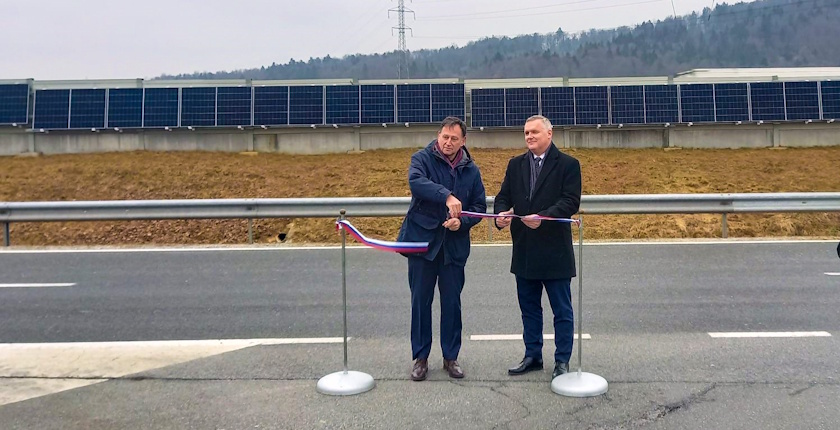
Družba za avtoceste v Republiki Sloveniji (DARS) has officially opened its first photovoltaic plant on a noise barrier at the Šmarje Sap West rest area. It is about ten kilometers from Ljubljana on the motorway connecting the Slovenian capital and Zagreb.

According to DARS, the project is part of a series of activities to achieve the company’s strategic goals in sustainable development, decarbonization, and efficient energy use.

The firm announced the development of such projects in July 2023. A pioneering idea in the region, it was later followed by Bosnia and Herzegovina, Montenegro, and Croatia.

Ribič: An example of thoughtful siting of renewable power plants

The opening ceremony was attended by the Chairman of the Management Board of DARS Andrej Ribič, Minister of the Environment, Climate and Energy Bojan Kumer, representatives of the contractor – Solvera Lynx, and representatives of distribution system operator Elektro Ljubljana.

Andrej Ribič stressed that the project is significant for electricity production but also as an example of thoughtful siting of renewable energy power plants without impacting traffic safety or routine highway maintenance.

The electricity generated by the PV system will be used for DARS’s own consumption, including public lighting and tunnel systems, he explained. This will ensure greater energy independence and more rational management of the energy system, Ribič added.

DARS plans to continue building PV plants

In line with its strategy, DARS aims to gradually reduce energy consumption from the grid and lower CO2 emissions in scopes 1 and 2. By 2030, the goal is to reduce energy consumption and carbon emissions by 30% from the 2024 levels, according to the firm.

Based on its revised strategy, DARS adopted several energy measures in 2024. They included the establishment of an energy department and the implementation of the first phase of solar installations across its five facilities, with a total capacity of 420 kW.

These plants can cover approximately 2% of the company’s annual electricity consumption.

DARS intends to further expand its solar energy projects. The plan includes building bigger plants in degraded areas and more PV systems on buildings and along highway tunnels.

The electricity produced would primarily power lighting and other road systems to ensure the safe and smooth operation of the motorway network, the company added.

Careful site selection for solar plants is crucial

In July 2023, DARS and state-owned hydropower operator Soške Elektrarne Nova Gorica (SENG) announced plans to build solar power plants along highways.

The first one was planned in the Slovenian Littoral and Coastal-Karst area. However, the new solar power plant is not located there.

The two firms later established similar cooperation with the Ministry of Defense and the Municipality of Vipava.

Solar energy use is expanding all over the planet. Experts warn that the optimal siting of PV panels is crucial to avoid occupying large areas of arable land or harming the environment. Therefore, the best solution is to install solar panels in locations that cannot be used for other purposes, such as alongside railways and roads, or on rooftops.

by in News

Elektroprivreda BiH to invest EUR 885 million over next three years

Government-controlled power company Elektroprivreda BiH plans to invest BAM 1.73 billion (EUR 884.6 million) over the next three years, according to its 2026-2028 business plan.

The investments would be financed through loans, and BAM 538 million (EUR 275 million) from own funds of Elektroprivreda BiH (EPBiH), which operates in the Federation of BiH. Of note, it is one of the two entities making up Bosnia and Herzegovina. The other one is the Republic of Srpska.

In line with available funds and restructuring plans, the company intends to continue investing in coal mines within the EPBiH group over the three-year period.

The goal is a stable and sustainable coal production at the volume needed for the planned operation of the thermal power plants, the utility said.

The previous business plan, for the 2025-2027 period, provided for investments of BAM 2.1 billion (EUR 1.074 billion).

The three-year period should be marked by the construction of a large number of PV plants

EPBiH has highlighted the construction of new renewable energy power plants as a long-term strategic and priority goal. The construction of several solar power plants at already identified locations are particularly significant, the plan reads.

The upcoming three-year period should be marked by the construction of a large number of PV facilities at multiple locations on mining sites, company-owned land, on the roofs of its own facilities and those of its customers, EPBiH explained.

EPBiH also plans to acquire operational renewable energy facilities as well as projects in development. The plan envisages the purchase or lease of land suitable for the construction of solar power plants.

Positive business performance and maintaining the position as the dominant electricity supplier in BiH are also outlined in the business plan, adopted by the company’s assembly.

Desulfurization and denitrification of flue gases projects are planned for two thermal power plants

EPBiH has launched flue gas desulfurization and denitrification projects for its Tuzla and Kakanj coal-fired power plants. It would also upgrade unit 7 in Kakanj, unit 4 in Tuzla, and the Salakovac hydropower plant.

The document envisages the establishment of the distribution system operator (DSO), based on the provisions of the Law on Electricity of the Federation of BiH. It came into force in August 2023.

The law stipulates unbundling the distribution activity from EPBiH and establishing the DSO as a separate legal entity, a 100%-owned subsidiary, the company underlined.

by in News

Elektroprivreda BiH to invest EUR 885 million over next three years

Government-controlled power company Elektroprivreda BiH plans to invest BAM 1.73 billion (EUR 884.6 million) over the next three years, according to its 2026-2028 business plan.

The investments would be financed through loans, and BAM 538 million (EUR 275 million) from own funds of Elektroprivreda BiH (EPBiH), which operates in the Federation of BiH. Of note, it is one of the two entities making up Bosnia and Herzegovina. The other one is the Republic of Srpska.

In line with available funds and restructuring plans, the company intends to continue investing in coal mines within the EPBiH group over the three-year period.

The goal is a stable and sustainable coal production at the volume needed for the planned operation of the thermal power plants, the utility said.

The previous business plan, for the 2025-2027 period, provided for investments of BAM 2.1 billion (EUR 1.074 billion).

The three-year period should be marked by the construction of a large number of PV plants

EPBiH has highlighted the construction of new renewable energy power plants as a long-term strategic and priority goal. The construction of several solar power plants at already identified locations are particularly significant, the plan reads.

The upcoming three-year period should be marked by the construction of a large number of PV facilities at multiple locations on mining sites, company-owned land, on the roofs of its own facilities and those of its customers, EPBiH explained.

EPBiH also plans to acquire operational renewable energy facilities as well as projects in development. The plan envisages the purchase or lease of land suitable for the construction of solar power plants.

Positive business performance and maintaining the position as the dominant electricity supplier in BiH are also outlined in the business plan, adopted by the company’s assembly.

Desulfurization and denitrification of flue gases projects are planned for two thermal power plants

EPBiH has launched flue gas desulfurization and denitrification projects for its Tuzla and Kakanj coal-fired power plants. It would also upgrade unit 7 in Kakanj, unit 4 in Tuzla, and the Salakovac hydropower plant.

The document envisages the establishment of the distribution system operator (DSO), based on the provisions of the Law on Electricity of the Federation of BiH. It came into force in August 2023.

The law stipulates unbundling the distribution activity from EPBiH and establishing the DSO as a separate legal entity, a 100%-owned subsidiary, the company underlined.

by in News

Bislimoski urges ESM to pivot toward market procurement of electricity

State-owned power utility Elektrani na Severna Makedonija should make the most of the opportunities when prices on the power market are lower than its production costs, according to Marko Bislimoski, President of the Energy, Water Services and Municipal Waste Management Services Regulatory Commission of the Republic of North Macedonia (ERC or RKE).

​Marko Bislimoski doesn’t see the future of Elektrani na Severna Makedonija (ESM) only in production. He expressed the belief it should also be much more active in the wholesale and retail markets.

The mindset that ESM should only produce power should be abandoned, in his view.

In times when the price of electricity in the domestic and regional market is lower than its production price, it is much more logical for the company to buy it on the market, Bislimoski underlined.

This is going to reduce costs, he added.

ESM should purchase electricity when prices are lower than its costs as well as when the level is below the one at which it sells the energy to universal supplier EVN Home, Bislimoski pointed out. The firm is responsible for all households, among other categories.

North Macedonia’s solar power capacity has reached 1,200 MW

He recalled that solar power plants with a total capacity of 1,200 MW are installed in the country.

Their owners sell electricity on the market to other suppliers and traders, who then resell it to consumers.

If ESM offers them a fair price, it would have a stable and predictable cost structure in terms of purchasing and producing electricity, Bislimoski pointed out.

He noted that ESM imports coal and mixes it with domestic coal, which has caused an increase in its power production costs. In Bislimoski’s view the company can offer a fair price over a longer period, five to 10 years.

Solar power would save water in hydropower plant reservoirs and coal for thermal power plants

It would enable, especially in the summer and spring months, the purchase of electricity from domestic photovoltaic plants at a price that should be lower than EUR 65 per MWh, avoiding losses, according to Bislimoski.

Of note, the company has offered to supply electricity to EVN Home at a rate of EUR 65 per MWh for 2026.

Purchasing electricity from photovoltaic plants would allow saving water in hydropower plant reservoirs, and only one unit in the REK Bitola coal power would be required to work during some daily hours, Bislimoski concluded.

by in News

EPCG Solar Gradnja installs 36 MW of solar power in 2025

So far this year, EPCG Solar Gradnja has installed solar power plants with an overall capacity of 36 MW.

EPCG Solar Gradnja, a subsidiary of state-owned power utility Elektroprivreda Crne Gore (EPCG), specializes in the procurement, design, installation, and maintenance of photovoltaic systems.

Its main role is the installation of solar panels within the programs Solari 3,000+, Solari 500+, and Solari 5,000+.

The programs were launched by EPCG to enable households and businesses to install solar panels under favorable conditions and become prosumers.

EPCG Solar Gradnja pointed out that the results it achieved by December 1 have exceeded the plan for 2025.

The plan for 2025 was 30 MW

“Instead of the planned 30 MW, a total of 36 MW of photovoltaic systems was installed in the first 11 months,” the Board of Directors said after its sixth regular meeting.

The management added that it expects to end the year with a positive financial result.

Of note, EPCG said that since the establishment of EPCG Solar Gradnja in late 2021, the firm installed a total of 75 MW of solar power capacity by August this year. Montenegro currently doesn’t have any large PV plants, so the vast majority of the capacity is in very small PV systems.

The Board of Directors has reappointed Sanja Žugić as acting CEO for a period of six months, or until a competition or the selection of a CEO. The management highlighted good results as the main reason for its decision.

The priority is the implementation of large ground-mounted solar power plants

Due to the increased volume of work and further project development, the board adopted a new rulebook on the organization and the classification of jobs. It brings adjustments to the organization and redistribution of work tasks, EPCG Solar Gradnja said.

In the coming months, the firm’s priority will be the implementation of ground-mounted solar power plants. Two units of 40 MW each are in the pipeline, together with the installation of rooftop solar on an even larger scale, it added.

So far, EPCG Solar Gradnja has installed PV plants on nearly 9,000 roofs.

The board’s meeting was attended by the representatives of the unions. Procedures recommended by the Montenegro State Audit Institution were adopted at the meeting.

by in News

Montenegro launches second BESS tender but for drastically smaller capacity

Power utility Elektroprivreda Crne Gore has launched its second battery energy storage system procurement tender. The required capacity is drastically lower than in the first call.

The initial public procurement was canceled because state-owned energy company Elektroprivreda Crne Gore (EPCG) didn’t obtain approval from the Government of Montenegro to take a loan for a EUR 58 million project.

The new tender envisages the procurement of a battery between 100 kW and 130 kW, with 200 kWh to 260 kWh in capacity. This is a pilot project, and the procurement is valued at EUR 75,000.

The canceled purchase was for two battery energy storage systems (BESS), at 30 MW and 120 MWh each.

The battery will be used on the distribution network

Potential locations include hydropower plant (HPP) Perućica, EPCG’s steel mill Željezara Nikšić, and the Pljevlja thermal power plant.

In the new call, the winning bidder will be obliged to secure a location for installing and testing the pilot BESS, according to the documentation.

EPCG explained that over the previous three years, its projects Solari 3000+, 500+, and 5000+ enabled a strong pace of the addition of prosumer solar power plants to the low-voltage, distribution network in Montenegro.

Although distributed generation has clear financial and ecological benefits, its rapid growth simultaneously brings a string of technical challenges for the distribution network, which was historically developed solely for supplying consumers and for unidirectional energy flow, according to the tender’s documentation.

EPCG sees the installation of batteries in substations as a solution to technical challenges caused by prosumers

The company sees the installation of BESS units within 10/0.4 kV substations as the solution for these challenges.

These batteries would be charged during the hours when photovoltaic facilities have high output in order to reduce and prevent reverse power flow. The idea is to discharge BESS units during hours of peak consumption and low voltage.

The main goal is to minimize voltage deviations in areas that the substations cover, during periods of production and consumption fluctuations. It would increase the hosting capacity for new prosumers, and enhance the stability of the distribution grid under an increased PV plant integration.

Scalability of the battery is one of the conditions for the bidders set by EPCG.

by in News

Negative prices to form so-called bathtub curve in Greece as photovoltaics keep growing

The latest modeling for the wholesale electricity market in Greece shows ever-decreasing prices at times when solar power output is the strongest within the day. The trend points to the formation of a so-called bathtub curve in the daily price charts at the power exchange, as a result of the expected continuation of the photovoltaic capacity surge.

Greece experienced its first negative prices this year. They intensified in August and September, weakening the profitability of investments in the production of renewable electricity.

This year, market participants expect at least 2 GW of photovoltaics to connect to the grid, along with the first standalone battery storage units.

Currently, prices usually fall to a negative EUR 1 per MWh at the most. However, the pace of installations indicates that prices will go even lower. According to the Hellenic Association of Photovoltaic Energy Producers (SPEF), analytical models indicate that for every 1,000 MW of new solar capacity, the so-called system marginal price (SMP) at noon is lowered by EUR 10 per MWh.

Storage acts as a shield against price drops. But even if as many batteries are added as photovoltaics, the wholesale price is seen at a negative EUR 5 per MWh on average during the hours of maximum solar production, the organization’s Chairman Stelios Loumakis said. The level would fluctuate depending on the season and conditions in the system.

With the addition of 500 MW of wind energy per year, the price is at EUR 7.5 per MWh below zero. If system demand also rises, then the level is slightly higher, at EUR 5 per MWh in negative territory.

Loumakis: The duck curve will eventually become the bathtub curve

Especially concerning is that such price formation would turn systematic, almost daily. Loumakis expects more than 1,000 MW of annual solar installations in the following years. Therefore, the actual price could be much lower.

As things stand today, the daily power price curve resembles a duck in markets with high renewable energy penetration. Medium prices in the morning are followed by a drop at noon and a great rise later in the day. A much more pronounced curve is expected in the near future, looking more like a bathtub, he explained.

Loumakis warned years ago about the repercussions from a rapid rise in solar energy, saying that the market would overheat and lower profits.

Up to 3 GW expected this year

Other market players echoed his concerns. CEO of MGD Energy Panagiotis Mourtopalas said at the Renewable and Storage Forum that business plans are under pressure because of curtailments and negative prices. This year, 2,000 jobs have been lost in the renewable energy market as a result.

The Hellenic Association of Photovoltaic Companies (HELAPCO) estimates that new capacities this year would amount to between 2.6 GW and 3 GW, with no sign of slowing down.

by in News

North Macedonia receives applications for 4.2 GW of battery projects

North Macedonia has received requests for new wind farms, solar parks and gas power plants of 7,100 MW in total capacity, as well as for standalone batteries and ones that would be co-located with power plants, for 4,172 MW in overall operating power, Minister of Energy, Mining and Mineral Resources Sanja Božinovska revealed.

The Ministry of Energy, Mining and Mineral Resources has received an initiative for a 495 MW gas-fired cogeneration plant. Sanja Božinovska said the details are unknown as the submitted documentation is too extensive and is still being analyzed, state news agency MIA reported.

Of note, there were already proposals for gas-fired power plants in the country. The government has signed a memorandum of understanding with Kazancı Holding on projects for such facilities.

Investors intend to install standalone and co-located BESS

Investors submitted initiatives for wind farms of 1,590 MW altogether, as well as for a total of 402 MW and 1,080 MWh in battery energy storage systems (BESS) that would be co-located with wind farms.

So-called initiatives were also received for solar power projects totaling 5,052 MW and accompanying BESS of 1,174 MW in combined capability and 3,018 MWh in capacity. Investors plan to build standalone batteries of an overall 2,596 MW and 3,094 MWh, respectively.

Božinovska said it is great news, though that it’s more important whether the documentation is valid.

She recalled that the recently adopted Law on Energy introduced an annual construction plan for priority energy projects.

October 1 was the deadline for foreign investors to submit their projects

October 1 was the deadline for foreign investors interested in the construction of power plants to submit documentation, Božinovska noted. The ministry received a huge number of documents and it will take time to process them, she stressed.

Batteries became all the rage in the renewable energy sector worldwide. North Macedonia is set for a landmark achievement in its region.

YESS Power plans to commission a 60 MW BESS in the country next month. It would be the first large facility of its kind in the Western Balkans.

by in News

Croatia’s HEP to install 90 solar power plants on rooftops of its facilities

Croatia’s power utility Hrvatska Elektroprivreda intends to install 90 solar power plants on its facilities across Croatia.

HEP ESCO, a subsidiary of Hrvatska Elektroprivreda (HEP), has launched a public procurement for the installation of 90 photovoltaic plants under a design-and-build model and on a turnkey basis.

The firm develops, implements, and finances energy efficiency projects based on the ESCO model.

The investment is estimated at EUR 5.3 million, and the deadline for submitting bids is November 3.

HEP ESCO plans to sign a contract with the best bidder within 90 days after selecting it. The deadline for the completion of works will be 18 months, according to the public call.

Five groups of solar power plants

The public call is divided into five geographical groups in Croatia.

Group 1 is for Zagreb and its surroundings. Solar panels would be installed at ten locations, with an estimated investment of EUR 1.2 million. Group 2 covers hydropower plants Zavrlje, Orlovac, Peruća, and Zakučaci in the coastal region of Dalmatia, as well as power distribution facilities. The works in the segment are valued at EUR 770,000, local media reported.

Four cities in the region of Slavonia make up the third group, with 20 locations. Solar panels would be installed for EUR 1.21 million in Virovitica, Požega, Vinkovci, and Vukovar.

HEP has over 50 solar power plants on the rooftops of its buildings and facilities

A total of 15 locations in the areas of Međimurje and Zagorje and the Sisak-Moslavina county, and including hydropower plant Ozalj, all in northwestern Croatia, are in the fourth group. The estimated value is EUR 1.1 million.

The value of the investment in Istria, Primorje, and Gorski Kotar is EUR 1.03 million. It entails the Fužine hydropower plant, Rijeka, Vinodol, and electricity distribution facilities.

Of note, HEP has more than 50 solar power plants on the rooftops of its buildings and facilities.

HEP Proizvodnja, HEP’s power production arm, has 12 PV plants on administrative buildings, thermal power plants and hydropower plants. The total capacity is about 1.5 MW. HEP ODS, the country’s distribution system operator, has another 44 solar power plants with a total capacity of 1.1 MW on its roofs.