by in News

Skopje Declaration signed as International Forum on Energy for Sustainable Development wraps up

The 14th International Forum on Energy for Sustainable Development (IFESD-14) concluded yesterday with the signing of the Skopje Declaration. During the three-day summit, North Macedonia’s capital became a global center of dialogue, ideas, and visions for the future, according to the Ministry of Energy, Mining and Mineral Resources of North Macedonia.

This year’s edition of the International Forum on Energy for Sustainable Development (IFESD-14), themed From Goals to Action: Powering the Future with Sustainable Energy, was closed in Skopje yesterday. The event was organized by the Ministry of Energy, Mining and Mineral Resources of North Macedonia, in cooperation with the United Nations Development Programme (UNDP) and the UN’s five regional commissions – UNECE, UNESCAP, UNECLAC, UNECA, and UNESCWA.

Representatives of the UN and the five regional commissions described the organization of the event as flawless, and praised North Macedonia and Skopje as excellent hosts on the global energy scene, the Ministry pointed out.

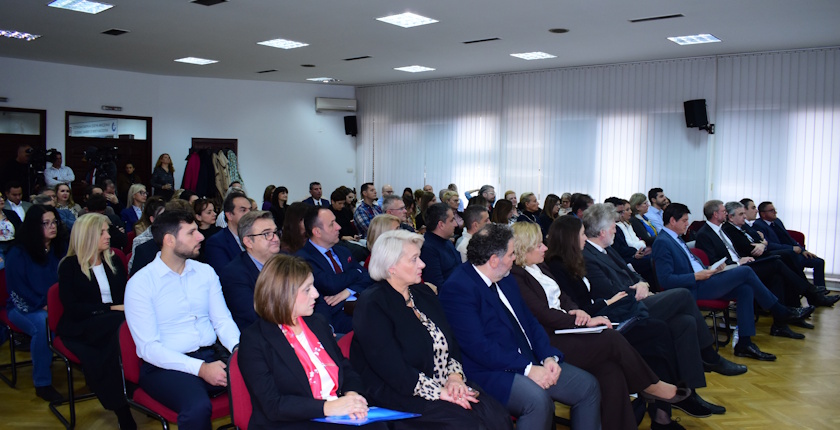
The forum brought together over 500 participants from more than 70 countries

The forum brought together over 500 participants from more than 70 countries. Over 150 speakers took part in 35 themed sessions and panels, presenting ideas, solutions, and concrete steps for the future of the global energy transition.

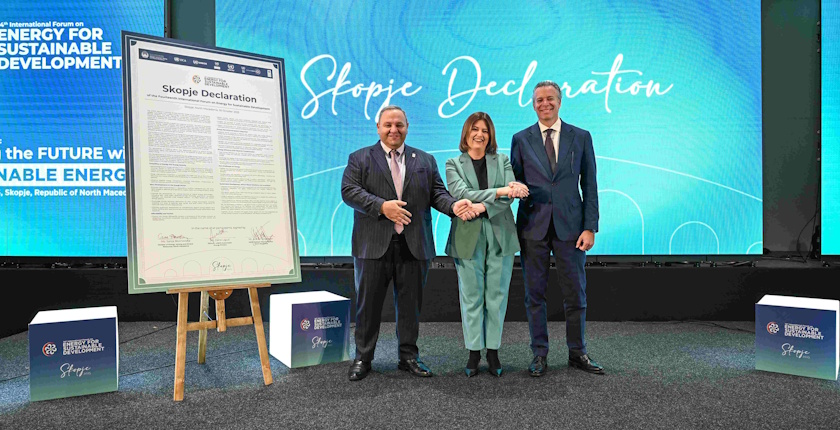
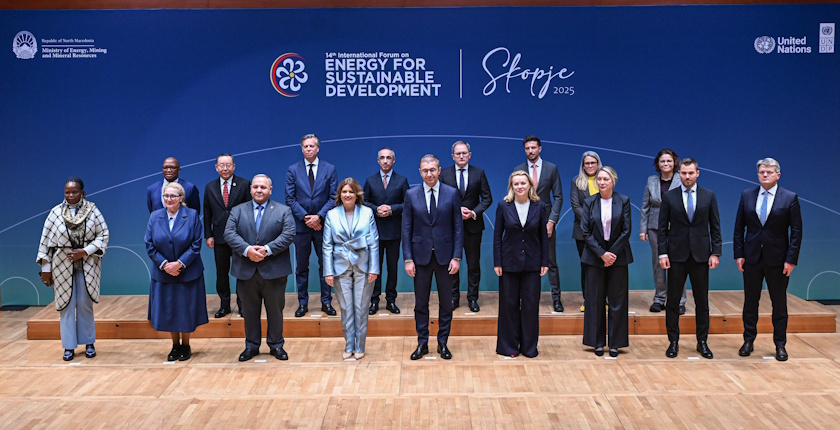
On behalf of all participants, the Declaration was signed by Minister of Energy, Mining and Mineral Resources Sanja Božinovska, UNDP Resident Representative for North Macedonia Armen Grigoryan, and Dario Liguti, Director of the Sustainable Energy Division at UNECE.

The signatories agreed that the way forward requires regional connectivity, smart investments, digital transformation, and an inclusive energy transition that leaves no one behind.

Božinovska: A new impetus for energy cooperation, solidarity, and vision

[wpcc-iframe title=”Sanja Božinovska statement on the occasion of IFEST25 Skopje and signing the Skopje Declaration” width=”500″ height=”281″ src=”https://www.youtube.com/embed/ZgcrsSuNVes?start=1&feature=oembed” frameborder=”0″ allow=”accelerometer; autoplay; clipboard-write; encrypted-media; gyroscope; picture-in-picture; web-share” referrerpolicy=”strict-origin-when-cross-origin” allowfullscreen=””]

In her closing address, Božinovska emphasized that the forum represented a turning point for the region.

“Over the past three days, Skopje has been a global stage for energy vision and dialogue on sustainable development. What we witnessed here was a wave of knowledge, cooperation, and ambition – a forum that demonstrated that when institutions, scientists, businesses, and international partners sit at the same table, change happens,” she stressed.

Božinovska emphasized that the Skopje Declaration sends a strong signal that the Western Balkan region is not just a follower of the global energy transition, but an active driver.

The future was not just discussed, but also set in motion

“I am proud that it is from Skopje, at the heart of the Balkans, that a new impetus for energy cooperation, solidarity, and vision is emerging. This is proof that North Macedonia can be a platform for ideas that will transform the region. The 14th International Forum on Energy for Sustainable Development will be remembered as the place where the future was not just discussed, but also set in motion. Let us continue to build the energy future that our citizens deserve,” said Božinovska.

Grigoryan: Skopje has demonstrated global solidarity in action

[wpcc-iframe title=”Mr Armen Grigoryan, UNDP Resident Representative, statement on IFESD25 Skopje” width=”500″ height=”281″ src=”https://www.youtube.com/embed/uH2-5cr5ju0?feature=oembed” frameborder=”0″ allow=”accelerometer; autoplay; clipboard-write; encrypted-media; gyroscope; picture-in-picture; web-share” referrerpolicy=”strict-origin-when-cross-origin” allowfullscreen=””]

Armen Grigoryan, UNDP Resident Representative for North Macedonia, said that the path to sustainable, reliable, and affordable energy is clear, but that it requires unity and vision.

According to him, it requires political will, global solidarity, and commitment.

UNDP is pleased to work together with the Government and the Ministry of Mining, Energy and Mineral Resources, as well as regional commissions, on policies, emission reduction solutions, inclusivity, and air quality improvements, according to him. UNDP invests in people and innovation to achieve measurable results that citizens can feel at home, at work, and everywhere, he added.

Liguti: The Skopje Declaration is a signal of the region’s ambition and vision

According to Dario Liguti, Director of the UNECE Sustainable Energy Division, the document signed in Skopje will remain an important reference point in global energy processes.

He said that the Skopje Declaration represents a strong signal of the regional and global cooperation and ambition, confirming the shared commitment to accelerating a just and inclusive energy transition – a transition that delivers real progress for people and the planet.

Conclusion: smart technologies, a just transition, and green investments

Božinovska, Grigorian, and Liguti (phto: Ministry of Mining, Energy and Mineral Resources)

The document states that signatories will work on integrated and inclusive energy policies; the modernization of power grids and digitalization; investments in renewable energy sources and a just transition; and the promotion of green financing and gender equality in energy.

“Together, we can transform the global energy system into one that safeguards our climate, drives innovation, ensures affordability, and delivers prosperity for all,” reads the closing paragraph of the Skopje Declaration.
by in News

Božinovska: Solar overtakes hydro in North Macedonia

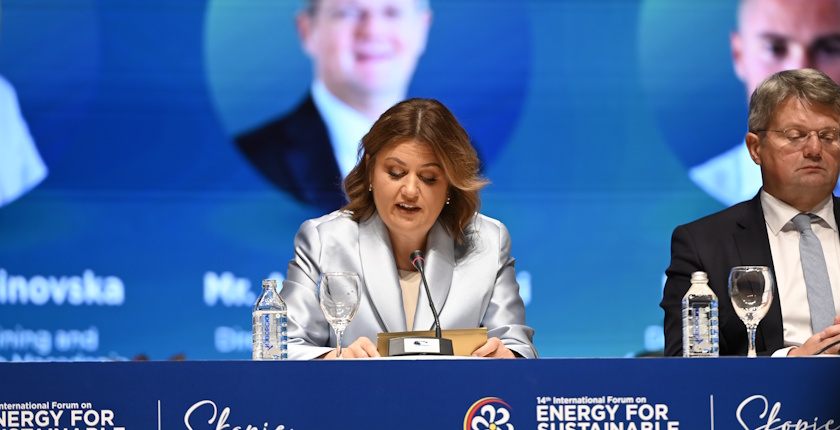
The share of solar power plants’ capacity in North Macedonia has surpassed hydropower plants in 2024, Minister of Energy, Mining and Mineral Resources Sanja Božinovska said at the 14th International Forum on Energy for Sustainable Development in Skopje.

The three-day International Forum on Energy for Sustainable Development (IFESD-14) started yesterday. Its theme is From Goals to Action: Powering the Future with Sustainable Energy. The event was organized by the Ministry of Energy, Mining and Mineral Resources of North Macedonia, in cooperation with the United Nations Development Programme (UNDP) and the UN’s five regional commissions – UNECE, UNESCAP, UNECLAC, UNECA, and UNESCWA.

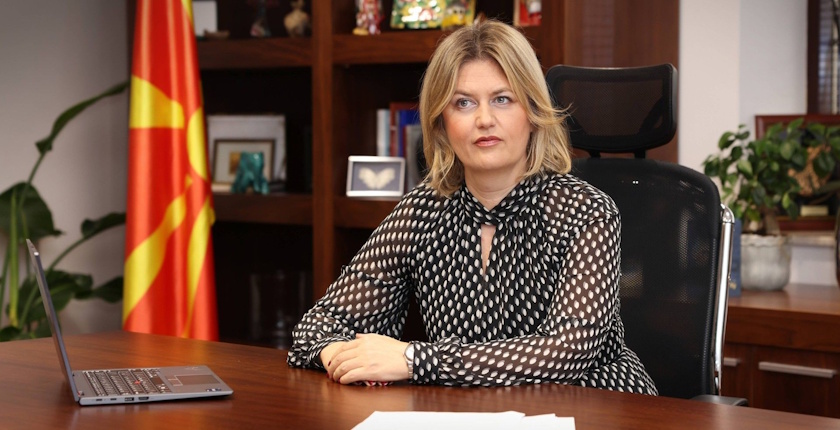
According to Sanja Božinovska, Minister of Energy, Mining and Mineral Resources, North Macedonia has taken decisive steps in recent years to transform its energy system and align it with the principles of sustainability, security, and affordability.

The reforms are already delivering measurable results, with renewables now accounting for more than half of the country’s total installed electricity capacity – 56% in 2024, she noted.

North Macedonia is moving from goals to action

“The structure of that progress is even more striking. Photovoltaic power plants now represent 28% of installed capacity, surpassing large hydropower, which is at 24%. For the first time in our history, solar has overtaken hydro – a symbolic and practical milestone in our path toward decarbonization,” the minister stated.

In 2024 alone, solar output grew by 186%, she underlined at the first high-level plenary session.

Photo: Ministry of Energy, Mining and Mineral Resources

The numbers speak louder than words: they highlight a nation that is not just planning a transition, but living it, in Božinovska’s view.

Of note, at the end of 2024 the capacity of solar power plants was 848 MW. The year-on-year was higher than 340 MW. Hydropower capacity was 720 MW, at the end of last year.

Božinovska: We are supporting over 5,000 workers and communities affected by the coal phaseout

“The numbers confirm it — North Macedonia is moving from goals to action,” Božinovska stressed.

She added that the country is investing in new solar and wind projects, expanding energy storage, and modernizing the national grid to absorb growing renewable capacity. “These investments are essential for maintaining reliability and flexibility as we integrate more clean energy sources,” she explained.

Božinovska pointed out that the commitment to a just energy transition is equally important.

“We are supporting over 5,000 workers and communities affected by the coal phaseout, helping them to retrain, diversify local economies, and secure green jobs,” she underlined.

Joksimović: Serbia to reach 2030 renewables target

Sanja Božinovska and Jovana Joksimović (photo: Ministry of Energy, Mining and Mineral Resources)

According to Jovana Joksimović, Serbian Assistant Minister of Mining and Energy for International Cooperation and European Integration, coal is still the backbone of the energy system in Serbia, while the share of energy from renewables is significant and growing, and it reached 38% in 2023.

The government plans that one in two megawatt-hours would be produced from renewables by 2030, she underlined.

“Existing valuable resources will need to remain the foundation of Serbia’s electricity sector until renewable energy, transmission and distribution infrastructure, as well as storage capacities and ability to integrate renewables, are sufficiently developed and aligned to reliably and securely replace coal-based electricity generation,” the assistant minister told the audience during the second high-level plenary session.

It is necessary to diversify supply channels but also the energy mix

Joksimović stressed that the increased capacity for clean energy, secured from the two very successful rounds of the auctions, would contribute to reaching 2030 targets.

When it comes to advancing the energy transition and powering the future, it is necessary to think outside the box, she added. Supply channels should be diversified but so does the energy mix, to be as self-sustainable as possible, in Joksimović’s view.

There is huge support for it from relevant international financial institutions – IFIs, but more is needed, in her words.

“If we are going to reach the targets that we set for us, I believe that the European Commission would be partnering with us in all efforts that we are taking,” she concluded.

Photo: Ministry of Energy, Mining and Mineral Resources
by in News

International Forum on Energy for Sustainable Development kicks off in Skopje: reliance on single supplier is risk of past

Reliance on a single source or supplier is a risk of the past – the future belongs to diversified, sustainable, and safe energy solutions, Minister of Energy, Mining and Mineral Resources of North Macedonia Sanja Božinovska said at the opening of the 14th International Forum on Energy for Sustainable Development in Skopje.

The three-day International Forum on Energy for Sustainable Development (IFESD-14), with the theme From Goals to Action: Powering the Future with Sustainable Energy, gathered more than 500 participants from more than 70 countries, including high-level representatives of international institutions, companies, as well as academics and experts.

The meeting is organized by the Ministry of Energy, Mining and Mineral Resources of North Macedonia, in cooperation with the United Nations Development Programme (UNDP) and the UN’s five regional commissions – UNECE, UNESCAP, UNECLAC, UNECA, and UNESCWA.

The Skopje Declaration will be signed at the forum. The document will remain as an important permanent record of the commitment of the participating countries to a sustainable, safe, and inclusive energy future, according to the ministry.

Sanja Božinovska, Minister of Energy, Mining and Mineral Resources, underlined that North Macedonia would be the center of the global energy dialogue for the next three days.

Božinovska: Energy transition is not a race between countries​

Energy resilience today is the ability of the system to withstand, adapt, and continue to function stably even in conditions of global uncertainty and geopolitical upheaval, she said.

“In this new era, technology and artificial intelligence are our allies, not a threat. They can help us forecast demand, optimize consumption, and improve energy accessibility. But energy must be used wisely, focusing on people, not just machines,” Božinovska stated.

Sanja Božinovska (photo: Ministry of Energy, Mining and Mineral Resources)​

​Energy transition is not a race between countries but a shared journey, in the minister’s view. No country, regardless of size, can handle climate challenges alone, she added.

“Our role, as ministers and leaders, is to create conditions for this transition to be fair, sustainable, and inclusive and to ensure that no one is left behind; no country, no community,” Božinovska stressed.

The actions of the Government of North Macedonia confirm the stance, she asserted and highlighted the construction of natural gas interconnectors with Greece and Serbia. The investment will enable supplying thousands of households and businesses and help Europe achieve better connectivity and security of gas supply, she explained.

Grid modernization and investments in digitalization and energy storage are the country’s policy as well, she added.

Mickoski: Energy is high on the government’s agenda

Hristijan Mickoski (photo: Ministry of Energy, Mining and Mineral Resources)

Prime Minister Hristijan Mickovski said the forum is an opportunity for North Macedonia to show that a small country can have a big impact – when it has a clear vision, determination, and leadership.

He highlighted the role and vision of Minister Božinovska, saying she is determined to move things forward even in the short term, to accelerate processes and not let Macedonia fall behind in the race against time.

“As someone who comes from the energy sector, I know very well how important that feeling of constant movement, change, and responsibility is. That’s why energy is high on the government agenda – not as a technical matter, but as a national priority and state strategy,” he asserted.

Every solar panel, every wind farm, every new power plant fueled by clean energy – this is part of the modern struggle for the independence of North Macedonia, he explained.

“Our vision is clear: to prepare the country for the future – for climate challenges, technological changes and global risks. To make an example in the region of a stable, clean and independent energy economy,” Mickoski said.

Molcean: The forum has developed into a leading global platform for the promotion of sustainable energy

Tatiana Molcean, United Nations Under-Secretary-General and Executive Secretary of the United Nations Economic Commission for Europe (UNECE), pointed out that the forum, which was launched in 2010, has evolved into a leading global platform for advancing sustainable energy.

“Today, we stand at a crossroads when it comes to multilateralism in energy. The global energy transition represents not only a historic opportunity for sustainable development but also a profound responsibility. We must build resilient energy systems that ensure a secure, affordable, and environmentally sustainable supply of energy,” she stressed and added: “None of us will succeed if we work in isolation.”

Tatiana Molcean (photo: Ministry of Energy, Mining and Mineral Resources)

​UNECE is here together with other UN partners to help make energy not only a driver of just transition and economic growth, but also a catalyst for sustainability and resilience, Molcean told the audience.

In the view of Resident Representative of UNDP in North Macedonia Armen Grigoryan, the forum’s theme, From Goals to Action: Powering the Future with Sustainable Energy, reflects urgency and growing consensus among nations that sustainable energy solutions are urgent.

Grigoryan: We have to move from commitments to concrete implementation

“Now we have to move from commitments to concrete implementation and steps. Sustainable energy stands as a cornerstone of our collective sustainable future. Around the world, the UNDP programme is deeply engaged in advancing this agenda,” he stressed.

Grigoryan recalled that the work of UNDP in North Macedonia, but also elsewhere, through the green finance facility and tackling air pollution initiatives, is about the people.

“By helping families heat their homes with green and affordable energy, enabling businesses to invest in green solutions, we are creating healthier communities and new opportunities for growth,” he asserted.

Photo: Ministry of Energy, Mining and Mineral Resources
by in News

North Macedonia launches decarbonization guide for small businesses

The Economic Chamber of North Macedonia has developed the country’s first decarbonization guide for small businesses. The digital tool is intended to help North Macedonia’s economy adapt to international climate rules, including the European Union’s carbon border tax (CBAM).

The decarbonization guide provides detailed instructions on the most effective ways for local companies to reduce their carbon footprint as part of the global fight against climate change, according to the Economic Chamber of North Macedonia.

The key feature is a carbon footprint calculator that covers nearly 60 different energy sources and refrigerants. Information is also available on EU and domestic climate regulations, as well as funding opportunities, such as subsidies.

The platform offers practical case studies and success stories of leading companies to highlight the benefits of clean energy, according to the chamber.

Božinovska: The decarbonization guide marks a turning point in the country’s green transition

The guide was developed in cooperation with the advisory team of the European Investment Bank (EIB) and the Delegation of the EU to North Macedonia.

The guide was presented in the country’s capital, Skopje, at a gathering attended by more than a hundred entrepreneurs from all sectors of the North Macedonian economy.

Sanja Božinovska (photo: Economic Chamber of North Macedonia)

“The decarbonization guide is a turning point in our country’s green transition, equipping businesses with the tools they need to act now,” said Sanja Božinovska, North Macedonia’s Minister of Energy, Mining and Mineral Resources.

The guide is designed to help companies reduce greenhouse gas emissions and adapt to international climate rules, while, as the chamber says, preserving competitiveness.

One of these rules is the EU’s tax on the import of carbon-intensive goods, the Carbon Border Adjustment Mechanism (CBAM), which is set to take effect on January 1, 2026.

The guide is available on the website of the Economic Chamber of North Macedonia

This digital tool will help North Macedonia move towards a low-carbon economy, the chamber added.

The guide is available on the chamber’s website in the form of an interactive platform. Its development was financed by EIB Global.

Björn Gabriel, Head of EIB Representation in North Macedonia, has said that the guide comes at a crucial time as North Macedonia advances its green transition and prepares for upcoming carbon regulations.

According to Head of the Delegation of the EU to North Macedonia Michalis Rokas, decarbonization, energy efficiency, and renewable energy sources are powerful tools for building a more innovative, resilient, and competitive economy.

If every small and medium-sized enterprise (SME) takes at least a few significant steps toward greener business practices, the combined impact on more than 68,000 firms will be truly transformative, claims Rokas.

Michalis Rokas (photo: Economic Chamber of North Macedonia)

by in News

North Macedonia receives applications for 4.2 GW of battery projects

North Macedonia has received requests for new wind farms, solar parks and gas power plants of 7,100 MW in total capacity, as well as for standalone batteries and ones that would be co-located with power plants, for 4,172 MW in overall operating power, Minister of Energy, Mining and Mineral Resources Sanja Božinovska revealed.

The Ministry of Energy, Mining and Mineral Resources has received an initiative for a 495 MW gas-fired cogeneration plant. Sanja Božinovska said the details are unknown as the submitted documentation is too extensive and is still being analyzed, state news agency MIA reported.

Of note, there were already proposals for gas-fired power plants in the country. The government has signed a memorandum of understanding with Kazancı Holding on projects for such facilities.

Investors intend to install standalone and co-located BESS

Investors submitted initiatives for wind farms of 1,590 MW altogether, as well as for a total of 402 MW and 1,080 MWh in battery energy storage systems (BESS) that would be co-located with wind farms.

So-called initiatives were also received for solar power projects totaling 5,052 MW and accompanying BESS of 1,174 MW in combined capability and 3,018 MWh in capacity. Investors plan to build standalone batteries of an overall 2,596 MW and 3,094 MWh, respectively.

Božinovska said it is great news, though that it’s more important whether the documentation is valid.

She recalled that the recently adopted Law on Energy introduced an annual construction plan for priority energy projects.

October 1 was the deadline for foreign investors to submit their projects

October 1 was the deadline for foreign investors interested in the construction of power plants to submit documentation, Božinovska noted. The ministry received a huge number of documents and it will take time to process them, she stressed.

Batteries became all the rage in the renewable energy sector worldwide. North Macedonia is set for a landmark achievement in its region.

YESS Power plans to commission a 60 MW BESS in the country next month. It would be the first large facility of its kind in the Western Balkans.