by in News

MEMO Analysis Links Solar Output to Lower Day-Ahead Power Prices in North Macedonia

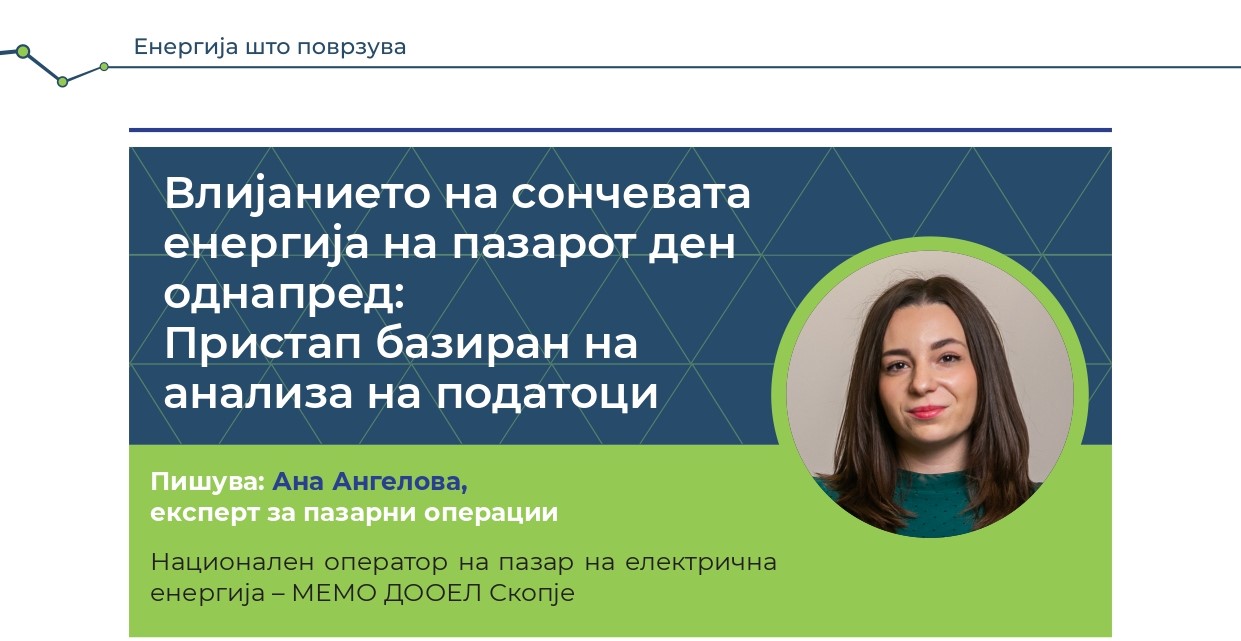
Electricity generation from solar power plants tends to push prices down on the power exchange, while reduced solar output is associated with price increases, according to an analysis by Ana Angelova, a market operations specialist at the National Electricity Market Operator (MEMO).

The analysis aimed to identify seasonal trends and highlight the relationship between photovoltaic (PV) generation, electricity consumption, traded volumes, and day-ahead prices on the North Macedonian power exchange. MEMO noted that the day-ahead market operates in an isolated mode.

Angelova used official power exchange data for 2024, focusing on hours when PV plant efficiency exceeded 30%.

Consumption remains broadly stable across the year

The findings point to a clear seasonal pattern. Electricity consumption stays relatively steady throughout the year, with only minor declines during spring and summer. PV generation, however, shows a pronounced seasonal swing—peaking in summer and reaching its lowest levels in winter.

Angelova also stressed that higher PV output coincides with increased traded volumes on the day-ahead market.

Prices bottom out in April, rise toward winter

According to the analysis, day-ahead prices are lowest in April, a period linked to milder weather, lower demand, and stronger solar production. From summer onward—and particularly during winter—prices trend higher, peaking in November.

The November price peak aligns with a combination of weak PV generation and higher consumption.

“Increased electricity generation from photovoltaic plants is associated with lower prices, while low generation leads to higher market prices, emphasizing the impact of renewable energy availability on price formation. The trend indicates that energy policies should focus on addressing weaknesses during the winter period and harnessing the potential of solar energy in summer,” Angelova wrote.

Proposed measures to strengthen renewables integration
north macedonia solar analysis memo power exchange ana angelova

Photo: MEMO

Angelova outlined several options to improve the integration of renewables—especially solar—into the power system. The proposed mechanisms include:

  • Flexible market mechanisms: introduction of a 15-minute trading interval, creation of an intraday market, dynamic tariffs, and guarantees of origin.

  • Energy storage technologies: battery energy storage systems (BESS) and pumped-storage hydropower plants.

  • Alignment with the European energy framework: adoption of ENTSO-E grid codes, coupling with the single European electricity market, deployment of smart meters, and use of financial instruments such as contracts for difference (CfD) and power purchase agreements (PPA).

by in News

EU’s amendments to CBAM: possibility of relief, but January 1 brought market uncertainty

Long-awaited implementing acts and amendments to the CBAM Regulation brought only a minor relief for the Western Balkans, investors in renewables, and electricity traders. Balkan Green Energy News has analyzed the documents that the European Commission published in December 2025, and the impact of the proposed measures on Energy Community contracting parties – Albania, BiH, Kosovo*, Montenegro, North Macedonia and Serbia.

From January 1, European firms importing aluminum, cement, electricity, iron and steel, hydrogen and fertilizers are obliged to pay a carbon price within the European Union’s Carbon Border Adjustment Mechanism (CBAM).

Last year, the CBAM Regulation was criticized by experts from the Western Balkans (Ljubo Maćić, Zoran Gjorgjievski), European think-tanks (Bruegel), and organizations (Energy Traders Europe). Even the European Network of Transmission System Operators for Electricity (ENTSO-E) requested that the transitional period be prolonged.

They said charging the tax, which started on January 1 as scheduled, would harm countries outside the EU, but also EU member states, market coupling of Western Balkan countries, and electricity trade.

Uncertainty surrounding electricity transit and trade remains high

The analysis showed that the European Commission is proposing changes to the CBAM regulation that would introduce a more favorable method for calculating the national emissions factor and actual emissions values. This benefits non-EU countries that export electricity to the EU, owners of operational renewable energy power plants in these countries, and future green energy investments.

The proposal foresees amendments to the procedure for market coupling, but it is unclear whether these will bring any concrete changes. The commission didn’t propose changes regarding transit, and consequently, electricity trading.

Provided that the proposal is accepted as proposed, it will bring the said positive changes in calculating the national emissions factor and actual emissions values only by the end of the year, meaning that uncertainty in the market will persist until then.

Uncertainty surrounding electricity transit and trade remains high. The impact on the Western Balkans, as well as on the EU member states Bulgaria, Croatia, Greece, Hungary, Romania, and Slovenia, will become clear in the coming weeks and months.

There are two legislative streams

There are two relevant streams currently ongoing in EU legislation for CBAM for electricity. The first are the so-called implementing acts, which are similar to secondary legislation in national law. They further define the technical details of the CBAM regulation.

The other part is the commission’s proposal to amend the CBAM Regulation itself. It will become part of the law when the other co-legislators in the EU – the Council of the EU, which includes the member states, and the European Parliament – together agree on it.

Nobody can say exactly when that process will be finished, but most likely not before the autumn.

National emissions factors, actual emission values: improvement

eu western balkans cbam electricity market coupling amendments
Photo: iStock

There is a proposal to change the way the national emission factors are calculated in the main CBAM Regulation. Currently it only includes the part of the electricity mix based on fossil fuels, regardless of their share in the country’s power generation mix.

For example, for Serbia, a contracting party of the Energy Community, this factor is 1.04. If the national power mix is taken into account, it would go down to 0.7, making the cost of CBAM about 40% lower.

The commission proposed to replace the electricity mix based on fossil fuels, in its accounting system, with one encompassing all energy sources.

The commission also intends to change the requirements for switching to actual emission values

The commission also intends to change the requirements for switching to actual emission values. These are relevant for the producers of renewable energy in non-EU countries. Current conditions are very strict and, to some stakeholders, not achievable.

For example, if a wind farm in the Western Balkans, owned by a domestic or foreign investor, cannot meet these conditions the CBAM payments for the electricity from the facility exported to the neighboring Croatia would be calculated based on the national emissions factor.

The commission suggested that an importer shouldn’t need to have a power purchase agreement (PPA) with a producer directly, which is one of the conditions, but that it could be done through intermediaries. It also proposed the removal of the requirements related to congestion.

These proposals could remove negative impacts on renewable electricity exports and development in non-EU countries, including contracting parties.

Transit: nothing new

The issue of transit hasn’t been addressed in the acts and amendments.

Under the CBAM Regulation, it is unclear how electricity transit costs would be calculated. For example, from Bulgaria to Hungary via Serbia, and who would be required to cover them.

The commission clarified several times that transit isn’t subject to CBAM. However, the physical, practical implementation is the problem.

For example, a trader buys electricity from Greece, transits it through North Macedonia, and puts it on the Serbian SEEPEX power exchange. Somebody else buys it and sells it in Hungary.

It would be very difficult or impossible to say that electricity from Greece was sold into Hungary.

This is why stakeholders take a conservative approach and say that they cannot prove. So, most likely they wouldn’t opt for these countries – non-EU countries, like contracting parties – for transit.

Retroactivity: possibility for improvement

eu western balkans electricity market cbam amendments
Photo: iStock

One of the provisions in the commission’s proposal to amend the CBAM Regulation is that the changes in the electricity sector could apply retroactively, starting from January 2026.

Just as a reminder, EU firms are obliged since the start of this month to pay a CBAM fee for importing designated goods and raw materials and electricity via purchasing so-called CBAM certificates.

Obviously, an importer will try to pass on this cost partly or fully to its counterparts in the third countries. But, importantly, EU firms won’t be able to purchase CBAM certificates yet this year, but only from February 1, 2027.

If the amendment on national emissions factor is adopted, for example in October, this could mean lower CBAM costs for EU importers of electricity from non-EU countries.

Without details on the path forward, market participants lack certainty about the level of CBAM costs

The commission intended to remedy some of the negative impacts on the electricity markets with amendments with retroactive effect. But without details on the path forward, market participants lack certainty about the level of CBAM costs to be paid for 2026.

Based on the current rules, CBAM costs for countries which have lignite in their generation mix could be EUR 70 per MWh to EUR 80 per MWh if the EU ETS price is around 80 EUR per ton of CO2. In some cases, the fee is almost 100% above the electricity price itself.

It is clear that it would rarely make sense to import electricity to the EU from third countries. The price difference, let’s say between Hungary and Serbia, would need to be more than EUR 70 per MWh to EUR 80 per MWh to make the business case.

Market coupling: nothing new or possibility for improvement

eu cbam western balkans electricity market amendments
Photo: Sergio Cerrato – Italia from Pixabay

There are several references to market coupling in the proposal. Energy Community contracting parties are in different phases of market coupling with EU countries.

The commission has proposed signing memoranda of understanding with third countries. It would set out the timeline and conditions for an exemption from CBAM on electricity.

This could be done after the commission approves the so-called verification process of a contracting party’s transposition of the Electricity Integration Package (EIP). It would be a green light for the next stage, which entails the technical tests, leading up to the completion of market coupling.

The current wording in the proposal leaves room for various interpretations

The current wording in the proposal leaves room for various interpretations, one being that the MoU may open the door for an exemption already when the “point of no return” is reached. It is when the contracting party has done all its homework and only the technical tests remain.

However, the commission didn’t propose the other conditions for CBAM exemption to be changed, such as the development of a roadmap on the introduction of a CO2 price that would be equivalent to the level in the EU’s Emissions Trading System (EU ETS).

The question is what the MoU would exactly be about, and if “equivalent” could be defined more precisely.

Why is this important?

No contracting party has yet met the conditions to receive a CBAM exemption in the electricity sector. A critical requirement is to agree to charge an emissions price from 2030 equivalent to the EU ETS.

The CBAM regulation says that the tax cannot technically be implemented on a market which is coupled with the EU internal energy market

If equivalent means the same price, here is the outcome for Serbia, for example: The current CO2 price in the EU is EUR 80 per ton of CO2 equivalent, but is expected to rise to above EUR 100 by 2030, or even reach EUR 150. It would raise prices to consumers by about EUR 75 per MWh and EUR 110, respectively.

The CBAM regulation says that the tax cannot technically be implemented on a market which is coupled with the EU internal energy market. This is why there is a possibility for an exemption for electricity for imports from those countries which are coupled until a technical solution is found how to implement CBAM.

Starting from January 1, any country that is ready to be coupled would in parallel also need to qualify for and receive an exemption from CBAM for electricity. If you fulfil the conditions, you get coupled and get an exemption and CBAM will disappear.

What next?

It could be said that CBAM implementation as of January 1 will certainly affect market integration in the sense that people, businesses would react to market uncertainty.

Trade will be impacted; imports from contracting parties to the EU will be expected to disappear. Of course, contracting parties will continue to import electricity from the EU member states.

The weeks and months ahead will show to what extent the prices and liquidity would be affected in the contracting parties and neighboring EU member states Bulgaria, Croatia, Greece, Hungary, Romania, Slovenia.

For example, Greece would have only the Bulgaria-Romania route to export electricity, and it is already congested. Greece could face curtailments in renewable electricity.

We will also see what the effect on the renewables deployment in contracting parties will be. Are investors going to postpone investments until they see if the changes proposed by the commission are adopted, or are they going to leave for other markets?


Pozsgai: Amendments point in the right direction

Péter Pozsgai, Lead of the EU Carbon Border Adjustment Mechanism Readiness Task Force in the Energy Community Secretariat:

“The European Commission’s proposed amendments point in the right direction, reflecting a consideration of the progress of contracting parties in electricity market coupling, and better outlining the operational details of an exemption via an MoU. The refinement of the rules on national emission factors and the conditions for using actual emission values also demonstrate the intention to minimize the unintended impacts of CBAM on renewable development in contracting parties”.


by in News

EU’s amendments to CBAM: possibility of relief, but January 1 brought market uncertainty

Long-awaited implementing acts and amendments to the CBAM Regulation brought only a minor relief for the Western Balkans, investors in renewables, and electricity traders. The documents has been analyzed that the European Commission published in December 2025, and the impact of the proposed measures on Energy Community contracting parties – Albania, BiH, Kosovo*, Montenegro, North Macedonia and Serbia.

From January 1, European firms importing aluminum, cement, electricity, iron and steel, hydrogen and fertilizers are obliged to pay a carbon price within the European Union’s Carbon Border Adjustment Mechanism (CBAM).

Last year, the CBAM Regulation was criticized by experts from the Western Balkans (Ljubo Maćić, Zoran Gjorgjievski), European think-tanks (Bruegel), and organizations (Energy Traders Europe). Even the European Network of Transmission System Operators for Electricity (ENTSO-E) requested that the transitional period be prolonged.

They said charging the tax, which started on January 1 as scheduled, would harm countries outside the EU, but also EU member states, market coupling of Western Balkan countries, and electricity trade.

Uncertainty surrounding electricity transit and trade remains high

The analysis showed that the European Commission is proposing changes to the CBAM regulation that would introduce a more favorable method for calculating the national emissions factor and actual emissions values. This benefits non-EU countries that export electricity to the EU, owners of operational renewable energy power plants in these countries, and future green energy investments.

The proposal foresees amendments to the procedure for market coupling, but it is unclear whether these will bring any concrete changes. The commission didn’t propose changes regarding transit, and consequently, electricity trading.

Provided that the proposal is accepted as proposed, it will bring the said positive changes in calculating the national emissions factor and actual emissions values only by the end of the year, meaning that uncertainty in the market will persist until then.

Uncertainty surrounding electricity transit and trade remains high. The impact on the Western Balkans, as well as on the EU member states Bulgaria, Croatia, Greece, Hungary, Romania, and Slovenia, will become clear in the coming weeks and months.

There are two legislative streams

There are two relevant streams currently ongoing in EU legislation for CBAM for electricity. The first are the so-called implementing acts, which are similar to secondary legislation in national law. They further define the technical details of the CBAM regulation.

The other part is the commission’s proposal to amend the CBAM Regulation itself. It will become part of the law when the other co-legislators in the EU – the Council of the EU, which includes the member states, and the European Parliament – together agree on it.

Nobody can say exactly when that process will be finished, but most likely not before the autumn.

National emissions factors, actual emission values: improvement

eu western balkans cbam electricity market coupling amendments
Photo: iStock

There is a proposal to change the way the national emission factors are calculated in the main CBAM Regulation. Currently it only includes the part of the electricity mix based on fossil fuels, regardless of their share in the country’s power generation mix.

For example, for Serbia, a contracting party of the Energy Community, this factor is 1.04. If the national power mix is taken into account, it would go down to 0.7, making the cost of CBAM about 40% lower.

The commission proposed to replace the electricity mix based on fossil fuels, in its accounting system, with one encompassing all energy sources.

The commission also intends to change the requirements for switching to actual emission values

The commission also intends to change the requirements for switching to actual emission values. These are relevant for the producers of renewable energy in non-EU countries. Current conditions are very strict and, to some stakeholders, not achievable.

For example, if a wind farm in the Western Balkans, owned by a domestic or foreign investor, cannot meet these conditions the CBAM payments for the electricity from the facility exported to the neighboring Croatia would be calculated based on the national emissions factor.

The commission suggested that an importer shouldn’t need to have a power purchase agreement (PPA) with a producer directly, which is one of the conditions, but that it could be done through intermediaries. It also proposed the removal of the requirements related to congestion.

These proposals could remove negative impacts on renewable electricity exports and development in non-EU countries, including contracting parties.

Transit: nothing new

The issue of transit hasn’t been addressed in the acts and amendments.

Under the CBAM Regulation, it is unclear how electricity transit costs would be calculated. For example, from Bulgaria to Hungary via Serbia, and who would be required to cover them.

The commission clarified several times that transit isn’t subject to CBAM. However, the physical, practical implementation is the problem.

For example, a trader buys electricity from Greece, transits it through North Macedonia, and puts it on the Serbian SEEPEX power exchange. Somebody else buys it and sells it in Hungary.

It would be very difficult or impossible to say that electricity from Greece was sold into Hungary.

This is why stakeholders take a conservative approach and say that they cannot prove. So, most likely they wouldn’t opt for these countries – non-EU countries, like contracting parties – for transit.

Retroactivity: possibility for improvement

eu western balkans electricity market cbam amendments
Photo: iStock

One of the provisions in the commission’s proposal to amend the CBAM Regulation is that the changes in the electricity sector could apply retroactively, starting from January 2026.

Just as a reminder, EU firms are obliged since the start of this month to pay a CBAM fee for importing designated goods and raw materials and electricity via purchasing so-called CBAM certificates.

Obviously, an importer will try to pass on this cost partly or fully to its counterparts in the third countries. But, importantly, EU firms won’t be able to purchase CBAM certificates yet this year, but only from February 1, 2027.

If the amendment on national emissions factor is adopted, for example in October, this could mean lower CBAM costs for EU importers of electricity from non-EU countries.

Without details on the path forward, market participants lack certainty about the level of CBAM costs

The commission intended to remedy some of the negative impacts on the electricity markets with amendments with retroactive effect. But without details on the path forward, market participants lack certainty about the level of CBAM costs to be paid for 2026.

Based on the current rules, CBAM costs for countries which have lignite in their generation mix could be EUR 70 per MWh to EUR 80 per MWh if the EU ETS price is around 80 EUR per ton of CO2. In some cases, the fee is almost 100% above the electricity price itself.

It is clear that it would rarely make sense to import electricity to the EU from third countries. The price difference, let’s say between Hungary and Serbia, would need to be more than EUR 70 per MWh to EUR 80 per MWh to make the business case.

Market coupling: nothing new or possibility for improvement

eu cbam western balkans electricity market amendments
Photo: Sergio Cerrato – Italia from Pixabay

There are several references to market coupling in the proposal. Energy Community contracting parties are in different phases of market coupling with EU countries.

The commission has proposed signing memoranda of understanding with third countries. It would set out the timeline and conditions for an exemption from CBAM on electricity.

This could be done after the commission approves the so-called verification process of a contracting party’s transposition of the Electricity Integration Package (EIP). It would be a green light for the next stage, which entails the technical tests, leading up to the completion of market coupling.

The current wording in the proposal leaves room for various interpretations

The current wording in the proposal leaves room for various interpretations, one being that the MoU may open the door for an exemption already when the “point of no return” is reached. It is when the contracting party has done all its homework and only the technical tests remain.

However, the commission didn’t propose the other conditions for CBAM exemption to be changed, such as the development of a roadmap on the introduction of a CO2 price that would be equivalent to the level in the EU’s Emissions Trading System (EU ETS).

The question is what the MoU would exactly be about, and if “equivalent” could be defined more precisely.

Why is this important?

No contracting party has yet met the conditions to receive a CBAM exemption in the electricity sector. A critical requirement is to agree to charge an emissions price from 2030 equivalent to the EU ETS.

The CBAM regulation says that the tax cannot technically be implemented on a market which is coupled with the EU internal energy market

If equivalent means the same price, here is the outcome for Serbia, for example: The current CO2 price in the EU is EUR 80 per ton of CO2 equivalent, but is expected to rise to above EUR 100 by 2030, or even reach EUR 150. It would raise prices to consumers by about EUR 75 per MWh and EUR 110, respectively.

The CBAM regulation says that the tax cannot technically be implemented on a market which is coupled with the EU internal energy market. This is why there is a possibility for an exemption for electricity for imports from those countries which are coupled until a technical solution is found how to implement CBAM.

Starting from January 1, any country that is ready to be coupled would in parallel also need to qualify for and receive an exemption from CBAM for electricity. If you fulfil the conditions, you get coupled and get an exemption and CBAM will disappear.

What next?

It could be said that CBAM implementation as of January 1 will certainly affect market integration in the sense that people, businesses would react to market uncertainty.

Trade will be impacted; imports from contracting parties to the EU will be expected to disappear. Of course, contracting parties will continue to import electricity from the EU member states.

The weeks and months ahead will show to what extent the prices and liquidity would be affected in the contracting parties and neighboring EU member states Bulgaria, Croatia, Greece, Hungary, Romania, Slovenia.

For example, Greece would have only the Bulgaria-Romania route to export electricity, and it is already congested. Greece could face curtailments in renewable electricity.

We will also see what the effect on the renewables deployment in contracting parties will be. Are investors going to postpone investments until they see if the changes proposed by the commission are adopted, or are they going to leave for other markets?


Pozsgai: Amendments point in the right direction

Péter Pozsgai, Lead of the EU Carbon Border Adjustment Mechanism Readiness Task Force in the Energy Community Secretariat:

“The European Commission’s proposed amendments point in the right direction, reflecting a consideration of the progress of contracting parties in electricity market coupling, and better outlining the operational details of an exemption via an MoU. The refinement of the rules on national emission factors and the conditions for using actual emission values also demonstrate the intention to minimize the unintended impacts of CBAM on renewable development in contracting parties”.


by in News

Serbia, North Macedonia seek to build gas interconnector by end-2027

Serbia and North Macedonia aim to complete the construction of a gas interconnector in late 2027 and put it into operation in early 2028, Serbian Minister of Mining and Energy Dubravka Đedović Handanović said following a meeting with North Macedonia’s Minister of Energy, Mining and Mineral Resources Sanja Božinovska. The pipeline’s projected annual capacity is 1.5 billion cubic meters of natural gas.

Following the construction of the interconnector with Bulgaria, Serbia continues to diversify its supply routes, and the gas link with North Macedonia is a priority in that context, according to Đedović Handanović.

Serbia’s portion of the interconnector with North Macedonia will be 144 kilometers long and will cost an estimated EUR 153 million to build, she said. The plan is to obtain a construction permit in mid-2026 and launch works immediately afterward, she added.

Serbia’s portion of the pipeline will cost EUR 153 million

The planned route on Serbia’s territory is Orljane – Leskovac – Vranje – the North Macedonian border, according to her.

Đedović Handanović: Serbia’s goal is a fully diversified gas supply

“The capacity of the gas interconnector with Bulgaria is 1.8 billion cubic meters per year, and with the completion of the interconnector with North Macedonia, as well as the planned interconnector with Romania, whose capacity will be between 1.6 and 2.5 billion cubic meters, we will have a fully diversified gas supply within the next few years,” said Đedović Handanović.

serbia north macedonia gas pipeline interconnection djedovic bozinovska

Photo: Ministry of Mining and Energy/Nenad Kostić

The goal is to have as many supply options as possible, not to depend on a single supplier, and to ensure greater security and a better negotiating position in terms of prices and capacity, she added.

Božinovska, for her part, said the interconnector with Serbia would ensure new gas sources for North Macedonia and strengthen regional energy stability.

Božinovska: The gas link is one of the most important regional infrastructure projects

“This is also one of the most important regional infrastructure projects – important not only for North Macedonia and Serbia, but for all of Europe. With this new energy link, both countries will gain access to alternative sources and routes, and Europe will get a stronger and better connected Balkans,” Božinovska asserted.

The two countries have completed the necessary studies, agreed on the route, ensured the European Union’s support, and defined a clear implementation timeline, according to her.

Joint efforts to secure a postponement of CBAM

The meeting also addressed the coordinated approach to the EU’s Carbon Border Adjustment Mechanism (CBAM), which is scheduled to take effect on January 1, 2026.

According to Đedović Handanović, the two sides agreed to act jointly on this issue and to request a postponement of the mechanism’s implementation.

“Letters from all contracting parties to the Energy Community will be sent next week so that we can continue the dialogue with the European Commission, which is important not only for Serbia and North Macedonia, but also for the other contracting parties,” she said.

The two sides also discussed the possibility of North Macedonia covering part of Serbia’s demand for oil derivatives, primarily in the country’s south, the Serbian Ministry of Mining and Energy said in a statement.

by in News

North Macedonia’s ESM secures loans for investments in solar, hydro

North Macedonia’s power utility Elektrani na Severna Makedonija has secured EUR 97 million for the installation of the Bitola 3 solar power plant and revitalization of hydropower plants.

Elektrani na Severna Makedonija (ESM) said today it signed the contracts for a state guarantee and loans totaling EUR 97 million for two major energy projects.

This is an important step in strengthening North Macedonia’s energy transition, ESM added.

The company received EUR 87 million for the construction of the largest photovoltaic plant, Bitola 3. KfW allocated EUR 50 million, and the European Bank for Reconstruction and Development approved EUR 37 million.

The Hydropower Plants Revitalization Project is estimated at EUR 47.3 million

Another EUR 10 million from KfW will support the revitalization of ESM’s hydropower plants (HPPs), ESM explained.

According to the utility, the Hydropower Plants Revitalization Project, estimated at EUR 47.3 million and supported by a EUR 10 million EU grant, will increase annual hydropower generation by 50 GWh.

The agreements were signed by Minister of Finance Gordana Dimitrieska-Kochoska, EBRD representative Fatih Türkmenoğlu, KfW’s director for Kosovo* and North Macedonia Moritz Remé, and ESM CEO Lazo Uzunchev.

The ceremony was attended by Prime Minister Hristijan Mickoski and Minister of Energy, Mining and Mineral Resources Sanja Božinovska.

Uzunčev: We will increase domestic renewable capacity by over 200 MW

“With these capital investments, together with ESM, we are strengthening domestic energy production, ensuring stable electricity supply, and fostering sustainable economic development,” Gordana Dimitrieska-Kochoska underscored.

According to ESM CEO Lazo Uzunčev, the company’s strategic goals are being implemented with strong momentum.

“With ongoing solar and wind projects, including Bitola 3, we will increase domestic renewable capacity by over 200 MW in the next two to three years, while reducing CO₂ emissions by more than 260,000 tons annually,” he stressed.

Petra Drexler, Ambassador of Germany to North Macedonia, recalled that over the last years, Germany and the EU have continuously supported North Macedonia on its path toward a sustainable and resilient energy future.

* This designation is without prejudice to positions onstatus and is in line with UNSCR 1244/99 and the ICJ Opinion on the Kosovo declaration of independence.
by in News

North Macedonia’s first annual construction plan for energy projects envisages EUR 1.4 billion in investments

The annual construction plan for energy projects for 2025 envisages the installation of power plants with a capacity of 1,265 MW, according to Minister of Energy, Mining and Mineral Resources Sanja Božinovska.

North Macedonia has introduced an annual construction plan for the energy projects with the new Law on Energy, adopted this year. The goal is to bring order to the approval and construction of new power plants.

According to the new regulation, October 1 was the deadline for investors to submit the documentation for their projects for the first annual plan. The review of all documents is in the final phase, according to Božinovska.

The construction of the power plants from the annual plan represents investments of around EUR 1.4 billion, Sanja Božinovska stressed, local media reported.

Solar power plants in the plan have the largest capacity – 812 MW, followed by wind farms  with 426 MW, biomass power plants with 11 MW, and hydropower plants with 15 MW.

Investors have submitted applications for the construction of energy facilities with a capacity of 10,950 MW

She recalled that for the first time, requests were received for the installation of standalone batteries and ones that would be co-located with power plants. The capacity of the standalone battery systems is 675 MW, and of the co-located is 93 MW, Božinovska added.

North Macedonia has received requests for the construction of energy facilities with a total capacity of 10,950 MW.

Investors submitted photovoltaic projects with a capacity of 4,758 MW and wind farms with a capacity of 1,697 MW. Investors were also interested in building gas-fired power plants.

Requests were also submitted for standalone battery energy storage systems (BESS) with a capacity of 2,573 MW and co-located with a capacity of 1,405 MW.

The annual plan should be adopted by January 31, 2026

Božinovska pointed out that 10,950 MW represents a large capacity. The transmission system operator (TSO) MEPSO will have to make a plan to strengthen the grid, she underlined.

The Government of North Macedonia should adopt the annual plan for the construction of energy facilities by January 31, 2026.

The minister recalled that the regulation for the construction of energy facilities has also been adopted. It precisely defines what every potential investor must submit, starting with a feasibility study, regardless of the type of facility, Bozinovska explained.

She said that the adoption of the law on renewable energy sources is expected in the first quarter of next year.

by in News

Bislimoski urges ESM to pivot toward market procurement of electricity

State-owned power utility Elektrani na Severna Makedonija should make the most of the opportunities when prices on the power market are lower than its production costs, according to Marko Bislimoski, President of the Energy, Water Services and Municipal Waste Management Services Regulatory Commission of the Republic of North Macedonia (ERC or RKE).

​Marko Bislimoski doesn’t see the future of Elektrani na Severna Makedonija (ESM) only in production. He expressed the belief it should also be much more active in the wholesale and retail markets.

The mindset that ESM should only produce power should be abandoned, in his view.

In times when the price of electricity in the domestic and regional market is lower than its production price, it is much more logical for the company to buy it on the market, Bislimoski underlined.

This is going to reduce costs, he added.

ESM should purchase electricity when prices are lower than its costs as well as when the level is below the one at which it sells the energy to universal supplier EVN Home, Bislimoski pointed out. The firm is responsible for all households, among other categories.

North Macedonia’s solar power capacity has reached 1,200 MW

He recalled that solar power plants with a total capacity of 1,200 MW are installed in the country.

Their owners sell electricity on the market to other suppliers and traders, who then resell it to consumers.

If ESM offers them a fair price, it would have a stable and predictable cost structure in terms of purchasing and producing electricity, Bislimoski pointed out.

He noted that ESM imports coal and mixes it with domestic coal, which has caused an increase in its power production costs. In Bislimoski’s view the company can offer a fair price over a longer period, five to 10 years.

Solar power would save water in hydropower plant reservoirs and coal for thermal power plants

It would enable, especially in the summer and spring months, the purchase of electricity from domestic photovoltaic plants at a price that should be lower than EUR 65 per MWh, avoiding losses, according to Bislimoski.

Of note, the company has offered to supply electricity to EVN Home at a rate of EUR 65 per MWh for 2026.

Purchasing electricity from photovoltaic plants would allow saving water in hydropower plant reservoirs, and only one unit in the REK Bitola coal power would be required to work during some daily hours, Bislimoski concluded.

by in News

Firms from Croatia, BiH, Serbia to build power line in North Macedonia

Croatia-based Dalekovod, Elnos from Bosnia and Herzegovina, and Serbian Kodar Energomontaža will jointly build electricity transmission infrastructure in North Macedonia.

Dalekovod said it signed a EUR 19.7 million contract with MEPSO, the transmission system operator of North Macedonia, as the lead member of a consortium that includes Elnos BL and Kodar Energomontaža.

The contracted works include the delivery and construction of a 400 kV power line from the 400/110 kV Bitola 2 substation, via the 400/110 kV Ohrid substation, to the North Macedonia – Albania border.

The project ensures long-term stability of the electricity system in the wider region

The new Ohrid substation is currently under construction, with Končar, another Croatian company, as contractor. Končar is the majority shareholder of Dalekovod since 2022.

The Croatian firm pointed out that the new power line in North Macedonia represents a significant infrastructure project ensuring long-term stability of the electricity system in the wider region.

Dalekovod: Strengthening position in the regional and European market

Construction is scheduled for completion by mid-2028.

Of note, all three companies are active on the territory of former Yugoslavia, as well as across Europe and even worldwide. The owners of Elnos and Kodar are individuals from Bosnia and Herzegovina and Serbia, respectively, while the largest shareholders of Dalekovod are the Government of Croatia and three foreign banks operating in the country.

Operations in the region, Europe, Africa

Dalekovod has subsidiaries in six countries, including Namibia. In October, the company concluded a EUR 100 million deal for the construction of a 400 kV power line in Sweden.

Elnos BL is part of Elnos Group based in Banja Luka, Bosnia and Herzegovina. The company, which recently marked a remarkable dual jubilee – 80 years of tradition and 30 years of modern business development, operates in 18 countries.

A week ago, it signed a contract with Power China Construction Group to build a connection to the transmission grid for the 300 MW Vetrozelena wind farm in Serbia.

Kodar Energomontaža, headquartered in Serbia’s capital Belgrade, has carried out numerous projects across Europe – from southeastern Balkans to Scandinavia, as well as in West Africa.

In March, the company inked a deal with Serbia’s transmission system operator Elektromreža Srbije (EMS) for the construction of a two-system 400 kV transmission line, part of the Trans-Balkan Electricity Corridor.

by in News

North Macedonia plans energy renovation of 14 major public buildings

North Macedonia’s Ministry of Energy, Mining, and Mineral Resources has finalized a plan for the reconstruction of 14 public buildings, describing it as the most extensive energy renovation of the country’s institutions to date.

The plan for the reconstruction of buildings used by the state administration for the period 2025–2028 establishes a clear, three-year framework for the most extensive energy renovation of institutions in the country to date, the Ministry of Energy, Mining, and Mineral Resources said.

The program covers 14 public buildings with a total usable area of nearly 103,000 square meters. They host 33 institutions with 5,000 employees.

The estimated value of the program is about EUR 11.11 million, including technical inspections, projects, supervision, and implementation, according to the ministry.

The plan aims to ensure less pollution, better air quality, and more efficient spending of public funds

The ministry pointed out that the goal of the energy renovation is to reduce energy costs, improve working conditions, reduce emissions, and modernize the public sector in line with European standards.

Less pollution, better air quality, and more efficient use of public money are the benefits that will be felt by both institutions and citizens, the ministry stressed.

This strategic document is envisaged by the reform agenda and represents a legal obligation to renovate at least 3% of the total usable area of public buildings each year.

The ministry recalled that the plan marks an important step in the transposition of European Union legislation on energy efficiency – Directive 2018/2002/EU and Regulation 2018/1999/EU – and that it is aligned with the country’s obligations towards the Energy Community.

The plan covers three groups of buildings

The plan groups buildings into three categories according to their condition and the urgency of renovation.

The first group includes the buildings used by the Ministry of Health (along with the Institute for Public Health and the state sanitary and health inspectorate), the State Statistical Office, the Agency for Real Estate Cadastre, and the hydrometeorological administration.

The second group includes part of the Ministry of Economy, the building housing the administration agency, the state inspectorate for energy, mining and mineral resources, as well as a broad administrative bloc — including the Ministry of Public Administration, the Ministry of Education and Science, the Ministry of Local Self‑Government, the State Election Commission, the Agency for Medicines, and the secretariat for legislation.

The third group includes eight buildings that were previously renovated but require energy upgrades and modern systems.

Each building will undergo an energy audit, after which specific measures will be defined – ranging from thermal insulation of façades and window replacement to the installation of solar thermal systems, PV panels on roof structures, and modern heating, lighting, and automated consumption-control systems, the ministry explained.

by in News

ESM secures EUR 1.5 million grant to accelerate North Macedonia’s energy transition

North Macedonia’s power utility Elektrani na Severna Makedonija has secured a EUR 1.5 million grant to strengthen its capacity and accelerate the energy transition.

Elektrani na Severna Makedonija (ESM) made a major step toward a market-driven green transformation with a grant implementing agreement with Germany’s KfW Development Bank.

The agreement formalizes a EUR 1.5 million technical assistance grant to boost the state-owned utility’s corporate and green transition processes.

The support will strengthen ESM’s institutional and commercial capacities, enable further investments in renewable energy, and prepare the company for integration into the European energy market, according to a social media post by Steffen Hudolin, Head of Cooperation at the European Union’s Delegation to North Macedonia.

Uzunčev: The grant represents a strategic cornerstone for the company’s institutional transformation

The grant is part of a wider EUR 13 million EU programme supporting the market-oriented green transformation of state-owned energy utilities across the Western Balkans and Eastern Neighbourhood, the post reads.

Lazo Uzunčev, EMS General Manager, said that the grant represents a strategic cornerstone for the company’s institutional transformation to a comprehensive, green, and market-oriented enterprise.

Hudolin, Uzunčev, Obrador (photo: ESM)

For ESM, it is a profound commitment to becoming a modern and commercially competitive force within the European energy market, he underlined.

“The funding will be instrumental in bolstering our internal capacities and corporate governance through the financing of critical modeling and strategic planning initiatives,” Uzunčev asserted.

​Hudolin: Accelerating the green transition has never been so close and so possible

According to Steffen Hudolin, accelerating the green transition has never been so close and so possible.

“With the support of the EU and the European Fund for Sustainable Development Plus (EFSD+) guarantees, the country will receive financial means and technical guidance by our partners in KfW to accelerate the transformation and decarbonisation of the energy sector,” he stated.

Pablo Obrador Alvarez, KfW Head of Division Energy and Transport for Southeast Europe and Türkiye, said the energy transition requires fit energy utilities able to cope with challenging conditions.

“With this project, KfW will support ESM’s transformation that will position and help them improve their performance and market readiness,” he added.