by in News

Premier Energy acquires 400 MWh battery energy storage project

Premier Energy has acquired a project for a 400 MWh battery energy storage system at a site near Iași, Romania’s third-largest city.

Premier Energy Group has announced the acquisition of 100% of a ready-to-build project for a battery energy storage system (BESS).

The planned power input and output is 200 MW, while the energy storage capacity would be 400 MWh.

Premier Energy Group is an electricity producer, distributor and supplier as well as natural gas distributor and supplier in Romania and Moldova. It owns and operates a total capacity of 1,100 MW.

The investment is estimated at EUR 75 million

The company has 328 MW in renewable energy projects under construction and in the pipeline.

Premier Energy revealed that the total development and construction cost of the battery near Iași is estimated at EUR 75 million. The firm’s management is currently in advanced discussions on financing options for the project, the update reads.

It expects to secure a long-term financial structure, while the BESS project would be commissioned in late 2026 or early 2027.

Garza: It will be among the largest battery plants in Southeastern Europe

In a market characterized by significant 15-minute price fluctuations and an increasing number of prosumers, the facility will enhance flexibility, reduce system costs and support the efficient integration of renewable generation, the company underscored.

According to José Garza, Premier Energy Group CEO, the project aligns naturally with its strategy of building a more flexible, integrated electricity platform in Romania.

“Its scale places it among the largest battery plants in Southeastern Europe, and it will support the market by helping to alleviate intraday price volatility, improve grid stability and complement our renewable production and supply activities,” he added.

Stohr: Large-scale storage enhances the efficiency of the entire value chain

Peter Stohr, Premier Energy Group CFO, explained that large-scale storage enhances the efficiency of the entire value chain, from production to supply, and creates important synergies with the company’s existing portfolio.

“We are already engaged in discussions with a major CEE financial institution regarding the project’s financing, and we are confident that this asset will integrate seamlessly into our broader energy platform,” he stated.

by in News

Greece to support 130 MW in agrivoltaics through tariffs

Greece aims to host a new batch of agrivoltaics, based on a bill of law that the Ministry of Environment and Energy submitted to Parliament. It includes subsidies.

Several proposed provisions concern carbon capture and storage (CCS), energy storage and renewable energy. Among them, a goal is set for the installation of 130 MW of agrivoltaics across the country.

Specifically, up to 10 MW would be allowed in each periphery (region), with individual projects at a maximum of 200 kW. The agrisosolar panels must be mounted at over 2.1 meters above the ground, in order to allow agricultural production below them. Alternatively, they can be installed on top of greenhouses.

Another interesting novelty is that agrivoltaics could be combined with battery storage unit. They would need to provide at least one hour of storage and wouldn’t be allowed to store energy from the grid, but only from the solar plant.

When it comes to the financial aspect, the agrivoltaic facilities would benefit from a EUR 65 per MWh tariff. It remains to be seen whether the sum is sufficient for support, as costs of photovoltaics raised at such height are higher than for traditional systems. The Panhellenic Association of Agricultural Photovolatics (PSAF) has warned that if the tariff is deemed too small, farmers will not invest in the technology and the entire program will be fruitless.

Applications to commence in February 2026

Eligible applicants are professional farmers or companies that have signed agreements with owners of cultivated fields and greenhouses. Each may install up to two agrivoltaic units.

Investors would be able to submit their applications for connection terms from February 2026. Consequently, the Hellenic Distribution Network Operator (HEDNO or DEDDIE) would decide on each project within two months, until the local limit of 10 MW is reached.

by in News

Montenegro drafts green hydrogen development program with 2026-2028 action plan

Montenegro has drafted a program for the development of green hydrogen with an action plan for the period 2026-2028 and a strategic environmental impact assessment report.

The public discussion is underway about the draft green hydrogen development program with an action plan for the period 2026-2028 and strategic environmental assessment report. It lasts 20 days from the publication of the public call – November 25.

Green hydrogen is a strategic priority for Montenegro by 2030 as a key energy fuel for transition, decarbonization, and security, the document reads.

The program defines four operational goals

Its use is planned in the energy, transportation, and industry sectors, with production based on excess electricity from wind and solar power plants and the development of grid balancing activity and charging infrastructure in line with the EU regulations, the draft underlines.

The document defines four operational goals.

The first is the establishment of an institutional, regulatory, and standardisation framework for the development of the hydrogen economy. It would include a national hydrogen council.

The plan is to produce a feasibility study with a financial assessment for a green hydrogen pilot project

Strengthening administrative capacity is the second goal. The activities include staff training and the adoption of guidelines and regulatory adjustments by the local authorities in line with the national green hydrogen policy.

The third objective is to plan and develop infrastructure for the integration of green hydrogen. The program envisages the creation and adoption of a national hydrogen infrastructure map, as well as a feasibility study with a financial assessment for a pilot project for the production of green hydrogen.

The final goal is to develop science, innovation, education, and promotion in the field of green hydrogen, for which educational programs at the high school and university levels would be developed.

NECP examined two scenarios for hydrogen

The program aims to increase the competitiveness of the Montenegrin economy and achieve carbon neutrality in line with the Paris Agreement, as well as other EU strategic documents, including the European Green Deal and the New Industrial Strategy for Europe.

The country’s National Energy and Climate Plan (NECP) has outlined two hydrogen scenarios – a moderate one (MH2E) and an ambitious one (AH2E).

Pilot projects are planned by 2030, while investments are estimated at EUR 127 million to EUR 212 million by 2050, according to the NECP.

by in News

Global wind installations jump 64% in H1 2025

Global wind power installations have risen by 64% in the first half of 2025 from the same period of last year, according to the latest report from the World Wind Energy Association. It expects 2025 to be a record year for new wind farms.

A total of 72.2 GW of new capacity was added between January and June, following 44.1 GW installed in the first half of the previous year, reads the World Wind Energy Association’s (WWEA) Half-year Report 2025.

By the end of June, total installed wind power capacity reached 1.25 TW, with wind energy now supplying approximately 12% of global electricity demand.

According to the report, the first half of 2025 demonstrates continued momentum and resilience of the global wind power sector.

“Driven by strong growth in China and steady expansion across major markets, wind energy is on course for its strongest year ever. With a record 150 GW expected to be installed in 2025 and a global total surpassing 1.3 TW, wind power continues to play a central role in the world’s renewable energy transformation,” WWEA said.

China continues to lead the global wind power deployment. In the first six months of the year, it installed 51.4 GW, compared to 25.8 GW from the same period of 2024 and 23.8 GW in 2023.

The country’s total capacity is over 600 GW, the report adds.

Five countries recorded more than 1 GW of new installations: India (3.5 GW), the United States (2.1 GW), Germany (1.9 GW), France (1.7 GW), and Brazil (1.3 GW).

According to WWEA President Irfan Mirza, the first half of 2025 was a defining period for the global wind energy sector – not only for its record-breaking growth but for the clarity it provides about the world’s energy direction.

“The addition of over 72 GW of new capacity globally demonstrates the sector’s resilience and the trust that governments, investors, and communities continue to place in wind power as a cornerstone of sustainable progress,” he added.

by in News

Serbia’s EPS inks EUR 109.7 million deal for Vlasina HPPs revamp

Serbia’s power utility Elektroprivreda Srbije (EPS) signed a contract for the modernization of its Vlasina hydropower plants with Energotehnika – Južna Bačka.

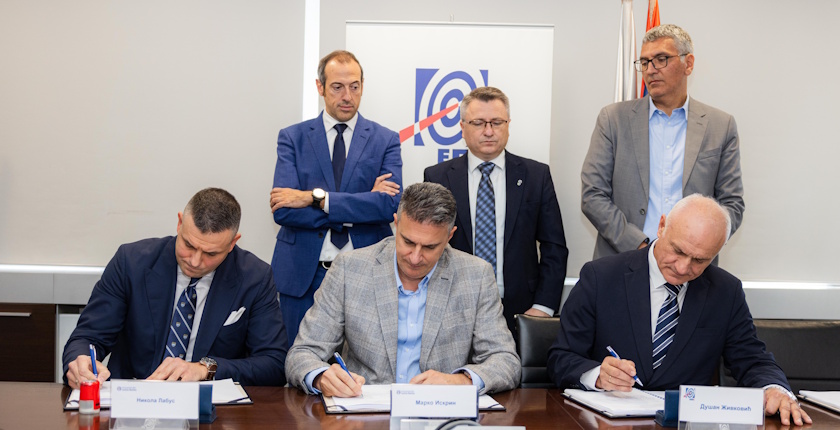
The contract for the reconstruction and modernization of the Vlasina (Vlasinske) hydropower plants (HPPs), with a capacity of 129 MW, was signed by Dušan Živković (sitting first from right), Chief Executive Officer of Elektroprivreda Srbije (EPS), and representatives of Energotehnika Južna Bačka – Marko Iskrin (second from left), Executive Director for Technical Affairs, and Nikola Labus (first from left), Deputy Executive Director for Financial Affairs.

Of note, in mid-July, Hungarian state-owned energy company MVM became the majority owner of Energotehnika – Južna Bačka.

The total value of the project is estimated at EUR 109.7 million. It envisages the reconstruction and modernization of generation units, auxiliary systems, and hydromechanical equipment. The main equipment suppliers are Andritz Hydro and Gamesa Electric, EPS said.

Financing has been secured through a EUR 67 million loan from the European Bank for Reconstruction and Development (EBRD), a EUR 15.4 million grant from the European Union via the Western Balkans Investment Framework (WBIF), and EPS’s own funds in the amount of EUR 27.2 million.

The capacity of the Vlasina HPPs would be increased by 8 MW

“On the day when the Vlasina HPPs celebrate their 70th anniversary, we officially start the project of their modernization. The result would be an increase in the installed capacity by 8 MW and reliable operation for the next three to four decades,” Dušan Živković underlined.

He recalled that the Vlasina HPPs are unique plants in the EPS portfolio. They operate in a cascade system, generating electricity four times one after the other and representing a significant source of peak energy.

The Vlasina HPPs began operating in 1955

According to Milan Aleksić (second from left in back row), advisor to the Minister of Mining and Energy for capital projects, investments are key to securing an electricity supply amid growing demand and the need to rely more on renewable energy sources.

Vlasina started its operations on November 6, 1955, with the commissioning of the first unit at the Vrla 1 hydropower plant.

The system consists of the Vlasina lake – reservoir, four cascade run-of-river hydropower plants, and the Lisina pumping station with the Lisina reservoir. Since the start of operation, the plants have produced more than 17 million GWh.

The signing was also attended by Francesco Corbo (first from left in back row), Regional Head of Energy for the Western Balkans and Croatia at the European Bank for Reconstruction and Development (EBRD).

Photo: EPS/Nenad Kostić
by in News

ESM secures EUR 1.5 million grant to accelerate North Macedonia’s energy transition

North Macedonia’s power utility Elektrani na Severna Makedonija has secured a EUR 1.5 million grant to strengthen its capacity and accelerate the energy transition.

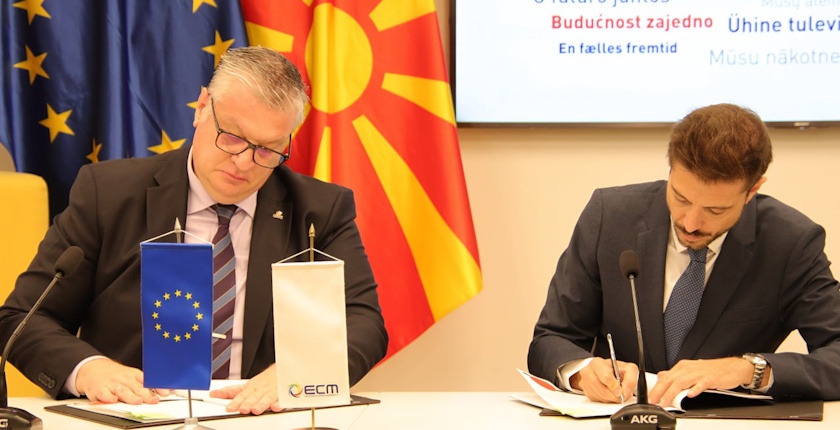
Elektrani na Severna Makedonija (ESM) made a major step toward a market-driven green transformation with a grant implementing agreement with Germany’s KfW Development Bank.

The agreement formalizes a EUR 1.5 million technical assistance grant to boost the state-owned utility’s corporate and green transition processes.

The support will strengthen ESM’s institutional and commercial capacities, enable further investments in renewable energy, and prepare the company for integration into the European energy market, according to a social media post by Steffen Hudolin, Head of Cooperation at the European Union’s Delegation to North Macedonia.

Uzunčev: The grant represents a strategic cornerstone for the company’s institutional transformation

The grant is part of a wider EUR 13 million EU programme supporting the market-oriented green transformation of state-owned energy utilities across the Western Balkans and Eastern Neighbourhood, the post reads.

Lazo Uzunčev, EMS General Manager, said that the grant represents a strategic cornerstone for the company’s institutional transformation to a comprehensive, green, and market-oriented enterprise.

Hudolin, Uzunčev, Obrador (photo: ESM)

For ESM, it is a profound commitment to becoming a modern and commercially competitive force within the European energy market, he underlined.

“The funding will be instrumental in bolstering our internal capacities and corporate governance through the financing of critical modeling and strategic planning initiatives,” Uzunčev asserted.

​Hudolin: Accelerating the green transition has never been so close and so possible

According to Steffen Hudolin, accelerating the green transition has never been so close and so possible.

“With the support of the EU and the European Fund for Sustainable Development Plus (EFSD+) guarantees, the country will receive financial means and technical guidance by our partners in KfW to accelerate the transformation and decarbonisation of the energy sector,” he stated.

Pablo Obrador Alvarez, KfW Head of Division Energy and Transport for Southeast Europe and Türkiye, said the energy transition requires fit energy utilities able to cope with challenging conditions.

“With this project, KfW will support ESM’s transformation that will position and help them improve their performance and market readiness,” he added.

by in News

Sunotec, Shell join forces to develop BESS in Europe

Sofia-based Sunotec signed an agreement with oil and gas major Shell on the development of battery energy storage systems in Central Eastern Europe.

Sunotec is developing projects for large solar and battery energy storage systems (BESS) in Europe while Shell is one of the leading oil and gas companies in the world.

Sunotec said it signed a cross-border agreement with Shell Energy Europe B.V. It marks a milestone in advancing innovative financial mechanisms for the development of battery energy storage systems in Central Eastern Europe, the Bulgaria-based company added.

The five-year agreement is linked to a 600 MW BESS project owned by Sunotec. The battery is under development and expected to enter commercial operation by Q2 2026, the update reads.

The deal helps Shell to diversify its wider power portfolio in the region

“The agreement provides long-term price stability for the project, supporting its financial viability. For Shell, the deal helps to diversify its wider power portfolio in the region. The agreement was facilitated by Enery Portfolio Optimisation,” Sunotec said.

The transaction is among the first of its kind in Central Eastern Europe and it helps to establish battery project development in the region, according to the renewables developer.

Kaloyan Velichkov, Sunotec founder and CEO, stressed that agreements like the one with Shell highlight the company’s commitment to working with leading energy players who share its vision for a sustainable and forward-looking energy future.

Velichkov: The agreement demonstrates the power of collaboration in advancing flexibility and renewable-energy driven independence

“This pioneering agreement demonstrates the power of collaboration in advancing flexibility and renewable-energy driven independence. By uniting technical expertise with financial ingenuity, we are helping to build a more resilient and integrated energy system,” he underlined.

The transaction demonstrates how cross-border cooperation and forward-looking financial mechanisms can enhance regional energy market integration and facilitate the deployment of large-scale renewable energy assets, in Kaloyan’s view.

Of note, Sunotec has been very active in the market over the last few months.

In October, the firm secured financing for a portfolio of seven projects in Bulgaria.

Three months prior, it signed an agreement with Sungrow on installing 2.4 GWh of BESS in Europe.

by in News

North Macedonia’s ESM needs investments of EUR 3 billion to replace coal power

Power utility Elektrani na Severna Makedonija estimated that it requires EUR 3 billion by 2040 to replace electricity from its lignite-fired power plants. According to member of the Board of Directors Ivan Stojanovski, the state-owned company is preparing investments in gas power plants, solar, wind, hydropower and energy storage. He highlighted its plans for a 300 MWh battery and the Bogdanci hybrid energy park.

North Macedonia’s utility Elektrani na Severna Makedonija (ESM), the country’s main electricity producer, generated 60% of the 2024 output in the Bitola and Oslomej coal plants.

A rough estimate is that ESM would have to invest around EUR 3 billion in the next 15 years to replace its power production from lignite, which is baseload energy, Ivan Stojanovski, a member of the Board of Directors and the company’s Chief Financial Officer, told Balkan Green Energy News on the sidelines of the International Forum on Energy for Sustainable Development (IFESD-14).

He explained that the transition to green energy is quite expensive. ESM needs to replace the 840 MW in baseload production that the Bitola and Oslomej thermal power plants provide, the executive added.

Hydropower is a domestic electricity source, unlike natural gas

The company opted for investments in diverse energy sources to achieve it, Stojanovski stressed.

Gas power plants provide baseload energy, but at the same time, they turn the spotlight on national security as well as the security of supply, in his words.

Lignite is currently mined in North Macedonia while natural gas must be imported, so gas supply interruption is possible, ESM’s CFO added.

Gas power plants are required, but it is necessary to invest in hydropower as it is a domestic resource, Stojanovski said. On the other hand, hydroelectric plants are more expensive and it takes longer to build them, he noted.

ESM launched the Bitola 3 solar power project

ESM is developing wind and solar power projects as well. Stojanovski highlighted the planned expansion of its Bogdanci wind farm. The European Bank for Reconstruction and Development (EBRD) is participating in the development of the Miravci wind power project, of at least 100 MW, he recalled.

The company is working on solar power projects Oslomej 1 (10 MW), Oslomej 2 (10 MW), Bitola 1 (20 MW) and Bitola 2 (60 MW), Stojanovski asserted. Bitola 3 endeavor is underway, too, and the financing contract is expected to be signed by the end of the year, he revealed.

The photovoltaic system will have at least 100 MW, Stojanovski asserted.

“We plan to sign a contract next year with Agence Française de Développement (AFD) for a solar power plant in Bogdanci of at least 30 MW and to create a hybrid energy park there – wind, solar, and a battery,” he stated.

According to Stojanovski, the company is developing a battery energy storage project with the EBRD, for up to 300 MWh in capacity. The site is within the REK Bitola coal complex and the facility will be a systemic solution for all the solar power plants there, he explained.

Blended financing as a solution

“EUR 1 billion to EUR 1.3 billion is needed just for solar, wind and batteries. We will need between EUR 500 million and EUR 700 million for gas power plants. Another EUR 1 billion to EUR 1.3 billion would be for large hydropower plants such as Čebren and Vardar Valley, and some smaller projects,” Stojanovski explained.

Asked how the company plans to secure financing, he pointed to blended financing – own sources combined with some participation from international financial institutions. It is important to diversify the sources by opening cooperation with as many financial institutions as possible, in Stojanovski’s view.

ESM traditionally cooperates with the EBRD and KfW. Stojanovski announced that the company would diversify financing by launching cooperation with the World Bank, Italy’s development bank Cassa Depositi e Prestiti, and AFD.

“It will enable us to access more sources and complement them with financing from local banks. We also tend to obtain support from the state budget over a longer period, 10-15 years, and state guarantees, but also additional funds. This is a financial model that can secure long-term and sustainable financing of infrastructure projects,” Stojanovski said.

by in News

Skopje Declaration signed as International Forum on Energy for Sustainable Development wraps up

The 14th International Forum on Energy for Sustainable Development (IFESD-14) concluded yesterday with the signing of the Skopje Declaration. During the three-day summit, North Macedonia’s capital became a global center of dialogue, ideas, and visions for the future, according to the Ministry of Energy, Mining and Mineral Resources of North Macedonia.

This year’s edition of the International Forum on Energy for Sustainable Development (IFESD-14), themed From Goals to Action: Powering the Future with Sustainable Energy, was closed in Skopje yesterday. The event was organized by the Ministry of Energy, Mining and Mineral Resources of North Macedonia, in cooperation with the United Nations Development Programme (UNDP) and the UN’s five regional commissions – UNECE, UNESCAP, UNECLAC, UNECA, and UNESCWA.

Representatives of the UN and the five regional commissions described the organization of the event as flawless, and praised North Macedonia and Skopje as excellent hosts on the global energy scene, the Ministry pointed out.

The forum brought together over 500 participants from more than 70 countries

The forum brought together over 500 participants from more than 70 countries. Over 150 speakers took part in 35 themed sessions and panels, presenting ideas, solutions, and concrete steps for the future of the global energy transition.

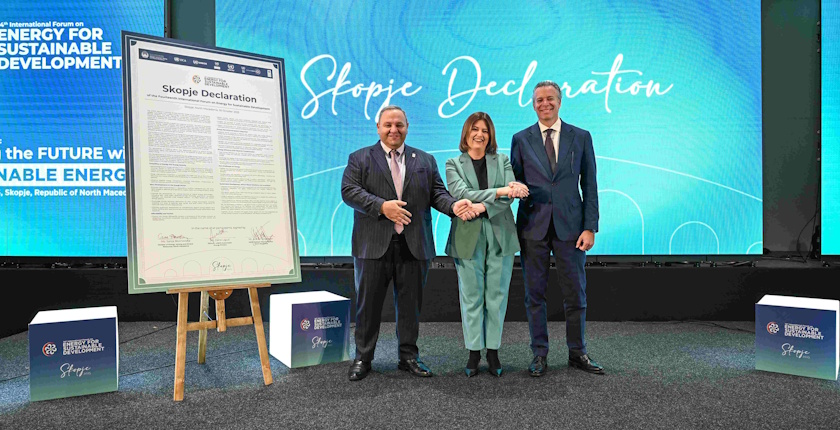
On behalf of all participants, the Declaration was signed by Minister of Energy, Mining and Mineral Resources Sanja Božinovska, UNDP Resident Representative for North Macedonia Armen Grigoryan, and Dario Liguti, Director of the Sustainable Energy Division at UNECE.

The signatories agreed that the way forward requires regional connectivity, smart investments, digital transformation, and an inclusive energy transition that leaves no one behind.

Božinovska: A new impetus for energy cooperation, solidarity, and vision

[wpcc-iframe title=”Sanja Božinovska statement on the occasion of IFEST25 Skopje and signing the Skopje Declaration” width=”500″ height=”281″ src=”https://www.youtube.com/embed/ZgcrsSuNVes?start=1&feature=oembed” frameborder=”0″ allow=”accelerometer; autoplay; clipboard-write; encrypted-media; gyroscope; picture-in-picture; web-share” referrerpolicy=”strict-origin-when-cross-origin” allowfullscreen=””]

In her closing address, Božinovska emphasized that the forum represented a turning point for the region.

“Over the past three days, Skopje has been a global stage for energy vision and dialogue on sustainable development. What we witnessed here was a wave of knowledge, cooperation, and ambition – a forum that demonstrated that when institutions, scientists, businesses, and international partners sit at the same table, change happens,” she stressed.

Božinovska emphasized that the Skopje Declaration sends a strong signal that the Western Balkan region is not just a follower of the global energy transition, but an active driver.

The future was not just discussed, but also set in motion

“I am proud that it is from Skopje, at the heart of the Balkans, that a new impetus for energy cooperation, solidarity, and vision is emerging. This is proof that North Macedonia can be a platform for ideas that will transform the region. The 14th International Forum on Energy for Sustainable Development will be remembered as the place where the future was not just discussed, but also set in motion. Let us continue to build the energy future that our citizens deserve,” said Božinovska.

Grigoryan: Skopje has demonstrated global solidarity in action

[wpcc-iframe title=”Mr Armen Grigoryan, UNDP Resident Representative, statement on IFESD25 Skopje” width=”500″ height=”281″ src=”https://www.youtube.com/embed/uH2-5cr5ju0?feature=oembed” frameborder=”0″ allow=”accelerometer; autoplay; clipboard-write; encrypted-media; gyroscope; picture-in-picture; web-share” referrerpolicy=”strict-origin-when-cross-origin” allowfullscreen=””]

Armen Grigoryan, UNDP Resident Representative for North Macedonia, said that the path to sustainable, reliable, and affordable energy is clear, but that it requires unity and vision.

According to him, it requires political will, global solidarity, and commitment.

UNDP is pleased to work together with the Government and the Ministry of Mining, Energy and Mineral Resources, as well as regional commissions, on policies, emission reduction solutions, inclusivity, and air quality improvements, according to him. UNDP invests in people and innovation to achieve measurable results that citizens can feel at home, at work, and everywhere, he added.

Liguti: The Skopje Declaration is a signal of the region’s ambition and vision

According to Dario Liguti, Director of the UNECE Sustainable Energy Division, the document signed in Skopje will remain an important reference point in global energy processes.

He said that the Skopje Declaration represents a strong signal of the regional and global cooperation and ambition, confirming the shared commitment to accelerating a just and inclusive energy transition – a transition that delivers real progress for people and the planet.

Conclusion: smart technologies, a just transition, and green investments

Božinovska, Grigorian, and Liguti (phto: Ministry of Mining, Energy and Mineral Resources)

The document states that signatories will work on integrated and inclusive energy policies; the modernization of power grids and digitalization; investments in renewable energy sources and a just transition; and the promotion of green financing and gender equality in energy.

“Together, we can transform the global energy system into one that safeguards our climate, drives innovation, ensures affordability, and delivers prosperity for all,” reads the closing paragraph of the Skopje Declaration.

by in News

First merchant battery projects in Greece to be highly profitable, study shows

Standalone battery units in Greece are expected to be profitable both in the short and the long term, according to a new study by the Aristotle University of Thessaloniki (AUTh).

The results were based on a simulation carried out for a variety of battery types, with storage durations between two and five hours. A maximum of two charge-discharge cycles per day was taken into account.

The study concerns merchant projects that rely exclusively on the market for their profitability. This means that they can generate revenue in three ways: through the daily arbitrage between the lowest and highest hourly wholesale power prices, from balancing the system and providing reserves.

Storage duration determines revenues

In the case of a battery with a capability of 10 MW and five hours of storage, the results showed a revenue of EUR 2.6 million in 2026. The amount falls after 2030 to EUR 1.6 million, which is still sufficient for investments. It remains near the same level all the way to 2037.

Revenues for a 10 MW facility with a two-hour duration are much lower. They begin at EUR 1.5 million in 2026 and decline to EUR 800,000 after 2030.

Projects will rely mostly on arbitrage after 2028

In comparison, a 10 MW project costs between EUR 2.5 and EUR 5 million to develop, depending on storage duration, according to current battery prices. Therefore, it is evident that investors would return the investment in less than 10 years. Typical systems have an operational life expectancy of 20-25 years.

“Batteries will benefit initially from high revenues through balancing and reserves provision. After the first few years, they will rely mostly on arbitrage,” said Pantelis Biskas, professor at AUTh.

Greece published a plan earlier this year to develop 4.7 GW in commercial battery storage systems. Businesses are currently moving to secure licenses and the first installations are expected to come online by 2028.

It means the projects will probably miss the initial high returns that AUTh expects. However, they will still be profitable, especially the ones with long storage duration.