by in News

Turkey pushing against rivals for transmission of green electricity to EU

Turkey’s agreement with Azerbaijan, Georgia and Bulgaria on the transmission of renewable electricity could set back the project for an interconnector under the Black Sea between Georgia and Romania. In addition, President Recep Tayyip Erdoğan’s government fiercely opposes the Great Sea Interconnector project, part of the proposed Greece-Cyprus-Israel submarine link. Turkey is also pushing against rival hydrocarbon projects around Cyprus.

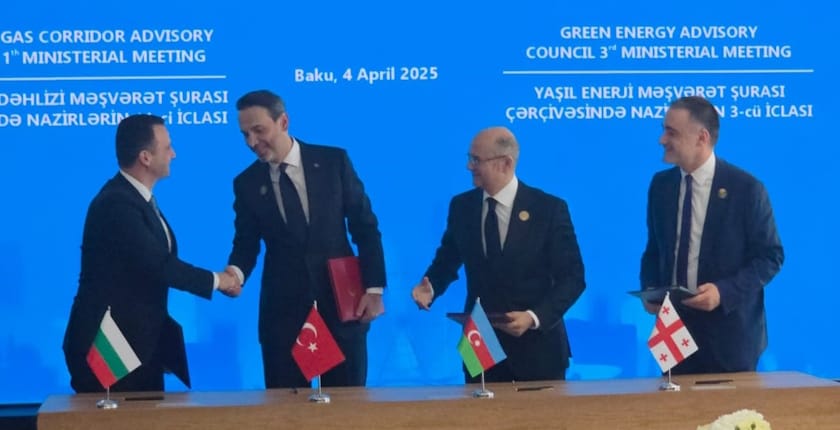
On the margins of the Southern Gas Corridor (SGC) annual meeting, a regional green energy project has come to the fore. Ministers of energy of Turkey, Bulgaria, Georgia and Azerbaijan, the host country, signed a memorandum of understanding on green electricity transmission and trade. The initiative envisages the establishment of a green energy corridor toward Europe.

The proposal for a power interconnections upgrade is an apparent competitor against a project by Romania, Georgia, Azerbaijan and Hungary. They plan to lay a high-voltage direct current (HVDC) cable under the Black Sea. Bulgaria does have a seat at the table, but even after several meetings it still hasn’t become a partner in the GECO submarine link project. The alternative onshore line through Turkey would give it a central role.

Bulgaria, which has been waiting to become a partner in the Black Sea submarine interconnection project, would get a central role in an onshore power transmission corridor that would go through Turkey

President Recep Tayyip Erdoğan’s government is determined to establish the key transmission and production hub for electricity and fossil fuels for the European Union. The new memorandum is another indicator, together with Turkey’s fierce opposition to the Great Sea Interconnector project, which is part of a proposed Greece-Cyprus-Israel submarine power link, and to hydrocarbon drilling around Cyprus.

Turkey also benefits from the TurkStream pipeline, which carries gas from Russia. It was built instead of the abandoned South Stream project, which was supposed to directly connect Russia and Bulgaria.

Studies to be commissioned by June

Turkish Minister of Energy and Natural Resources Alparslan Bayraktar said electricity from Azerbaijan and the region would reach his country via Georgia as well as Azerbaijan’s exclave of Nakhchivan. It means a line would go through Armenia.

The four energy ministers said a working group would complete the technical details and commission feasibility studies already by June.

Azerbaijani President Ilham Aliyev said his country would add 6.5 GW of renewable energy capacity by 2030, compared to the current 8 GW, from all sources. One of the biggest private investors is Abu Dhabi Future Energy Co. (Masdar).

TANAP’s capacity to be doubled

Turkey is diversifying its energy supply, Bayraktar noted. “Our natural gas imports from Turkmenistan, which started on March 1, are an important step towards the goal of securing our own supply while also carrying Central Asian energy to European markets,” he stated.

The minister highlighted the goal to increase the capacity of the Trans Anatolian Natural Gas Pipeline (TANAP), part of the Southern Gas Corridor, to 31 billion cubic meters per year from 16 billion.

Tensions rising as seabed survey for Great Sea Interconnector to resume

The NG Worker vessel is returning to carry out seabed surveys east of Greece’s Kasos-Karpathos island area, Energypress reported. The activity, part of the Great Sea Interconnector, was interrupted again in February after a Turkish corvette approached the ships NG Worker and Ievoli Relume.

After research was completed in the territorial waters of Greece and Cyprus, the last section is in international waters. Türkiye Gazetesi learned from security sources that Turkey wouldn’t allow “such a fait accompli.” The unnamed sources said the seabed survey is a breach of international law.

The power link project has also faced delays due to disputes around financing and it still risks losing a massive EU funding package. Turkey is promoting the idea of a cable connecting Cyprus to its own electricity transmission network instead.

by in News

Cypriot minister not optimistic about cable project with Greece amid Turkish intimidation

Cypriot Minister of Finance Makis Keravnos said the Great Sea Interconnector (GSI) project still faces very serious political obstacles. He highlighted the pressure from Turkey, alongside the financing disputes with Greece regarding the EU-backed bilateral investment to lay an undersea electricity cable that would connect the two countries.

Following a second incident this month when Turkish navy intimidated ships researching the seabed, Minister of Finance of Cyprus Makis Keravnos expressed doubt in the feasibility of the Great Sea Interconnector (GSI). It is a project to connect his country’s electricity system with Greece’s through Crete, by laying a cable under the sea.

“I can’t say I’m optimistic, especially when there are still very serious political obstacles, namely those posed by Turkey,” the official said, as quoted by domestic media. Namely, Turkish corvette TCG Bartın has approached Ievoli Relume and NG Worker, Italian vessels conducting research for the interconnection, in international waters just north of Crete.

GSI investment concerns now have to be addressed

Nevertheless, a recent due diligence study by a hired foreign consultancy showed the draft bilateral deal heavily favors Greece’s Independent Power Transmission Operator (IPTO or, in Greek, Admie). The authors warned of an “unnecessary additional layer of risks for any equity investors in GSI.”

Keravnos said the document confirms his concerns and that they must be discussed. While the two sides are working to overcome their financing dispute, the project is suffering delays, increasing the risk of cancellation.

Keravnos said in October that the total cost could well surpass EUR 2 billion. The Crete-Cyprus part is substantially leaning on funding from the European Union. The idea was to later extend the interconnector to Israel.

Turkey has been obstructing both GSI surveys and hydrocarbon exploration around Cyprus. There were several incidents involving gunboats.

Cyprus craves interconnections, flexibility sollutions

Meanwhile, Cyprus is struggling to maintain the stability of its isolated electricity system. Oil-fired power plants are increasingly working near their upper limits in peak hours. Conversely, storage capacities, flexibility systems and digital controls are needed for mitigating the pressure on the grid at times of weather-induced jumps in the production of wind and solar power, but also sharp drops.

It is the only noninterconnected country in the European Union. Moreover, Cyprus has no access to natural gas yet.

GSI was formerly known as EuroAsia Interconnector.

by in News

Greece’s IPTO connects to balancing energy platform PICASSO

The Independent Power Transmission Operator of Greece announced that it connected to PICASSO. It is the second transmission system operator or TSO in Southeastern Europe that joined the European platform, so now it can exchange balancing energy with its counterpart in Bulgaria. In addition, IPTO (or Admie, in Greek) has proposed the introduction of negative prices in the domestic balancing market.

The Platform for the International Coordination of Automated Frequency Restoration and Stable System Operation (PICASSO) optimizes balancing energy between control blocks in the Continental Europe synchronous area. Bulgaria’s Electricity System Operator (ESO) joined last month, but it was isolated as it didn’t share electrical borders with any other operational member. Neighboring Greece’s transmission system operator IPTO (or, in Greek, Admie), has just connected to the platform, so the two countries can now exchange balancing energy.

Denmark, Germany, Belgium, the Netherlands, Czech Republic, Slovakia, Austria and Italy are a geographically separate group within PICASSO. Lithuania’s Litgrid joined earlier this month.

Key step for common European energy market

By becoming the 14th operational member, IPTO made a key step in the process of formation of a resilient and efficient common European energy market, the statement adds. The PICASSO methodology and algorithm are intended primarily for the cross-border provision of secondary reserve so that the electricity grid’s operating frequency remains stable.

There are 29 TSOs from the European Network of Transmission System Operators for Electricity – ENTSO-E in the project. Additionally, North Macedonia’s MEPSO, which has electrical borders with both Bulgaria and Greece, is an observer in PICASSO. The platform doesn’t include the rest of the Western Balkans.

With the latest achievement, IPTO and ESO can jointly benefit from the automatic frequency restoration reserve (aFRR). Romania has been delaying its connection to PICASSO.

The platform collects and rates all available offers for balancing energy from aFRR according to their prices, placing them into a common merit order list – CMOL.

PICASSO helping reduce number of balancing price spike events

The new method for calculating cross-border marginal prices on PICASSO has greatly improved performance as the number of instances of electricity balancing price spikes dropped, according to European Union Agency for the Cooperation of Energy Regulators (ACER). Integrating balancing markets across borders lowers costs and improves efficiency by allowing TSOs to activate cheaper balancing energy bids, the body explained.

In other relevant news, IPTO has proposed the introduction of negative prices in the balancing market in Greece of EUR 50 per MWh at most for one year, Energypress reported. The change would enter into force on allocation day April 10, ahead of Easter, a critical moment for grid stability.

The TSO said the limit should be boosted to EUR 15,000 per MWh after joining PICASSO.

by in News

Bulgaria aims to make Europe’s biggest energy community

The Ministry of Energy, Electricity System Operator (ESO) and the Bulgarian Development Bank (BDB) are launching a solar power program for municipalities, schools, kindergartens, hospitals and small businesses. There are no upfront costs and the installations become the beneficiary’s ownership within eight years.

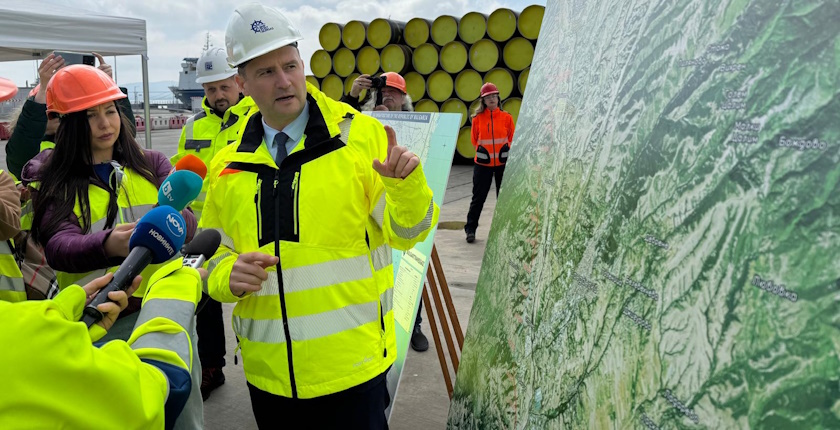
Minister Zhecho Stankov said the goal is to create the largest energy community in Europe and hinted that the government would finance the scheme with a green bond. He also declared the start of the regional Vertical Gas Corridor project in Bulgaria as the first pipes were delivered.

Every school and hospital in Bulgaria can become an electricity producer, Minister of Energy Zhecho Stankov stressed as he presented a financial support mechanism designed with the ambition to create the largest energy community in Europe. The model will benefit both the public sector and private business, he pointed out in the port city of Burgas at a ceremony marking the arrival of the first 4,000 pipes for the Bulgarian sections of the regional Vertical Gas Corridor.

The joint initiative with the country’s power transmission system operator ESO and the Bulgarian Development Bank is for the installation of solar panels with no upfront costs. Beneficiaries – municipalities, schools, kindergartens, hospitals and small businesses – would pay through energy savings and become owners in six to eight years, Stankov claimed.

Bulgaria mulls issuing green bond to finance sustainable energy

The minister also said the project could lead to the government’s first green bond to finance clean and locally produced energy available to a wide range of consumers.

For example, Burgas Municipality can equip all schools, hospitals, kindergartens and other facilities with photovoltaic panels without spending a penny from the local budget, Stankov explained.

Government to invest EUR 57 million in Vertical Gas Corridor

The Vertical Gas Corridor is envisaged to connect Greece, Bulgaria, Romania, Moldova and Ukraine. They plan to transport the fuel from liquefied natural gas (LNG) terminals Alexandroupolis and Revithoussa in Greece, and from the Caspian region, via the Southern Gas Corridor.

The government is fully funding the first stage of the project on Bulgarian territory, with EUR 57 million. The pipes for the pipelines came from India.

Stankov: Bulgaria will never again be left without natural gas

“Bulgaria will never again be left without natural gas,” said Minister Stankov. The capacity of the line between Kulata, on the border with Greece, and Kresna will be increased to 3.6 billion cubic meters per year from 2.3 billion, he added. The distance is 48.5 kilometers.

The most difficult part is between Mikrevo and Ribnik, where three kilometers will be built by horizontal drilling, the minister revealed. He explained there would be no aboveground work, so that nature and infrastructure wouldn’t be affected.

Another section, 80 kilometers, is from Rupcha to Vetrino. The purpose of the investment is to double the maximum annual flow toward Romania to 10 billion cubic meters, Stankov stressed. The last one, Tarnik-Piperovo, is 51 kilometers long.

The compressors on the corridor are reversible, allowing gas supply in both directions, the minister noted.