by in News

Turkey aims to become major lithium producer with its geothermal wells

Turkey is using only 10% of its geothermal potential, according to Chairman of the Geothermal Power Plant Investors Association (JESDER) Ufuk Şentürk. He said existing wells alone could open the way for the country to become one of the world’s major producers of lithium.

Studies are underway to determine the accessibility of valuable minerals in Turkey’s geothermal waters. There are already some one thousand wells with 100,000 tons of water coming out every hour, Chairman of JESDER Ufuk Şentürk told Anadolu Agency Energy Terminal. He pointed to the potential for the extraction of lithium, cesium, selenium and silicon.

Turkey is utilizing only 10% of its geothermal potential, Şentürk stressed. An inventory is under development of wells that were drilled to find oil and left unused, he added. The temperatures are as high as 150 degrees Celsius and the said resources can provide heat for 5,000 hectares of greenhouses, the organization’s chief said.

Researchers have found a lithium source in Turkey of 20 parts per million in geothermal water

The İzmir Institute of Technology (İYTE) and Afyon Kocatepe University have been conducting studies for two years, within the Turkish-German Energy Partnership, on obtaining minerals, Şentürk noted. He said there are 100 parts per million of lithium in one geothermal source in Germany, while 20 parts per million were found in Turkey.

Investment costs are much lower without exploratory drilling, if lithium is extracted from geothermal water already coming to the surface. The head of JESDER, Geothermal Power Plant Investors Association, estimated that Turkey could produce 35,000 tons per year and said global production came in at 36,000 tons last year.

“Even if we obtain 10%, we will still be one of the countries with the largest lithium resources in the world,” he stated.

Volumes of lithium extracted from geothermal waters are still symbolic

As Şentürk didn’t elaborate, it remains unclear if he compared the country’s potential to the output from so-called direct lithium extraction (DLE) or perhaps evaporation from brine pumped from underground. They make up one tenth and one quarter, respectively, of the 240,000 tons of lithium produced last year in the world. The rest is mined.

A different benchmark, the lithium carbonate equivalent or LCE, is almost five times larger. Additionally, about 5% of lithium ion batteries are recycled. The volumes of lithium extracted from geothermal waters are still symbolic.

Investors are betting on the combination with geothermal energy, to make lithium production cost effective, as it is found in very small quantities in underground water. Direct extraction of the alkali metal from water has an immeasurably lower environmental impact than mining.

Existing geothermal power plants can provide heat to 4,000 hectares of greenhouses

Şentürk pointed out that Turkey hosts 65 geothermal power plants of 1.74 GW overall. They generated 11.2 TWh in 2024 of the total 350 TWh.

Geothermal energy currently heats 7,000 hectares of greenhouses in Turkey and 160,000 homes, Şentürk said. The Ministry of Agriculture and Forestry is providing incentives for greenhouse zones of 2,800 hectares in total. But existing geothermal power plants alone could, with such support, provide for 3,500 to 4,000 hectares of greenhouses, the association’s chief estimated.

On a global scale, Turkey trails only the United States, Indonesia and the Philippines in geothermal power. Nevertheless, after several years of rapid growth, it only added 120 MW in capacity since 2020.

A recent study, conducted within the project called Li+Fluids, showed geothermal waters in north Germany and its Thuringia state contain between 0.39 and 26.5 million tons of lithium. The country’s demand for 2030 is projected at 0.17 million tons.
by in News

Case of Struga illegal landfill in North Macedonia goes to Strasbourg court

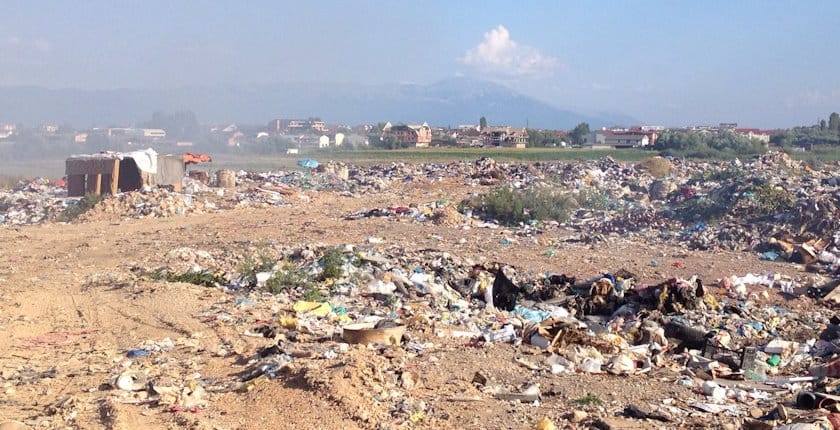
The Macedonian Young Lawyers Association (MYLA or MZMP) from Skopje said the only hope for justice regarding the issue of the illegal landfill near Struga is now outside North Macedonia. Namely, judicial authorities have declared themselves incompetent for the nongovernmental organization’s 2021 lawsuit against local and state institutions. The landfill is jeopardizing a basic human right – to a healthy environment, the young lawyers pointed out.

North Macedonian environmental and civic activists have been trying to prove in court for years that the illegal landfill at the entrance of the town of Struga is poisoning people. It is the second-largest tourist center in the country, located on the shores of Lake Ohrid. Their struggle, which began in January 2021, has not yielded results.

The Macedonian Young Lawyers Association is suing the Municipality of Struga, the Public Utility Company of Struga, and the Ministry of Environment and Spatial Planning, claiming they have done nothing to solve the serious issue. They demanded that the court bans further waste dumping and that the area be cleaned and revitalized. But instead, thousands of tons of various waste are piling up at the landfill every year, polluting the environment, air, and agricultural land, thus negatively affecting the health of citizens.

Both the Basic Court in Struga and the Appellate Court in nearby Bitola declared that the courts in the country do not have the authority to rule on the issue. It is the first such lawsuit in the country.

Courts protect government even amid human rights violations

Now the landfill issue is moving to the Court of Human Rights in Strasbourg, after a failed attempt to prove that the landfill threatens a fundamental human right, to a healthy environment, but also the right to life, as the institutions did not take measures to prevent or reduce harmful consequences.

„I have an impression that Macedonian courts have a hard time getting out of this matrix, constantly protecting state and public authorities, even when we have a situation of violation of fundamental human rights and the constitutionally guaranteed right to a healthy environment,” Gligorie Kjatoski, from the civil initiative Enough is Enough, told Balkan Green Energy News. He is involved in the dispute as a lawyer.

The two courts in North Macedonia referred to the fact that there is not a single judgment yet against the government that they could apply

„If Strasbourg establishes a violation of one of the fundamental human rights, then that will be the basis for our request to repeat the procedure before the Macedonian courts,” Kjatoski said.

According to him, there are already examples when the European Court of Human Rights acknowledged its jurisdiction for similar cases.

„The practice in Strasbourg is very clear. That no one is responsible for an illegal landfill and enormous environmental pollution is not an option. During the procedure, we submitted several judgments to the European Court of Human Rights, where a violation was established in similar situations. The Appellate Court in Bitola and the court in Struga did not take into account the practice of the European Court, claiming there were no judgments against the Republic of Macedonia that could be directly applied. But I do not know how much that argument holds up,” Kjatoski added.

One 2022 judgment of Higher Court in Serbia is example of protection from illegal landfills

In neighboring Serbia, there are cases where the courts have ruled in favor of the citizens.

„The practice of the European Court of Human Rights is that resolving issues such as this one with the Struga landfill falls within the jurisdiction of regular courts. Unlike the domestic courts, which claim that civil courts do not have the jurisdiction to play a proactive role in protecting human rights in the context of protecting the environment from illegal landfills, courts in the region do rule in favor of citizens, Kjatoski stated. He pointed to a decision by the Higher Court in Belgrade in neighboring Serbia, from September 22, 2022.

Mayor of Struga Ramiz Merko from the Democratic Union for Integration, one of the parties representing the Albanian community in the country, has promised that the problem would be solved and the landfill moved to another location. The United States Department of State blacklisted him almost two years ago.

There are 54 illegal landfills in the Republic of North Macedonia

The Struga site is than 2,000 meters from Lake Ohrid, in a fertile agricultural plain. It covers an area the size of four football fields. According to estimates, more than 40,000 tons of waste are disposed of there annually.

The landfill was established in 2006, as a temporary solution. It is more than 18 meters high and about 10 meters deep.

It is located five hundred meters from the first houses in the city of Struga and the same distance from the Black Drim river. The United Nations Educational, Scientific and Cultural Organization (UNESCO) declared the area a world natural and cultural heritage.

According to data from the Ministry of Environment and Spatial Planning, there are 54 non-standard, illegal landfills in North Macedonia. The only one that meets such conditions is the Drisla near the capital Skopje.

The only solution to the problem is seen in the closure of local and construction of regional landfills, which public officials have been promising for years. But they cannot be built due to resistance from people residing around the proposed locations.

For the waste from Struga and several other settlements in the southwest and the Pelagonia area, there are plans to build a regional landfill in the small municipality of Novaci near Bitola.

by in News

Serbian Minister of Mining and Energy Dubravka Đedović Handanović gets third mandate; Sara Pavkov takes over environment

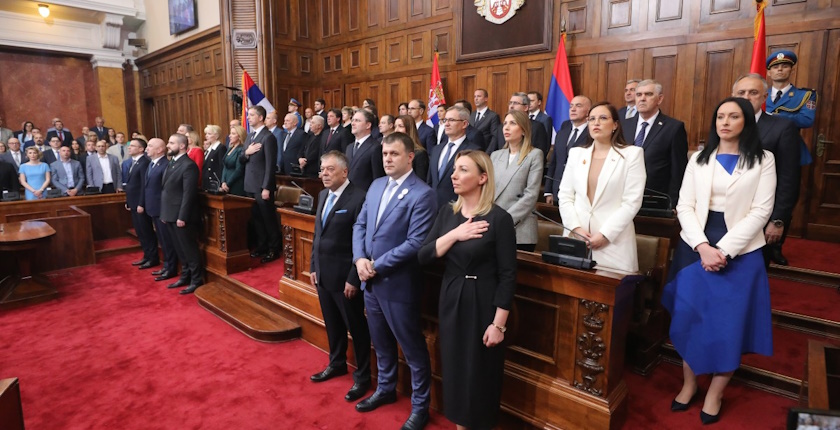
The National Assembly of Serbia reelected Minister of Mining and Energy Dubravka Đedović Handanović for her third term. The youngest member of the new cabinet, led by Prime Minister Đuro Macut, is the new Minister of Environmental Protection – Sara Pavkov.

Members of parliament voted in the new Government of Serbia today with 153 in favor and 46 against the proposal, while 51 lawmakers were absent from the session. The lineup under Prime Minister Đuro Macut, who has just entered the political arena now, includes Sara Pavkov, responsible for environmental protection. At 33, she is the youngest member of the cabinet.

Minister of Mining and Energy Dubravka Đedović Handanović was elected for her third mandate.

At 33 years old, Sara Pavkov is the youngest minister in the team of new Prime Minister Đuro Macut

Pavkov holds a graduate and master’s degree from the biology and ecology department of the University of Novi Sad Faculty of Sciences (FTN). She is a doctoral candidate and research intern at the faculty, according to her official biography.

Since 2022, she has served as a state secretary at the Ministry of Environmental Protection. Before that, she was the chief of staff since June 2021, after holding the position of special advisor for environmental protection from November 2020.

As one of the vice-presidents of the Bureau of the United Nations Framework Convention on Climate Change (UNFCCC), Sara Pavkov participated in the UN Climate Change Conference COP26 in Glasgow in 2021.

From 2013 to 2020, she coordinated more than 20 civil society projects for environmental protection. The new minister has authored or coauthored 11 scientific and professional papers in the same field.

She joined the ruling Serbian Progressive Party (SNS) since 2012. Since November 2021, Sara Pavkov has been a member of its presidency.

Third run for Dubravka Đedović Handanović as minister of mining and energy

Dubravka Đedović Handanović was first elected minister of environment and energy in October 2022 in the cabinet of Prime Minister Ana Brnabić. She was reappointed last May, when Miloš Vučević became the prime minister of Serbia.

Before becoming minister, she was a member of the Executive Board of NLB Komercijalna banka, responsible for corporate and investment banking. She has an international experience in banking of more than 16 years.

Minister Đedović Handanović, who remained in position in the new government, has worked in the EIB

Đedović Handanović has graduated in banking and finance from the Faculty of Economics in Belgrade and obtained her master’s degree in finance and management from SDA Bocconi University in Milan and the Anderson School of Management at the University of California in Los Angeles (UCLA).

She headed the Regional Office of the European Investment Bank (EIB) for the Western Balkans from 2016 to 2021, before moving to NLB Komercijalna banka.

Until the start of her tenure in Belgrade, Dubravka Đedović Handanović was the manager for Albania, North Macedonia and Serbia at the headquarters of the EIB in Luxembourg. It is the European Union’s main lending institution. She was also in charge of public-private partnership projects and project financing in countries including Ireland, France, the United Kingdom and the Benelux.

Before starting her career in banking, the reelected minister of mining and energy worked in the media and communications sector.

by in News

EU lawmakers urge for rule of law in Jadar lithium project in Serbia

A group of members of the European Parliament is asking the European Commission to demand from the Government of Serbia to comply with domestic and European law as regards Rio Tinto’s disputed Jadar lithium mining project. They pointed out that arresting and intimidating opponents who criticize the proposed investment is unacceptable. The European lawmakers invited Serbian activists to the European Parliament. Without strict rules, transparency and respect for local communities, things can end badly in mining, the Left’s Jonas Sjöstedt warned.

Rio Tinto is expecting to have its controversial lithium mining project Jadar in Serbia declared strategic by the European Union. Serbia and the European Commission have signed a memorandum of understanding for a strategic partnership in sustainable raw materials, battery value chains and electric vehicles. The Anglo-Australian mining giant’s proposed investment was met with years of fierce resistance from the local population and environmentalists.

Now a group of members of the European Parliament is also raising the issue of the persecution of activists, corruption and the risks to water, nature and public health.

Of note, Balkan Green Energy News has published a chronological overview of the key events in the development of the Jadar project since 2001, when the company arrived in Serbia.

The movement includes people from other areas in the country and neighboring Bosnia and Herzegovina with sites for the exploration of lithium and various minerals, as well as various mining operations.

Some mining companies leaving their waste behind for others to tackle

Completing their visit to Serbia, three EU lawmakers from the Left claimed that the Government of Serbia has many questions to answer about the Jadar project.

“My experience is that if you don’t put up strict demands on mining companies, if you don’t have transparency, if you don’t have respect for local communities, things can end really badly when it comes to mining,” MEP Jonas Sjöstedt stressed at a press conference.

He added that in northern Sweden, where he is from, some mining companies have extracted minerals for a short while before leaving without cleaning up first.

Sjöstedt: Multinationals take advantage of countries if they can

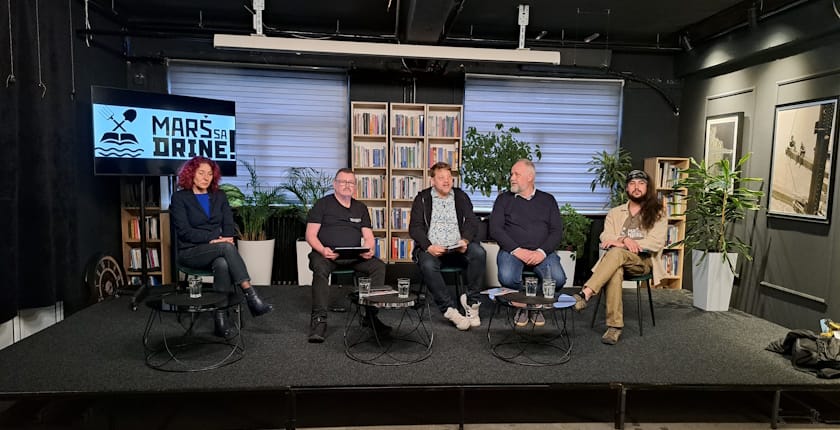
“That’s why it’s so important, so vital to listen to local communities. To have full respect for those who raise environmental concerns. And to not accept corruption or adapt legislation to the wishes of the multinational companies. Because they take advantage of countries if they have the chance,” Sjöstedt said at the event, organized by the Marš sa Drine activist group.

The environmental concerns in the Jadar area are real, especially about the quality of water for millions of people, in his view. If all the questions are not answered how toxic underground water and waste will be treated, it could be a very risky project, Sjöstedt pointed out.

“I’m also deeply worried about all the things we have heard about corruption. That it is possible for big multinational businesses to get their way with Serbian authorities by giving them economical benefits or making a contract that is not fully publicly available. I think that’s a really bad start of big industrial projects,” he asserted.

The level of intimidation against protesters including arbitrary arrests is unacceptable, according to Sjöstedt. “To be able to organize, to freely express your political will, it’s really the essence of democracy and that is what is at stake. Serbia is at a crossroads for the democratic development of the country,” he underscored.

Jadar is unique in natural harmony

The MEPs from the Left vowed to bring activists from Serbia to the European Parliament. Professor Ljiljana Tomović from the Faculty of Biology in Belgrade said at the event that the Jadar area and the adjacent Rađevina in western Serbia are one of the best examples of harmony between natural and human habitats.

They are unique, not only in Serbia, but in most parts of the Balkans, in her view. Tomović noted that more than 3,100 scientists and professors sent a letter to the European Commission to give up on the project.

All deals must be published

Rio Tinto has a long track record of environmental disasters and human rights violations, said EU lawmaker Per Clausen.

“There are legitimate reasons to meet this project with skepticism. Unfortunately, this is not an isolated case in Serbia. Other mining projects, including those financed and operated by Chinese interests, have already led to serious environmental damage and the destruction of nature. Widespread corruption and attacks on democratic rights are part of everyday reality. This is why there is no trust that Serbian authorities will prioritize the needs of local people, the environment or the preservation of nature,” he added.

Voices that should be heard are being silenced, the MEP from Denmark said.

Without democratic control over shared resources, the door opens to corruption and corporate exploitation, MEP Per Clausen warned

“This is not just about biodiversity. It’s about basic survival,” he stressed.

Without democratic control over shared resources, the door opens to corruption and corporate exploitation, Clausen warned.

“We ask the EU Commission to demand that the Serbian government complies with the law in both Serbia and the EU, and give total transparency about all elements of the deal between the EU and Serbia and the deal between the state and the mining company,” he stated.

True democracy means that natural resources belong to the people and are managed correctly for the common good, according to Clausen.

Let’s not replace fossil fuels with another form of environmental destruction

The group met with scientists, locals and representatives of the civil society. “We visited some test drillings and nothing lives around them due to the toxic substances. We cannot achieve the green transition by appeasing our industry and destroying nature and wildlife. In this process, we must not exchange environmental destruction caused by oil and gas for another form of environmental destruction,” said Sebastian Everding.

The German MEP said research should be supported to replace lithium in battery technology “with something that has less impact on the environment and the climate.”

by in News

Serbia adopts first ever rulebook on standards for wood pellets

Serbia has adopted the rulebook on solid fuels from wood biomass, which for the first time regulates the quality of pellets and briquettes on the domestic market.

The rulebook on technical and other requirements for solid fuels from wood biomass sold on the Serbian market will enter into force in three months. In the meantime, an institution needs to be established for control, compliance, and corrective measures regarding the new requirements.

The rulebook introduces technical standards and mandatory laboratory analysis, defines rules for assessing compliance, and product labeling. It envisages oversight of the levels of substances affecting health and the environment, according to the Ministry of Mining and Energy.

Ministry: Only high-quality pellets will be sold on the Serbian market, in line with the standards set by the EU

“By adopting the rulebook we want to preserve the competitiveness of the pellet industry in Serbia. This document represents a fine example of the cooperation between the authorities and the businesses,” Minister Dubravka Đedović Handanović stated.

The ministry claims that the rulebook secures that only high-quality pellets can be sold on the Serbian market in line with the standards applicable in the European Union.

For the first time, the physical and chemical characteristics of wood pellets will be controlled

According to the Chamber of Commerce and Industry, only pellets with positive results from laboratory analysis and the kinds that meet strict standards on harmful substances will be allowed on the market in Serbia.

“For the first time our authorities would control physical and chemical characteristics of wood pellets such as size, shape, stability, caloric values, moisture, and ash level,” the association of Serbian firms added.

The same will apply to the substances affecting human health and the environment including heavy metals – arsenic, cadmium, chromium, copper, lead, mercury, nickel, zinc, sulfur, and nitrogen.

The association recalled that the ministry established the working group for the preparation of the rulebook upon its initiative.

by in News

Activists in northeastern BiH to obstruct Majevica lithium mining project

Switzerland-based Arcore and Canadian company Rock Tech Lithium are planning to excavate lithium, boron and magnesium ore and process it near Lopare in northeastern Bosnia and Herzegovina. Citizens and activists from the area surrounding the Majevica mountain are opposing the project, together with people from the border area in neighboring Serbia.

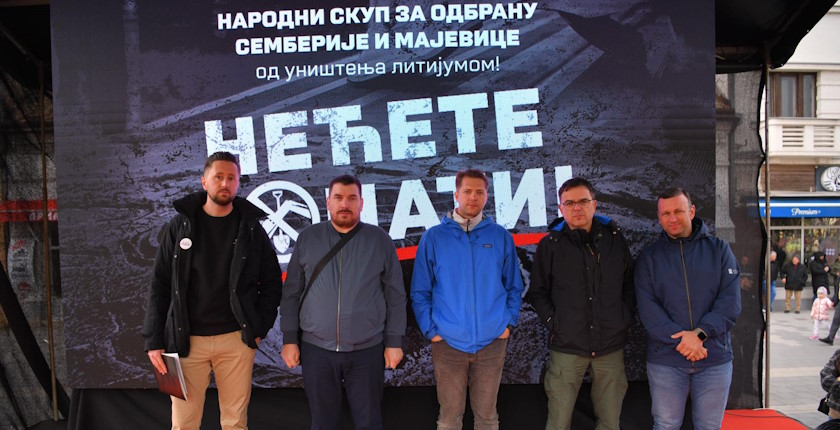
Supported by the local authority, citizens from both entities in BiH and environmental activists have gathered in the city of Bijeljina at another protest against the plans to mine lithium as well as rare metals. Among the participants were the inhabitants of border areas in neighboring Serbia, where Rio Tinto is developing a controversial project for mining and processing jadarite, a unique lithium mineral. Based on the results of its exploration, Swiss firm Arcore submitted a request to the Government of the Republic of Srpska in February for a concession for a mine on the Majevica mountain.

Around the same time, it also agreed with Canadian company Rock Tech Lithium to establish a joint venture that would include the location in northeastern BiH.

Investors want to produce lithium sulfate on site

According to the partners, they plan to start delivering in 2030 the lithium sulfate produced on site to Rock Tech Lithium’s future converter in Guben, Germany. The facility would process the raw material to get battery-grade lithium hydroxide.

The lithium, boron and magnesium deposit is in Lopare municipality, they added. The investment in Brandenburg was in the final financing phase when the agreement was signed, the two companies have revealed. They estimated that 600,000 tons of lithium carbonate equivalent can be obtained from the proposed mine.

The next step is to complete the prefeasibility study. Rock Tech Lithium holds 75% of the JV. Arcore claims that the location contains at least two million tons of lithium carbonate and that it can be exploited for 65 years.

In addition, President of the Republic of Srpska Milorad Dodik said in early March that the entity and Hungary are preparing an agreement on mining rare metals.

Bijeljina, Lopare and Majevica are all in the Republic of Srpska. The country’s other entity is called the Federation of Bosnia and Herzegovina, where activists in the nearby city of Tuzla and municipalities like Čelić are warning of the potential environmental impact of lithium mining and other shady projects.

Environmentalists demand Majevica to be protected as nature park

Environmentalist groups earlier requested from the Republic of Srpska to impose a moratorium on geological exploration and mining on the mountain.

Environmentalist associations submitted a petition with over 6,000 signatures for a moratorium on geological exploration and mining in Majevica

“This gathering was envisaged to have a regional character as today the citizens of several cities and municipalities have come together. Entire northeastern BiH is in the scope, as Majevica is our joint mountain. We all share the same water, same air and we live on the same land. We organized a civic initiative and we collected more than six thousand signatures and demanded for Majevica to become a nature park,” said Snežana Jagodić Vujić from the Eko put association based in Bijeljina.

In her opinion, the rich part of the world is building for its clean energy while destroying the environment and people in the poorer part of the world.

Semberija plain and Sava basin area are under threat as well

Head of the Municipality of Lopare Rado Savić said opening a mine in Majevica would jeopardize Lopare as well as Semberija, Posavina – areas around the river Sava, all wildlife downstream from its tributary Gnjica, and the Janja, which flows into the Drina river. “Unless there are other development projects, we don’t need mining either,” he added.

Machines shall not pass through any village, Adi Selman from Tuzla-based activist group Karton revolucija told the crowd. “We promise tonight that, if it is necessary, we will be chasing them away with our pickaxes and hoes and that, even if we are left all alone in this world, we will never give up on the fight to save our Majevica, Semberija and Posavina”, he stressed.

There is no rich mining town in the world and no lithium mine near a populated place or in a nature park, Bijeljina Mayor Ljubiša Petrović claims. “We won’t allow a handful of strongmen to destroy, for other people’s interests and profits, what was created for generations – our water, land and life,” he stated.