by in News

Turkey-based Yıldırım building 109 MW solar park in Kosovo* for its ferronickel plant

Yıldırım Energy laid the foundation stone in Kosovo* for the first phase of its 150 MW solar farm. The Turkish company intends to produce electricity for its ferronickel plant, which exports its entire output.

A renewable energy investment of more than EUR 43 million is underway in Gllogovc (also known as Glogovac and Drenas). Yıldırım Group’s subsidiary Yıldırım Energy marked its expansion to Kosovo* by inaugurating the construction works on a 109 MW solar park.

The facility will reduce electricity costs and facilitate sustainable production at the NewCo Ferronikeli plant, its General Manager Cemil Acar said. The ferronickel production complex exports all its products, he pointed out. The photovoltaic plant is due to come online early next year, he revealed.

Company’s solar park is among largest ones in construction in Western Balkans

Using renewable energy in production would enable the group to be exempted from paying the European Union’s CO2 import levy, imposed through the Carbon Border Adjustment Mechanism or CBAM. Ferronickel is a ferroalloy, consisting of iron and nickel.

With the new photovoltaic plant, the group will get cheap electricity for its production lines and it can also exempt it from the EU’s carbon border tax system

Separately, the government in Prishtina said the first section of the solar power plant would have over 54 MW in capacity. The company’s target is to reach 150 MW by 2026, it added. It would make it the biggest in the Western Balkans so far, though Solar Energy Group Europe (SEGE) said a year ago that it launched the construction of an agrisolar power plant of 150 MW in peak capacity in Gjakova (Đakovica), also in Kosovo*.

The Ministry of Economy recently completed its first solar power auction, for a plant of up to 117 MW in peak terms. In comparison, government-controlled power utility Kosovo Energy Corp. (KEK) has a PV project of 120 MW underway. The facility will be built at a former ash dump of its Kosovo A power plant.

Energy crisis knocked out Ferronikeli in 2021

NewCo Ferronikeli resumed production last June after a break of almost two years. It was caused by a surge in electricity prices amid the energy crisis. The group entered ownership in 2022.

Yıldırım Energy trades power and gas, conducts electrification services and produces renewable energy, focused on hydropower, solar and wind. The firm is building a solar panel plant in Kocaeli in Turkey, according to its website. It also operates in North Macedonia and Albania.

The group, founded in 1963, is active in 57 countries. Its operations are based in Istanbul and the financial headquarters are in Amsterdam.

* This designation is without prejudice to positions onstatus and is in line with UNSCR 1244/99 and the ICJ Opinion on the Kosovo declaration of independence.
by in News

Kosovo* invites firms to qualify for 100 MW wind power auction

The Ministry of Economy of Kosovo* started the first phase of the first of two planned auctions for wind power. The target capacity for the first round is 50 MW to 100 MW, out of a total of 150 MW.

Qualified companies can submit documentation for the first wind power auction in Kosovo*. They will bid for power purchase agreements (PPAs) and contracts for difference (CfDs) with a duration of 15 years.

The Ministry of Economy said the target capacity in the first round is 50 MW to 100 MW. The auction plan envisages two auctions of an overall 150 MW.

At the presentation, officials announced that it is receiving prequalification documentation by February 20. The ministry aims to publish the list of eligible firms in March. The schedule showed that final bids would be opened in August and the winners declared in September.

Maximum bidding price is EUR 80.2 per MWh

Companies will be obligated to design, build, operate, maintain and decommission wind parks. The maximum price is EUR 80.2 per MWh and the lowest bid, submitted excluding value-added tax, shall win.

According to an earlier brochure, the accepted price will be adjusted every 12 months, based on the inflation rate for the sector.

The Law on Renewable Energy Sources stipulates that the contracts would be converted into CfDs twelve months after the establishment of a day-ahead electricity market price in Kosovo*, the document reads. In addition, balancing responsibility is limited to imbalance volumes greater than 10%. Curtailment is subject to financial compensation.

Kosovo* has extraordinary wind energy potential, Minister of Economy Artane Rizvanolli said. Around 17% of the territory has winds of above six meters per second, while in mountainous areas they reach eight meters per second, she added.

Wind capacity factors range between 28.2% and 32.2%, translating to as much as 2.82 GWh in annual output per 1 MW of installed capacity, the ministry said.

Wind power auction winners to establish public-private partnership with government

Other earlier documents reveal that individual wind projects would be run by special purpose vehicles (SPVs), firms where the government would have a share of up to 49%. The Ministry of Economy intends to use the funds from the International Monetary Fund’s Resilience and Sustainability Facility (RSF) in the development of the 150 MW. The purpose of the public-private partnership scheme is to reduce risk for private investors.

Applicants are required to provide a guarantee of EUR 7,000 per MW of proposed capacity. Winners will be obligated to submit guarantees of EUR 70,000 per MW.

Eligible companies have a net worth of at least EUR 30,000 over the last three calendar years and a minimum annual turnover of EUR 25,000 in the same period.

Kosovo* hosts just three wind power facilities: Selac, also known as Bajgora (104.1 MW), Kitka (32.4 MW) and Golesh (1.35 MW).

Of note, Millennium Challenge Account Kosovo has just invited qualified companies to respond to the prequalification call for a battery storage project. The government earlier said it was planning auctions for 950 MW including battery storage within two years.

The first solar power auction was completed in April.

* This designation is without prejudice to positions onstatus and is in line with UNSCR 1244/99 and the ICJ Opinion on the Kosovo declaration of independence.
by in News

Greece presents 3.55 GW plan for standalone batteries

A new ministerial decree sets the framework for the installation of 3.55 GW of energy storage – standalone batteries, without subsidies.

The new framework for batteries, presented by the Ministry of Environment and Energy, is under public consultation.

It drastically increases the ambition, originally for between 2 GW and 2.5 GW. Now the government aims for 2.65 GW of batteries in the transmission grid plus another 900 MW in the distribution grid.

It should be noted that the Greek National Energy and Climate Plan (NECP) calls for 4.3 GW of storage by 2030. So far, 900 MW was allocated through auctions, which means that all the rest would be under the scope of the new plan. The difference is that there are no more subsidies, as battery storage is considered a mature technology.

Strict completion times for new standalone batteries

To participate in auctions, batteries will need to provide at least two hours of storage. The new projects will face strict completion deadlines, including 14 months for grid connection terms. Otherwise, investors will lose the EUR 200,000 per MW letter of guarantee required for projects in the transmission network and EUR 50,000 per MW in distribution.

Another interesting aspect is the inclusion of a competition restriction. Each company would be able to submit applications for a maximum 200 MW in combined capability.

Capability quota split among several categories

Future auctions for standalone batteries will be divided into categories.

In the transmission network, 500 MW was allocated to projects with power purchase agreements (PPAs) of at least eight years with energy intensive industries.

Another 100 MW is set for batteries of over 10 MW each, also with private PPAs.

There is a 250 MW quota for batteries in coal regions. The largest part, 1.8 GW, is for other projects

When it comes to the distribution level, 400 MW is for battery energy storage systems (BESS) of at least 5 MW apiece.

The categories of 1 MW to 5 MW, and under 1 MW, have quotas of 200 MW each. The ministry envisages 100 MW for investments with PPAs signed with businesses or industrial production facilities.

The regions of Central Macedonia and Western Macedonia account for the largest shares of the planned operating power, 300 MW each.

by in News

Greek renewables sector slams curtailments bill for not including compensation

Power network operators won’t need to compensate renewable energy producers in Greece for curtailments, according to the latest bill of law. It prompted reactions in the renewable energy market.

The bill, submitted for public consultation, received damning remarks from the Hellenic Wind Energy Association (HWEA or ELETAEN) and various other bodies and corporations for the provisions regarding curtailments.

The country’s two operators wouldn’t be obligated to pay compensation. It should be noted that last year curtailments rose by 277% and reached 3.3% of all renewable production in Greece. They are projected to reach new highs in 2025.

The issue primarily plagues larger plants including wind farms, as they have the technical ability to respond to curtailment orders from the Independent Power Transmission Operator (IPTO or Admie). Conversely, smaller photovoltaic facilities connected to the grid of the Hellenic Distribution Network Operator (HEDNO or DEDDIE) have no such telemetering equipment, so they produce freely at all times.

Indeed, Greek authorities aim to make such systems mandatory in smaller renewables plants to be able to curtail them, to maintain system stability, especially during the days of Easter. If an owner fails to make necessary changes, they would be subject to a high penalty, yet to be determined.

Producers point to European law for compensation

HWEA expressed the belief operators should be exempted from compensation only if a proper framework is established that compensates larger producers for curtailments. In practice, it means any revenue collected from the penalties should be used as compensation for other producers.

HWEA: Producer compensation mechanism is necessary

The association added that compensation is obligatory under European law and therefore needs to be included in the regulatory framework.

“The only right way is for the government to conclude the long-awaited framework and introduce a specific producer compensation mechanism,” HWEA pointed out.

Cero Generation Holdings Greece said it is very concerned about proposals for IPTO and HEDNO not to be obliged to provide any compensation.

Curtailment responsibility shifted to aggregators

Another issue concerns the role of renewable energy aggregators, which represent groups of smaller producers in the market. Both HWEA and Elpedison said it is the operators that need to enforce and manage curtailments, and not aggregators, as in the proposed law.

With such measures, aggregators will face increased costs as well as the possibility of having their license recalled if they cannot carry out their new duties, the company pointed out.

by in News

Greece’s IPTO connects to balancing energy platform PICASSO

The Independent Power Transmission Operator of Greece announced that it connected to PICASSO. It is the second transmission system operator or TSO in Southeastern Europe that joined the European platform, so now it can exchange balancing energy with its counterpart in Bulgaria. In addition, IPTO (or Admie, in Greek) has proposed the introduction of negative prices in the domestic balancing market.

The Platform for the International Coordination of Automated Frequency Restoration and Stable System Operation (PICASSO) optimizes balancing energy between control blocks in the Continental Europe synchronous area. Bulgaria’s Electricity System Operator (ESO) joined last month, but it was isolated as it didn’t share electrical borders with any other operational member. Neighboring Greece’s transmission system operator IPTO (or, in Greek, Admie), has just connected to the platform, so the two countries can now exchange balancing energy.

Denmark, Germany, Belgium, the Netherlands, Czech Republic, Slovakia, Austria and Italy are a geographically separate group within PICASSO. Lithuania’s Litgrid joined earlier this month.

Key step for common European energy market

By becoming the 14th operational member, IPTO made a key step in the process of formation of a resilient and efficient common European energy market, the statement adds. The PICASSO methodology and algorithm are intended primarily for the cross-border provision of secondary reserve so that the electricity grid’s operating frequency remains stable.

There are 29 TSOs from the European Network of Transmission System Operators for Electricity – ENTSO-E in the project. Additionally, North Macedonia’s MEPSO, which has electrical borders with both Bulgaria and Greece, is an observer in PICASSO. The platform doesn’t include the rest of the Western Balkans.

With the latest achievement, IPTO and ESO can jointly benefit from the automatic frequency restoration reserve (aFRR). Romania has been delaying its connection to PICASSO.

The platform collects and rates all available offers for balancing energy from aFRR according to their prices, placing them into a common merit order list – CMOL.

PICASSO helping reduce number of balancing price spike events

The new method for calculating cross-border marginal prices on PICASSO has greatly improved performance as the number of instances of electricity balancing price spikes dropped, according to European Union Agency for the Cooperation of Energy Regulators (ACER). Integrating balancing markets across borders lowers costs and improves efficiency by allowing TSOs to activate cheaper balancing energy bids, the body explained.

In other relevant news, IPTO has proposed the introduction of negative prices in the balancing market in Greece of EUR 50 per MWh at most for one year, Energypress reported. The change would enter into force on allocation day April 10, ahead of Easter, a critical moment for grid stability.

The TSO said the limit should be boosted to EUR 15,000 per MWh after joining PICASSO.

by in News

Applications open for ninth Energy Community Summer School in Kotor

The Energy Community Secretariat is organizing its ninth Energy Community Summer School for young professionals in the energy sector. It will be held from July 19 to 26 in Kotor, at the Faculty of Maritime Studies of the University of Montenegro.

The Energy Community Summer School focuses on energy sectors in transition, particularly in Southeast and Eastern Europe. It offers young people a unique opportunity to explore the technical, economic, political, legal, and other aspects of energy transition.

The goal is to enable participants to understand the energy sector and promote skill development in all energy-related topics. The program includes a combination of courses, guest lectures, social, and cultural activities. Alongside theoretical elements, it provides practical training through case studies and mock cases.

The application deadline is March 31

The application process involves filling out a form that includes a CV and a short paper of up to five pages. In it, each candidate should present and briefly analyze current issues in energy policy related to economic implications, technical aspects of energy production, political implications and energy diplomacy, legal aspects, or sustainability of energy systems.

Postgraduate students (master’s and PhD), researchers from various fields, and professionals from government institutions, energy companies, and NGOs under 35 years of age are eligible to apply. Successful candidates will be selected by the Energy Community Secretariat in consultation with a network of academic and research institutions from participating countries. A total of 40 participants will be chosen.

The Energy Community Summer School is accredited, and participating students  can earn three ECTS credits.

Adrian Jasimi, the organizer of the Summer School, said its success lies in its ability to unite future leaders in the energy sector, encourage diverse perspectives, and inspire lasting connections. “It’s not just about knowledge; it’s about shaping the future of energy together,” he said.

The Energy Community Secretariat covers all costs

The Energy Community Secretariat covers all program-related expenses, including lectures, accommodation, excursions, and most meals. In addition to European Union citizens, participation is free for citizens of Albania, Armenia, Azerbaijan, Bosnia and Herzegovina, Georgia, Kosovo*, Moldova, Montenegro, North Macedonia, Norway, Serbia, Ukraine, the United Kingdom, and Turkey.

Energy Community contracting parties take turns hosting the Summer School each year. Last year it was held in Chișinău, the capital of Moldova.

* This designation is without prejudice to positions onstatus and is in line with UNSCR 1244/99 and the ICJ Opinion on the Kosovo declaration of independence.
by in News

Eurowind Energy signs virtual PPA in Romania with automotive manufacturer

Denmark-based Eurowind Energy signed a 12-year virtual power purchase agreement (PPA) with Autoliv in Romania, for the supply of electricity from the Pecineaga wind park. The automotive manufacturer headquartered in Stockholm also signed one such deal for a solar park in Finland.

The strongest wind turbines in Romania will generate electricity for Autoliv, which makes safety systems for vehicles including airbags and seatbelts, as well as steering wheels and other components. Eurowind Energy will supply the energy from its Pecineaga wind power plant for 12 years under a virtual PPA. In addition, the Swedish automotive manufacturer has another new contract in Finland.

Eurowind Energy recently completed the construction of all eight SG 6.6-170 turbines at the site in Northern Dobruja (Dobrogea in Romanian). However, the 48 MW wind farm is expected to become operational by 2027, according to an update from Autoliv.

PPAs essential for project development for Eurowind Energy

Estimated annual output is 176 GWh, equivalent to the electricity needs of 48,000 Romanian households. The investment is worth EUR 79 million. Eurowind Energy, based in Hobro, Denmark, is one of the biggest wind and solar power developers in Romania.

The company is also a partner in the construction of a giant photovoltaic plant in Bulgaria. The Tenevo facility is planned to be combined with a future wind park and a battery energy storage system into a hybrid power plant.

“PPAs are essential in developing new energy parks. Power purchase agreements with large, ambitious companies like Autoliv ensure the continuous development of new parks and a cleaner future for all of us,” Commercial Director Jesper Schaumburg-Düring said. Eurowind Energy is 50% owned by EWE Holding while Norlys Holding controls the other half.

Autoliv is combining wind with solar in different countries to optimize electricity production

Autoliv’s other new virtual PPA, also for 12 years, is with Alight, for a proposed solar power plant of 100 MW in peak capacity. The two deals are important for ensuring a consistent and reasonably priced energy supply for the manufacturer’s activities in Europe, reducing the risks associated with potential future energy price fluctuations, the announcement reads.

“The innovative approach of combining solar and wind technologies ensures optimal energy generation during both day and night. This approach and the fact that the facilities are located in two different European countries provides flexibility in Autoliv’s physical operations and electricity procurement,” the company added.

The PV park in Eurajoki, Finland is supposed to come online in 2026. Autoliv revealed that it intends to “contract a majority of the clean electricity produced.” Construction is set to start during the spring, the statement adds.

“Through these initiatives, we support our ability to supply customers seeking sustainable products and we take a significant step forward in achieving our climate targets for the European operations,” said Autoliv Europe’s President Magnus Jarlegren. The company aims to achieve carbon neutrality in own operations by 2030 and net zero emissions across the supply chain by 2040.

by in News

Bulgaria aims to make Europe’s biggest energy community

The Ministry of Energy, Electricity System Operator (ESO) and the Bulgarian Development Bank (BDB) are launching a solar power program for municipalities, schools, kindergartens, hospitals and small businesses. There are no upfront costs and the installations become the beneficiary’s ownership within eight years.

Minister Zhecho Stankov said the goal is to create the largest energy community in Europe and hinted that the government would finance the scheme with a green bond. He also declared the start of the regional Vertical Gas Corridor project in Bulgaria as the first pipes were delivered.

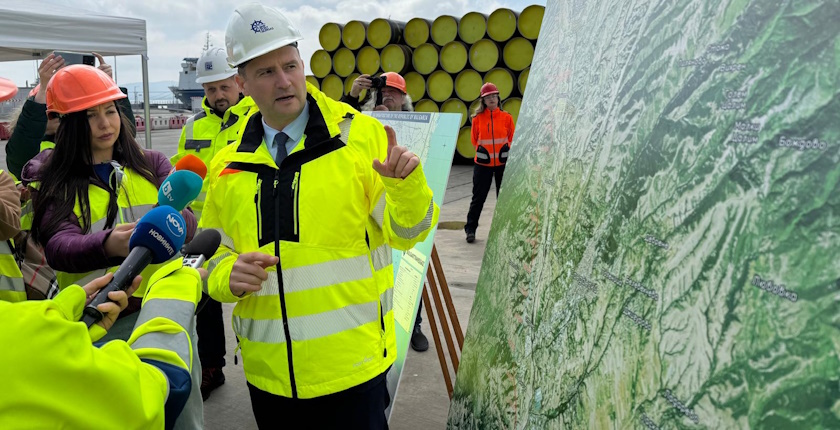
Every school and hospital in Bulgaria can become an electricity producer, Minister of Energy Zhecho Stankov stressed as he presented a financial support mechanism designed with the ambition to create the largest energy community in Europe. The model will benefit both the public sector and private business, he pointed out in the port city of Burgas at a ceremony marking the arrival of the first 4,000 pipes for the Bulgarian sections of the regional Vertical Gas Corridor.

The joint initiative with the country’s power transmission system operator ESO and the Bulgarian Development Bank is for the installation of solar panels with no upfront costs. Beneficiaries – municipalities, schools, kindergartens, hospitals and small businesses – would pay through energy savings and become owners in six to eight years, Stankov claimed.

Bulgaria mulls issuing green bond to finance sustainable energy

The minister also said the project could lead to the government’s first green bond to finance clean and locally produced energy available to a wide range of consumers.

For example, Burgas Municipality can equip all schools, hospitals, kindergartens and other facilities with photovoltaic panels without spending a penny from the local budget, Stankov explained.

Government to invest EUR 57 million in Vertical Gas Corridor

The Vertical Gas Corridor is envisaged to connect Greece, Bulgaria, Romania, Moldova and Ukraine. They plan to transport the fuel from liquefied natural gas (LNG) terminals Alexandroupolis and Revithoussa in Greece, and from the Caspian region, via the Southern Gas Corridor.

The government is fully funding the first stage of the project on Bulgarian territory, with EUR 57 million. The pipes for the pipelines came from India.

Stankov: Bulgaria will never again be left without natural gas

“Bulgaria will never again be left without natural gas,” said Minister Stankov. The capacity of the line between Kulata, on the border with Greece, and Kresna will be increased to 3.6 billion cubic meters per year from 2.3 billion, he added. The distance is 48.5 kilometers.

The most difficult part is between Mikrevo and Ribnik, where three kilometers will be built by horizontal drilling, the minister revealed. He explained there would be no aboveground work, so that nature and infrastructure wouldn’t be affected.

Another section, 80 kilometers, is from Rupcha to Vetrino. The purpose of the investment is to double the maximum annual flow toward Romania to 10 billion cubic meters, Stankov stressed. The last one, Tarnik-Piperovo, is 51 kilometers long.

The compressors on the corridor are reversible, allowing gas supply in both directions, the minister noted.

by in News

Number of prosumers in Romania spikes 79% in one year to 204,000

Prosumers in Romania operated 2.44 GW of capacity at the end of January or 63% more than one year before. Their number soared 79% to 203,984 and it is set to keep growing substantially with more government subsidies underway.

Once again, prosumers confirmed their role as the main pillar of Romania’s energy transition. Growth in the segment is fueled by government support, mostly through funds obtained via the European Union. The number of households, small firms and institutions with the status reached 203,984 by the end of January or a stunning 79% more than 12 months earlier. There were only 303 registered at the end of 2019!

Total capacity jumped 63% on an annual basis, to 2.44 GW, the National Energy Regulatory Authority (ANRE) said. Photovoltaic installations in Romania surged 57% last year, to 4.7 GW, according to the International Renewable Energy Agency (IRENA). It means prosumers still account for more than half.

The Environment Fund Administration (AFM) said it would propose a record EUR 442 million budget for the Casa Verde Fotovoltaice subsidy scheme for prosumers

The number of households was 180,617 two months ago, so roughly 2.4% are currently prosumers. They had 1.13 GW installed.

The remaining ones are legal entities, 23,277 of them, with 1.31 GW.

Most prosumers are in Ilfov county, almost 13,783, followed by Timiș (10,007) and Bihor (8,286).

The Environment Fund Administration (AFM) said it would propose a record EUR 442 million budget for Casa Verde Fotovoltaice. It is a subsidy program for the installation of solar panels, mostly for households. Last year the sum amounted to EUR 402 million.

This year the fund is introducing a scheme worth EUR 80.4 million for battery storage for prosumers. More than 66,000 candidates already applied for a maximum of EUR 6,000 per household for solar panels with storage systems.

President of the APCE association of prosumers and energy communities Dan Pîrșan said EUR 80.4 million for 2025-2026 enables one in four existing prosumers to install batteries and become almost energy independent.

by in News

Energy efficiency, renewables in rural communities in Serbia’s Zlatibor region

Author: Stevan Vujasinović

The population in rural areas in the municipalities of Priboj, Čajetina and Arilje in Serbia have been heavily affected for years with frequent and prolonged interruptions in electricity supply. The interruptions not only disturb everyday life but they also substantially hinder the development of family businesses, especially in tourism and agriculture. However, solutions do exist.

Regional Development Agency Zlatibor almost simultaneously marked World Energy Efficiency Day (March 5) and International Women’s Day (March 8) last week. On the occasion, it organized “energy discussions” with members of women’s associations in rural areas of these municipalities, and the main topics were energy efficiency and renewable energy sources for rural households.

The Zlatibor mountain is one of Serbia’s main tourist and skiing resorts. It partly spans the territories of Priboj, Čajetina and Arilje.

Energy needs and challenges in rural households

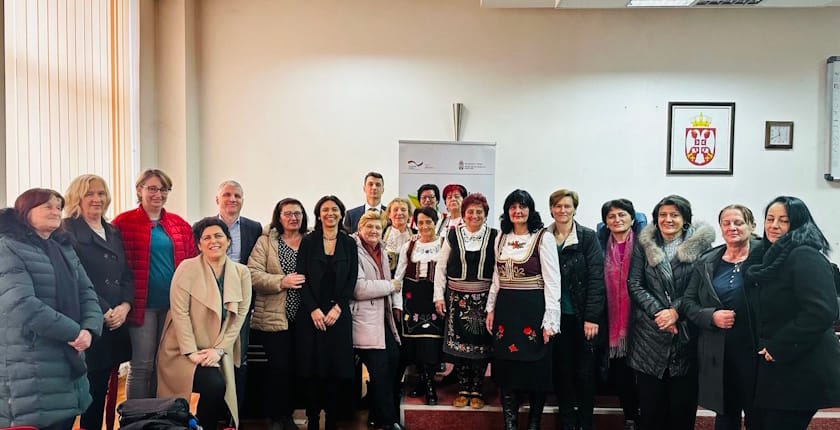
“We are without power for several hours at a time in the winter. It is not only discomfort, but a serious problem for heating and preserving food, and especially for us who have guests in rural tourism”, said one of the participants at a discussion in Čajetina. The event gathered the members of the Čajetina Rural Women’s Association and Zlata association.

It became clear from the discussions that there is great interest in installing solar panels, among private households as well as hospitality facilities. However, the access to these technologies is often difficult because of high initial costs and complex procedures for obtaining subsidies, which despite growth in the available volume for the purpose still don’t meet all the existing demand.

High initial expenses and complex procedures for obtaining subsidies make the availability of solar panel installations more difficult

The problem is exacerbated by the fact that many houses in the villages were built illegally, making it more difficult to access energy efficiency subsidies. Besides, the calls are too often only accessible for the beneficiaries that already have initial capital to invest, while the village population often doesn’t know about them.

The Municipality of Čajetina acknowledges the significance of energy efficiency. Last year it issued a public call for cofunding energy efficiency measures in family houses and apartments. However, targeted support for users with the vulnerable energy buyer statuses still hasn’t been provided. Assistance could additionally improve the availability of these measures to the wider population, and in fact the very people who need help the most.

Photo: Members of the Čajetina Rural Women’s Association and Zlata association (Miloš Radojević)

Possibilities for using renewable energy sources

One of the key conclusions of the discussion was that solar panels and heat pumps can significantly improve the situation. Aleksandar Macura from RES Foundation pointed out that the law already enables households to produce their own energy and exchange it with state-owned power utility Elektroprivreda Srbije (EPS). “There are sufficient examples of good practice – around 2,500 households in Serbia already use rooftop power plants and work as buyers-producers,” Macura stated.

Buyers-producers are Serbia’s legal category for prosumers.

Nevertheless, solar panels still require initial investments of several thousand euros, which is an insurmountable obstacle for many. The participants in the discussion proposed solutions such as subsidized loans with delayed payment, in installments, to make the technology more accessible both to retirees and socially disadvantaged persons.

Assembling and energy communities

Another important aspect of the discussion was the possibility of establishing energy communities. In line with European regulations, Serbia is opening the space for joint production and use of solar energy within local communities.

It means any village council could install a solar power plant and distribute the energy among households. It would be especially useful for women running family businesses in agriculture and tourism, as it would provide them with a stable energy source without leaning on an unpredictable power distribution network.

Wood is traditional but inefficient energy source

Wood biomass usage still dominates in many rural households. Some said in Arilje: “Wood is irreplaceable” and “we believe in wood!” However, for people in villages, wood is almost never, even though it is the most accessible, never the most efficient solution for heating. It is partly because of moisture in the solid fuel, and mostly because of inefficient devices.

There are fewer and fewer people in the countryside, so it is getting more difficult and more expensive to timely obtain the wood felling and preparation service, even in one’s own forest. “We have been using wood for decades, but who today can afford quality dried wood? We often heat ourselves using wet wood, which only increases consumption and air pollution,” said one of the participants in an event in Arilje, describing her experience. It was attended by women from two associations: Sibirka and Ariljka.

Photo: Members of associations Sibirka and Ariljke (Miloš Radojević)

How to proceed?

It is clear that rural communities mustn’t be left behind in the energy transition process. Solar panels, energy communities and subsidies for more efficient heating are solutions that can bring concrete changes. However, the key to success lies in a greater accessibility of these solutions for all citizens, regardless of their financial situation or the place of residence.

Energy sustainability in rural communities is not just a matter of comfort but also of the survival and development of local communities. If we want villages to be vital and economically stable, it is necessary to facilitate a stable, sustainable and affordable energy source for them. Through smart investments, better subsidy organization and the development of energy communities it is possible to significantly improve the quality of life in these areas. In addition, additional training in the usage and maintenance of energy-efficient systems can contribute to a greater deployment of the technologies.

The energy discussions with the women of the Zlatibor county was organized within the project Improving the Use of Sustainable Energy in the Zlatibor region, financed by the German Organization for International Cooperation (GIZ) by order of the Government of the Federal Republic of Germany (Federal Ministry for Economic Cooperation and Development – BMZ).