by in News

Sunotec, Shell join forces to develop BESS in Europe

Sofia-based Sunotec signed an agreement with oil and gas major Shell on the development of battery energy storage systems in Central Eastern Europe.

Sunotec is developing projects for large solar and battery energy storage systems (BESS) in Europe while Shell is one of the leading oil and gas companies in the world.

Sunotec said it signed a cross-border agreement with Shell Energy Europe B.V. It marks a milestone in advancing innovative financial mechanisms for the development of battery energy storage systems in Central Eastern Europe, the Bulgaria-based company added.

The five-year agreement is linked to a 600 MW BESS project owned by Sunotec. The battery is under development and expected to enter commercial operation by Q2 2026, the update reads.

The deal helps Shell to diversify its wider power portfolio in the region

“The agreement provides long-term price stability for the project, supporting its financial viability. For Shell, the deal helps to diversify its wider power portfolio in the region. The agreement was facilitated by Enery Portfolio Optimisation,” Sunotec said.

The transaction is among the first of its kind in Central Eastern Europe and it helps to establish battery project development in the region, according to the renewables developer.

Kaloyan Velichkov, Sunotec founder and CEO, stressed that agreements like the one with Shell highlight the company’s commitment to working with leading energy players who share its vision for a sustainable and forward-looking energy future.

Velichkov: The agreement demonstrates the power of collaboration in advancing flexibility and renewable-energy driven independence

“This pioneering agreement demonstrates the power of collaboration in advancing flexibility and renewable-energy driven independence. By uniting technical expertise with financial ingenuity, we are helping to build a more resilient and integrated energy system,” he underlined.

The transaction demonstrates how cross-border cooperation and forward-looking financial mechanisms can enhance regional energy market integration and facilitate the deployment of large-scale renewable energy assets, in Kaloyan’s view.

Of note, Sunotec has been very active in the market over the last few months.

In October, the firm secured financing for a portfolio of seven projects in Bulgaria.

Three months prior, it signed an agreement with Sungrow on installing 2.4 GWh of BESS in Europe.
by in News

RE-Source Platform: Number of PPAs in Europe drops by 60%

The number of power purchase agreements in Europe decreased by 60% compared to the same period last year, while contracted capacity has dropped by 40%, according to RE-Source Platform.

Europe’s power purchase agreement (PPA) market is facing headwinds in grid development, permitting and electrification and from negative electricity prices, RE-Source Platform warned.

RE-Source Platform facilitates corporate renewable energy sourcing in Europe. It was founded by WindEurope, SolarPower Europe, Climate Group RE100, and World Business Council for Sustainable Development, and steered by a group of corporate buyers and developers.

There are four main problems

“This slowdown is very paradoxical. Europe has no path to energy security and competitiveness unless it electrifies its economy – shielding itself from energy shocks and leveraging large scale deployment of wind and solar energy. But the market is facing headwinds,” the update reads.

The platform identified four main problems.

Europe is not expanding its grid infrastructure quickly enough. The main bottleneck is grid permitting with hundreds of gigawatts of projects awaiting grid connection.

The permitting process for renewables remains too slow. The Renewable Energy Directive has set permitting rules for acceleration, but EU member states have not implemented them.

The Clean Industrial Deal rightly names PPAs as a key solution

Direct electrification is the cheapest and most efficient way to decarbonize. It could also improve competitiveness and energy security, however Europe’s electrification rates are stagnating.

The increase of the negative price hours is making PPA negotiations harder. The way out are energy storage solutions.

The platform stressed the importance of PPAs.

“The Clean Industrial Deal rightly names PPAs as a key solution. Without them, we risk losing industrial competitiveness – and missing our climate targets. PPAs are a cornerstone of Europe’s industrial decarbonization,” the platform added.

They also give companies price certainty, help new wind and solar projects get financed and cut buyers’ exposure to volatile energy markets, according to the update.

by in News

North Macedonia’s ESM needs investments of EUR 3 billion to replace coal power

Power utility Elektrani na Severna Makedonija estimated that it requires EUR 3 billion by 2040 to replace electricity from its lignite-fired power plants. According to member of the Board of Directors Ivan Stojanovski, the state-owned company is preparing investments in gas power plants, solar, wind, hydropower and energy storage. He highlighted its plans for a 300 MWh battery and the Bogdanci hybrid energy park.

North Macedonia’s utility Elektrani na Severna Makedonija (ESM), the country’s main electricity producer, generated 60% of the 2024 output in the Bitola and Oslomej coal plants.

A rough estimate is that ESM would have to invest around EUR 3 billion in the next 15 years to replace its power production from lignite, which is baseload energy, Ivan Stojanovski, a member of the Board of Directors and the company’s Chief Financial Officer, told Balkan Green Energy News on the sidelines of the International Forum on Energy for Sustainable Development (IFESD-14).

He explained that the transition to green energy is quite expensive. ESM needs to replace the 840 MW in baseload production that the Bitola and Oslomej thermal power plants provide, the executive added.

Hydropower is a domestic electricity source, unlike natural gas

The company opted for investments in diverse energy sources to achieve it, Stojanovski stressed.

Gas power plants provide baseload energy, but at the same time, they turn the spotlight on national security as well as the security of supply, in his words.

Lignite is currently mined in North Macedonia while natural gas must be imported, so gas supply interruption is possible, ESM’s CFO added.

Gas power plants are required, but it is necessary to invest in hydropower as it is a domestic resource, Stojanovski said. On the other hand, hydroelectric plants are more expensive and it takes longer to build them, he noted.

ESM launched the Bitola 3 solar power project

ESM is developing wind and solar power projects as well. Stojanovski highlighted the planned expansion of its Bogdanci wind farm. The European Bank for Reconstruction and Development (EBRD) is participating in the development of the Miravci wind power project, of at least 100 MW, he recalled.

The company is working on solar power projects Oslomej 1 (10 MW), Oslomej 2 (10 MW), Bitola 1 (20 MW) and Bitola 2 (60 MW), Stojanovski asserted. Bitola 3 endeavor is underway, too, and the financing contract is expected to be signed by the end of the year, he revealed.

The photovoltaic system will have at least 100 MW, Stojanovski asserted.

“We plan to sign a contract next year with Agence Française de Développement (AFD) for a solar power plant in Bogdanci of at least 30 MW and to create a hybrid energy park there – wind, solar, and a battery,” he stated.

According to Stojanovski, the company is developing a battery energy storage project with the EBRD, for up to 300 MWh in capacity. The site is within the REK Bitola coal complex and the facility will be a systemic solution for all the solar power plants there, he explained.

Blended financing as a solution

“EUR 1 billion to EUR 1.3 billion is needed just for solar, wind and batteries. We will need between EUR 500 million and EUR 700 million for gas power plants. Another EUR 1 billion to EUR 1.3 billion would be for large hydropower plants such as Čebren and Vardar Valley, and some smaller projects,” Stojanovski explained.

Asked how the company plans to secure financing, he pointed to blended financing – own sources combined with some participation from international financial institutions. It is important to diversify the sources by opening cooperation with as many financial institutions as possible, in Stojanovski’s view.

ESM traditionally cooperates with the EBRD and KfW. Stojanovski announced that the company would diversify financing by launching cooperation with the World Bank, Italy’s development bank Cassa Depositi e Prestiti, and AFD.

“It will enable us to access more sources and complement them with financing from local banks. We also tend to obtain support from the state budget over a longer period, 10-15 years, and state guarantees, but also additional funds. This is a financial model that can secure long-term and sustainable financing of infrastructure projects,” Stojanovski said.

by in News

Cypriot firm preparing to build several solar parks with batteries

Public consultation is underway in Cyprus for environmental impact assessment (EIA) studies for three projects for photovoltaic units, of 14.5 MW in total peak capacity, with 40 MWh in battery storage. The developer, SAOLA, plans several such investments. It is facing opposition from the local population and environmentalists.

The electricity system in Cyprus is severely strained due to the lack of interconnections and energy storage and amid a photovoltaics boom and power demand surge. Even though the installation of the required battery capacity depends on substantial grid investments as well, investors are lining up to seize the opportunity in the budding market as soon as possible. Larnaca-based SAOLA opted for a group of hybrid power plants consisting of small photovoltaic units and battery energy storage systems (BESS) with a matching operating power.

Public consultation is underway for environmental impact assessment (EIA) studies that the firm submitted to the Department of Environment for three such projects. The sites are on the territory of the Agios Theodoros community, in Larnaca district.

SAOLA has vowed to apply a range of mitigation measures

One investment would involve the installation of a solar park of 5 MW in peak capacity together with a 5 MW / 15 MWh BESS. The second project is for 5.5 MW in photovoltaic panels and a battery system with a 5.5 MW capability and 15 MWh in storage capacity. The remaining facility would have 4 MW in peak PV capacity and BESS operating power, and 10 MWh of storage capacity.

The company owns the land. Suggestions and comments will be received until November 26.

Earlier, residents from the affected area raised concerns because the facilities would be on agricultural land, as well as about the impact on the rural landscape. Environmental groups and hunters pointed out that wildlife habitats would be affected.

SAOLA has vowed to conduct mitigation measures. According to the EIA studies, it would plant trees, preserve animal migration corridors and, after decommissioning, recycle equipment and return the area to its original state.

The company is preparing several other investments in photovoltaics with BESS, including in Alaminos and Anafotia in the same district.

by in News

R.Power completing its first solar parks in Romania while more assets enter construction phase

Poland-based R.Power began work on its Lazuri photovoltaic plant of 55 MW in peak capacity in Satu Mare county in northwestern Romania. The company is energizing four solar parks of more than 23 MW overall, its first operational assets in the country. In addition, it is about to break ground on its 254 MWh Scornicești battery energy storage system.

Notably, Electrica recently commissioned its Satu Mare 2 solar power plant, of 21.7 MW.

Romania is set to appear on the map of renewable energy plants and battery energy storage systems (BESS) operated by Poland-based R.Power. The company also has such assets in its home market and Portugal and projects under development in Germany, Spain and Italy. In line with the schedule, R.Power is energizing its first photovoltaic plants in Romania – Stâlpu, Suseni, Dudești and Punghina – and is preparing to begin the construction its first BESS in the country, in Scornicești.

The four solar parks in central and eastern Romania have more than 23 MW altogether in peak capacity. R.Power’s contractors are Nomad Electric and Waldevar. The former has also just begun the construction of the Lazuri solar park in northwestern Romania for the same client.

The PV park in the commune of the same name in Satu Mare county would have 55 MW in peak capacity. The company won a 15-year contract for difference (CfD) for 48 MW in connection terms at Romania’s first renewable energy auction.

Lazuri was part of a group of five solar power projects with support approved for 73.1 MW, or 85 MW in peak capacity. Its annual output is estimated at 70 GWh, equivalent to the consumption of more than 48,000 households in the country.

Major BESS project up for sale

The Scornicești project in Olt county, west of Bucharest, is for 127 MW in operating power. The BESS would have a duration of two hours, translating to 254 MWh in capacity. The project received EUR 15 million in funding via the National Recovery and Resilience Plan (NRRP or, in Romanian, PNRR).

R.Power has sold a 49.99% stake last month to Eiffel Investment Group. The transaction follows the two companies’ previous cooperation in photovoltaic projects.

The Polish firm recently said it would divest of a ready-to-build project for a battery energy storage system of 200 MW and 400 MWh. The move is part of an asset rotation and portfolio diversification strategy, according to the update.

The company added that the future facility near Bucharest would provide flexibility for the grid. It is known as Project Tessara.

Solar-battery hybrids in project pipeline

As of August, R.Power had over 1.2 GW of projects for standalone BESS in Romania. It said it would set up PV-BESS hybrid configurations as well.

“The start of construction of the Lazuri solar farm highlights our commitment to expanding operations in Romania, which is one of our key markets. Alongside Lazuri, we are developing additional photovoltaic and battery energy storage (BESS) projects there,” the company’s Chief Executive Officer and Co-founder Przemek Pięta said.

Satu Mare county also hosts several new solar parks. Romanian power supplier and distributor Electrica recently commissioned its Satu Mare 2 unit of 27.1 MW in peak capacity, in the Botiz commune.

The company partially funded the investment, worth more than EUR 20 million, from NRRP. The project included a 110/20 kV transformer station and grid connections.

by in News

PPC building three battery storage facilities in Greece

PPC Group has launched the construction of a battery energy storage system in the area of its Amyntaio coal plant. The company is also building BESS facilities at its thermal power plants Kardia and Meliti, as it is preparing to end coal use in Greece. One BESS unit is under construction in Bulgaria, as well. In Romania, PPC is expanding its wind park project Deleni, which would bring its operational portfolio in the country to over 1.5 GW.

Public Power Corp. – PPC Group is investing in energy storage in Greece and surrounding countries, complementing its solar and wind power investments and contributing to the transformation of coal regions. The government-controlled utility revealed that its future battery energy storage system near the Amyntaio coal plant in the Western Macedonia region is under construction.

The new station will consist of batteries with 50 MW in operating power and a duration of four hours, translating to a capacity of 200 MWh. Wholly-owned subsidiary PPC Renewables is responsible for the project. It is for liquid-cooled batteries of the LFP (lithium iron phosphate) technology.

The construction of two more electrochemical storage stations is already underway in the same northern region, in the areas of the Kardia and Meliti thermal power plants, the company pointed out. Their combined capability would be 98 MW, for 196 MWh in capacity.

Western Macedonia region to host 860 MW of energy storage

The role of energy storage units for the system is critical, as they aim to support the operation of adjacent photovoltaic power plants and contribute to the stability of the electricity system, PPC Group added. It is planning 860 MW of energy storage in the Western Macedonia coal region. The company said it would create 1,300 jobs in the construction phase and hundreds during operation.

Two pumped storage hydropower projects are included in the portfolio. The one that would transform the Kardia mine is for 320 MW and eight hours, and the facility at the South Field mine would have 240 MW and a 12-hour duration. PPC Group said it has completed the permitting process for the latter.

Solar power plants of 2.13 GW in northern Greece nearing completion

Earlier this month, the utility said its solar power projects in Western Macedonia of 2.13 GW overall are moving ahead at a fast pace and within schedule, in areas around coal plants Ptolemaida, Kardia, Agios Dimitrios and Amyntaio. Overall, upon their completion, the photovoltaic clusters in the region, largest ones in the entire Europe, will generate almost 3.15 TWh of electricity per year, the company added.

Coal land in the Western Macedonia region is turning into endless solar parks

It is equivalent to over 6% of the annual energy consumption in the Greek mainland. Utilising the land of the former lignite mines of Ptolemaida, Kardia, and Agios Dimitrios, PV plants totaling 1.19 GW are being installed, of which 90% is complete and some is in operation.

The clusters include PPC Group’s flagship project, of 550 MW. It would be the biggest facility of its kind in Southeastern Europe excluding Turkey.

In cooperation with the German company RWE, the construction of photovoltaic plants in Amyntaio of 940 MW overall is also advancing rapidly toward completion, the latest update reads.

Advancing investments in Bulgaria, Romania

In addition, the company said it is building a BESS unit of 25 MW and 55 MWh in neighboring Bulgaria.

As for other recent news, PPC said it is expanding its Deleni wind park project in Vaslui county in northwest Romania. The first phase, 140 MW, is supposed to be completed by the end of the year. The addition would amount to 85 MW, consisting of 14 turbines, the Greek company added.

The site is at the Bogdănița commune. With the 225 MW in Deleni, PPC in Romania would reach 1.5 GW in operational capacity.

by in News

Enery, SmartPulse launch regional partnership for multi-market optimization

Austrian green energy producer Enery and Turkish software company SmartPulse have entered a strategic partnership to deliver advanced solutions for the management and trading of renewable energy and storage assets. The collaboration aims to amplify market results for renewable energy producers and battery owners, while strengthening integration into the regional energy markets.

Enery Portfolio Optimization (EPO) – the licensed power trader of Enery managing a portfolio of over 750 MW of renewables assets and 700 MWh of battery capacity, will enhance its services through SmartPulse’s multi-market optimization platform, which automates trading, delivers real-time dispatch, and provides analytics and forecasting. The Turkish software company’s services coupled with EPO’s market know-how accelerate revenue growth and strengthen financial outcomes, according to the announcement.

The combined offering will be available for standalone and co-located storage assets on the Romanian market as part of a wider regional partnership. The platform aims to ensure the highest profitability from day-ahead, intraday and ancillary services markets, while ensuring the optimal physical dispatch of the asset, the Austrian company pointed out.

Balancing group members gain access to market opportunities

The service captures the full spectrum of financial arbitrage opportunities, reserve and balancing energy market participation to maximize revenue potential, Enery added. By joining its balancing group, renewables producers and battery storage owners gain access to all markets opportunities, reduced balancing costs, and 24/7 monitoring and trading through an artificial intelligence–powered platform, the update reads.

The offering in Romania will be part of a wider regional partnership

“Our international expertise in storage and renewables optimisation combined with SmartPulse’s innovative platform allows us to be more flexible and deliver tailored solutions for each asset. This partnership ensures that our Romanian clients will receive the highest quality services and optimised profitability from their assets,” said Enery’s Head of Energy Trading Petya Dimova.

Romania is among most dynamic power markets in Europe

The two companies stressed that they are bringing international experience and know-how in optimizing the value of large-scale renewables and storage assets to the Romanian market. The joint approach ensures clients can focus on business development, operations, and maintenance, while entrusting the financial realization of their electricity to expert hands, they said.

“Romania is one of the most dynamic power markets in Europe, and we are proud to make it a priority in our growth journey. By partnering with Enery, we bring our technology together with their strong local expertise to deliver advanced optimization and trading solutions,” Head of Global Growth at SmartPulse Uygar Yörük stated.

Enery, an independent power producer, operates a diversified portfolio of 511 MW and has 212 MW under construction. Its development pipeline amounts to almost 10 GW across 10 countries in Central and Eastern Europe. In the region that Balkan Green Energy News covers, the company is active in Romania, Bulgaria and Slovenia.

SmartPulse, founded in 2018 in Istanbul, focuses on short-term power trading automation. The firm has just been acquired by Volue.

by in News

Božinovska: Solar overtakes hydro in North Macedonia

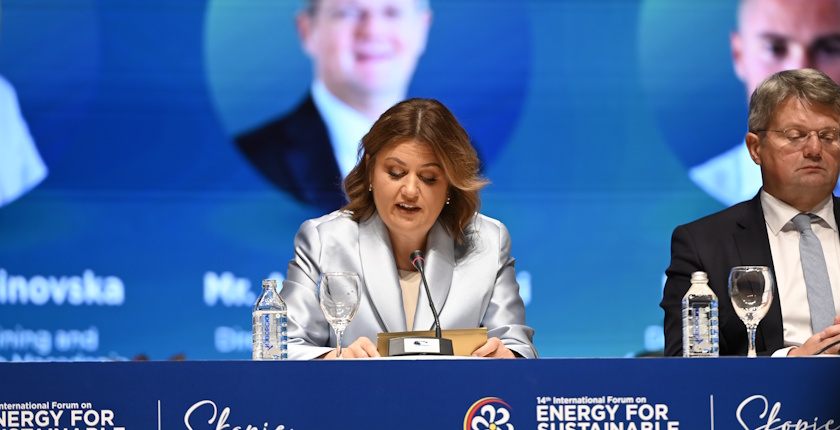
The share of solar power plants’ capacity in North Macedonia has surpassed hydropower plants in 2024, Minister of Energy, Mining and Mineral Resources Sanja Božinovska said at the 14th International Forum on Energy for Sustainable Development in Skopje.

The three-day International Forum on Energy for Sustainable Development (IFESD-14) started yesterday. Its theme is From Goals to Action: Powering the Future with Sustainable Energy. The event was organized by the Ministry of Energy, Mining and Mineral Resources of North Macedonia, in cooperation with the United Nations Development Programme (UNDP) and the UN’s five regional commissions – UNECE, UNESCAP, UNECLAC, UNECA, and UNESCWA.

According to Sanja Božinovska, Minister of Energy, Mining and Mineral Resources, North Macedonia has taken decisive steps in recent years to transform its energy system and align it with the principles of sustainability, security, and affordability.

The reforms are already delivering measurable results, with renewables now accounting for more than half of the country’s total installed electricity capacity – 56% in 2024, she noted.

North Macedonia is moving from goals to action

“The structure of that progress is even more striking. Photovoltaic power plants now represent 28% of installed capacity, surpassing large hydropower, which is at 24%. For the first time in our history, solar has overtaken hydro – a symbolic and practical milestone in our path toward decarbonization,” the minister stated.

In 2024 alone, solar output grew by 186%, she underlined at the first high-level plenary session.

Photo: Ministry of Energy, Mining and Mineral Resources

The numbers speak louder than words: they highlight a nation that is not just planning a transition, but living it, in Božinovska’s view.

Of note, at the end of 2024 the capacity of solar power plants was 848 MW. The year-on-year was higher than 340 MW. Hydropower capacity was 720 MW, at the end of last year.

Božinovska: We are supporting over 5,000 workers and communities affected by the coal phaseout

“The numbers confirm it — North Macedonia is moving from goals to action,” Božinovska stressed.

She added that the country is investing in new solar and wind projects, expanding energy storage, and modernizing the national grid to absorb growing renewable capacity. “These investments are essential for maintaining reliability and flexibility as we integrate more clean energy sources,” she explained.

Božinovska pointed out that the commitment to a just energy transition is equally important.

“We are supporting over 5,000 workers and communities affected by the coal phaseout, helping them to retrain, diversify local economies, and secure green jobs,” she underlined.

Joksimović: Serbia to reach 2030 renewables target

Sanja Božinovska and Jovana Joksimović (photo: Ministry of Energy, Mining and Mineral Resources)

According to Jovana Joksimović, Serbian Assistant Minister of Mining and Energy for International Cooperation and European Integration, coal is still the backbone of the energy system in Serbia, while the share of energy from renewables is significant and growing, and it reached 38% in 2023.

The government plans that one in two megawatt-hours would be produced from renewables by 2030, she underlined.

“Existing valuable resources will need to remain the foundation of Serbia’s electricity sector until renewable energy, transmission and distribution infrastructure, as well as storage capacities and ability to integrate renewables, are sufficiently developed and aligned to reliably and securely replace coal-based electricity generation,” the assistant minister told the audience during the second high-level plenary session.

It is necessary to diversify supply channels but also the energy mix

Joksimović stressed that the increased capacity for clean energy, secured from the two very successful rounds of the auctions, would contribute to reaching 2030 targets.

When it comes to advancing the energy transition and powering the future, it is necessary to think outside the box, she added. Supply channels should be diversified but so does the energy mix, to be as self-sustainable as possible, in Joksimović’s view.

There is huge support for it from relevant international financial institutions – IFIs, but more is needed, in her words.

“If we are going to reach the targets that we set for us, I believe that the European Commission would be partnering with us in all efforts that we are taking,” she concluded.

Photo: Ministry of Energy, Mining and Mineral Resources
by in News

Bulgaria’s coal regions to get further EUR 808 million for just transition

Bulgaria’s coal regions will receive BGN 1.58 billion (EUR 808 million) through the Just Transition program, under the European Union’s Just Transition Fund (JTF), for energy efficiency, renewable energy, and green hydrogen projects, as well as for converting mining areas for commercial use.

With a EUR 598 million program already underway, total investments in the economic transformation during and after the country’s coal phaseout would reach EUR 1.38 billion. They cover coal regions Stara Zagora, Kyustendil, and Pernik and the municipalities of Nova Zagora, Yambol, Simeonovgrad, Harmanli, Topolovgrad, Dimitrovgrad, Haskovo, Elhovo, Sliven and Tundzha.

Grants from the JTF are intended to help coal regions shut down mines and coal-fired power plants, rehabilitate land, switch to a circular and climate-neutral economy, and lift households out of energy poverty.

By the end of the year, the Bulgarian Ministry of Regional Development and Public Works will launch three new procedures for the allocation of grants, according to Deputy Minister Yura Vitanova.

One, worth EUR 153.4 million, will focus on energy communities and energy efficiency in public buildings. Another, worth EUR 72.6 million, will help small and medium-sized enterprises (SMEs) install solar panels and energy storage systems for both self-consumption and commercial use.

A third call, with a budget of EUR 242.9 million, will support the socio-economic transformation, including projects to convert mining areas into business and industrial zones.

Green hydrogen projects will be backed with EUR 134.5 million

Additionally, EUR 134.5 million will be used to fund the development of hydrogen production and transportation infrastructure in Stara Zagora. It includes the construction of a green hydrogen production complex and hydrogen charging stations, the procurement of hydrogen vehicles and hydrogen trailers, and the construction of supporting infrastructure, including photovoltaic systems and energy storage facilities.

The current JTF program in Bulgaria’s coal regions focuses on renovating residential buildings, supporting SMEs, and developing industrial and logistics parks. It also funds training and retraining programs for workers affected by the energy transition, as well as production investments in large enterprises.

by in News

Shanghai Electric becomes contractor for Romania’s largest solar park with batteries

Israeli company Econergy, owner of the largest photovoltaic park in Romania, has selected Shanghai Electric as the engineering, procurement, and construction contractor for a facility with a two times higher capacity and a 150 MW battery energy storage system.

After building the solar park in Romania’s Brașov county for Econergy, Shanghai Electric also won the contract for Părău 2. “Building on our successfully completed projects in Romania, we aim to further strengthen our presence across Central and Eastern Europe and deliver tailored solutions that accelerate Romania’s energy transformation,” Chairman of Shanghai Electric Group Wu Lei said.

The company’s photovoltaics portfolio in the country has reached 550 MW, according to the update. The investor behind Părău and Părău 2 is Israel-based Econergy. The first part, of 91.4 MW in peak capacity, was commissioned a year ago.

Econergy operates Romania’s largest solar park, Rătești. It has 155 MW in peak capacity. Părău 2 is for 342 MW, together with a 150 MW battery energy storage system (BESS).

Shanghai Electric is the EPC contractor for Econergy’s four PV parks, of which two are already operational

The investment is valued at EUR 275 million altogether. Părău 2, on 337 hectares in central Romania, has won a 15-year contract for difference (CfD) in December at the country’s first round of renewable energy auctions.

Econergy bid EUR 49.4 per MWh for 125 MW in connection terms or 150 MW in peak capacity. It was the biggest project on the list. The developer expects to put it into operation in 2027.

The solar park will supply both residential and commercial users, according to Shanghai Electric. Its Romanian portfolio includes Econergy’s Scurtu Mare 56 MW photovoltaic plant, which was provisionally cleared for the start of operations in June. Another one is the Ovidiu project for the same client, with 60 MW in peak capacity under construction.

Econergy has hinted that it could invite a partner for Părău 2. The Israeli company noted that it normally holds a 49% or 50% stake in Romania. It revealed that it could pick a previous partner such as Phoenix, headquartered in Israel, or RGreen Invest, a French investment fund.