by in News

Zen Energy Group kicks off construction of hybrid PV-BESS project in North Macedonia

Luxembourg-based Zen Energy Group has started the installation of a hybrid energy project in North Macedonia, combining a solar power plant and a battery energy storage system.

A solar power plant with a battery energy storage system (BESS) could become the country’s second hybrid power plant, with Fortis Energy installing energy storage near Oslomej solar park.

Zen Energy Group kicked off the construction of a landmark solar plus storage project in North Macedonia, Yossi Edelstein, Chief Executive Officer of Zen Energy Group, wrote on LinkedIn.

From concept to construction, Zen Energy Group is making the future of energy a reality in the country, he added.

“We are proud to share that our 82 MW utility-scale solar project with 50 MWh BESS in North Macedonia has officially entered the construction phase,” Edelstein stated.

The PV plant will use LONGi bifacial solar panels

The company’s team kicked off earthworks, development of access roada and cut-and-fill activities. The project is scheduled to start delivering green electricity to the national grid by late April 2026 and to achieve full commercial operation date in August 2026, according to Edelstein.

The project marks another significant step toward advancing clean energy generation in the region, he added.

According to the firm’s website, the photovoltaic plant will be located near Negotino. It will use LONGi bifacial solar panels for the expected annual production of 124,198 MWh.

The financing was secured from NLB bank, the website reads.

The developer revealed that it has signed a power purchase agreement (PPA) for 10 years in total, with a six-year fixed price period.

Seven projects in the pipeline

Works near Negotino (photo: Zen Energy Group/LinkedIn)

Zen Energy Group is developing seven energy investments – for three solar parks, two wind farms, a standalone BESS, and a commercial and industrial (C&I) portfolio in the UK.

Wind farms Unirea (102 MW) and Traian (78 MW) are located in Romania, while two PV facilities in North Macedonia would have a total capacity of 137 MW. The Negotino endeavor is for 82 MW and the Armatus investment envisages 55 MW.

Solar project Hajdučica of 125 MW is planned in Serbia. All three PV plants would have BESS. The company is developing the Lacu Sarat standalone battery facility in Romania. If it were in operation now, it would be the largest BESS in Europe.
by in News

ElevenEs mulls building advanced battery cells gigafactory in Poland

Battery technology developer ElevenEs, which has production facilities in Serbia, plans to build a EUR 600 million gigafactory. It revealed that it is considering locations in Poland. The company said InnoEnergy is now one of its main shareholders.

Now backed by a group of international investors including the InnoEnergy fund, ElevenEs announced its next major step. The company registered in Luxembourg said it is “seriously considering Poland” for its planned investment: a EUR 600 million gigafactory for advanced battery cells.

The battery technology developer, which operates production facilities in Serbia, has unveiled its latest product in May. It said the Edge574 blade cell charges up to 80% in 12 minutes. The cycle life translates to a range of at least 500,000 kilometers for electric cars, ElevenEs’ update reads. The company specializes in lithium iron phosphate (LFP) technology.

“ElevenEs is revolutionizing the battery market, including batteries intended for the electric vehicle industry,” according to its statement on the gigafactory project.

The company aims to begin construction by the end of 2027 and eventually employ 700 engineers.

Company shortlists Kraków, Silesia, Lower Silesia

ElevenEs hasn’t determined the exact location, but it hinted it would be in southern Poland: Kraków, Silesia or Lower Silesia. The country would benefit from technology transfer and the opportunity to further develop it within the domestic economy, it stressed.

ElevenEs’ CEO Nemanja Mikać praised the Polish labor market, supply chain and access to Western European markets

An open labor market, availability of suppliers within the supply chain, presence of many universities, and access to Western European markets are all undeniable advantages of Poland, said founder and Chief Executive Officer of ElevenEs Nemanja Mikać.

“If we add potential public sector involvement to this, we have one of the most attractive places for investment in Europe… From a technology development standpoint, we are a clear leader in Europe. One of the most significant benefits of our technology is its ability to integrate different industrial sectors and build an innovation ecosystem around it,” he stated.

InnoEnergy becomes one of main shareholders of ElevenEs

In introducing the company to Poland and securing additional investors, ElevenEs is being supported by InnoEnergy. Since its founding in 2010, it has invested in over 540 European tech companies. InnoEnergy is now one of the main shareholders of ElevenEs.

“We specialize in connecting different stakeholder groups. Our broad ecosystem includes financial and industrial investors, as well as technology providers, research institutions, and academic centers. The projects we’ve completed demonstrate our experience and ability to execute large, complex investment ventures. We see enormous potential in the ElevenEs project – not only will it help build a strong, competitive Polish economy, but it may also allow Europe to finally establish a significant presence in the global battery value chain. This is one of those projects that could change the rules of the game,” said Mikołaj Budzanowski, CEO of InnoEnergy for Central Europe.

There are investors willing to support the project, but the success of the investment depends critically on the timing and decisiveness of the public sector, he explained. He also highlighted the necessary role of financial institutions.

Serbia in scope for mass production

Of note, Mikać recently said that ElevenEs would “localize and scale” LFP battery production in Serbia over the next seven or eight years. It could become the first country in Europe to launch mass production, he added.

The company wants to participate in creating a robust supply chain in Serbia and Central and Eastern Europe, but also potentially across the continent, he asserted.

by in News

Greece loses EU grant intended for renewable electricity for vulnerable consumers

The ambitious Apollo program, which the Greek government outlined in late 2023, is losing EUR 100 million. The European Union earlier approved the grant for investments in renewable energy and storage, intended to lower energy costs for vulnerable consumers through self-consumption.

The first phase of the Apollo program was envisaged to help vulnerable households. It aimed to support renewable energy projects, through auctions, of 400 MW to 500 MW overall, combined with battery systems.

Each of Greece’s 13 regions, also known as peripheries, would get a green power plant, and eligible consumers who join a local energy community get discounted electricity bills. Therefore, the program is in the form of virtual self-consumption. It is the first of its kind in the region that Balkan Green Energy News tracks.

Apollo fails to take off on time

The scheme was supposed to benefit from an EUR 100 million grant from the European Union’s Recovery and Resilience Facility (RRF). It is implemented via the National Recovery and Resilience Plan Greece 2.0.

However, Apollo was significantly delayed and now the deadlines are considered impossible to achieve, even if they are extended. It means RRF funds are going to be lost. Energypress reported that they have already been removed from the budget.

Namely, the issue is with the batteries. Now their costs would have to be covered entirely by the producers. In turn, they are expected to lock higher prices in Apollo’s auctions, possibly passing them on to end consumers and making the whole initiative less effective at combating energy poverty.

It should be noted that the rest of Apollo remains intact for the time being, despite the setback. The loss of funds concerns household consumers with special tariff A. Funding is still available, in theory, for the other category of vulnerable households, defined by different income criteria.

The entire initiative also aims to lower energy costs for municipal authorities, water utilities and irrigation associations. They haven’t been affected so far.

Standalone battery plants also at risk

Another Greek initiative, for subsidized standalone battery plants, faces very short deadlines. It is eligible for EUR 341 million in RRF funding. In total, projects for 900 MW overall have been selected through three auctions.

The first wave of investors should declare connection readiness this month, so their facilities can become operational by the end of 2025.

HAESS: Selected projects may not receive support

They have complained of a lengthy licensing process and logistical difficulties. The investors asked the Ministry of Environment and Energy for an extension.

In July, the Ministry of Finance submitted a request for the sixth RRF tranche, EUR 2.1 billion in grants, after completing 39 more targets. If it is approved by the administration in Brussels, Greece will have secured EUR 23.4 billion overall, or 65% of allotted funds.

by in News

European electricity industry issues Paris Pledge on pumped storage hydropower

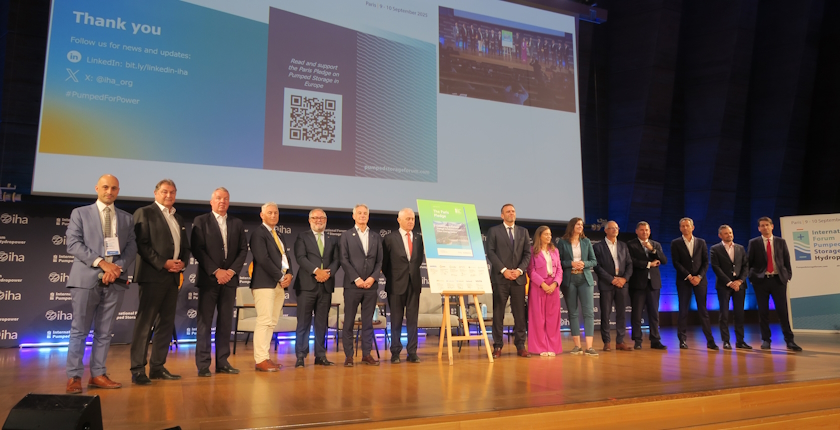
The International Hydropower Association (IHA) and Eurelectric launched the Paris Pledge. It is a collective call to action, aimed at unlocking the potential of pumped storage hydropower in Europe. The signatories urge the European Union and national governments to create the right conditions for long-duration storage to meet clean energy goals.

Over 50 utilities, hydropower suppliers and energy-focused associations have signed the Paris Pledge. The document’s alternative headline is Committing to Pumped Storage to Secure Europe’s Clean Energy Future.

The International Hydropower Association (IHA) and Eurelectric – Union of the Electricity Industry launched the initiative. They warned that Europe faces an urgent and growing need for long-duration electricity storage to secure a reliable, affordable and sustainable energy future.

Amid the transition to a renewables-dominated power system, the ability to store and dispatch electricity over long periods will be critical to balance variable generation from wind and solar, ensure grid stability and resilience, and reduce reliance on imported fossil fuels, the authors stressed. They called pumped storage hydropower or PSH the most important, scalable and cost-effective long-duration electricity storage solution available today. It still provides over 90% of the world’s long-duration electricity storage capacity.

PSH is currently the most important, scalable and cost-effective long-duration electricity storage solution, the industry pointed out

By 2050, around 86% of production capacity in Europe will come from variable sources, according to the material accompanying the Paris Pledge. Encouragingly, 78 pumped storage hydropower projects are under development, for 35 GW overall. The EU accounts for over 32 GW, and the rest is in Switzerland, Norway and Turkey.

The combined pipeline would provide storage capacity in excess of 700 GWh, equivalent to more than 10 hours of consumption of Italy and Spain taken together. There is 3.9 GW in the ready-to-build phase, and 2.8 GW is under construction. Of note, an earlier report showed 52.9 GW of PSH was under development.

The existing capacity amounts to 48 GW, compared to 190 GW globally. In the EU, pumped storage hydropower systems can store 1.2 TWh overall.

Photo: Types of pumped storage (IHA, Eurelectric)

Paris Pledge calls for separate legislation for long-duration energy storage

Among other proposals, the signatories are asking the EU for a dedicated initiative to boost the rollout of electricity storage. They suggested legislation to be separate for long duration, short duration and other solutions.

The Paris Pledge calls on member states to remunerate the provision of system services and security of supply for all time frames. They should eliminate double grid fees on electricity storage technologies and accelerate permitting for PSH, the document reads.

With strong political commitment, Europe can double its pumped storage hydropower capacity in the next 25 years, according to the Paris Pledge. In-person signatories represent EDP, EDF, Iberdrola, Andritz, Enel, Statkraft, Voith, Hydrogrid, Verbund, Landsvirkjun and GE Vernova.

Pumped storage hydropower’s contribution during Iberian Peninsula blackout

During the power blackout in Spain and Portugal on April 28, pumped storage played a pivotal role in balancing and supporting the recovery of the system. In Spain, PSH generated 11 GWh of electricity in the first 12 hours, instead of the planned 12 GWh recharge. Similarly, in Portugal, hydropower and pumped storage covered 80% of the demand in the first ten hours.

Such facilities also made a major contribution to restoring the electricity grid in the entire peninsula, thanks to their so-called black start capability. It allows the power plant to be restarted without relying on external power sources and to reenergise the power system.

“Very few technologies can provide this function. As a result, within a few minutes, the first pumped storage plants were ready for synchronization and awaiting dispatch instruction” from transmission system operators, notes the report published with the Paris Pledge.

by in News

Bajramović: Investments of BAM 1.4 billion needed for distribution grids in BiH

Necessary investments in Bosnia and Herzegovina’s electricity distribution grids by 2030 amount to BAM 1.4 billion (EUR 716 million), according to Zijad Bajramović, chairman of the Bosnia and Herzegovina committee of the International Council on Large Electric Systems (CIGRE).

The growing installation of power plants utilizing renewable energy sources is creating congestion in transmission and distribution networks, so the limited available capacity for their connection is an issue across the entire region, Zijad Bajramović told state news agency Fena. Nezavisne Novine republished the report.

An additional burden on the distribution network is expected from the electrification of transportation and increased electricity use for heating and cooling.

Energy storage is a solution for the problems emerging in the grid

Bajramović explained that new 110 kV substations are necessary, as is the completion of the ongoing transition to the 20 kV voltage level. Attention should also be paid to integrating prosumers, especially the households that both produce electricity, with solar panels on their roofs, and consume it.

He highlighted balancing as well as maintaining voltage conditions and supply quality as the main challenges from the rise in renewable electricity capacity on the grid. Energy storage is a solution for the issues.

Batteries can prevent renewables generation curtailments

Bajramović expects battery energy storage systems to play an increasingly significant role in relieving network congestion.

BESS, in his words, are a flexibility tool for absorbing excess generation locally, and temporarily easing the pressure on the transmission grid. They can prevent curtailments of power generation from variable renewable sources, he added.

Bajramović recalled that calculations have showed batteries of 225 MW / 450 MWh in total would be necessary to connect 1,500 MW of solar power capacity and 1,000 MW of wind power to the transmission network.

An increase in distribution network tariffs would provide funds for investment in strengthening and modernizing the distribution network, in his view.

Batteries are being installed at a rapid rate around the world as well as in the region. Not only private companies, but also state-owned utilities such as Romania’s Hidroelectrica and Montenegro’s Elektroprivreda Crne Gore (EPCG) are investing in such projects.

by in News

Bulgaria opens public consultation on subsidies for 1.9 GWh of battery projects

Bulgaria’s Ministry of Energy has launched a public consultation on a new round of its subsidy program for battery energy storage projects, aimed at facilitating the integration of renewable energy sources. The plan is to support the deployment of 1.9 GWh of new battery capacity with around EUR 118 million.

In the first round of the National Infrastructure for Storage of Electricity from Renewable Sources (RESTORE) program, Bulgaria approved EUR 587 million in subsidies for 82 battery energy storage system (BESS) projects totaling 9.71 GWh, with another 30 applicants falling below the threshold.

Draft application and implementation documents for RESTORE 2 will be available for comments and proposals until September 15, while a tentative date for inviting applications for grants is September 18.

The BESS systems are expected to be deployed throughout the country and connected to the transmission network or the distribution grid. A BESS system must have a minimum nominal AC capacity of 10 MW to qualify for the program.

The minimum required capacity is 10 MW

The maximum support is 50% of the eligible project costs, but not more than BGN 156,466 (EUR 80,000) per 1 MWh of usable energy capacity, according to the documents. In the previous round, the maximum support per 1 MWh was BGN 148,600 (around EUR 76,000), Economic.bg recalled.

The deadline to build and commission the BESS capacities is July 31, 2026. The battery systems selected in the first part of the program must come online by the end of March 2026.

The new round of RESTORE aims to finance projects in more advanced stages

Another difference from the previous call is that proposed projects must be in a much more advanced stage. In addition to a connection agreement, applicants must already have a construction permit or installation permit issued, a signed supply contract or orders and payments made for the equipment for the storage system, as well as secured financing for the investment, according to the draft documents.

by in News

Dozens of airports in Southeastern Europe invest in solar power, energy efficiency

Airports in Istanbul and Athens are becoming completely self-reliant with their large solar power projects. Many other airports in Southeastern Europe are investing in photovoltaics as well. Together with energy efficiency, electric mobility and waste and wastewater management projects, they aim to decarbonize their operations and reduce their environmental impact.

Surfaces around infrastructure such as railways and motorways are convenient for solar power as there are few alternatives for their use and the technology can directly provide them with electricity. Airports, too, have embraced the global trend of introducing photovoltaics and electrifying operations, and Southeastern Europe is no exception, with several notable investments.

The largest ones in Istanbul and Athens are about to switch 100% to solar power, which would make them some of the first in the world. In addition, airports in the region are increasing energy efficiency and rolling out electric vehicle fleets. They are introducing resource, waste and wastewater management systems to decarbonize their operations and reduce their environmental impact.

Airport operator in Albania expanding to solar power market

In other recent news, the operator of Kukës International Airport Zayed in Albania’s northeast is in the process of obtaining a license to generate and trade electricity. Namely, the company, Global Technical Mechanics, received a concession five months ago in consortium with local construction firm Bami to build and operate a 12 MW solar power plant.

The location at the village of Shtiqen is in the municipality of Kukës. The airport, built with investments by Emaar Properties from the United Arab Emirates, was inaugurated in 2021. However, it ceased operations in the meantime as Wizz Air withdrew from the facility.

The entire Vlora International Airport, which is under construction, will be covered with solar panels, Albanian officials said earlier. The PV project is for 5.2 MW. A consortium led by Swiss-based Mabco Constructions is building and financing the construction. The firm is part of Mabetex Group, controlled by Behgjet Pacolli, Kosovar businessman and former president, deputy prime minister and foreign minister.

Zagreb Airport starts with small PV unit

Zagreb Airport, which installed a 250 kW photovoltaic unit this year, said it plans to expand it soon. In addition, it switched to 100% renewable energy supply.

Like other airports in the region, the main one in Croatia replaced conventional, halogen lighting with LED. The operator has committed to cutting its emissions in accordance with the recommendations from the Intergovernmental Panel on Climate Change (IPCC).

Zagreb Airport is renovating its buildings and increasingly using solar energy for heating water. Interestingly, it plans to switch from diesel-fueled generators to hydrogen-ready systems.

Athens to integrate strong battery with its arrays

Athens International Airport Eleftherios Venizelos commissioned an 8.05 MW solar park in 2011, followed by another one in 2023, with 15.8 MW in peak capacity.

This year two more units with a combined peak capacity of 35.5 MW are coming online, together with a battery energy storage system (BESS) of 82 MWh.

The operator of Turkey’s largest airport is completing a photovoltaic park of nearly 200 MW and aiming to cover almost all its energy needs from renewable sources by the end of the decade

IGA Istanbul Airport reported that its greenhouse gas emissions in 2024 were 10.5% lower than its goal. Moreover, its operator increased its 2030 renewable energy target from 50% to 90%.

Namely, it expects its Eskişehir solar farm of a whopping 199.3 MW to begin operations before the end of the year. The location spans 300 hectares and the investment amounts to EUR 212 million. The PV park will generate an estimated 340 GWh per year.

Dalaman Airport hosts world’s largest rooftop solar power plant among airport terminals

Several other airports in Turkey are also decarbonizing their electricity systems. TAV Airports Holding (TAV Havalimanları Holding), part of Groupe ADP, completed a solar power plant 6.7 MW in peak capacity at its Milas-Bodrum Airport in the country’s southwest. Within the same project for setting up PV systems at parking areas, the Izmir Adnan Menderes Airport is getting a 5.9 MW unit.

The Izmir Adnan Menderes Airport is getting a 5.9 MW solar power system at parking areas

Dalaman Airport, near Bodrum, operates a solar power plant of 8.3 MW in peak capacity. It is the world’s largest on the roof of an airport terminal building.

The facility now covers more than 55% of its consumption from solar energy. The investment was worth EUR 5.4 million. The operator, YDA Airport Investment and Management, has vowed to reach 100% in phase two. The airport has completely switched to electric vehicles.

In 2023, airports Milas-Bodrum, Gaziantep, Erzurum and Ordu-Giresun all commissioned smaller PV systems.

Romanian operators leaning on EU funds

Iași International Airport is about to expand its 1 MW solar power plant, installed in 2023. It was the first in Romania in the sector. The management intends to add 5 MW and a 2 MW energy storage unit.

The investment will reportedly be supported with a grant from the European Union’s Modernisation Fund. The hybrid power plant is supposed to cover a fifth of the electricity consumption of the facility in Romania’s far northeast.

Maramureş International Airport (AIM) is also seeking funding, for a system of 2.6 MW in peak capacity on parking canopies. It would include battery storage.

The PV unit would feature 25 inverters of 100 kW each. The project, worth EUR 12.1 million, should be complete by the end of next year, the management said. The facility is in Romania’s northwest, near the border with Ukraine and Hungary.

Cluj International Airport Avram Iancu said in December that it would install a PV system with batteries. It claimed it would make it energy independent in 2026. According to the facility’s website, the solar power project is for 2 MW.

Bacau International Airport George Enescu is another one that applied for funds. The management envisages a 1.25 MW solar power unit and a BESS of 2.1 MWh in capacity, to fully cover electricity consumption.

Sibiu International Airport is developing a project for a ground-mounted unit of 1.7 MW in peak capacity. The site is two kilometers from the terminal.

The management is expecting to cover the costs mainly with a grant via the Modernisation Fund. It said the PV park would be completed within a year and a half and suggested that it would introduce electric cars and buses and charging stations.

Notably, National Company Bucharest Airports (CNAB) has a geotermal energy project.

Hermes Airports equipped its two facilities with PV systems in 2023

Hermes Airports commissioned two solar power plants in Cyprus two years ago. The unit at Larnaka International Airport has 3.5 MW in peak capacity and the one at Pafos International Airport has 1.1 MW. They cover 25% and 30%, respectively, of the facilities’ electricity needs.

Belgrade Nikola Tesla Airport in Serbia commissioned a PV system of 1 MW in peak capacity in 2022. The facility’s concessionaire, Vinci Airports, has also set up solar-powered LED lighting.

International airports in Sarajevo and Tuzla in Bosnia and Herzegovina unveiled plans for PV systems a few years ago.

by in News

Investors in standalone batteries in Greece request extension as deadline looms

September 30 marks a crucial deadline for standalone battery projects selected through Greece’s first two auctions.

Investors in battery projects of about 700 MW in total are rushing to submit their so-called declarations of readiness to the Independent Power Transmission Operator (IPTO or ADMIE) by the end of September. After that point, the projects must become operational by the end of the year.

Investors claim that a lengthy licensing process, combined with a one year equipment procurement span, means many will be unable to reach the finish line in time. Licensing delays also caused problems with financing.

If a project breaches the deadlines, it will be subject to the loss of the letter of guarantee, resulting in losses that can even reach several million euros, depending on the capacity of the battery.

The deadline for commissioning for projects selected through the third auction, which amount to 200 MW, is April 30.

Market warns of insufficient time for batteries

The Hellenic Association of Energy Storage Systems (HAESS) has asked for more time and a new final declarations deadline, end-July 2026, for the projects selected through all three auctions. It added that the investors of the first two rounds only managed to acquire connection terms by mid-year.

The deadlines are binding to secure funding from the European Union’s Recovery and Resilience Facility (RRF), the organization explained. It means that if the timeframe is breached, selected projects will not receive support.

So far there has been no official statement about the possibility of extending the deadlines. Therefore, it remains to be seen whether the Ministry of Environment and Energy will maintain a strict stance, as Greece urgently needs storage to address ever higher curtailments.

by in News

German startup Voltfang turning used EV batteries into energy storage for solar, wind

German startup Voltfang has opened a plant to manufacture energy storage units for solar and wind from used electric vehicle batteries. The company says the facility is the largest of its kind in Europe, with annual output set to reach 250 MWh in 2026.

The plant in Aachen will produce second-life battery storage systems for commercial, industrial, and large-scale applications. Its annual output is planned to rise to 1 GWh by 2030.

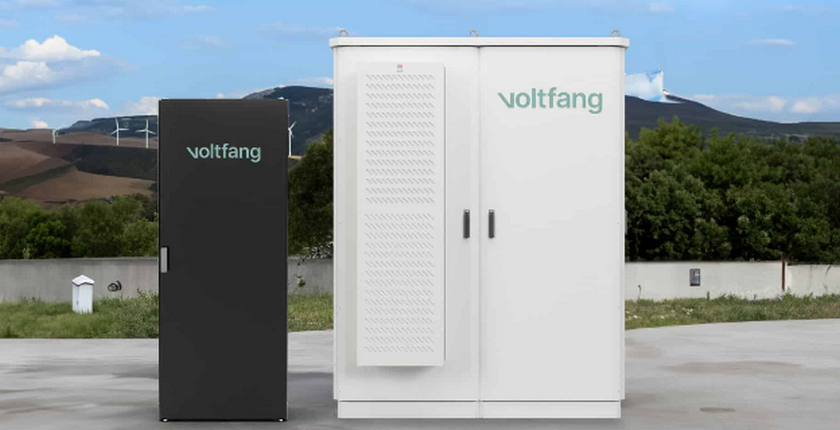
The facility will assemble fridge-sized energy storage units that households and companies can use to store excess electricity generated by solar panels or wind turbines.

Voltfang’s batteries can be used by homes and businesses to store energy from solar or wind facilities

The plant employs around 100 people, and Voltfang claims it is the largest facility in Europe for repurposing lithium-ion batteries.

David Oudsandji, co-founder and managing director of Voltfang, said the company’s goal is to develop high-performance battery storage systems for German and European industry.

Voltfang hopes to turn a profit by next year, but Oudsandji noted that the supply of used EV batteries is still small, as most such vehicles are only a few years old.

The supply of used electric vehicle batteries is still limited

Another obstacle is that new batteries, mainly from China, are becoming increasingly efficient and affordable, while refurbishing old ones is a complex process.

On the other hand, it is more sustainable and helps create a circular economy and ensure energy independence, according to Oudsandji.

by in News

Agios Efstratios becomes Greece’s first energy-autonomous island

A hybrid energy project transforming Agios Efstratios into the first energy-autonomous island in Greece is in trial operation. The system consists of a wind turbine, solar power plant, batteries, electric boilers and a district heating network.

It is a benchmark for the non-interconnected islands that won’t be connected to the mainland grid with undersea power cables.

Agios Efstratios is no longer renowned only for its history and natural beauty. It is an example of energy autonomy and sustainability. The island, also known as Ai Stratis, became the first non-interconnected Greek island with a 100% electricity supply from renewables. And more.

A pioneering energy complex is in trial operation. Agios Efstratios, which has only some 250 permanent residents, is in a group of small islands undergoing transformation through projects launched at the national level and benefiting from European Union funding.

Terna Energy completed hybrid energy system in Agios Efstratios

The Centre for Renewable Energy Sources and Saving (CRES or KAPE), an independent public entity, is responsible for the endeavor, on behalf of the Municipality of Agios Efstratios. Terna Energy, owned by Masdar, is the contractor for the works in the small North Aegean island.

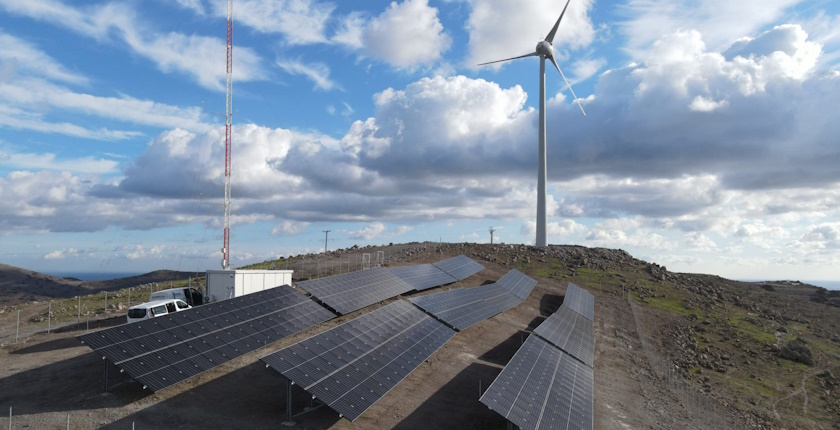
The new hybrid energy system includes a 900 kW Enercon E44 wind turbine and a solar power unit of 225 kW. Their combined annual output is estimated at above 3 GWh.

Excess electricity is stored. One unit is a Tesla Megapack battery energy storage system (BESS) of 1.25 MW in operating power and a two-hour duration. It means the capacity is 2.5 MWh. There is also an electric boiler facility of 1 MW with hot water storage tanks that can hold 500 cubic meters of water at 120 degrees Celsius. It corresponds to 25 MWh.

The district heating network in Agios Efstratios is four kilometers long. It will be tested in the winter.

An oil-fired generator operated by state-controlled Public Power Corp. (PPC) remains as backup. It can work alongside the hybrid power plant.

Greece is connecting many islands to mainland power grid

The solutions from Agios Efstratios can be applied in other islands or in microgrids, CRES noted and said residents are getting cheaper energy.

The government launched its Islands Decarbonization Fund last year, with financing from the European Investment Bank (EIB). Together they aim to provide at least EUR 1.6 billion, and mobilize total investments of EUR 3 billion to EUR 5 billion.

In the hot summer months, there are many non-interconnected islands that can’t meet their power demand, especially because of the tourist season. Some are also struggling with water supply, prompting the need for desalination, which requires electricity. They rely on fuel oil generators.

The country’s Independent Power Transmission Operator (IPTO or, in Greek, Admie) is investing in major interconnection projects. A link to the mainland grid has improved the living conditions in the Cyclades islands of Syros, Paros and Mykonos. Together with a project for the western part of the archipelago, the transmission system operator is planning subsea cables to the Dodecanese and the Northeast Aegean.