by in News

European day-ahead power market rolls out 15-minute trading intervals

The Single Day-Ahead Coupling area split its hourly units into 15-minute intervals for electricity trading. The change, affecting most European markets, is aimed at enhancing the integration of renewables by making flexibility and balancing more efficient.

After delays and intensive testing, the European wholesale electricity market switched to a 15-minute market time unit (MTU) from hourly blocks within the Single Day-Ahead Coupling (SDAC) mechanism. The transition was implemented across all bidding zones and bidding zone borders, according to the All NEMOs Committee, gathering nominated electricity market operators.

Thirty transmission system operators were involved in the move, aimed at creating an integrated pan-European cross-zonal day-ahead electricity market. Only Great Britain, Switzerland, the Western Balkans, Turkey and Cyprus, the European Union’s only non-interconnected member state, are outside of the SDAC region.

The first trading sessions were held at power exchanges yesterday, for delivery today. So far there were no indications of glitches with the quarter-hourly products.

A more than a year-long testing campaign for the 15-minute MTU solution included the validation of local, regional and cross-border functionalities, verification of connectivity between parties and confirmation of overall system readiness, the Market Coupling Steering Committee, MCSC, said last month.

Also of note, Cyprus launched its electricity exchange yesterday, with day-ahead, forward and balancing markets. In spot trading, the interval is 30 minutes.

Benefits from trading blocks with shorter intervals

The European Union is pushing the electricity market to improve efficiency by matching production and consumption more accurately. With the rising shares of solar and wind power in the energy mix, the frequency and intensity of fluctuations from weather changes are growing as well.

As the energy transition and digitalization progress, market time units could get shorter and shorter

The 15-minute interval captures the changes better than the one-hour block, reducing balancing needs and costs and freeing up capacity. As the energy transition and digitalization progress, market time units could get shorter and shorter. Importantly, it implies an exponential rise in computing power.

Wind and clouds aren’t very predictable, so unmatched production forecasts cause imbalances. It can burden the intraday market, where they are corrected. Shorter intervals lower the deviations.

Opportunity for battery storage deployment

With 15-minute products, more short-term fluctuations will already be captured in the day-ahead auction, Vattenfall said in a comment.

“Generation and demand can now be mapped much more precisely. We can submit more accurate forecasts, market renewables more effectively, deploy batteries and pumped storage more efficiently, and significantly increase system flexibility,” the company’s Head of Short-Term Asset Optimization Jörg Seidel pointed out.

Consumers could also benefit, according to the Swedish energy producer and supplier. More precise price signals open new savings potential through dynamic tariffs and smart meters, enabling households to use electricity when it is cheapest, it explained. It could make heat pumps, photovoltaic systems, batteries, and electric vehicle charging more efficient and affordable.

“Flexibility is becoming the currency of the energy transition,” Seidel stressed.

Nevertheless, nothing changes for small consumers including households until they get an electricity meter that can track quarter-hourly blocks.

With higher fluctuations in shorter intervals, opportunities arise for operators of battery energy storage systems (BESS) and other storage and balancing technologies, which stabilizes the electricity system. The switch to the 15-minute MTU is mostly beneficial for aggregators as well, reducing their exposure to penalties for failing to meet forecasted levels of production.
by in News

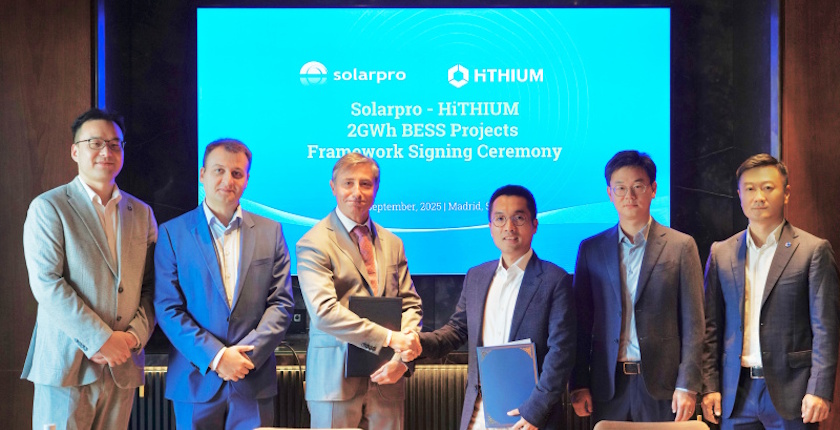
HiTHIUM, Solarpro partner to develop long-duration energy storage in Eastern Europe

China-based HiTHIUM and Solarpro Holding have signed a 2 GWh master supply agreement for battery energy storage systems.

HiTHIUM is a global provider of long-duration energy storage (LDES) technology, while Solarpro Holding is an EPC provider of photovoltaic and battery energy storage systems (BESS) in Europe.

The agreement will support multiple utility-scale projects across Eastern Europe, including but not limited to Bulgaria, Hungary, Romania, and North Macedonia – which are accelerating renewable deployment as part of their energy transition strategies, according to HiTHIUM.

HiTHIUM will supply its bespoke DC block solutions

Under the agreement, HiTHIUM will supply its bespoke direct current (DC) block solutions, applying the ∞Power 6.25 MWh BESS with high-performance batteries of 1,175 Ah and 587 Ah.

The devices will be deployed exclusively in several utility-scale projects across Europe, HiTHIUM stressed.

DC block is the basic unit of a large BESS and a ready-to-deploy solution.

HiTHIUM expressed the opinion that intraday market volatility and cannibalization of photovoltaics can be addressed mostly by LDES solutions.

Li: We will deliver projects that turn renewables generation into dispatchable, flexible, and reliable resources

According to Kelson Li, HiTHIUM Europe Senior Director of Sales, Eastern Europe’s energy transformation requires energy storage solutions that go beyond short-term balancing.

“By combining HiTHIUM’s industry-leading long-duration energy storage technology with Solarpro’s deep regional experience in large-scale renewable energy integration, we will deliver projects that turn renewable generation into dispatchable, flexible, and reliable resources, advancing the region’s clean energy transition,” he underlined.

Nenov: LDES is a next critical technology upgrade of Europe’s electricity generation mix

Konstantin Nenov, Solarpro Chairman, said his company sees LDES as the next critical technology upgrade of Europe’s electricity generation mix.

“Partnering with HiTHIUM allows us to combine their advanced BESS technology with our proven track record in designing, integration and delivering complex renewable and storage projects across the region,” he stated.

HiTHIUM and Solarpro have already collaborated on landmark projects in Bulgaria and Hungary that were commissioned in 2024 and 2025.

by in News

DRI acquires 112 MW battery storage project in Poland from Greenvolt

DRI expanded its activities in Poland with the acquisition of rights to build a battery energy storage system (BESS) in Kozienice, located in the east-central part of the country. The investment will also strengthen Ukraine’s grid, according to the update.

DRI, DTEK’s renewables arm in the European Union, acquired a BESS project for 112 MW in capability from Greenvolt Group. The battery system would have a four-hour duration, translating to a capacity of 448 MWh. The project is in a ready-to-build (RTB) stage, with all necessary administrative approvals, permits, and grid connection agreements in place for immediate construction, the two companies said.

The site is in Kozienice in the east-central part of Poland. In addition to making the country’s electricity grid more stable, the project will progressively strengthen Ukraine’s grid as the country’s energy network is integrated into a single European system, DRI pointed out.

The ambition is part of DTEK’s broader drive to prioritise energy security for Ukraine and the rest of Europe, the announcement reads.

DRI lifts battery storage project portfolio in Poland to 245 MW

With the new agreement, DRI is consolidating its position in the Polish energy market, and more broadly, in Europe’s energy transition, said DRI’s new Chief Executive Officer Murat Çinar.

Battery energy storage systems will be at the heart of the power grid of the future, DRI’s CEO Murat Çinar underscored

“By adding a second battery storage project to our portfolio, the acquisition of the Kozienice BESS will increase our total storage capacity available to the Polish grid to 245 MW. This technology will play a vital role in Europe’s transition towards a renewables-based system, enhancing grid stability and reducing the risk of outages during periods of system stress. Battery energy storage systems will be at the heart of the power grid of the future,” he stated.

Alongside its two battery storage projects in Poland, Amsterdam-based DRI is advancing fifteen solar and onshore wind projects at various stages of development in Croatia, Italy and Romania. The company said its mission is to work in underserved markets in Europe to achieve their net zero goals.

Its parent DTEK Group is the biggest private investor in Ukraine’s energy sector.

Greenvolt delivers high-impact BESS project

Greenvolt is one of the largest developers of energy storage in Europe, a technology that stands as a key pillar of the energy transition, the group’s CEO João Manso Neto said.

“This agreement fully aligns with our strategic objective to deliver high-impact projects that drive the ongoing transformation of the European energy landscape and attract strong market interest,” he stressed.

Greenvolt Group is a company within KKR’s portfolio. Through Greenvolt Power, it develops utility-scale wind, solar, and energy storage projects across 18 markets in Europe, North America, and Asia.

by in News

Half of EU auction-backed hydrogen projects pull out

Seven projects for 1.88 GW of total electrolyzer capacity turned out to be unfeasible even with grants won at the second European Hydrogen Bank auction, out of 2.34 GW overall. The developers withdrew, with some citing policy and infrastructure delays and uncertainty. A project from the first renewable hydrogen auction also pulled out.

The European Commission has invited ten projects from the reserve list of the second European Hydrogen Bank auction to start preparing documentation for signing grant agreements, after seven that were initially selected withdrew. The round, completed in May, resulted in 15 projects for renewable hydrogen winning support, for 2.34 GW of total electrolyzer capacity.

Five endeavors remained in the general category, for just 453.46 MW overall, and the remaining three are in the maritime segment. They account for 108.5 MW. The ten reserve projects envisage 774 MW, compared to the 1.88 GW that dropped out, including the three biggest proposed systems.

Stuck at completion guarantees

Some developers of the withdrawn proposals weren’t able to provide completion guarantees. Completion guarantees are worth 8% of the grant, S&P Global noted in a report. Companies cited policy and infrastructure delays and uncertainty.

Four sites are in Spain, two in Germany and the seventh one is in the Netherlands: the Zeevonk electrolyser, the largest of all. It would have 560 MW and produce 411,000 tons over ten years, receiving EUR 0.6 per kilogram.

Beneficiaries receive premiums from the European Hydrogen Bank budget that compensate for the difference between the production price and the amount that buyers offer.

European Hydrogen Bank mechanism designed to weed out unfeasible investments

Before the end of the year, the European Commission expects to publish the final list for the said IF24 auction. One project recently dropped out from the first round as well.

“The auction’s completion guarantee is working as expected in weeding out companies that have bid too low, or were forced to reassess their project maturity or financial viability between bidding and having to provide the completion guarantee,” EU Innovation Fund Policy Officer Johanna Schiele said.

The withdrawn projects could still head for implementation if they complete the financing structure.

Under the second round within the European Hydrogen Bank mechanism, EUR 1.2 billion was available, but only EUR 992 million rewarded.

by in News

Slovenia’s TSO ELES joins forces with army to develop hydrogen technologies

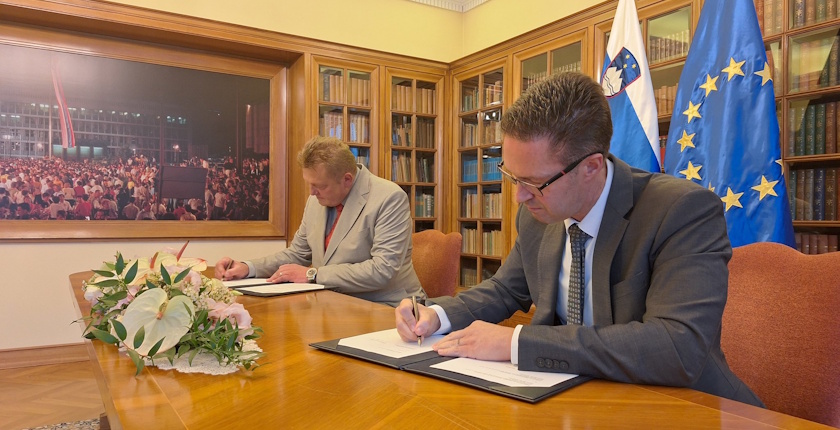
Slovenia’s transmission system operator ELES and the Ministry of Defence have signed a cooperation agreement for the Defence Resilience Hub Network in Europe – RESHUB project.

Last year, the Ministry of Defence of Slovenia initiated the Defence Resilience Hub Network in Europe (RESHUB) project, which aims to establish self-sufficient energy hubs in Slovenian military barracks.

As part of the initiative, the military barracks in Kranj will be transformed into a demonstration center for energy self-sufficiency, integrating military infrastructure with innovative solutions in renewable energy and hydrogen technologies.

Aleksander Mervar, CEO of ELES, and Marko Lovše, State Secretary of the Ministry of Defence, now signed the agreement, during the Slovenia-Japan Business Conference.

The deal outlines cooperation in the field of energy self-sufficiency and the development of hydrogen technologies, according to state-owned ELES.

The Kranj military barracks will be converted into a demonstration center for energy self-sufficiency

The project will turn the Kranj military barracks into a demonstration center for energy self-sufficiency by integrating military infrastructure with innovative technology for renewables and hydrogen.

ELES will contribute to the development of the RESHUB (Resilience Hub) pilot project concept, which focuses on the production, storage, and use of hydrogen, the country’s TSO noted.

The company will be involved in all phases of the project — from preparing expert studies and technical groundwork to providing professional support for documentation development.

ELES considers hydrogen a potential key energy carrier for storing surplus energy from low-carbon sources

“At ELES, we recognize hydrogen as a potentially key energy carrier for storing surplus energy from low-carbon sources, which can later be reused in the energy sector, transport, and industry,” according to the company.

ELES recalled that in 2024 it established a consortium to build a hydrogen ecosystem based on low-carbon sources.

Collaboration with Japanese partners, who have been actively developing and, in some cases, successfully deploying hydrogen technologies for decades, is essential for the company. ELES has already established several partnerships with Japanese companies and is now exploring new opportunities for deeper cooperation in the further development and application of hydrogen technologies.

In recognition of Mervar’s outstanding contribution to strengthening bilateral economic and technological ties, Japanese Ambassador to Slovenia Akiko Yoshida awarded him an honorary recognition at the business conference.

Akiko Yoshida and Aleksander Mervar (photo: ELES)
by in News

Prime Batteries expanding battery storage manufacturing capacity in Romania

Prime Batteries Technology started the works on multiplying the capacity of its battery storage factory in Bucharest, despite the deteriorating prospects for its industry segment in Romania. Czechia-based Tesla Group has given up on a manufacturing facility project worth almost EUR 100 million, even with state aid approved. The government’s renegotiation of a funding package with the European Union resulted in erasing EUR 150 million in grants.

Prime Batteries Technology or PBT got a major investor on board and launched the works on the expansion of its factory in Romania. Earlier this month, the company obtained the building permit for boosting the capacity in Bucharest to 8.5 GWh per year from the current 2.5 GWh, Chief Executive Officer Vicențiu Ciobanu revealed at a conference organized by Energynomics.

Prime Batteries expects to grow its operational portfolio to 226 MWh this month. The facilities are within existing renewable electricity plants – mainly photovoltaics. The company expects to deliver another 152 MWh in the same segment and another 227.8 MWh in standalone battery energy storage systems (BESS) before the end of 2025.

The rest of the 800 MWh target for this year is due by the end of March. PBT also manufactures batteries for electric vehicles, industrial production and electricity grids.

Private equity firm T2Y steps in, confident in manufacturing investment bet

Prime Batteries has just welcomed private equity firm T2Y on board. According to the announcement, their goal is to surpass 8 GWh in annual capacity by 2030. T2Y became the second-largest shareholder, while Prime Batteries Technology’s Founder Adrian Polec controls the largest stake, Handelsblatt reported.

The company has a supply chain independent of China, T2Y’s Founder Patrick Bettscheider pointed out. He noted that PBT’s machines are Korean while the suppliers are Japanese, Korean and European.

The battery manufacturer has also agreed a partnership with Monsson for the development of projects for 1.07 GWh of storage capacity in Romania and Europe. In addition, Prime Batteries introduced a battery-as-a-service (BaaS) offer for the commercial and industrial segment.

Tesla Group backs out with major loss as EU fails to address Chinese subsidies

Launching the construction of another factory occurred at a hard time for investors in battery manufacturing in the country, but also Europe.

Tesla Group from the Czech Republic recently canceled a project in Romania estimated at almost EUR 100 million, including EUR 39.4 million in state aid. The company acknowledged that it already spent EUR 10 million before the pullout: on land in Brăila for the planned factory, technology, procurement and tenders.

Among other headwinds, Tesla Group cited the significant decline BESS equipment prices and the bankruptcy of major players

Namely, the situation worsened in June 2024 as global competition intensified, Tesla Group stressed, as quoted by Profit.ro. It cited “heavily subsidized Chinese manufacturers” together with “the lack of effective trade protection policies at the EU level,” the significant decline in prices of BESS and the bankruptcy of major players such as Northvolt in Sweden.

The Czech firm said it has become “impossible to sustain or expand battery production operations in Europe.”

Lyten, headquartered in the United States, agreed in July to take over Northvolt.

Romania folds plan to make BESS manufacturing its strategic sector

On top of it all, Romania has lost EUR 150 million in EU grants for battery production, assembly and recycling, according to a document from the Ministry of Energy that the same media outlet saw. The sum was from the National Recovery and Resilience Plan (NRRP or, in Romanian, PNRR), which the government is renegotiating with the administration in Brussels.

Two beneficiaries have requested that their funding contracts be canceled. The ministry will scrap another three, the article reads.

Notably, several contracts for hydrogen production and manufacturing facilities for solar panels have been suspended. Financial support for two cogeneration plants was reduced. Greece, Bulgaria and Romania have been breaching deadlines for reforms and procedures for EU subsidies for batteries, but also other investments essential for the energy transition.

by in News

YESS Power set to commission Western Balkans’ first large battery energy storage system

YESS Power said that in November it plans to commission a 60 MW battery energy storage system (BESS) in North Macedonia. The Turkey-based contractor is installing the facility for Mey Energy at the site of the client’s solar power plant in Novaci. It would be the first large BESS and hybrid power plant in the region.

While the Western Balkans still doesn’t host any utility-scale BESS, giant leaps forward are seen in North Macedonia. Fortis Energy intends to expand its Oslomej solar power plant with one such facility, while Zen Energy Group has started the installation of a hybrid energy plant of the same kind. In addition, Turkey-based engineering, procurement, installation, and commissioning contractor YESS Power is spearheading the project for the addition of a BESS to the Novaci photovoltaic plant.

When Mey Energy put the 55 MW solar park into operation two years ago, it was the biggest in the said region. Now YESS Power, in cooperation with battery manufacturer Cubenergy from China, is installing a BESS of 60 MW at the site for the client.

With the commissioning date scheduled for November, it is about to become the first large battery energy storage facility in North Macedonia and the Western Balkans.

Novaci was the biggest PV park in the region when it was built in 2023

YESS Power, Topkapı Endüstri’s new brand, is responsible for engineering, installation, technical services and maintenance of the battery segment of the future hybrid power plant.

Mey Energy’s Novaci solar power plant spans 57 hectares. It generates 85 GWh per year, equivalent to the electricity demands of 30,000 households in the country. Notably, the PV system is next to the open pit coal mines of the REK Bitola energy complex, which includes a thermal power plant.

YESS Power said it specializes in scalable, secure, turnkey energy storage solutions for solar plants, industrial facilities, grid support and microgrids. It revealed that the current project marks the beginning of a “a broader strategic partnership in the Turkish and Eastern European markets” with Cubenergy.

In the wider Southeastern European region, Romania, Bulgaria and Turkey are massively adding BESS capacity. The remaining countries remain slow with administrative changes, planning and investment.

by in News

Fortis Energy preparing to build solar-battery hybrid power plant in Serbia

Fortis Energy has obtained a construction permit for a solar park of 270 MW on the territory of the city of Sremska Mitrovica in Serbia, Mayor Branislav Nedimović said. The company plans to include a battery energy storage system (BESS) of 36 MWh.

Turkey-based Fortis Energy bought a solar power project in Serbia last year, which would have a 180 MW grid connection. At the time, the company announced that it also planned a battery energy storage system of 36 MWh. Chief Operational Officer Velimir Gavrilović said in May, at Belgrade Energy Forum (BEF 2025) that the projects Noćaj 1 and Noćaj 2 are nearing a ready-to-build status.

After his recent meeting with the representatives of Fortis Energy, Mayor of Sremska Mitrovica Branislav Nedimović said the company has obtained a construction permit for the solar park. The transmission permit is expected within three months, and the works are beginning in the spring, he revealed. Sremska Mitrovica is a city west of Belgrade.

The location is on private land just south of the river Sava, toward Drenovac village in the Mačva area, Nedimović asserted. He said the solar power plant’s capacity would be 270 MW.

Fortis Energy received a construction permit for a proposed solar park across the river from Sremska Mitrovica

In May, the company signed a contract for the connection of its planned solar park Erdevik in Šid, a municipality bordering Sremska Mitrovica. The plan is to install 110 MW in peak capacity, with a BESS system of 31.2 MWh.

The developer and engineering, procurement and construction (EPC) contractor is working on wind power projects Vranje, Gornjak and Juhor.

The company has five biogas facilities in Serbia of 21 MW altogether.

Last year in North Macedonia, Fortis Energy commissioned a photovoltaic plant of 79.9 MW in peak capacity in Oslomej in North Macedonia. The grid capacity is 68.7 MW.

The company said in February that it contracted the construction of a BESS of 62 MW at the same location. It opted for lithium ion batteries of 104 MWh in total capacity, which means that they can run at full power for two hours.

by in News

Bulgarian coal plant mulls replacing boiler with molten salt battery

The operator of the AES Maritsa iztok 1 coal plant in Bulgaria is interested in replacing one of its boilers with a molten salt reactor. It would accumulate excess renewable energy from the power grid as heat and produce steam to drive the existing turbine.

With the surge in solar and wind power capacity throughout the world, the grid needs to match it with balancing and flexibility to handle the intermittency of the two sources. Their output varies with weather conditions, so the amount of electricity is often much higher or lower than demand.

Batteries are all the rage now, with investors racing to bridge the gaps between intraday peak production and peak consumption. Southeastern Europe is catching up with the trend, especially in Bulgaria, Romania and Turkey.

A molten salt battery could turn out to be a lifeline for AES Maritsa East 1

It opens up space for some other solutions in the emerging energy storage market which are nearing maturity. United States-based AES Corp.’s subsidiary in Bulgaria is examining one such overlooked opportunity. The molten salt reactor technology could revive the prospects of its coal power plant in Galabovo in Stara Zagora province.

The operator of the AES Maritsa iztok 1 (AES Maritsa East 1) facility is planning to transform one of the units into a so-called Carnot battery, Capital.bg reported. Such systems turn electricity into thermal energy and store it, to convert it back to electricity.

AES plans to maintain generator’s capacity

The company’s solution of choice is a molten salt reactor, which would replace the boiler. AES plans to power it with surplus renewable energy and produce steam for the existing 345 MW turbine. Importantly, among its other assets is the Saint Nikola wind power plant of 156 MW, the largest in Bulgaria.

The battery would hold enough heat to drive the unit at maximum power for five hours, translating to 1.73 GWh.

Coal plants can technically work nonstop, but the market has all but overrun most such facilities in Europe. Now they increasingly operate only when prices are high, covering peaks. It could make the business case for molten salt reactors and preserve jobs.

Molten salt is used in concentrated solar power (CSP) plants. They mostly use electrolytes such as alkali metal chlorides – sodium chloride, potassium chloride or lithium chloride – or nitrates: for instance, sodium nitrate or potassium nitrate.

Need for energy storage strengthening with rise in intraday price spreads

Market prices were negative on 2.8% of the days of last year, while they were lower than EUR 5 per MWh for 8.8% of the time. It compares to 1.9% and 5.5% in 2025, respectively, the article adds. The spread between the maximum and minimum prices is increasing. On 53% of days in the first half of this year, the difference was between EUR 100 per MWh and EUR 200 per MWh. The share of spreads above EUR 200 per MWh was 30%.

Such high amplitudes indicate both oversupply and shortages within the same day, amid the strong growth in variable renewables capacity.

by in News

One year in: insights from REIB’s inaugural BESS investments and increasing importance of safety standards

When discussing Europe’s green transition, battery energy storage systems (BESS) are often talked about as “the next big thing,” as the technologies have the potential to transform the grid, stabilise renewable energy sources, and enable new business models. However, while it’s easy to talk about storage, operating it with real assets, real risks, and real returns on the line is where theory meets reality. That is why hitting the one-year mark with two operational co-located BESS projects is more than just a date on the calendar for Renewable Energy Insurance Broker (REIB). It is a chance to look back at what worked, what caught them by surprise, and what they would tell anyone about to start their own storage journey.

In September 2024, REIB launched its own operational projects — a 4 MW / 8 MWh system and a 6 MW / 12 MWh system, developed together with Sunotec. They have now been in uninterrupted operation for twelve months, making them among the first large-scale storage sites in the region.

Eager to hear the first insights from REIB on two BESS facilities, we sat down with Delyan Iliev, Managing Director of REIB, to discuss the lessons learned from commissioning and operating these projects, and how their experience relates to broader market trends.

Delyan, achieving one year of uninterrupted operation is a significant milestone. What has stood out to you the most during this time?

One of the first things that became clear is the critical importance of certifications and compliance requirements from banks and insurers. They not only want to ensure that a project is technically sound but also require proof that it meets internationally recognised safety standards. In many cases, these certificates are prerequisites for financing. Without them, your project simply cannot move forward.

So, is early planning crucial?

Exactly. A preliminary consultation is not a formality; it is essential. When insurance professionals are involved from the beginning, we can identify and address technical or contractual issues before they escalate into costly problems. The same goes for having solid protection in the early stages of a project — too many investors believe that insurance is something you can add later. In reality, early-phase cover can mean the difference between a minor setback and a project-crippling loss.

And where does Business Interruption coverage fit into this?

That comes in a later stage, but it is equally important. Business Interruption insurance is not just about replacing lost revenue; it’s about making sure the cover matches your specific revenue model and contractual obligations. If those two are not aligned, you may face serious gaps in protection when you need it most.

REIB also works closely with clients during negotiations. How does this benefit them?

When “Insurance Requirements” are included in contracts, we are there with our clients in the negotiation room. We help to shape those clauses so that they are realistic and achievable. You don’t want to sign a contract only to realise later that you have agreed to provide policies that are impossible to obtain, have excessively high limits, or are prohibitively expensive.

Beyond that, we give our clients additional security by advising them on the most suitable insurance solutions and coverage structures for their specific project. This approach ensures that they meet their contractual obligations in a manner that is efficient, sustainable, and aligned with their risk profile.

Let’s talk about safety standards. How do they fit into this picture?

They’re the backbone of insurability. Because there’s no universal regulation for BESS yet, and rules can differ even within a single country, insurers have taken the lead in enforcing global benchmarks, such as UL, IEC, and NFPA standards. These cover everything from battery chemistry and fire safety spacing to manufacturing quality and site-specific studies. And they are not static; they evolve alongside technology.

For example, lithium ferro phosphate, or LFP, is now preferred over older chemistries like NMC (nickel, manganese, cobalt) because it is more stable, lasts longer, and is less risky. Aligning with these standards from the start not only makes insurance possible but also reassures lenders and streamlines the financing process.

And after a year, how do your projects measure up against these benchmarks?

Very well. Early alignment with international safety standards enabled us to avoid delays in securing insurance and financing. It also gave us leverage in our dealings with contractors and suppliers, because the requirements were clear from the very beginning, and everyone involved in the project knew what had to be delivered. This approach not only reduced uncertainty but also helped us manage risks more effectively during construction and commissioning.

That is your own experience. How does it fit with REIB’s broader role in the European market?

At REIB, we are proud to help unlock the potential of storage projects, and the scale speaks for itself: in 2024, Europe installed a total of 21.9 GWh of BESS, while in just the first six months of 2025, we insured more than 6 GWh — with projects in Bulgaria, Germany, and the UK. This demonstrates both the speed of market growth and the trust our clients place in us to manage their complex insurance requirements.

Finally, if you had to give one piece of advice to investors who are just starting their BESS journey, what would it be?

Don’t wait until your project is fully designed to think about insurance. The right insurance strategy is as important as the right technology. Too many projects lose valuable time and money because risk management is treated as an afterthought. Our experience shows that when insurance expertise is integrated from the earliest stage, financing is smoother, negotiations are easier, and the project stands on much firmer ground.

We already know how to align BI coverage with your revenue model, which certifications are non-negotiable for financing, and how to avoid uninsurable contract clauses. If you’re planning a BESS or hybrid project, talk to us before you break ground. It will save you time, money, and a lot of headaches in the long run.