by in News

RWE-PPC partnership starting to build 567 MW of PV capacity

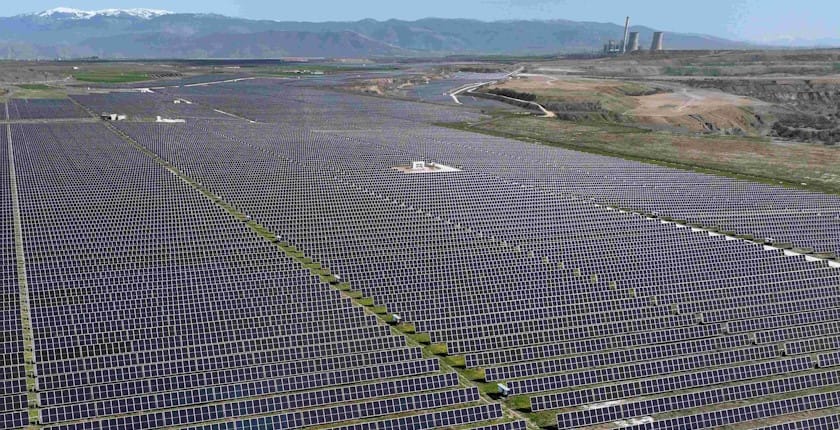
Meton Energy has taken the final investment decision for two photovoltaic projects north of Thessaloniki. Through their joint venture, Germany-based RWE and Greek government-controlled utility PPC are about to start construction of 567 MW in total peak capacity.

Most of the 2 GW solar power portfolio that the top tier German-Greek partnership is developing is now materializing. RWE, holding 51% in the Meton Energy joint venture, and Public Power Corp. (PPC), the other co-owner, agreed to move to the construction phase in an investment worth EUR 418 million.

The endeavor consists of two photovoltaic projects in the Central Macedonia region in north Greece. Solar farms Kotyli and Neo Syrakio would have a total peak capacity of 567 MW, translating to 518 MW in grid connection terms.

Commissioning expected in 2027

Construction is planned to start this spring, with commissioning expected in 2027. The two sites are in the Kilkis regional unit north of Thessaloniki. Estimated annual output is equivalent to the electricity demand of more than 140,000 households.

PPC, or DEI in Greek, formally entered its largest joint venture in 2021 with German energy giant RWE. It took the domestic company less than five years to swing from deep losses to a nearly completed coal phaseout and a regional expansion at full speed. It is building some of the largest renewables and gas facilities in Europe. Moreover, PPC is transforming the two areas in Greece that rely on the solid fossil fuel and lignite-fired power plants.

RWE, PPC won EUR 175 million in EU grants for Kotyli, Neo Syrakio

The partners manage their stakes through PPC Renewables and the RWE Renewables Europe and Australia branch.

As they reached their latest final investment decision, the companies pointed out that they secured EUR 175 million in grants for the twin projects from the European Union’s Recovery and Resilience Facility (RRF) and the National Recovery and Resilience Plan (NRRP) Greece 2.0.

They are financing the rest from own funds and with EUR 169 million from commercial banks, the announcement reads. Meton Energy has signed 10-year bilateral power purchase agreements (PPAs) with PPC and RWE Supply and Trading.

“With our latest investment decision, we underpin once again our strong commitment to the Greek market with now roughly 1.5 GW of solar capacity in deployment. This great achievement is the result of the excellent cooperation between the teams involved at RWE and PPC. Together we are accelerating the energy transition in Greece,” said Chief Executive Officer of RWE Renewables Europe and Australia Katja Wünschel.

Amynteo PV clusters coming online by year end

The two partners have so far energized five solar farms with 210 in total peak capacity. The construction of another PV plant with a peak of 105 MW is complete. Three more, of 625 MW in combined peak capacity, are planned to become operational by the end of 2025.

The nine units in three clusters have 940 MW altogether or 870 MW on the transmission grid, as alternating current. They are in the former Amynteo open cast lignite mine in Western Macedonia in the country’s north.

“We are delivering our solar projects at an impressive pace. The first cluster of the Amynteo portfolio is already energised, construction works for Amynteo clusters 2 and 3 are at an advanced stage and we are looking forward to connecting all projects to the grid this year,” said Costas Papamantellos, CEO of RWE Renewables Hellas and Meton Energy.

by in News

Turkey pushing against rivals for transmission of green electricity to EU

Turkey’s agreement with Azerbaijan, Georgia and Bulgaria on the transmission of renewable electricity could set back the project for an interconnector under the Black Sea between Georgia and Romania. In addition, President Recep Tayyip Erdoğan’s government fiercely opposes the Great Sea Interconnector project, part of the proposed Greece-Cyprus-Israel submarine link. Turkey is also pushing against rival hydrocarbon projects around Cyprus.

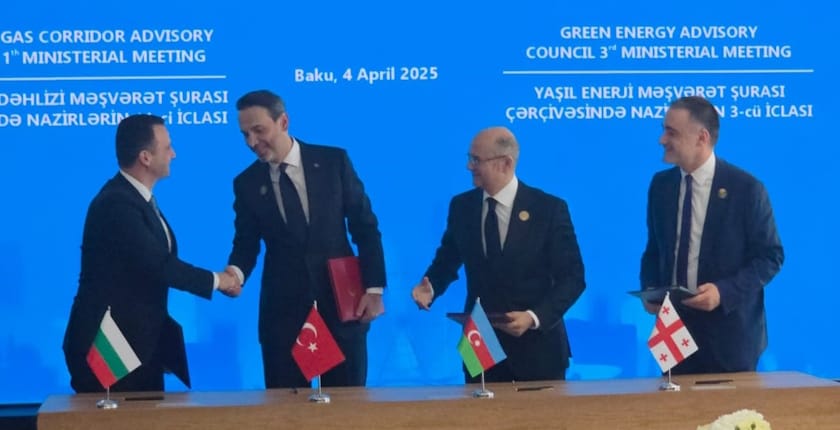
On the margins of the Southern Gas Corridor (SGC) annual meeting, a regional green energy project has come to the fore. Ministers of energy of Turkey, Bulgaria, Georgia and Azerbaijan, the host country, signed a memorandum of understanding on green electricity transmission and trade. The initiative envisages the establishment of a green energy corridor toward Europe.

The proposal for a power interconnections upgrade is an apparent competitor against a project by Romania, Georgia, Azerbaijan and Hungary. They plan to lay a high-voltage direct current (HVDC) cable under the Black Sea. Bulgaria does have a seat at the table, but even after several meetings it still hasn’t become a partner in the GECO submarine link project. The alternative onshore line through Turkey would give it a central role.

Bulgaria, which has been waiting to become a partner in the Black Sea submarine interconnection project, would get a central role in an onshore power transmission corridor that would go through Turkey

President Recep Tayyip Erdoğan’s government is determined to establish the key transmission and production hub for electricity and fossil fuels for the European Union. The new memorandum is another indicator, together with Turkey’s fierce opposition to the Great Sea Interconnector project, which is part of a proposed Greece-Cyprus-Israel submarine power link, and to hydrocarbon drilling around Cyprus.

Turkey also benefits from the TurkStream pipeline, which carries gas from Russia. It was built instead of the abandoned South Stream project, which was supposed to directly connect Russia and Bulgaria.

Studies to be commissioned by June

Turkish Minister of Energy and Natural Resources Alparslan Bayraktar said electricity from Azerbaijan and the region would reach his country via Georgia as well as Azerbaijan’s exclave of Nakhchivan. It means a line would go through Armenia.

The four energy ministers said a working group would complete the technical details and commission feasibility studies already by June.

Azerbaijani President Ilham Aliyev said his country would add 6.5 GW of renewable energy capacity by 2030, compared to the current 8 GW, from all sources. One of the biggest private investors is Abu Dhabi Future Energy Co. (Masdar).

TANAP’s capacity to be doubled

Turkey is diversifying its energy supply, Bayraktar noted. “Our natural gas imports from Turkmenistan, which started on March 1, are an important step towards the goal of securing our own supply while also carrying Central Asian energy to European markets,” he stated.

The minister highlighted the goal to increase the capacity of the Trans Anatolian Natural Gas Pipeline (TANAP), part of the Southern Gas Corridor, to 31 billion cubic meters per year from 16 billion.

Tensions rising as seabed survey for Great Sea Interconnector to resume

The NG Worker vessel is returning to carry out seabed surveys east of Greece’s Kasos-Karpathos island area, Energypress reported. The activity, part of the Great Sea Interconnector, was interrupted again in February after a Turkish corvette approached the ships NG Worker and Ievoli Relume.

After research was completed in the territorial waters of Greece and Cyprus, the last section is in international waters. Türkiye Gazetesi learned from security sources that Turkey wouldn’t allow “such a fait accompli.” The unnamed sources said the seabed survey is a breach of international law.

The power link project has also faced delays due to disputes around financing and it still risks losing a massive EU funding package. Turkey is promoting the idea of a cable connecting Cyprus to its own electricity transmission network instead.

by in News

Energy efficiency: the jack of all trades of EU electrification

By Arianna Vitali, Secretary General at the Coalition for Energy Savings, EUSEW’s partner organisation, highlighting the importance of energy efficiency in EU electrification, including cost savings, better grid flexibility, and protecting consumers.

It is no secret that for the EU to reach climate neutrality, the progressive electrification of our energy system will be essential – and with it, a sound strategy to achieve it in a cost-effective manner. With an Electrification Action Plan on the books for the new European Commission, it is crucial to ensure that the potential of energy efficiency to enable, accelerate, and lower the costs of EU electrification is not overlooked, but rather fully leveraged.

Energy efficiency and electrification: a match made in heaven

Shifting away from fossil fuels and towards renewable energy sources will require accelerating the electrification of both energy production and end-uses. While we all agree that electrification boosts energy efficiency, it is important to remember that this relationship is a two-way street where energy efficiency also has something to offer to the EU electrification process.

Indeed, by reducing overall energy demand, energy efficiency can ease grid congestion, reduce the costs of electrifying the EU energy system, and stabilise the prices paid by consumers. In that vein, the European Commission recently stressed that combined action on electrification and energy efficiency can reduce the EU’s fossil fuel import bill by €32.5 billion every year by 2030 (representing 25% of the total savings that would result from implementing the Action Plan). With the top priorities for this mandate focusing on improving competitiveness and affordability, leveraging the joint potential of energy efficiency and electrification is more relevant than ever.

Flexibility is key

A resilient energy system starts with a flexible energy system. Beyond supporting the EU’s climate neutrality goal, reducing energy demand through demand-side measures eases stress on the grid, allows for more flexible consumption patterns, and ultimately ensures a more adaptable and resilient energy system. The evidence is there: by adopting ambitious demand-side measures (both efficiency and flexibility), peak demand can be reduced by up to 39% in 2030 compared to a scenario without such improvements. This, by extension, lowers the need for additional infrastructure, making the overall electrification process faster and more manageable.

Lowering costs, boosting affordability, and protecting citizens

Energy efficiency’s potential to reduce infrastructure costs, and therefore overall system costs, is significant. For instance, ambitious demand-side measures respectively lower total energy system costs and reduce annual investments in distribution grids by around €40 billion.

These saved costs, which will ultimately not be paid by businesses and citizens, contribute to energy affordability by keeping electricity prices in check, helping European industries decarbonise while improving their competitiveness.

Finally, energy efficiency measures would also cut energy costs for households, helping to protect the most vulnerable. With ambitious demand-side measures, households could save significantly on their annual energy bills. Annual average household energy spending could go down to €900 by 2030, a considerable drop from today’s average of €1,190. This proves particularly useful for heating and road transport, which are expected to increase fossil fuel prices.

Time to put energy efficiency first

The EU transition towards decarbonisation and electrification of the energy system will require careful planning and substantial investment. Luckily, the EU has a jack of all trades on hand. With its wide range of benefits, from reducing infrastructure needs and costs, increasing energy security, cutting energy bills, and supporting both businesses and vulnerable citizens, energy efficiency offers readily available solutions to many of the challenges ahead and must be prioritised.

As stressed in the Action Plan for Affordable Energy, the EU needs a ‘decarbonised energy system, driven by a substantial scale-up of clean energy and electrification, with energy efficiency at its centre’. Prioritising the implementation of energy efficiency solutions on the ground will be key to building an affordable, secure, and competitive energy system for the future.

This opinion editorial is produced in co-operation with the European Sustainable Energy Week 2025. See ec.europa.eu/eusew for more details.

Disclaimer: This article is a contribution from a partner. All rights reserved.

Neither the European Commission nor any person acting on behalf of the Commission is responsible for the use that might be made of the information in the article. The opinions expressed are those of the author(s) only and should not be considered as representative of the European Commission’s official position.

by in News

Kosovo* to subsidize solar panels for prosumers, solar thermal systems

Kosovo* is using an EU grant for public calls for families and firms to install solar power panels and solar thermal collectors. The subsidies for photovoltaics amount to EUR 250 per kW, or EUR 200 per kW for businesses that set up larger systems. There is a bonus for female-owned enterprises.

The Ministry of Economy of Kosovo* launched a mechanism to support households and micro, small, and medium-sized enterprises in investing in renewable energy. The measures are funded with a EUR 75 million grant from the European Union within its EUR 500 million direct budget aid package for the Western Balkans. It was approved at the height of the energy crisis, to subsidize the energy bills of households and businesses that were at high risk.

The authorities issued a call for photovoltaics for self-consumption for families and micro, small, and medium-sized enterprises. Households can apply for support for solar systems with capacities ranging from 3 kW to 7 kW. They will be subsidized with EUR 250 per kW to become prosumers but only up to EUR 1,750 overall.

Firms that build photovoltaic systems of 10 kW and more are entitled to as much as EUR 6,000 per beneficiary

For micro, small, and medium-sized enterprises, the subsidy will be EUR 250 per kW for capacities ranging from 3 kW to 9 kW. The maximum payment to one beneficiary is EUR 2,000. For capacities of 10 kW and above, future prosumers in the business sector will be subsidized with EUR 200 per kW or up to EUR 6,000 in total.

In cases where businesses are owned by women or are jointly owned by women holding at least 51% of ownership, the government will add EUR 200 to the subsidy.

The deadline for the first phase is May 31 or until all funds are reserved, on a first-come-first-served basis. Applications in the second phase will be accepted until September 30, according to the announcement.

Public call for solar thermal systems for firms expected in one week

The other call, which the ministry expects to be launched in mid-February, is for supporting micro, small, and medium-sized enterprises in investing in solar thermal systems, for water heating.

The share of subsidies is 40% of the investment value or up to EUR 4,000 in total.

Government promises pathways for investments

Kosovo’s Prime Minister Albin Kurti expressed commitment to the energy transition pathway.

“While we are working on projects with large capacities such as the solar auction, we are also pushing forward opportunities for our citizens to develop small-scale energy capacities for consumption and self-consumption. Not only are we reducing the burden on our system, but we are also empowering families and businesses to make sustainable and affordable choices,” he said.

The Law on Renewable Energy Sources has passed the first reading in parliament

It is a favorable time for investments in renewables, Minister of Economy Artane Rizvanolli claimed and highlighted the work on the Law on Renewable Energy Sources. It has passed the first reading in parliament.

The law will make the installation of solar systems more attractive and obligate operators to make it easier for citizens, she added. The energy strategy stipulates that citizens should be in the center with regard to development and benefit from the energy transition, Rizvanolli asserted.

Alessandro Bianciardi from the European Union Office in Kosovo* vowed to continue supporting the government’s initiatives in the sector. They are cooperating on the 2024-2027 agenda to boost the economy of Kosovo* and other Western Balkan countries with grants and subsidies in the energy sector, he stressed.

* This designation is without prejudice to positions onstatus and is in line with UNSCR 1244/99 and the ICJ Opinion on the Kosovo declaration of independence.
by in News

Kosovo* power utility KEK replaces acting CEO

The Board of Directors of Kosovo Energy Corp. (KEK) appointed Bekir Gërguri as acting chief executive officer and Ramadan Budakova as his deputy, also in an acting capacity.

The change in leadership in Prishtina-based KEK has prompted controversy. Bekir Gërguri has been named acting CEO instead of Përparim Kabashi, who has returned to his previous position as secretary. Ramadan Budakova became acting deputy CEO of the government-controlled electricity producer.

The company runs the only two coal-fired power plants in Kosovo*, which account for more than 90% of domestic output. But KEK also has a major renewables project underway, backed by funding from the European Union.

Connections between the newly appointed CEO and Kosovo’s ruling party Lëvizja Vetëvendosje (LVV) surfaced immediately after the announcement. Gërguri’s previous affiliation with it, including his candidacy for the Municipal Assembly of Fushë Kosova (called Kosovo Polje in Serbian), has raised questions about potential political influence.

KEK generated 5.53 TWh of electricity last year

Additionally, there are concerns about reports that Budakova was accused of planting wheat over a decade ago on KEK land near coal mines without authorization, resulting in his demotion.

There were issues with earlier leadership as well. Police arrested former CEO Nagip Krasniqi last year over alleged tender manipulation. He was released from detention last September, but the legal proceedings against him are ongoing.

As Kosovo’s primary energy provider, KEK plays a vital role in the country’s infrastructure and economy. It remains to be seen how the new management will navigate the challenges ahead and address concerns about transparency, accountability, and political influence.

KEK generated 5.53 TWh of electricity last year. The Kosovo A thermal power plant contributed 2.29 TWh, while Kosovo B accounted for the remainder.

Separately, through the cogeneration project with Prishtina’s Termokos, over 327 GWh of thermal energy was generated for heating purposes. This significant output has been achieved through the combustion of coal, with a total of 6.92 million tons extracted during the year 2023.

* This designation is without prejudice to positions onstatus and is in line with UNSCR 1244/99 and the ICJ Opinion on the Kosovo declaration of independence.
by in News

Kosovo* to measure wind potential for auctions, public projects

The Ministry of Economy of Kosovo* will install wind gauges this year at many locations to develop projects that it intends to auction or build capacities in public ownership or within public-private partnerships.

The government never had precise data on wind energy potential, as various potential investors measured it themselves, but they didn’t do it properly either, so Kosovo* is “a little behind” in the aspect, according to Minister of Economy Artane Rizvanolli. She told lawmakers that the ministry would set up anemometers and wind vanes in many places this year to determine wind speed and direction, Buletini Ekonomik reported.

The next step will be to conduct other preliminary studies, Rizvanolli explained. The ministry will develop them into projects for the first auctions or to install capacities in public ownership or within public-private partnerships, she revealed.

Data for foreign investors

The aim is to present foreign investors with exact information on wind potential, in her words. It will contribute the success rate and process transparency, for which the ministry was praised during the first auction, Rizvanolli stressed.

Kosovo* hosts two wind power plants. Bajgora (also known as Selac) has 102.6 MW in connection capacity. The Kitka facility, of 36 MW is planned for expansion.

There is an estimated 1 GW in overall potential in the locations of Çiçavica (also Čičavica, Çiçavica and Qyqavica), Zatriq (Zatrić), Budakovo (Budakova) and Kozhica (Kožica), the article adds.

Air Energy 2 intends to install two wind power plants of 34.8 MW each, in combination with a solar power plant. StubllaEnergy is also working on a hybrid power plant of 170 MW, of which 132 MW would be in wind turbines. Most projects have long been dormant.

Next up is 150 MW wind power auction

One month ago the Ministry of Economy published the names of companies that applied to qualify for Kosovo’s pilot renewable energy auction. They are competing for a contract for difference of CfD for a solar power project of 100 MW in indicated connection capacity.

The government plans auctions for a combined 950 MW in wind and solar power and battery storage in the next two years. First up would be a public call for 150 MW in wind power.

* This designation is without prejudice to positions onstatus and is in line with UNSCR 1244/99 and the ICJ Opinion on the Kosovo declaration of independence.
by in News

Kosovo* receives financing for 120 MW solar power plant on coal ash dump

The European Investment Bank is providing a EUR 33 million loan for a solar power plant of 120 MW in peak capacity. Government-controlled power utility KEK plans to install it on its former coal ash dump near Prishtina.

The European Investment Bank (EIB) signed a EUR 33 million investment loan for the construction of a photovoltaic plant in Kosovo* with a connection to the grid of up to 100 MW, translated to 120 MW in peak capacity.

The financing package for the Solar4Kosovo project is part of the European Union’s Economic and Investment Plan for the Western Balkans of EUR 9 billion in grants. It is aimed at mobilizing a total of EUR 30 billion.

Solar power project involves EUR 32 million EU grant

The proposed facility is expected to produce 169 GWh per year, EIB said. The location, owned by government-controlled Kosovo Energy Corp. (KEK), is on the former ash dump of its Kosovo A power plant. The electricity producer is also getting a EUR 32 million grant via the EU’s Western Balkans Investment Framework.

“As one of the largest renewable energy developments in the region under Team Europe, this project will help Kosovo* achieve its energy security and renewable energy goals. Together with the European Commission and other partners, we are glad to be able to jointly help Kosovo* lay the groundwork for the decarbonisation of the local economy and diversification of the energy mix, in line with the EU Green Agenda,” said EIB’s Vice-President Kyriacos Kakouris.

Investment valued at EUR 107 million in total

Germany’s KfW Development bank is providing a EUR 29 million loan. The project’s total value, including KEK’s own funds, is estimated at EUR 107 million. The solar power plant between the towns of Obiliq/Obilić and Fushë Kosova (called Kosovo Polje in Serbian), near Prishtina, would have an underground connection to the existing substation at the Kosovo A thermal power plant.

“This project, the largest of its kind in the region, not only guarantees a sustainable energy production method but also accelerates Kosovo’s shift from conventional energy sources,” according to Kosovo’s Minister of Finance, Labour and Transfers Hekuran Murati.

Kosovo* is dependent on obsolete Kosovo A and Kosovo B coal plants for almost all its electricity. Renewables projects are gradually gaining traction.

The other part of the Solar4Kosovo project is for a solar thermal facility for the nearby capital city’s district heating system. The site is in the village of Shkabaj (Orlović) in Obiliq municipality.

In other news, the government in Prishtina established Energy Storage Corp. or ESCorp. It will manage the project for batteries with total operating power of 125 MW and 250 MWh in capacity. It is funded by the Millennium Challenge Corp. (MCC) of the United States.

The remaining 45 MW (90 MWh) is expected to be owned by Transmission, System and Market Operator (KOSTT). The battery systems are envisaged to store surplus electricity and stabilize the frequency in the transmission system. They are valued at USD 180 million altogether.

* This designation is without prejudice to positions onstatus and is in line with UNSCR 1244/99 and the ICJ Opinion on the Kosovo declaration of independence.
by in News

Kosovo* completes first solar power auction at EUR 48.88 per MWh

A consortium led by Switzerland-based construction company Orllati was selected to build and operate a solar park of up to 105 MW in connection capacity for 30 years including a 15-year contract for difference. The group won the first renewable electricity auction in Kosovo* with a bid of EUR 48.88 per MWh.

Almost a year since the initial public call, the Ministry of Economy in Prishtina completed its pilot solar power auction. Even though it raised the ceiling price in late December to EUR 75 per MWh from EUR 65 per MWh amid repeated delays, it was closed at EUR 48.88 per MWh.

Switzerland-based Orllati leads the winning consortium, consisting of companies from Germany and Kosovo*. The construction firm is led by Kosovar diaspora, officials said.

The victory in the electronic auction translates to the right to take land on lease for a photovoltaic park of 90 MW to 105 MW in total connection capacity and up to 117 MW in peak terms. Orllati agreed to build and operate the facility for 30 years, of which the first 15 years it would sell electricity under a contract for difference (CfD) equalling the winning price.

The government-owned land is in the cadastral zones of Kramovik and Petković (Guri i Kuq) in the municipality of Rahovec or Orahovac.

Auction terms were amended ten times

Two Turkish consortia participated in the auction – Çalik and Limak, and Güri̇ş İnşaat ve Mühendislik (Güri̇ş Construction and Engineering) – together with Akuo Energy, headquartered in France, and Egypt-based Elswedy Electric. It consisted of four rounds, the ministry said. The first one, with 43 bids, drove the price down to EUR 57 per MWh while the final level was reached in the third one.

Kosovo* intends to launch auctions this year for 45 MW in battery storage and 150 MW in wind power

Minister of Economy Artane Rizvanolli said the competitive process is ensuring affordability for citizens, strengthening the security of supply and the sector’s sustainability and enabling private investments. She revealed that the auction terms were amended ten times in line with investors’ suggestions.

The winner will invest more than EUR 70 million, according to the government, which is preparing to issue calls for auctions this year for 45 MW in battery storage and 150 MW in wind power. There is 950 MW in total in the pipeline, Rizvanolli noted, saying the potential investments are valued at an overall EUR 1.2 billion.

Ceiling price at Albania’s next auction will be EUR 59.97 per MWh

The bidding was organized with the support of the United States Agency for International Development (USAID). The renewable electricity auction model was developed with the European Bank for Reconstruction and Development.

Kosovo* hosts just two operational wind power plants and some hydropower and photovoltaic capacities.

For comparison, Romania is preparing its first solar power auction for CfDs with a maximum price of EUR 91 per MWh. Amid weak participation, the lowest price at Serbia’s first solar power auction, held last year, was EUR 88.65 per MWh, just 35 eurocents below the starting level.

The maximum acceptable price in Albania’s upcoming auction is EUR 59.97 per MWh. The two previous auctions, in 2021 and 2020, were similar to the latest one in Kosovo*. The government secured land for one large-scale project at a time and for one investor each. Voltalia was the winner both for Spitalla (EUR 29.89 per MWh) and Karavasta (EUR 24.89 per MWh).

* This designation is without prejudice to positions onstatus and is in line with UNSCR 1244/99 and the ICJ Opinion on the Kosovo declaration of independence.
by in News

Kosovo* adopts Law on the Promotion of the Use of Renewable Energy Sources

Only after the first auction was held, lawmakers in Prishtina enabled subsidizing renewable electricity plants through contracts for difference (CfDs). Passing the Law on the Promotion of the Use of Renewable Energy Sources, they also cleared the way for the introduction of guarantees of origin, a renewable energy operator and support fund, energy communities and energy storage in Kosovo*. The legislation includes provisions on self-consumption.

Kosovo’s parliament adopted the Law on the Promotion of the Use of Renewable Energy Sources. It won praise from the Energy Community Secretariat for aligning the legal framework with the Renewable Energy Directive. The international organization based in Vienna also commended the move toward sustainable energy development.

“This law will bring benefits to the private sector, through new concepts of consumer involvement in the energy sector and through the definition of procedures that must be done competitively. In this way, all enterprises are treated equally, benefiting from their competition which leads to lower prices and affordable costs for citizens,” the Ministry of Energy said.

Provisions for green heating, cooling, transportation

Among the objectives are increasing the security of supply and protecting the environment. The Law on the Promotion of the Use of Renewable Energy Sources includes provisions on the combined generation of heat and power (CHP or cogeneration).

The legislation covers the electricity sector, heating and cooling and transportation. The law cleared the way for incentivizing consumers to produce, store and sell the surplus of renewable electricity.

A system for guarantees of origin of electricity is envisaged to be rolled out as well. Notably, the Energy Regulatory Office (ERO) expects to establish a registry in June. The law stipulates that a renewable energy operator would be founded. The entity would manage a renewable energy support fund.

Liquid day-ahead market was necessary to have reference prices for CfDs

In addition, the legislation defines energy communities, energy storage activities and behind-the-meter installations for renewables self-consumers. Such units wouldn’t be able to inject electricity into the grid.

The adoption of the law was apparently on hold until the Albanian Power Exchange (ALPEX) set up a liquid day-ahead market. Kosovo* and Albania jointly launched the bourse. The reference price set in trading is necessary for obligations determined in contracts for difference (CfDs). The subsidies are awarded in renewable energy auctions.

On the other hand, the first such competitive bidding process was completed late last month, before the Law on the Promotion of the Use of Renewable Energy Sources was passed.

The Government of North Macedonia sent a similar bill to the national assembly a month ago.

* This designation is without prejudice to positions onstatus and is in line with UNSCR 1244/99 and the ICJ Opinion on the Kosovo declaration of independence.
by in News

Kosovo* issues terms for upcoming wind power auctions

The first wind power tenders in Kosovo* will be conducted in two rounds of 75 MW to 100 MW each. The Ministry of Economy published the draft criteria for participants. It intends to issue the first call in October.

Instead of a single first tender, the Ministry of Economy in Prishtina said it would auction off electricity from wind power projects in two rounds. Advised by the International Finance Corp. (IFC) and with support from the Energy Sustainable Activity (ESA) project of the United States Agency for International Development (USAID), Kosovo* issued the conditions for applicants.

Mirroring the first solar power auction, both tenders will consist of two stages: qualifications and proposals, according to the ministry. The approximate total quota is 150 MW and each bidding will be for 75 MW to 100 MW, it explained.

Second round to begin next year

The document lists preliminary requirements regarding project feasibility, sustainability and the bidders’ experience and capacities. The conditions can still change before the release of the tender documentation, the authorities pointed out.

The first call for qualifications is expected to be published in October and the qualified bidders will be invited to submit proposals early next year, the ministry revealed. It added that it intends to kickstart the second procedure in 2025.

IMF is funding wind tenders in Kosovo*

Kosovo* is tapping into the International Monetary Fund’s (IMF) Resilience and Sustainability Facility for the 150 MW endeavor. The ministry added that it would coinvest in wind energy projects under a public-private partnership mechanism. It would lower the risk for private investors, it said.

The locations for the projects are still unknown. Auction winners are entitled to power purchase agreements (PPAs), the announcement reads.

The documentation shows applicants would be required to submit production estimates per year over a 20-year period. The assessments must be carried out by independent and qualified wind energy consultants. The company or consortium will also be obligated to hire biodiversity specialists to conduct basic studies on birds and bats.

Eligible companies have experience in the development and operation of grid-connected renewable electricity plants of 60 MW in total. The minimum share of wind is 40 MW, of which one project must be bigger than 20 MW, the summary shows.

The government earlier said it was planning auctions for 950 MW including battery storage within two years.

* This designation is without prejudice to positions onstatus and is in line with UNSCR 1244/99 and the ICJ Opinion on the Kosovo declaration of independence.