by in News

Vatopedi monastery on Mt. Athos gets largest grid-forming BESS in Greece

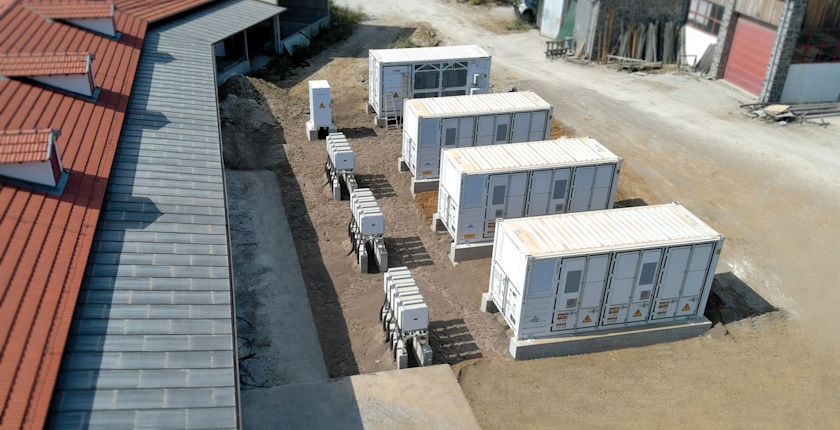
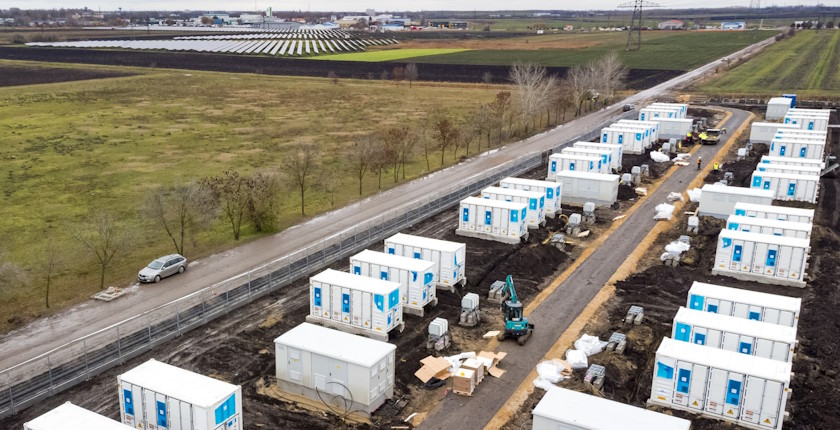
A grid-forming battery energy storage system of 3 MW was put into trial operation at the Vatopedi monastery on Mount Athos. The project is part of the green energy transition of the monastic republic in northern Greece.

The Sacred Patriarchal and Stavopegial Monastery of Vatopedi, founded in the 10th century, has a microgrid. Engineering, procurement and construction (EPC) contractor ENGAIA said it installed the largest grid-forming battery energy storage system (BESS) in Greece at the site. The facility with 3 MW in operating power and a capacity of 6 MWh is also the largest in the country, according to the company.

The Monastic Republic of Mount Athos of 20 monasteries in the Chalkidiki peninsula in northern Greece isn’t connected to the national electricity network. Reliant until recently only on diesel-fired generators and solid fuel, the self-governing area is shifting to solar power with storage.

Not long ago, Mount Athos relied on diesel-fired generators and solid fuel for its energy needs

ENGAIA, a Greek member of the London-based ECOERA group of companies, is also adding a 1.1 MW photovoltaic unit. It said it would enable it to commission the battery facility fully.

The company stressed that the independent microgrid with a virtual synchronous generator (VSG) at Vatopedi, enabling energy autonomy, is also the largest in the country and one of the largest in Europe. The new BESS is the first large-scale deployment of Huawei’s equipment in the sector in Greece.

Mount Athos is also known as Agion Oros – Holy Mountain. Three years ago, European funds were approved for 21 autonomous photovoltaic stations, with a total capacity of 2.64 MW, in combination with energy storage systems. Mytilineos, now called Metlen, won the contract for the installation of the facilities.
by in News

Turkey selects first hydropower reservoir for YEKA floating solar power auction

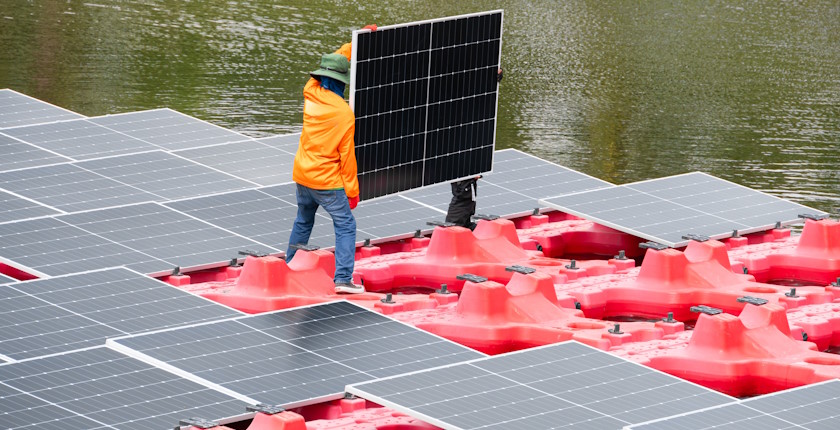
The reservoir of state-owned Electricity Generation Corp.’s Demirköprü hydropower plant is the first proposed area for Turkey’s planned floating solar power auction. The YEKA support mechanism provides grid permits for several decades and a period with guaranteed prices.

Within its ambition to grow the solar and wind power capacity to 120 GW in total by 2035, the Turkish government is counting on floating photovoltaics as well. The Ministry of Energy and Natural Resources proposed the reservoir of the Demirköprü hydropower plant for the first dedicated auction for the technology.

Detailed studies of the area are underway under the framework for the Renewable Energy Zones (REZ) state support mechanism, the announcement revealed. The scheme is better known by its Turkish acronym YEKA.

Demirköprü is on the Gediz river, east of Izmir, in Manisa province. Its owner is state-owned Electricity Generation Corp. (Elektrik Üretim A.Ş. – EÜAŞ). The 69 MW hydropower plant’s dam holds a reservoir with a regular surface of just under 48 square kilometers.

The Demirköprü hydropower plant’s reservoir spans almost 48 square kilometers under regular conditions

The country’s second floating solar power plant came online early this year. The only other such facilities in the region that Balkan Green Energy News covers are in Romania and Albania.

Turkey held auctions for 7.85 GW in total for wind and solar power, of which 3.8 GW for PV projects. Winners get grid permits for several decades and a period with guaranteed prices.

The country’s total electricity production capacity reached 119.3 GW by the end of May, of which 72.5 GW ran on renewable sources. Solar power accounted for 22.6 GW, compared to 20.4 GW in mid-February.

The ministry selected the first offshore wind power zones in August 2023.

by in News

Hungary’s MAVIR commissions 60 MWh battery energy storage system

MAVIR, the Hungarian electricity transmission system operator (TSO), put into operation a battery energy storage system, BESS, of 20 MW in capability and a three-hour cycle. It will help grid security and the integration of renewable energy sources.

After entering the world’s top ten in photovoltaic capacity per capita, Hungary is picking up pace in terms of batteries as well. Energy storage units are coming online to maintain grid stability and bridge the hours between the peaks of daily solar power production and electricity consumption. Transmission system operator MAVIR commissioned a BESS of 20 MW in operating power and a three-hour cycle, translating to 60 MWh in capacity.

The EUR 20.3 million project received support in the form of a grant via the European Union. MET Group also put into operation a similarly-sized BESS last month in Hungary, while MOL Group launched construction of another one.

MAVIR’s battery energy storage system is in Szolnok, southeast from the capital Budapest. The company picked Forest-Vill as the contractor in late 2023. They signed the contract in February 2024. The same firm built MET Group’s BESS and also used equipment from Huawei Technologies.

Investors in BESS in Hungary are benefiting from EU grants

MAVIR’s new facility will contribute to grid security and a more efficient integration of renewable energy sources and support a sustainable, green future, said Deputy Minister of Energy and Parliamentary State Secretary of the Ministry of Energy Gábor Czepek.

The government’s EUR 45.1 million subsidy program for residential and corporate investments resulted in the installation of 12,000 batteries in households of 109 MWh in total, the official pointed out. Hungary now hosts 114 MW in battery capability.

Czepek estimated that the grants would bring 1 GW online by 2030, as targeted. Another call, of EUR 12.5 million, will soon be launched for energy storage for the industrial sector, he stressed.

Notably, the Ministry of Energy said solar power production reached 6.25 GW around noon on June 25. It was more than the country’s entire electricity demand at the time, it added.

by in News

Montenegro publishes NECP for public consultation – sole coal plant planned for shutdown in 2041

State institutions, companies, organizations, and individuals have until August 6 to deliver their suggestions and comments about the draft National Energy and Climate Plan of Montenegro. It sets the provisional date for taking the Pljevlja coal power plant, the only one in the country, at 2041, but the authors pointed out that it primarily depends on a just transition and the security of electricity supply.

Montenegro’s long-awaited draft National Energy and Climate Plan (NECP) sets out the key 2030 targets for greenhouse gas emission cuts, share of renewable energy sources in gross final energy consumption, and energy efficiency.

The document, also known for its acronym INECP, in which the first letter stands for integrated, was published for the public consultation phase. It lasts until August 6. The Ministry of Energy and Mining called on the interested public – local authorities and other state institutions, the expert and scientific communities, associations, organizations, companies and individuals, to send their comments and suggestions.

“The energy and climate policy isn’t just a task for the government – it is a joint responsibility. That is why I am inviting all stakeholders, and especially nongovernmental organizations, to use this opportunity and contribute to the creation of a realistic, ambitious and just plan,” Minister Admir Šahmanović stated.

Renewables target can be surpassed

National goals match the ones adopted within the Energy Community. The targeted primary energy consumption in 2030 amounts to 0.92 million tons of oil equivalent. Under the business-as-usual scenario (with existing measures – WEM), the benchmark is expected to land at 1.04 million. With additional measures (WEM), the trajectory moves closer to the objective, projected at 0.97 million tons of oil equivalent.

The goal for final energy consumption is 0.73 million tons of oil equivalent. Existing measures result in 0.82 million, and added ones in 0.77 million tons of oil equivalent.

The share of renewable sources in transportation could reach 24.4% instead of only 7.2%

Montenegro fares better with its expected share of renewables in gross final energy consumption, against the 50% target. In the WEM scenario, it reaches 42.5%, and the WAM projection is 53.3%.

Without additional measures, renewable sources have a 66.3% share in electricity production. The document’s authors calculated that it could grow to 79.4%. As for transportation, the range is from 7.2% to 24.4%. In heating and cooling, the possible progress from the results of current measures is only 0.4 percentage points, reaching 49.2%.

The targeted reduction in emissions is 55%, the same as in the European Union. It translates to 2.42 million tons of carbon dioxide equivalent in the final year of the current decade. With existing measures, the curve touches 3.06 million in 2030, and with added ones the result is 2.4 million tons of CO2 equivalent.

Retirement of Pljevlja coal plant depends on socio-economic situation in northern region

Oil derivatives, which are all imported, participated in the 2022 final energy consumption with 47.3%, followed by electricity, 33.3%. Wood fuel is the next item, with 18.7%. The share of coal is only 0.7%, because almost the entire output goes to thermal power plant Pljevlja, the only such facility in Montenegro.

The overall electricity production capacity at the end of 2023 was 1.07 GW. The Pljevlja coal plant, which is currently under reconstruction, has 225 MW.

According to the projection, the Pljevlja coal plant is in cold reserve after 2040

The provisional date for its shutdown is 2041, but it primarily depends on the success of the just transition process and maintaining the security of electricity supply, the NECP reads. It also shows the Pljevlja coal plant in cold reserve after 2040.

In addition, taking it offline requires supplying end consumers under favorable conditions, while minding the overall socio-economic situation in the country’s northern region, where the coal mines and the power plant are, the authors explained. They noted as well that an energy storage pilot project is under consideration for the site of the Pljevlja facility.

Electricity sector’s self-sufficiency varying due to dependence on hydrological conditions

The country’s two large hydropower plants Piva and Perućica have 342 MW and 307 MW in capacity, respectively.

There are 38 other hydroelectric units in Montenegro, of which the smallest one is 200 kW. The biggest facility, Vrbnica (6.75 MW), is owned by a firm with the same name, registered in the capital Podgorica.

The high share of hydropower plants in electricity production, implying dependence on hydrology, is the main reason of the variability of the level of self-sufficiency of the national energy balance year after year, the NECP says.

There are two wind power plants on the grid: Krnovo (72 MW) and Možura (46 MW), while the third one, called Gvozd, is under construction. The project envisages 54.6 MW in the first phase.

There are only five independent solar power plants. The biggest one, Čevo, has 4.4 MW in nominal capacity and a 3.25 MW connection. Nevertheless, units operated by prosumers reached 75 MW altogether, according to one entry, though the numbers are lower in other parts of the NECP.

by in News

LONGi ignites Romania’s energy transition with 54.1 MW BC technology triumph

A solar power plant in Romania’s northwest is on schedule to be connected to the grid in the fourth quarter of this year. The 54.1 MW facility in Chișineu-Criș features LONGi Solar’s back contact or BC modules, with an efficiency of 24.8%. It is the largest solar installation for retail infrastructure in the country.

LONGi Solar, a global leader in solar technology, has deployed 54.1 MW of its Hi-MO 9 back contact (BC) modules at the CEF Chișineu-Criș solar park in Romania’s Arad county. Developed for NEPI Rockcastle and its subsidiary Solpower Energy, and engineered by engineering, purchase and construction (EPC) partner Enevo Group, this utility-scale project – Romania’s largest solar installation for retail infrastructure – will positively impact the direct pathway for decarbonization at NEPI Rockcastle’s property portfolio in Romania, showcasing BC technology’s pivotal role in grid-scale renewable transitions.

The Chișineu-Criș facility, features 84,000 Hi-MO 9 modules, strategically deployed to maximize energy autonomy for NEPI Rockcastle’s retail assets in Romania. The plant, located in the country’s northwest, has been in full ownership of the leading owner and developer of shopping centers across Central and Eastern Europe since last year.

Hi-MO 9 has unmatched performance

Construction started in January 2025, and it remains on schedule for a grid connection in the fourth quarter. The project exemplifies BC technology’s scalability, with Hi-MO 9’s 24.8% module efficiency and -0.26%/°C temperature coefficient, ensuring optimal performance in Romania’s continental climate.

“This project exemplifies how BC technology transforms utility-scale solar into a reliable backbone for major infrastructure. Hi-MO 9’s unmatched performance ensures NEPI Rockcastle’s portfolio achieves energy stability,” stated Mirel Jarnea, Country Manager Utility Scale Business Unit of LONGi.

Faced with Romania’s grid limitations and land efficiency demands, Hi-MO 9’s back contact architecture eliminated front-grid shading losses to achieve 8% higher yield versus TOPCon products. Its PID/LID resistance guarantees 30-year performance stability – critical for NEPI Rockcastle’s long-term asset strategy – while minimizing maintenance costs across the 54.1 MW site.

Eduard Meiloiu, Executive Director Renewables BU of ENEVO, said: “Our collaboration with LONGi has been seamless from start to finish, reflecting a truly efficient and aligned partnership. BC technology brought clear engineering advantages – from higher efficiency and improved thermal performance to long-term reliability. Our engineering team greatly appreciated the precision and flexibility of the solution, which enabled us to deliver a robust project tailored to local conditions and fully aligned with Romania’s sustainability goals.”

Project to create over one hundred local jobs

This project is expected to generate around 70,171 MWh of clean electricity each year, which is enough to power approximately 29,300 Romanian homes. In doing so, it will also help avoid around 21,100 tons of CO₂ emissions annually, as contribution to climate goals.

Beyond environmental benefits, the project will create over 100 local jobs and give priority to regional contractors, boosting the local economy. By aligning climate mitigation with local economic development, this utility-scale solar initiative highlights how renewable infrastructure can meaningfully contribute to emissions reduction and socio-economic resilience.

Radu: NEPI Rockcastle’s photovoltaic project pipeline will enable it to generate 6% of its portfolio’s electricity needs

“NEPI Rockcastle’s green energy program is advancing through three major stages, reflecting our long-term commitment to sustainability and decarbonization. We’re investing EUR 110 million in new photovoltaic projects, including solar panel installations across 23 properties in CEE and greenfield developments in Romania totaling 159 MW in capacity. These efforts already enable us to generate 6% of our portfolio’s electricity needs and will help us reach our target of 84% renewable electricity usage. As part of this program, we partnered with LONGi specifically for the Chișineu-Criș solar project, where their high-efficiency photovoltaic modules are helping us deliver a flagship utility-scale development in Romania. This collaboration supports our strategic goal of enhancing the use of electricity from renewable sources and energy autonomy of our retail assets,” concluded Andrei Radu, Group Development Director at NEPI Rockcastle.

As Eastern Europe’s premier solar portfolio directly powering retail infrastructure, CEF Chișineu-Criș establishes a replicable model for large-scale renewable integration. With NEPI Rockcastle planning expansion across its property network, LONGi’s BC technology stands ready to accelerate Europe’s utility-scale revolution.

About NEPI Rockcastle

NEPI Rockcastle is Europe’s third-largest listed retail real estate company by investment portfolio value and the largest owner, operator, and developer of shopping centers in Central and Eastern Europe (CEE). The company’s EUR 8 billion portfolio is located across eight CEE countries and includes 60 properties. It is a market leader in Romania and Poland (NEPI Rockcastle’s two largest markets) and has shopping centers in Bulgaria, Hungary, Slovakia, Croatia, the Czech Republic, and Lithuania.

About LONGi

Founded in 2000, LONGi is committed to being the world’s leading solar technology company, focusing on customer-driven value creation for full scenario energy transformation.

Under its mission of “making the best of solar energy to build a green world,” LONGi has dedicated itself to technology innovation and established several business sectors, covering mono silicon wafers, cells and modules, commercial and industrial distributed solar solutions, green energy solutions and hydrogen equipment. The company has honed its capabilities to provide green energy and has, more recently, also embraced green hydrogen products and solutions to support global zero-carbon development.

by in News

Fortis Energy gets green light in Albania for 62 MW solar power project

Fortis Energy received approval from the Albanian government for the construction of a 62 MW solar power plant in the country’s southeast. It is allowed to operate the facility for 49 years since the entry of the decision into force.

Turkey-based Fortis Energy is expanding its presence across the Balkans. Its subsidiary Fortis Energy and Construction won consent from the Council of Ministers of Albania, where it has a 600 MW project pipeline, for a 62 MW solar power plant.

At the site in the municipality of Kolonja in the country’s southeast, at the village of Taç Lartë, the facility must be built within 36 months since the entry of the decision into force. The company is yet to obtain a construction permit.

In addition to solar power, Fortis Energy invests in wind power, biogas power plants and battery storage. The company was a bronze sponsor this year at Belgrade Energy Forum, organized by Balkan Green Energy News.

PV plant’s location is in Korça district

The government’s approval includes the operation of the facility for 49 years, including the said 36 months for construction, ancillary works and commissioning. The location for Fortis Energy’s future solar power plant in the district of Korça is not subject to concession, according to the update.

The project doesn’t benefit from any state support measures, it reads.

The amount of the required guarantee is equivalent to 5% of the investment

Every three months, the company is obligated to send a progress report to the Ministry of Infrastructure and Energy and the National Agency of Natural Resources. They both have the right to supervise during the implementation, commissioning and operation.

Before signing the contract with the ministry for the solar power project, Fortis is required to provide a guarantee in the amount of no less than 5% of the investment value. The company will deliver 2% of the annual output or an equivalent in money, as a royalty, the government added.

Fortis Energy has 2 GW underway in Southeast Europe, of which one half would be solar and wind parks in Serbia

Fortis Energy is working on renewable energy projects of 2 GW altogether in Southeast Europe. One half would be solar and wind power plants in Serbia. The company recently signed a grid connection contract there for the Erdevik solar park, of 110 MW in peak capacity.

Last year it commissioned a 79.9 MW solar power plant in Oslomej in North Macedonia. The connection capacity is 68.7 MW. It plans to build battery energy storage systems (BESS) with both PV facilities.

by in News

Hidroelectrica to begin construction of its pilot floating photovoltaic plant

Romanian state-owned hydropower plant operator Hidroelectrica picked the contractor for a 10 MW floating solar power plant, its first, on the reservoir of the Ipotești hydroelectric plant.

Hidroelectrica awarded the contract for the construction of the Proiect Pilot Nufărul floating photovoltaic system.

The pilot project could open the way for the installation of a group of such facilities, also on the Olt river and in a joint venture with Abu Dhabi Future Energy Co. (Masdar).

Pilot floating plant is part of wider push for synergy of photovoltaic technology with hydropower

Notably, Hidroelectrica picked the contractor last month for setting up solar panels on the roofs of its 20 hydroelectric plants. They are on the middle and downstream parts of the Olt river as well.

The site for the 10 MW pilot project is the reservoir of the 57 MW Ipotești hydropower plant. Hidroelectrica conducted the procurement through a tender, which it valued at EUR 9.3 million excluding value-added tax. The utility awarded the deal to Waldevar Energy, which won with a bid of EUR 7.7 million excluding VAT.

The firm’s subcontractors are Marine Research, S.C. DHI-SW Project, and Makor Energy Solutions.

Project implementation is limited to 14 months, of which the works would last ten months.

Hidroelectrica to learn from new investment to replicate it

The floating power plant will consist of bifacial photovoltaic panels of 620 W, inverters of 100 kW, energy optimizers and four transformer stations, the documentation reveals. Annual output is estimated at 13.4 GWh. The floaters would be made of high-density polyethylene (HDPE).

The facility would be connected to the grid via the Ipotești hydropower plant.

Hidroelectrica pointed out that it aims to diversify the production portfolio and capitalize on synergy between solar and hydropower. The state-owned hydropower operator intends to obtain know-how from the construction and exploitation of the pilot system and replicate the concept elsewhere.

The turnkey contract includes design, purchases, assembly, installation, testing and commissioning.

Hidroelectrica operates 188 plants with a capacity of 6.4 GW overall. It has one wind farm, Crucea Nord, of 108 MW.

by in News

Satellite dishes get new life, hosting solar panels for data center

A Swiss telecom service provider converted unused satellite dishes into solar dishes, powering its data center’s rising energy needs. Smart energy tech firm SolarEdge provided its DC-optimized inverter solution, overcoming the challenge of shading.

CKW, a Swiss provider of integrated energy and building technology solutions, has transformed disused satellite dishes located on the premises of telecom service provider Leuk TDC. The project was developed in collaboration with smart energy technology company SolarEdge, highlighting the potential of repurposing infrastructure for solar.

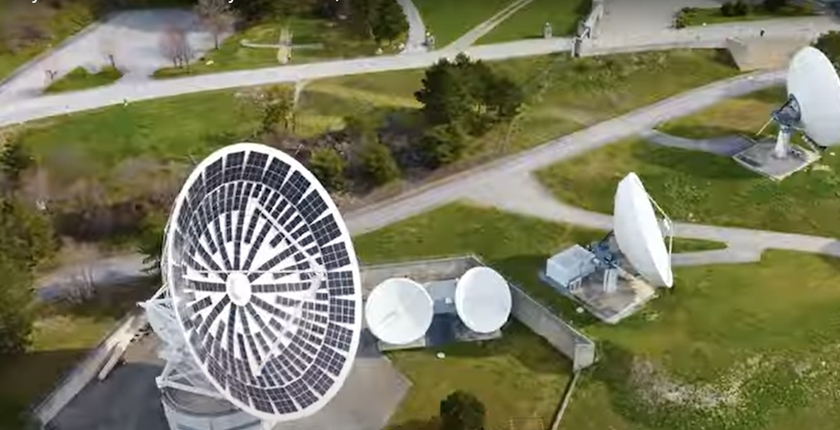
Instead of disposing of the parabolic antennas, they now host photovoltaic systems. Axpo’s subsidiary CKW fitted two satellite dishes in Leuk, Switzerland, with 307 solar panels each.

The new design for the complex, constructed in 1972, enables meeting the energy requirements of Leuk TDC’s power-hungry data centre. Each dish generates an estimated 110 MWh of clean energy per year. The telecommunications firm has also installed a rooftop solar system on the main building of the computing and data centre, for a further 555 MWh.

The data centre is powered by hydroelectric plants as well, so its electricity demand is covered with 100% renewable energy.

[wpcc-iframe title=”Case study: Satellite Dish to PV System – Leuk, Switzerland” width=”500″ height=”281″ src=”https://www.youtube.com/embed/dR2ETrx3aJ0?feature=oembed” frameborder=”0″ allow=”accelerometer; autoplay; clipboard-write; encrypted-media; gyroscope; picture-in-picture; web-share” referrerpolicy=”strict-origin-when-cross-origin” allowfullscreen=””]

SolarEdge systems maximizing output of each pair of PV panels in satellite dishes

Given the complex orientation and inclination of the solar panels on the satellite dishes, shadows threatened to reduce the efficiency of the solar system. With traditional string solar inverters, they reduce the overall performance of the solar array to match the weakest-performing panel on the string, meaning one shaded panel could reduce energy yield considerably.

In a string structure, a photovoltaic unit in a satellite dish wouldn’t be cost-effective

SolarEdge’s DC-optimized inverter solution was used with Power Optimizers, attached to the underside of every pair of solar panels. It enables the solar system to mitigate the impact of module mismatch on the satellite dishes. Inverters turn the direct current (DC) from PV panels into alternating current (AC).

“Having design flexibility with a solar installation is a huge benefit for installers. In complex cases such as these, with uneven surfaces, without the use of power optimizers we simply would not have been able to achieve anywhere close to the level of energy being produced today. I recommend that others planning similar solar installations allocate sufficient time for planning and collaborate with trusted personnel to overcome any technical challenges,” said CKW’s Deputy Head of Solar Technology for Central Switzerland Manuel Jossi.

Making use of existing ability to track sun’s movement

The combination of PV and hydropower provides Leuk TDC with more financial stability by reducing its dependency on variable grid electricity costs. “The satellite dishes were becoming obsolete, so we always knew we wanted to make use of them in some way or another,” the company’s Chief Executive Officer John Harris explained.

One other advantage is that the parabolic antennas follow the sun’s path throughout the day, maximizing the solar power output.

by in News

Solar power exceeds Bulgaria’s entire electricity demand for first time

For the first time, photovoltaic production alone surpassed power consumption in Bulgaria – for two hours. Interestingly, even more electricity was exported at the same time.

On Friday, June 20, the active photovoltaic capacity in Bulgaria between 10:00 and 11:00 before noon was 2,935 MW, and in the following hour it grew to 3,230 MW, state news agency BTA reported. According to data from the Electricity System Operator (ESO) and the European Network of Transmission System Operators for Electricity (ENTSO-E), it exceeded the country’s entire consumption for the first time ever, by 17 MW and 313 MW, respectively.

Even more electricity was exported at the same time, as total domestic production amounted to 6,567 MW and 6,736 MW.

Of note, not all solar power went to Bulgarian consumers, given that some traders and customers have long-term contracts with other suppliers, like the National Electricity Co. (NEK) and nuclear power plant Kozloduy, the article adds.

“This is a significant event and a great success for Bulgaria and the Bulgarian energy sector. Positioning us this way – as a leading country in the production of photovoltaic energy – not only supports the implementation and fulfillment of the commitments that Bulgaria has made for decarbonization, but it also has a positive effect on the country’s investment climate. Thanks to the solar energy that we transform into electricity, we are modernizing the entire Bulgarian energy sector,” Chairwoman of the Bulgarian Photovoltaic Association Meglena Rusenova commented.

Photovoltaics are perhaps the fastest-growing private investment sector in Bulgaria, she said.

Photovoltaics are biggest factor lowering prices at the electricity exchange

Over the past two years, over EUR 2 billion have been invested in electricity production, according to Rusenova. On top of that there are capital investments in energy storage and infrastructure, she pointed out.

Solar energy contributes to reducing prices for end users, and in practice, photovoltaics are the most significant factor for lower prices on the Independent Bulgarian Energy Exchange (IBEX), Rusenova underscored.

According to ESO, a total of 3.5 GW of photovoltaic capacity has been connected in the last three years, bringing the total to 4.7 GW.

by in News

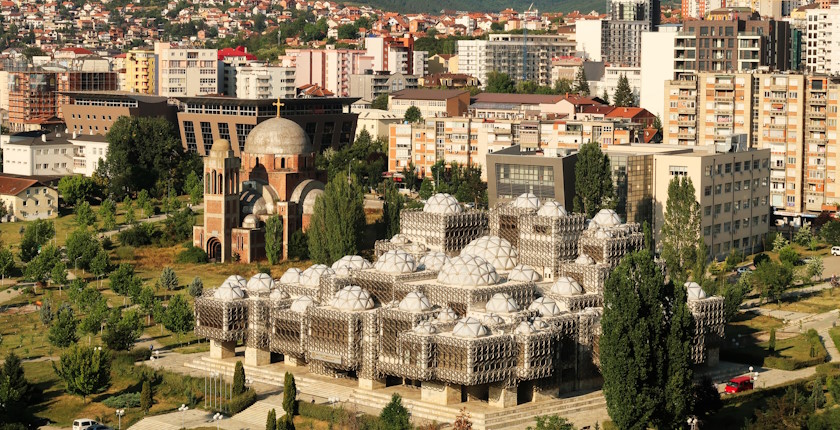
Court ruling brings risk of reversal of power market liberalization in Kosovo*

The Commercial Court in Kosovo* supported the claims filed by one company in a complaint, suspending its obligation to purchase electricity in the free market. The ruling follows protests against the controversial liberalization of the power market for larger firms, which came into force on June 1.

Two old coal-fired power plants in Kosovo* account for 92% of domestic production, which is the highest level in the world. Outages often prompt expensive emergency imports of electricity. Just last week, all operational coal units malfunctioned, while one in Kosovo B has been under reconstruction since last month.

Nevertheless, the authorities pushed through a controversial liberalization of the market for companies with more than 50 employees or an annual turnover of more than EUR 10 million. The measure, which came into force on June 1, led to two large protests. Almost 1,300 firms must purchase electricity in the free market.

However, the Commercial Court in Kosovo* suspended the obligation for REKS in a recent first-degree ruling. The company filed a complaint after it wasn’t allowed to use universal supply. It argued that it faced irreversible financial damage.

KEK signs few commercial power purchase contracts

The designated supplier of last resort is government-controlled Kosovo Energy Corp. (KEK). It is the operator of the Kosovo A and Kosovo B coal plants. Corporate consumers can opt for contracts of up to six months with the supplier of last resort.

KEK said a week ago that 360 such deals have been signed and that another 540 were coming. It only had 16 commercial contracts until that point.

Kosovo Chamber of Commerce claims KESCO is favored in liberalization

In the interpretation of the Kosovo Chamber of Commerce (KCC or OEK), the new court ruling means the entire power market liberalization needs to be suspended.

Conversely, the Energy Regulatory Office (ERO) said that last week the Basic Court of Prishtina rejected the motion that the chamber filed challenging the regulator’s public notice on the matter, which it issued in March.

KCC suggested that KESCO was favored in the switch, citing the lack of offers to consumers from other power suppliers. Dozens of other companies have also filed complaints, it added. The chamber called for a fair and feasible transitional phase and the creation of a clear plan that would ensure the stability for businesses and citizens.

Also of note, the Commercial Court said REKS’s gross income last year amounted to just EUR 6.5 million.

In other news, the opposition Democratic Party of Kosovo (PDK) said it would challenge ERO’s decision at the Basic Court because of the potential increase in electricity prices due to the liberalization.

* This designation is without prejudice to positions onstatus and is in line with UNSCR 1244/99 and the ICJ Opinion on the Kosovo declaration of independence.