by in News

Bulgarian coal plant mulls replacing boiler with molten salt battery

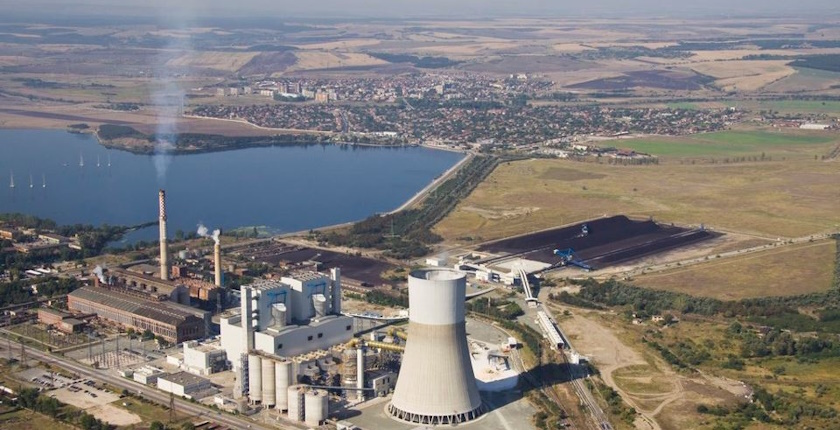
The operator of the AES Maritsa iztok 1 coal plant in Bulgaria is interested in replacing one of its boilers with a molten salt reactor. It would accumulate excess renewable energy from the power grid as heat and produce steam to drive the existing turbine.

With the surge in solar and wind power capacity throughout the world, the grid needs to match it with balancing and flexibility to handle the intermittency of the two sources. Their output varies with weather conditions, so the amount of electricity is often much higher or lower than demand.

Batteries are all the rage now, with investors racing to bridge the gaps between intraday peak production and peak consumption. Southeastern Europe is catching up with the trend, especially in Bulgaria, Romania and Turkey.

A molten salt battery could turn out to be a lifeline for AES Maritsa East 1

It opens up space for some other solutions in the emerging energy storage market which are nearing maturity. United States-based AES Corp.’s subsidiary in Bulgaria is examining one such overlooked opportunity. The molten salt reactor technology could revive the prospects of its coal power plant in Galabovo in Stara Zagora province.

The operator of the AES Maritsa iztok 1 (AES Maritsa East 1) facility is planning to transform one of the units into a so-called Carnot battery, Capital.bg reported. Such systems turn electricity into thermal energy and store it, to convert it back to electricity.

AES plans to maintain generator’s capacity

The company’s solution of choice is a molten salt reactor, which would replace the boiler. AES plans to power it with surplus renewable energy and produce steam for the existing 345 MW turbine. Importantly, among its other assets is the Saint Nikola wind power plant of 156 MW, the largest in Bulgaria.

The battery would hold enough heat to drive the unit at maximum power for five hours, translating to 1.73 GWh.

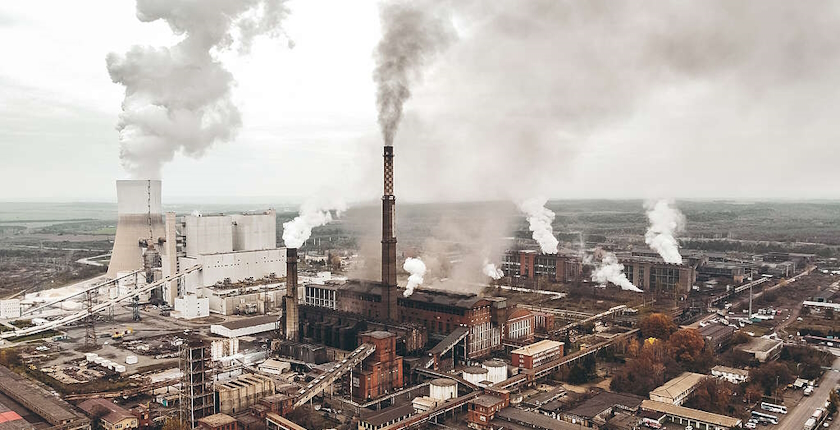
Coal plants can technically work nonstop, but the market has all but overrun most such facilities in Europe. Now they increasingly operate only when prices are high, covering peaks. It could make the business case for molten salt reactors and preserve jobs.

Molten salt is used in concentrated solar power (CSP) plants. They mostly use electrolytes such as alkali metal chlorides – sodium chloride, potassium chloride or lithium chloride – or nitrates: for instance, sodium nitrate or potassium nitrate.

Need for energy storage strengthening with rise in intraday price spreads

Market prices were negative on 2.8% of the days of last year, while they were lower than EUR 5 per MWh for 8.8% of the time. It compares to 1.9% and 5.5% in 2025, respectively, the article adds. The spread between the maximum and minimum prices is increasing. On 53% of days in the first half of this year, the difference was between EUR 100 per MWh and EUR 200 per MWh. The share of spreads above EUR 200 per MWh was 30%.

Such high amplitudes indicate both oversupply and shortages within the same day, amid the strong growth in variable renewables capacity.

by in News

One year in: insights from REIB’s inaugural BESS investments and increasing importance of safety standards

When discussing Europe’s green transition, battery energy storage systems (BESS) are often talked about as “the next big thing,” as the technologies have the potential to transform the grid, stabilise renewable energy sources, and enable new business models. However, while it’s easy to talk about storage, operating it with real assets, real risks, and real returns on the line is where theory meets reality. That is why hitting the one-year mark with two operational co-located BESS projects is more than just a date on the calendar for Renewable Energy Insurance Broker (REIB). It is a chance to look back at what worked, what caught them by surprise, and what they would tell anyone about to start their own storage journey.

In September 2024, REIB launched its own operational projects — a 4 MW / 8 MWh system and a 6 MW / 12 MWh system, developed together with Sunotec. They have now been in uninterrupted operation for twelve months, making them among the first large-scale storage sites in the region.

Eager to hear the first insights from REIB on two BESS facilities, we sat down with Delyan Iliev, Managing Director of REIB, to discuss the lessons learned from commissioning and operating these projects, and how their experience relates to broader market trends.

Delyan, achieving one year of uninterrupted operation is a significant milestone. What has stood out to you the most during this time?

One of the first things that became clear is the critical importance of certifications and compliance requirements from banks and insurers. They not only want to ensure that a project is technically sound but also require proof that it meets internationally recognised safety standards. In many cases, these certificates are prerequisites for financing. Without them, your project simply cannot move forward.

So, is early planning crucial?

Exactly. A preliminary consultation is not a formality; it is essential. When insurance professionals are involved from the beginning, we can identify and address technical or contractual issues before they escalate into costly problems. The same goes for having solid protection in the early stages of a project — too many investors believe that insurance is something you can add later. In reality, early-phase cover can mean the difference between a minor setback and a project-crippling loss.

And where does Business Interruption coverage fit into this?

That comes in a later stage, but it is equally important. Business Interruption insurance is not just about replacing lost revenue; it’s about making sure the cover matches your specific revenue model and contractual obligations. If those two are not aligned, you may face serious gaps in protection when you need it most.

REIB also works closely with clients during negotiations. How does this benefit them?

When “Insurance Requirements” are included in contracts, we are there with our clients in the negotiation room. We help to shape those clauses so that they are realistic and achievable. You don’t want to sign a contract only to realise later that you have agreed to provide policies that are impossible to obtain, have excessively high limits, or are prohibitively expensive.

Beyond that, we give our clients additional security by advising them on the most suitable insurance solutions and coverage structures for their specific project. This approach ensures that they meet their contractual obligations in a manner that is efficient, sustainable, and aligned with their risk profile.

Let’s talk about safety standards. How do they fit into this picture?

They’re the backbone of insurability. Because there’s no universal regulation for BESS yet, and rules can differ even within a single country, insurers have taken the lead in enforcing global benchmarks, such as UL, IEC, and NFPA standards. These cover everything from battery chemistry and fire safety spacing to manufacturing quality and site-specific studies. And they are not static; they evolve alongside technology.

For example, lithium ferro phosphate, or LFP, is now preferred over older chemistries like NMC (nickel, manganese, cobalt) because it is more stable, lasts longer, and is less risky. Aligning with these standards from the start not only makes insurance possible but also reassures lenders and streamlines the financing process.

And after a year, how do your projects measure up against these benchmarks?

Very well. Early alignment with international safety standards enabled us to avoid delays in securing insurance and financing. It also gave us leverage in our dealings with contractors and suppliers, because the requirements were clear from the very beginning, and everyone involved in the project knew what had to be delivered. This approach not only reduced uncertainty but also helped us manage risks more effectively during construction and commissioning.

That is your own experience. How does it fit with REIB’s broader role in the European market?

At REIB, we are proud to help unlock the potential of storage projects, and the scale speaks for itself: in 2024, Europe installed a total of 21.9 GWh of BESS, while in just the first six months of 2025, we insured more than 6 GWh — with projects in Bulgaria, Germany, and the UK. This demonstrates both the speed of market growth and the trust our clients place in us to manage their complex insurance requirements.

Finally, if you had to give one piece of advice to investors who are just starting their BESS journey, what would it be?

Don’t wait until your project is fully designed to think about insurance. The right insurance strategy is as important as the right technology. Too many projects lose valuable time and money because risk management is treated as an afterthought. Our experience shows that when insurance expertise is integrated from the earliest stage, financing is smoother, negotiations are easier, and the project stands on much firmer ground.

We already know how to align BI coverage with your revenue model, which certifications are non-negotiable for financing, and how to avoid uninsurable contract clauses. If you’re planning a BESS or hybrid project, talk to us before you break ground. It will save you time, money, and a lot of headaches in the long run.

by in News

ElevenEs mulls building advanced battery cells gigafactory in Poland

Battery technology developer ElevenEs, which has production facilities in Serbia, plans to build a EUR 600 million gigafactory. It revealed that it is considering locations in Poland. The company said InnoEnergy is now one of its main shareholders.

Now backed by a group of international investors including the InnoEnergy fund, ElevenEs announced its next major step. The company registered in Luxembourg said it is “seriously considering Poland” for its planned investment: a EUR 600 million gigafactory for advanced battery cells.

The battery technology developer, which operates production facilities in Serbia, has unveiled its latest product in May. It said the Edge574 blade cell charges up to 80% in 12 minutes. The cycle life translates to a range of at least 500,000 kilometers for electric cars, ElevenEs’ update reads. The company specializes in lithium iron phosphate (LFP) technology.

“ElevenEs is revolutionizing the battery market, including batteries intended for the electric vehicle industry,” according to its statement on the gigafactory project.

The company aims to begin construction by the end of 2027 and eventually employ 700 engineers.

Company shortlists Kraków, Silesia, Lower Silesia

ElevenEs hasn’t determined the exact location, but it hinted it would be in southern Poland: Kraków, Silesia or Lower Silesia. The country would benefit from technology transfer and the opportunity to further develop it within the domestic economy, it stressed.

ElevenEs’ CEO Nemanja Mikać praised the Polish labor market, supply chain and access to Western European markets

An open labor market, availability of suppliers within the supply chain, presence of many universities, and access to Western European markets are all undeniable advantages of Poland, said founder and Chief Executive Officer of ElevenEs Nemanja Mikać.

“If we add potential public sector involvement to this, we have one of the most attractive places for investment in Europe… From a technology development standpoint, we are a clear leader in Europe. One of the most significant benefits of our technology is its ability to integrate different industrial sectors and build an innovation ecosystem around it,” he stated.

InnoEnergy becomes one of main shareholders of ElevenEs

In introducing the company to Poland and securing additional investors, ElevenEs is being supported by InnoEnergy. Since its founding in 2010, it has invested in over 540 European tech companies. InnoEnergy is now one of the main shareholders of ElevenEs.

“We specialize in connecting different stakeholder groups. Our broad ecosystem includes financial and industrial investors, as well as technology providers, research institutions, and academic centers. The projects we’ve completed demonstrate our experience and ability to execute large, complex investment ventures. We see enormous potential in the ElevenEs project – not only will it help build a strong, competitive Polish economy, but it may also allow Europe to finally establish a significant presence in the global battery value chain. This is one of those projects that could change the rules of the game,” said Mikołaj Budzanowski, CEO of InnoEnergy for Central Europe.

There are investors willing to support the project, but the success of the investment depends critically on the timing and decisiveness of the public sector, he explained. He also highlighted the necessary role of financial institutions.

Serbia in scope for mass production

Of note, Mikać recently said that ElevenEs would “localize and scale” LFP battery production in Serbia over the next seven or eight years. It could become the first country in Europe to launch mass production, he added.

The company wants to participate in creating a robust supply chain in Serbia and Central and Eastern Europe, but also potentially across the continent, he asserted.

by in News

European electricity industry issues Paris Pledge on pumped storage hydropower

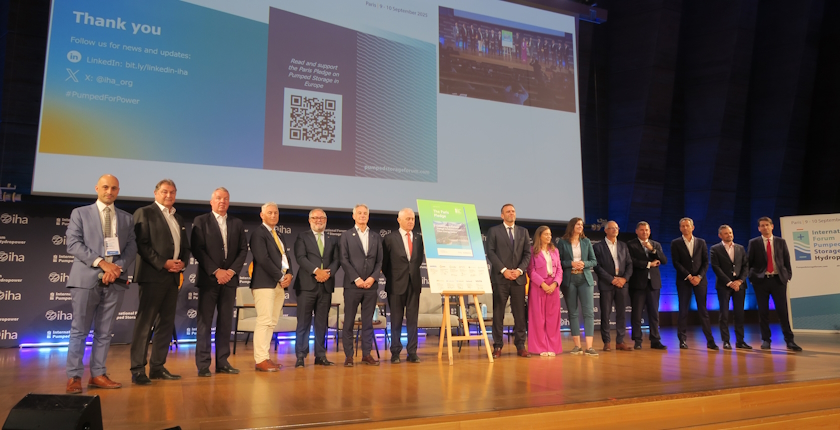
The International Hydropower Association (IHA) and Eurelectric launched the Paris Pledge. It is a collective call to action, aimed at unlocking the potential of pumped storage hydropower in Europe. The signatories urge the European Union and national governments to create the right conditions for long-duration storage to meet clean energy goals.

Over 50 utilities, hydropower suppliers and energy-focused associations have signed the Paris Pledge. The document’s alternative headline is Committing to Pumped Storage to Secure Europe’s Clean Energy Future.

The International Hydropower Association (IHA) and Eurelectric – Union of the Electricity Industry launched the initiative. They warned that Europe faces an urgent and growing need for long-duration electricity storage to secure a reliable, affordable and sustainable energy future.

Amid the transition to a renewables-dominated power system, the ability to store and dispatch electricity over long periods will be critical to balance variable generation from wind and solar, ensure grid stability and resilience, and reduce reliance on imported fossil fuels, the authors stressed. They called pumped storage hydropower or PSH the most important, scalable and cost-effective long-duration electricity storage solution available today. It still provides over 90% of the world’s long-duration electricity storage capacity.

PSH is currently the most important, scalable and cost-effective long-duration electricity storage solution, the industry pointed out

By 2050, around 86% of production capacity in Europe will come from variable sources, according to the material accompanying the Paris Pledge. Encouragingly, 78 pumped storage hydropower projects are under development, for 35 GW overall. The EU accounts for over 32 GW, and the rest is in Switzerland, Norway and Turkey.

The combined pipeline would provide storage capacity in excess of 700 GWh, equivalent to more than 10 hours of consumption of Italy and Spain taken together. There is 3.9 GW in the ready-to-build phase, and 2.8 GW is under construction. Of note, an earlier report showed 52.9 GW of PSH was under development.

The existing capacity amounts to 48 GW, compared to 190 GW globally. In the EU, pumped storage hydropower systems can store 1.2 TWh overall.

Photo: Types of pumped storage (IHA, Eurelectric)

Paris Pledge calls for separate legislation for long-duration energy storage

Among other proposals, the signatories are asking the EU for a dedicated initiative to boost the rollout of electricity storage. They suggested legislation to be separate for long duration, short duration and other solutions.

The Paris Pledge calls on member states to remunerate the provision of system services and security of supply for all time frames. They should eliminate double grid fees on electricity storage technologies and accelerate permitting for PSH, the document reads.

With strong political commitment, Europe can double its pumped storage hydropower capacity in the next 25 years, according to the Paris Pledge. In-person signatories represent EDP, EDF, Iberdrola, Andritz, Enel, Statkraft, Voith, Hydrogrid, Verbund, Landsvirkjun and GE Vernova.

Pumped storage hydropower’s contribution during Iberian Peninsula blackout

During the power blackout in Spain and Portugal on April 28, pumped storage played a pivotal role in balancing and supporting the recovery of the system. In Spain, PSH generated 11 GWh of electricity in the first 12 hours, instead of the planned 12 GWh recharge. Similarly, in Portugal, hydropower and pumped storage covered 80% of the demand in the first ten hours.

Such facilities also made a major contribution to restoring the electricity grid in the entire peninsula, thanks to their so-called black start capability. It allows the power plant to be restarted without relying on external power sources and to reenergise the power system.

“Very few technologies can provide this function. As a result, within a few minutes, the first pumped storage plants were ready for synchronization and awaiting dispatch instruction” from transmission system operators, notes the report published with the Paris Pledge.

by in News

LONGi and Nofar Energy forge landmark partnership for Romania’s largest solar project using revolutionary BC technology

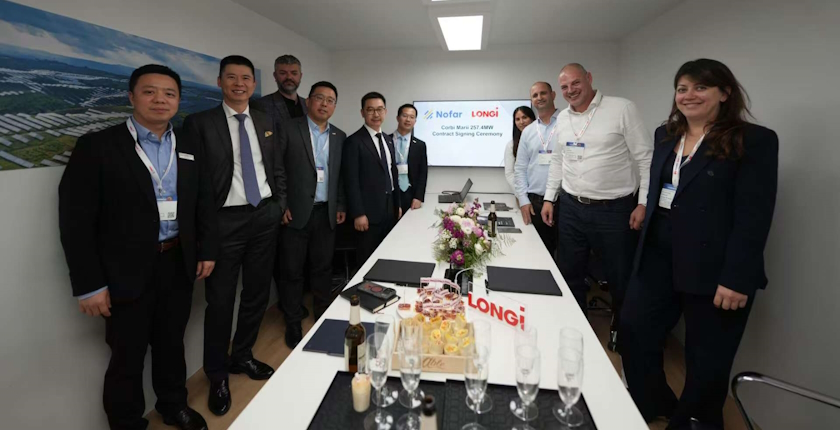
LONGi Solar, the global leader in solar innovation, and Israel’s premier renewable energy developer Nofar Energy have announced a historic partnership to develop one of Romania‘s largest solar installations – the 282 MW Corbii Mari project in Dâmbovița county. This pathbreaking collaboration will deploy over 430,000 Hi-MO 9 BC modules, establishing back contact technology as Europe’s definitive solution for utility-scale energy transformation while marking Nofar’s most ambitious international venture to date.

The Corbii Mari photovoltaic project of 282 MW will go into production in 2026. It represents a dual milestone in Europe’s renewable transition. As Nofar Energy’s largest overseas IPP investment, it anchors the Israeli leader’s strategic expansion into European markets. Simultaneously, the installation stands as Romania’s largest BC deployment, leveraging Hi-MO 9’s industry-leading 24.8% efficiency to overcome the region’s climatic challenges. The project’s seamless execution demonstrates how the BC technology of LONGi Solar delivers unparalleled bankability for developers navigating Europe’s complex energy landscape.

The two companies have agreed to deploy more than 430,000 Hi-MO 9 BC modules.

Leon Zhang, President of LONGi Europe, emphasized the project’s transformative impact: “Corbii Mari transcends conventional solar deployments – it’s a powerful validation that BC technology has matured into Europe’s utility-scale foundation. By choosing Hi-MO 9 for their flagship European venture, Nofar Energy demonstrates how visionary partners are accelerating the energy transition through technological leadership.”

The 282 MW Corbii Mari initiative positions back contact modules as Europe’s utility-scale standard

Mirel Jarnea, Strategic Accounts Manager SEE of LONGi Europe, added: “Nofar’s selection of Hi-MO 9 is a testament to the global energy sector’s recognition of BC technology as the ultimate frontier in solar innovation. This partnership reaffirms our commitment to delivering solutions that redefine efficiency, durability, and sustainability.”

Setting benchmark for sustainable innovation

Favi Stelian, Managing Partner Romania of Nofar Energy, stated: “The Corbii Mari project represents a defining moment for Nofar Energy’s European vision. By partnering with LONGi and deploying Hi-MO 9 BC technology, we are not only delivering Romania’s largest solar initiative but also setting a new benchmark for sustainable innovation across the continent.”

The project harnesses Hi-MO 9’s revolutionary back contact architecture to achieve exceptional performance in Romania’s variable climate. The modules’ temperature resilience and 30-year degradation guarantee ensure consistent energy generation, while the ultra-high power output minimizes land use – preserving Dâmbovița county’s agricultural ecosystems.

With an estimated annual output of 380 GWh, Corbii Mari will displace 220,000 tonnes of carbon emissions annually, equivalent to removing 48,000 combustion-engine vehicles from roads while powering over 50,000 Romanian households.

Positioned at the vanguard of Eastern Europe’s energy transition, Corbii Mari establishes a replicable model for Nofar’s expanding multi-GW European pipeline. The collaboration signals accelerating regional adoption of BC technology, with project insights informing solar development across emerging markets where efficiency and bankability are paramount.

About LONGi

Founded in 2000, LONGi is committed to being the world’s leading solar technology company, focusing on customer-driven value creation for full scenario energy transformation.

Under its mission of Making the Best of Solar Energy to Build a Green World, LONGi has dedicated itself to technology innovation and established several business sectors, covering mono silicon wafers cells and modules, commercial and industrial (C&I) distributed solar solutions, green energy solutions and hydrogen equipment. The company has honed its capabilities to provide green energy and, more recently, also embraced green hydrogen products and solutions to support global zero-carbon development.

About NOFAR Energy

Founded in 2011, Nofar Energy is a global leader in renewable energy investments. Since 2020, Nofar has been a public traded company (TASE: NOFR) at the Tel Aviv Stock Exchange. For the last 12 years, Nofar has been growing rapidly and consistently, with an extensive portfolio of projects and subsidiaries across nine territories, 200 employees worldwide, and major renewable energy and energy storage projects.

by in News

Environmentalists warn EU that Bulgaria ignores coal plants breaching pollution rules

Greenpeace Bulgaria and Za Zemiata (For the Earth) said they would file a complaint today with the European Commission over repeated failures by Bulgarian authorities to enforce the European Union’s environmental law at four coal plants. They expressed the view that institutions are prioritizing financial interests over public health and the environment.

Environmental organizations Greenpeace Bulgaria and Za Zemiata wrote a complaint, to submit to the European Commission, regarding what they described as long-standing violations by four coal power plants linked to Bulgarian businessman Hristo Kovachki. “Bulgarian institutions refuse to apply EU environmental law as intended, favoring coal owners over people and nature. This complaint provides evidence for the European Commission to initiate infringement procedures,” said environmental lawyer Regina Stoilova.

Alleged breaches from 2018 to 2023 concern thermal power plants Bobov Dol in Golemo Selo, Brikel in Galabovo, Republika in Pernik, and Maritsa 3 in Dimitrovgrad. The two groups said they exhausted all national-level mechanisms for holding the polluters accountable and protecting affected citizens and the environment.

The two groups have exhausted all legal mechanisms on the national level

Instead of enforcing environmental standards, Bulgarian institutions – including the Ministry of Environment and Water, the Executive Environmental Agency and regional environmental and water inspectorates – have repeatedly issued permits to offenders, imposed weak or ineffective fines, and ignored serious pollution events that threaten public health, the environmentalists added.

“These coal plants are shielded by an institutional network protecting Kovachki’s opaque coal business. Thousands of Bulgarians living under these chimneys continue to face rampant pollution with no accountability,” said Director of Greenpeace Bulgaria Meglena Antonova.

Penalties could have been millions of euros higher

Bulgarian courts have also failed to act, according to the statement. During the legal proceedings after Brikel and Maritsa 3 were temporarily closed in 2022, the plants continued operating for three years. In the said six-year period, Kovachki-linked plants avoided nearly EUR 2.5 million in penalties, , the organizations calculated and stressed that Brikel payed only EUR 3,300 in fines.

In official documents, the businessman holds no ownership in most of the firms that media outlets regularly link him to. Kovachki has only identified himself as a consultant in some of them. Investigative journalists have obtained documents indicating that he controls a group of companies through a holding called Orion, which he denied.

Violations include illegal wastewater discharge

The violations of the permits consisted of illegal emissions into the air, illegal discharge of wastewater into rivers, and use of prohibited fuels.

“In an attempt to reduce production costs, the coal power plants associated with Kovachki have systematically co-fired waste and biomass with coal without possessing the necessary permits. Even after obtaining the required permits, the operators have significantly exceeded the biomass limits specified in them,” reads a report accompanying the announcement.

Meanwhile, the power plants have gained millions from saved carbon emission allowances, the document adds. An analysis by Za Zemiata estimates the damages for the period 2017-2021 at EUR 75 million for five plants associated with Kovachki, four of which are the subject of the new complaint.

Attack on activist living near Bobov Dol

“Not only has there been no accountability, but activists are also facing aggression for speaking out. Over the weekend, Daniela Toneva, an activist opposing the Bobov Dol TPP coal plant, was attacked after speaking out about the plant’s severe pollution and the links between Hristo Kovachki and the chairman of the Bobov Dol Municipal Council Krasimir Chavraganski,” said Beyond Fossil Fuels, a partner organization.

Namely, someone spilled paint on Toneva’s car and broke her window with a stone they threw into the house. She told Svobodna Evropa (RFE/RL) that local authorities are hostile to her because of her activism. The firm operating the nearby Bobov Dol facility condemned the attack.

by in News

Turkey launches solar, wind power auctions with November deadlines

The Ministry of Energy and Natural Resources of Turkey issued a public call for solar and wind power auctions for 2 GW in total. It will receive the applications on November 4 and November 18, respectively. One competitive bidding process is for a floating solar power project of 35 MW.

Following the successful auctions for renewable energy projects that were completed early this year, Turkey kicked off another round. It is also for 2 GW of overall connection capacity, in light of the country’s ambition to grow its combined solar and wind power capacity to 120 GW by 2035. The two technologies reached 37.1 GW together a month ago, out of 120.2 GW in total.

Auctions are held under the Renewable Energy Zones (REZ) state support mechanism. The scheme is better known by its Turkish acronym YEKA.

Ten solar power areas in eight provinces

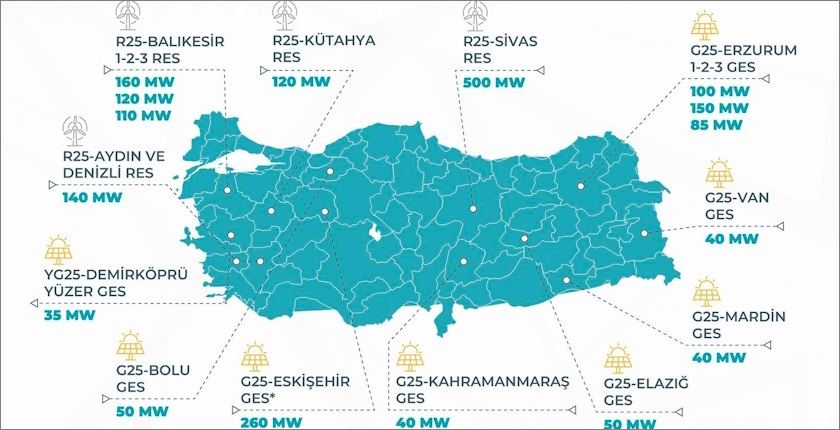
The upcoming solar energy auctions, REZ SPP 2025 (YEKA GES 2025), are for 850 MW altogether. There are ten areas in eight provinces designated for bidding: Kahramanmaraş, Mardin and Van, with 40 MW each, Bolu and Elazığ (50 MW each), Erzurum 1-3 (100 MW, 150 MW and 85 MW), Eskişehir (260 MW) and Demirköprü in Manisa province, with 35 MW.

The upcoming solar power auctions will include Turkey’s first bidding for a floating photovoltaic plant

Notably, the last one is for a planned floating solar power plant on the reservoir of the Demirköprü hydropower plant. The facility on the Gediz river, east of Izmir, is owned by state-owned Electricity Generation Corp. (EÜAŞ). Turkey now hosts only two small floating photovoltaic units, and the auction will be the first of its kind.

Applications will be received on November 4, the ministry said and added it would subsequently publish a schedule for bidding.

Wind power capacity quota is 1.15 GW

Participants can apply on November 18 for the wind energy round of auctions, REZ WPP 2025 (YEKA RES 2025). It is for an overall 1.15 GW in six areas.

Investors will compete for 500 MW in Sivas province, a 140 MW project in Aydın and Denizli, 120 MW in Kütahya and three areas in Balıkesir – 160 MW, 120 MW and 110 MW.

Winners to submit guarantees of EUR 75,000 per MW for PV projects, EUR 100,000 per MW for wind

Potential bidders will pay a fee of EUR 1,550 for each auction they apply for. They must submit letters of guarantee lasting one year and worth EUR 15,000 per MW for photovoltaics and EUR 20,000 per MW for wind power. Winners will submit 10-year guarantees before signing their contracts: EUR 75,000 per MW and EUR 100,000 per MW, respectively.

The ceiling or starting price is EUR 55 per MWh and the floor prices are EUR 32.5 per MWh for solar power and EUR 35 per MWh for wind. If bids hit the floor, another auction will be held between the competitors, like in the previous round. It is for a so-called contribution share that they are ready to pay. The minimum is EUR 10,000 per MW of planned capacity and the highest bid wins.

Successful participants can sell electricity on the free market for five years in the case of solar power plants, while the period lasts six years for wind. After that, both categories enter a 20-year scheme with a guaranteed price.

Turkey tops 120 GW in total electricity capacity

At the end of July, electricity capacity in Turkey totaled 120.2 GW, the ministry revealed. Hydropower accounted for 26.9% or 32.3 GW, compared to 23.4 GW in photovoltaics (19.5%) and 13.7 GW of wind power, translating to 11.4%.

The share of biofuel and waste was 1.9%, with 2.34 GW, and geothermal power plants had 1.73 GW altogether, which is 1.4%. Gas power plants in Turkey had 24.7 GW in combined capacity (20.6%). The remainder is coal: 21.9 GW or 18.3%.

by in News

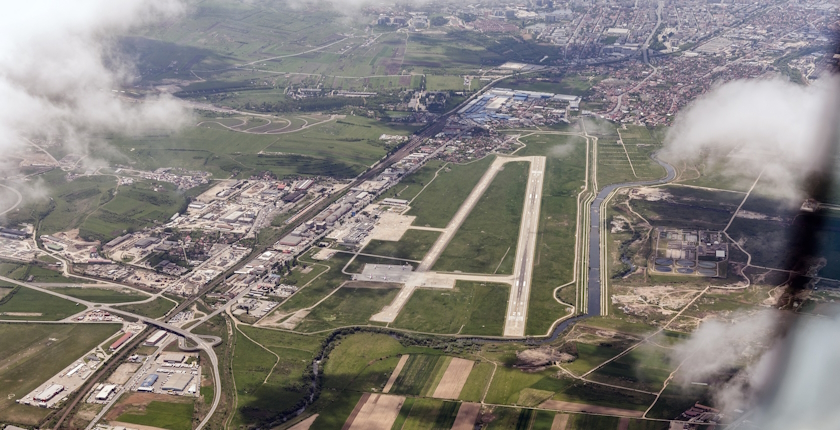
Airport in Cluj-Napoca secures grant for battery-backed solar park

International Airport Avram Iancu Cluj will cover more than half of the costs for a 5 MW solar power plant, with a battery energy storage system of 12 MW, from European funds. It expects the facility to cover more than 60% of its electricity needs.

Civilian airports throughout Southeastern Europe are building dozens of solar parks and rooftop photovoltaic systems to increase their energy autonomy and achieve cost savings. Some of the capacity is backed up by battery energy storage systems (BESS). International Airport Avram Iancu Cluj in Romania is set to join the group with a project worth EUR 10.7 million including value-added tax.

The Ministry of Transport and Infrastructure declared it eligible for EUR 6 million grant from the European Union’s Modernisation Fund. The operator is controlled by the Cluj County Council.

Cluj International Airport to save EUR 1 million per year

International Airport Avram Iancu Cluj in Transylvania serves Cluj-Napoca, Romania’s second-largest city. With the green light for EU funding, it can proceed with the PV project of 5 MW with an energy storage unit of 12 MW in operating power. The airport expects the facility to cover more than 60% of its electricity consumption.

The airport in northwestern Romania serves Cluj-Napoca, the country’s second-largest city

The system would span eight hectares and include more than 7,500 solar panels. It is intended only for self-consumption. Cost savings amount to an estimated EUR 1 million per year. The initially planned capacity of the solar park was 2 MW.

“In the context of rising energy prices and budgetary constraints, energy independence is one of the major objectives we are focusing on. The investment in a photovoltaic park at Cluj Airport, from non-reimbursable funds, is a notable achievement and creates the premises for financial stability and achieving energy independence,” said Cluj County Council President Alin Tișe.

Gearing up for rising emissions costs

The airport’s General Manager David Ciceo stressed that heat pumps are also part of the plan to decarbonize and increase energy autonomy. President of the Board of Directors Viorel Federiga noted it is an important step toward meeting new international requirements.

For instance, the EU plans to extend the EU Emissions Trading System (EU ETS) to all flights from the European Economic Area (EEA). Currently it only covers the flights within the region and toward the United Kingdom and Switzerland. A scheme called EU ETS 2, to be launched in 2027, will include buildings and road transportation.

Within its efforts to reduce carbon emissions, Cluj International Airport added another electric bus to its vehicle fleet, to take passengers to and from aircraft. It can carry 110 people. The bus, which cost EUR 830,000, features a battery that allows for an autonomy of over 300 kilometers.

The airport projected the number of its passengers this year at 3.4 million.

by in News

Record solar panel imports in Africa: a lifeline for a continent where 600 million people lack electricity

Half of Africa’s population still lacks access to electricity, but a record surge in solar panel imports could signal a turning point. A report by the Ember research center shows a 60% increase in solar panel imports from China to Africa. Although it is too early to make forecasts, the report suggests that the solar boom could positively impact the power systems of many African countries.

As many as 570 million people in Africa still lack reliable access to electricity, which is almost half of the continent’s population. According to data from the Energy Progress Report, in 2022, 685 million people worldwide did not have access to electricity, meaning that Africa accounts for 80% of the global population without access.

While North African nations and countries like Ghana, Gabon, and South Africa have made progress, major challenges remain in Central Africa and the Sahel region (Burkina Faso, Mali, Niger, Cameroon, Guinea, Gambia, Senegal, Nigeria, Chad, and Mauritania), where entire communities remain off the grid.

Solar energy could be an opportunity for Africa to skip the phase of relying on fossil fuels and make a significant step toward an energy transition. It is still too early to say if this process is already underway, but the latest report by Ember shows that solar power is gaining serious momentum.

The total imported capacity reached 15,032 MW

According to their analysis, from June 2024 to June 2025, solar panel imports from China to Africa increased by 60%. The total imported capacity during these 12 months amounted to 15,032 MW. Ember used Chinese customs data in the report because China is the world’s largest producer and exporter of solar panels, accounting for around 80% of the global output in 2024.

The last significant increase in solar imports was recorded in 2023, when South Africa experienced a solar boom due to its energy crisis. However, new data shows that interest in solar energy is spreading to other countries as well. Solar panel imports outside South Africa nearly tripled in the last two years, rising from 3,734 MW to 11,248 MW.

The report shows that a record solar panel import was set in as many as 20 African countries, while 25 countries imported at least 100 MW of solar capacity from June 2024 to June 2025.

Increasing solar panel imports could reduce fuel imports

Ember’s analysis suggests that solar could significantly contribute to electricity production in many African countries. If Sierra Leone installed all the panels imported in the last 12 months, it could produce the equivalent of 61% of its total electricity output from 2023. Similar results are seen in Chad — 49%.

In five countries, newly imported solar panels could contribute more than 10% of total electricity production from 2023: Liberia (25%), Somalia (15%), Eritrea (15%), Togo (11%), and Benin (10%). Overall, 16 countries have the potential to increase electricity production by at least 5%, according to the report.

In addition, solar panel imports can significantly reduce fossil fuel imports, especially diesel, on which many African countries still rely. According to 2022 research by Wood Mackenzie, 17 African countries had more diesel generator capacity than grid-connected power plants.

In some countries, such as Nigeria, if diesel imports for electricity production were stopped, savings could cover the cost of solar panels in approximately six months or even less.

Although solar expansion in Africa is accelerating, experts emphasize that the process is still in its early stages and that more data and research are needed to fully understand its potential.

by in News

Climate won’t suffer if Romanian coal power plants keep running – energy minister

The Romanian government is in talks on postponing the coal power plant closures envisaged under the National Recovery and Resilience Plan (NRRP), according to Energy Minister Bogdan Ivan. The current deadline for decommissioning these plants is the end of 2025, but Romania is hoping to push it back to 2030.

Ivan noted that Romania’s gas and coal power generation has dropped by 56% over the past decade, with around 7,000 MW of capacity closed and only 1,200 MW replaced.

“Now I am convinced that the world’s climate will not suffer so much if Romania continues to keep its coal-fired power plants in the Jiu Valley,” the minister said, according to Profit.ro.

Ivan: Keeping the Jiu Valley coal power plants operational will not hurt the global climate

He also stressed that Romania has pursued the most aggressive decarbonization policy in the European Union, choosing 2025 as a deadline to eliminate coal-fired electricity generation, compared to Poland or Germany, which intend to use coal until 2040–2050.

Ivan explained that wind and solar capacity in Romania has been growing, but that the country needs more battery storage to better utilize its output.

Romania needs more battery storage for the growing wind and solar capacities

Romania’s former energy minister, Sebastian Burduja, said earlier this year that the country intended to extend the operation of coal-fired power plants because there was no other option to ensure energy security and replace existing capacities.

He said in January that the operating period of coal-fired power plants was expected to be extended by three years.

According to earlier reports, Romania intends to stop coal mining by 2032 at the latest, while replacing conventional power plants in the meantime. Romania’s largest producer of coal-based electricity is state-owned power utility CE Oltenia, based in Târgu Jiu. It is also the country’s third-largest producer of electricity.