by in News

Repono acquires BESS project for 404 MWh in Romania

Swedish energy storage operator Repono has completed the acquisition of a 202 MW / 404 MWh battery energy storage system project located in Romania’s Argeș county.

Romania has become one of the most active markets for battery energy storage system (BESS) projects in South East Europe.

Developed by a domestic firm, the Argeș project reached a ready-to-build stage, Repono said. The investment benefits from a grid connection contract with the country’s transmission system operator Transelectrica. The entry point is the 220 kV Pitești substation, northwest of Bucharest.

Once operational, it will be among the largest grid-scale storage assets in Southeast Europe, capable of storing and releasing enough energy to supply more than 120,000 four-person households during peak-demand periods, according to the company.

The partnership with local developers includes a framework for additional energy storage projects

A partnership with local developers is set to drive significant future growth for the firm, based in Sweden.

It includes a framework for additional energy storage projects across Romania with a combined capacity of up to 1.4 GW, reinforcing Repono’s long-term commitment to the market, the update reads.

“This transaction represents an important milestone for Repono AB and demonstrates our continued commitment to developing large-scale storage infrastructure that supports Europe’s energy transition,” CEO Karim Nils Grueber stated.

De Kool: Large-scale storage assets are key enablers of a stable European power system

The Argeș project’s market optimization will be handled by Gunvor, in collaboration with Vienna-based optimiser Enspired. They are tasked with managing the energy offtake and market strategy to ensure the BESS is efficiently integrated into the Romanian and regional power markets.

According to Harmen de Kool, Chairman of the Board of Repono and a representative of InnoEnergy, large-scale storage assets like the one in Argeș are key enablers of a stable and decarbonized European power system.

It further fortifies InnoEnergy’s aim to achieve carbon neutrality, he added.

With this acquisition, Repono continues to expand its European portfolio of grid-scale BESS, with active developments spanning Germany, Romania, Italy, Austria, and Poland.
by in News

Romanian power distributor Electrica to build 15 battery systems totaling 1 GWh

Romanian power supplier and distributor Electrica has initiated a permitting procedure for the construction of 15 battery energy storage parks, with a combined capacity of about 1 GWh, aimed at providing flexibility to the national grid and supporting the integration of renewable energy sources.

The battery energy storage systems (BESS) would boost Electrica’s ability to respond dynamically to fluctuations in consumption and production within the national energy system. It should also enable the efficient integration of growing renewable capacities in Romania, significantly reducing price volatility and dependence on imports, according to a press release from Electrica.

Electrica’s new battery capacity is expected to reduce price volatility and dependence on energy imports

“Developing this 1 GWh storage infrastructure is a strategic pillar in Electrica’s transformation into a leader of the energy transition,” the company said, adding that the battery systems would be built on Electrica’s own land, leveraging assets from its existing portfolio.

“This project is not just about technology or capacity; it is about redefining how Romania manages energy security for the decades ahead,” said Alexandru Chirița, Electrica’s CEO. He also stated that the timeline for the project was “ambitious,” according to the press release.

The BESS capacities will be distributed across Romania

The project, part of Electrica’s 2030 strategy, will be developed in phases, with BESS installations distributed across Romania. The first phase is expected to bring a significant portion of the storage capacity online already in 2025, according to a report by PVknowhow.com.

Battery energy storage is on track to become another pillar of Romania’s energy transition, as investors increasingly develop BESS capacities combined with solar, hydropower, and wind, or as standalone energy storage facilities.

Romania is supporting BESS projects for renewables integration with subsidies provided from its national recovery and resilience plan (NRRP). In September last year, the Ministry of Energy awarded grants to 13 projects.

by in News

Sunotec secures financing for Bulgarian BESS, renewables portfolio

Sunotec has secured financing for a portfolio of seven projects in Bulgaria. The deals were agreed in September.

The portfolio, for 115 MW in peak solar power capacity and 763 MWh of battery storage, significantly expands Sunotec‘s investment presence in its home market, according to the update.

Six projects are for standalone battery energy storage systems (BESS) and one is for a solar power plant with a colocated BESS.

According to the firm, they are either wholly owned or partially, through Solaris Holding AD, a 50/50 joint venture with the main shareholders of Eurohold Bulgaria AD.

The standalone battery energy storage system projects are part of the government’s RESTORE program

The seven projects contribute to decarbonizing Bulgaria’s power sector, enhancing its grid stability and energy independence, Sunotec stressed.

The Bulgarian Ministry of Energy has approved the said standalone BESS projects to receive subsidies under the RESTORE program, the company added.

In the first round of the National Infrastructure for Storage of Electricity from Renewable Sources (RESTORE) program, Bulgaria approved EUR 587 million in subsidies for 82 BESS projects totaling 9.71 GWh.

In late July, Sunotec and Sungrow agreed to install 2.4 GWh of BESS

In late August, the ministry launched the public consultation process for a proposed new round of its subsidy program for BESS.

Viktor Stefanov, Head of IPP at Sunotec, said the seven investments mark a major milestone in its evolution.

The company added that they further strengthen its position, as well as of Solaris Holding, among Bulgaria’s leading investors in photovoltaics and energy storage.

In late July, China-based Sungrow achieved an agreement with Sunotec on installing 2.4 GWh of BESS in Europe. The portfolio includes several large-scale projects across Bulgaria, which will serve energy storage needs.

by in News

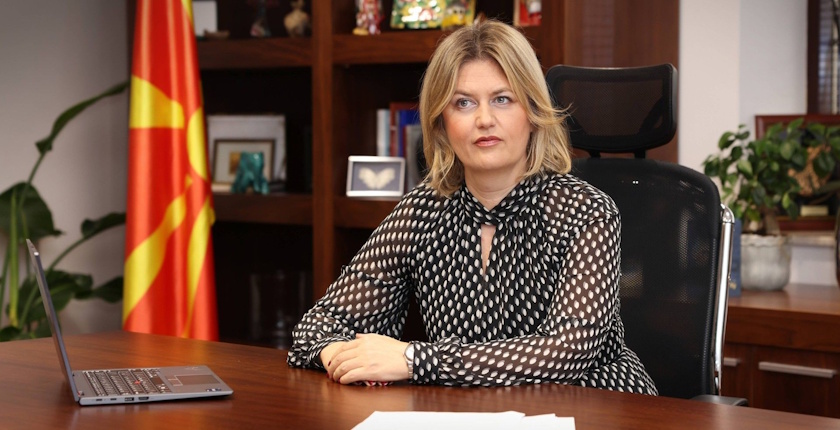
Šahmanović: Second submarine cable line with Italy to be installed by 2031

The second line of the submarine cable connecting Montenegro and Italy is expected to be completed by 2031, Montenegro’s Minister of Energy and Mining Admir Šahmanović said at the European Union – Montenegro Investment Conference.

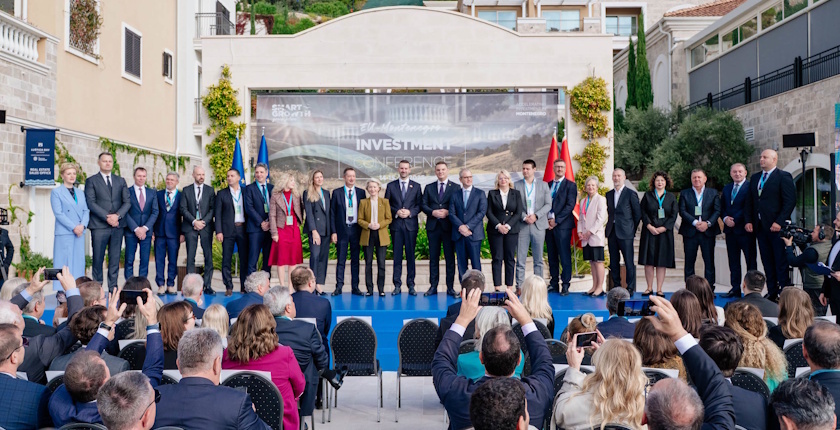
The two-day conference, titled Smart Growth, Green Future: Accelerating Investment in Montenegro, was opened yesterday in Luštica, near Tivat, by European Commission President Ursula von der Leyen and Prime Minister of Montenegro Milojko Spajić.

Fourteen cooperation projects between Montenegrin and European companies have been initiated at the conference, including investments in wind farms, solar parks, energy storage, and grids. It shows the great significance of the energy sector for investments.

A panel called Renewables: Scaling Montenegro’s Energy Transition examined the possibilities for accelerating the country’s energy transition and enhancing the sector’s attractiveness for investment in renewables.

Šahmanović: Montenegro strives to position green energy as an export product

Prominent international experts and investors took part in the discussion. Representing the Government of Montenegro, Minister of Energy and Mining Admir Šahmanović outlined the country’s renewable energy priorities and highlighted Montenegro’s role as a regional leader in clean energy.

Montenegro has fully harmonized its legislation with EU standards, creating a stable and predictable investment environment, in his words. Šahmanović highlighted the launch of the first solar power auction as a significant step forward in the development of renewables.

Photo: Đorđe Cmiljanić/Government of Montenegro

“The government invests in battery energy storage systems (BESS), ensuring the flexibility and stability of the grid. Montenegro strives to position green energy as a recognizable export product, thereby strengthening the country’s economic sustainability,” Šahmanović stated.

He revealed that Montenegro is about to sign a memorandum of understanding with Italy that would additionally position Montenegro as an energy bridge between the Western Balkans and the EU.

Montenegro is looking for strategic partners and investors ready to jointly implement capital projects in the energy sector

The government is wrapping up the work concerning the oil and gas sector to close chapter 15 in its accession negotiations with the EU, further strengthening investor trust, Šahmanović said.

“The implementation of the project for the construction of the second phase of the subsea cable link with Italy is expected by 2031, which will further strengthen Montenegro’s role in regional and European energy connectivity. Montenegro is looking for strategic partners and investors ready to jointly materialize capital projects in energy and contribute to regional energy stability,” the minister underlined. The investment is estimated at EUR 500 million, he asserted.

In a message to investors, Šahmanović said Montenegro is open for investments and added: “Now is the time for you to invest. We will be your service 24 hours a day, seven days a week.”

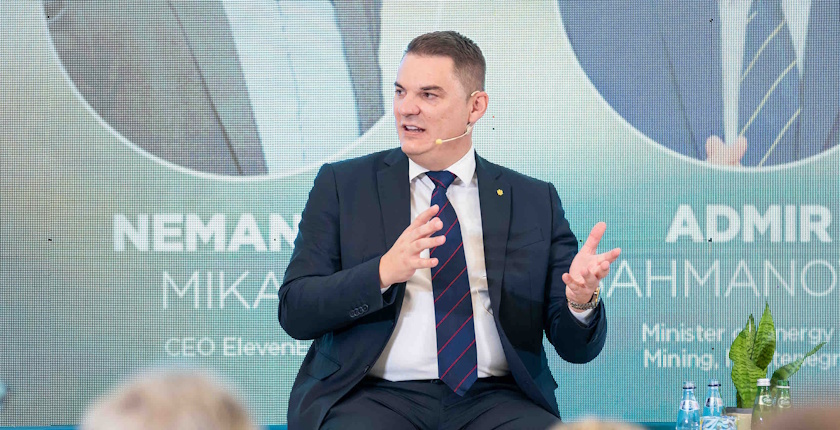
Participants at the panel included Daniel Calderon, Alcazar Energy Co-Founder and Managing Partner, Yann Guinard, EDF Director of Development for Europe, Louis Blanchard, Qair Energy President, and Nemanja Mikać, ElevenEs CEO.

Memorandum with EDF

Admir Šahmanović and Yann Guinard (photo: Ministry of Energy and Mining)

Within the conference, the Ministry of Energy and Mining of Montenegro and EDF International Networks signed a memorandum of understanding. It establishes a framework for future cooperation on modernizing the distribution network, digitizing smart grids, and integrating renewable energy sources, according to the ministry.

The memorandum foresees the implementation of pilot projects and feasibility studies that will contribute to the acceleration of the energy transition of Montenegro.

Admir Šahmanović said the deal is an important step towards strengthening green and innovative energy projects. Cooperation with EDF confirms the position of Montenegro as a country with a clear vision and open opportunities for investors, he underscored.

“EDF International Networks, as part of the global EDF Group, brings international expertise in the sector of power distribution, grid upgrade and digital transformation, which opens up space for new strategic partnerships and capital infrastructure projects,” the minister pointed out.

The memorandum confirmed the joint commitment to sustainability, integrity and energy security, with a clear focus on the well-being of citizens and the economy of Montenegro, the ministry said.

by in News

EU-Montenegro Investment Conference: 14 partnerships, MoUs signed for energy, sustainable projects

A total of 14 cooperation projects between Montenegrin and European companies have been initiated at the ongoing European Union-Montenegro Investment Conference, including investments in wind farms, solar parks, energy storage, and grids.

The two-day conference, titled Smart Growth, Green Future: Accelerating Investment in Montenegro, was opened today in Luštica, near Tivat, by the President of the European Commission, Ursula von der Leyen, and the Prime Minister of Montenegro, Milojko Spajić.

Montenegro’s growing potential for strategic, green, and sustainable investments was presented through new partnerships between leading Montenegrin and European companies, according to a press release by the Government of Montenegro.

The Conference was jointly organized by the government and the European Commission, with the support of the Montenegro Investment Agency (MIA).

State power utility EPCG has signed three memoranda of understanding

State-owned power utility Elektroprivreda Crne Gore (EPCG) has signed three memoranda of understanding (MoUs). One was signed with Akuo for the development of several renewable energy projects, including floating solar, a photovoltaic plant, and energy storage.

The second MoU, signed with SS&A Power Group, envisages the development, manufacture, and installation of thermal energy storage, while the third, with Wind Fisher, concerns a new technology for high-altitude wind power generation.

Alcazar Energy signed a memorandum with the government’s project management office for the development and financing of renewable energy projects. CWP Europe and the Montenegrin Investment Agency (MIA) signed a memorandum on the development of the Montečevo solar farm project with battery storage. The company signed a similar agreement for its project in Albania yesterday.

A memorandum was also signed between Čevo Solar and Grawert Jenny & Partner on battery energy storage systems (BESS). A 20 MW/60 MWh battery is being considered.

Four sustainable investment partnerships were also signed

The Ministry of Energy and Mining and EDF will further discuss the issue of modernizing Montenegro’s power distribution network.

Among the signed documents is an MoU on collaboration between the European Bank for Reconstruction and Development (EBRD) and Erste on a Regional Energy Efficiency Program (REEP), as well as cooperation in the field of wastewater management between Suez and MIA.

In addition, four sustainable investment partnerships were also signed: Farm2Fork Montenegro, Station M, Green Logistics Hub, and Northern Investments Compact for Ecology & Resilience (NICER). Green Logistics Hub refers to the Port of Bar, which aims to become the first net-zero port on the Adriatic. NICER concerns the just transition and is led by the Pljevlja Coal Mine.

Von der Leyen: Do not wait for accession to invest in Montenegro

Photo: Bojan Gnjidić/Vlada Crne Gore

The event brought together senior representatives of the Government of Montenegro, the European Union, international financial institutions, as well as prominent European and Montenegrin investors.

“My message is very clear: do not wait for accession to invest in Montenegro, because by then you may miss the opportunities that others will seize,” Ursula von der Leyen noted.

She stressed that by continuing its European journey with determination and speed, Montenegro is making its goal of EU accession attainable.

“Today, we are opening a new chapter of development—we are beginning a major investment cycle, strengthening our ties with the European market even before formally joining the European family. Today, we are bringing our vision of green and smart growth to life. We are doing this together with our most important strategic partner—the European Union, which is also the largest investor in our country,” Prime Minister Milojko Spajić said.

He recalled that the country plans to close all negotiating chapters with the EU by the end of 2026 and become its 28th member state in 2028.

Photo: Bojan Gnjidić/Vlada Crne Gore
by in News

EU, Serbia to support ElevenEs in battery cell manufacturing expansion

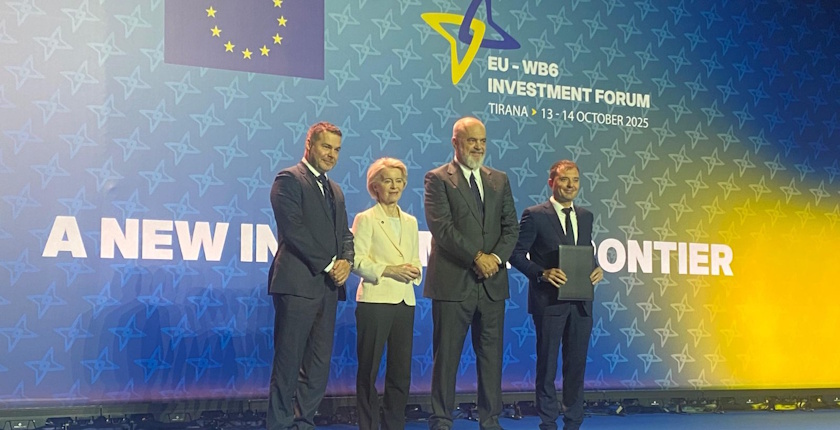
At the EU–Western Balkans Investment Forum in Tirana, Serbian company ElevenEs signed a joint declaration of support with representatives of the European Commission and the Development Agency of Serbia, marking a major step toward expanding battery cell manufacturing in the region.

ElevenEs CEO Nemanja Mikać signed the document in the presence of European Commission President Ursula von der Leyen. The joint declaration of support recognizes the company’s battery manufacturing expansion as a project aligned with the European Green Deal and Global Gateway strategy. The initiative highlights ElevenEs’s role in supporting the European Union’s decarbonization goals across the energy, transport, and industrial sectors.

The signing ceremony took place on the first day of the inaugural EU–Western Balkans Investment Forum, which is supported by the European Commission and aims to enhance economic cooperation and investment opportunities between European Union member states and Western Balkan partners.

“Signing this joint declaration of support with the European Commission and the Serbian Development Agency is an important recognition of the quality of the prismatic LFP blade cells battery we produce, and ElevenEs’s upcoming contribution to the EU’s decarbonization efforts, and the economic and industrial development across the region”, Mikać said.

With a EUR 700 million investment in two phases, ElevenEs will create roughly 1,000 jobs in Serbia

Mikać said the Western Balkans have the potential to become a key location for Europe’s energy storage industry, emphasizing that his company’s technological expertise and commitment to innovation demonstrate the region’s capability to be a reliable partner for the EU’s battery supply chain.

With an investment of EUR 700 million planned in two phases, ElevenEs aims to establish Serbia and the Western Balkans as a key hub for LFP (lithium-iron-phosphate) battery cell production, creating around 1,000 new jobs. The company’s LFP blade cells are designed to meet Europe’s growing demand for batteries used in electric vehicles and stationary energy storage systems.

Founded in 2022 as a spin-out from Al Pack Group, ElevenEs is building Europe’s first LFP gigafactory in Subotica. The company leverages three decades of electrode manufacturing expertise to produce long-lasting, cost-efficient batteries that support the continent’s clean energy transition.

by in News

Croatian IE-Energy, Slovenia’s NGEN plan virtual network of smart battery storage systems

Croatian firm IE-Energy and Slovenia’s NGEN are developing a battery system for smart energy storage, with a total operating power of 60 MW and a capacity of 120 MWh. The project, valued at 60 million, marks the first step toward creating a virtual network of battery storage systems that would connect producers and consumers of renewable energy.

The project has received a EUR 19.8 million grant from the European Union’s Modernization Fund. The funds are intended for the second and crucial phase of the project, for 50 MW, while the first phase, of 10 MW, is already in an advanced stage of implementation, Croatia’s Ministry of Economy stated following the signing of the subsidy contract.

The project, located in the Croatian city of Šibenik, is expected to be completed as early as next year, according to the statement.

IE-Energy CEO Željko Šmitran told Balkan Green Energy News it would be the first battery energy storage system in Croatia connected to the transmission grid. The project is being implemented in partnership with NGEN, which is also the main engineering, procurement, and construction (EPC) contractor.

The battery modules used are Tesla Megapacks, which enable real-time grid balancing, he added. 

The virtual smart energy storage network will connect renewable power plants, industry, and households

The project represents the first step towards creating a virtual network of smart energy storage facilities that will connect renewable energy producers, industry, and households, Šmitran explained.

The entire project is connected to NGEN’s advanced technology platform, which enables participation in the markets for ancillary services, balancing, and intraday trading, as well as electricity supply, added Šmitran.

Developing a regional smart storage network

The model developed in Croatia in collaboration with NGEN is intended to be replicated in other regional markets where grid flexibility and system stability are in high demand, including Serbia, Bosnia and Herzegovina, and North Macedonia, Šmitran said.

The objective is to build a regional model of smart battery storage facilities and energy communities that will ensure sustainable, reliable, and independent energy supply across Southeast Europe in the long term, he said.

In its statement, the Ministry of Economy also said that the project in Šibenik paves the way for advanced grid services, such as virtual inertia for grid stabilization.

by in News

North Macedonia receives applications for 4.2 GW of battery projects

North Macedonia has received requests for new wind farms, solar parks and gas power plants of 7,100 MW in total capacity, as well as for standalone batteries and ones that would be co-located with power plants, for 4,172 MW in overall operating power, Minister of Energy, Mining and Mineral Resources Sanja Božinovska revealed.

The Ministry of Energy, Mining and Mineral Resources has received an initiative for a 495 MW gas-fired cogeneration plant. Sanja Božinovska said the details are unknown as the submitted documentation is too extensive and is still being analyzed, state news agency MIA reported.

Of note, there were already proposals for gas-fired power plants in the country. The government has signed a memorandum of understanding with Kazancı Holding on projects for such facilities.

Investors intend to install standalone and co-located BESS

Investors submitted initiatives for wind farms of 1,590 MW altogether, as well as for a total of 402 MW and 1,080 MWh in battery energy storage systems (BESS) that would be co-located with wind farms.

So-called initiatives were also received for solar power projects totaling 5,052 MW and accompanying BESS of 1,174 MW in combined capability and 3,018 MWh in capacity. Investors plan to build standalone batteries of an overall 2,596 MW and 3,094 MWh, respectively.

Božinovska said it is great news, though that it’s more important whether the documentation is valid.

She recalled that the recently adopted Law on Energy introduced an annual construction plan for priority energy projects.

October 1 was the deadline for foreign investors to submit their projects

October 1 was the deadline for foreign investors interested in the construction of power plants to submit documentation, Božinovska noted. The ministry received a huge number of documents and it will take time to process them, she stressed.

Batteries became all the rage in the renewable energy sector worldwide. North Macedonia is set for a landmark achievement in its region.

YESS Power plans to commission a 60 MW BESS in the country next month. It would be the first large facility of its kind in the Western Balkans.

by in News

Indian ChemVolt Global, Serbian ElevenEs forge strategic partnership for batteries

Indian company ChemVolt Global and ElevenEs, based in Serbia, established a strategic partnership to accelerate the development of battery energy storage systems (BESS), lithium-ion cell manufacturing, and electric vehicle (EV) battery pack supply across India.

ChemVolt Global is a clean energy and storage solutions company and ElevenEs develops lithium-ion battery cell technology.

The collaboration combines ChemVolt Global’s extensive expertise in project development, engineering, procurement, and construction (EPC), and local market execution, with ElevenEs’ industry-leading experience in lithium-iron-phosphate (LFP) cell technology and large-scale European manufacturing, the Serbian company said.

The first objective is to deploy advanced BESS solutions across India and the Middle East

The two companies aim to establish a robust ecosystem for advanced energy storage and electric mobility in India.

The partnership includes three key objectives.

The first one is to deploy advanced BESS solutions across India and the Middle East, with advanced lithium ion cells with a higher life cycle and less degradation and high thermal stability.

The two companies also plan lithium-ion cell manufacturing collaboration based on ElevenEs’ pioneering European cell technology and production capabilities, the update reads.

The companies intend to accelerate the adoption of electric mobility across India

The third goal is to supply EV battery packs to original equipment manufacturers (OEMs).

The partners plan to enable domestic automotive manufacturers to access high-performance, safe, fast-charging and reliable battery packs, accelerating the adoption of electric mobility across India.

Gupta: The deepening industrial and technological cooperation between India and Europe

ChemVolt Global CEO Kuldeep Gupta said the partnership with ElevenEs represents a defining moment for India’s clean energy and electric mobility ambitions.

“Beyond technology, this collaboration reflects the deepening industrial and technological cooperation between India and Europe, positioning both nations at the forefront of the global energy transition,” he stated.

Mikać: We are not just participating

According to Nemanja Mikać, CEO of ElevenEs, the partnership is a decisive move to bring the company’s proven LFP cell technology and large-scale manufacturing to India.

ElevenEs’ expertise, in his words, is ready to deliver nothing less than advanced battery solutions that will be foundational to India’s energy independence.

“We are not just participating; we are positioned to define the future of this industry,” Mikać stressed.

by in News

GridFlex to install standalone BESS in Serbia

GridFlex plans to install a standalone battery energy storage system with a capacity of 125 MWh near the city of Leskovac, in southern Serbia. The investment is estimated at EUR 17 million.

Serbia doesn’t have any utility-scale batteries, but many are in the project pipeline. GridFlex is one of 11 companies in the process of obtaining approvals from transmission system operator (TSO) Elektromreža Srbije (EMS) for the connection of planned standalone battery energy storage systems (BESS) to the network.

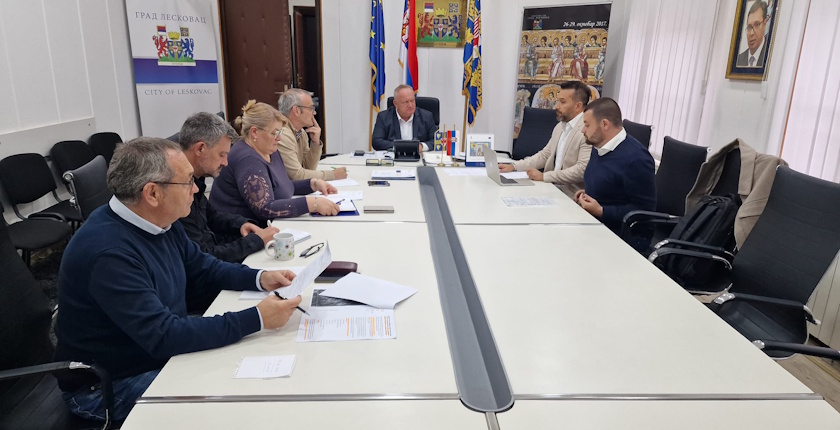
Mayor of Leskovac Goran Cvetanović met with representatives of Turkish company GridFlex, which has an office in Belgrade.

Battery systems provide flexibility to the system

The company is developing a project for a BESS that would provide system flexibility, support the integration of renewable energy sources, and contribute to the local economy, the city authority said.

GridFlex plans to invest EUR 17 million in the installation of an energy storage facility in Leskovac, the update revealed.

Owner and CEO of GridFlex Alkin Yaman participated in the meeting.

The deadline for completing the construction is the end of 2026

The planning and technical documentation for the facility is under development. The deadline for completing the facility is the end of 2026, while commissioning is expected in early 2027, the city stressed.

The battery would be installed on 1.5 hectares of privately owned land that the firm purchased near the Leskovac 2 substation.

The city will provide assistance to GridFlex for project implementation.

Three co-owners

The investment will secure numerous benefits for the city – the possibility of new investments, weakened load and voltage fluctuations in the power system, and an increase in the capacity for connecting new local consumers and producers to the grid, the local authority stressed.

According to data from the Business Registers Agency, the owners of GridFlex are Alkin Sevket Yaman, Sirin Cem, and Denis Severinov Karamov.

Of note, investors in Serbia are in the process of obtaining approvals for connecting their planned BESS facilities of an overall 2,021 MW and 5,899 MWh to the grid. They would be standalone batteries and ones co-located with power plants.